REVIEW 3 major objections 5 minor 1 cited by
Learning-based Multiuser Beamforming for Holographic MIMO~Systems
T0 review · 3 major / 5 minor · reviewed 2026-08-16 · deepseek-v4-flash
Pith's one-line read A cascaded GGNN with two projection modules learns holographic-MIMO beamformers that outperform alternating optimization in spectral efficiency at a fraction of the inference latency.
desk verdict The equivalent-beamformer reformulation is a genuine idea, but a dimensionally broken key equation makes the method unreproducible until corrected. read the letter →
The pith
A machine-rendered reading of the paper's core claim, the machinery that carries it, and where it could break.
The reading
What carries the argument
The central mechanism is the equivalent-beamformer reformulation $V_e = M_p V$ paired with a gradient-based graph neural network (GGNN) and two projection modules. The reformulation merges phase pattern and digital beamformer into one learned object, removing the RF-chain dimension from the network output while keeping the column-space constraint; the GGNN's update equations are read off from gradient iteration on the sum-of-rates objective; the first projection module applies the pseudo-inverse $(M_p^H M_p)^{-1} M_p^H$ to return $V_e$ to the column space of $M_p$; and the second normalization module scales the transmit signal to the power budget $P_{\max}$. Together these components convert a symmetry-preserving, low-dimensional learned policy into the actual digital and holographic beamformers.
What would settle it
Take the trained GGNN and a fixed channel realization with its phase-pattern matrix, compute the output, then permute the user indices, antenna indices, and RF-chain indices of the input and check whether the output is the correspondingly permuted version of the original output, as equation (6) requires. A disagreement for any random permutation at any SNR would falsify the permutation-equivariance claim that the architecture's generalization relies on; the paper reports no such direct symmetry check.
Extended reading notes
Core claim
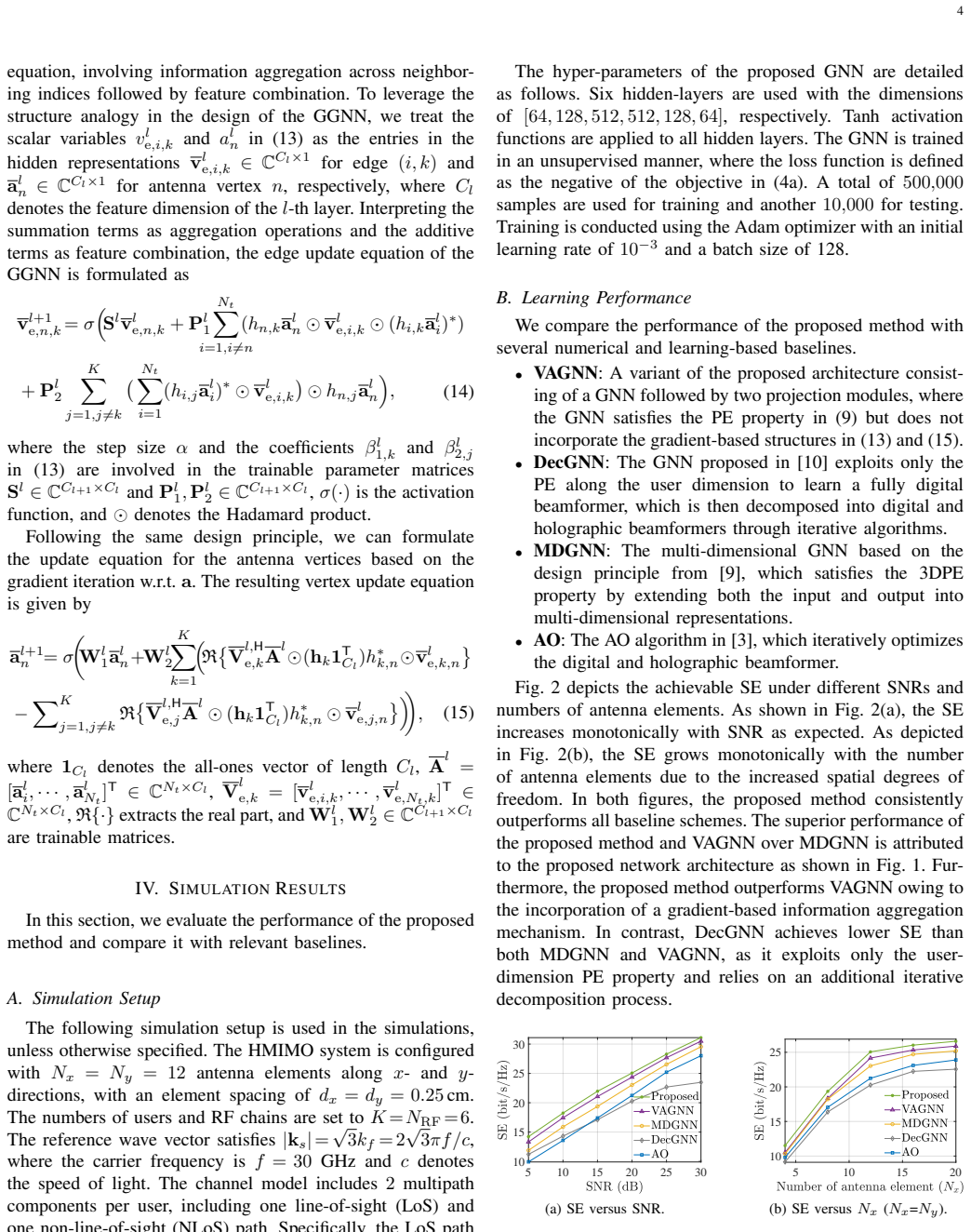
On the paper's own terms, the discovery is that the RF-chain dimension can be eliminated from the learned beamforming policy without losing the three-dimensional permutation equivariance of the optimal solution. The optimal policy maps the channel matrix and phase-pattern matrix to a digital beamformer and holographic amplitude vector; by defining the equivalent beamformer $V_e = M_p V$, the network only needs to learn $a$ and $V_e$, at the price of a column-space constraint on $V_e$. The paper constructs a gradient-based graph neural network whose edge and vertex updates mirror gradient-descent iterations of the sum-of-rates objective, then cascades a projection module that solves $\min_V \|V_e - M_p V\|^2$ in closed form and a normalization module that imposes the transmit-power limit. Simulations show the cascade exceeding the alternating-optimization baseline in spectral efficiency while cutting inference latency from 68.20 s to 21.69 ms, and outperforming multidimensional and user-only GNN baselines in generalization.
Load-bearing premise
The load-bearing premise is that the GGNN's update equations (14) and (15) genuinely respect reorderings of users, antennas, and radio-frequency chains exactly as the optimal beamforming policy does; the paper asserts this property without proof and gives no derivation for equation (15), so if the learned updates break symmetry under such reorderings, the generalization and consistency claims would not follow.
Editorial extensions
If this is right
- If the central claim holds, HMIMO beamforming can be executed in about 22 ms per realization rather than 68 s, moving the optimization from offline design to real-time operation.
- The RF-chain-dimension-free reformulation reduces model size to roughly 1 million parameters and training samples to 25,000, versus 13.77 million parameters and 75,000 samples for the multidimensional GNN, making the learned policy cheaper to train and store.
- The learned policy keeps a higher fraction of AO spectral efficiency than the baselines when evaluated on K = 4 to 8 users after training on K = 6 with N_RF = 10, so deployment does not require retraining for every user count.
- Because the GGNN update rules are read from gradient descent on the objective, the architecture incorporates the optimization geometry, which yields higher SE than a generic GNN with the same projection modules (the V_AGNN comparison).
- The cascade also recovers the digital beamformer through a closed-form projection, so the final outputs satisfy the phase-pattern column-space and power constraints by construction.
Reading between the lines
- The paper leaves implicit that the same symmetry argument should make the architecture transferable to antenna-count and RF-chain-count changes, not only user-count changes; testing on unseen N_x, N_y, and L would probe whether the three-dimensional permutation equivariance actually carries the generalization.
- A testable extension is to replace the pseudo-inverse projection with a regularized or truncated-SVD projection for phase-pattern matrices that are poorly conditioned or when N_t is not much larger than L, since the closed-form projection assumes full column rank.
- Because the gradient-based update equations are derived from the specific sum-of-rates objective, the same design recipe — derive GNN updates from gradient iteration and add a projection for structural constraints — could be applied to other constrained beamforming problems, such as hybrid analog-digital arrays with unit-modulus constraints.
- The paper's unsupervised training uses 25,000 samples to reach AO-level SE; comparing sample-efficiency curves against the 50,000-sample V_AGNN baseline would clarify how much of the gain comes from the gradient structure and how much from the equivalent-beamformer reformulation.
Signed reviews
Editorial analysis
A structured set of objections, weighed in public.
Referee Report
Summary. The paper considers downlink multiuser beamforming in a holographic MIMO system, where a base station with a holographic surface serves K single-antenna users. The authors reformulate the original joint optimization of the digital beamformer and the holographic beamformer into an equivalent form that optimizes an equivalent beamformer together with the holographic beamformer, thereby removing the RF-chain dimension from the GNN output while preserving a three-dimensional permutation-equivariance structure. They then propose a cascaded architecture composed of a gradient-based graph neural network (GGNN) and two projection modules: the GGNN outputs the equivalent beamformer and the holographic beamformer, the first projection module recovers the digital beamformer by projecting onto the column space of the phase-pattern matrix, and the second module normalizes the power. The central claim, stated in the abstract and in Section IV, is that this method achieves higher spectral efficiency with significantly shorter inference latency than an alternating-optimization baseline and exhibits better generalization than existing learning-based baselines. Simulation results are reported for spectral efficiency versus SNR, versus the number of antenna elements, and for generalization to different numbers of users, as well as a complexity comparison in Table I.
Significance. If the architecture is implementable as intended, the problem reformulation that eliminates the RF-chain dimension from the network output while retaining the permutation-equivariance property is a useful and nontrivial step toward low-complexity learned HMIMO beamforming. The closed-form projection for the column-space constraint and the unsupervised training on the spectral-efficiency objective are clean design choices, and the reported latency reduction relative to the AO baseline is consistent with the intended contribution. However, the significance is conditional: the central method is not reproducible from the manuscript as written because the antenna-vertex update in Eq. (15) is dimensionally inconsistent and no derivation is provided, and the claimed PEPI property of the GGNN is asserted without proof. These gaps are load-bearing for the generalization claims, so the contribution cannot yet be evaluated as stated.
major comments (3)
- [III-D, Eq. (15)] The antenna-vertex update in Eq. (15) is not well-defined as printed. With V_{e,k}^l in C^{N_t x C_l} and A^l in C^{N_t x C_l}, the product V_{e,k}^{l,H} A^l is C_l x C_l, while h_k 1_{C_l}^T is N_t x C_l; the Hadamard product of these two matrices is undefined unless N_t = C_l, which is not the setting of the paper. No derivation of Eq. (15) is given, so the intended correction cannot be inferred. Because this update is one of the two defining equations of the GGNN, the architecture is not reproducible from the manuscript, and the asserted PEPI property in Eq. (9) cannot be checked. Please provide a corrected equation and a derivation from the gradient of the objective in (7a) with respect to a.
- [III-C, Eq. (9)] The PEPI property of the GGNN is asserted rather than proven. The text states that the GGNN satisfies the PE property of F_e and refers to later details, but no proof appears. The projection-module relations in (10a) and (10b) are also stated by inspection without a formal argument. This matters because the generalization claims in Section IV-C rest on the preservation of permutation equivariance in all three dimensions; if the architecture does not in fact preserve this equivariance, the stated consistency with the 3DPE property of the optimal policy would not hold. Please supply a proof or a precise argument for (9) and (10), including the case of the corrected Eq. (15).
- [IV-B and IV-C, Figs. 2 and 3] The empirical comparisons in Figures 2 and 3 report single curves without error bars, confidence intervals, or multiple training seeds. Given that the training process is stochastic and the channels are randomly drawn, the claims that the proposed method 'consistently outperforms' baselines and 'attains the highest SE ratio' are not supported with statistical significance. Please report averaged results over multiple random seeds and channel realizations, with standard deviations or confidence intervals, especially for the generalization curve over K in Fig. 3.
minor comments (5)
- [Introduction] There is a typo: 'A approach to capture PE properties' should read 'An approach to capture PE properties'.
- [III-D] There are small language errors: 'the feate is' should be 'the feature is', and 'scaler coefficients' should be 'scalar coefficients'. Also, the notation h_{n,k} is used before being defined explicitly as the n-th entry of h_k.
- [III-D, Eqs. (14)-(15)] The notation for the trainable matrices is inconsistent: the text defines S^l, P_1^l, P_2^l, W_1^l, W_2^l, but the displayed equations use symbols such as S^l, P_1^l, etc.; please make the notation uniform and clearly state the dimensions of each matrix.
- [IV-D, Table I] The training complexity metric is described as 'the minimum training requirement for each learning-based method to reach the SE of the AO baseline', but the proposed method exceeds the AO baseline. Please clarify how 'reach' is defined when the method surpasses the baseline, and specify the stopping criterion used for the measurements in Table I.
- [Overall] The manuscript does not state whether code or trained models will be released. Given that the architecture as printed contains a dimensionally inconsistent equation, a reproducibility statement or a reference to an implementation would be valuable.
Circularity Check
No significant circularity: the central SE comparison is self-contained, evaluated against external baselines, and the cited prior work is not load-bearing.
full rationale
The paper's central claim is an empirical comparison of a learned beamforming policy against external baselines (AO [3], DecGNN [10], MDGNN [9]), and the proposed method is trained unsupervised by maximizing the same SE objective (4a) that defines the task. This is a standard policy-optimization formulation, not a fitted parameter renamed as a prediction. The transformation V_e = M_p V in problem (7) and the subsequent projection modules are algebraic reformulations of the original constraint set, and they do not presuppose the conclusion that the learned policy outperforms the baselines. The only self-citation is [11], which is used to motivate the analogy between GNN updates and gradient descent; the actual gradient equations (11)-(13) are derived in this paper, and the update rules (14) and (15) are then constructed from those equations. Thus no load-bearing argument reduces to a self-citation. The possible dimensional inconsistency in equation (15) noted by the skeptic is a correctness and reproducibility concern, not a circularity, because it does not make any quantity equal to its own input by construction. No prediction in the paper is equivalent to its training input, and no fitted value is relabeled as a derived result. The derivation chain from problem (4) to the network architecture and to the simulation comparisons is therefore self-contained, and the appropriate circularity score is 0.
Assumptions & free parameters
free parameters (2)
- GNN architecture hyperparameters (6 hidden layers, widths [64,128,512,512,128,64], Tanh) =
as listed in Sec. IV-A
- Training hyperparameters (learning rate 1e-3, batch size 128, 500,000 training samples) =
as listed in Sec. IV-A
assumptions (4)
- domain assumption Geometric channel model with I=2 paths, LoS gain CN(0,1), NLoS gain CN(0,0.01), AoD uniform in (-pi/2, pi/2).
- domain assumption M_p has full column rank because N_t >> L.
- domain assumption The GGNN architecture can approximate the optimal beamforming policy within the chosen function class.
- domain assumption Unsupervised training by minimizing negative SE (4a) converges to a policy that generalizes on the test distribution.
Cite this review
Pith. "Pith review of Learning-based Multiuser Beamforming for Holographic MIMO~Systems." pith.science (2026). https://pith.science/paper/FT74EPON
@misc{pith2026250419522,
  author       = {Pith},
  title        = {Pith review of: Learning-based Multiuser Beamforming for Holographic MIMO~Systems},
  year         = {2026},
  howpublished = {\url{https://pith.science/paper/FT74EPON}},
  note         = {Machine review of arXiv:2504.19522}
}
read the original abstract
Holographic multiple-input multiple-output (HMIMO) can improve spectral efficiency (SE) with low hardware cost, but conventional alternating optimization (AO) methods for jointly optimizing digital and holographic beamformers are computationally expensive. Learning-based beamforming offers a low-complexity alternative, and graph neural networks (GNNs) are particularly attractive because they can exploit permutation equivariance (PE). The optimal HMIMO beamforming policy exhibits PE properties across multiple dimensions. Existing methods either use high-dimensional GNNs, increasing model size and training complexity, or exploit only partial PE properties, leading to performance degradation. To address this issue, we reformulate the problem by learning an equivalent beamformer that removes the RF-chain dimension from the network output while preserving the PE property of the original problem. The reformulation introduces a nontrivial column-space constraint because the equivalent beamformer must be representable by the phase-pattern matrix. We then develop a cascaded architecture consisting of a gradient-based graph neural network (GGNN) and two projection modules. The GGNN jointly learns the holographic and equivalent beamformers using update equations motivated by their coupled gradient structures, while the projection modules recover the digital beamformer and enforce the column-space and transmit-power constraints. Simulation results show that the proposed method achieves higher SE with lower inference latency than the AO baseline and exhibits better generalization than existing learning-based baselines.
Figures


Forward citations
Cited by 1 Pith paper
-
Implicit Neural Representation for Multiuser Continuous Aperture Array Beamforming
BeamINR, a WMMSE-structured GNN INR, nearly matches functional WMMSE sum rate for multiuser multi-CAPA beamforming with far lower inference latency and better scale/frequency generalization than prior INRs.
Reference graph
Works this paper leans on
-
[9]
Multidimensional graph neural networks for wireless communications,
S. Liu, J. Guo, and C. Yang, “Multidimensional graph neural networks for wireless communications,”IEEE Trans. Wireless Commun., vol. 23, no. 4, pp. 3057–3073, Aug. 2024
work page 2024
-
[11]
Gradient based information aggregation of GNN for precoder learning,
S. Chen, S. Han, and Y . Li, “Gradient based information aggregation of GNN for precoder learning,” inProc. IEEE 97th V eh. Technol. Conf., Dec. 2023, pp. 1–6
work page 2023
-
[1]
An overview of massive MIMO for 5G and 6G,
F. A. P. de Figueiredo, “An overview of massive MIMO for 5G and 6G,”IEEE Lat. Am. Trans., vol. 20, no. 6, pp. 931–940, 2022
work page 2022
-
[2]
Hybrid digital and analog beamforming design for large-dcale antenna arrays,
F. Sohrabi and W. Yu, “Hybrid digital and analog beamforming design for large-dcale antenna arrays,”IEEE J. Sel. Top. Signal Process., vol. 10, no. 3, pp. 501–513, Jan. 2016
work page 2016
-
[3]
R. Deng, B. Di, H. Zhang, Y . Tan, and L. Song, “Reconfig- urable holographic surface-enabled multi-user wireless communications: Amplitude-controlled holographic beamforming,”IEEE Trans. Wireless Commun., vol. 21, no. 8, pp. 6003–6017, Jan. 2022
work page 2022
-
[4]
Analysis of a waveguide-fed metasurface antenna,
D. R. Smith, O. Yurduseven, L. P. Mancera, P. Bowen, and N. B. Kundtz, “Analysis of a waveguide-fed metasurface antenna,”Phys. Rev. Appl., vol. 8, no. 5, p. 054048, Nov. 2017
2017
-
[5]
Dynamic metasurface antennas for uplink massive MIMO systems,
N. Shlezinger, O. Dicker, Y . C. Eldar, I. Yoo, M. F. Imani, and D. R. Smith, “Dynamic metasurface antennas for uplink massive MIMO systems,”IEEE Trans. Commun., vol. 67, no. 10, pp. 29–43, Jul. 2019
work page 2019
-
[6]
Downlink beamforming for dynamic metasurface antennas,
S. F. Kimaryo and K. Lee, “Downlink beamforming for dynamic metasurface antennas,”IEEE Trans. Wireless Commun., vol. 22, no. 7, pp. 4745–4755, Jul. 2023
work page 2023
Show all 11 references
-
[7]
Near-field wideband extremely large-scale MIMO transmissions with holographic metasurface-based antenna arrays,
J. Xu, L. You, G. C. Alexandropoulos, X. Yi, W. Wang, and X. Gao, “Near-field wideband extremely large-scale MIMO transmissions with holographic metasurface-based antenna arrays,”IEEE Trans. Wireless Commun., vol. 23, no. 9, pp. 12 054–12 067, Apr. 2024
2024
-
[8]
Understanding the performance of learn- ing precoding policies with graph and convolutional neural networks,
B. Zhao, J. Guo, and C. Yang, “Understanding the performance of learn- ing precoding policies with graph and convolutional neural networks,” IEEE Trans. Commun., vol. 72, no. 9, pp. 5657–5673, Sept. 2024
2024
-
[10]
Graph neural network aided beamforming for holographic millimeter wave MIMO systems,
Z. Linfu, P. Zhiwen, and M. El-Hajjar, “Graph neural network aided beamforming for holographic millimeter wave MIMO systems,”IEEE Trans. V eh. Technol, pp. 1–14, 2025, early Access
2025
Reviewed August 16, 2026 · model on record in the stance chip above.
Discussion (0). Continue with ORCID to comment.