Compressible Turbulence as a Source of Particle Beams and Ion Bernstein Waves in Collisionless Plasmas
Pith reviewed 2026-05-25 06:49 UTC · model grok-4.3
The pith
Compressive turbulence damps fluctuations via transit-time damping to produce proton beams and excites ion Bernstein waves at sub-ion scales.
A machine-rendered reading of the paper's core claim, the machinery that carries it, and where it could break.
Core claim
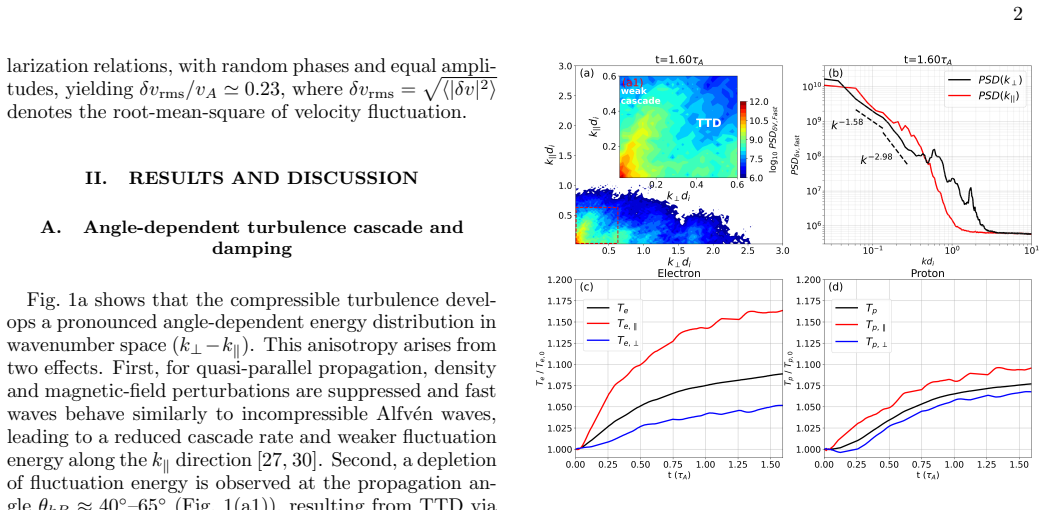
In high-resolution particle-in-cell simulations of compressible turbulence, compressive fluctuations are damped via transit-time damping at magnetohydrodynamic scales, naturally producing suprathermal electrons and proton beams. At sub-ion scales, quasi-perpendicular fast modes excite multiple branches of ion Bernstein waves whose properties agree with predictions from the plasma dispersion relation solver. Under solar wind conditions, transit-time damping remains efficient and provides a natural explanation for the super-Alfvénic proton beams measured in situ.
What carries the argument
Transit-time damping of compressive fluctuations at MHD scales, which produces suprathermal electrons and proton beams, together with excitation of ion Bernstein waves by quasi-perpendicular fast modes at sub-ion scales.
Load-bearing premise
The particle-in-cell simulations accurately capture transit-time damping and wave excitation without numerical artifacts or insufficient resolution altering the beam formation or wave properties.
What would settle it
In-situ solar wind data showing no link between compressive fluctuation amplitude and super-Alfvénic proton beam speeds, or observed wave spectra lacking the predicted ion Bernstein branches, would falsify the proposed generation mechanism.
Figures


read the original abstract
Unraveling the origin of proton beams and ion Bernstein waves is important to understanding kinetic dissipation in the solar wind. Here we focus on their generation mechanisms, rather than their well-studied roles in instabilities and particle heating. We investigate their formation in collisionless plasmas using high-resolution particle-in-cell simulations of compressible turbulence. At magnetohydrodynamic (MHD) scales, compressive fluctuations are damped via transit-time damping (TTD), naturally producing suprathermal electrons and proton beams. At sub-ion scales, quasi-perpendicular fast modes excite multiple branches of ion Bernstein waves, whose properties agree with predictions from the plasma dispersion relation solver. Under solar wind conditions, TTD remains efficient and provides a natural explanation for the super-Alfv\'enic proton beams measured in situ. Our results demonstrate that compressive fluctuations play a central role in driving cross-scale energy transfer and kinetic dissipation in collisionless plasma turbulence.
Editorial analysis
A structured set of objections, weighed in public.
Referee Report
Summary. The paper uses high-resolution particle-in-cell simulations of compressible turbulence to argue that transit-time damping (TTD) of compressive fluctuations at MHD scales generates suprathermal electrons and proton beams, while quasi-perpendicular fast modes at sub-ion scales excite ion Bernstein waves matching dispersion-relation predictions. It concludes that TTD remains efficient under solar wind conditions and naturally explains observed super-Alfvénic proton beams.
Significance. If the simulations robustly isolate physical TTD from numerical effects, the result would be significant for solar-wind physics by linking compressible turbulence directly to beam formation and cross-scale dissipation without additional free parameters or external drivers.
major comments (2)
- [Simulation setup] Simulation setup (methods section): no values are reported for particles per cell, cells per ion inertial length, or Debye-length resolution, and no convergence tests with varied resolution are shown. Because the central claim that TTD produces the observed beams depends on these runs being free of particle noise and artificial scattering, the absence of such data makes the result load-bearing and unverifiable from the given information.
- [Results] Results on proton beam velocities: the reported beam speeds are stated to match solar-wind observations, but no quantitative comparison, error bars, or sensitivity to initial conditions is provided. This weakens the assertion that TTD is the natural explanation, as the match could be influenced by numerical seeding of tails.
minor comments (2)
- [Abstract] The abstract and introduction use “high-resolution” without defining the scale relative to ion inertial length or Debye length; a single sentence specifying these ratios would improve clarity.
- [Figures] Figure captions for the wave spectra should explicitly state the time interval and spatial averaging used, to allow direct comparison with the dispersion-relation solver results mentioned in the text.
Simulated Author's Rebuttal
We thank the referee for the careful and constructive review. We respond to each major comment below and indicate where revisions will be made.
read point-by-point responses
-
Referee: [Simulation setup] Simulation setup (methods section): no values are reported for particles per cell, cells per ion inertial length, or Debye-length resolution, and no convergence tests with varied resolution are shown. Because the central claim that TTD produces the observed beams depends on these runs being free of particle noise and artificial scattering, the absence of such data makes the result load-bearing and unverifiable from the given information.
Authors: We agree that these parameters are necessary to assess numerical fidelity. The manuscript omitted explicit reporting of particles per cell, cells per ion inertial length, and Debye-length resolution, as well as convergence tests. In the revised manuscript we will add these values and any available resolution studies to the methods section. revision: yes
-
Referee: [Results] Results on proton beam velocities: the reported beam speeds are stated to match solar-wind observations, but no quantitative comparison, error bars, or sensitivity to initial conditions is provided. This weakens the assertion that TTD is the natural explanation, as the match could be influenced by numerical seeding of tails.
Authors: The manuscript states a match to solar-wind beam speeds but presents only a qualitative statement without quantitative metrics or error bars. We will strengthen this section in revision by adding quantitative comparisons (including error estimates) and a brief discussion of sensitivity to initial conditions. Full parameter-space scans would require additional runs beyond the present study. revision: partial
Circularity Check
No circularity; simulation outcomes independent of inputs
full rationale
The paper reports outcomes from high-resolution PIC simulations of compressible turbulence, with proton beams attributed to transit-time damping at MHD scales and ion Bernstein waves to fast modes at sub-ion scales. No derivation chain, equations, or claims reduce by construction to fitted parameters, self-definitions, or load-bearing self-citations. Results are presented as direct simulation findings compared against solar wind observations and a plasma dispersion solver, remaining self-contained without circular reduction.
Axiom & Free-Parameter Ledger
axioms (2)
- domain assumption Transit-time damping efficiently damps compressive fluctuations in collisionless plasmas at MHD scales
- domain assumption Quasi-perpendicular fast modes excite ion Bernstein waves whose properties match the plasma dispersion relation
Reference graph
Works this paper leans on
- [1]
-
[2]
J. He, L. Wang, C. Tu, E. Marsch, and Q. Zong, The Astrophysical Journal Letters800, L31 (2015)
work page 2015
- [3]
-
[4]
R. De Marco, R. Bruno, V. K. Jagarlamudi, R. d’Amicis, M. Marcucci, V. Fortunato, D. Perrone, D. Telloni, C. Owen, P. Louarn,et al., Astronomy & Astrophysics 669, A108 (2023)
work page 2023
-
[5]
J. Verniero, B. Chandran, D. Larson, K. Paulson, B. Al- terman, S. Badman, S. Bale, J. Bonnell, T. Bowen, T. D. de Wit,et al., The Astrophysical Journal924, 112 (2022)
work page 2022
-
[6]
L. K. Jian, C. T. Russell, J. G. Luhmann, R. J. Strange- way, J. S. Leisner, and A. B. Galvin, The Astrophysical Journal701, L105 (2009)
work page 2009
-
[7]
T. A. Bowen, B. D. Chandran, J. Squire, S. D. Bale, D. Duan, K. G. Klein, D. Larson, A. Mallet, M. D. Mc- Manus, R. Meyrand,et al., Physical Review Letters129, 165101 (2022)
work page 2022
-
[8]
S. Livi and E. Marsch, Journal of Geophysical Research: Space Physics92, 7255 (1987)
work page 1987
- [9]
-
[10]
J. A. Araneda, E. Marsch, and A. F.-Vi˜ nas, Physical re- view letters100, 125003 (2008)
work page 2008
-
[11]
B. Lavraud, R. Kieokaew, N. Fargette, P. Louarn, A. Fe- dorov, N. Andre, G. Fruit, V. G´ enot, V. R´ eville, A. P. Rouillard,et al., Astronomy & Astrophysics656, A37 (2021)
work page 2021
-
[12]
Y. Tong, I. Y. Vasko, A. V. Artemyev, S. D. Bale, and F. S. Mozer, The Astrophysical Journal878, 41 (2019)
work page 2019
-
[13]
L. Jian, H. Wei, C. Russell, J. Luhmann, B. Klecker, N. Omidi, P. Isenberg, M. Goldstein, A. Figueroa-Vi˜ nas, and X. Blanco-Cano, The Astrophysical Journal786, 123 (2014)
work page 2014
- [14]
-
[15]
C. J. Joyce, C. W. Smith, P. A. Isenberg, S. P. Gary, N. Murphy, P. C. Gray, and L. F. Burlaga, The Astro- physical Journal745, 112 (2012)
work page 2012
-
[16]
O. W. Roberts, D. Verscharen, Y. Narita, R. Nakamura, Z. V¨ or¨ os, and F. Plaschke, Physical Review Research2, 043253 (2020)
work page 2020
-
[17]
L. Turc, O. W. Roberts, D. Verscharen, A. P. Dimmock, P. Kajdiˇ c, M. Palmroth, Y. Pfau-Kempf, A. Johlander, M. Dubart, E. K. Kilpua,et al., Nature Physics19, 78 (2023)
work page 2023
-
[18]
J. J. Podesta, Journal of Geophysical Research: Space Physics117(2012)
work page 2012
- [19]
- [20]
-
[21]
S. Zhao, H. Yan, T. Z. Liu, K. H. Yuen, and M. Shi, The Astrophysical Journal962, 89 (2024)
work page 2024
-
[22]
P. Pavaskar, K. H. Yuen, H. Yan, and S. Malik, The Astrophysical Journal971, 58 (2024)
work page 2024
- [23]
-
[24]
L. Adhikari, G. P. Zank, L.-L. Zhao, J. C. Kasper, K. E. Korreck, M. Stevens, A. W. Case, P. Whittlesey, D. Lar- son, R. Livi,et al., The Astrophysical Journal Supple- ment Series246, 38 (2020)
work page 2020
-
[25]
S. Q. Zhao, H. Yan, T. Z. Liu, M. Liu, and M. Shi, The Astrophysical Journal923, 253 (2021)
work page 2021
- [26]
-
[27]
C. Hou, H. Yan, S. Zhao, and P. Pavaskar, The Astro- physical Journal Letters992, L28 (2025)
work page 2025
-
[28]
T. K. Suzuki, A. Lazarian, and A. Beresnyak, The As- trophysical Journal662, 1033 (2007)
work page 2007
-
[29]
K. J. Bowers, B. J. Albright, L. Yin, W. Daughton, V. Roytershteyn, B. Bergen, and T. J. Kwan, inJournal of Physics: Conference Series, Vol. 180 (IOP Publishing,
-
[30]
Galtier, Journal of Plasma Physics89, 905890205 (2023)
S. Galtier, Journal of Plasma Physics89, 905890205 (2023)
work page 2023
-
[31]
S. Zhao, H. Yan, T. Z. Liu, and C. Hou, The Astrophys- ical Journal996, 46 (2026)
work page 2026
- [32]
-
[33]
S. Zhao, H. Yan, T. Z. Liu, M. Liu, and H. Wang, The Astrophysical Journal937, 102 (2022)
work page 2022
-
[34]
Q. Luo, X. Zhu, J. He, J. Cui, H. Lai, D. Verscharen, and D. Duan, The Astrophysical Journal928, 36 (2022)
work page 2022
-
[35]
K. H. Yuen, H. Li, and H. Yan, The Astrophysical Jour- nal986, 221 (2025)
work page 2025
-
[36]
H. Comi¸ sel, Y. Narita, and U. Motschmann, Earth, Plan- ets and Space67, 32 (2015)
work page 2015
-
[37]
A. Balogh and R. A. Treumann,Physics of collisionless shocks: space plasma shock waves(Springer Science & Business Media, 2013)
work page 2013
-
[38]
V. Petrosian, H. Yan, and A. Lazarian, The Astrophysical Journal644, 603 (2006)
work page 2006
- [39]
- [40]
- [41]
- [42]
discussion (0)
Sign in with ORCID, Apple, or X to comment. Anyone can read and Pith papers without signing in.