REVIEW 3 major objections 6 minor 28 references
Electrically-induced resonance shifts of whispering gallery resonators made of barium magnesium fluoride
T0 review · 3 major / 6 minor · reviewed 2026-08-07 · deepseek-v4-flash
Pith's one-line read Femtosecond-laser fabrication yields BMF whispering gallery resonators with quality factors beyond 10^7, and voltage shifts their frequencies linearly at -0.8 MHz/(V/mm), independent of polarization, indicating a piezoelectric origin.
desk verdict Fs-laser fabrication of BMF WGRs with Q>10^7 and -0.8 MHz/(V/mm) tuning is new and useful; the piezoelectric attribution is plausible but underdetermined by the polarization-independence argument. read the letter →
The pith
A machine-rendered reading of the paper's core claim, the machinery that carries it, and where it could break.
The reading
What carries the argument
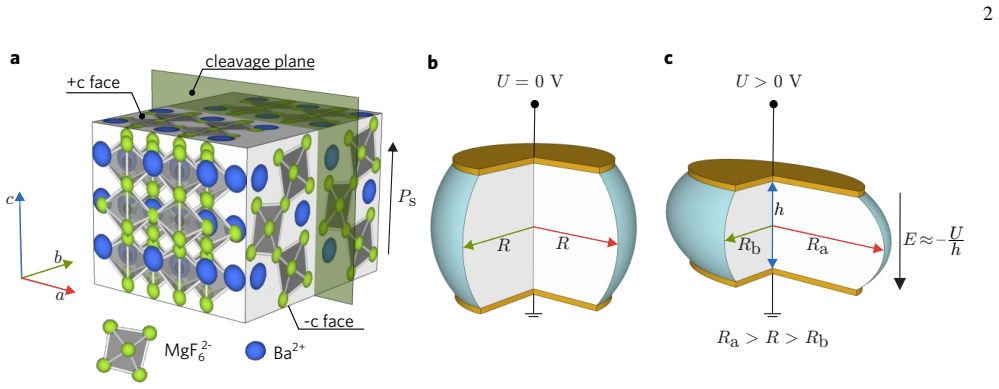
The argument runs through the resonance condition $\nu = m c_0/(L n)$, which converts any perturbation into a relative frequency shift $\Delta\nu/\nu = -\Delta L/L - \Delta n/n$. The converse piezoelectric effect enters through the strain tensor of BMF (point group mm2), with nonzero coefficients $d_{31}, d_{32}, d_{33}, d_{24}, d_{15}$; for an electric field along the $c$ axis, the circumference $L$ becomes an ellipse with semiaxes $R(1-d_{31}U/h)$ and $R(1-d_{32}U/h)$, giving $\Delta L/L = -(d_{31}+d_{32})U/(2h)$, a shift independent of light polarization. The electro-optic effect instead changes the refractive indices $n_a, n_b, n_c$ via the coefficients $r_{13}, r_{23}, r_{33}$, and the resulting frequency shift depends on polarization unless the accidental relation $r_{33}\approx(r_{13}+r_{23})/2$ holds. The polarization independence of the measured shift is therefore the diagnostic that separates the piezoelectric from the electro-optic contribution. The fabrication machinery is the femtosecond-laser material processing at 388 nm with 200-fs pulses, which cuts the preform and shapes the rim without initiating cleavage, followed by two short polishing steps.
What would settle it
Measure the electro-optic coefficients $r_{13}, r_{23}, r_{33}$ of the same BMF crystals used here; if they are substantial and happen to satisfy $r_{33}\approx(r_{13}+r_{23})/2$, the polarization-independence argument collapses and the electro-optic contribution could dominate. Alternatively, directly interferometrically measure the circumference strain under the applied voltage: a purely piezoelectric origin requires the entire observed $-0.8$ MHz/(V/mm) shift to be accounted for by the measured $\Delta L/L$, leaving no unexplained index contribution.
Extended reading notes
Core claim
The central experimental result is that a BMF whispering gallery resonator fabricated by femtosecond-laser processing—preform cutting and rim shaping followed by short diamond-slurry polishing—achieves a quality factor of about $1.3\times10^{7}$ at 1064 nm. When a DC voltage is applied between the $+c$ and $-c$ faces, the resonance frequencies shift linearly with a slope of $-0.8$ MHz/V, which for the 1 mm electrode separation is $-0.8$ MHz/(V/mm); the direction is toward lower frequencies for positive voltage on the $+c$ face. The shift is the same for light polarized parallel to the $c$ axis and perpendicular to it, both under DC excitation and for AC excitation between 9 kHz and 10 MHz. Because a refractive-index contribution from the electro-optic effect would in general split the two polarizations, the polarization independence identifies the converse piezoelectric effect—the strain of the resonator circumference—as the dominant mechanism. The measured slope is about three times larger than the value predicted from the literature piezoelectric coefficients $d_{31}$ and $d_{32}$, which the authors take as evidence that the coefficients of the recently grown high-quality crystals differ from the 1974 values, and they call for a careful re-determination of BMF's fundamental material properties.
Load-bearing premise
The central conclusion that the electro-optic effect is negligible assumes that a significant electro-optic contribution would necessarily make the resonance shift polarization-dependent; this would fail only if BMF's electro-optic coefficients satisfy the unlikely near-equality $r_{33}\approx(r_{13}+r_{23})/2$, in which case the observed polarization independence could not rule out a large electro-optic effect.
Editorial extensions
If this is right
- Femtosecond-laser fabrication yields BMF whispering gallery resonators with $Q > 10^7$ in under an hour of processing, replacing a procedure that previously took over 100 hours.
- Voltage-controlled tuning at $-0.8$ MHz/(V/mm) is polarization-independent, so a single electrode configuration can tune any resonant mode without disturbing its polarization state.
- The AC measurements show the electrically induced shift is enhanced by more than an order of magnitude at mechanical resonances near 0.91, 1.93, 2.46, and 7.35 MHz, which could be exploited for optomechanical modulation.
- The discrepancy between measured and literature piezoelectric coefficients implies that the elastic and piezoelectric constants of BMF must be re-measured on modern crystals for accurate device design.
- The combination of high $Q$, electrical tunability, and deep-UV transparency supports the feasibility of millimeter-sized BMF frequency converters in the deep ultraviolet.
Reading between the lines
- If the newly grown BMF crystals indeed have piezoelectric coefficients roughly three times the 1974 values, then other piezoelectric devices made from this material, such as acousto-optic modulators or mechanical resonators, should also show correspondingly enhanced responses; this is a direct, testable consequence.
- The polarization-independence test is specific to the field-along-$c$ geometry; applying the field along the $a$ or $b$ axes would produce different combinations of piezoelectric strain and electro-optic index change, offering a cleaner way to separate the two contributions without relying on the unlikely-coincidence assumption.
- The mechanical resonances seen in the AC response could be used for optomechanical transduction; a straightforward next experiment would be to lock the laser detuning to the side of a resonance and measure the modulated transmission at these frequencies to confirm the optomechanical coupling strength.
- The authors' note that the electro-optic response remains a topic of debate leaves open the possibility that the earlier large coefficient was measured on differently oriented or poled samples; a comparative measurement on the same resonator would settle whether the domain state influences the electro-optic response.
Editorial analysis
A structured set of objections, weighed in public.
Referee Report
Summary. The manuscript reports femtosecond-laser-based fabrication of barium magnesium fluoride (BMF) whispering gallery resonators with a measured quality factor of about 1.3e7 at 1064 nm, and a DC voltage-controlled resonance shift that is linear with a slope of -0.8 MHz/(V/mm), independent of light polarization. The authors attribute the shift primarily to the converse piezoelectric effect and argue that the electro-optic contribution is negligible, noting that the measured slope is about three times larger than the prediction based on literature piezoelectric coefficients. AC measurements show resonantly enhanced shifts at mechanical frequencies, which support a geometric, piezoelectric mechanism. The paper concludes that the optical properties of BMF make it promising for deep-ultraviolet frequency conversion and that the material's fundamental piezoelectric and electro-optic properties require re-determination.
Significance. If the fabrication and tuning results hold, the paper provides a practical route to high-Q, voltage-tunable BMF whispering gallery resonators, which is valuable for nonlinear optics in the deep ultraviolet. The work is honest about the discrepancy between measured and predicted shifts and about the remaining uncertainty in the electro-optic coefficients. The linear tuning measurement is clean, the AC mechanical resonances provide supporting evidence for a geometric deformation mechanism, and the piezo prediction is parameter-free in the sense that it uses only literature coefficients and standard resonator formulas. The main weakness is that the polarization-independence argument does not uniquely single out piezoelectricity as the dominant mechanism, because the electro-optic coefficients are insufficiently constrained; this weakens the abstract's categorical statement that the electro-optic effect is negligible.
major comments (3)
- [Section IV and Eq. (5)] The conclusion that the electro-optic contribution is negligible is not established by the observed polarization independence. The authors themselves state in Section II that the polarization independence would only vanish in the unlikely scenario where r33 is approximately (r13+r23)/2, and the exact condition involves the different refractive indices along the relevant axes. Since only one electro-optic coefficient has been reported in the literature (r31 = -36.2 pm/V, Ref. 4) and the other coefficients are unknown, this near-equality is not excluded. With a measured DC slope of -0.8 MHz/(V/mm) versus the piezoelectric prediction of -0.25 MHz/(V/mm), a polarization-independent electro-optic contribution of about -0.55 MHz/(V/mm) is numerically allowed. The AC resonances in Fig. 4 show that a geometric, piezoelectric contribution exists, but the normalized response does not provide an absolute calibration that separates a flat electro-optic offset from the resonant piezoelectric part. The statement in Section IV that the missing polarization dependence indicates the shift is 'just due to the change of the geometric circumference' therefore overreaches. The conclusion section itself later concedes 'there remains uncertainty regarding the electro-optic response,' which is in tension with the abstract's categorical claim. A quantitative bound on the relevant combination of electro-optic coefficients, or an independent measurement of r13, r23, and r33 on the same crystals, is needed before the electro-optic effect can be declared negligible.
- [Section III, Figs. 2 and 3] The claim that femtosecond-laser processing 'enables the reliable fabrication' of BMF whispering gallery resonators is supported by a single resonator, and the quantitative results (Q = 1.3e7, slope -0.8 MHz/V, polarization independence) are reported without error bars or uncertainty estimates. The authors should state the number of resonators and voltage cycles measured, report the slope with its uncertainty, and demonstrate reproducibility on at least one additional resonator to substantiate the 'reliable' claim. Without this, the fabrication route is a promising demonstration rather than a statistically supported process.
- [Section II and IV, Eq. (4) and homogeneous-field assumption] The interpretation of the threefold discrepancy between the measured and predicted piezo slope as evidence that the literature d coefficients do not apply to the recently grown crystal relies on the homogeneous-field approximation E = -U/h and on the assumption that field distortions near the curved rim are negligible. Because the whispering gallery mode is localized near the rim, the local electric field in the region that actually contributes to the strain could differ from the uniform value by an order-one factor. A field-enhancement or field-reduction factor of about three would reconcile the measured slope with the literature coefficients, changing the paper's conclusion about which material property is discrepant. The authors should quantify the field distribution for the actual electrode/resonator geometry, for example by finite-element modeling as in Ref. 16, or by varying the electrode spacing h and checking whether the shift scales as 1/h, before attributing the entire excess to a change in the piezoelectric coefficients.
minor comments (6)
- [Section II, after Eq. (4)] The parenthetical '(d31 - d32)/2 = -0.85 pm/V' is inconsistent with Eq. (4) and with the stated values d31 = -4.2 pm/V and d32 = 2.5 pm/V; it should read (d31 + d32)/2 = -0.85 pm/V.
- [Section II, Eq. (5)] The polarization-perpendicular expression in Eq. (5) uses r31 and r32, while the text defines the relevant coefficients as r13 and r23. Please harmonize the index convention for the electro-optic tensor.
- [Section IV] There is a typo 'determnined' that should be 'determined'.
- [Section IV] The sentence 'It’s output is fed into the network analyzer’s port 2' should use 'Its' instead of 'It’s'.
- [Conclusion] The phrase 'could might be beneficial' should be 'could be beneficial'.
- [Abstract and Introduction] The phrase 'an unique candidate' should be 'a unique candidate'.
Circularity Check
No significant circularity: the piezoelectric prediction is computed from independent literature coefficients, the measured slope is compared to it, and no fitted parameter is renamed as a prediction.
full rationale
The derivation chain for the central electric-tuning claim is self-contained and non-circular. The predicted slope of -0.25 MHz/V is obtained by inserting literature values d31 = -4.2 pm/V and d32 = 2.5 pm/V (Ref. 3) into the standard whispering-gallery relation Eq. (2) with Eq. (4), Δν/ν = -(ΔL/L) - (Δn/n) and ΔL/L = -(d31+d32)U/(2h). The measured slope, -0.8 MHz/(V/mm), is then compared with that prediction, and the discrepancy is interpreted as evidence that the piezoelectric coefficients of the recently grown crystal differ from the old literature values; no parameter is fitted to the target result. The paper's self-citations (Refs. 16, 18, 20) support auxiliary modeling or fabrication choices rather than the central claim. The weakest point—ruling out a significant electro-optic contribution solely from polarization independence—is a logical underdetermination, not a circular reduction: Eq. (5) explicitly admits a polarization-independent electro-optic contribution when r33 ≈ (r13 + r23)/2, so the conclusion that the electro-optic effect is negligible is not forced by the equations. However, this is an inference gap about material coefficients, not an equivalence between an input and an output. No equation is defined in terms of the target measurement, and no load-bearing result is supplied by self-citation. Therefore the circularity score is 0.
Assumptions & free parameters
assumptions (7)
- standard math Resonance frequency is nu = m c0/(L n) with m the azimuthal order and n the bulk refractive index (Eq. 1).
- standard math Relative frequency shift is Delta nu/nu = -Delta L/L - Delta n/n (Eq. 2).
- domain assumption The mm2 piezoelectric tensor and coefficients d31=-4.2, d32=2.5, d33=8.1, d24=-5.3, d15=-1.2 pm/V from Recker et al. (Ref. 3) describe BMF.
- domain assumption The applied field inside the curved resonator is homogeneous, E = -U/h, with negligible field distortion from the rim.
- domain assumption A significant electro-optic contribution would make the resonance shift polarization-dependent unless r33 approximately equals (r13+r23)/2.
- domain assumption Deformation along the c axis and changes in the minor radius have negligible effect on the resonance frequency.
- domain assumption For the electro-optic contribution, the relevant refractive index is the round-trip average nbar=(na+nb)/2.
Cite this review
Pith. "Pith review of Electrically-induced resonance shifts of whispering gallery resonators made of barium magnesium fluoride." pith.science (2026). https://pith.science/paper/FV4OJW5C
@misc{pith2026250603873,
  author       = {Pith},
  title        = {Pith review of: Electrically-induced resonance shifts of whispering gallery resonators made of barium magnesium fluoride},
  year         = {2026},
  howpublished = {\url{https://pith.science/paper/FV4OJW5C}},
  note         = {Machine review of arXiv:2506.03873}
}
abstract
Barium magnesium fluoride (BMF) is a ferroelectric crystal with a transparency range far beyond the one of other optical materials. In particular, its low loss in the deep ultraviolet makes this material an unique candidate for frequency conversion in this spectral range. Due to its relatively weak second-order nonlinearity, a resonant configuration such as an optical whispering gallery would be beneficial. We show that femtosecond-laser based material processing enables the reliable fabrication of BMF whispering gallery resonators with quality factors beyond $10^7$. Their resonance frequencies can be shifted linearly by applying electric fields between the $+c$ and $-c$ faces of the crystal. The slope of the shift is $-0.8$~MHz/(V/mm). It seems that the origin of this shift is piezoelectricity, while the electro-optic effect is negligible. Our results pave the way for millimeter-sized frequency converters in the deep ultraviolet. Furthermore, they indicate that a careful determination of fundamental material properties is still necessary.
Figures


Figures from the paper (1 more)

Reference graph
Works this paper leans on
-
[1]
merlin.mbs aapmrev4-1.bst 2010-07-25 4.21a (PWD, AO, DPC) hacked
FUNCTION id.bst "merlin.mbs aapmrev4-1.bst 2010-07-25 4.21a (PWD, AO, DPC) hacked" ENTRY address archive archivePrefix author bookaddress booktitle chapter collaboration doi edition editor eid eprint howpublished institution isbn issn journal key language month note number organization pages primaryClass publisher school SLACcitation series title translat...
2010
-
[2]
merlin.mbs aipauth4-1.bst 2010-07-25 4.21a (PWD, AO, DPC) hacked
FUNCTION id.bst "merlin.mbs aipauth4-1.bst 2010-07-25 4.21a (PWD, AO, DPC) hacked" ENTRY address archive archivePrefix author bookaddress booktitle chapter collaboration doi edition editor eid eprint howpublished institution isbn issn journal key language month note number organization pages primaryClass publisher school SLACcitation series title translat...
2010
-
[3]
merlin.mbs aipnum4-1.bst 2010-07-25 4.21a (PWD, AO, DPC) hacked
FUNCTION id.bst "merlin.mbs aipnum4-1.bst 2010-07-25 4.21a (PWD, AO, DPC) hacked" ENTRY address archive archivePrefix author bookaddress booktitle chapter collaboration doi edition editor eid eprint howpublished institution isbn issn journal key language month note number organization pages primaryClass publisher school SLACcitation series title translati...
2010
-
[4]
merlin.mbs apsrev4-1.bst 2010-07-25 4.21a (PWD, AO, DPC) hacked
FUNCTION id.bst "merlin.mbs apsrev4-1.bst 2010-07-25 4.21a (PWD, AO, DPC) hacked" ENTRY address archive archivePrefix author bookaddress booktitle chapter collaboration doi edition editor eid eprint howpublished institution isbn issn journal key language month note number organization pages primaryClass publisher school SLACcitation series title translati...
2010
-
[5]
merlin.mbs apsrmp4-1.bst 2010-07-25 4.21a (PWD, AO, DPC) hacked
FUNCTION id.bst "merlin.mbs apsrmp4-1.bst 2010-07-25 4.21a (PWD, AO, DPC) hacked" ENTRY address archive archivePrefix author bookaddress booktitle chapter collaboration doi edition editor eid eprint howpublished institution isbn issn journal key language month note number organization pages primaryClass publisher school SLACcitation series title translati...
2010
-
[6]
author author M. DiDomenico , author M. Eibschütz , author H. Guggenheim , \ and\ author I. Camlibel ,\ title title Dielectric behavior of ferroelectric BaMF _4 above room temperature , \ https://doi.org/10.1016/0038-1098(69)90497-9 journal journal Solid State Commun. \ volume 7 ,\ pages 1119--1122 ( year 1969 ) NoStop
-
[7]
author author E. G. \ V \' llora , author K. Shimamura , author K. Sumiya , \ and\ author H. Ishibashi ,\ title title Birefringent-and quasi phase-matching with BaMgF4 for vacuum-UV/UV and mid-IR all solid-state lasers , \ @noop journal journal Opt. express \ volume 17 ,\ pages 12362--12378 ( year 2009 ) NoStop
work page 2009
-
[8]
author author K. Recker , author F. Wallrafen , \ and\ author H. Haussühl ,\ title title Single crystal growth and optical, elastic, and piezoelectric properties of polar magnesium barium fluoride , \ @noop journal journal J. Cryst. Growth \ volume 26 ,\ pages 97--100 ( year 1974 ) NoStop
work page 1974
Show all 28 references
-
[9]
Wang , author H
author author Z. Wang , author H. Dai , author Y. Zheng , \ and\ author X. Chen ,\ title title Measurement of the electro-optic coefficient of a BaMgF _4 single crystal , \ @noop journal journal Opt. Mater. Express \ volume 7 ,\ pages 361 ( year 2017 ) NoStop
2017
-
[10]
Chen , author X
author author J. Chen , author X. Chen , author Y. Ma , author Y. Zheng , author A. Wu , author H. Li , author L. Jiang , \ and\ author J. Xu ,\ title title Measurement of second-order nonlinear optical coefficients of BaMgF4 , \ @noop journal journal J. Opt. Soc. Am. B \ volu...
2012
-
[11]
Chen , author X
author author J. Chen , author X. Chen , author A. Wu , author H. Li , author Y. Zheng , author Y. Ma , author L. Jiang , \ and\ author J. Xu ,\ title title Femtosecond Z-scan measurement of third-order nonlinear refractive indices of BaMgF4 , \ @noop journal journal Appl. Phy...
2011
-
[12]
Mateos , author M
author author L. Mateos , author M. O. \ Ramírez , author I. Carrasco , author P. Molina , author J. F. \ Galisteo-López , author E. G. \ Víllora , author C. de las Heras , author K. Shimamura , author C. Lopez , \ and\ author L. E. \ Bausá ,\ title title BaMgF _4 : An ultra-t...
2014
-
[13]
author author S. J. \ Herr , author H. Tanaka , author I. Breunig , author M. Bickermann , \ and\ author F. Kühnemann ,\ title title Fanout periodic poling of BaMgF _4 crystals , \ @noop journal journal Opt. Mater. Express \ volume 13 ,\ pages 2158 ( year 2023 ) NoStop
2023
-
[14]
author author J. G. \ Bergman , author G. R. \ Crane , \ and\ author H. Guggenheim ,\ title title Linear and nonlinear optical properties of ferroelectric BaMgF _4 and BaZnF _4 , \ @noop journal journal J. Appl. Phys. \ volume 46 ,\ pages 4645 ( year 1975 ) NoStop
1975
-
[15]
Seres ,\ title title Dispersion of second-order nonlinear optical coefficient , \ @noop journal journal Appl
author author J. Seres ,\ title title Dispersion of second-order nonlinear optical coefficient , \ @noop journal journal Appl. Phys. B \ volume 73 ,\ pages 705--709 ( year 2001 ) NoStop
2001
-
[16]
Breunig ,\ title title Three-wave mixing in whispering gallery resonators , \ @noop journal journal Laser Photon Rev
author author I. Breunig ,\ title title Three-wave mixing in whispering gallery resonators , \ @noop journal journal Laser Photon Rev. \ volume 10 ,\ pages 569--587 ( year 2016 ) NoStop
2016
-
[17]
author author D. V. \ Strekalov , author C. Marquardt , author A. B. \ Matsko , author H. G. L. \ Schwefel , \ and\ author G. Leuchs ,\ title title Nonlinear and quantum optics with whispering gallery resonators , \ @noop journal journal J. Opt. \ volume 18 ,\ pages 123002 ( y...
2016
-
[18]
author author J. U. \ Fürst , author K. Buse , author I. Breunig , author P. Becker , author J. Liebertz , \ and\ author L. Bohatý ,\ title title Second-harmonic generation of light at 245 nm in a lithium tetraborate whispering gallery resonator , \ @noop journal journal Opt. ...
1932
-
[19]
Min'kov , author A
author author K. Min'kov , author A. Shitikov , \ and\ author A. Danilin ,\ title title BaMgF4 whispering-gallery-mode crystal resonator with high Q-factor , \ in\ 10.1109/ICLO54117.2022.9839714 booktitle 2022 International Conference Laser Optics (ICLO) \ ( year 2022 )\ pp.\ ...
2022
-
[20]
author author M. L. \ Gorodetsky \ and\ author A. E. \ Fomin ,\ title title Geometrical theory of whispering-gallery modes , \ @noop journal journal IEEE J. Sel. Top. Quantum Electron. \ volume 12 ,\ pages 33--39 ( year 2006 ) NoStop
2006
-
[21]
Minet , author H
author author Y. Minet , author H. Zappe , author I. Breunig , \ and\ author K. Buse ,\ title title Electro-optic control of lithium niobate bulk whispering gallery resonators: Analysis of the distribution of externally applied electric fields , \ @noop journal journal Crystal...
2021
-
[22]
Bronstein , author K
author author I. Bronstein , author K. Semendjajew , author G. Musiol , \ and\ author H. M \"u hlig ,\ title title Taschenbuch der mathematik (handbook of mathematics) , \ @noop journal journal Harri Deutsch GmbH \ ( year 1985 ) NoStop
1985
-
[23]
Fürst , author B
author author J. Fürst , author B. Sturman , author K. Buse , \ and\ author I. Breunig ,\ title title Whispering gallery resonators with broken axial symmetry: Theory and experiment , \ @noop journal journal Opt. Express \ volume 24 ,\ pages 20143 ( year 2016 ) NoStop
2016
-
[24]
author author I. S. \ Grudinin , author V. S. \ Ilchenko , \ and\ author L. Maleki ,\ title title Ultrahigh optical Q factors of crystalline resonators in the linear regime , \ 10.1103/PhysRevA.74.063806 journal journal Phys. Rev. A \ volume 74 ,\ pages 063806 ( year 2006 ) NoStop
-
[25]
author author C. S. \ Werner , author W. Yoshiki , author S. J. \ Herr , author I. Breunig , \ and\ author K. Buse ,\ title title Geometric tuning: spectroscopy using whispering-gallery resonator frequency-synthesizers , \ 10.1364/OPTICA.4.001205 journal journal Optica \ volum...
-
[26]
Leidinger , author S
author author M. Leidinger , author S. Fieberg , author N. Waasem , author F. K\" u hnemann , author K. Buse , \ and\ author I. Breunig ,\ title title Comparative study on three highly sensitive absorption measurement techniques characterizing lithium niobate over its entire t...
2015
-
[27]
Shen , author J
author author M. Shen , author J. Xie , author C.-L. \ Zou , author Y. Xu , author W. Fu , \ and\ author H. X. \ Tang ,\ title title High frequency lithium niobate film-thickness-mode optomechanical resonator , \ @noop journal journal Appl. Phys. Lett. \ volume 117 ,\ pages 13...
2020
-
[28]
Xie , author M
author author J. Xie , author M. Shen , \ and\ author H. X. \ Tang ,\ title title Sub-terahertz optomechanics , \ https://opg.optica.org/optica/abstract.cfm?URI=optica-11-5-724 journal journal Optica \ volume 11 ,\ pages 724--725 ( year 2024 ) NoStop
2024
Reviewed August 7, 2026 · model on record in the stance chip above.
Discussion (0). Sign in to comment.