REVIEW 2 major objections 4 minor 127 references
$\boldsymbol{S}$-adic sequences. A bridge between dynamics, arithmetic, and geometry
T0 review · 2 major / 4 minor · reviewed 2026-08-14 · deepseek-v4-flash
Pith's one-line read S-adic sequences generalize Sturmian coding to rotations on higher-dimensional tori.
desk verdict A genuinely useful survey of Rauzy's program whose central theorem is honestly quoted from the author's own paper; the abstract's metric 'rare counterexamples' claim, however, outruns the theorem as stated. read the letter →
The pith
A machine-rendered reading of the paper's core claim, the machinery that carries it, and where it could break.
The reading
What carries the argument
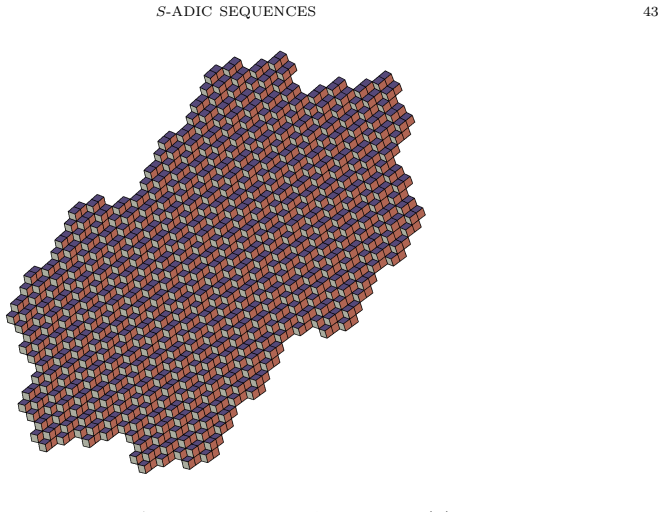
One load-bearing object is the S-adic Rauzy fractal: for a sequence $\sigma$ with letter-frequency vector $u$, the set $R_w$ is the closure of the projection, along $u$ onto the hyperplane $w^\perp$, of the abelianized prefixes of all limit sequences; the subtile $R_w(i)$ keeps only prefixes ending in the letter $i$. These sets admit a subdivision governed by the set equation, expressed through the dual substitution $E_1^*(\sigma)$ acting on discrete hyperplanes $\Gamma(w)$, and the diameter of the level-$n$ pieces tends to zero under the hypotheses of the theorem. The collection $\mathcal{C}_1=\{\pi_{u,1}x+R(i):[x,i]\in\Gamma(1)\}$ is the decisive object: when it tiles $1^\perp$, which Proposition 3.8.8 equates with the geometric coincidence condition, the fractal $R$ is a fundamental domain of the lattice $1^\perp\cap\mathbb{Z}^d$, the piecewise translation exchange on the subtiles becomes a rotation on the torus $1^\perp/\Lambda\cong T^{d-1}$, and the representation map $X_\sigma\to R$ becomes a measurable isomorphism. Balance buys compactness of the tiles, algebraic irreducibility buys rational independence of $u$ and strong convergence, and the Pisot Lyapunov condition makes the whole package generic in the metric theorem.
What would settle it
Run the theorem's own construction on any sequence satisfying all its hypotheses: build the representation map $\phi:X_\sigma\to R$ from nested subtiles and check whether it is injective off a set of measure zero. If two positive-measure sets of sequences collapse to the same Rauzy-fractal point, or if the shift has a measurable eigenfunction not coming from the torus rotation, the claimed conjugacy fails; a numerical implementation for a Brun or Arnoux-Rauzy example would be a direct check.
Extended reading notes
Core claim
At the center is Theorem 3.9.4: for a finite set of unimodular substitutions and a sequence $\sigma$ that is primitive and algebraically irreducible, whose shifted languages are eventually $C$-balanced and whose blocks repeat (the recurrence condition), if the collection $\mathcal{C}_1$ of translates of the S-adic Rauzy fractal tiles the hyperplane $1^\perp$, then the S-adic shift $(X_\sigma,\Sigma,\mu)$ is measurably conjugate to a rotation on $T^{d-1}$. Consequently the shift has purely discrete spectrum; every element of $X_\sigma$ is a natural coding of that rotation with respect to the partition into fractal subtiles $R(1),\ldots,R(d)$; and each subtile is a bounded remainder set. The chapter also establishes the metric version, Theorem 3.9.5: inside an ergodic shift over a finite substitution set satisfying the Pisot condition $\vartheta_1>0>\vartheta_2\geq\cdots\geq\vartheta_d$, almost every $\sigma$ gives a minimal, uniquely ergodic system whose Rauzy fractals have the required regularity, and those that satisfy the tiling condition are conjugate to torus rotations. The upshot is that the classical triangle linking Sturmian sequences, continued fractions, and circle rotations is realized in dimension $d-1$, with generalized continued fraction algorithms encoded by the substitution sequences.
Load-bearing premise
The load-bearing premise is that the translates in $\mathcal{C}_1$ tile the hyperplane $1^\perp$ exactly once—equivalently, the geometric coincidence condition—since primitivity, recurrence, balance, and algebraic irreducibility do not by themselves force this tiling.
Editorial extensions
If this is right
- Every S-adic system satisfying the hypotheses of Theorem 3.9.4 has purely discrete spectrum, so it is as far from weakly mixing as a measure-preserving system can be.
- Elements of $X_\sigma$ are natural codings of an explicit rotation on $T^{d-1}$, so the substitution coding sequence carries the Diophantine data of the rotation vector.
- The subtiles $R(i)$ are bounded remainder sets: every word frequency in the S-adic sequence deviates from its limit by a uniformly bounded error.
- Under the Pisot condition on Lyapunov exponents, almost every substitution sequence produces balanced, primitive, recurrent, algebraically irreducible S-adic systems; the tiling condition is the only additional hypothesis needed for conjugacy.
- The framework applies to recurrent Arnoux-Rauzy and Brun substitution sequences, giving explicit higher-dimensional analogues of the Sturmian–continued-fraction–rotation correspondence.
Reading between the lines
- If the theorem is correct, the practical question for any concrete substitution family is whether geometric coincidence holds, and Proposition 3.8.8 turns that into a finite check; one could automate this for recursively generated families and map which S-adic systems are rotation codings.
- The metric theorem suggests a dichotomy that can be tested numerically: within an ergodic Pisot substitution shift, either almost every sequence satisfies the tiling condition or the exceptional set has positive measure, and random sampling over the Brun alphabet would distinguish the two regimes.
- The construction may extend to a coding of higher-rank diagonal actions such as the Weyl chamber flow, in the way the classical continued fraction codes the geodesic flow on the modular surface; the Rauzy-fractal tilings would then serve as non-stationary Markov partitions.
- The chapter's separation of balance from the tiling condition indicates that imbalance and failure of geometric coincidence are the two obstructions that stand between a general S-adic system and a rotation model; other dynamical pathologies, such as weak mixing, should be traceable to one of them.
Signed reviews
Editorial analysis
A structured set of objections, weighed in public.
Referee Report
Summary. This survey chapter presents the S-adic approach to Rauzy's program, aiming to bridge Sturmian-type combinatorics, generalized continued fraction algorithms, and rotations on higher-dimensional tori. The first part gives a largely self-contained exposition of the classical correspondence between Sturmian sequences, the continued fraction/Gauss map, and irrational rotations, including the natural-extension picture via the geodesic and scenery flows on SL_2(Z)\SL_2(R). The second part develops the general machinery: S-adic systems, Rauzy fractals and their subtiles, primitivity, recurrence, balance, algebraic irreducibility, strong convergence, coincidence conditions, and tiling properties. The chapter then states and sketches the proofs of two main results. Theorem 3.9.4 asserts that, for a primitive and algebraically irreducible sequence of unimodular substitutions satisfying a recurrence/balance hypothesis and a tiling condition on C1, the S-adic shift is measurably conjugate to a rotation on T^{d-1}. Theorem 3.9.5 is a metric version: under an ergodic Pisot condition on the associated linear cocycle, almost every directive sequence yields minimal, uniquely ergodic, well-behaved Rauzy fractals, and conditionally on the C1 tiling property one obtains the measurable conjugacy to a torus rotation. The chapter closes with applications to Arnoux-Rauzy and Brun substitution systems.
Significance. If the results reported from Berthé–Steiner–Thuswaldner [52] are correct, this is a valuable survey that organizes a large body of material and gives a coherent roadmap for Rauzy's program. Its strengths are the detailed proofs of the classical Sturmian theory, the precise references for the newer results, and the honest discussion of several technical points, including the author's explicit remark in Remark 3.3.8 that one stronger statement from [63] could not be verified. The chapter also does a good job of explaining why primitivity, recurrence, balance, and algebraic irreducibility are natural hypotheses. The principal weakness is that the advertised metric genericity claim goes beyond what is actually proved or stated in the chapter: Theorem 3.9.5(3) is conditional on the C1 tiling condition, and no argument is supplied showing that this condition is generic.
major comments (2)
- [§3.9.3–3.9.4 and Abstract] Theorem 3.9.5(3) is stated conditionally on the collection C1 forming a tiling of 1^⊥, and the proof in Section 3.9.4 establishes genericity only for primitivity and recurrence (Proposition 3.9.6), finite balance (Lemma 3.9.7), and algebraic irreducibility (Lemma 3.9.8). No lemma or displayed argument in Section 3.9.4 shows that the tiling condition, equivalently geometric coincidence by Proposition 3.8.8, holds for ν-almost every σ. Since the abstract and Section 3.1 advertise a metric theory showing that counterexamples of the Cassaigne–Ferenczi–Zamboni type are rare, this claim is not supported by the chapter as written; the author should either supply the missing genericity statement with a precise reference to [52] or rephrase the abstract and introduction to present Theorem 3.9.5(3) as a conditional result.
- [§3.9.2 / Theorem 3.9.4] The tiling condition is not a harmless technicality: the proof of the conjugacy uses it at the decisive step where the representation map is identified with a rotation on 1^⊥/Λ, and the text explicitly notes that without a tiling the map φ is m-to-1 with m equal to the covering degree of C1. This should be stated prominently when the theorem is announced, and Section 3.8 should make clear that primitivity, recurrence, balance, and algebraic irreducibility do not by themselves imply geometric coincidence; Section 3.8.3 indeed describes checking this condition as substantial work. The current wording of the abstract, namely "under certain natural conditions", obscures that the tiling hypothesis is an additional, independently checkable condition.
minor comments (4)
- [§3.7.1] In the definition of C^{(k)}_w and in Proposition 3.7.6, the translation term is written as π_{u,w}x, but consistency with (3.43)–(3.45) requires π^{(k)}_{u,w}x, since R^{(k)}_w(i) lives in (w^{(k)})^⊥ and the sets being translated must lie in the same hyperplane; as written, the left-hand side is not even a subset of a single hyperplane.
- [§3.9.1] Definition 3.9.1 contains the typo "Defintion" in the citation to [126]; it should read "Definition".
- [§3.3.2 / Remark 3.3.8] The remark honestly records that the author could not verify the unbounded-fundamental-domain version of [63, Corollary 2.6], but the survey would benefit from repeating this limitation when Corollary 3.3.7 is cited, so that readers do not attribute the stronger statement to this chapter.
- [§3.9.2] In the proof sketch of Theorem 3.9.4, the sentence "E is a surjective piecewise isometry. Therefore, E is bijective" is too quick: surjectivity alone does not imply injectivity for piecewise isometries, and the argument should explicitly mention that the tiling hypothesis and measure disjointness of the subtiles are what make the map bijective almost everywhere.
Circularity Check
No significant circularity: the central theorems are stated with explicit hypotheses from [52], and the tiling/coincidence condition is an independent additional input rather than an output derived from the target conjugacy.
full rationale
The derivation chain in this chapter is expository and mathematical, not a fitted prediction. Theorem 3.9.4 is stated with explicit hypotheses—primitivity, algebraic irreducibility, recurrence of the directive sequence with balanced shifted languages, and the C1 tiling condition—and the proof sketch in Section 3.9.2 uses the tiling condition at the decisive point where R is identified with a fundamental domain of the lattice Λ = 1^⊥ ∩ Z^d. Without that condition the representation map is only m-to-1 and the induced map need not be a rotation on the torus. This is not a circular reduction: the tiling condition is neither defined in terms of the target conjugacy nor fitted from a subset of the data it is used to predict. Proposition 3.8.8 proves an equivalence between C1 being a tiling and the geometric coincidence condition; an equivalence theorem is not a renaming of the conclusion, and the equivalence is a substantive result. The metric Theorem 3.9.5 is also honest in structure: parts (1) and (2) are asserted for ν-almost every σ, while part (3) explicitly retains the hypothesis 'If the collection C1 associated with σ forms a tiling of 1⊥'. Thus the proof of Theorem 3.9.5 establishes genericity of primitivity, recurrence, balance, and algebraic irreducibility, but the displayed theorem does not itself prove that the C1 tiling condition is ν-generic. The abstract's phrase that counterexamples are rare is therefore stronger than the theorem as stated in the chapter; the Skeptic's concern is a support or correctness gap, not circularity. The self-citations to [52] are normal reporting of prior work by the same research group. The cited theorems have stated assumptions that do not include the target conjugacy as an input, and the chapter reproduces independent proof sketches for several auxiliary results in Sections 3.5–3.7. No specific equation in the paper reduces to another by construction, and no fitted parameter is renamed as a prediction. Accordingly, no circular step can be exhibited, and the appropriate score is 0.
Assumptions & free parameters
assumptions (5)
- domain assumption The sequence of substitutions σ is primitive and recurrent.
- domain assumption The language Lσ is finitely balanced.
- domain assumption The sequence σ is algebraically irreducible.
- domain assumption The collection C1 of Rauzy fractal translates forms a tiling of the hyperplane 1⊥ (or the geometric coincidence condition).
- domain assumption The shift (S^N, Σ, ν) is ergodic and satisfies the Pisot condition ϑ1 > 0 > ϑ2 ≥ ... ≥ ϑd on Lyapunov exponents.
Cite this review
Pith. "Pith review of $\boldsymbol{S}$-adic sequences. A bridge between dynamics, arithmetic, and geometry." pith.science (2026). https://pith.science/paper/FVWPL5FG
@misc{pith2026190805954,
  author       = {Pith},
  title        = {Pith review of: $\boldsymbolS$-adic sequences. A bridge between dynamics, arithmetic, and geometry},
  year         = {2026},
  howpublished = {\url{https://pith.science/paper/FVWPL5FG}},
  note         = {Machine review of arXiv:1908.05954}
}
abstract
A Sturmian sequence is an infinite nonperiodic string over two letters with minimal subword complexity. In two papers, the first written by Morse and Hedlund in 1940 and the second by Coven and Hedlund in 1973, a surprising correspondence was established between Sturmian sequences on one side and rotations by an irrational number on the unit circle on the other. In 1991 Arnoux and Rauzy observed that an induction process (invented by Rauzy in the late 1970s), related with the classical continued fraction algorithm, can be used to give a very elegant proof of this correspondence. This process, known as the Rauzy induction, extends naturally to interval exchange transformations (this is the setting in which it was first formalized). It has been conjectured since the early 1990s that these correspondences carry over to rotations on higher dimensional tori, generalized continued fraction algorithms, and so-called $S$-adic sequences generated by substitutions. The idea of working towards such a generalization is known as Rauzy's program. Recently Berth\'e, Steiner, and Thuswaldner made some progress on Rauzy's program and were indeed able to set up the conjectured generalization of the above correspondences. Using a generalization of Rauzy's induction process in which generalized continued fraction algorithms show up, they proved that under certain natural conditions an $S$-adic sequence gives rise to a dynamical system which is measurably conjugate to a rotation on a higher dimensional torus. Moreover, they established a metric theory which shows that counterexamples like the one constructed in 2000 by Cassaigne, Ferenczi, and Zamboni are rare. It is the aim of the present chapter to survey all these ideas and results.
Figures


Figures from the paper (19 more)




Reference graph
Works this paper leans on
-
[52]
Berth´ e, V., Steiner, W., Thuswaldner, J.M.: Geometry, dynamics, and arithmetic ofS-adic shifts. Ann. Inst. Fourier (Grenoble) 69(3), 1347–1409 (2019)
work page 2019
-
[63]
Cassaigne, J., Ferenczi, S., Zamboni, L.Q.: Imbalances in Arnoux-Rauzy sequences. Ann. Inst. Fourier (Greno- ble) 50(4), 1265–1276 (2000)
work page 2000
-
[1]
Adamczewski, B.: Balances for fixed points of primitive substitutions. Theoret. Comput. Sci. 307(1), 47–75 (2003). Words
2003
-
[2]
Akiyama, S.: Self affine tilings and Pisot numeration systems. In: K. Gy˝ ory, S. Kanemitsu (eds.) Number Theory and its Applications, pp. 1–17. Kluwer (1999)
1999
-
[3]
Akiyama, S.: On the boundary of self affine tilings generated by Pisot numbers. J. Math. Soc. Japan 54(2), 283–308 (2002)
2002
-
[4]
In: Mathe- matics of aperiodic order, Progr
Akiyama, S., Barge, M., Berth´ e, V., Lee, J.Y., Siegel, A.: On the Pisot substitution conjecture. In: Mathe- matics of aperiodic order, Progr. Math., vol. 309, pp. 33–72. Birkh¨ auser/Springer, Basel (2015)
2015
-
[5]
In: Proceedings of the 13th Czech and Slovak International Conference on Number Theory (Ostravice, 1997), vol
Akiyama, S., Sadahiro, T.: A self-similar tiling generated by the minimal Pisot number. In: Proceedings of the 13th Czech and Slovak International Conference on Number Theory (Ostravice, 1997), vol. 6, pp. 9–26 (1998)
1998
-
[6]
Cambridge University Press, Cambridge (2003)
Allouche, J.P., Shallit, J.: Automatic sequences. Cambridge University Press, Cambridge (2003). Theory, applications, generalizations
2003
Show all 127 references
-
[7]
Graphical Models and Image Processing 59, 302–309 (1997)
Andres, A., Acharya, R., Sibata, C.: Discrete analytical hyperplanes. Graphical Models and Image Processing 59, 302–309 (1997)
1997
-
[8]
Springer Monographs in Mathematics
Arnold, L.: Random dynamical systems. Springer Monographs in Mathematics. Springer-Verlag, Berlin (1998)
1998
-
[9]
Arnoux, P.: Un exemple de semi-conjugaison entre un ´ echange d’intervalles et une translation sur le tore. Bull. Soc. Math. France 116(4), 489–500 (1989) (1988)
1989
-
[10]
Arnoux, P.: Le codage du flot g´ eod´ esique sur la surface modulaire. Enseign. Math. (2)40(1-2), 29–48 (1994)
1994
-
[11]
In: Natural extension of arith- metic algorithms and S-adic system, RIMS Kˆ okyˆ uroku Bessatsu, B58, pp
Arnoux, P.: Continued fractions: natural extensions and invariant measures. In: Natural extension of arith- metic algorithms and S-adic system, RIMS Kˆ okyˆ uroku Bessatsu, B58, pp. 19–32. Res. Inst. Math. Sci. (RIMS), Kyoto (2016)
2016
-
[12]
In preparation
Arnoux, P., Berth´ e, V., Minervino, M., Steiner, W., Thuswaldner, J.: Nonstationary Markov partitions, flows on homogeneous spaces, and continued fractions (2018). In preparation
2018
-
[13]
Acta Arith
Arnoux, P., Ferenczi, S., Hubert, P.: Trajectories of rotations. Acta Arith. 87(3), 209–217 (1999)
1999
-
[14]
Chinese Ann
Arnoux, P., Fisher, A.M.: The scenery flow for geometric structures on the torus: the linear setting. Chinese Ann. Math. Ser. B 22(4), 427–470 (2001)
2001
-
[15]
Ergodic Theory Dynam
Arnoux, P., Fisher, A.M.: Anosov families, renormalization and non-stationary subshifts. Ergodic Theory Dynam. Systems 25(3), 661–709 (2005)
2005
-
[16]
Arnoux, P., Furukado, M., Harriss, E., Ito, S.: Algebraic numbers, free group automorphisms and substitutions on the plane. Trans. Amer. Math. Soc. 363(9), 4651–4699 (2011)
2011
-
[17]
a Rauzy fractal? Notices Amer
Arnoux, P., Harriss, E.: What is ... a Rauzy fractal? Notices Amer. Math. Soc. 61(7), 768–770 (2014)
2014
-
[18]
Arnoux, P., Ito, S.: Pisot substitutions and Rauzy fractals. Bull. Belg. Math. Soc. Simon Stevin 8(2), 181–207 (2001). Journ´ ees Montoises d’Informatique Th´ eorique (Marne-la-Vall´ ee, 2000)
2001
-
[19]
Ergodic Theory and Dynamical Systems 38(5), 1601–1626 (2018)
Arnoux, P., Labb´ e, S.: On some symmetric multidimensional continued fraction algorithms. Ergodic Theory and Dynamical Systems 38(5), 1601–1626 (2018)
2018
-
[20]
Arnoux, P., Mizutani, M., Sellami, T.: Random product of substitutions with the same incidence matrix. Theoret. Comput. Sci. 543, 68–78 (2014)
2014
-
[21]
Arnoux, P., Nogueira, A.: Mesures de Gauss pour des algorithmes de fractions continues multidimensionnelles. Ann. Sci. ´Ecole Norm. Sup. (4) 26(6), 645–664 (1993)
1993
-
[22]
Arnoux, P., Rauzy, G.: Repr´ esentation g´ eom´ etrique de suites de complexit´ e 2n + 1. Bull. Soc. Math. France 119(2), 199–215 (1991)
1991
-
[23]
Nonlinearity 26(3), 711–726 (2013)
Arnoux, P., Schmidt, T.A.: Cross sections for geodesic flows and α-continued fractions. Nonlinearity 26(3), 711–726 (2013)
2013
-
[24]
Discrete Contin
Arnoux, P., Schmidt, T.A.: Commensurable continued fractions. Discrete Contin. Dyn. Syst. 34(11), 4389– 4418 (2014)
2014
-
[25]
In: Further developments in fractals and related fields, Trends Math., pp
Arnoux, P., Starosta, ˇS.: The Rauzy gasket. In: Further developments in fractals and related fields, Trends Math., pp. 1–23. Birkh¨ auser/Springer, New York (2013)
2013
-
[26]
Artin, E.: Ein mechanisches System mit quasiergodischen Bahnen. Abh. Math. Sem. Univ. Hamburg 3(1), 170–175 (1924)
1924
-
[27]
Auslander, J.: Minimal flows and their extensions, North-Holland Mathematics Studies , vol. 153. North- Holland Publishing Co., Amsterdam (1988). Notas de Matem´ atica [Mathematical Notes], 122 S-ADIC SEQUENCES 65
1988
-
[28]
Preprint, http://arxiv.org/abs/1506
Avila, A., Delecroix, V.: Some monoids of Pisot matrices (2015). Preprint, http://arxiv.org/abs/1506. 03692
2015
-
[29]
Avila, A., Hubert, P., Skripchenko, A.: Diffusion for chaotic plane sections of 3-periodic surfaces. Invent. Math. 206(1), 109–146 (2016)
2016
-
[30]
Avila, A., Hubert, P., Skripchenko, A.: On the Hausdorff dimension of the Rauzy gasket. Bull. Soc. Math. France 144(3), 539–568 (2016)
2016
-
[31]
Barat, G., Berth´ e, V., Liardet, P., Thuswaldner, J.: Dynamical directions in numeration. Ann. Inst. Fourier (Grenoble) 56(7), 1987–2092 (2006). Num´ eration, pavages, substitutions
2006
-
[32]
Discrete Contin
Barge, M.: Pure discrete spectrum for a class of one-dimensional substitution tiling systems. Discrete Contin. Dyn. Syst. 36(3), 1159–1173 (2016)
2016
-
[33]
Ergodic Theory Dynam
Barge, M.: The Pisot conjecture for β-substitutions. Ergodic Theory Dynam. Systems 38(2), 444–472 (2018)
2018
-
[34]
Barge, M., Diamond, B.: Coincidence for substitutions of Pisot type. Bull. Soc. Math. France 130(4), 619–626 (2002)
2002
-
[35]
Michigan Math
Barge, M., Kellendonk, J.: Proximality and pure point spectrum for tiling dynamical systems. Michigan Math. J. 62(4), 793–822 (2013)
2013
-
[36]
Barge, M., Kwapisz, J.: Geometric theory of unimodular Pisot substitutions. Amer. J. Math. 128(5), 1219– 1282 (2006)
2006
-
[37]
Discrete Contin
Barge, M., ˇStimac, S., Williams, R.F.: Pure discrete spectrum in substitution tiling spaces. Discrete Contin. Dyn. Syst. 33(2), 579–597 (2013)
2013
-
[38]
In: Algebraic meth- ods in dynamical systems, Banach Center Publ
Belov, A.Y., Kondakov, G.V., Mitrofanov, I.V.: Inverse problems of symbolic dynamics. In: Algebraic meth- ods in dynamical systems, Banach Center Publ. , vol. 94, pp. 43–60. Polish Acad. Sci. Inst. Math., Warsaw (2011)
2011
-
[39]
Recueil pour les Astronomes, Berlin 1, 255–284 (1772)
Bernoulli, J.: Sur une nouvelle espece de calcul. Recueil pour les Astronomes, Berlin 1, 255–284 (1772)
-
[40]
Berstel, J.: Transductions and context-free languages, Leitf¨ aden der Angewandten Mathematik und Mechanik [Guides to Applied Mathematics and Mechanics] , vol. 38. B. G. Teubner, Stuttgart (1979)
1979
-
[41]
Integers 11B, A2 (2011)
Berth´ e, V.: Multidimensional Euclidean algorithms, numeration and substitutions. Integers 11B, A2 (2011)
2011
-
[42]
Ergodic Theory Dynam
Berth´ e, V., Bourdon, J., Jolivet, T., Siegel, A.: A combinatorial approach to products of Pisot substitutions. Ergodic Theory Dynam. Systems 36(6), 1757–1794 (2016)
2016
-
[43]
Internat
Berth´ e, V., Cassaigne, J., Steiner, W.: Balance properties of Arnoux-Rauzy words. Internat. J. Algebra Comput. 23(4), 689–703 (2013)
2013
-
[44]
RIMS lecture note ‘Kˆ okyˆ uroku Bessatsu’B46, 81–123 (2014)
Berth´ e, V., Delecroix, V.: Beyond substitutive dynamical systems: S-adic expansions. RIMS lecture note ‘Kˆ okyˆ uroku Bessatsu’B46, 81–123 (2014)
2014
-
[45]
In: Numeration and substitution 2012, RIMS Kˆ okyˆ uroku Bessatsu, B46, pp
Berth´ e, V., Domenjoud, E., Jamet, D., Proven¸ cal, X.: Fully subtractive algorithm, tribonacci numeration and connectedness of discrete planes. In: Numeration and substitution 2012, RIMS Kˆ okyˆ uroku Bessatsu, B46, pp. 159–174. Res. Inst. Math. Sci. (RIMS), Kyoto (2014)
2014
-
[46]
In: Algebraic and topological dynamics, Contemp
Berth´ e, V., Ferenczi, S., Zamboni, L.Q.: Interactions between dynamics, arithmetics and combinatorics: the good, the bad, and the ugly. In: Algebraic and topological dynamics, Contemp. Math. , vol. 385, pp. 333–364. Amer. Math. Soc., Providence, RI (2005)
2005
-
[47]
Acta Arith
Berth´ e, V., Holton, C., Zamboni, L.Q.: Initial powers of Sturmian sequences. Acta Arith. 122(4), 315–347 (2006)
2006
-
[48]
Berth´ e, V., Jolivet, T., Siegel, A.: Substitutive Arnoux-Rauzy sequences have pure discrete spectrum. Unif. Distrib. Theory 7(1), 173–197 (2012)
2012
-
[49]
Berth´ e, V., Labb´ e, S.: Factor complexity ofS-adic words generated by the Arnoux-Rauzy-Poincar´ e algorithm. Adv. in Appl. Math. 63, 90–130 (2015)
2015
-
[50]
Topology Appl
Berth´ e, V., Minervino, M., Steiner, W., Thuswaldner, J.: TheS-adic Pisot conjecture on two letters. Topology Appl. 205, 47–57 (2016)
2016
-
[51]
In: Combinatorics, Automata and Number Theory, Encyclopedia of Mathematics and its Applications , vol
Berth´ e, V., Siegel, A., Thuswaldner, J.M.: Substitutions, Rauzy fractals, and tilings. In: Combinatorics, Automata and Number Theory, Encyclopedia of Mathematics and its Applications , vol. 135. Cambridge University Press (2010)
2010
-
[53]
Ergodic Theory Dynam
Bezuglyi, S., Kwiatkowski, J., Medynets, K., Solomyak, B.: Invariant measures on stationary Bratteli dia- grams. Ergodic Theory Dynam. Systems 30(4), 973–1007 (2010)
2010
-
[54]
Bezuglyi, S., Kwiatkowski, J., Medynets, K., Solomyak, B.: Finite rank Bratteli diagrams: structure of invariant measures. Trans. Amer. Math. Soc. 365(5), 2637–2679 (2013)
2013
-
[55]
Birkhoff, G.: Extensions of Jentzsch’s theorem. Trans. Amer. Math. Soc. 85, 219–227 (1957)
1957
-
[56]
Boshernitzan, M.: A unique ergodicity of minimal symbolic flows with linear block growth. J. Analyse Math. 44, 77–96 (1984/85)
1984
-
[57]
Boyland, P., Severa, W.: Geometric representation of the infimax S-adic family. Fund. Math. 240(1), 15–50 (2018)
2018
-
[58]
Brentjes, A.J.: Multidimensional continued fraction algorithms, Mathematical Centre Tracts, vol. 145. Math- ematisch Centrum, Amsterdam (1981)
1981
-
[59]
In: Treizi` eme congr` es des math` ematiciens scandinaves, tenu ` a Helsinki 18-23 aoˆ ut 1957, pp
Brun, V.: Algorithmes euclidiens pour trois et quatre nombres. In: Treizi` eme congr` es des math` ematiciens scandinaves, tenu ` a Helsinki 18-23 aoˆ ut 1957, pp. 45–64. Mercators Tryckeri, Helsinki (1958) 66 J ¨ORG M. THUSWALDNER
1958
-
[60]
Burger, E.B., Gell-Redman, J., Kravitz, R., Walton, D., Yates, N.: Shrinking the period lengths of continued fractions while still capturing convergents. J. Number Theory 128(1), 144–153 (2008)
2008
-
[61]
Canterini, V., Siegel, A.: Geometric representation of substitutions of Pisot type. Trans. Amer. Math. Soc. 353(12), 5121–5144 (2001)
2001
-
[62]
Cassaigne, J., Ferenczi, S., Messaoudi, A.: Weak mixing and eigenvalues for Arnoux-Rauzy sequences. Ann. Inst. Fourier (Grenoble) 58(6), 1983–2005 (2008)
2008
-
[64]
In: Combinatorics on words, Lecture Notes in Comput
Cassaigne, J., Labb´ e, S., Leroy, J.: A set of sequences of complexity 2 n + 1. In: Combinatorics on words, Lecture Notes in Comput. Sci. , vol. 10432, pp. 144–156. Springer, Cham (2017)
2017
-
[65]
In: Combinatorics, automata and number theory, Encyclopedia Math
Cassaigne, J., Nicolas, F.: Factor complexity. In: Combinatorics, automata and number theory, Encyclopedia Math. Appl. , vol. 135, pp. 163–247. Cambridge Univ. Press, Cambridge (2010)
2010
-
[66]
Cortez, M.I., Durand, F., Host, B., Maass, A.: Continuous and measurable eigenfunctions of linearly recurrent dynamical Cantor systems. J. London Math. Soc. (2) 67(3), 790–804 (2003)
2003
-
[67]
Coven, E.M., Hedlund, G.A.: Sequences with minimal block growth. Math. Systems Theory 7, 138–153 (1973)
1973
-
[68]
In: WORDS, Lecture Notes in Computer Science , vol
Delecroix, V., Hejda, T., Steiner, W.: Balancedness of Arnoux-Rauzy and Brun words. In: WORDS, Lecture Notes in Computer Science , vol. 8079, pp. 119–131. Springer (2013)
2013
-
[69]
DeLeo, R., Dynnikov, I.A.: Geometry of plane sections of the infinite regular skew polyhedron {4, 6| 4}. Geom. Dedicata 138, 51–67 (2009)
2009
-
[70]
Dumont, J.M., Thomas, A.: Systemes de numeration et fonctions fractales relatifs aux substitutions. Theoret. Comput. Sci. 65(2), 153–169 (1989)
1989
-
[71]
Ergodic Theory Dynam
Durand, F.: Linearly recurrent subshifts have a finite number of non-periodic subshift factors. Ergodic Theory Dynam. Systems 20, 1061–1078 (2000)
2000
-
[72]
Linearly recurrent subshifts have a finite number of non- periodic subshift factors
Durand, F.: Corrigendum and addendum to: “Linearly recurrent subshifts have a finite number of non- periodic subshift factors” [Ergodic Theory Dynam. Systems 20 (2000), no. 4, 1061–1078]. Ergodic Theory Dynam. Systems 23, 663–669 (2003)
2000
-
[73]
Integer Seq
Durand, F., Leroy, J., Richomme, G.: Do the properties of an S-adic representation determine factor com- plexity? J. Integer Seq. 16(2), Article 13.2.6, 30 pp. (2013)
2013
-
[74]
Ei, H.: Some properties of invertible substitutions of rank d, and higher dimensional substitutions. Osaka J. Math. 40(2), 543–562 (2003)
2003
-
[75]
Ei, H., Ito, S., Rao, H.: Atomic surfaces, tilings and coincidences. II. Reducible case. Ann. Inst. Fourier (Grenoble) 56(7), 2285–2313 (2006). Num´ eration, pavages, substitutions
2006
-
[76]
Einsiedler, M., Ward, T.: Ergodic theory with a view towards number theory, Graduate Texts in Mathematics , vol. 259. Springer-Verlag London, Ltd., London (2011)
2011
-
[77]
Ergodic Theory Dynam
Ferenczi, S.: Rank and symbolic complexity. Ergodic Theory Dynam. Systems 16(4), 663–682 (1996)
1996
-
[78]
Ferenczi, S., Fisher, A.M., Talet, M.: Minimality and unique ergodicity for adic transformations. J. Anal. Math. 109, 1–31 (2009)
2009
-
[79]
Internat
Fernique, T.: Multidimensional Sturmian sequences and generalized substitutions. Internat. J. Found. Com- put. Sci. 17(3), 575–599 (2006)
2006
-
[80]
In: Discrete geometry for computer imagery, Lecture Notes in Comput
Fernique, T.: Generation and recognition of digital planes using multi-dimensional continued fractions. In: Discrete geometry for computer imagery, Lecture Notes in Comput. Sci. , vol. 4992, pp. 33–44. Springer, Berlin (2008)
2008
-
[81]
Fisher, A.M.: Nonstationary mixing and the unique ergodicity of adic transformations. Stoch. Dyn. 9(3), 335–391 (2009)
2009
-
[82]
Fogg, N.P.: Substitutions in dynamics, arithmetics and combinatorics, Lecture Notes in Mathematics , vol
-
[83]
Ergodic Theory Dynam
Fujita, T., Ito, S., Keane, M., Ohtsuki, M.: On almost everywhere exponential convergence of the modified Jacobi-Perron algorithm: a corrected proof. Ergodic Theory Dynam. Systems 16(6), 1345–1352 (1996)
1996
-
[84]
Annals of Mathematics Studies, No
Furstenberg, H.: Stationary processes and prediction theory. Annals of Mathematics Studies, No. 44. Prince- ton University Press, Princeton, N.J. (1960)
1960
-
[85]
Chelsea Publishing Co., New York (1960)
Halmos, P.R.: Lectures on ergodic theory. Chelsea Publishing Co., New York (1960)
1960
-
[86]
Holton, C., Zamboni, L.Q.: Geometric realizations of substitutions. Bull. Soc. Math. France 126(2), 149–179 (1998)
1998
-
[87]
Addison-Wesley Publishing Co., Reading, Mass
Hopcroft, J.E., Ullman, J.D.: Introduction to automata theory, languages, and computation. Addison-Wesley Publishing Co., Reading, Mass. (1979). Addison-Wesley Series in Computer Science
1979
-
[88]
Acta Arith
Hubert, P., Messaoudi, A.: Best simultaneous Diophantine approximations of Pisot numbers and Rauzy fractals. Acta Arith. 124(1), 1–15 (2006)
2006
-
[89]
Ito, S., Kimura, M.: On Rauzy fractal. Japan J. Indust. Appl. Math. 8(3), 461–486 (1991)
1991
-
[90]
Ito, S., Ohtsuki, M.: Parallelogram tilings and Jacobi-Perron algorithm. Tokyo J. Math. 17(1), 33–58 (1994)
1994
-
[91]
Ito, S., Rao, H.: Atomic surfaces, tilings and coincidence. I. Irreducible case. Israel J. Math. 153, 129–155 (2006)
2006
-
[92]
In: Discrete geometry for computer imagery, Lecture Notes in Comput
Jamet, D., Lafreni` ere, N., Proven¸ cal, X.: Generation of digital planes using generalized continued-fractions algorithms. In: Discrete geometry for computer imagery, Lecture Notes in Comput. Sci. , vol. 9647, pp. 45–56. Springer, [Cham] (2016) S-ADIC SEQUENCES 67
2016
-
[93]
In: Discrete geometry for computer imagery, Lecture Notes in Comput
Jamet, D., Toutant, J.L.: On the connectedness of rational arithmetic discrete hyperplanes. In: Discrete geometry for computer imagery, Lecture Notes in Comput. Sci. , vol. 4245, pp. 223–234. Springer, Berlin (2006)
2006
-
[94]
Israel J
Katok, A.: Interval exchange transformations and some special flows are not mixing. Israel J. Math. 35(4), 301–310 (1980)
1980
-
[95]
http://arxiv.org/abs/1511
Labb´ e, S.: 3-dimensional continued fraction algorithms cheat sheets (2015). http://arxiv.org/abs/1511. 08399
2015
-
[96]
Lagarias, J., Wang, Y.: Self-affine tiles in Rn. Adv. Math. 121, 21–49 (1996)
1996
-
[97]
Leroy, J.: Some improvements of the S-adic conjecture. Adv. in Appl. Math. 48(1), 79–98 (2012)
2012
-
[98]
Discrete Math
Leroy, J.: An S-adic characterization of minimal subshifts with first difference of complexity 1 ≤p(n + 1)− p(n)≤ 2. Discrete Math. Theor. Comput. Sci. 16(1), 233–286 (2014)
2014
-
[99]
Levitt, G.: La dynamique des pseudogroupes de rotations. Invent. Math. 113(3), 633–670 (1993)
1993
-
[100]
Discrete Comput
Loridant, B., Minervino, M.: Geometrical models for a class of reducible Pisot substitutions. Discrete Comput. Geom. 60, 981–1028 (2018)
2018
-
[101]
Lothaire, M.: Algebraic combinatorics on words, Encyclopedia of Mathematics and its Applications , vol. 90. Cambridge University Press, Cambridge (2002). A collective work by J. Berstel, D. Perrin, P. Seebold, J. Cas- saigne, A. De Luca, S. Varricchio, A. Lascoux, B. Leclerc, ...
2002
-
[102]
Ergodic Theory Dynam
Meester, R.: A simple proof of the exponential convergence of the modified Jacobi-Perron algorithm. Ergodic Theory Dynam. Systems 19(4), 1077–1083 (1999)
1999
-
[103]
Acta Arith.95(3), 195–224 (2000)
Messaoudi, A.: Fronti` ere du fractal de Rauzy et syst` eme de num´ eration complexe. Acta Arith.95(3), 195–224 (2000)
2000
-
[104]
Acta Arith
Messaoudi, A.: Propri´ et´ es arithm´ etiques et topologiques d’une classe d’ensembles fractales. Acta Arith. 121(4), 341–366 (2006)
2006
-
[105]
Minervino, M., Steiner, W.: Tilings for Pisot beta numeration. Indag. Math. (N.S.) 25(4), 745–773 (2014)
2014
-
[106]
Minervino, M., Thuswaldner, J.M.: The geometry of non-unit Pisot substitutions. Ann. Inst. Fourier (Greno- ble) 64(4), 1373–1417 (2014)
2014
-
[107]
Sturmian trajectories
Morse, M., Hedlund, G.A.: Symbolic dynamics II. Sturmian trajectories. Amer. J. Math. 62, 1–42 (1940)
1940
-
[108]
Keio Engrg
Nakada, H., Ito, S., Tanaka, S.: On the invariant measure for the transformations associated with some real continued-fractions. Keio Engrg. Rep. 30(13), 159–175 (1977)
1977
-
[109]
Perron, O.: Grundlagen f¨ ur eine Theorie des Jacobischen Kettenbruchalgorithmus. Math. Ann. 64(1), 1–76 (1907)
1907
-
[110]
1294, second edn
Queff´ elec, M.: Substitution dynamical systems—spectral analysis, Lecture Notes in Mathematics , vol. 1294, second edn. Springer-Verlag, Berlin (2010)
2010
-
[111]
Radin, C., Wolff, M.: Space tilings and local isomorphism. Geom. Dedicata 42(3), 355–360 (1992)
1992
-
[112]
In: S´ eminaire Delange-Pisot-Poitou, 18e ann´ ee: 1976/77, Th´ eorie des nombres, Fasc
Rauzy, G.: Une g´ en´ eralisation du d´ eveloppement en fraction continue. In: S´ eminaire Delange-Pisot-Poitou, 18e ann´ ee: 1976/77, Th´ eorie des nombres, Fasc. 1, pp. Exp. No. 15, 16. Secr´ etariat Math., Paris (1977)
1977
-
[113]
Acta Arith
Rauzy, G.: ´ echanges d’intervalles et transformations induites. Acta Arith. 34(4), 315–328 (1979)
1979
-
[114]
Rauzy, G.: Nombres alg´ ebriques et substitutions. Bull. Soc. Math. France 110(2), 147–178 (1982)
1982
-
[115]
Reveill` es, J.P.: G´ eom´ etrie discr` ete, calculs en nombres entiers et algorithmes. Ph.D. thesis, Universit´ e Louis Pasteur, Strasbourg (1991)
1991
-
[116]
Magyar Tud
Rohlin, V.A.: Exact endomorphism of a Lebesgue space. Magyar Tud. Akad. Mat. Fiz. Oszt. K¨ ozl. 14, 443–474 (1964)
1964
-
[117]
Sano, Y., Arnoux, P., Ito, S.: Higher dimensional extensions of substitutions and their dual maps. J. Anal. Math. 83, 183–206 (2001)
2001
-
[118]
¨Osterreich
Schratzberger, B.R.: The exponent of convergence for Brun’s algorithm in two dimensions. ¨Osterreich. Akad. Wiss. Math.-Natur. Kl. Sitzungsber. II 207, 229–238 (1999) (1998)
1999
-
[119]
Oxford Science Publications
Schweiger, F.: Multidimensional continued fractions. Oxford Science Publications. Oxford University Press, Oxford (2000)
2000
-
[120]
Nordisk Nat
Selmer, E.S.: Continued fractions in several dimensions. Nordisk Nat. Tidskr. 9, 37–43, 95 (1961)
1961
-
[121]
Series, C.: The modular surface and continued fractions. J. London Math. Soc. (2) 31(1), 69–80 (1985)
1985
-
[122]
Ergodic Theory Dynam
Siegel, A.: Repr´ esentation des syst` emes dynamiques substitutifs non unimodulaires. Ergodic Theory Dynam. Systems 23(4), 1247–1273 (2003)
2003
-
[123]
Siegel, A., Thuswaldner, J.M.: Topological properties of Rauzy fractals. M´ em. Soc. Math. Fr. (N.S.) 118, 144pp (2009)
2009
-
[124]
Pacific J
Sirvent, V.F., Wang, Y.: Self-affine tiling via substitution dynamical systems and Rauzy fractals. Pacific J. Math. 206(2), 465–485 (2002)
2002
-
[125]
Viana, M.: Ergodic theory of interval exchange maps. Rev. Mat. Complut. 19(1), 7–100 (2006)
2006
-
[126]
Walters, P.: An introduction to ergodic theory, Graduate Texts in Mathematics , vol. 79. Springer-Verlag, New York (1982) 68 J ¨ORG M. THUSWALDNER J¨org M. Thuswaldner, Department Mathematics and Information Technology, University of Leoben, Franz-Josef-Strasse 18, A-8700 Leob...
1982
-
[1794]
Springer-Verlag, Berlin (2002)
2002
Reviewed August 14, 2026 · model on record in the stance chip above.
Discussion (0). Continue with ORCID to comment.