REVIEW 3 major objections 5 minor 56 references
Ferrimagnetic Kitaev spin liquids in mixed spin 1/2 spin 3/2 honeycomb magnets
T0 review · 3 major / 5 minor · reviewed 2026-08-11 · deepseek-v4-flash
Pith's one-line read A honeycomb magnet with alternating spin-1/2 and spin-3/2 ions and Kitaev exchange interactions can host four distinct quantum spin liquid phases, distinguished by quadrupolar order parameters, the paper claims.
desk verdict Solid mixed-spin Kitaev paper with a new four-phase diagram; the isotropic-point discrepancy and B-phase flux-sector assumption need scrutiny, but the core result is real and deserves peer review. read the letter →
The pith
A machine-rendered reading of the paper's core claim, the machinery that carries it, and where it could break.
The reading
What carries the argument
The load-bearing construction is an exact mapping of the model's conserved plaquette operators onto static $Z_2$ gauge fields. Spin-1/2 sites are written in the Kitaev Majorana representation $S^\gamma = -\tfrac{i}{2}\eta^\gamma c$, while spin-3/2 sites use an SO(6) Majorana representation in which the pseudospin operators $\sigma^\gamma$, the pseudo-orbital quadrupole/octupole operators $T^\alpha$, and their products become Majorana bilinears; in this representation the constraint $D_i = 1$ restricts to the physical Hilbert space. Working in the zero-flux sector ($W_p = +1$ everywhere), the paper decouples the quartic term $ic_i\theta^0_j$ into pairing parameters $\Delta^t$ and onsite quadrupolar order parameters $Q^t = \langle T^t\rangle$, then solves the resulting quadratic Majorana Hamiltonian self-consistently from about two hundred initial conditions to produce the phase diagram. The single-ion anisotropy $D_z\sum (J^z_j)^2$ acts as the control knob: as $D_z\to\infty$, pseudo-orbital fluctuations freeze out and the model maps onto the spin-1/2 Kitaev model with modified couplings, giving an exactly solvable limit against which the mean-field bands are checked.
What would settle it
A direct all-flux-sector calculation of the model for $K_z$ near 1 and small $D_z$--for instance, exact diagonalization on a 24-site torus including sectors with $W_p = -1$ and flux-disordered superpositions--would settle the zero-flux assumption. If the ground state there is not the $W_p = +1$ sector, the mean-field phases A0, Az, B, and C do not exhaust the phase diagram; a second check is to study the inverted $Q_z$ value on larger DMRG cylinders in the disputed region and show that it survives with increasing bond dimension.
Extended reading notes
Core claim
The central claim is that the mixed-spin Kitaev honeycomb model $H = \sum_{\langle ij\rangle\gamma} K_\gamma S^\gamma_i J^\gamma_j + D_z \sum_j (J^z_j)^2$ hosts four quantum spin liquid phases--labeled A0, Az, B, and C--distinguished by the quadrupolar order parameters $Q_z = \langle T_z\rangle$ and $Q_x = \langle T_x\rangle$. In the large-$D_z$ limit the A0 and Az phases are adiabatically connected to the gapless and gapped spin-1/2 Kitaev spin liquids; the B phase is a gapped toric-code-like liquid with $Q_z > 0$, $Q_x = 0$, and the C phase is a twofold-degenerate gapped liquid with $Q_z < 0$ and two possible signs of $Q_x$. The paper shows that the plaquette fluxes $W_p$ remain exact conserved quantities in the mixed-spin model, that the single-ion anisotropy commutes with them, and that the mean-field ground states in the zero-flux sector reproduce this structure. Exact diagonalization at the isotropic point gives a threefold-degenerate ground state whose quadrupolar values, $(Q_z,Q_x) = (-0.1214, 0)$ and $(\pm 0.0607, \pm 0.1051)$, match the mean-field relative pattern but not its magnitude, which the paper interprets as a qualitatively different spin liquid that the parton Ansatz does not describe.
Load-bearing premise
The argument rests on the assumption that the zero-flux sector, with $W_p = +1$ on every plaquette, contains the true ground state of the mixed-spin model, a fact imported by analogy from the spin-1/2 Kitaev model and from numerical evidence in uniform higher-spin models rather than proved for this particular system.
Editorial extensions
If this is right
- If the phase diagram is right, the quadrupolar parameters $Q_z$ and $Q_x$ serve as measurable bulk signatures that tell the four spin liquids apart in candidate crystals.
- In the large-$D_z$ limit the model reduces to the spin-1/2 Kitaev model with modified couplings, so the A0 and Az phases inherit the exact Majorana spectrum of the solvable limit.
- The superexchange derivation indicates that hopping parameters with $t_1 = -t_3$ and small $t_4$ can make the Kitaev coupling the dominant exchange in Zr$_{0.5}$Ru$_{0.5}$Cl$_3$, identifying a concrete ferrimagnetic compound to search for these states.
- The threefold-degenerate ground state at the isotropic point, with its quadrupolar values matching the mean-field relative pattern, implies a distinct spin liquid that the parton Ansatz does not capture and that is not adiabatically connected to A0 or Az.
Reading between the lines
- A systematic scan of all flux sectors would likely locate the parameter boundary at which the zero-flux choice fails, and may reveal that the isotropic spin liquid is a flux-fluctuating state rather than a fixed-gauge state.
- Extending the same parton construction to the Heisenberg, $\Gamma$, and Dzyaloshinskii-Moriya terms of the derived superexchange Hamiltonian could stabilize chiral spin liquids or magnetically ordered phases that the pure-Kitaev model excludes.
- Since the superexchange calculation uses identical $U_2$, $J_H$, and $\lambda$ for both ions, a first-principles determination of the onsite parameters and the Zr potential $V$ is the crucial next step in testing whether the Kitaev-dominant regime survives in the real material.
Signed reviews
Editorial analysis
A structured set of objections, weighed in public.
Referee Report
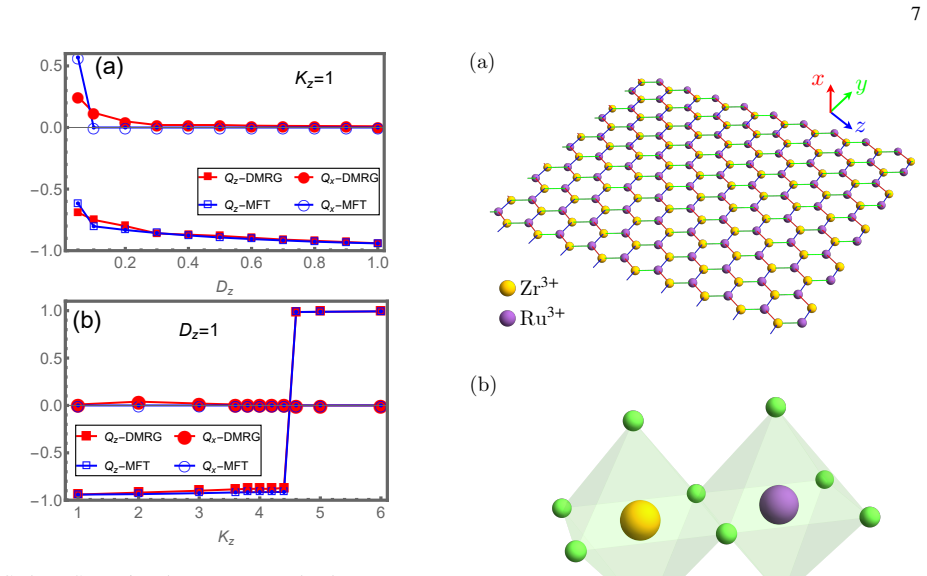
Summary. The paper studies a mixed-spin Kitaev honeycomb model with S=1/2 and J=3/2 ions on alternating sublattices, H = sum K_gamma S_i^gamma J_j^gamma + D_z sum (J_j^z)^2. It rewrites the model in terms of SU(4) pseudospin/pseudo-orbital operators, identifies conserved Z2 plaquette fluxes, and uses an SO(6) Majorana parton construction to perform mean-field theory in the zero-flux sector. This yields four quantum spin liquid phases, labeled A0, Az, B, and C, distinguished by the quadrupolar order parameters Qz and Qx, with a full phase diagram shown in Fig. 2. The paper compares these mean-field results with DMRG calculations on cylinders (bond dimension up to 4000, truncation errors around 1e-6) and with exact diagonalization at the isotropic point. Good agreement is found in the A0 and Az phases and for most of the parameter plane, but the DMRG/ED results differ substantially near the isotropic point and the DMRG flux configuration in the B phase is not zero-flux. The paper also derives a superexchange Hamiltonian for Zr0.5Ru0.5Cl3 and identifies parameter regimes in which the Kitaev coupling dominates.
Significance. If the central phase diagram is correct, this work establishes ferrimagnetic mixed-spin honeycomb magnets as a new family of Kitaev spin liquids with coexisting quadrupolar order, which is a genuinely new contribution beyond uniform spin-1/2 and spin-3/2 Kitaev models. The paper is technically strong in several respects: the self-consistent mean-field procedure is documented in detail (200 initial guesses, tolerance 1e-12), the DMRG calculations have small truncation errors, and the comparison between mean-field and numerical order parameters is presented explicitly in Table I and Fig. 4. The authors also disclose the two main limitations of their approach: the isotropic-point discrepancy and the disordered-flux states in the B phase. These disclosures are important, because the central claim of quantitative confirmation is weaker exactly in the regions where the load-bearing zero-flux and parton Ansatz assumptions are not independently supported.
major comments (3)
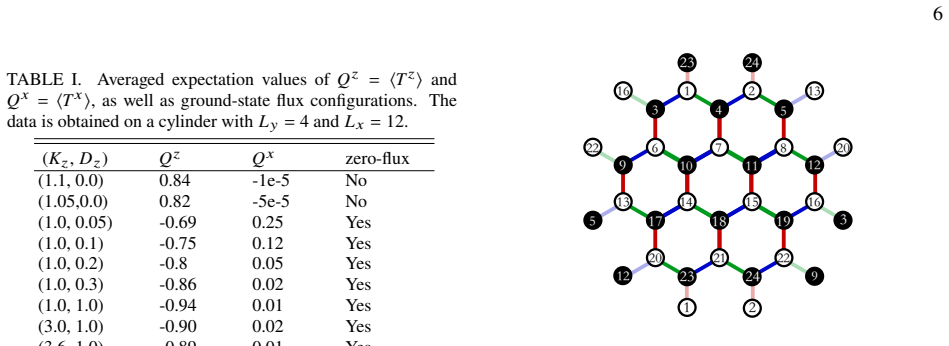
- [Section II B, Eq. (19), and Table I] The parton mean-field theory is performed entirely in the zero-flux sector (u = +1 on every bond, W_p = +1 on every plaquette), justified by analogy with the spin-1/2 Kitaev model and by the statement that DMRG supports this choice. However, Table I lists (Kz, Dz) = (1.1, 0.0), (1.05, 0.0), (4.6, 1.0), and (5.0, 1.0) as having zero-flux configuration 'No', and Section III states that in the B phase DMRG yields a disordered-flux state rather than a unique flux configuration. Since the B phase occupies a substantial part of the phase diagram, the mean-field description of B is not controlled unless the flux gap is shown to be small and the zero-flux sector is shown to dominate the variational energy over other flux sectors. The sentence in the abstract and conclusion that the analytical results are 'quantitatively confirmed by DMRG' is therefore too strong for the B phase. The authors should either compare mean-field solutions in different flux sectors, provide a quantitative estimate of the flux gap, or explicitly restrict the claimed confirmation to sectors and parameter regions where the zero-flux assumption is verified.
- [Section III, Fig. 4(a), and Eqs. (26)-(27)] Near the isotropic point, the mean-field and numerical results disagree in a way that is qualitatively important. At (Kz, Dz) = (1, 0), the mean-field solution is threefold degenerate with Qz values proportional to +1 and -1/2, whereas exact diagonalization in the zero-flux sector finds the opposite sign pattern with much smaller magnitudes, and DMRG shows a sizable divergence from the mean-field curves for Dz below about 0.1. The text acknowledges that the nature of this DMRG/ED spin liquid is 'not yet tractable within our parton Ansatz.' Because this region contains the B-C boundary and the isotropic point that connects the A0 and Az phases, the phase diagram is incomplete in a region that is physically central rather than peripheral. This is a disclosed limitation, but the abstract and conclusions need to state more prominently that the four-phase diagram is established only outside a finite neighborhood of the isotropic point, and the boundary structure inside that neighborhood remains unresolved.
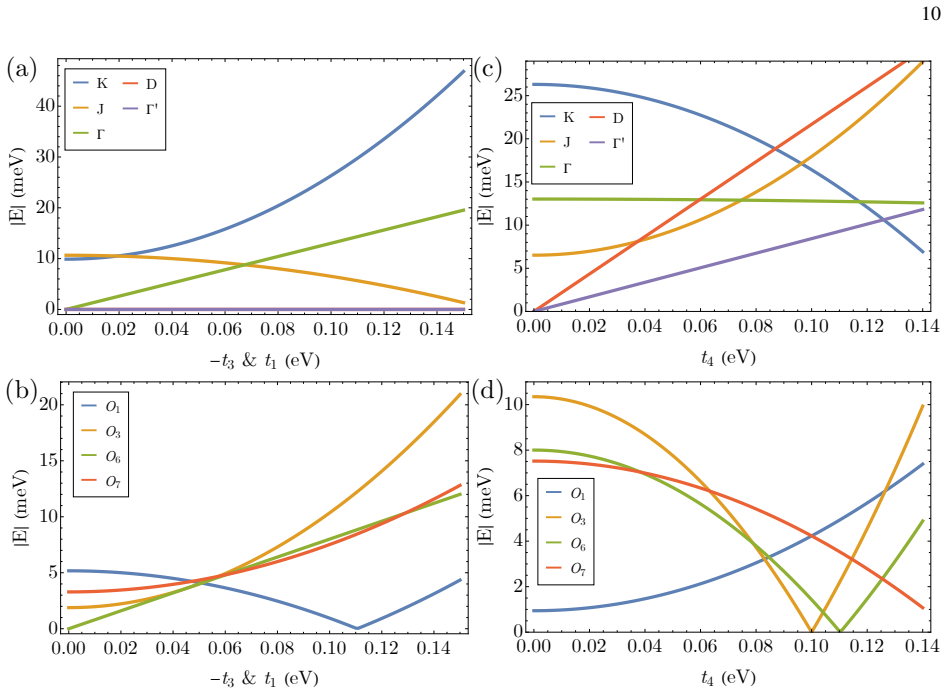
- [Section IV, Eq. (30), and Fig. 6] The superexchange derivation for Zr0.5Ru0.5Cl3 is presented as a proof of principle, but the link between the microscopic model and the pure Kitaev plus SIA Hamiltonian of Eq. (1) is not quantitative. The authors fix the onsite parameters U2, JH, and lambda to the same values for Zr and Ru, introduce a large onsite potential V on Zr, and then tune the hopping parameters to t1 = -t3 and t4 = 0 to maximize the Kitaev coupling. Even in the tuned regime, the couplings include a significant Gamma term and several comparable higher-order multipolar terms (Fig. 6). The paper should clarify that these conditions are a proof of existence for dominant Kitaev interactions in the mixed-spin setting, not a concrete prediction for Zr0.5Ru0.5Cl3, and should state what would be needed to elevate the material claim to a realistic model.
minor comments (5)
- [Fig. 4 caption] The caption of Fig. 4(b) is incomplete; it ends with '... over values such' and the sentence is cut off. The caption should state the full range of Kz used and the phase labels for each segment.
- [Section II B, after Eq. (22)] The notation r_gamma for the spin-3/2 nearest neighbor of site r is used without a precise definition before Eq. (22). The text should define r_gamma as the B-sublattice site reached from r along the gamma-bond.
- [Section III and Table I] The column 'zero-flux' in Table I would benefit from a definition of how the flux configuration is diagnosed in the cylindrical DMRG calculation, including how plaquette flux values are averaged and how the open boundaries are handled. This is important given that the B-phase flux disorder is a central qualitative result.
- [Section IV] The approximation of using identical U2, JH, and lambda for Zr and Ru is stated in Section IV but the text later notes that these parameters should differ for the two ions. This should be flagged as a simplifying assumption from the outset, rather than only in the concluding paragraph of the section.
- [Abstract and Conclusions] The phrase 'quantitatively confirmed by DMRG' appears in the abstract and in the conclusions without the qualification that the confirmation excludes a finite region around the isotropic point and that the B phase has disordered flux in DMRG. The abstract should carry the same caveat as Section III.
Circularity Check
No load-bearing circularity: the central phase diagram rests on independent DMRG benchmarks, with only minor self-citations motivating the parton framework.
full rationale
The paper's central claim, four distinct quantum spin liquid phases distinguished by quadrupolar parameters, is derived from a parton mean-field theory and then tested against DMRG and exact diagonalization. The order parameters Qz and Qx are defined identically in both methods (Eq. 21 and Table I), but that is a consistency check, not a construction: DMRG computes ground-state expectation values from the original Hamiltonian (1), not from the mean-field solution. No fitted parameter is renamed as a prediction; the mean-field self-consistency equations are solved and the resulting phases are compared with an independent numerical benchmark. The main caveat, the zero-flux sector assumption in Section II B, is not circular because the paper explicitly reports that DMRG does not converge to a zero-flux ground state in the B phase (Table I and Section III). This is an acknowledged validity gap, not a reduction of the prediction to its input. The self-citations to Refs. [12] and [13] (overlapping author groups) are used to motivate the SO(6) Majorana representation and the expectation of flux-sector ground states, but the present paper's own DMRG data provide independent support for most of the phase diagram, and the isotropic-point disagreement is openly disclosed. The superexchange section tunes hopping parameters (t1=-t3, t4=0) to maximize K; this is parameter exploration rather than a circular prediction. Overall, there is no exhibited Eq.-X-equals-Eq.-Y reduction, and no fitted quantity is relabeled as a prediction.
Assumptions & free parameters
free parameters (2)
- Zr on-site potential V =
V ~ 8 eV; acceptable range 7-10 eV
- Tuned hopping parameters (t1 = -t3, t4) =
t1 = -t3 = 0.1 eV, t4 = 0, t2 = 0.114 eV
assumptions (5)
- domain assumption The zero-flux sector (W_p = +1 on every plaquette) contains the ground state
- domain assumption The quartic term ic_i theta0_j can be captured by the mean-field decoupling of Eq. (20)
- domain assumption Zr and Ru share identical single-ion parameters U2, JH, lambda
- domain assumption The d1-d5 configuration is the ground state and the system remains a Mott insulator
- standard math SU(4) algebra of the fifteen pseudospin/pseudo-orbital operators spans the J = 3/2 operator space
Cite this review
Pith. "Pith review of Ferrimagnetic Kitaev spin liquids in mixed spin 1/2 spin 3/2 honeycomb magnets." pith.science (2026). https://pith.science/paper/FWLRHFYG
@misc{pith2026241209310,
  author       = {Pith},
  title        = {Pith review of: Ferrimagnetic Kitaev spin liquids in mixed spin 1/2 spin 3/2 honeycomb magnets},
  year         = {2026},
  howpublished = {\url{https://pith.science/paper/FWLRHFYG}},
  note         = {Machine review of arXiv:2412.09310}
}
abstract
We explore the potential experimental realization of the mixed-spin Kitaev model in materials such as Zr$_{0.5}$Ru$_{0.5}$Cl$_3$, where spin-1/2 and spin-3/2 ions occupy distinct sublattices of a honeycomb lattice. By developing a superexchange theory specifically for this mixed-spin system, we identify the conditions under which dominant Kitaev-like interactions emerge. Focusing on the limiting case of pure Kitaev coupling with single-ion anisotropy, we employ a combination of superexchange theory, parton mean-field theory, and density matrix renormalization group (DMRG) simulations. We establish a comprehensive ground-state phase diagram identifying four distinct quantum spin liquid phases. Our findings highlight the importance of spin-orbital couplings and quadrupolar order parameters in stabilizing exotic phases, providing a foundation for exploring mixed-spin Kitaev magnets.
Figures

Figures from the paper (1 more)
Reference graph
Works this paper leans on
-
[1]
One-particle eigenstates The spin-orbit coupling (SOC) interaction couples the spin 𝑆 = 1/2 of either the single hole in Ru 3+ or the single electron in Zr 3+ to their effective orbital angular momentum 𝐿 = 1, resulting in total angular momenta of 𝐽 = 1/2 and 𝐽 = 3/2, respectively. Consequently, for the single electron in Zr 3+, the lowest-energy state is...
-
[2]
and spin-3/2 KHM [10, 12, 13]. The extensive number of conserved quantities indicates that the model realizes a Kitaev QSL and is amenable to an analytical treatment, as we will show in the following section. These con- served quantities also provide guidelines for interpreting the DMRG results, as explored in Section III. The SIA term in Eq. (2) and 𝑊𝑝 a...
-
[3]
Hopping matrix The effective hopping Hamiltonian between sites on the honeycomb lattice occupied by spin-1/2 and spin-3/2 ions reads H𝑡 = ∑︁ 𝑖𝑗 ∑︁ 𝛼𝛽𝜎 𝑡𝛼𝛽 𝑖𝑗 𝑑† 𝑖𝛼𝜎𝑑𝑗𝛽𝜎, (A7) where 𝑑𝑖𝛼𝜎 are the annihilation operators for the 𝛼-th orbital with spin 𝜎 (↑ or↓) at site 𝑖, and 𝑡𝛼𝛽 𝑖𝑗 represents the hopping parameters, which, in the most general case, can be ex...
-
[4]
Perturbation theory Using the perturbation expansion for the effective su- perexchange Hamiltonian Eq. (30), we explicitly account for both𝑖→ 𝑗 and𝑗→𝑖 hoppings, as𝑖 and𝑗 sites are oc- cupied by inequivalent Ru3+ and Zr3+ ions. The excited intermediate states resulting from these single-electron 12 hoppings correspond to the 𝑑0–𝑑6 and 𝑑2–𝑑4 configu- ration...
-
[5]
Spin-1/2 - spin-3/2 Hamiltonian After constructing the perturbation matrix, we project it onto a set of orthogonal spin matrices to express the superexchange Hamiltonian in terms of the correspond- ing spin operators. There are multiple representations of the superexchange Hamiltonian, as various orthogonal spin matrices can be employed to describe the sp...
-
[6]
P. W. Anderson, Materials Research Bulletin8, 153 (1973)
1973
-
[7]
Kitaev, Annals of Physics 321, 2 (2006)
A. Kitaev, Annals of Physics 321, 2 (2006)
2006
-
[8]
Balents, Nature 464, 199 (2010)
L. Balents, Nature 464, 199 (2010)
2010
Show all 56 references
-
[9]
Savary and L
L. Savary and L. Balents, Rep. Prog. Phys. 80, 016502 (2017)
2017
-
[10]
Knolle and R
J. Knolle and R. Moessner, Annual Review of Condensed Matter Physics 10, 451 (2019)
2019
-
[11]
Y. Zhou, K. Kanoda, and T.-K. Ng, Rev. Mod. Phys. 89, 025003 (2017)
2017
-
[12]
Broholm, R
C. Broholm, R. J. Cava, S. A. Kivelson, D. G. Nocera, M. R. Norman, and T. Senthil, Science 367 (2020)
2020
-
[13]
Takagi, T
H. Takagi, T. Takayama, G. Jackeli, G. Khaliullin, and S. E. Nagler, Nature Reviews Physics1, 264 (2019)
2019
-
[14]
Trebst and C
S. Trebst and C. Hickey, Physics Reports 950, 1 (2022)
2022
-
[15]
Baskaran, D
G. Baskaran, D. Sen, and R. Shankar, Phys. Rev. B 78, 115116 (2008)
2008
-
[16]
Rousochatzakis, Y
I. Rousochatzakis, Y. Sizyuk, and N. B. Perkins, Nat. Com- mun. 9, 1575 (2018). 13
2018
-
[17]
H.-K. Jin, W. M. H. Natori, F. Pollmann, and J. Knolle, Nature Communications 13, 3813 (2022)
2022
-
[18]
W. M. H. Natori, H.-K. Jin, and J. Knolle, Phys. Rev. B 108, 075111 (2023)
2023
-
[19]
V. S. de Carvalho, H. Freire, and R. G. Pereira, Phys. Rev. B 108, 094418 (2023)
2023
-
[20]
Ma, Phys
H. Ma, Phys. Rev. Lett. 130, 156701 (2023)
2023
-
[21]
Georgiou, I
M. Georgiou, I. Rousochatzakis, D. J. J. Farnell, J. Richter, and R. F. Bishop, arXiv:2405.14378 (2024)
2024 arXiv
-
[22]
Hermanns, I
M. Hermanns, I. Kimchi, and J. Knolle, Annual Review of Condensed Matter Physics 9, 17 (2018)
2018
-
[23]
Rousochatzakis, N
I. Rousochatzakis, N. B. Perkins, Q. Luo, and H.-Y. Kee, Reports on Progress in Physics 87, 026502 (2024)
2024
-
[24]
Jackeli and G
G. Jackeli and G. Khaliullin, Physical Review Letters102, 017205 (2009)
2009
-
[25]
Chaloupka, G
J. Chaloupka, G. Jackeli, and G. Khaliullin, Physical Re- view Letters 105, 027204 (2010)
2010
-
[26]
Khaliullin, Progr
G. Khaliullin, Progr. Theor. Phys. Suppl. 160, 155 (2005)
2005
-
[27]
K. W. Plumb, J. P. Clancy, L. J. Sandilands, V. V. Shankar, Y. F. Hu, K. S. Burch, H.-Y. Kee, and Y.-J. Kim, Phys. Rev. B 90, 041112(R) (2014)
2014
-
[28]
Banerjee, J
A. Banerjee, J. Yan, J. Knolle, C. A. Bridges, M. B. Stone, M. D. Lumsden, D. G. Mandrus, D. A. Tennant, R. Moess- ner, and S. E. Nagler, Science 356, 1055 (2017)
2017
-
[29]
Do, S.-Y
S.-H. Do, S.-Y. Park, J. Yoshitake, J. Nasu, Y. Motome, Y. Kwon, D. T. Adroja, D. J. Voneshen, K. Kim, T.-H. Jang, J.-H. Park, K.-Y. Choi, and S. Ji, Nat. Phys.13, 1079 (2017)
2017
-
[30]
Jan ˇsa, A
N. Jan ˇsa, A. Zorko, M. Gomil ˇsek, M. Pregelj, K. W. Kr¨amer, D. Biner, A. Biffin, C. R¨ uegg, and M. Klanjˇsek, Nat. Phys. 14, 786 (2018)
2018
-
[31]
C. Xu, J. Feng, M. Kawamura, Y. Yamaji, Y. Nahas, S. Prokhorenko, Y. Qi, H. Xiang, and L. Bellaiche, Phys. Rev. Lett.124, 087205 (2020)
2020
-
[32]
I. Lee, F. G. Utermohlen, D. Weber, K. Hwang, C. Zhang, J. van Tol, J. E. Goldberger, N. Trivedi, and P. C. Hammel, Phys. Rev. Lett.124, 017201 (2020)
2020
-
[33]
P. P. Stavropoulos, D. Pereira, and H.-Y. Kee, Phys. Rev. Lett. 123, 037203 (2019)
2019
-
[34]
P. P. Stavropoulos, X. Liu, and H.-Y. Kee, Phys. Rev. Res. 3, 013216 (2021)
2021
-
[35]
M. G. Yamada, M. Oshikawa, and G. Jackeli, Phys. Rev. Lett. 121, 097201 (2018)
2018
-
[36]
M. G. Yamada, M. Oshikawa, and G. Jackeli, Phys. Rev. B 104, 224436 (2021)
2021
-
[37]
W. M. H. Natori, E. C. Andrade, and R. G. Pereira, Phys. Rev. B 98, 195113 (2018)
2018
-
[38]
Churchill, E
D. Churchill, E. Z. Zhang, and H.-Y. Kee, Micro- scopic roadmap to a yao-lee spin-orbital liquid (2024), arXiv:2410.21389 [cond-mat.str-el]
2024 arXiv
-
[39]
Swaroop and S
B. Swaroop and S. N. Flengas, Canadian Journal of Chem- istry 42, 1495 (1964)
1964
-
[40]
Swaroop and S
B. Swaroop and S. N. Flengas, Canadian Journal of Chem- istry 42, 1886 (1964)
1964
-
[41]
G. Chen, R. Pereira, and L. Balents, Phys. Rev. B 82, 174440 (2010)
2010
-
[42]
N ´eel, Proceedings of the Physical Society
L. N ´eel, Proceedings of the Physical Society. Section A 65, 869 (1952)
1952
-
[43]
W. P. Wolf, Reports on Progress in Physics24, 212 (1961)
1961
-
[44]
M. O. Takahashi, W.-H. Kao, S. Fujimoto, and N. B. Perkins, arXiv:2409.02190 (2024)
2024 arXiv
-
[45]
Wang and A
F. Wang and A. Vishwanath, Phys. Rev. B 80, 064413 (2009)
2009
-
[46]
Coleman, E
P. Coleman, E. Miranda, and A. Tsvelik, Phys. Rev. B 49, 8955 (1994)
1994
-
[47]
J. Fu, J. Knolle, and N. B. Perkins, Phys. Rev. B97, 115142 (2018)
2018
-
[48]
Schaden and J
Y. Schaden and J. Reuther, Phys. Rev. Res. 5, 023067 (2023)
2023
-
[49]
E. H. Lieb, Phys. Rev. Lett. 73, 2158 (1994)
1994
-
[50]
Ralko and J
A. Ralko and J. Merino, Phys. Rev. Lett. 124, 217203 (2020)
2020
-
[51]
S. R. White, Physical review letters 69, 2863 (1992)
1992
-
[52]
S. R. White, Physical Review B 48, 10345 (1993)
1993
-
[53]
Weinberg and M
P. Weinberg and M. Bukov, SciPost Phys.2, 003 (2017)
2017
-
[54]
S. M. Winter, Y. Li, H. O. Jeschke, and R. Valent ´ı, Phys. Rev. B 93, 214431 (2016)
2016
-
[55]
J. G. Rau, E. K.-H. Lee, and H.-Y. Kee, Physical Review Letters 112, 077204 (2014)
2014
-
[56]
The octupolar term (𝐽𝑥)3 in the Hamiltonian is derived from the orthogonal basis component (𝐽𝑥)3− 41 20𝐽𝑥, and the remaining dipolar part − 41 20𝐽𝑥 is absorbed in the dipolar-dipolar interaction, i,e.,𝐽𝑥𝑆𝑥,𝐽𝑥𝑆𝑦, and𝐽𝑥𝑆𝑧
Reviewed August 11, 2026 · model on record in the stance chip above.
Discussion (0). Continue with ORCID to comment.