Quadratic Planar Differential Systems with Algebraic Limit Cycles via Quadratic Plane Cremona Maps
Pith reviewed 2026-05-25 16:41 UTC · model grok-4.3
The pith
Quadratic Cremona maps create new quadratic differential systems with algebraic limit cycles of degree 5.
A machine-rendered reading of the paper's core claim, the machinery that carries it, and where it could break.
Core claim
Quadratic plane Cremona maps allow the construction of new quadratic planar differential systems from old ones while preserving the quadratic character and any algebraic limit cycles. This yields a previously unknown family of quadratic systems possessing an algebraic limit cycle of degree five, and it generates all known families with algebraic limit cycles of higher degree from earlier examples.
What carries the argument
Quadratic plane Cremona maps: birational transformations that map the plane to itself and send quadratic vector fields to quadratic vector fields while keeping algebraic limit cycles algebraic.
If this is right
- A new family of quadratic systems with algebraic limit cycle of degree 5 is obtained.
- Known families with algebraic limit cycles of degree greater than four are recovered via these maps.
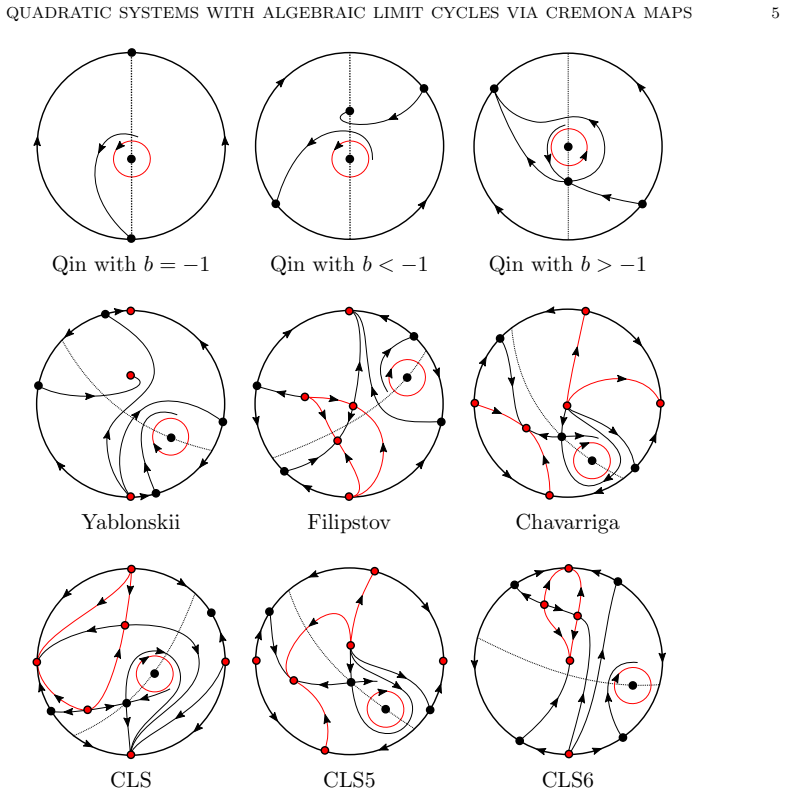
- Phase portraits on the Poincaré disk are provided for all families of quadratic systems with algebraic limit cycles.
- The transformations supply a systematic method to produce quadratic systems carrying algebraic limit cycles.
Where Pith is reading between the lines
- Iterating the maps further might produce quadratic systems with algebraic limit cycles of degree six or higher.
- Analogous birational transformations could apply to cubic or higher-degree planar systems.
- The supplied phase portraits indicate that the topological types realized by these systems are finite and potentially classifiable.
Load-bearing premise
Quadratic plane Cremona maps send quadratic vector fields to quadratic vector fields while preserving the algebraic character of any limit cycle they carry.
What would settle it
An explicit quadratic plane Cremona map applied to a quadratic system with an algebraic limit cycle that results in either a non-quadratic system or a system whose limit cycle is no longer algebraic would disprove the preservation property.
Figures


read the original abstract
In this paper we show how we can transform quadratic systems into new quadratic systems after some kind of birational transformations, the quadratic plane Cremona maps. We afterwards apply these transformations to the families of quadratic differential systems having an algebraic limit cycle. As a consequence, we provide a new family of quadratic systems having an algebraic limit cycle of degree 5. Moreover we show how the known families of quadratic differential systems having an algebraic limit cycle of degree greater than four are obtained using these transformations. We also provide the phase portraits on the Poincar\'e disk of all the families of quadratic differential systems having algebraic limit cycles.
Editorial analysis
A structured set of objections, weighed in public.
Referee Report
Summary. The paper applies quadratic plane Cremona maps (birational transformations of degree 2) to known families of quadratic planar vector fields possessing algebraic limit cycles. It claims that these maps produce new quadratic systems, including a previously unknown family with an algebraic limit cycle of degree 5, while also recovering all known families with algebraic limit cycles of degree greater than 4. Phase portraits on the Poincaré disk are supplied for the complete collection of such families.
Significance. If the maps are shown to preserve both the quadratic degree of the vector field (after clearing denominators) and the isolation of the algebraic limit cycle, the construction supplies a systematic geometric mechanism for generating and unifying examples. This would be a useful addition to the literature on quadratic systems with algebraic limit cycles, especially given the scarcity of explicit high-degree examples.
major comments (2)
- [Abstract / § on the new family] The central technical claim (that a quadratic Cremona map applied to a quadratic vector field yields, after clearing denominators, another quadratic vector field whose algebraic limit cycle remains isolated and of the stated degree) is stated in the abstract and paragraph 2 but is not accompanied by an explicit computation of the denominator cancellation for the new degree-5 family. Without this verification, it is impossible to confirm that the degree remains exactly 2 rather than rising.
- [Section on recovery of known families] The recovery of known higher-degree families is asserted to follow from the same maps, yet no explicit base system plus map pair is exhibited that reproduces, for instance, a known degree-6 or degree-8 algebraic limit cycle while keeping the transformed field quadratic. This step is load-bearing for the unification claim.
minor comments (2)
- [Abstract] The abstract refers to “some kind of birational transformations”; the precise definition and the indeterminacy loci of the quadratic Cremona maps should be stated at the first use.
- [Phase-portrait section] Phase-portrait figures on the Poincaré disk are mentioned but their captions should explicitly label which family each portrait corresponds to and note any equilibria at infinity.
Simulated Author's Rebuttal
We thank the referee for the careful reading and constructive comments, which help clarify the presentation of our results on quadratic Cremona maps applied to systems with algebraic limit cycles. We address each major comment below and will revise the manuscript to incorporate the requested explicit verifications.
read point-by-point responses
-
Referee: [Abstract / § on the new family] The central technical claim (that a quadratic Cremona map applied to a quadratic vector field yields, after clearing denominators, another quadratic vector field whose algebraic limit cycle remains isolated and of the stated degree) is stated in the abstract and paragraph 2 but is not accompanied by an explicit computation of the denominator cancellation for the new degree-5 family. Without this verification, it is impossible to confirm that the degree remains exactly 2 rather than rising.
Authors: We agree that an explicit computation of the denominator cancellation is essential to rigorously confirm that the transformed vector field remains quadratic. In the revised version we will add the full algebraic details of this cancellation for the degree-5 family, including the explicit expressions for the numerator and denominator polynomials and the verification that no common factors remain after clearing. revision: yes
-
Referee: [Section on recovery of known families] The recovery of known higher-degree families is asserted to follow from the same maps, yet no explicit base system plus map pair is exhibited that reproduces, for instance, a known degree-6 or degree-8 algebraic limit cycle while keeping the transformed field quadratic. This step is load-bearing for the unification claim.
Authors: We acknowledge that the unification claim would be strengthened by concrete examples. In the revision we will exhibit explicit base quadratic systems together with the corresponding quadratic Cremona maps that recover known families with algebraic limit cycles of degrees 6 and 8, including the verification that the transformed fields remain quadratic after clearing denominators. revision: yes
Circularity Check
No circularity: explicit application of external birational maps to known base systems
full rationale
The derivation applies quadratic plane Cremona maps (standard objects in algebraic geometry) to previously classified quadratic systems that already possess algebraic limit cycles. The new degree-5 family and the recovery of known families are obtained by direct substitution and clearing denominators, with the resulting vector field verified to remain quadratic and the image curve verified to remain an isolated algebraic limit cycle. No equation reduces a claimed output to a fitted parameter or to a self-referential definition; no load-bearing uniqueness theorem is imported from the authors' prior work; the central preservation property is established by explicit calculation rather than by ansatz or renaming.
Axiom & Free-Parameter Ledger
axioms (1)
- standard math Quadratic plane Cremona maps transform quadratic vector fields into quadratic vector fields while mapping algebraic curves to algebraic curves.
Reference graph
Works this paper leans on
-
[1]
M. Alberich-Carrami˜nana, Geometry of the plane Cremona maps , Lecture Notes in Mathematics 1769, Springer-Verlag, 2002
work page 2002
-
[2]
Effective computation of base points of ideals in two-dimensional local rings
M. Alberich-Carrami ˜nana, J. `Alvarez Montaner and G. Blanco , Effec- tive computation of base points of two-dimensional ideals , preprint available at arXiv:1605.05665, 2016
work page internal anchor Pith review Pith/arXiv arXiv 2016
-
[3]
M.J. ´Alvarez, A. Ferragut , Local behavior of planar analytic vector fields via integrability, J. Math. Anal. Appl. 385 (2012), 264–277
work page 2012
-
[4]
A.A. Andronov, E.A. Leontovich, I.I. Gordon, A.G. Maier , Qualitative The- ory of Second-Order Dynamic Systems, John Wiley & Sons, New York 1973
work page 1973
-
[5]
Casas-Alvero, Singularities of Plane Curves
E. Casas-Alvero, Singularities of Plane Curves . London Mathematical Society Lec- ture Note Series, 276, Cambridge University Press, 2000
work page 2000
-
[6]
D. Cerveau, J. D ´eserti, Action fo the Cremona group on foliations of P2 C: some curious facts, Forum Math. 27 (2015), 893–905
work page 2015
-
[7]
J. Chavarriga, H. Giacomini, J. Llibre , Uniqueness of algebraic limit cycles for quadratic systems, J. Math. Anal. Appl. 261 (2001), 85–99
work page 2001
-
[8]
J. Chavarriga, J. Llibre, J. Moulin Ollagnier , On a result of Darboux , LMS J. Comput. Math. 4 (2001), 197–210
work page 2001
-
[9]
J. Chavarriga, J. Llibre, J. Sorolla , Algebraic limit cycles of degree 4 for qua- dratic systems, J. Differential Equations 200 (2004), 206–244
work page 2004
-
[10]
C. Christopher, J. Llibre, G. ´Swirszcz, Invariant algebraic curves of large degree for quadratic systems , J. Math. Anal. Appl. 303 (2005), 450–461
work page 2005
-
[11]
Coppel , Some quadratic systems with at most one limit cycle , Dynamics re- ported, Dynam
W.A. Coppel , Some quadratic systems with at most one limit cycle , Dynamics re- ported, Dynam. Report. Ser. Dynam. Systems. Appl., 2 (1989), 61–68
work page 1989
-
[12]
B. Coll, J. Llibre, Limit cycles for a quadratic system with an invariant straight line and some evolution of phase portraits , Colloquia Mathematica Societatis Janos Bolyai, 53, Qualitative Theory of Differential Equations, Bolyai Institut, Szeged, Hungary (1988), 111–123
work page 1988
-
[13]
G. Darboux, M´ emoire sur les ´ equations diff´ erentielles alg´ ebriques du premier ordre et du premier degr´ e(M´ elanages), Bull. Sci. Math.2 (1878), 60–96, 124–144, 152–200
-
[14]
F. Dumortier, J. Llibre, J.A. Art ´es, Qualitative theory of planar differential systems, Springer-Verlag, Berlin, 2006
work page 2006
-
[15]
R.M. Evdokimenco, Construction of algebraic paths and the qualitative investigation in the large of the properties of integral curves of a system of differential equations , Differential Equations 6 (1970), 1349–1358
work page 1970
-
[16]
R.M. Evdokimenco , Behavior of integral curves of a dynamic system , Differential Equations 9 (1974), 1095–1103
work page 1974
-
[17]
R.M. Evdokimenco , Investigation in the large of a dynamic system , Differential Equations 15 (1979), 215–221
work page 1979
-
[18]
Filipstov, Algebraic limit cycles, Differential Equations 9 (1973), 983–986
V.F. Filipstov, Algebraic limit cycles, Differential Equations 9 (1973), 983–986. 28 M. ALBERICH-CARRAMI ˜NANA, A. FERRAGUT, J. LLIBRE
work page 1973
-
[19]
Hilbert, Mathematische Problem (lecture), Second Internat
D. Hilbert, Mathematische Problem (lecture), Second Internat. Congress Math. Paris 1900 Nachr. Ges. Wiss. G¨ ottingen Math-Phys. Kl. (1900), 253–297. English transl., Bull. Amer. Math. Soc. 8 (1902), 437–479
work page 1900
- [20]
-
[21]
L. G. Mendes and J. V. Pereira, Hilbert modular foliations on the projective plane, Comment. Math. Helv. 80 (2005), 243–291
work page 2005
-
[22]
Seidenberg, Reduction of singularities of the differential equation Ady = Bdx, Amer
A. Seidenberg, Reduction of singularities of the differential equation Ady = Bdx, Amer. J. Math. 90 (1968),248–269
work page 1968
-
[23]
Y.-X. Qin, On the algebraic limit cycles of second degree of the differential equation dy/dx = ∑ 0≤i+j≤2aijxiyj/ ∑ 0≤i+j≤2bijxiyj, Acta Math. Sinica 8 (1958), 23–35
work page 1958
-
[24]
A.I. Yablonskii, Limit cycles of a certain differential equations , Differential Equa- tions 2 (1966), 335–344 (in Russian). M. Alberich-Carrami˜nana: Institut de Rob `otica i Inform`atica Industrial (IRI, CSIC-UPC) and Departament de Matem`atiques, Universitat Polit`ecnica de Catalunya, Av. Diagonal, 647, 08028 Barcelona, Spain E-mail address: maria.alberi...
work page 1966
discussion (0)
Sign in with ORCID, Apple, or X to comment. Anyone can read and Pith papers without signing in.