Passive transverse forcing of turbulent boundary-layer flow using sinusoidal surface grooves
Pith reviewed 2026-06-28 08:14 UTC · model grok-4.3
The pith
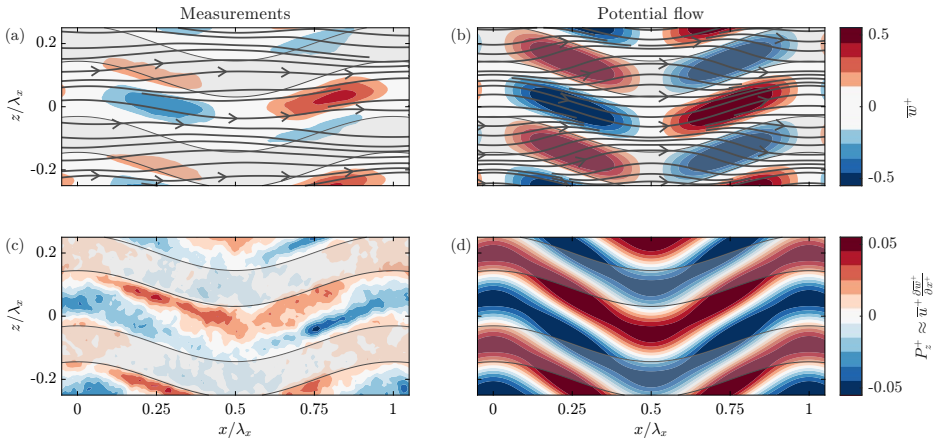
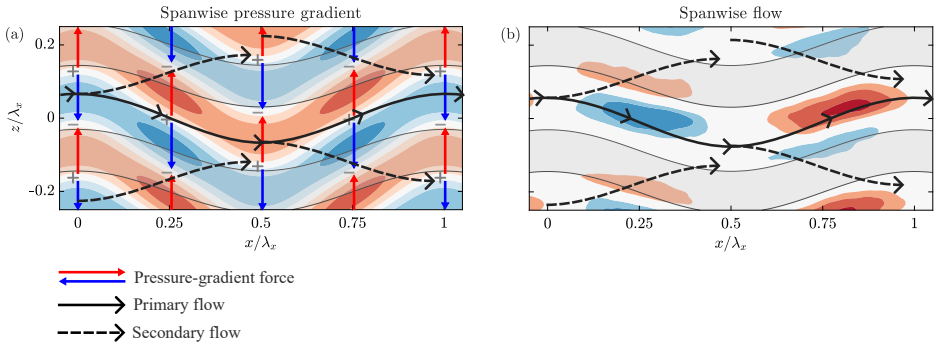
Sinusoidal surface grooves induce a passive transverse flow pattern in turbulent boundary layers through pressure-driven convergence and divergence, but yield at most a few percent frictional drag reduction after pressure losses.
A machine-rendered reading of the paper's core claim, the machinery that carries it, and where it could break.
Core claim
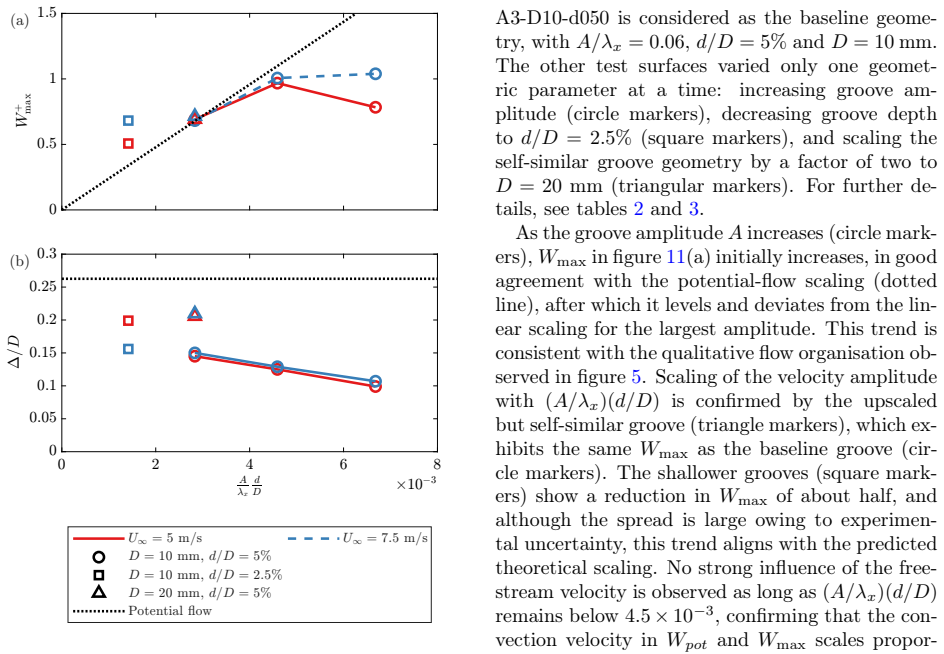
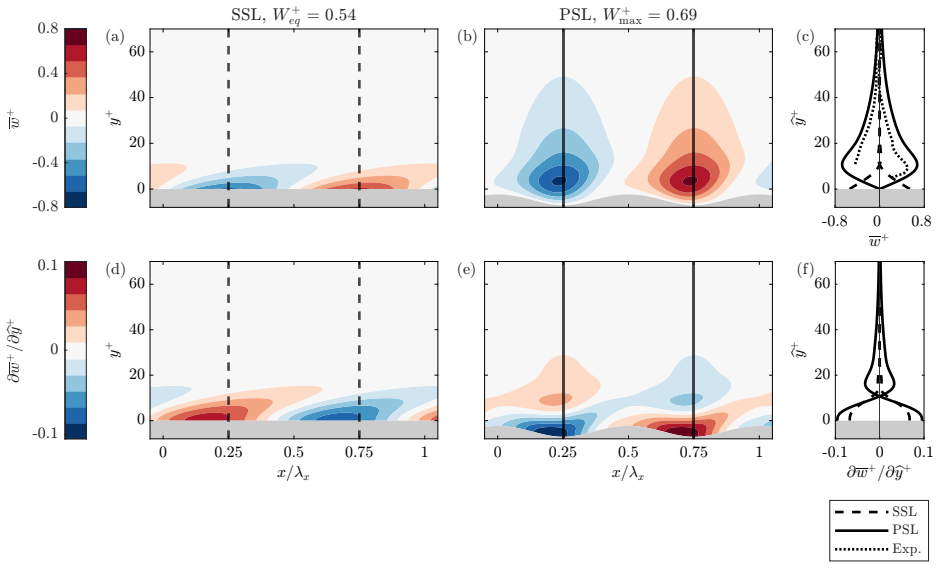
The grooves generate a Passive Stokes Layer (PSL) composed of an inertial pressure-driven outer solution from the surface displacement effect and a viscous inner solution satisfying no-slip at the wall. The spanwise periodicity of the lateral pressure gradient produces a converging-diverging flow rather than spanwise-uniform undulation. The forcing increases with groove amplitude until the slope becomes too steep and saturates. An inviscid model relates the induced transverse velocity directly to the surface geometric properties and agrees with experiment. Turbulence intensity near the wall decreases, but no net drag reduction is measured; a comparison to an equivalent active spatial Stokes
What carries the argument
Passive Stokes Layer (PSL): the composite flow consisting of an inviscid outer solution generated by surface displacement and a viscous inner solution at the wall, driven by the spanwise-periodic lateral pressure gradient.
If this is right
- The induced transverse velocity saturates once groove slope exceeds a threshold set by the surface geometry.
- Near-wall turbulence intensity decreases over the grooved surface.
- Any frictional savings are offset by pressure drag, limiting net drag reduction to a few percent at most.
- The mechanism is controlled by the spanwise periodicity of the lateral pressure gradient rather than by a uniform wall-normal displacement.
Where Pith is reading between the lines
- Groove wavelength and amplitude could be optimized to maximize the pressure gradient while keeping the slope below the saturation limit.
- The same pressure-gradient mechanism might appear on other streamwise-periodic roughness elements whose lateral variation creates spanwise pressure differences.
- Direct particle-image velocimetry of the inner viscous layer would confirm whether the PSL thickness scales with the active Stokes layer thickness.
Load-bearing premise
Frictional drag reduction can be estimated from a tentative match to an equivalent active spatial Stokes layer even though net drag on the grooved surface was never measured directly.
What would settle it
A direct force-balance measurement of net drag (friction plus pressure) on a flat plate with and without the sinusoidal grooves that shows whether total drag rises or falls by more than a few percent.
Figures
read the original abstract
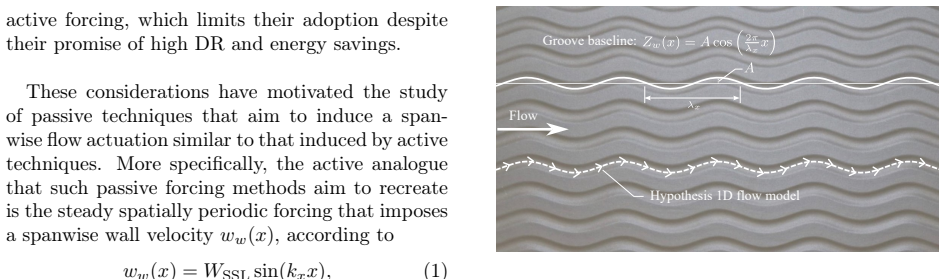
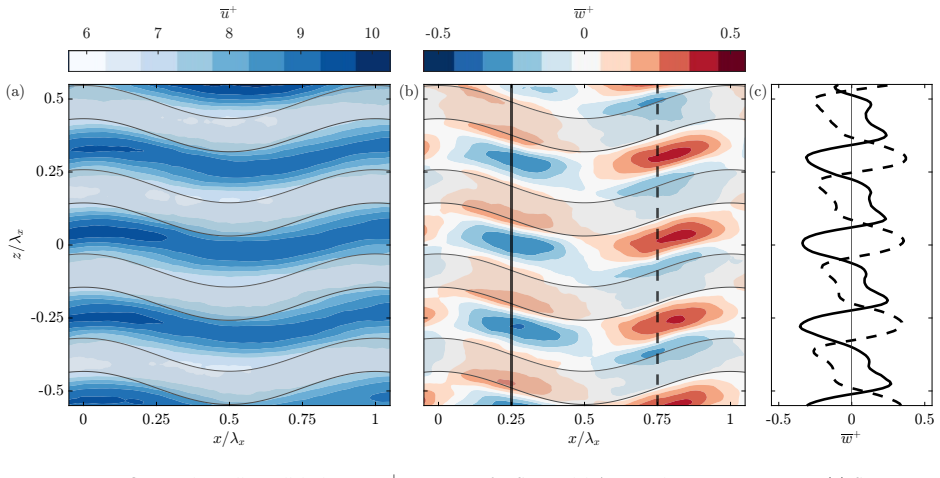
A surface geometry consisting of parallel, meandering streamwise grooves has been experimentally studied as an alternative means of passive transverse forcing of turbulent boundary-layer flow. Contrary to the original expectation, the flow does not exhibit a spanwise-uniform undulation aligned with the grooves; instead, a converging-diverging flow pattern results. This flow pattern can be attributed to the spanwise periodicity of the lateral pressure gradient. The forcing effect is found to initially increase with the groove amplitude, but it saturates when the groove slope becomes too steep. The observed induced flow, referred to as a Passive Stokes Layer (PSL), can be considered as being composed of an inertial (pressure-driven) outer solution generated by the displacement effect of the non-smooth surface geometry, and a viscous inner solution to accommodate the no-slip condition at the wall. The mechanism of transverse flow generation is elucidated by an inviscid flow model that relates the forcing to the surface geometric properties, with predictions in good agreement with the experimental results. Although a reduction in the near-wall turbulence levels over the groove surfaces is observed, no direct evidence for (mean) drag reduction is evident from the data. Instead, an estimate of the frictional drag potential is based on establishing a tentative relation to an equivalent spatial Stokes layer (SSL) induced by active wall forcing. This theoretical comparison indicates that the induced passive forcing is sufficient to act on the (active) spanwise forcing mechanism, but produces at most a few per cent of frictional drag reduction. Any potential savings are likely offset by pressure drag and other losses, so that, similar to active forcing, its potential for net drag reduction in practical applications is limited.
Editorial analysis
A structured set of objections, weighed in public.
Referee Report
Summary. The manuscript experimentally studies parallel meandering streamwise sinusoidal grooves as a means of passive transverse forcing in turbulent boundary-layer flow. Contrary to expectation, a converging-diverging flow pattern emerges due to spanwise-periodic lateral pressure gradients. The induced flow is decomposed into an inertial outer solution and viscous inner solution, termed a Passive Stokes Layer (PSL). An inviscid model relating forcing to surface geometry agrees well with experiments. Near-wall turbulence levels are reduced, but no direct mean drag reduction is measured. Frictional drag reduction is instead estimated at most a few percent via a tentative equivalence to an active spatial Stokes layer (SSL), leading to the conclusion that net savings are likely offset by pressure drag and other losses, limiting practical potential similarly to active forcing.
Significance. The experimental characterization of the PSL and the inviscid model's agreement with data provide a clear mechanistic explanation for passive transverse forcing and its saturation with groove amplitude. These elements would remain valuable contributions even if the drag-reduction estimate is reframed. The work highlights that passive geometries can induce spanwise forcing comparable in mechanism to active methods, but the tentative nature of the drag bound limits implications for net drag reduction applications.
major comments (2)
- [Abstract] Abstract: the central quantitative claim that the passive forcing 'produces at most a few per cent of frictional drag reduction' rests entirely on an unvalidated mapping to prior active SSL results. No direct wall-shear integration, skin-friction coefficient, or Reynolds-stress profile comparison between the grooved (passive) and active cases is reported to support the equivalence, and the paper itself notes the absence of direct drag evidence.
- [Abstract] Abstract / implied discussion: the conclusion that 'any potential savings are likely offset by pressure drag and other losses' is stated without quantification of the pressure-drag penalty or an integrated force balance on the grooved surface, making the net-drag assessment load-bearing for the practical-limitation claim yet unsupported by new data.
minor comments (1)
- [Abstract] The introduction of the acronym PSL (Passive Stokes Layer) occurs without an explicit definition at first use in the abstract; a parenthetical expansion on first appearance would improve clarity.
Simulated Author's Rebuttal
We thank the referee for the thorough review and valuable feedback. We address each major comment below, proposing revisions where appropriate to clarify the tentative nature of our drag estimates.
read point-by-point responses
-
Referee: [Abstract] Abstract: the central quantitative claim that the passive forcing 'produces at most a few per cent of frictional drag reduction' rests entirely on an unvalidated mapping to prior active SSL results. No direct wall-shear integration, skin-friction coefficient, or Reynolds-stress profile comparison between the grooved (passive) and active cases is reported to support the equivalence, and the paper itself notes the absence of direct drag evidence.
Authors: We agree that the frictional drag reduction bound is derived from a tentative analogy to prior active SSL work rather than direct validation. The manuscript already qualifies the relation as tentative and notes the lack of direct drag evidence. The analogy is motivated by the mechanistic similarity between the observed PSL and active spanwise forcing (matching velocity profiles and turbulence attenuation), but we accept that this does not constitute equivalence. We will revise the abstract to remove the specific quantitative phrasing and instead state that the induced forcing is comparable in scale to levels previously shown to produce modest frictional drag reduction in active cases, while explicitly underscoring the limitations of the mapping. revision: partial
-
Referee: [Abstract] Abstract / implied discussion: the conclusion that 'any potential savings are likely offset by pressure drag and other losses' is stated without quantification of the pressure-drag penalty or an integrated force balance on the grooved surface, making the net-drag assessment load-bearing for the practical-limitation claim yet unsupported by new data.
Authors: The statement on pressure drag offsetting savings is qualitative and not supported by a measured force balance or separate pressure-drag quantification in the present experiments. We will revise the abstract and discussion to present this as an expected outcome based on the presence of form drag in non-streamlined geometries, rather than a firm conclusion, and will note it as a limitation requiring future integrated measurements. The core contributions—the experimental characterization of the PSL and the inviscid model—remain independent of this net-drag assessment. revision: yes
Circularity Check
No significant circularity; central claims derive from experiment and model without reduction to inputs by construction.
full rationale
The paper derives the converging-diverging flow pattern and Passive Stokes Layer from experimental observations and an inviscid flow model relating forcing to surface geometry, with direct agreement to data. The frictional drag estimate is explicitly labeled tentative and based on external comparison to active SSL literature rather than any internal fit, self-definition, or equation that reduces the output to the paper's own inputs. No self-citation chains, ansatz smuggling, or renaming of known results appear as load-bearing steps. The derivation chain for the flow mechanism and saturation behavior remains self-contained against the reported measurements.
Axiom & Free-Parameter Ledger
axioms (1)
- domain assumption Inviscid flow approximation suffices for the outer solution relating forcing to surface geometry
invented entities (1)
-
Passive Stokes Layer (PSL)
no independent evidence
Reference graph
Works this paper leans on
-
[1]
1851 , publisher=
On the effect of the internal friction of fluids on the motion of pendulums , author=. 1851 , publisher=
-
[2]
Physics and control of wall turbulence for drag reduction , author=. Philos. Trans. R. Soc. A , volume=. 2011 , DOI =
2011
-
[3]
Propagation velocity of perturbations in turbulent channel flow , author=. Phys. Fluids A: Fluid Dyn. , volume=. 1993 , doi =
1993
-
[4]
Turbulent flows over rough walls , author=. Annu. Rev. Fluid Mech. , volume=. 2004 , doi =
2004
-
[5]
Experimental assessment of drag reduction by traveling waves in a turbulent pipe flow , volume =. Phys. Fluids , author =. doi:10.1063/1.3491203 , pages =
-
[6]
Experimental Control of Turbulent Boundary Layers with In-plane Travelling Waves , volume =. Flow Turbul. Combust. , author =. doi:10.1007/s10494-018-9926-2 , pages =
-
[7]
Fluid Dyn
Criteria for assessing experiments in zero pressure gradient boundary layers , volume =. Fluid Dyn. Res. , author =. 2009 , doi =
2009
-
[8]
Drag Reduction by Spanwise Wall Oscillation in Wall-Bounded Turbulent Flows , volume =. AIAA J. , author =. doi:10.2514/2.1750 , pages =
-
[9]
Near-wall structure of turbulent boundary layer with spanwise-wall oscillation , volume =. Phys. Fluids , author =. doi:10.1063/1.1477922 , pages =
-
[10]
Cimarelli, A. and Frohnapfel, B. and Hasegawa, Y. and De Angelis, E. and Quadrio, M. , year =. Prediction of turbulence control for arbitrary periodic spanwise wall movement , volume =. doi:10.1063/1.4813807 , journal =
-
[11]
Reynolds-number dependence of turbulent skin-friction drag reduction induced by spanwise forcing , volume =. J. Fluid Mech. , author =. doi:10.1017/jfm.2016.485 , pages =
-
[12]
Suppression of turbulence in wall‐bounded flows by high‐frequency spanwise oscillations , volume =. Phys. Fluids , author =. doi:10.1063/1.858381 , pages =
-
[13]
Turbulence reduction in a boundary layer by a local spanwise oscillating surface , volume =. Phys. Fluids , author =. doi:10.1063/1.868052 , pages =
-
[14]
An energy-efficient pathway to turbulent drag reduction , volume =. Nat. Commun. , author =. doi:10.1038/s41467-021-26128-8 , number =
-
[15]
Mishra, M. and Skote, M. , year =. Drag reduction in turbulent boundary layers with half wave wall oscillations , volume =. doi:10.1155/2015/253249 , journal =
-
[16]
Variations of von Kármán coefficient in canonical flows , volume =. Phys. Fluids , author =. doi:10.1063/1.3006423 , pages =
-
[17]
Overview of the self-sustaining mechanisms of wall turbulence , volume =. Prog. Aerosp. Sci. , author =. doi:10.1016/S0376-0421(01)00009-4 , pages =
-
[18]
Critical assessment of turbulent drag reduction through spanwise wall oscillations , doi =. J. Fluid Mech. , author =
-
[19]
The laminar generalized Stokes layer and turbulent drag reduction , volume =. J. Fluid Mech. , author =. doi:10.1017/s0022112010004398 , pages =
-
[20]
Streamwise-travelling waves of spanwise wall velocity for turbulent drag reduction , volume =. J. Fluid Mech. , author =. doi:10.1017/S0022112009006077 , pages =
-
[21]
Modification of near-wall turbulence due to spanwise wall oscillations , volume =. J. Turbul. , author =. doi:10.1088/1468-5248/5/1/024 , pages =
-
[22]
On the effects of lateral wall oscillations on a turbulent boundary layer , volume =. Exp. Therm. Fluid Sci. , author =. 2004 , keywords =. doi:10.1016/j.expthermflusci.2004.01.010 , pages =
-
[23]
A review of turbulent skin-friction drag reduction by near-wall transverse forcing , volume =. Prog. Aerosp. Sci. , author =. doi:10.1016/j.paerosci.2021.100713 , pages =
-
[24]
Comparison between spatial and temporal wall oscillations in turbulent boundary layer flows , volume =. J. Fluid Mech. , author =. doi:10.1017/jfm.2013.344 , pages =
-
[25]
On the Effect of the Internal Friction of Fluids on the Motion of Pendulums , author=. Trans. Cambridge Philos. Soc. , volume=
-
[26]
Viotti, C. and Quadrio, M. and Luchini, P. , year =. Streamwise oscillation of spanwise velocity at the wall of a channel for turbulent drag reduction , volume =. doi:10.1063/1.3266945 , journal =
-
[27]
and Hasegawa, Y
Yakeno, A. and Hasegawa, Y. and Kasagi, N. , year =. Spatio-temporally periodic control for turbulent friction drag reduction , isbn =. 6th Int. Symp. Turbul. Shear. Flow. Phenomena , publisher =
-
[28]
Ghebali, S and Chernyshenko, SI and Leschziner, MA , title =. Phys. Fluids , volume =. doi:10.1063/1.5003617 , year =
-
[29]
van Nesselrooij, Michiel and Veldhuis, LLM and Van Oudheusden, BW and Schrijer, FFJ , title =. Exp. Fluids , volume =. 2016 , type =
2016
-
[30]
Journal of Fluid Mechanics , volume=
On the relationship between manipulated inter-scale phase and energy-efficient turbulent drag reduction , author=. Journal of Fluid Mechanics , volume=. 2023 , publisher=
2023
-
[31]
and Zampiron, A
Deshpande, R. and Zampiron, A. and Chandran, D. and Smits, A. J. and Marusic, I.n , journal=. Near-Wall Flow Statistics in High-. 2024 , publisher=
2024
-
[32]
Acceleration is the key to drag reduction in turbulent flow , author=. Proc. Natl. Acad. Sci. , volume=. 2024 , DOI =
2024
-
[33]
Turbulent drag reduction by spanwise wall forcing. Part 1. Large-eddy simulations , author=. J. Fluid Mech , volume=. 2023 , DOI =
2023
-
[34]
J Fluid Mech , author =
Near-wall physics of a shear-driven three-dimensional turbulent boundary layer with varying crossflow , volume =. J Fluid Mech , author =. 2003 , pages =
2003
-
[35]
Baron, Arturo and Quadrio, Maurizio , title =. Appl. Sci. Res. , volume =. doi:10.1007/bf00856638 , year =
-
[36]
Multi-image oil-film interferometry skin friction measurements , journal =. 2013 , type =. doi:10.1088/0957-0233/24/12/124003 , author =
-
[37]
Baars, WJ and Squire, DT and Talluru, KM and Abbassi, MR and Hutchins, Nicholas and Marusic, Ivan , title =. 2016 , type =. doi:10.1007/s00348-016-2168-y , journal =
-
[38]
Agostini, L. and Touber, E. and Leschziner, M. A. , year=. Spanwise oscillatory wall motion in channel flow: drag-reduction mechanisms inferred from DNS-predicted phase-wise property variations at. doi:10.1017/jfm.2014.40 , journal =
-
[39]
Tanner, LH and Blows, LG , title =. J. Phys. E: Sci. Instr. , volume =. doi:10.1088/0022-3735/9/3/015 , year =
-
[40]
and Scarano, Fulvio and Elsinga, Gerrit E
Kempaiah, Kushal U. and Scarano, Fulvio and Elsinga, Gerrit E. and Van Oudheusden, Bas W. and Bermel, Leon , title =. Phys. Fluids , volume =. doi:10.1063/5.0015359 , year =
-
[41]
Sciacchitano, Andrea and Wieneke, Bernhard , title =. Meas. Sci. Technol. , volume =. 2016 , type =
2016
-
[42]
Bradshaw, P and Pontikos, NS , title =. J. Fluid Mech. , volume =. 1985 , type =
1985
-
[43]
Experiments in Fluids , volume =
Gatti, Davide and Güttler, Andreas and Frohnapfel, Bettina and Tropea, Cameron , title =. Experiments in Fluids , volume =. doi:10.1007/s00348-015-1983-x , year =
-
[44]
Touber, Emile and Leschziner, Michael A. , title =. J. Fluid Mech. , volume =. doi:10.1017/jfm.2011.507 , year =
-
[45]
Skote, Martin and Mishra, Maneesh and Wu, Yanhua , title =. Flow, Turbul. and Combust. , volume =. doi:10.1007/s10494-018-9979-2 , year =
-
[46]
Liu, Chang and Gayme, Dennice F. , title =. Journal of Fluid Mechanics , volume =. doi:10.1017/jfm.2020.48 , year =
-
[47]
Spatial discretization effects in spanwise forcing for turbulent drag reduction , author=. J. of Fluid Mech. , volume=. 2024 , DOI =
2024
-
[48]
Knoop, Max W. and Hartog, Friso H. and Schrijer, Ferdinand F. J. and van Campenhout, Olaf W. G. and van Nesselrooij, Michiel and van Oudheusden, Bas W. , title =. Exp. Fluids , volume =. doi:10.1007/s00348-024-03799-9 , year =
-
[49]
Choi, K. S. and Clayton, B. R. , title =. Int. J. Heat Fluid Fl. , volume =. doi:Doi 10.1016/S0142-727x(00)00070-9 , year =
-
[50]
3rd Shear Flow Conference , pages =
Akhavan, R and Jung, W and Mangiavacchi, N , title =. 3rd Shear Flow Conference , pages =. 1993 , type =
1993
-
[51]
Schultz, M. P. and Flack, K. A. , year=. The rough-wall turbulent boundary layer from the hydraulically smooth to the fully rough regime , volume=. doi:10.1017/S0022112007005502 , journal=
-
[52]
Opposition flow control for reducing skin-friction drag of a turbulent boundary layer , author=. Phys. Rev. Fluids , volume=. 2024 , DOI =
2024
-
[53]
45th AIAA Aerospace Sciences Meeting and Exhibit , pages =
Chauhan, Kapil and Nagib, Hassan and Monkewitz, Peter , title =. 45th AIAA Aerospace Sciences Meeting and Exhibit , pages =. 2007 , type =
2007
-
[54]
Musker, A. J. , title =. AIAA J. , volume =. doi:10.2514/3.61193 , year =
-
[55]
Nagib, Hassan M and Christophorou, Chris and Monkewitz, Peter A , booktitle=. High. 2006 , organization=
2006
-
[56]
On near wall measurements of wall bounded flows—The necessity of an accurate determination of the wall position , author=. Prog. Aerosp. Sci. , volume=. 2010 , publisher=
2010
-
[57]
A robust post-processing method to determine skin friction in turbulent boundary layers from the velocity profile , author=. Exp. Fluids , volume=. 2015 , publisher=
2015
-
[58]
Assessment of direct numerical simulation data of turbulent boundary layers , author=. J. Fluid Mech. , volume=. 2010 , publisher=
2010
-
[59]
Validating under-resolved turbulence intensities for PIV experiments in canonical wall-bounded turbulence , author=. Exp. Fluids , volume=. 2016 , DOI =
2016
-
[60]
Henrik and Örlü, Ramis , title =
Alfredsson, P. Henrik and Örlü, Ramis , title =. Eur. J. Mech. B Fluids , volume =. doi:https://doi.org/10.1016/j.euromechflu.2010.07.006 , year =
-
[61]
Turbulent drag reduction by spanwise wall forcing
Chandran, Dileep and Zampiron, Andrea and Rouhi, Amirreza and Fu, Matt K and Wine, David and Holloway, Brian and Smits, Alexander J and Marusic, Ivan , journal=. Turbulent drag reduction by spanwise wall forcing. Part 2. 2023 , DOI =
2023
-
[62]
The turbulence vorticity as a window to the physics of friction-drag reduction by oscillatory wall motion , author=. Int. J. Heat Fluid Fl. , volume=. 2015 , DOI =
2015
-
[63]
Vorticity transport in a turbulent channel flow subjected to streamwise travelling waves , author=. J. of Fluid Mech. , volume=. 2023 , DOI =
2023
-
[64]
The autonomous cycle of near-wall turbulence , author=. J. of Fluid Mech. , volume=. doi:10.1017/S0022112099005066 , year=
-
[65]
On the generation of turbulent wall friction , author=. Phys. Fluids , volume=. 1994 , DOI =
1994
-
[66]
JSME Int J., Ser
On the mechanism of drag reduction of near-wall turbulence by wall oscillation , author=. JSME Int J., Ser. B , volume=. 1997 , publisher=
1997
-
[67]
1972 , publisher=
A first course in turbulence , author=. 1972 , publisher=
1972
-
[68]
The return to isotropy of homogeneous turbulence , author=. J. Fluid Mech. , volume=. 1977 , publisher=
1977
-
[69]
The structure of turbulent boundary layers , author=. J. Fluid Mech. , volume=. 1967 , publisher=
1967
-
[70]
Westerweel, Jerry and Scarano, Fulvio , title =. Exp. fluids , volume =. 2005 , type =
2005
-
[71]
Reynolds number trend of hierarchies and scale interactions in turbulent boundary layers , author=. Philos. Trans. R. Soc. A , volume=. 2017 , publisher=
2017
-
[72]
Pattern prediction by linear analysis of turbulent flow with drag reduction by wall oscillation , author=. J. Fluid Mech. , volume=. 2013 , publisher=
2013
-
[73]
The streamwise drag-reduction response of a boundary layer subjected to a sudden imposition of transverse oscillatory wall motion , author=. Phys. Fluids , volume=. 2013 , DOI =
2013
-
[74]
On the enhancement of boundary layer skin friction by turbulence: an angular momentum approach , author=. J. Fluid Mech. , volume=. 2022 , DOI =
2022
-
[75]
Near-wall turbulence , author=. Phys. of Fluids , volume=. 2013 , publisher=
2013
-
[76]
Lardeau, Sylvain and Leschziner, Michael A. , title =. Phys. Fluids , volume =. doi:10.1063/1.4816290 , year =
-
[77]
Turbulent boundary layer flow subject to streamwise oscillation of spanwise wall-velocity , author=. Phys. Fluids , volume=. 2011 , pages =. doi:10.1063/1.3626028 , publisher=
-
[78]
Numerical studies of active control of turbulent boundary layers using transverse travelling waves , author=. Proc. 9th Int. Symp. Turbul. Shear Flow Phenomena , volume=
-
[79]
and Jiménez, Javier and Moser, Robert D
Sillero, Juan A. and Jiménez, Javier and Moser, Robert D. , title = ". Phys. Fluids , volume =. 2014 , issn =. doi:10.1063/1.4899259 , publisher=
-
[80]
Hurst, Edward and Yang, Qiang and Chung, Yongmann M , title =. J. Fluid Mech. , volume =. doi:10.1017/jfm.2014.524 , year =
discussion (0)
Sign in with ORCID, Apple, or X to comment. Anyone can read and Pith papers without signing in.