About the Shadowing Theorem for piecewise smooth vector fields with sliding motion
Pith reviewed 2026-06-26 19:11 UTC · model grok-4.3
The pith
Under tailored assumptions a shadowing theorem holds for piecewise-smooth vector fields that include sliding motion.
A machine-rendered reading of the paper's core claim, the machinery that carries it, and where it could break.
Core claim
Under appropriate assumptions we prove a Shadowing-like Theorem specifically tailored to piecewise-smooth vector fields with sliding motion, after first exhibiting that the standard C2 hypotheses fail to yield such a result in this framework, and we propose several extensions aimed at intrinsic phenomena of the piecewise-smooth setting.
What carries the argument
A shadowing-like theorem constructed for piecewise-smooth vector fields that accommodates on-off stages and sliding motion.
If this is right
- True orbits exist that closely follow chains of trajectories with approximation introduced at each step.
- The result applies to dynamics that alternate between distinct regimes.
- Extensions capture phenomena that arise only in the piecewise-smooth setting.
Where Pith is reading between the lines
- The theorem supplies a tool for validating numerical approximations in switched or hybrid models.
- Similar robustness statements may hold for other classes of discontinuous dynamical systems once comparable assumptions are identified.
Load-bearing premise
The vector fields must satisfy a collection of appropriate assumptions that enable the shadowing construction to succeed.
What would settle it
A piecewise-smooth vector field satisfying the appropriate assumptions together with a pseudo-orbit that no true orbit shadows.
Figures
read the original abstract
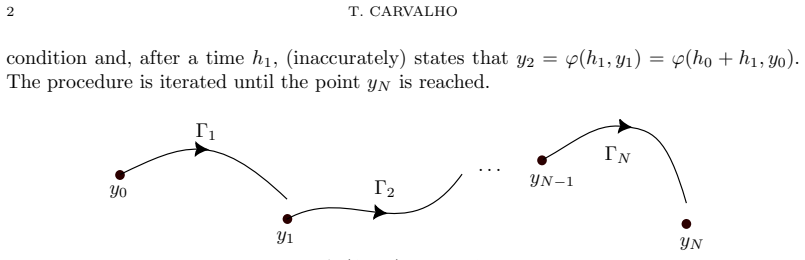
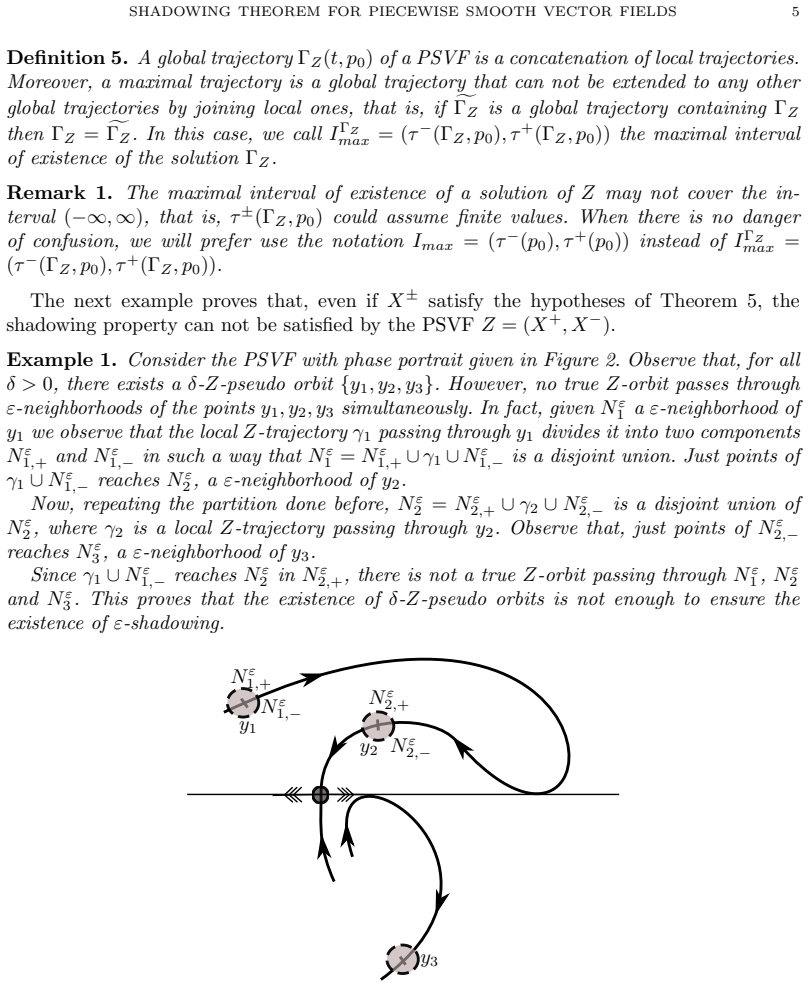
Since every modeling process in real-world situations is subject to errors, the study of the so-called shadowing property becomes highly relevant. This property allows for the identification of true orbits that closely follow a chain of trajectories in which some degree of approximation is introduced at each step. The objective of this paper is to establish a version of the Shadowing Theorem for vector fields governed by ordinary differential equations in the piecewise-smooth setting, where the dynamics alternate between distinct regimes, or on-off stages. First, we present an example showing that such a result can not be obtained under the same hypotheses commonly assumed in the C2 scenario. Consequently, under appropriate assumptions, we prove a Shadowing-like Theorem specifically tailored to this framework. Furthermore, we propose several extensions of the main result aimed at capturing characteristic phenomena intrinsic to piecewise-smooth vector fields - features that do not arise in the C2 setting.
Editorial analysis
A structured set of objections, weighed in public.
Referee Report
Summary. The manuscript shows via a counterexample in Section 2 that the standard C² hypotheses of the classical shadowing theorem fail for piecewise-smooth vector fields when sliding motion occurs on the discontinuity surface. It then states a collection of tailored assumptions in Section 2.3 (on the sliding vector field, transversality to the switching manifold, and local uniqueness of Filippov solutions). Under these hypotheses, Section 3 proves a shadowing-like theorem by constructing a true orbit through concatenation of smooth flows in each region with the sliding dynamics, via a fixed-point argument on a Banach space of pseudo-orbits. Several extensions capturing phenomena specific to the piecewise-smooth setting are also proposed.
Significance. If the listed assumptions are satisfied in applications, the result extends the shadowing property to an important class of non-smooth systems arising in control and mechanics. The explicit counterexample and the constructive fixed-point argument (rather than an appeal to an abstract theorem) are strengths; the work supplies a concrete, falsifiable statement that can be checked on concrete Filippov systems.
major comments (2)
- [Section 3] Section 3, construction of the Banach space: the precise norm on the space of pseudo-orbits (and the constants appearing in the contraction estimate) are not written explicitly; without these the verification that the map is a contraction under the stated assumptions cannot be checked line-by-line.
- [Section 2.3] Section 2.3, assumption on local uniqueness of Filippov solutions: the assumption is invoked to guarantee that the concatenated orbit is well-defined, but it is not shown that the assumption is preserved under the small perturbations used in the shadowing construction; this step is load-bearing for the fixed-point argument.
minor comments (2)
- [Abstract] The abstract refers to 'appropriate assumptions' without naming them; the introduction should state the three main assumptions of Section 2.3 in a single enumerated list for quick reference.
- [Section 2] Notation for the sliding vector field (e.g., the symbol used for the convex combination on the discontinuity surface) is introduced only in Section 2.3; a short preliminary subsection collecting all standing notation would improve readability.
Simulated Author's Rebuttal
We thank the referee for the careful reading and constructive comments on our manuscript. The positive assessment of the counterexample and the constructive nature of the fixed-point argument is appreciated. We respond point-by-point to the major comments below.
read point-by-point responses
-
Referee: [Section 3] Section 3, construction of the Banach space: the precise norm on the space of pseudo-orbits (and the constants appearing in the contraction estimate) are not written explicitly; without these the verification that the map is a contraction under the stated assumptions cannot be checked line-by-line.
Authors: We agree that the norm on the space of pseudo-orbits and the explicit constants in the contraction estimate must be stated to permit line-by-line verification. In the revised manuscript we will define the norm explicitly (as a weighted supremum norm incorporating the exponential decay factor determined by the minimal expansion rate away from the switching manifold) and supply the full contraction-mapping estimates, expressing the contraction constant in terms of the Lipschitz constants of the smooth vector fields, the sliding vector field, and the transversality angle. revision: yes
-
Referee: [Section 2.3] Section 2.3, assumption on local uniqueness of Filippov solutions: the assumption is invoked to guarantee that the concatenated orbit is well-defined, but it is not shown that the assumption is preserved under the small perturbations used in the shadowing construction; this step is load-bearing for the fixed-point argument.
Authors: The local-uniqueness assumption is indeed essential for the concatenated Filippov orbit to be unambiguously defined. While the smallness of the perturbations (in the C^0 topology on compact time intervals) and the transversality condition together suggest that uniqueness carries over by continuity of the Filippov regularization, we acknowledge that an explicit stability argument is missing. In the revision we will insert a short lemma establishing that the local-uniqueness property is preserved for all sufficiently small pseudo-orbits, using the openness of the transversality condition and the upper-semicontinuity of the Filippov set-valued map. revision: yes
Circularity Check
No circularity: proof is self-contained under explicitly stated assumptions
full rationale
The paper exhibits a counterexample to the standard C2 shadowing hypotheses when sliding occurs, then states a list of tailored assumptions on the sliding vector field, transversality, and Filippov uniqueness (Section 2.3). The main result is proved in Section 3 by a fixed-point argument that concatenates smooth flows with the sliding dynamics on a Banach space of pseudo-orbits. No equation reduces the claimed shadowing property to a fitted parameter, no self-citation supplies a load-bearing uniqueness theorem, and the derivation does not rename or smuggle in prior results by the same author. The construction is independent of the target statement and rests on the listed hypotheses rather than on any circular reduction.
Axiom & Free-Parameter Ledger
axioms (1)
- standard math Existence and uniqueness of solutions for the piecewise-smooth ODEs in each smooth regime and along the sliding surface
Reference graph
Works this paper leans on
-
[1]
Hayes, K
W. Hayes, K. R. Jackson, A survey of shadowing methods for numerical solutions of ordinary differential equations, Applied Numerical Mathematics 53 (2005) 299–321
2005
-
[2]
Backes, D
L. Backes, D. Dragievi, L. Singh, Shadowing for nonautonomous and nonlinear dynamics with impulses, Monatsh Math 198 (2022) 485–502
2022
-
[3]
Q. Zhan, Z. Zhang, Y. Li, Numerical implementation of finite-time shadowing of stochastic differential equations, Indian J Pure Appl Math 51 (2020) 1939 – 1957
2020
-
[4]
Gao, A shadowing lemma for random dynamical systems, Journal of Applied Analysis and Compu- tation 11 (6) (2021) 3014 – 3030
S. Gao, A shadowing lemma for random dynamical systems, Journal of Applied Analysis and Compu- tation 11 (6) (2021) 3014 – 3030
2021
-
[5]
L. F. Gon¸ calves, D. S. Rodrigues, P. F. A. Mancera, T. Carvalho, A mathematical model for chemoim- munotherapy of chronic lymphocytic leukemia, Applied Mathematics and Computation 349 (2019) 118–133
2019
-
[6]
L. F. Gon¸ calves, D. S. Rodrigues, P. F. A. Mancera, T. Carvalho, Sliding mode control in a mathemat- ical model to chemoimmunotherapy: the occurrence of typical singularities, Applied Mathematics and Computation 387 (2020) 124782
2020
-
[7]
B. A. Coomes, H. Ko´ cak, K. J. Palmer, Shadowing orbits of ordinary differential equations, Journal of Computational and Applied Mathematics 52 (1995) 35–43
1995
-
[8]
A. F. Filippov, Differential Equations with Discontinuous Righthand Sides, 1st Edition, Vol. 18 of Mathematics and its Applications, Springer Netherlands, 1988
1988
-
[9]
C. A. Buzzi, T. Carvalho, R. D. Euz´ ebio, Chaotic planar piecewise smooth vector fields with non-trivial minimal sets, Ergodic Theory and Dynamical Systems 36 (2) (2016) 458–469
2016
-
[10]
Carvalho, A
T. Carvalho, A. Antunes, R. Var˜ ao, On topological entropy of piecewise smooth vector fields, Journal of Differential Equations 362 (2023) 52–73
2023
-
[11]
Carvalho, On the closing lemma for planar piecewise smooth vector fields, Journal de Math` ematiques Pures et Appliqu´ ees 106 (6) (2016) 1174–1185
T. Carvalho, On the closing lemma for planar piecewise smooth vector fields, Journal de Math` ematiques Pures et Appliqu´ ees 106 (6) (2016) 1174–1185
2016
-
[12]
Carvalho, R
T. Carvalho, R. Euzebio, Minimal sets and chaos in planar piecewise smooth vector fields, Electronic Journal of Qualitative Theory of Differential Equations 33 (2020) 1–15. Appendix The purpose of this appendix is to announce the Shadowing Theorem stated in [7]. To do this, we rewrite the introductory technical text given in [7]. Consider a C 2 vector fie...
2020
discussion (0)
Sign in with ORCID, Apple, or X to comment. Anyone can read and Pith papers without signing in.