REVIEW 3 major objections 4 minor 55 references
New constraints on the values of the fundamental constants at a look-back time of 7.3 Gyr
T0 review · 3 major / 4 minor · reviewed 2026-08-15 · deepseek-v4-flash
Pith's one-line read New limits from hydroxyl absorption lines at z = 0.89 bound changes in the fine-structure constant, the proton-electron mass ratio, and the proton g-factor over 7.3 Gyr, all consistent with no evolution.
desk verdict A new but weak data point on alpha and g_p at z=0.89 that hangs on an unquantified conjugate-line assumption; fine as a null result, needs systematics before being used as a reference. read the letter →
The pith
A machine-rendered reading of the paper's core claim, the machinery that carries it, and where it could break.
The reading
What carries the argument
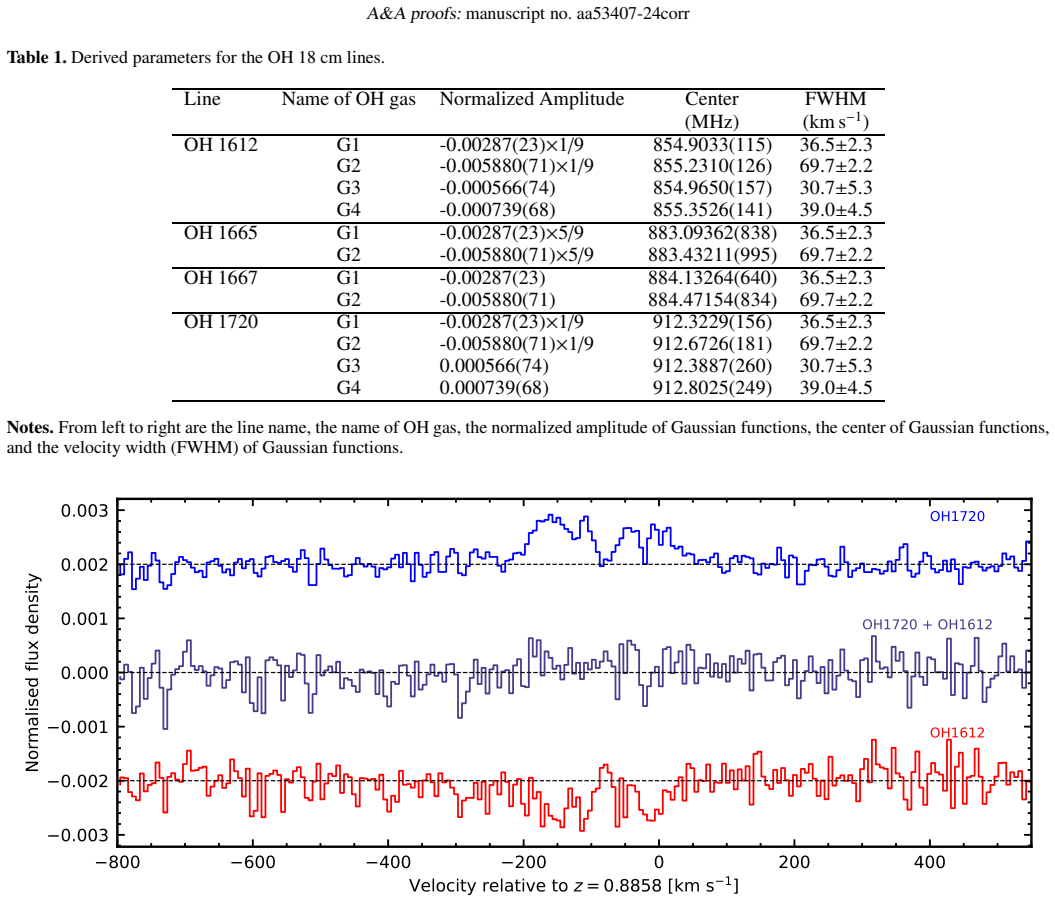
The load-bearing object is the frequency pattern of the four OH 18 cm lines. In the rest frame the frequencies satisfy $\nu_{1612} + \nu_{1720} = \nu_{1665} + \nu_{1667}$, and each transition has a different sensitivity coefficient to $\alpha$, $\mu$, and $g_p$. Because the lines come from the same gas, physical velocity offsets cancel; only differential shifts remain. The fitting procedure adds two free offsets, one between the 1665 and 1667 MHz lines and one between the 1612 and 1667 MHz lines, models the 1612/1720 pair as conjugate absorption/emission, and converts the fitted offsets into the linear equations that constrain the constant variations.
What would settle it
Fitting the same spectra while allowing the 1612 and 1720 MHz rest frequencies to float independently, or modeling the OH excitation with a radiative-transfer code that predicts an intrinsic $1612{-}1720$ offset at the $\sim 10^{-5}$ fractional level, would settle whether the conjugate assumption is safe; a still cleaner check is to observe a local ($z=0$) OH absorber with similar physical conditions and test whether the satellite lines are exactly conjugate when the constants are known to be unchanged.
Extended reading notes
Core claim
The central discovery is a null measurement of cosmological constant evolution in the $z = 0.8858$ absorber toward PKS 1830-211. By simultaneously fitting two thermalized OH main lines (1665 and 1667 MHz) and two conjugate OH satellite lines (1612 absorption and 1720 emission), the paper obtains two linear combinations relating $\Delta\mu/\mu$, $\Delta\alpha/\alpha$, and $\Delta g_p/g_p$. Substituting the prior $\Delta\mu/\mu = (-1.8\pm1.2)\times10^{-7}$ gives $\Delta(\alpha g_p^{0.27})/(\alpha g_p^{0.27}) = (-3.2\pm5.7)\times10^{-5}$, $\Delta\alpha/\alpha = (-3.3\pm23.0)\times10^{-4}$, and $\Delta g_p/g_p = (1.1\pm7.9)\times10^{-3}$, which the paper quotes as 1$\sigma$ upper limits $5.7\times10^{-5}$, $2.3\times10^{-3}$, and $7.9\times10^{-3}$. It concludes that the constants are consistent with no evolution over a look-back time of 7.3 Gyr.
Load-bearing premise
The result collapses if the four OH 18 cm lines do not trace exactly the same gas, or if excitation and radiative-transfer effects produce intrinsic frequency shifts between the 1612 and 1720 MHz satellite lines, because the fitting would then attribute those shifts to changes in the constants.
Editorial extensions
If this is right
- If the limits are correct, any model predicting fractional changes larger than roughly $10^{-5}$ in $\alpha g_p^{0.27}$, $10^{-3}$ in $\alpha$, or $10^{-2}$ in $g_p$ by $z < 1$ is ruled out.
- The measurement adds a second, independent constraint at $z = 0.89$ alongside the much tighter methanol-based $\mu$ bound, and it is one of the few direct bounds on $g_p$ evolution.
- The null result extends constant-drift tests to a look-back time of 7.3 Gyr, beyond the reach of terrestrial atomic-clock and Oklo reactor limits.
- With only one OH absorber known above $z = 0.1$, this is currently the highest-redshift anchor for simultaneous $\alpha$, $\mu$, and $g_p$ constraints from a single species.
Reading between the lines
- Editorial inference: if a second OH 18 cm absorber is found at a different redshift, the same pipeline would turn this single null result into a two-epoch measurement, which is the minimum needed to separate a real drift from a constant systematic offset.
- Editorial inference: the $g_p$ and $\alpha$ limits are dominated by the satellite-line frequency combination $\nu_{1720}-\nu_{1612}$, so deeper integrations on the 1720 MHz line alone could tighten both limits substantially without new instruments.
- Editorial inference: the conjugate-line assumption is only validated statistically on noise-dominated residuals; a velocity-resolved comparison of the 1612/1720 line ratio against the fitted offsets would test whether an excitation effect is masquerading as a constant change.
Signed reviews
Editorial analysis
A structured set of objections, weighed in public.
Referee Report
Summary. This paper re-analyzes the MeerKAT OH 18 cm absorption spectra toward PKS 1830–211 at z≈0.8858, fitting the four lines with a model consisting of two thermal (LTE) Gaussian components and two conjugate satellite components, with global frequency offsets FO1 and FO2 between the 1665/1612 lines and the 1667 line. Using the sensitivity equations of Chengalur & Kanekar (2003) and adopting the independent methanol-based Δμ/μ = (-1.8±1.2)×10^-7 (Muller et al. 2021), the authors derive Δ(αg_p^0.27)/(αg_p^0.27) = (-3.2±5.7)×10^-5, Δα/α = (-3.3±23.0)×10^-4, and Δg_p/g_p = (1.1±7.9)×10^-3, which they interpret as upper limits consistent with no evolution over 7.3 Gyr.
Significance. If the underlying assumptions hold, this is a useful new null measurement of fundamental-constant evolution at z=0.89, and one of the very few cosmological constraints on the proton g-factor. The use of same-species lines avoids inter-species velocity offsets, and the simultaneous fit with tied strengths and widths is a reasonable approach. The statistical checks (reduced χ²=1.17, KS and AD p-values of 0.64 and 0.46) are reported transparently, and the paper is honest about the key assumptions. The main value is as a new data point for the evolution of α and especially g_p, though the precision is modest compared to other probes of α.
major comments (3)
- [Section 3, conjugate-line assumption] The paper states that 'a crucial assumption is the existence of conjugate OH satellite lines,' but the KS and AD tests (p = 0.64 and 0.46) are performed on the summed residual after the conjugate-tied model is subtracted; they test whether that residual is consistent with Gaussian noise, not whether the data exclude a non-conjugate component of the size relevant here. A centroid offset of ~1–2 km/s between the 1612 and 1720 conjugate components (or between the 1665 and 1667 main-line components) would produce residual amplitudes of order A×Δv/FWHM ≈ 2×10^-5, below the per-channel rms of ~2×10^-4, so the test cannot bound such offsets. Since the derived limits on Δα/α and Δg_p/g_p in Eq. (5) correspond to frequency offsets of order 1–10 kHz (roughly 0.2–2 km/s), an excitation-induced offset of this size would shift the central values by an amount comparable to their stated uncertainties. The paper should either constrain the size of possible excitation-induced frequency offsets from OH radiative-transfer/excitation models, or add a systematic error term to the limits that accounts for this. As written, the quoted constraints in Eq. (5) and the Summary rest entirely on an assumption whose associated uncertainty is not bounded.
- [Section 4, Eq. (5)] The combination of Eqs. (1a),(2a) and (1b),(2b),(3),(4) uses inverse-variance weighting, which assumes the individual component measurements are statistically independent. However, G1–G4 are fitted simultaneously with global offsets FO1 and FO2, so the parameter estimates are correlated. Without the covariance matrix (or a justification of independence), the quoted uncertainties of 7.9×10^-3 and 2.1×10^-4 in Eq. (5) may be underestimated. Please propagate the full covariance of the fit into the combined constraints, or explain why the components can be treated as independent.
- [Section 3, Table 1] The fitted values and uncertainties of the global frequency offsets FO1 and FO2, which are the direct observables entering Eqs. (1)–(5), are not reported anywhere. The reader cannot verify the error propagation from the line centroids to the final constant limits. The paper should list FO1, FO2 (and their covariance), and state explicitly how the uncertainties on the right-hand sides of Eqs. (1)–(4) are derived from the fit.
minor comments (4)
- [Section 6] The reported '1σ limits' are actually the 1σ uncertainties of the fitted constants rather than upper limits computed from the full posterior: for Δg_p/g_p = (1.1±7.9)×10^-3, the 1σ upper limit is 9.0×10^-3, not 7.9×10^-3. Please clarify how the limits are defined and whether the central values are being included.
- [Section 4] The text refers to 'comparisons of the redshifts between ν1667+ν1665 and ν1667-ν1665,' but the equations appear to use frequency combinations with a different normalization. Please rewrite this sentence to match the actual equations and definitions used.
- [Figure 1 and Table 1] There are encoding artifacts in the displayed text (e.g., '/uni03BC/' and 'Normali ed flux den ity'), which should be fixed in the final version.
- [Abstract and Summary] The abstract quotes limits with the symbol '≲' but the body gives central values and uncertainties; please be consistent about whether the constraints are 1σ upper limits or 1σ uncertainties, and specify the confidence level (1σ, 2σ, etc.).
Circularity Check
No significant circularity: the OH frequency offsets are measured from the spectra and converted to fundamental-constant limits through published sensitivity coefficients and an external methanol-based Δμ/μ prior.
full rationale
The derivation chain is self-contained as a measurement: the paper first fits Gaussian components to the four OH 18 cm spectra and introduces free frequency offsets FO1 and FO2; it then converts the measured offset combinations into linear equations in Δμ/μ, Δα/α, and Δg_p/g_p using the published frequency-constant sensitivity relations (Chengalur & Kanekar 2003); finally it combines these with the independent methanol constraint Δμ/μ=(-1.8±1.2)×10^-7 (Muller et al. 2021) to solve for the two remaining constants. No step defines one target constant in terms of another, fits a parameter to a subset and then presents a closely related fitted quantity as a prediction, or imports a uniqueness result from the same authors. The Muller et al. prior comes from different molecular lines (CH3OH) and, although one author overlaps, it is an externally published measurement used transparently as an input rather than as an unverified self-citation. The 'crucial assumption' of conjugate OH satellite lines is a physical modeling choice with a statistical test (KS and AD p-values of 0.64 and 0.46); if wrong it could bias the derived limits, but that is a systematic-uncertainty concern, not a circular reduction. The paper also explicitly discusses the dominance of the ν1720−ν1612 and ν1667−ν1665 uncertainties and notes the ∼3.7σ residual feature, further indicating that the quoted limits are data-driven rather than forced by construction. No circular step is identifiable by the standards of this review.
Assumptions & free parameters
free parameters (3)
- FO1 (1665-1667 frequency offset) =
Not quoted directly; implied by Table 1 line centers (order kHz)
- FO2 (1612-1667 frequency offset) =
Not quoted directly; implied by Table 1 line centers
- Input Delta mu/mu from methanol =
(-1.8 +/- 1.2)e-7
assumptions (6)
- domain assumption The OH 18 cm rest frequencies and the sensitivity coefficients in Eqs. (12)-(13) of Chengalur and Kanekar (2003) correctly map frequency offsets to Delta alpha/alpha, Delta mu/mu, and Delta g_p/g_p.
- domain assumption The four OH 18 cm lines originate from the same gas at the same redshift, so fitted offsets FO1 and FO2 are not caused by velocity differences between the lines.
- domain assumption The 1612/1720 satellite lines are exactly conjugate, with residual noise symmetric after thermal subtraction.
- domain assumption The methanol Delta mu/mu measurement of Muller et al. (2021) is valid for the same absorbing gas and the proton-electron mass ratio did not vary between the methanol and OH regions.
- domain assumption The chosen Gaussian component structure, two main-line components plus two conjugate satellite pairs, is a complete description of the absorption.
- domain assumption Standard Lambda CDM cosmology with H0=70 km/s/Mpc, Omega_m=0.3, and Omega_Lambda=0.7 is sufficient for the 7.3 Gyr look-back time.
Cite this review
Pith. "Pith review of New constraints on the values of the fundamental constants at a look-back time of 7.3 Gyr." pith.science (2026). https://pith.science/paper/FYBFQ3XV
@misc{pith2026250507200,
  author       = {Pith},
  title        = {Pith review of: New constraints on the values of the fundamental constants at a look-back time of 7.3 Gyr},
  year         = {2026},
  howpublished = {\url{https://pith.science/paper/FYBFQ3XV}},
  note         = {Machine review of arXiv:2505.07200}
}
abstract
The study of redshifted spectral lines can provide a measure of the fundamental constants over large look-back times. Current grand unified theories predict an evolution in these constants and astronomical observations offer the only experimental measure of the values of the constants over large timescales. Of particular interest are the dimensionless constants: the fine structure constant ($\alpha$), the proton-electron mass ratio ($\mu$), and the proton g-factor ($g_p$), since these do not require a "standard meterstick". Here we present a re-analysis of the 18 cm hydroxyl (OH) lines at $z=0.89$, which were recently detected with the MeerKAT telescope, toward the radio source PKS\,1830-211. Utilizing the previous constraint of $\Delta\mu/\mu=(-1.8\pm1.2)\times10^{-7}$, we obtain $\Delta (\alpha g_p^{0.27})/(\alpha g_p^{0.27})\lesssim5.7\times10^{-5}$, $\Delta \alpha/\alpha\lesssim2.3\times10^{-3}$ , and $\Delta g_p/g_p\lesssim7.9\times10^{-3}$. These new constraints are consistent with no evolution over a look-back time of 7.3 Gyr and provide another valuable data point in the putative evolution of the constants.
Figures

Reference graph
Works this paper leans on
-
[1]
Allison, J. R., Moss, V . A., Macquart, J. P ., et al. 2017, MNRAS, 465, 4450
work page 2017
-
[2]
Avelino, P . P ., Martins, C. J. A. P ., Nunes, N. J., & Olive, K. A . 2006, Phys. Rev. D, 74, 083508
work page 2006
-
[3]
Bagdonaite, J., Jansen, P ., Henkel, C., et al. 2013, Science, 339, 46
work page 2013
-
[4]
Carilli, C. L., Menten, K. M., Stocke, J. T., et al. 2000, Phys . Rev. Lett., 85, 5511
work page 2000
-
[5]
Chandola, Y ., Saikia, D. J., Ma, Y .-Z., et al. 2024, ApJ, 973, 48
work page 2024
-
[6]
Chengalur, J. N., de Bruyn, A. G., & Narasimha, D. 1999, A&A, 3 43, L79
work page 1999
-
[7]
Chengalur, J. N. & Kanekar, N. 2003, Phys. Rev. Lett., 91, 241 302
work page 2003
- [8]
Show all 55 references
-
[9]
Curran, S. J. 2021, MNRAS, 508, 1165
2021
-
[10]
J., Darling, J., Bolatto, A
Curran, S. J., Darling, J., Bolatto, A. D., et al. 2007, MNRAS , 382, L11
2007
-
[11]
J., Kanekar, N., & Darling, J
Curran, S. J., Kanekar, N., & Darling, J. K. 2004, New A Rev., 4 8, 1095
2004
-
[12]
J., Tanna, A., Koch, F
Curran, S. J., Tanna, A., Koch, F. E., et al. 2011, A&A, 533, A5 5
2011
-
[13]
& Dyson, F
Damour, T. & Dyson, F. 1996, Nuclear Physics B, 480, 37
1996
-
[14]
& Polyakov, A
Damour, T. & Polyakov, A. M. 1994, Nuclear Physics B, 423, 532
1994
-
[15]
2003, Phys
Darling, J. 2003, Phys. Rev. Lett., 91, 011301
2003
-
[16]
2004, ApJ, 612, 58
Darling, J. 2004, ApJ, 612, 58
2004
-
[17]
P ., V oronkov, M
Ellingsen, S. P ., V oronkov, M. A., Breen, S. L., & Lovell, J. E. J. 2012, ApJ, 747, L7
2012
-
[18]
Flambaum, V . V . & Kozlov, M. G. 2007, Phys. Rev. Lett., 98, 240801
2007
-
[19]
A., Nair, S., Porcas, R
Garrett, M. A., Nair, S., Porcas, R. W., & Patnaik, A. R. 1997, Vistas in Astron- omy, 41, 281
1997
-
[20]
B., Wolfe, A
Griest, K., Whitmore, J. B., Wolfe, A. M., et al. 2010, ApJ, 70 8, 158
2010
-
[21]
2021, ApJ, 9 07, 11
Gupta, N., Jagannathan, P ., Srianand, R., et al. 2021, ApJ, 9 07, 11
2021
-
[22]
2018, ApJ, 860, L 22
Gupta, N., Momjian, E., Srianand, R., et al. 2018, ApJ, 860, L 22
2018
-
[23]
2016, in MeerKA T Sci ence: On the Pathway to the SKA, 14
Gupta, N., Srianand, R., Baan, W., et al. 2016, in MeerKA T Sci ence: On the Pathway to the SKA, 14
2016
-
[24]
2011, ApJ, 728, L12
Kanekar, N. 2011, ApJ, 728, L12
2011
-
[25]
& Chengalur, J
Kanekar, N. & Chengalur, J. N. 2004, MNRAS, 350, L17
2004
-
[26]
Kanekar, N., Ghosh, T., & Chengalur, J. N. 2018, Phys. Rev. Le tt., 120, 061302
2018
-
[27]
I., Stocke, J
Kanekar, N., Langston, G. I., Stocke, J. T., Carilli, C. L., & Menten, K. M. 2012, ApJ, 746, L16
2012
-
[28]
M., et al
Kanekar, N., Ubachs, W., Menten, K. M., et al. 2015, MNRAS, 44 8, L104
2015
-
[29]
Koopmans, L. V . E. & de Bruyn, A. G. 2005, MNRAS, 360, L6
2005
-
[30]
& Gott, J
Li, L.-X. & Gott, J. Richard, I. 1998, Phys. Rev. D, 58, 103513
1998
-
[31]
Lovell, J. E. J., Jauncey, D. L., Reynolds, J. E., et al. 1998, ApJ, 508, L51
1998
-
[32]
Marciano, W. J. 1984, Phys. Rev. Lett., 52, 489 Martí-Vidal, I., Muller, S., Combes, F., et al. 2013, A&A, 55 8, A123
1984
-
[33]
2011, A&A, 535, A10 3
Muller, S., Beelen, A., Guélin, M., et al. 2011, A&A, 535, A10 3
2011
-
[34]
2014, A&A, 566, A11 2
Muller, S., Combes, F., Guélin, M., et al. 2014, A&A, 566, A11 2
2014
-
[35]
& Guélin, M
Muller, S. & Guélin, M. 2008, A&A, 491, 739
2008
-
[36]
2024, A&A, 683, A62
Muller, S., Le Gal, R., Roue ff, E., et al. 2024, A&A, 683, A62
2024
-
[37]
2023, A&A, 67 4, A101
Muller, S., Martí-Vidal, I., Combes, F., et al. 2023, A&A, 67 4, A101
2023
-
[38]
H., et al
Muller, S., Roueff, E., Black, J. H., et al. 2020, A&A, 637, A7
2020
-
[39]
M., Henkel, C., & Kanekar, N
Muller, S., Ubachs, W., Menten, K. M., Henkel, C., & Kanekar, N. 2021, A&A, 652, A5
2021
-
[40]
T., Flambaum, V
Murphy, M. T., Flambaum, V . V ., Webb, J. K., et al. 2004, in Ast rophysics, Clocks and Fundamental Constants, ed. S. G. Karshenboim & E. Peik, V ol. 648, 131–150
2004
-
[41]
J., Dent, T., Martins, C
Nunes, N. J., Dent, T., Martins, C. J. A. P ., & Robbers, G. 2009 , Mem. Soc. As- tron. Italiana, 80, 785
2009
-
[42]
B., Schmidt, P
Rosenband, T., Hume, D. B., Schmidt, P . O., et al. 2008, Scien ce, 319, 1808
2008
-
[43]
B., Barrow, J
Sandvik, H. B., Barrow, J. D., & Magueijo, J. 2002, Phys. Rev. Lett., 88, 031302
2002
-
[44]
M., et al
Schulz, A., Henkel, C., Menten, K. M., et al. 2015, A&A, 574, A 108
2015
-
[45]
2004, Ph ys
Srianand, R., Chand, H., Petitjean, P ., & Aracil, B. 2004, Ph ys. Rev. Lett., 92, 121302
2004
- [46]
-
[47]
2020, A&A, 636, L7
Tercero, B., Cernicharo, J., Cuadrado, S., de Vicente, P ., & Guélin, M. 2020, A&A, 636, L7
2020
-
[48]
Thompson, R. I. 2013, MNRAS, 431, 2576
2013
-
[49]
I., Martins, C
Thompson, R. I., Martins, C. J. A. P ., & Vielzeuf, P . E. 2013, MNRAS, 428, 2232
2013
-
[50]
T., Webb, J
Tzanavaris, P ., Murphy, M. T., Webb, J. K., Flambaum, V . V ., & Curran, S. J. 2007, MNRAS, 374, 634
2007
-
[51]
K., Murphy, M
Tzanavaris, P ., Webb, J. K., Murphy, M. T., Flambaum, V . V ., & Curran, S. J. 2005, Phys. Rev. Lett., 95, 041301
2005
-
[52]
2003, Reviews of Modern Physics, 75, 403
Uzan, J.-P . 2003, Reviews of Modern Physics, 75, 403
2003
-
[53]
2011, Living Reviews in Relativity, 14, 2
Uzan, J.-P . 2011, Living Reviews in Relativity, 14, 2
2011
-
[54]
2024, arXiv e-prints, arXiv:2410.07281
Uzan, J.-P . 2024, arXiv e-prints, arXiv:2410.07281
2024 arXiv
-
[55]
& Combes, F
Wiklind, T. & Combes, F. 1996, Nature, 379, 139
1996
Reviewed August 15, 2026 · model on record in the stance chip above.
Discussion (0). Continue with ORCID to comment.