REVIEW 4 major objections 6 minor 2 cited by
Magnetic fields in the Eos Cloud: dynamically important fields in the interface between atomic and molecular gas
T0 review · 4 major / 6 minor · reviewed 2026-08-16 · deepseek-v4-flash
Pith's one-line read The paper argues that the magnetic field in the nearby starless Eos cloud is dynamically important: it is aligned with the cloud's structure, sub-Alfvénic, and magnetically subcritical, with field strengths of about 6 µG in Eos and 12 µG…
desk verdict First magnetic-field study of the new Eos cloud: the qualitative claim that B is dynamically important holds up, but the quantitative DCF numbers depend on an adopted linewidth, not a measured one. read the letter →
The pith
A machine-rendered reading of the paper's core claim, the machinery that carries it, and where it could break.
The reading
What carries the argument
The analysis rests on the Davis–Chandrasekhar–Fermi (DCF) method, which estimates the plane-of-sky magnetic field strength from the dispersion of polarization position angles, the gas density, and the non-thermal velocity dispersion, after a structure-function fit separates turbulent from large-scale field variation. A histogram of relative orientation (HRO) quantifies whether the magnetic field runs parallel or perpendicular to contours of column density, and the mass-to-flux ratio and Alfvénic Mach number turn the field strength and alignment into statements about dynamical support against gravity and turbulence.
What would settle it
Measure the velocity dispersion of molecular gas directly within the Eos cloud, for example with deep CO (1-0) or OH emission/absorption observations, along with an accurate gas temperature. If the derived non-thermal linewidth is well below 2.5 km/s, the DCF field strength falls below ~3 µG and the cloud would no longer be sub-Alfvénic or magnetically subcritical, contradicting the paper's central claim.
Extended reading notes
Core claim
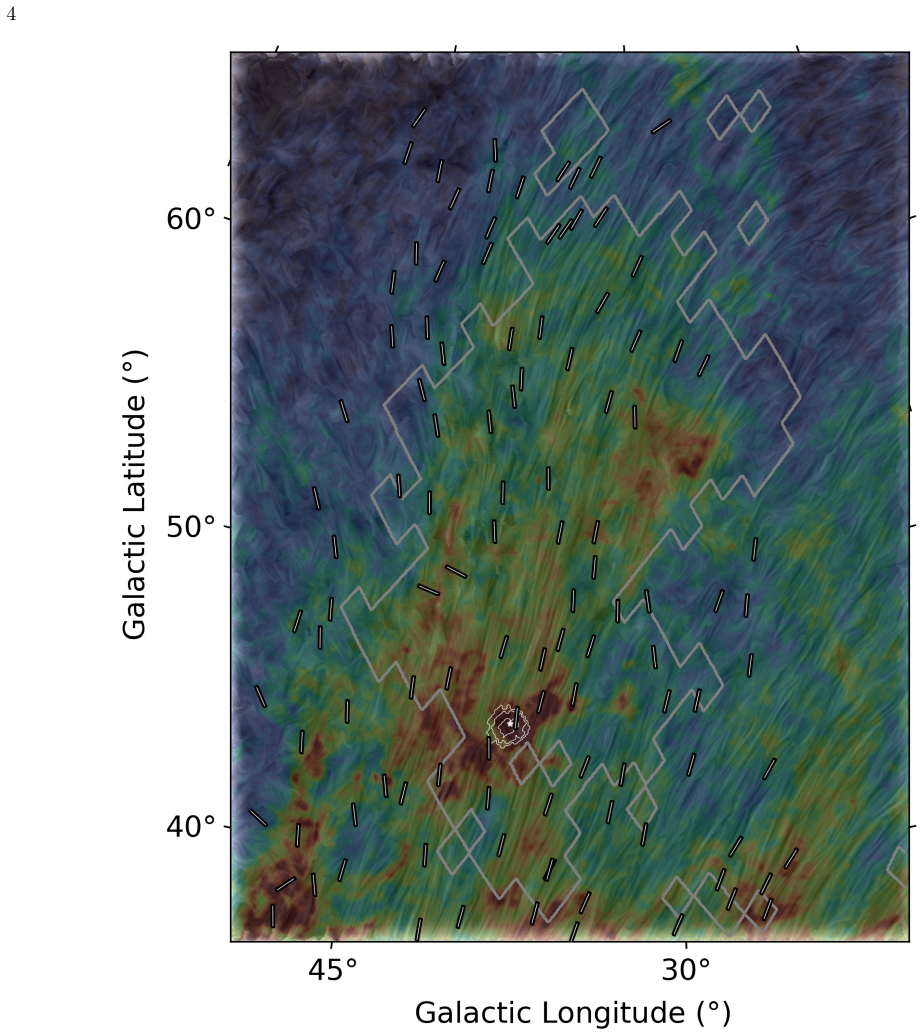
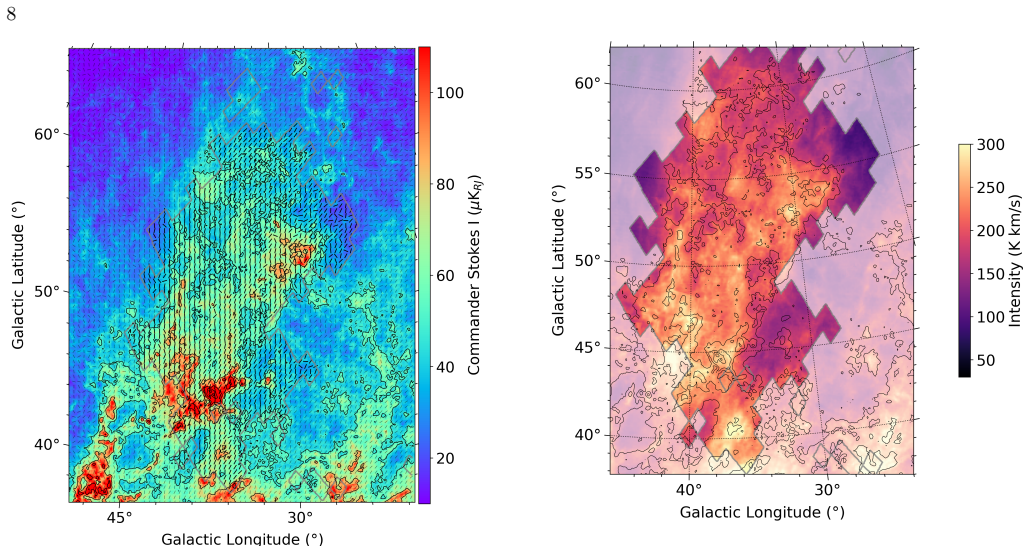
The central claim is that the magnetic field in Eos and MBM 40 is dynamically important by every metric the authors apply: the field is preferentially parallel to the cloud's density structure, the gas is sub-Alfvénic, the mass-to-flux ratio is strongly subcritical, and the inferred field strength does not vary with gas density. The histogram of relative orientation shows a parallel alignment across nearly all column densities, with the mean field angle (163.5° east of north) matching the cloud's major axis (≈165°). The Davis–Chandrasekhar–Fermi analysis yields plane-of-sky field strengths of 6.0±3.4 µG for Eos and 12.0±4.3 µG for MBM 40, giving Alfvénic Mach numbers of 0.38±0.17 and 0.3±0.1 and mass-to-flux ratios of 0.10±0.07 and 0.10±0.05, respectively.
Load-bearing premise
The load-bearing premise is that the non-thermal velocity dispersion of the molecular gas in Eos is about 2.5 km/s, because the DCF field strength scales linearly with that linewidth and the authors adopt it from H I observations toward MBM 40 and extend it to the entire cloud; if the true linewidth or the assumed 350 K temperature differs, the field strength and the subcritical mass-to-flux ratio change directly.
Editorial extensions
If this is right
- If the field is as strong as measured, the Eos cloud is magnetically supported against gravitational collapse, explaining its lack of star formation.
- Magnetic fields can dominate the dynamics of low-density, non-self-gravitating gas at the CNM-to-molecular transition, not just in star-forming cores.
- The field strength being consistent between Eos and the denser MBM 40 clump supports the picture that B remains roughly constant below the density threshold where collapse begins.
- A sub-Alfvénic, field-aligned cloud implies that gas flows along field lines, which would shape the cloud's elongated morphology and may slow its evaporation by hot surrounding gas.
Reading between the lines
- If the magnetic field is as strong as inferred, the magnetic pressure in the Local Bubble could account for the pressure balance implied by C I fine-structure lines, independent of the X-ray emitting gas.
- A direct test would be to measure the velocity dispersion of molecular gas in Eos (for example with deep CO or OH observations); if the non-thermal linewidth is much smaller than the adopted 2.5 km/s, the DCF field strength would drop below the subcritical threshold.
- The Eos cloud is a clean case of the parallel-alignment regime; mapping the HRO across other CO-dark clouds could test whether the transition to perpendicular alignment occurs at a universal column density.
- The field's role in slowing cloud evaporation could be tested by comparing magnetic field morphology and temperature structure at the cloud's boundary with the hot Loop I gas.
Signed reviews
Editorial analysis
A structured set of objections, weighed in public.
Referee Report
Summary. The manuscript analyzes the magnetic field of the nearby CO-dark Eos molecular cloud using Planck 353 GHz dust polarization, starlight polarization from Berdyugin et al. (2014), and GALFA-H I data. It reports a plane-of-sky field strength of B_DCF = 6.0 ± 3.4 µG for Eos and 12.0 ± 4.3 µG for the MBM 40 subregion, and finds that the field is aligned with the cloud major axis via a histogram of relative orientation analysis. The authors conclude that the magnetic field is dynamically important in every metric they consider: it is aligned with the cloud structure, magnetically subcritical (λ ≈ 0.1), sub-Alfvénic (M_A ≈ 0.3–0.4), and roughly constant with gas density, consistent with a magnetized CNM origin for the cloud. The central claim is the dynamical importance of the field at the CNM/molecular interface, with the quantitative DCF strengths used to support the subcritical and constant-field conclusions.
Significance. If the results hold, this is a valuable addition to the small set of magnetic field measurements in CO-dark, non-star-forming clouds at the atomic-to-molecular transition. The paper has several strengths: it uses a newly identified, very nearby cloud; it combines independent starlight and dust-emission polarimetry; and it is unusually transparent about its caveats, explicitly acknowledging the absence of Planck Q/U uncertainties, the use of a uniform-sphere density estimate, and the upper-limit nature of the MBM 40 density. The HRO analysis and the consistency between optical and submillimeter polarization angles provide genuine, partially independent support for an ordered field aligned with the cloud. However, the quantitative field strengths and the sub-Alfvénic and constant-field claims rest on assumptions that are either unmeasured or degenerate with the DCF formalism, so the quantitative conclusions need substantial additional justification before the strongest claims can be accepted.
major comments (4)
- [§3.3.2, Eq. (6)] The DCF field strength for the entire Eos cloud is not based on a measured non-thermal linewidth in Eos; the authors adopt an H I CNM linewidth of 3 ± 1 km/s from Verschuur & Magnani (1994) toward MBM 40 and extend it to the whole cloud after visual inspection of GALFA-H I cubes. Because B_DCF ∝ Δv_NT in Eq. (6), the quoted 6.0 ± 3.4 µG, the mass-to-flux ratio in Eq. (11), and the comparison with MBM 40 all scale directly with this assumed linewidth. Please provide a quantitative fit to GALFA-H I spectra within the Eos boundary, or failing that, a sensitivity analysis over a plausible range of Δv_NT and CNM temperature; without this, the formal uncertainty bars in Table 1 do not capture the dominant systematic error.
- [§4.2, Eq. (10)] The sub-Alfvénic Mach number is not an independent diagnostic of field significance. Substituting the DCF relation into the definition of M_A cancels the density and velocity dispersion, leaving M_A proportional to σθ/Q (up to the √2 projection factor), so the result M_A ≈ 0.3–0.4 follows algebraically from the small angle dispersion used to derive B. The paper should state this degeneracy explicitly and, if possible, compute M_A directly from the measured Δv and B, or present the HRO and M_A results as mutually reinforcing but not independent.
- [§3.3.1 and Table 1] The claim that the magnetic field strength does not vary with gas density (Section 4.2) rests on comparing Eos at n(H2) = 0.71 cm^-3 with MBM 40 at n(H2) = 140 cm^-3, but the latter is an upper limit from an arcminute-scale PGCC clump while the DCF analysis of MBM 40 is performed over a degree-scale region. The density contrast between the two DCF measurements is therefore not established, and the constancy-with-density conclusion should be presented as tentative unless the mean density of the region actually analyzed is measured.
- [§3.1.1] The absence of Planck Commander Q/U uncertainties means the polarization fractions are not debiased and the position-angle dispersion σθ is formally an upper limit. Because B_DCF ∝ 1/σθ, this could bias the field strengths low. The authors acknowledge the issue, but since the paper's quantitative conclusions depend on B, the potential impact on the central results should be estimated or bounded rather than only noted.
minor comments (6)
- [Abstract and §1] 'One of the nearest molecular cloud' should be 'one of the nearest molecular clouds'.
- [§5 vs §3.1.1] The power-law index for the S–p_frac relation is reported as '-0.82 ± 0.02' in Section 3.1.1 but as '0.82' in Section 5; the sign should be consistent.
- [§5] 'Consistent with a picture of magnetic pressure support within the Local.' is incomplete; it should end 'Local Bubble'.
- [§3.1.1] The text refers to a 'linear fit of log(S) versus log(p_frac)' but then quotes a power-law index; please clarify the fitted functional form and the sign conventions used.
- [References] Cabral & Leedom (2023) is cited for line integral convolution; the original method is Cabral & Leedom (1993), and the citation and reference entry should be updated accordingly.
- [General] There are several typographical issues, including 'logarithimically' in §3.1, 'the the' in §5, and 'T able' in the Table 1 caption; these should be corrected in a final proofread.
Circularity Check
Sub-Alfvénic Mach number is an algebraic restatement of the DCF angle dispersion, not an independent dynamical metric; the rest of the analysis is self-contained.
-
self definitional
[Section 4.2, Eq. (10) (and Table 1)]
"We calculate the Alfvénic Mach number as M_A = 1.74×10^{-2}√2 σθ(degree)/Q, (10) ... We find Alfvénic Mach numbers for Eos and MBM 40 of 0.38±0.17 and 0.3±0.1 respectively. In both cases M_A < 1 which suggests the clouds are sub-Alfvénic, in line with the results of the HRO analysis."
Equation (10) is obtained by substituting the DCF field strength (Eq. 6) into the definition M_A = σ_v/v_A and cancelling n(H2) and Δv_NT; with v_A ∝ B/√ρ this leaves M_A ∝ σθ/Q (up to the quoted √2 factor). Thus M_A<1 is not an independent constraint on the dynamics: it is the small measured angle dispersion σθ=7.6° reprocessed through the DCF/Alfvén-wave relation δB/B=δv/v_A. The same σθ also enters B_DCF, which is used for the subcritical λ (Eq. 11) and for the B-vs-n comparison, so three of the four 'every metric' conclusions share the same input and model assumption. The HRO is a separate statistic, and λ retains the external linewidth assumption, so the central claim does not reduce entirely; but the sub-Alfvénic metric should not be counted as an independent confirmation.
full rationale
I walked the derivation chain. The Eos cloud boundary, mass, distance, and non-star-forming status are taken from companion papers with overlapping authors (Burkhart et al. 2025; Saxena et al. 2025); these are observational inputs, not uniqueness theorems or unverified ansätze, and the magnetic-field analysis does not rest on them for its internal logic. The DCF field strengths (Eq. 6) use external Planck polarization, Berdyugin et al. (2014) starlight polarization, Verschuur & Magnani (1994) H i linewidths, and Dame & Thaddeus (2022) CO linewidths; no parameter is fitted to the 'dynamically important' conclusion, and the extension of the MBM 40 H i linewidth to the whole Eos cloud is an external assumption, not a fit. The one genuine circular dependency is the Alfvénic Mach number: Eq. (10) is algebraically equivalent to Eq. (6) with density and linewidth cancelled, so the sub-Alfvénic result is a restatement of the DCF angle dispersion rather than an independent dynamical metric. The HRO alignment and the subcritical mass-to-flux ratio (with its external column density) provide independent support, so the paper's central claim is not forced by the circular step. Score 3 reflects one partial, non-fatal reducible metric; the rest of the analysis is self-contained.
Assumptions & free parameters
free parameters (4)
- DCF correction factor Q =
0.5
- Eos volume density n(H2) =
0.71 cm^-3
- MBM 40 volume density n(H2) =
140 cm^-3 (upper limit)
- CNM temperature for H i velocity decomposition =
350 K
assumptions (5)
- domain assumption DCF equipartition between turbulent kinetic energy and magnetic field perturbations, traced by polarization angle dispersion.
- domain assumption Radiative alignment of dust grains with magnetic field, so polarization angle rotated by 90 degrees gives B orientation.
- domain assumption The H i CNM linewidth measured toward MBM 40 by Verschuur & Magnani (1994) represents the non-thermal velocity dispersion of the magnetized gas across the entire Eos cloud.
- domain assumption Planck 353 GHz Stokes I is proportional to column density.
- domain assumption Distance, mass, and boundary of Eos are taken from Burkhart et al. (2025).
Cite this review
Pith. "Pith review of Magnetic fields in the Eos Cloud: dynamically important fields in the interface between atomic and molecular gas." pith.science (2026). https://pith.science/paper/FYC4N5AL
@misc{pith2026250417855,
  author       = {Pith},
  title        = {Pith review of: Magnetic fields in the Eos Cloud: dynamically important fields in the interface between atomic and molecular gas},
  year         = {2026},
  howpublished = {\url{https://pith.science/paper/FYC4N5AL}},
  note         = {Machine review of arXiv:2504.17855}
}
abstract
The recently-discovered Eos molecular cloud, is a CO-dark, low-density cloud located at a distance of approximately 94 pc from the Sun which does not appear to have formed stars at any point in its history. In this paper we investigate the magnetic fields in the Eos cloud, near the interface between the atomic Cold Neutral Medium (CNM) and molecular gas, using dust emission and extinction polarimetry. A Histogram of Relative Orientation analysis shows that the magnetic field is preferentially parallel to the density structure of the cloud, while a Davis-Chandrasekhar-Fermi analysis finds magnetic field strengths of 6$\pm$3 $\mu$G across the Eos cloud and 12$\pm$4 $\mu$G in the somewhat denser MBM 40 sub-region. These results are consistent with a previous estimate of magnetic field strength in the Local Bubble and suggest that the fields in the Eos cloud are dynamically important compared to both gravity and turbulence. Our findings are fully consistent with the expected behavior of magnetized, non-self-gravitating gas near the CNM/molecular cloud boundary.
Figures


Figures from the paper (3 more)


Forward citations
Cited by 2 Pith papers
-
CO Structures with Narrow Lines in Nearby Quiescent Regions
A systematic MWISP survey finds 57 narrow-line CO structures, mostly nearby diffuse 'veil clouds' with subsonic turbulence, likely shaped by the Local Bubble and ion-neutral friction.
-
Searching for star formation towards the Eos molecular cloud
No young stellar population or kinematic clustering is found toward the Eos cloud, indicating it has not recently formed stars.
Reference graph
Works this paper leans on
-
[1]
Andersson, B. G., Knauth, D. C., Snowden, S. L., Shelton, R. L., & Wannier, P. G. 2004, ApJ, 606, 341, doi: 10.1086/382861
-
[2]
G., Lazarian, A., & Vaillancourt, J
Andersson, B. G., Lazarian, A., & Vaillancourt, J. E. 2015, ARA&A, 53, 501, doi: 10.1146/annurev-astro-082214-122414
-
[3]
Andersson, B. G., & Potter, S. B. 2006, ApJL, 640, L51, doi: 10.1086/503199 Astropy Collaboration, Robitaille, T. P., Tollerud, E. J., et al. 2013, A&A, 558, A33, doi: 10.1051/0004-6361/201322068 Astropy Collaboration, Price-Whelan, A. M., Sip˝ ocz, B. M., et al. 2018, AJ, 156, 123, doi: 10.3847/1538-3881/aabc4f
doi:10.1086/503199 2006
-
[4]
Barreto-Mota, L., de Gouveia Dal Pino, E. M., Burkhart, B., et al. 2021, MNRAS, 503, 5425, doi: 10.1093/mnras/stab798
-
[5]
2014, A&A, 561, A24, doi: 10.1051/0004-6361/201322604
Berdyugin, A., Piirola, V., & Teerikorpi, P. 2014, A&A, 561, A24, doi: 10.1051/0004-6361/201322604
-
[6]
Bowyer, C. S., Field, G. B., & Mack, J. E. 1968, Nature, 217, 32, doi: 10.1038/217032a0
-
[7]
Bowyer, S., Lieu, R., Sidher, S. D., Lampton, M., & Knude, J. 1995, Nature, 375, 212, doi: 10.1038/375212a0
-
[8]
1994, Nature, 371, 774, doi: 10.1038/371774a0
Breitschwerdt, D., & Schmutzler, T. 1994, Nature, 371, 774, doi: 10.1038/371774a0
doi:10.1038/371774a0 1994
Show all 63 references
-
[9]
E., & Stanimirovi´ c, S
Burkhart, B., Lee, M.-Y., Murray, C. E., & Stanimirovi´ c, S. 2015, ApJL, 811, L28, doi: 10.1088/2041-8205/811/2/L28
2015 doi
-
[10]
E., Bialy, S., et al
Burkhart, B., Dharmawardena, T. E., Bialy, S., et al. 2025, arXiv e-prints, arXiv:2504.17843. https://arxiv.org/abs/2504.17843
2025 arXiv
-
[11]
Cabral, B., & Leedom, L. C. 2023, Imaging Vector Fields Using Line Integral Convolution, 1st edn. (New York,
2023
-
[12]
https://doi.org/10.1145/3596711.3596752
NY, USA: Association for Computing Machinery). https://doi.org/10.1145/3596711.3596752
-
[13]
1953, ApJ, 118, 116, doi: 10.1086/145732
Chandrasekhar, S., & Fermi, E. 1953, ApJ, 118, 116, doi: 10.1086/145732
1953 doi
-
[14]
E., Peek, J
Clark, S. E., Peek, J. E. G., & Putman, M. E. 2014, ApJ, 789, 82, doi: 10.1088/0004-637X/789/1/82 14
2014 doi
-
[15]
Misselt, K. A. 2003, ApJ, 588, 871, doi: 10.1086/374316
2003 doi
-
[16]
Crutcher, R. M. 2012, ARA&A, 50, 29, doi: 10.1146/annurev-astro-081811-125514
2012 doi
-
[17]
M., & Kemball, A
Crutcher, R. M., & Kemball, A. J. 2019, Frontiers in Astronomy and Space Sciences, 6, 66, doi: 10.3389/fspas.2019.00066
2019
-
[18]
Kirk, J. M. 2004, ApJ, 600, 279, doi: 10.1086/379705
2004 doi
-
[19]
Troland, T. H. 2010, ApJ, 725, 466, doi: 10.1088/0004-637X/725/1/466
2010 doi
-
[20]
M., & Thaddeus, P
Dame, T. M., & Thaddeus, P. 2022, ApJS, 262, 5, doi: 10.3847/1538-4365/ac7e53
2022 doi
-
[21]
1951, PhRv, 81, 890, doi: 10.1103/PhysRev.81.890.2
Davis, L. 1951, PhRv, 81, 890, doi: 10.1103/PhysRev.81.890.2
1951 doi
-
[22]
Z., & Mitrofanov, I
Dolginov, A. Z., & Mitrofanov, I. G. 1976, Ap&SS, 43, 291, doi: 10.1007/BF00640010
1976 doi
-
[23]
Sembach, K. R. 2006, in Astronomical Society of the Pacific Conference Series, Vol. 348, Astrophysics in the Far Ultraviolet: Five Years of Discovery with FUSE, ed. G. Sonneborn, H. W. Moos, & B. G. Andersson, 385 Gaia Collaboration, Vallenari, A., Brown, A. G. A., et al. 2023...
2006 doi
-
[24]
Heiles, C., & Troland, T. H. 2005, The Astrophysical Journal, 624, 773, doi: 10.1086/428896
2005 doi
-
[25]
D., & Burkhart, B
Heyer, M., Soler, J. D., & Burkhart, B. 2020, MNRAS, 496, 4546, doi: 10.1093/mnras/staa1760
2020 doi
-
[26]
Hildebrand, R. H. 1983, QJRAS, 24, 267
1983
-
[27]
Vaillancourt, J. E. 2009, ApJ, 696, 567, doi: 10.1088/0004-637X/696/1/567
2009 doi
-
[28]
2008, MNRAS, 388, 117, doi: 10.1111/j.1365-2966.2008.13249.x —
Hoang, T., & Lazarian, A. 2008, MNRAS, 388, 117, doi: 10.1111/j.1365-2966.2008.13249.x —. 2016, ApJ, 831, 159, doi: 10.3847/0004-637X/831/2/159
2008
-
[29]
2016, ApJ, 829, 102, doi: 10.3847/0004-637X/829/2/102
Imara, N., & Burkhart, B. 2016, ApJ, 829, 102, doi: 10.3847/0004-637X/829/2/102
2016 doi
-
[30]
Jenkins, E. B. 2002, ApJ, 580, 938, doi: 10.1086/343796
2002 doi
-
[31]
2017, ApJS, 231, 21, doi: 10.3847/1538-4365/aa8091
Jo, Y.-S., Seon, K.-I., Min, K.-W., Edelstein, J., & Han, W. 2017, ApJS, 231, 21, doi: 10.3847/1538-4365/aa8091
2017 doi
-
[32]
Jones, T. J. 1989, ApJ, 346, 728, doi: 10.1086/168054
1989 doi
-
[33]
2022, ApJ, 926, 163, doi: 10.3847/1538-4357/ac4bbe
Kwon, W., Pattle, K., Sadavoy, S., et al. 2022, ApJ, 926, 163, doi: 10.3847/1538-4357/ac4bbe
2022 doi
-
[34]
2008, ApJL, 676, L25, doi: 10.1086/586706 Le Gouellec, V
Lazarian, A., & Hoang, T. 2008, ApJL, 676, L25, doi: 10.1086/586706 Le Gouellec, V. J. M., Maury, A. J., Guillet, V., et al. 2020, A&A, 644, A11, doi: 10.1051/0004-6361/202038404
2008 doi
-
[35]
A., et al
Lee, M.-Y., Stanimirovi´ c, S., Douglas, K. A., et al. 2012, ApJ, 748, 75, doi: 10.1088/0004-637X/748/2/75
2012 doi
-
[36]
1985, ApJ, 295, 402, doi: 10.1086/163385
Magnani, L., Blitz, L., & Mundy, L. 1985, ApJ, 295, 402, doi: 10.1086/163385
1985 doi
-
[37]
S., Rumpl, W., & Nordsieck, K
Mathis, J. S., Rumpl, W., & Nordsieck, K. H. 1977, ApJ, 217, 425, doi: 10.1086/155591
1977 doi
-
[38]
Kraushaar, W. L. 1983, ApJ, 269, 107, doi: 10.1086/161024
1983 doi
-
[39]
F., & Ostriker, E
McKee, C. F., & Ostriker, E. C. 2007, ARA&A, 45, 565, doi: 10.1146/annurev.astro.45.051806.110602
2007 arXiv
-
[40]
1966, MNRAS, 133, 265, doi: 10.1093/mnras/133.2.265
Mestel, L. 1966, MNRAS, 133, 265, doi: 10.1093/mnras/133.2.265
1966 doi
-
[41]
1956, Monthly Notices of the Royal Astronomical Society, 116, 503, doi: 10.1093/mnras/116.5.503
Mestel, L., & Spitzer, L., J. 1956, Monthly Notices of the Royal Astronomical Society, 116, 503, doi: 10.1093/mnras/116.5.503
1956 doi
-
[42]
Mouschovias, T. C. 1991, ApJ, 373, 169, doi: 10.1086/170035
1991 doi
-
[43]
C., Stone, J
Ostriker, E. C., Stone, J. M., & Gammie, C. F. 2001, ApJ, 546, 980, doi: 10.1086/318290
2001 doi
-
[44]
2013, A&A, 550, A38, doi: 10.1051/0004-6361/201220500
Palmeirim, P., Andr´ e, P., Kirk, J., et al. 2013, A&A, 550, A38, doi: 10.1051/0004-6361/201220500
2013 doi
-
[45]
2023, in Astronomical Society of the Pacific Conference
Pattle, K., Fissel, L., Tahani, M., Liu, T., & Ntormousi, E. 2023, in Astronomical Society of the Pacific Conference
2023
- [46]
-
[47]
2019, ApJ, 880, 27, doi: 10.3847/1538-4357/ab286f
Pattle, K., Lai, S.-P., Hasegawa, T., et al. 2019, ApJ, 880, 27, doi: 10.3847/1538-4357/ab286f
2019 doi
-
[48]
Peek, J. E. G., Heiles, C., Douglas, K. A., et al. 2011, ApJS, 194, 20, doi: 10.1088/0067-0049/194/2/20
2011 doi
-
[49]
M., Lee, M.-Y., Burkhart, B., & Stanimirovi´ c, S
Pingel, N. M., Lee, M.-Y., Burkhart, B., & Stanimirovi´ c, S. 2018, ApJ, 856, 136, doi: 10.3847/1538-4357/aab34b Planck Collaboration, Ade, P. A. R., Aghanim, N., et al. 2015a, A&A, 576, A104, doi: 10.1051/0004-6361/201424082 —. 2015b, A&A, 576, A105, doi: 10.1051/0004-6361/20...
2018 doi
-
[50]
J., Burkhart, B., et al
Saxena, S., Haworth, T. J., Burkhart, B., et al. 2025, arXiv e-prints, arXiv:2504.17850. https://arxiv.org/abs/2504.17850
2025 arXiv
-
[51]
N., Magnani, L., LaRosa, T
Shore, S. N., Magnani, L., LaRosa, T. N., & McCarthy, M. N. 2003, ApJ, 593, 413, doi: 10.1086/376355
2003 doi
-
[52]
2021, A&A, 647, A186, doi: 10.1051/0004-6361/202039779
Skalidis, R., & Tassis, K. 2021, A&A, 647, A186, doi: 10.1051/0004-6361/202039779
2021 doi
- [53]
-
[54]
L., Egger, R., Finkbeiner, D
Snowden, S. L., Egger, R., Finkbeiner, D. P., Freyberg, M. J., & Plucinsky, P. P. 1998, ApJ, 493, 715, doi: 10.1086/305135
1998 doi
-
[55]
D., Bracco, A., & Pon, A
Soler, J. D., Bracco, A., & Pon, A. 2018, A&A, 609, L3, doi: 10.1051/0004-6361/201732203
2018 doi
-
[56]
D., & Hennebelle, P
Soler, J. D., & Hennebelle, P. 2017, A&A, 607, A2, doi: 10.1051/0004-6361/201731049
2017 doi
-
[57]
D., Hennebelle, P., Martin, P
Soler, J. D., Hennebelle, P., Martin, P. G., et al. 2013, ApJ, 774, 128, doi: 10.1088/0004-637X/774/2/128
2013 doi
-
[58]
D., Ade, P
Soler, J. D., Ade, P. A. R., Angil` e, F. E., et al. 2017, A&A, 603, A64, doi: 10.1051/0004-6361/201730608
2017 doi
-
[59]
2021, ApJ, 920, 83, doi: 10.3847/1538-4357/ac167b
Sternberg, A., Gurman, A., & Bialy, S. 2021, ApJ, 920, 83, doi: 10.3847/1538-4357/ac167b
2021 doi
-
[60]
2021, ApJS, 256, 46, doi: 10.3847/1538-4365/ac1601
Sun, M., Jiang, B., Zhao, H., & Ren, Y. 2021, ApJS, 256, 46, doi: 10.3847/1538-4365/ac1601
2021 doi
- [61]
-
[62]
E., et al
Virtanen, P., Gommers, R., Oliphant, T. E., et al. 2020, Nature Methods, 17, 261, doi: 10.1038/s41592-019-0686-2
2020 doi
-
[63]
A., Alves, J., et al
Zucker, C., Goodman, A. A., Alves, J., et al. 2022, Nature, 601, 334, doi: 10.1038/s41586-021-04286-5
2022 doi
Reviewed August 16, 2026 · model on record in the stance chip above.
Discussion (0). Continue with ORCID to comment.