Ornstein--Uhlenbeck semigroup on rooted trees
Pith reviewed 2026-07-01 04:15 UTC · model grok-4.3
The pith
The Neumann realization of the Ornstein-Uhlenbeck operator on rooted metric trees is Markovian with the Gaussian measure as its unique invariant measure up to scalars.
A machine-rendered reading of the paper's core claim, the machinery that carries it, and where it could break.
Core claim
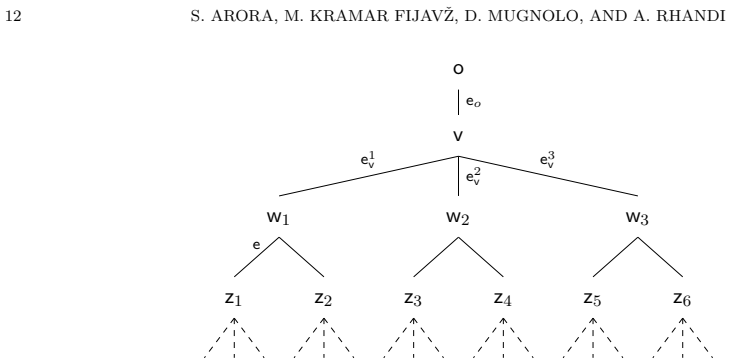
On rooted metric trees with Gaussian-type measure the Ornstein-Uhlenbeck operator admits Dirichlet and Neumann realizations via closed forms. The Neumann semigroup is Markovian and admits the Gaussian measure as unique invariant measure up to scalar multiples. The resolvent is compact with linear eigenvalue asymptotics. For regular rooted trees the Naimark-Solomyak decomposition extends to the Gaussian-weighted setting and reduces the spectral problem to half-line operators, giving localisation and lower bounds.
What carries the argument
Naimark-Solomyak decomposition adapted to the Gaussian-weighted setting on regular rooted trees, which reduces the operator to one-dimensional half-line problems.
If this is right
- The Neumann semigroup is Markovian and admits the Gaussian measure as unique invariant up to scalars.
- Both semigroups are symmetric, analytic and positivity preserving.
- The resolvent is compact and eigenvalues obey linear asymptotics.
- On regular trees the spectrum localises with explicit lower bounds after reduction to half-line problems.
Where Pith is reading between the lines
- The same form construction may extend to irregular trees provided the forms remain closable.
- Numerical spectral computations on large regular trees could be replaced by solving the reduced one-dimensional problems.
- The reduction suggests that branching diffusion models on trees inherit their long-time behaviour from effective half-line diffusions.
Load-bearing premise
Rooted metric trees with Gaussian-type measure allow closed quadratic forms for the Dirichlet and Neumann realizations and permit the Naimark-Solomyak decomposition to extend after weighting on regular trees.
What would settle it
An explicit computation showing that the Neumann semigroup fails to preserve the total mass with respect to the Gaussian measure would disprove the Markovian and invariance claims.
Figures
read the original abstract
We study Ornstein--Uhlenbeck operators on rooted metric trees equipped with a Gaussian-type measure. Using form methods, we construct Dirichlet and Neumann realisations corresponding, respectively, to killing and reflection at the root. The associated semigroups are symmetric, analytic and positivity preserving; the Dirichlet semigroup is sub-Markovian, while the Neumann semigroup is Markovian and admits the Gaussian measure as its unique invariant measure up to scalar multiples. We prove compactness of the resolvent and derive linear eigenvalue asymptotics. For regular rooted trees, we adapt the Naimark--Solomyak decomposition to the Gaussian weighted setting, reducing the operators to one-dimensional half-line problems and obtaining refined spectral localisation and lower bounds.
Editorial analysis
A structured set of objections, weighed in public.
Referee Report
Summary. The manuscript constructs Ornstein-Uhlenbeck operators on rooted metric trees equipped with Gaussian-type measures via quadratic form methods, yielding Dirichlet (killing at root) and Neumann (reflection at root) realizations. The associated semigroups are shown to be symmetric, analytic, and positivity-preserving; the Dirichlet semigroup is sub-Markovian while the Neumann semigroup is Markovian with the Gaussian measure as its unique (up to scalars) invariant measure. Compactness of the resolvent and linear eigenvalue asymptotics are established. For regular rooted trees the Naimark-Solomyak decomposition is adapted to the weighted setting, reducing the spectral problem to one-dimensional half-line operators and furnishing refined localization and lower bounds.
Significance. If the constructions and reductions hold, the work extends classical Ornstein-Uhlenbeck theory from Euclidean space to metric trees, a setting relevant to branching diffusions and network models. The verification of closability and locality for the weighted forms together with the adaptation of the Naimark-Solomyak technique supplies a concrete spectral-reduction method that yields explicit half-line problems; this is a clear technical contribution.
minor comments (3)
- The abstract states that the Neumann semigroup admits the Gaussian measure as unique invariant measure 'up to scalar multiples,' but the precise normalization and the argument establishing uniqueness (e.g., via ergodicity or Poincaré inequality) should be cross-referenced to the relevant theorem in the main text.
- Notation for the Gaussian-type measure (density, variance parameter) is introduced in the abstract but would benefit from an explicit display equation early in the introduction to fix constants before the form-method constructions begin.
- The claim of 'linear eigenvalue asymptotics' is stated without the leading coefficient or the precise asymptotic regime; a short remark indicating where the constant is computed would improve readability.
Simulated Author's Rebuttal
We thank the referee for the careful summary of our manuscript, the positive assessment of its significance, and the recommendation of minor revision. No major comments appear in the report.
Circularity Check
No significant circularity identified
full rationale
The paper's derivation applies standard form methods to construct Dirichlet and Neumann realizations on rooted metric trees with Gaussian-type measures, verifies closability, locality, symmetry, analyticity, positivity preservation, sub-Markovian/Markovian properties, uniqueness of the invariant measure, resolvent compactness, and eigenvalue asymptotics. For regular trees it adapts the known Naimark-Solomyak decomposition to the weighted setting to reduce to half-line operators. These are independent verifications and extensions of external techniques to a new geometric setting; no step reduces by definition or self-citation to the paper's own fitted outputs or premises, and the central claims remain externally falsifiable via the cited functional-analytic tools.
Axiom & Free-Parameter Ledger
axioms (2)
- standard math Standard properties of closed symmetric forms on Hilbert spaces allow construction of self-adjoint realizations and associated semigroups
- domain assumption The Naimark-Solomyak decomposition extends to the Gaussian weighted setting on regular rooted trees
Reference graph
Works this paper leans on
-
[1]
Larbi Alili, Pierre Patie, and Jesper L. Pedersen. Representations of the first hitting time density of an Ornstein-Uhlenbeck process.Stoch. Models, 21(4):967–980, 2005.doi:10.1080/15326340500294702
-
[2]
Wolfgang Arendt and Alexander V. Bukhvalov. Integral representations of resolvents and semigroups.Forum Math., 6:111–135, 1994.doi:10.1515/form.1994.6.111
-
[3]
Gregory Berkolaiko and Peter Kuchment.Introduction to Quantum Graphs, volume 186 ofMath. Surveys and Monographs. Amer. Math. Soc., Providence, RI, 2013.doi:10.1090/surv/186
-
[4]
Nonclassical Sturm-Liouville problems and Schr¨ odinger operators on radial trees.Electron
Robert Carlson. Nonclassical Sturm-Liouville problems and Schr¨ odinger operators on radial trees.Electron. J. Differ. Equ., 2000:24, 2000. Id/No 71. URL:https://eudml.org/doc/120929
2000
-
[5]
ORNSTEIN-UHLENBECK ON TREES 25
Masatoshi Fukushima, Yoichi Oshima, and Masayoshi Takeda.Dirichlet forms and symmetric Markov pro- cesses, volume 19 ofStudies in Math.De Gruyter, Berlin, 2010.doi:10.1515/9783110889741. ORNSTEIN-UHLENBECK ON TREES 25
-
[6]
A new proof of Doob’s theorem.J
Moritz Gerlach and Robin Nittka. A new proof of Doob’s theorem.J. Math. Anal. Appl., 388:763–774, 2012. doi:10.1016/j.jmaa.2011.09.070
-
[7]
Birkh¨ auser, Cham, 2023.doi:10.1007/978-3-662-67872-5
Pavel Kurasov.Spectral Geometry of Graphs, volume 293 ofOperator Theory: Advances and Applications. Birkh¨ auser, Cham, 2023.doi:10.1007/978-3-662-67872-5
-
[8]
Luca Lorenzi.Analytical methods for Kolmogorov equations. Monogr. Res. Notes Math. Boca Raton, FL: CRC Press, 2nd edition of the book previously published under the title ‘Analytical methods for Markov semigroups’ edition, 2017.doi:10.1201/9781315372938
-
[9]
On the Ornstein-Uhlenbeck operator inL 2 spaces with respect to invariant measures
Alessandra Lunardi. On the Ornstein-Uhlenbeck operator inL 2 spaces with respect to invariant measures. Trans. Am. Math. Soc., 349(1):155–169, 1997.doi:10.1090/S0002-9947-97-01802-3
-
[10]
Spectrum of Ornstein-Uhlenbeck operators inL p spaces with respect to invariant measures.J
Giorgio Metafune, Diego Pallara, and Enrico Priola. Spectrum of Ornstein-Uhlenbeck operators inL p spaces with respect to invariant measures.J. Funct. Anal., 196(1):40–60, 2002.doi:10.1006/jfan.2002.3978
-
[11]
The domain of the Ornstein- Uhlenbeck operator on anL p-space with invariant measure.Annal
Giorgio Metafune, Jan Pr¨ uss, Abdelaziz Rhandi, and Roland Schnaubelt. The domain of the Ornstein- Uhlenbeck operator on anL p-space with invariant measure.Annal. Scuola Norm. Sup. Pisa, 5(1):471–485,
-
[12]
URL:https://eudml.org/doc/84478
-
[13]
What is actually a metric graph? Preprint.arXiv:1912.07549v2
Delio Mugnolo. What is actually a metric graph? Preprint.arXiv:1912.07549v2
-
[14]
Vector-valued heat equations and networks with coupled dynamic boundary conditions.Adv
Delio Mugnolo. Vector-valued heat equations and networks with coupled dynamic boundary conditions.Adv. Differ. Equ., 15(11-12):1125–1160, 2010.doi:10.57262/ade/1355854437
-
[15]
Delio Mugnolo.Semigroup Methods for Evolution Equations on Networks. Underst. Compl. Syst. Springer- Verlag, Berlin, 2014.doi:10.1007/978-3-319-04621-1
-
[16]
Delio Mugnolo and Abdelaziz Rhandi. Ornstein–Uhlenbeck semigroups on star graphs.Discrete and Contin- uous Dynamical Systems - S, 15:3765–3779, 2022.doi:10.3934/dcdss.2022030
-
[17]
Dynamic and generalized Wentzell node conditions for network equa- tions.Math
Delio Mugnolo and Silvia Romanelli. Dynamic and generalized Wentzell node conditions for network equa- tions.Math. Methods Appl. Sci., 30(6):681–706, 2007.doi:10.1002/mma.805
-
[18]
Cham: Springer, 1986.doi:10.1007/BFb0074922
Rainer Nagel, editor.One-parameter semigroups of positive operators, volume 1184 ofLecture Notes in Math- ematics. Cham: Springer, 1986.doi:10.1007/BFb0074922
-
[19]
Eigenvalue estimates for the weighted Laplacian on metric trees
Katherine Naimark and Michael Solomyak. Eigenvalue estimates for the weighted Laplacian on metric trees. Proc. Lond. Math. Soc. (3), 80(3):690–724, 2000.doi:10.1112/S0024611500012272
-
[20]
Geometry of Sobolev spaces on regular trees and the Hardy inequalities.Russ
Katherine Naimark and Michael Solomyak. Geometry of Sobolev spaces on regular trees and the Hardy inequalities.Russ. J. Math. Phys., 8(3):322–335, 2001
2001
-
[21]
Princeton, NJ: Princeton University Press, 2005.doi:10.1515/9781400826483
El Maati Ouhabaz.Analysis of heat equations on domains, volume 31. Princeton, NJ: Princeton University Press, 2005.doi:10.1515/9781400826483
-
[22]
Alexander V. Sobolev and Michael Solomyak. Schr¨ odinger operators on homogeneous metric trees: spectrum in gaps.Rev. Math. Phys., 14(5):421–467, 2002.doi:10.1142/S0129055X02001235
-
[23]
Michael Solomyak. On the spectrum of the Laplacian on regular metric trees.Waves Random Media, 14(1):s155–s171, 2004.doi:10.1088/0959-7174/14/1/017
-
[24]
[BS05] Pieter Blue and Avy Soffer
Hendrik Vogt and J¨ urgen Voigt. Wentzell boundary conditions in the context of Dirichlet forms.Adv. Diff. Equ., 8:821–842, 2003.doi:10.57262/ade/1355926813. Sahiba Arora, Leibniz Universit¨at Hannover, Institut f¨ur Analysis, Welfengarten 1, 30167 Han- nover, Germany Email address:sahiba.arora@math.uni-hannover.de Marjeta Kramar Fijavˇz, Faculty of Civil...
discussion (0)
Sign in with ORCID, Apple, or X to comment. Anyone can read and Pith papers without signing in.