When Distortion Helps: Secure GNN Precoding with Nonlinear Power Amplifiers
Pith reviewed 2026-06-26 07:05 UTC · model grok-4.3
The pith
Nonlinear power amplifier distortion can be redirected to eavesdroppers to raise secrecy rates in multi-user MISO wiretap channels.
A machine-rendered reading of the paper's core claim, the machinery that carries it, and where it could break.
Core claim
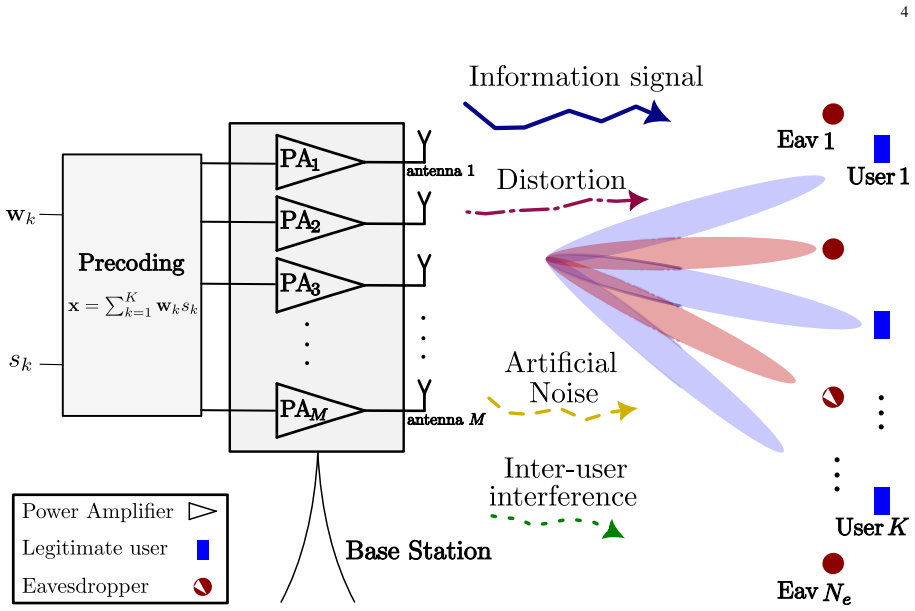
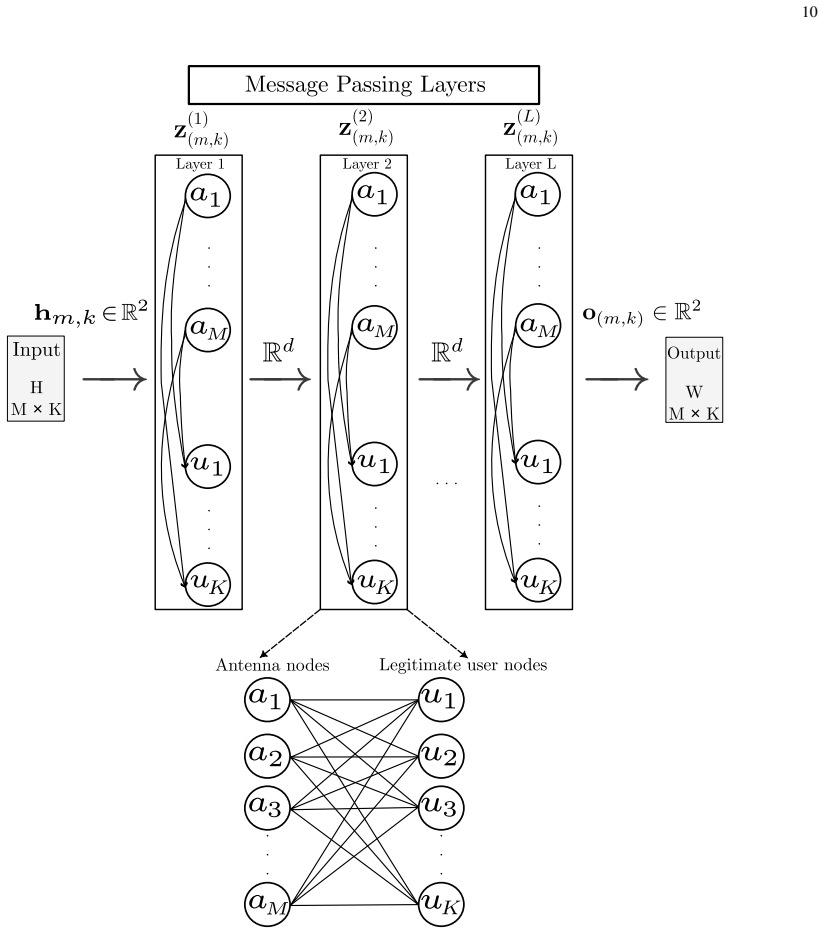
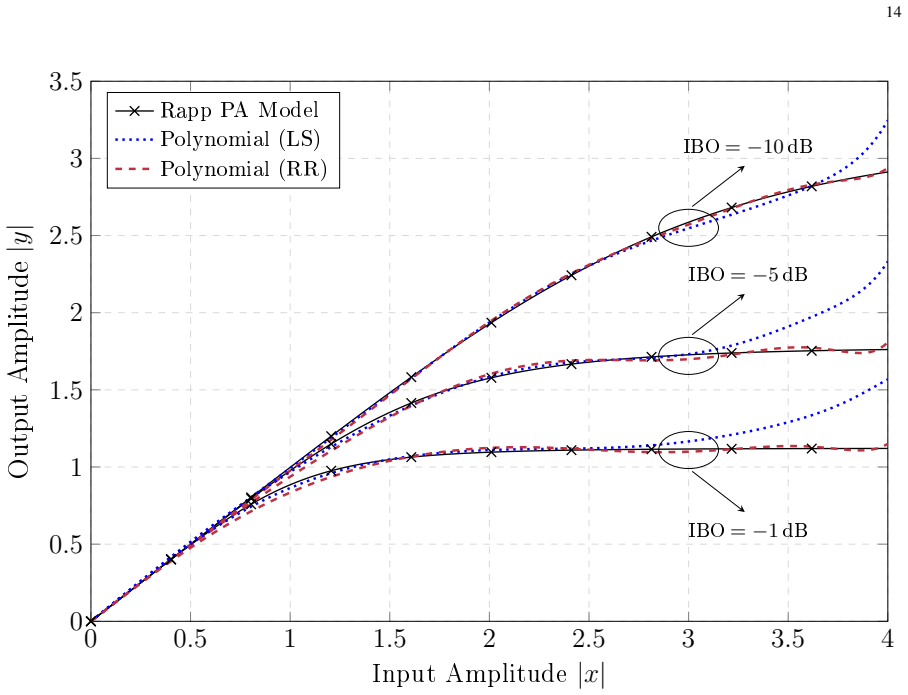
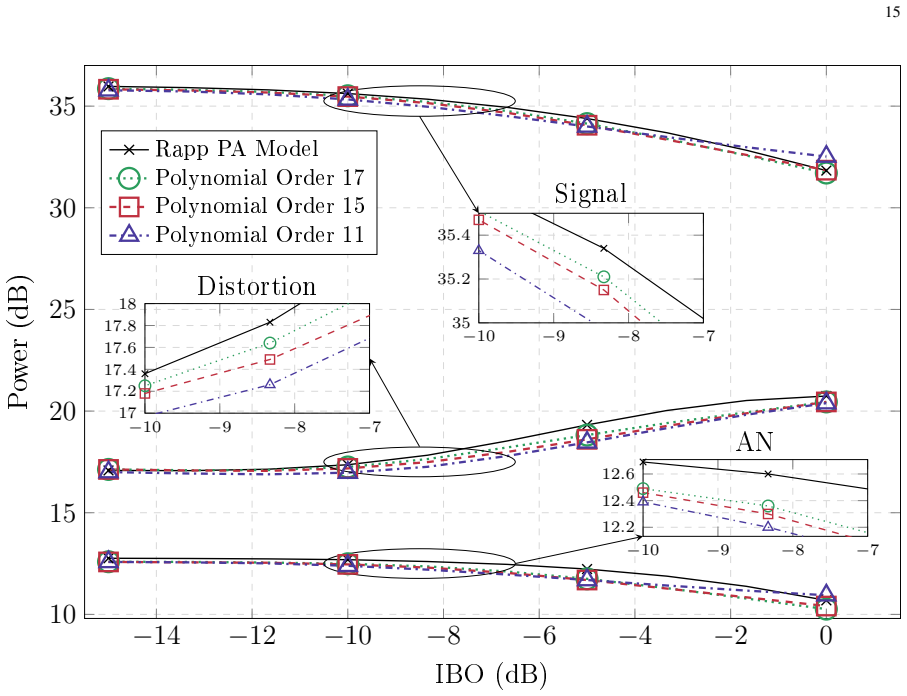
A graph neural network can learn precoding vectors that exploit PA nonlinearity to achieve higher sum secrecy rates in multi-user MISO wiretap channels without eavesdropper channel state information, by training directly on an analytical secrecy rate derived from the Bussgang decomposition and a high-order polynomial power amplifier model.
What carries the argument
GNN precoder trained solely on legitimate user channels, with Bussgang-derived analytical secrecy rate serving as the training objective to redirect nonlinear distortion toward eavesdroppers.
If this is right
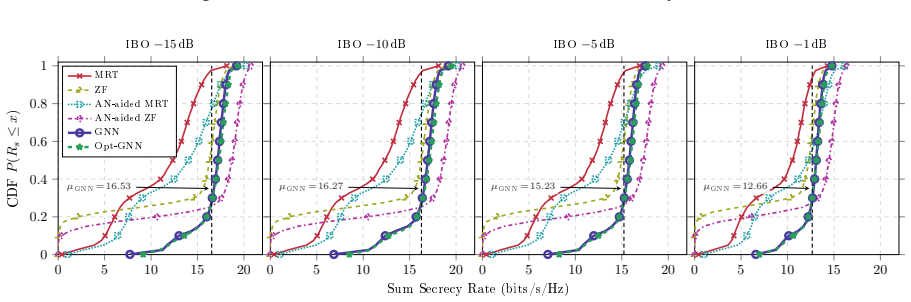
- The GNN delivers 39.89 percent and 35.26 percent higher sum secrecy rate than MRT and ZF at 22 dB SNR under IBO = -1 dB.
- It also outperforms AN-aided MRT and ZF by 17.99 percent and 8.67 percent under the same conditions.
- Performance variance drops by 58.13 to 75.31 percent relative to all listed baselines.
- No eavesdropper CSI or dedicated artificial noise power allocation is required.
Where Pith is reading between the lines
- The same principle could be tested on other hardware nonlinearities such as phase noise or quantization to see whether they likewise become security assets when properly shaped.
- The approach might extend to multi-antenna eavesdroppers or frequency-selective channels if the analytical rate expression can be generalized.
- Hardware designers could explore deliberately operating PAs closer to saturation when secrecy is the primary goal rather than always backing off for linearity.
Load-bearing premise
The Bussgang decomposition together with the chosen polynomial PA model produces a closed-form secrecy rate expression reliable enough to train the network without any eavesdropper channel data.
What would settle it
Running end-to-end Monte Carlo simulations of the actual nonlinear PA output using the learned precoders and comparing the resulting empirical secrecy rates to the analytical values used during training.
Figures
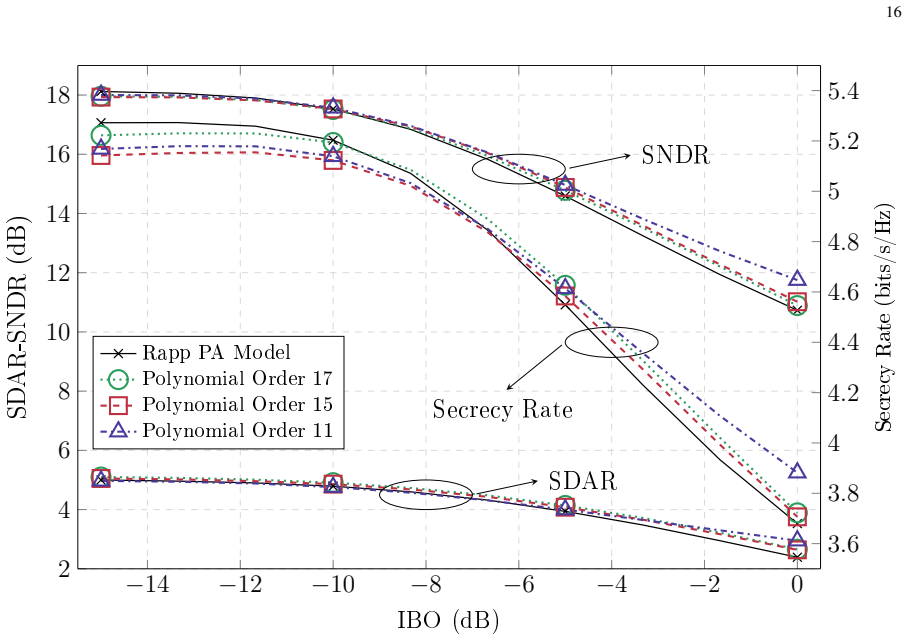
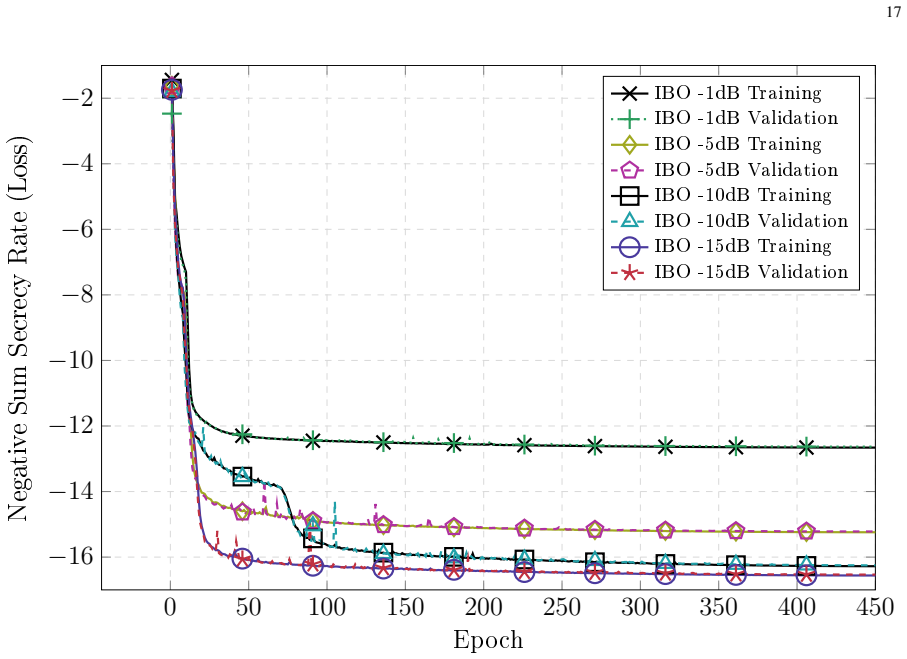
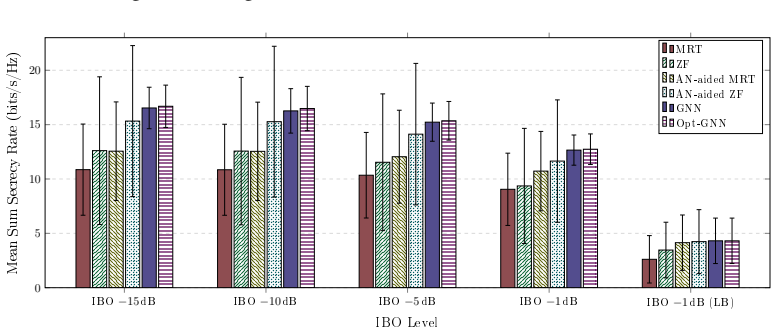
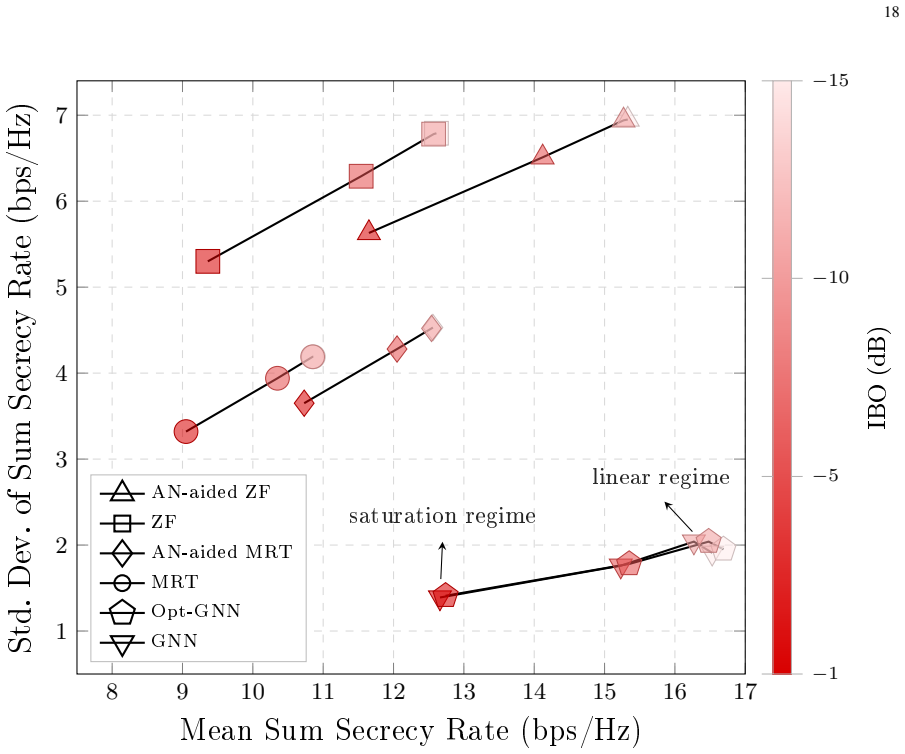
read the original abstract
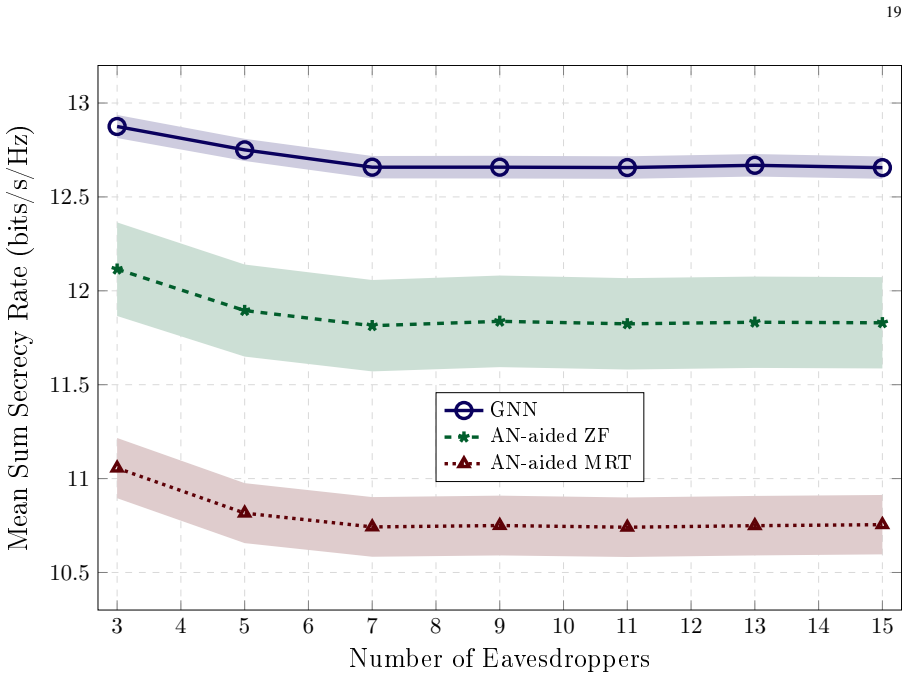
Physical layer security (PLS) provides information-theoretic protection against eavesdropping. While existing techniques assume ideal linear transmitters, power amplifiers (PAs) in practice introduce nonlinear distortion, typically considered detrimental to signal quality. This paper demonstrates that such distortion can instead be exploited as a security asset by redirecting it toward eavesdroppers, particularly in the power-efficient PA saturation regime. To this end, we propose a graph neural network (GNN)-based precoding framework for multi-user multiple-input single-output (MISO) wiretap channels that maximizes the sum secrecy rate by exploiting PA nonlinearity. Since the resulting optimization is highly non-convex, classical methods are intractable. The GNN instead learns precoding strategies directly from legitimate users' channel data, requiring neither eavesdropper channel state information (CSI) nor dedicated artificial noise (AN) power allocation. For this, the Bussgang decomposition and a high-order polynomial PA model provide an analytical secrecy rate as the training objective. At 22 dB signal-to-noise ratio (SNR) under severe PA saturation with input back-off (IBO) $= -1$ dB, the proposed GNN achieves 39.89% and 35.26% higher sum secrecy rate over maximum ratio transmission (MRT) and zero-forcing (ZF), respectively, 17.99% over AN-aided MRT and 8.67% over AN-aided ZF, with 58.13-75.31% lower standard deviation across all baselines.
Editorial analysis
A structured set of objections, weighed in public.
Referee Report
Summary. The paper proposes a GNN-based precoding framework for multi-user MISO wiretap channels that exploits nonlinear distortion from power amplifiers (PAs) to enhance physical layer security. It employs the Bussgang decomposition together with a high-order polynomial PA model to obtain an analytical sum secrecy rate expression used as the GNN training objective, enabling optimization from legitimate-user channels alone without eavesdropper CSI or dedicated artificial noise. At 22 dB SNR with IBO = -1 dB, the GNN is reported to achieve 39.89% and 35.26% higher sum secrecy rate than MRT and ZF, respectively, and 17.99% and 8.67% higher than AN-aided MRT and ZF, with substantially lower variance.
Significance. If the analytical secrecy-rate expression is valid and independent of eavesdropper CSI, the work is significant for showing that PA nonlinearity can be turned into a security asset rather than a liability and for offering a practical, CSI-light GNN solution to a non-convex secure-precoding problem. The reported gains and variance reduction are quantitatively substantial; the approach of learning precoders solely from legitimate channels addresses a key deployment obstacle in PLS.
major comments (2)
- [Secrecy-rate derivation (Bussgang + polynomial model section)] The central claim that training requires only legitimate-user channels H rests on the Bussgang-derived secrecy-rate expression being closed-form and independent of the eavesdropper channel. The manuscript must explicitly display this expression (including the term that would normally be R_eve) and demonstrate that it contains no eavesdropper dependence or that any bound employed is tight and justified under the chosen polynomial model; otherwise the “no eavesdropper CSI” guarantee for both training and the reported performance numbers cannot be assessed.
- [Numerical results and simulation setup] The numerical claims at 22 dB SNR / IBO = -1 dB (39.89 % over MRT, etc.) are load-bearing. The text supplies no derivation details for the training objective, no validation of the closed-form rate against end-to-end nonlinear PA simulation, no error bars, and no statement on whether PA-model coefficients were fitted to the same data used for evaluation; these omissions prevent verification that the gains are not artifacts of the modeling assumptions.
minor comments (2)
- [Abstract] The abstract states “high-order polynomial PA model” without specifying the polynomial degree; this information is needed for reproducibility and should appear in the system-model section.
- [Figures] Figure captions and axis labels should explicitly state whether the plotted secrecy rates are obtained from the analytical expression or from Monte-Carlo simulation with the full nonlinear PA.
Simulated Author's Rebuttal
We thank the referee for the thorough review and constructive feedback on our work exploiting PA nonlinearity for secure GNN precoding. We address each major comment below, providing clarifications and committing to revisions where needed to strengthen the manuscript.
read point-by-point responses
-
Referee: [Secrecy-rate derivation (Bussgang + polynomial model section)] The central claim that training requires only legitimate-user channels H rests on the Bussgang-derived secrecy-rate expression being closed-form and independent of the eavesdropper channel. The manuscript must explicitly display this expression (including the term that would normally be R_eve) and demonstrate that it contains no eavesdropper dependence or that any bound employed is tight and justified under the chosen polynomial model; otherwise the “no eavesdropper CSI” guarantee for both training and the reported performance numbers cannot be assessed.
Authors: We agree that explicit display of the expression is required for full assessment. Section III derives the sum secrecy rate via Bussgang decomposition applied to the high-order polynomial PA model, yielding effective gain α and distortion variance σ_d^{2} at the legitimate receivers. The resulting closed-form expression for the training objective replaces the standard R_eve term with an upper bound on mutual information to the eavesdropper that depends solely on the PA coefficients, total power, and precoder (via the induced distortion statistics), with no dependence on the eavesdropper channel matrix. This bound is tight under the polynomial model because the nonlinearity creates irreducible distortion noise that scales with the signal amplitude and cannot be equalized by the eavesdropper. To address the comment directly, we will revise the manuscript to display the full expression (including the bounded R_eve term) with a dedicated paragraph proving its independence from eavesdropper CSI. revision: yes
-
Referee: [Numerical results and simulation setup] The numerical claims at 22 dB SNR / IBO = -1 dB (39.89 % over MRT, etc.) are load-bearing. The text supplies no derivation details for the training objective, no validation of the closed-form rate against end-to-end nonlinear PA simulation, no error bars, and no statement on whether PA-model coefficients were fitted to the same data used for evaluation; these omissions prevent verification that the gains are not artifacts of the modeling assumptions.
Authors: We acknowledge these omissions limit verifiability. The training objective is exactly the closed-form Bussgang-derived secrecy rate from Section III. In the revision we will add: (1) the step-by-step derivation of the objective from the polynomial model, (2) a direct numerical validation comparing the closed-form rate to Monte-Carlo end-to-end simulations with the nonlinear PA, (3) error bars (standard deviation over 1000 independent channel realizations) for all reported curves, and (4) an explicit statement that PA coefficients are taken from the standard Rapp model in the literature and were not fitted to any evaluation data. These additions will confirm that the 39.89 % / 35.26 % gains and variance reductions at 22 dB / IBO = -1 dB are not modeling artifacts. revision: yes
Circularity Check
No circularity detected; derivation relies on standard external techniques
full rationale
The paper states that Bussgang decomposition combined with a high-order polynomial PA model yields an analytical secrecy rate expression used as the GNN training objective, learned solely from legitimate-user channels. No equations, self-citations, or parameter-fitting steps are quoted that reduce any claimed prediction or result to its own inputs by construction. The approach treats the PA model and decomposition as given external tools to produce the objective function, with reported performance gains presented as outcomes of GNN optimization rather than tautological re-statements of fitted values. This is a self-contained derivation chain with no load-bearing self-referential elements.
Axiom & Free-Parameter Ledger
axioms (1)
- domain assumption Bussgang decomposition provides a usable analytical expression for secrecy rate under the polynomial PA model
Reference graph
Works this paper leans on
-
[1]
Wireless Physical Layer Security,
H. V . Poor and R. F. Schaefer, “Wireless Physical Layer Security,”Proc. Nat. Acad. Sci., vol. 114, no. 1, pp. 19–26, 2017
2017
-
[2]
The Wire-Tap Channel,
A. D. Wyner, “The Wire-Tap Channel,”Bell Syst. Tech. J., vol. 54, no. 8, pp. 1355–1387, 1975
1975
-
[3]
Broadcast Channels with Confidential Messages,
I. Csiszar and J. Korner, “Broadcast Channels with Confidential Messages,”IEEE Trans. Inf. Theory, vol. 24, no. 3, pp. 339–348, 1978
1978
-
[4]
Framework and Overall Objectives of the Future Development of IMT for 2030 and Beyond,
ITU-R, “Framework and Overall Objectives of the Future Development of IMT for 2030 and Beyond,” International Telecommunication Union, Recommendation M.2160-0, 2023
2030
-
[5]
Physical Layer Security for 6G: Toward Achieving Intelligent Native Security at Layer-1,
I. Ara and B. Kelley, “Physical Layer Security for 6G: Toward Achieving Intelligent Native Security at Layer-1,” IEEE Access, vol. 12, pp. 82 800–82 824, 2024
2024
-
[6]
A Note on the Secrecy Capacity of the Multiple-Antenna Wiretap Channel,
T. Liu and S. Shamai, “A Note on the Secrecy Capacity of the Multiple-Antenna Wiretap Channel,”IEEE Trans. Inf. Theory, vol. 55, no. 6, pp. 2547–2553, 2009. 20
2009
-
[7]
Secure Transmission with Multiple Antennas I: The MISOME Wiretap Channel,
A. Khisti and G. W. Wornell, “Secure Transmission with Multiple Antennas I: The MISOME Wiretap Channel,” IEEE Trans. Inf. Theory, vol. 56, no. 7, pp. 3088–3104, 2010
2010
-
[8]
Antenna Subset Modulation for Secure Millimeter-Wave Wireless Communication,
N. Valliappan, A. Lozano, and R. W. Heath, “Antenna Subset Modulation for Secure Millimeter-Wave Wireless Communication,”IEEE Trans. Commun., vol. 61, no. 8, pp. 3231–3245, 2013
2013
-
[9]
MIMO Beamforming for Secure and Energy-Efficient Wireless Communication,
N. T. Nguyen, H. D. Tuan, T. Q. Duong, and H. V . Poor, “MIMO Beamforming for Secure and Energy-Efficient Wireless Communication,”IEEE Signal Process. Lett., vol. 24, no. 2, pp. 236–239, 2017
2017
-
[10]
LDPC Codes for the Gaussian Wiretap Channel,
D. Klinc, J. Ha, S. W. McLaughlin, J. Barros, and B.-J. Kwak, “LDPC Codes for the Gaussian Wiretap Channel,” IEEE Trans. Inf. Forensics Security, vol. 6, no. 3, pp. 532–540, 2011
2011
-
[11]
Polar Coding for the General Wiretap Channel With Extensions to Multiuser Scenarios,
Y .-P. Wei and S. Ulukus, “Polar Coding for the General Wiretap Channel With Extensions to Multiuser Scenarios,” IEEE J. Sel. Areas Commun., vol. 34, no. 2, pp. 278–291, 2016
2016
-
[12]
Lattice Codes for the Wiretap Gaussian Channel: Construction and Analysis,
F. Oggier and P. Solé, “Lattice Codes for the Wiretap Gaussian Channel: Construction and Analysis,”IEEE Trans. Inf. Theory, vol. 62, no. 10, pp. 5690–5708, 2016
2016
-
[13]
Secret Key Agreement by Public Discussion from Common Information,
U. M. Maurer, “Secret Key Agreement by Public Discussion from Common Information,”IEEE Trans. Inf. Theory, vol. 39, no. 3, pp. 733–742, 1993
1993
-
[14]
CSI-Based Versus RSS-Based Secret Key Generation Under Correlated Eavesdropping,
F. Rottenberg, T.-H. Nguyen, J.-M. Dricot, F. Horlin, and J. Louveaux, “CSI-Based Versus RSS-Based Secret Key Generation Under Correlated Eavesdropping,”IEEE Trans. Commun., vol. 69, no. 3, pp. 1868–1881, 2021
2021
-
[15]
A Survey of Physical Layer Security Techniques for 5G Wireless Networks and Challenges Ahead,
Y . Wu, A. Khisti, C. Xiao, G. Caire, K.-K. Wong, and X. Gao, “A Survey of Physical Layer Security Techniques for 5G Wireless Networks and Challenges Ahead,”IEEE J. Sel. Areas Commun., vol. 36, no. 4, pp. 679–695, 2018
2018
-
[16]
Guaranteeing Secrecy Using Artificial Noise,
S. Goel and R. Negi, “Guaranteeing Secrecy Using Artificial Noise,”IEEE Trans. Wireless Commun., vol. 7, no. 6, pp. 2180–2189, 2008
2008
-
[17]
Secret Communication Using Artificial Noise,
R. Negi and S. Goel, “Secret Communication Using Artificial Noise,” inProc. IEEE Veh. Technol. Conf. (VTC), 2005, pp. 1906–1910
2005
-
[18]
Secure Transmission With Artificial Noise Over Fading Channels: Achievable Rate and Optimal Power Allocation,
X. Zhou and M. R. McKay, “Secure Transmission With Artificial Noise Over Fading Channels: Achievable Rate and Optimal Power Allocation,”IEEE Trans. Veh. Technol., vol. 59, no. 8, pp. 3831–3842, 2010
2010
-
[19]
Solutions for the MIMO Gaussian Wiretap Channel with a Cooperative Jammer,
S. A. A. Fakoorian and A. L. Swindlehurst, “Solutions for the MIMO Gaussian Wiretap Channel with a Cooperative Jammer,”IEEE Trans. Signal Process., vol. 59, no. 10, pp. 5013–5022, 2011
2011
-
[20]
Linear Precoding of Data and Artificial Noise in Secure Massive MIMO Systems,
J. Zhu, R. Schober, and V . K. Bhargava, “Linear Precoding of Data and Artificial Noise in Secure Massive MIMO Systems,”IEEE Trans. Wireless Commun., vol. 15, no. 3, pp. 2245–2261, 2016
2016
-
[21]
Secure Transmission in Cell-Free Massive MIMO Under Active Eavesdropping,
Y . S. Atiya, Z. Mobini, H. Q. Ngo, and M. Matthaiou, “Secure Transmission in Cell-Free Massive MIMO Under Active Eavesdropping,”IEEE Trans. Wireless Commun., vol. 23, no. 12, pp. 18 036–18 052, 2024
2024
-
[22]
Effects of HPA-Nonlinearity on a 4-DPSK/OFDM-Signal for a Digital Sound Broadcasting System,
C. Rapp, “Effects of HPA-Nonlinearity on a 4-DPSK/OFDM-Signal for a Digital Sound Broadcasting System,” in Proceedings of the Second European Conference on Satellite Communications, 1991, pp. 179–184
1991
-
[23]
Schenk,RF Imperfections in High-rate Wireless Systems: Impact and Digital Compensation
T. Schenk,RF Imperfections in High-rate Wireless Systems: Impact and Digital Compensation. Springer, 2008
2008
-
[24]
Distortion-Aware Linear Precoding for Millimeter-Wave Multiuser MISO Downlink,
S. R. Aghdam, S. Jacobsson, and T. Eriksson, “Distortion-Aware Linear Precoding for Millimeter-Wave Multiuser MISO Downlink,” inProc. IEEE Int. Conf. Commun. (ICC), 2019, pp. 1–6
2019
-
[25]
S. R. Aghdam, S. Jacobsson, U. Gustavsson, G. Durisi, C. Studer, and T. Eriksson, “Distortion-Aware Linear Pre- coding for Massive MIMO Downlink Systems with Nonlinear Power Amplifiers,”arXiv preprint arXiv:2012.13337, 2020
-
[26]
On the Energy Efficiency of MIMO Hybrid Beam- forming for Millimeter-Wave Systems with Nonlinear Power Amplifiers,
N. N. Moghadam, G. Fodor, M. Bengtsson, and D. J. Love, “On the Energy Efficiency of MIMO Hybrid Beam- forming for Millimeter-Wave Systems with Nonlinear Power Amplifiers,”IEEE Trans. Wireless Commun., vol. 17, no. 11, pp. 7208–7221, 2018
2018
-
[27]
Power Allocation for Distributed Massive LoS MIMO with Nonlinear Power Amplifiers,
B. Liu, F. Rottenberg, and S. Pollin, “Power Allocation for Distributed Massive LoS MIMO with Nonlinear Power Amplifiers,” inProc. IEEE Veh. Technol. Conf. (VTC-Fall), 2022, pp. 1–5
2022
-
[28]
Massive MIMO Systems with Non-Ideal Hardware: Energy Efficiency, Estimation, and Capacity Limits,
E. Björnson, J. Hoydis, M. Kountouris, and M. Debbah, “Massive MIMO Systems with Non-Ideal Hardware: Energy Efficiency, Estimation, and Capacity Limits,”IEEE Trans. Inf. Theory, vol. 60, no. 11, pp. 7112–7139, 2014
2014
-
[29]
Hardware Distortion Correlation Has Negligible Impact on UL Massive MIMO Spectral Efficiency,
E. Björnson, L. Sanguinetti, and J. Hoydis, “Hardware Distortion Correlation Has Negligible Impact on UL Massive MIMO Spectral Efficiency,”IEEE Trans. Commun., vol. 67, no. 2, pp. 1085–1098, 2019
2019
-
[30]
Z3RO Precoder Canceling Nonlinear Power Amplifier Distortion in Large Array Systems,
F. Rottenberg, G. Callebaut, and L. Van der Perre, “Z3RO Precoder Canceling Nonlinear Power Amplifier Distortion in Large Array Systems,” inProc. IEEE Int. Conf. Commun. (ICC), 2022, pp. 432–437
2022
-
[31]
The Z3RO Family of Precoders Cancelling Nonlinear Power Amplification Distortion in Large Array Systems,
F. Rottenberg, G. Callebaut, and L. Van der Perre, “The Z3RO Family of Precoders Cancelling Nonlinear Power Amplification Distortion in Large Array Systems,”IEEE Trans. Wireless Commun., vol. 22, no. 3, pp. 2036–2047, 2023
2036
-
[32]
Measurement-Based Validation of Z3RO Precoder to Prevent Nonlinear Amplifier Distortion in Massive MIMO Systems,
T. Feys, G. Callebaut, L. Van der Perre, and F. Rottenberg, “Measurement-Based Validation of Z3RO Precoder to Prevent Nonlinear Amplifier Distortion in Massive MIMO Systems,” inProc. IEEE Veh. Technol. Conf. (VTC- Spring), 2022, pp. 1–5
2022
-
[33]
Analysis and Design of Secure Massive MIMO Systems in the Presence of Hardware Impairments,
J. Zhu, D. W. K. Ng, N. Wang, R. Schober, and V . K. Bhargava, “Analysis and Design of Secure Massive MIMO Systems in the Presence of Hardware Impairments,”IEEE Trans. Wireless Commun., vol. 16, no. 3, pp. 2001–2016, 2017
2001
-
[34]
Secure Communications Over Cell-Free Massive MIMO Networks with Hardware Impairments,
X. Zhang, D. Guo, K. An, and B. Zhang, “Secure Communications Over Cell-Free Massive MIMO Networks with Hardware Impairments,”IEEE Syst. J., vol. 14, no. 2, pp. 1909–1920, 2020
1909
-
[35]
Impact of Hardware Impairments on Physical Layer Security of Cell-Free Massive MIMO,
A. Tahreem, D. Tubail, and S. Ikki, “Impact of Hardware Impairments on Physical Layer Security of Cell-Free Massive MIMO,” inProc. IEEE Can. Conf. Elect. Comput. Eng. (CCECE), 2024, pp. 246–251
2024
-
[36]
Security Capacity by Nonlinear Transmission in MIMO Systems for Physical Layer Security,
M. Li, J. Wang, B.-Z. Shen, and Y . Zhou, “Security Capacity by Nonlinear Transmission in MIMO Systems for Physical Layer Security,”Wireless Pers. Commun., vol. 137, pp. 593–613, 2024
2024
-
[37]
Secrecy Capacity Analysis Using Nonlinear Trans- missions for Physical Layer Security,
J. Wang, Z. Wang, M. Sellathurai, B.-Z. Shen, and Y . Zhou, “Secrecy Capacity Analysis Using Nonlinear Trans- missions for Physical Layer Security,”Wireless Pers. Commun., vol. 136, no. 2, pp. 883–897, 2024. 21
2024
-
[38]
Leveraging Power Amplifier Distortion for Physical Layer Security,
R. Ghasemi Alavicheh, T. Feys, M. A. Rahman, and F. Rottenberg, “Leveraging Power Amplifier Distortion for Physical Layer Security,” inProc. IEEE Int. Symp. Pers., Indoor, Mobile Radio Commun. (PIMRC), 2025, pp. 1–6
2025
-
[39]
The Graph Neural Network Model,
F. Scarselli, M. Gori, A. C. Tsoi, M. Hagenbuchner, and G. Monfardini, “The Graph Neural Network Model,”IEEE Trans. Neural Netw., vol. 20, no. 1, pp. 61–80, 2009
2009
-
[40]
W. L. Hamilton,Graph Representation Learning(Synthesis Lectures on Artificial Intelligence and Machine Learning 3). Morgan & Claypool Publishers, 2020, vol. 14
2020
-
[41]
Relational inductive biases, deep learning, and graph networks
P. W. Battaglia et al., “Relational Inductive Biases, Deep Learning, and Graph Networks,”arXiv preprint arXiv:1806.01261, 2018
work page internal anchor Pith review Pith/arXiv arXiv 2018
-
[42]
Learning Precoding Policy: CNN or GNN?
B. Zhao, J. Guo, and C. Yang, “Learning Precoding Policy: CNN or GNN?” InProc. IEEE Wireless Commun. Netw. Conf. (WCNC), 2022, pp. 1027–1032
2022
-
[43]
Graph Neural Networks for Scalable Radio Resource Management: Architecture Design and Theoretical Analysis,
Y . Shen, Y . Shi, J. Zhang, and K. B. Letaief, “Graph Neural Networks for Scalable Radio Resource Management: Architecture Design and Theoretical Analysis,”IEEE J. Sel. Areas Commun., vol. 39, no. 1, pp. 101–115, 2021
2021
-
[44]
Toward Energy-Efficient Massive MIMO: Graph Neural Network Precoding for Mitigating Non-Linear PA Distortion,
T. Feys, L. Van der Perre, and F. Rottenberg, “Toward Energy-Efficient Massive MIMO: Graph Neural Network Precoding for Mitigating Non-Linear PA Distortion,”IEEE Trans. Cogn. Commun. Netw., vol. 11, no. 1, pp. 184–201, 2025
2025
-
[45]
Learning to Quantize and Precode in Massive MIMO Systems for Energy Reduction: A Graph Neural Network Approach,
T. Feys, L. Van der Perre, and F. Rottenberg, “Learning to Quantize and Precode in Massive MIMO Systems for Energy Reduction: A Graph Neural Network Approach,”IEEE J. Sel. Topics Signal Process., vol. 19, no. 6, pp. 983–998, 2025
2025
-
[46]
Unfolding WMMSE Using Graph Neural Networks for Efficient Power Allocation,
A. Chowdhury, G. Verma, C. Rao, A. Swami, and S. Segarra, “Unfolding WMMSE Using Graph Neural Networks for Efficient Power Allocation,”IEEE Trans. Wireless Commun., vol. 20, no. 9, pp. 6004–6017, 2021
2021
-
[47]
Testbed Evaluation of AI-based Precoding in Distributed MIMO Systems
T. Miao, T. Feys, G. Callebaut, J. Van Mulders, M. A. Rahman, and F. Rottenberg, “Testbed Evaluation of AI-based Precoding in Distributed MIMO Systems,”arXiv preprint arXiv:2511.11251, 2025
work page internal anchor Pith review Pith/arXiv arXiv 2025
-
[48]
Study on Scenarios and Requirements for Next Generation Access Technologies,
3GPP, “Study on Scenarios and Requirements for Next Generation Access Technologies,” 3rd Generation Partnership Project (3GPP), Technical Report TR 38.913 V18.0.0, Mar. 2024
2024
-
[49]
Crosscorrelation Functions of Amplitude-Distorted Gaussian Signals,
J. J. Bussgang, “Crosscorrelation Functions of Amplitude-Distorted Gaussian Signals,”Research Laboratory of Electronics, MIT, vol. 216, pp. 1–14, 1952
1952
-
[50]
Boyd and L
S. Boyd and L. Vandenberghe,Convex Optimization. Cambridge University Press, 2004
2004
-
[51]
Multilayer Feedforward Networks are Universal Approximators,
K. Hornik, M. Stinchcombe, and H. White, “Multilayer Feedforward Networks are Universal Approximators,”Neural Netw., vol. 2, no. 5, pp. 359–366, 1989
1989
-
[52]
Adam: A Method for Stochastic Optimization
D. P. Kingma and J. Ba, “Adam: A Method for Stochastic Optimization,”arXiv preprint arXiv:1412.6980, 2014. APPENDIXA LOSSFUNCTIONANALYSIS WITHMRT This section analyzes a specific case with a single legitimate user and linear PA regime to provide intuition that MRT does not maximize the expected secrecy rateE hE[f(w)], wheref(w) = log 2 (1+ SNRL)/(1 +SNR E...
work page internal anchor Pith review Pith/arXiv arXiv 2014
-
[53]
Evaluating at MRT,A(w MRT) =σ 2 + 1 + cos(2ϕ),B(w MRT) = σ2 + 1− 2 sinϕ π ,∇ wA|MRT = 2 √ 2 cosϕ ejϕ[1, e−jϕ]T , and∇ wB|MRT = √ 2[1 + 2j π ejϕ,− 2j π +e jϕ]T
The expected eavesdropper covariance isE[h EhH E ] = 1 2j/π −2j/π1 , since E[ejθ] = 1 π R π 0 ejθ dθ= 2j/π. Evaluating at MRT,A(w MRT) =σ 2 + 1 + cos(2ϕ),B(w MRT) = σ2 + 1− 2 sinϕ π ,∇ wA|MRT = 2 √ 2 cosϕ ejϕ[1, e−jϕ]T , and∇ wB|MRT = √ 2[1 + 2j π ejϕ,− 2j π +e jϕ]T . The full gradient at MRT is ∇wf(w) MRT ≈ √ 2 2 cosϕ ejϕ[1, e−jϕ]T σ2 + 1 + cos(2ϕ) − [1 ...
discussion (0)
Sign in with ORCID, Apple, or X to comment. Anyone can read and Pith papers without signing in.