REVIEW 29 references
SEROAISE: Advancing ROA Estimation for ReLU and PWA Dynamics through Estimating Certified Invariant Sets
T0 review · reviewed 2026-08-16 · deepseek-v4-flash
Pith's one-line read SEROAISE estimates larger certified regions of attraction for PWA and ReLU dynamical systems by growing a certified invariant set via the NUGIS procedure and then solving a linear program for a Lyapunov-like function on that set.
desk verdict The NUGIS expansion idea is genuinely new, but the IISE certificate is not sound as written: the LP checks the barrier condition on the wrong partition, so the claimed RoA guarantees do not follow. read the letter →
The pith
A machine-rendered reading of the paper's core claim, the machinery that carries it, and where it could break.
The reading
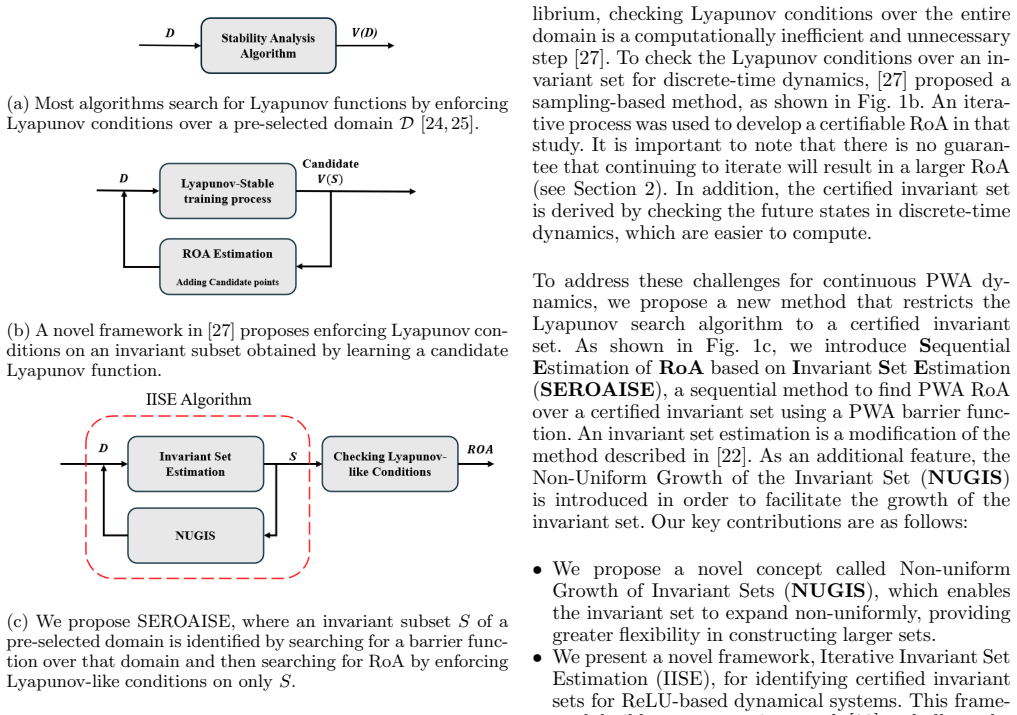
The authors' approach, SEROAISE, has two steps. First, they find a large set of states that is forward invariant: if you start inside, you stay inside. They grow this set iteratively using a new rule called Non-Uniform Growth (NUGIS), which identifies boundary points where the dynamics push inward, and then they solve a linear program to expand the set around those points using barrier functions. Second, on this certified invariant set, they solve another linear program to find a Lyapunov-like function that strictly decreases along trajectories. If such a function exists on the invariant set, then every state in that set converges to the origin, so the set is an inner estimate of the region of attraction.
The paper reports larger estimates than two recent neural-network-based methods on three examples: path following, inverted pendulum, and cart-pole. However, the proof that the linear program actually certifies an invariant set has gaps. The constraints use a smaller slope for states outside the set, and some vertices that end up inside the set are still checked with that weaker slope, so the certificate may not be valid. The growth theorem also assumes away sliding behavior on cell boundaries, which is not stated in the theorem.
Extended reading notes
Core claim
The load-bearing claim is that the IISE algorithm produces certified invariant sets that grow monotonically and are systematically larger than those from the authors' prior work and from state-of-the-art methods, and that SEROAISE then certifies these sets as regions of attraction. The paper states: 'SEROAISE introduces a framework that finds a large RoA by identifying a large certified invariant subset and applying Lyapunov-like conditions to states inside this subset.' The certificate is grounded in optimization problem (35), where a barrier function h is found such that the barrier condition is satisfied at vertices, and in Remark 11, which asserts the solution is a certified invariant set when certain slack variables are zero.
Load-bearing premise
The LP certificate in Section 5.2 is valid only if the new barrier function's zero set aligns with the refined partition, so that checking the sign-dependent barrier constraint (35f)/(35g) at vertices is sufficient. The LP neither enforces this alignment nor reclassifies I_UC vertices after solving; a vertex that the solver places inside the set (h >= 0) is still checked with the alpha_m slope in (35g), which is weaker than the required alpha_0 slope. Additionally, Theorem 8's set-valued proof assumes 'absence of sliding behavior', a condition not stated in the theorem and not verified in examples. If the certificate is invalid, the claimed larger RoA estimates are not formally justified.
Signed reviews
Editorial analysis
A structured set of objections, weighed in public.
Assumptions & free parameters
free parameters (6)
- epsilon =
1e-4 in examples
- epsilon_1, epsilon_2, epsilon_3 =
1e-4 in examples
- alpha_0 =
not specified
- gamma =
not specified, < 1
- Gamma =
> 1
- max_iter =
not specified
assumptions (5)
- standard math LaSalle's theorem (Theorem 1) and Nagumo's theorem for forward invariance
- domain assumption Assumption 4: all cells are bounded polytopes and the vertex representation applies
- ad hoc to paper Absence of sliding behavior in set-valued vector fields for Theorem 8
- domain assumption Feasibility of Leaky ReLU as a K-infinity function is taken from [23, Theorem 1]
- domain assumption The initial invariant set from [22] exists and is certified
Cite this review
Pith. "Pith review of SEROAISE: Advancing ROA Estimation for ReLU and PWA Dynamics through Estimating Certified Invariant Sets." pith.science (2026). https://pith.science/paper/FZBTACT7
@misc{pith2026250412269,
  author       = {Pith},
  title        = {Pith review of: SEROAISE: Advancing ROA Estimation for ReLU and PWA Dynamics through Estimating Certified Invariant Sets},
  year         = {2026},
  howpublished = {\url{https://pith.science/paper/FZBTACT7}},
  note         = {Machine review of arXiv:2504.12269}
}
read the original abstract
This paper presents a novel framework for constructing the Region of Attraction (RoA) for dynamics derived either from Piecewise Affine (PWA) functions or from Neural Networks (NNs) with Rectified Linear Units (ReLU) activation function. This method, described as Sequential Estimation of RoA based on Invariant Set Estimation (SEROAISE), computes a Lyapunov-like PWA function over a certified PWA invariant set. While traditional approaches search for Lyapunov functions by enforcing Lyapunov conditions over pre-selected domains, this framework enforces Lyapunov-like conditions over a certified invariant subset obtained using the Iterative Invariant Set Estimator(IISE). Compared to the state-of-the-art, IISE provides systematically larger certified invariant sets. In order to find a larger invariant subset, the IISE utilizes a novel concept known as the Non-Uniform Growth of Invariant Set (NUGIS). A number of examples illustrating the efficacy of the proposed methods are provided, including dynamical systems derived from learning algorithms. The implementation is publicly available at: https://github.com/PouyaSamanipour/SEROAISE.git.
Figures


Figures from the paper (5 more)


Reference graph
Works this paper leans on
-
[1]
Formal synthesis of lyapunov neural networks
Alessandro Abate, Daniele Ahmed, Mirco Giacobbe, and Andrea Peruffo. Formal synthesis of lyapunov neural networks. IEEE Control Systems Letters, 5(3):773–778, 2020
work page 2020
-
[2]
Control barrier functions: Theory and applications
Aaron D Ames, Samuel Coogan, Magnus Egerstedt, Gennaro Notomista, Koushil Sreenath, and Paulo Tabuada. Control barrier functions: Theory and applications. In 2019 18th European control conference (ECC), pages 3420–3431. IEEE, 2019
2019
-
[3]
Piecewise linear optimal controllers for hybrid systems
Alberto Bemporad, Francesco Borrelli, and Manfred Mora ri. Piecewise linear optimal controllers for hybrid systems. I n Proceedings of the 2000 American Control Conference. ACC (IEEE Cat. No. 00CH36334) , volume 2, pages 1190–1194. IEEE, 2000
work page 2000
-
[4]
Neural lyapunov control
Ya-Chien Chang, Nima Roohi, and Sicun Gao. Neural lyapunov control. Advances in neural information processing systems, 32, 2019
2019
-
[5]
Learning lyapunov functions for hybrid systems
Shaoru Chen, Mahyar Fazlyab, Manfred Morari, George J Pappas, and Victor M Preciado. Learning lyapunov functions for hybrid systems. In Proceedings of the 24th International Conference on Hybrid Systems: Computation and Control , pages 1–11, 2021
2021
-
[6]
Taylor, Ugo Rosolia, and Aaron D
Noel Csomay-Shanklin, Andrew J. Taylor, Ugo Rosolia, and Aaron D. Ames. Multi-rate planning and control of uncertain nonlinear systems: Model predictive control and control lyapunov functions. In 2022 IEEE 61st Conference on Decision and Control (CDC) , pages 3732–3739, 2022
work page 2022
-
[7]
Lyapunov-stable neural-network control
Hongkai Dai, Benoit Landry, Lujie Yang, Marco Pavone, and Russ Tedrake. Lyapunov-stable neural-network control . arXiv preprint arXiv:2109.14152 , 2021
arXiv 2021
-
[8]
Safe nonlinear control using robust neural lyapunov-barri er functions
Charles Dawson, Zengyi Qin, Sicun Gao, and Chuchu Fan. Safe nonlinear control using robust neural lyapunov-barri er functions. In Conference on Robot Learning , pages 1724–
Show all 29 references
-
[9]
Fossil 2.0: Formal certificate synthesis for the verificatio n and control of dynamical models
Alec Edwards, Andrea Peruffo, and Alessandro Abate. Fossil 2.0: Formal certificate synthesis for the verificatio n and control of dynamical models. arXiv preprint arXiv:2311.09793, 2023
2023 arXiv
-
[10]
A general verification framework for dynamical and control models via certificate synthesis
Alec Edwards, Andrea Peruffo, and Alessandro Abate. A general verification framework for dynamical and control models via certificate synthesis. arXiv preprint arXiv:2309.06090, 2023
2023 arXiv
-
[11]
Safety verification and robustness analysis of neural netwo rks via quadratic constraints and semidefinite programming
Mahyar Fazlyab, Manfred Morari, and George J Pappas. Safety verification and robustness analysis of neural netwo rks via quadratic constraints and semidefinite programming. IEEE Transactions on Automatic Control , 2020
2020
-
[12]
Generalized approxim ation theorem and computational capabilities of neural networks
Aleksandr Nikolaevich Gorban’. Generalized approxim ation theorem and computational capabilities of neural networks . Sibirskii zhurnal vychislitel’noi matematiki, 1(1):11–24, 1998
1998
-
[13]
Gurobi Optimizer Reference Manual, 2024
Gurobi Optimization, LLC. Gurobi Optimizer Reference Manual, 2024
2024
-
[14]
Robust estimations of the region of attraction using invari ant sets
Andrea Iannelli, Andr´ es Marcos, and Mark Lowenberg. Robust estimations of the region of attraction using invari ant sets. Journal of the Franklin Institute , 356(8):4622–4647, 2019. 14
2019
-
[15]
Asymptotic stability of piecewise affine systems with filippo v solutions via discontinuous piecewise lyapunov functions
Raffaele Iervolino, Stephan Trenn, and Francesco Vasca . Asymptotic stability of piecewise affine systems with filippo v solutions via discontinuous piecewise lyapunov functions . IEEE Transactions on Automatic Control , 66(4):1513–1528, 2020
2020
-
[16]
Nonlinear control, volume 406
Hassan K Khalil. Nonlinear control, volume 406. Pearson New York, 2015
2015
-
[17]
Stability and performance verification of dynamical systems controlled by neural networks: algorith ms and complexity
Milan Korda. Stability and performance verification of dynamical systems controlled by neural networks: algorith ms and complexity. IEEE Control Systems Letters , 2022
2022
-
[18]
Numb a: A llvm-based python jit compiler
Siu Kwan Lam, Antoine Pitrou, and Stanley Seibert. Numb a: A llvm-based python jit compiler. In Proceedings of the Second Workshop on the LL VM Compiler Infrastructure in HPC, pages 1–6, 2015
2015
-
[19]
Tool lyznet: A lightweight python tool for learning an d verifying neural lyapunov functions and regions of attract ion
Jun Liu, Yiming Meng, Maxwell Fitzsimmons, and Ruikun Zhou. Tool lyznet: A lightweight python tool for learning an d verifying neural lyapunov functions and regions of attract ion. In Proceedings of the 27th ACM International Conference on Hybrid Systems: Computation and Contr...
2024
-
[20]
Soft-minimum and soft-maximum barrier functions for safety with actuation constraints
Pedram Rabiee and Jesse B Hoagg. Soft-minimum and soft-maximum barrier functions for safety with actuation constraints. arXiv preprint arXiv:2305.10620 , 2023
2023 arXiv
-
[21]
Learni ng lyapunov (potential) functions from counterexamples and demonstrations
Hadi Ravanbakhsh and Sriram Sankaranarayanan. Learni ng lyapunov (potential) functions from counterexamples and demonstrations. arXiv preprint arXiv:1705.09619 , 2017
2017 arXiv
-
[22]
Invariant set estimation for piecewise affine dynamical systems using piecewise affine barrier function
Pouya Samanipour and Hasan Poonawala. Invariant set estimation for piecewise affine dynamical systems using piecewise affine barrier function. European Journal of Control, page 101115, 2024
2024
-
[23]
Replacing k- infinity function with leaky relu in barrier function design : A union of invariant sets approach for relu-based dynamical systems
Pouya Samanipour and Hasan Poonawala. Replacing k- infinity function with leaky relu in barrier function design : A union of invariant sets approach for relu-based dynamical systems. arXiv preprint arXiv:2502.03765 , 2025
2025 arXiv
-
[24]
Poonawala
Pouya Samanipour and Hasan A. Poonawala. Automated stability analysis of piecewise affine dynamics using vertices. In 2023 59th Annual Allerton Conference on Communication, Control, and Computing (Allerton) , pages 1–8, 2023
2023
-
[25]
Poonawala
Pouya Samanipour and Hasan A. Poonawala. Stability analysis and controller synthesis using single-hidden-la yer relu neural networks. IEEE Transactions on Automatic Control, pages 1–12, 2023
2023
-
[26]
Neural lyapunov control for discrete-time systems
Junlin W u, Andrew Clark, Yiannis Kantaros, and Yevgeni y Vorobeychik. Neural lyapunov control for discrete-time systems. Advances in neural information processing systems , 36:2939–2955, 2023
2023
-
[27]
Lyapunov-stable neural control for state and output feedback: A novel formulation
Lujie Yang, Hongkai Dai, Zhouxing Shi, Cho-Jui Hsieh, R uss Tedrake, and Huan Zhang. Lyapunov-stable neural control for state and output feedback: A novel formulation. In Forty- first International Conference on Machine Learning , 2024
2024
-
[28]
Neural lyapunov control of unknown nonlinear systems with stability guarantees
Ruikun Zhou, Thanin Quartz, Hans De Sterck, and Jun Liu. Neural lyapunov control of unknown nonlinear systems with stability guarantees. arXiv preprint arXiv:2206.01913 , 2022
2022 arXiv
-
[29]
Analysing region of attract ion of load balancing on complex network
Mengbang Zou and W eisi Guo. Analysing region of attract ion of load balancing on complex network. Journal of Complex Networks, 10(4):cnac025, 2022. 15
2022
Reviewed August 16, 2026 · model on record in the stance chip above.
Discussion (0). Continue with ORCID to comment.