REVIEW 3 major objections 4 minor 91 references
Exploring the long-term dynamics of perturbed Keplerian motion in high degree potential fields
T0 review · 3 major / 4 minor · reviewed 2026-08-14 · deepseek-v4-flash
Pith's one-line read This paper shows that Kaula's classical recursion formulas for converting the zonal gravity potential into orbital elements remain the fastest way to build the averaged, mean-elements Hamiltonian for high-degree gravity fields…
desk verdict Plausible but under-supported performance claim attached to a genuinely useful compact formulation; the benchmark needs code and rigor before the superiority claim can be trusted. read the letter →
The pith
A machine-rendered reading of the paper's core claim, the machinery that carries it, and where it could break.
The reading
What carries the argument
The load-bearing object is Kaula's eccentricity-function recursion for the averaged zonal term, $$\langle V_i\rangle_f = \frac{R_\oplus^i}{a^i} C_{i,0} \sum_{j=0}^{i_2} (2-\delta_{j+i_\star,0})\, F_{i,i_\star 0+j}(s)\, G_{i,i_\star 0+j}(e,\eta)\, \cos\big[(2j+i_\star)\omega + i\pi\big],$$ with the eccentricity polynomials $G_{i,j}$ given in closed form in $e$ and $\eta=\sqrt{1-e^2}$. This formula organizes each zonal harmonic as the product of an inclination function, an eccentricity function, and one cosine, so the averaged Hamiltonian keeps the structure of the original potential instead of degenerating into expanded monomials; it is this factorization that makes evaluation fast and permits arbitrary-degree truncations without further simplification.
What would settle it
Re-implement all three schemes in the same compiled language with matched effort and time the construction of zonal terms up to degree 200: the paper's central claim fails if Kaula's advantage does not grow roughly linearly with degree at about 0.10 per degree, or if the brute-force expansion is not orders of magnitude slower at moderate degrees.
Extended reading notes
Core claim
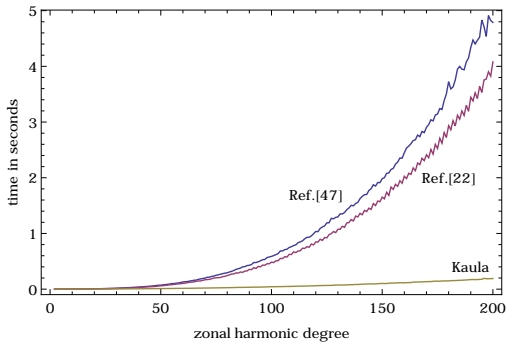
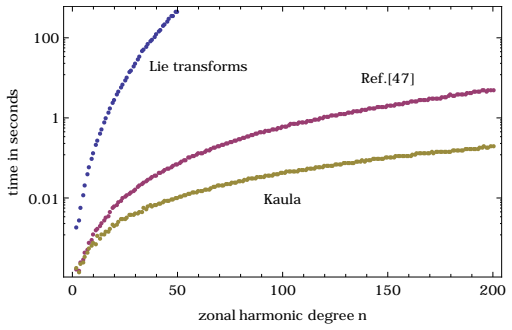
On the paper's own terms, the discovery is that the first-order averaged zonal Hamiltonian can be written as $$H' = -\frac{\mu}{2a} - \frac{\mu}{a} \sum_{i\ge 2} \langle V_i\rangle_f,$$ where each $\langle V_i\rangle_f$ is a compact trigonometric series built from Kaula's inclination and eccentricity functions, and that this representation is not merely compact but computationally dominant. Timing runs up to zonal degree 200 show Kaula's recursions constructing each term in a few seconds on an ordinary laptop, with computation time growing slightly faster than quadratically in the degree; the more recent recursions take about $0.10\,n$ times longer (roughly five times at degree 50, twenty times at degree 200), and the brute-force Lie-transform expansion grows so fast that recursions are already 1000 times faster at moderate degrees. For bodies like the Moon and Venus, where one harmonic does not dominate, this first-order form is sufficient; for Earth-like bodies the paper appends known expanded second-order $J_2$ terms to the same recursion-based structure. The same averaged Hamiltonian then renders eccentricity-vector diagrams and inclination-eccentricity curves instantly, and the paper uses that to show how many zonal harmonics are needed to stabilize the long-term description of lunar orbits at different altitudes.
Load-bearing premise
The comparison treats the implementations of the three recursion schemes as equally optimized, so if the newer recursions were coded less carefully than Kaula's, the reported speed advantage would be exaggerated.
Editorial extensions
If this is right
- Averaged zonal Hamiltonians of degree 100 or 200 can be constructed and evaluated in seconds on desktop hardware, so high-fidelity long-term dynamics no longer require huge expanded literal expressions.
- Eccentricity-vector diagrams and inclination-eccentricity curves of frozen orbits can be redrawn in real time for a chosen truncation, making coefficient-by-coefficient sensitivity analysis of the gravity model routine.
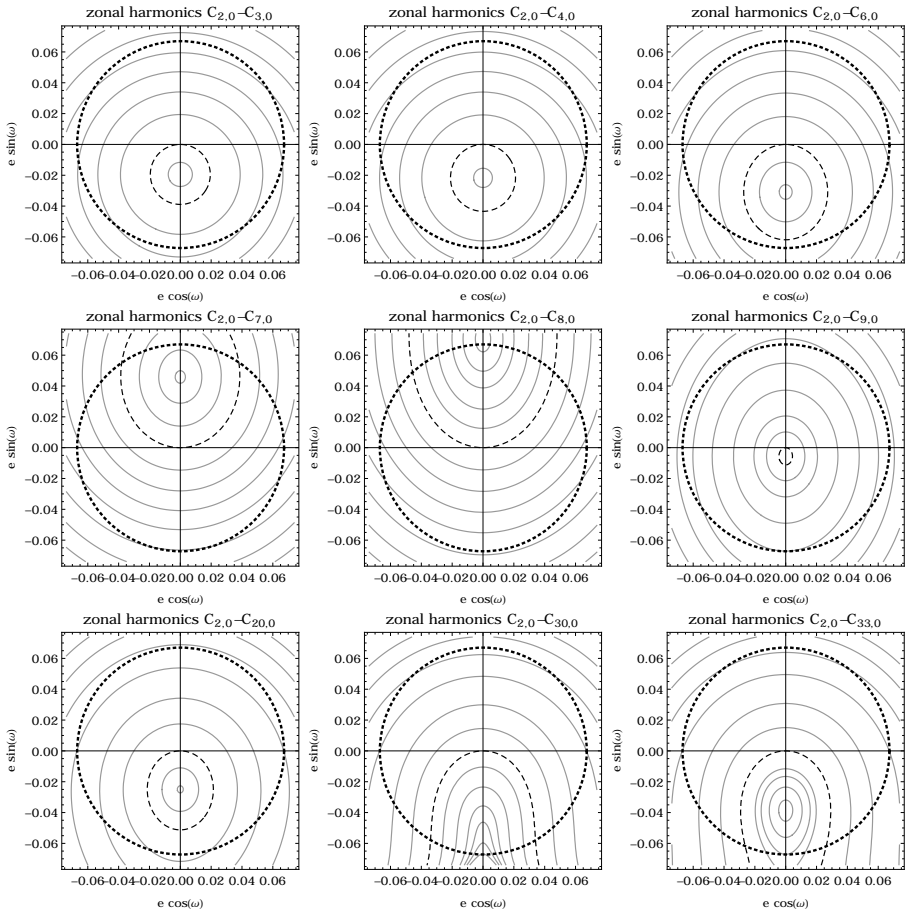
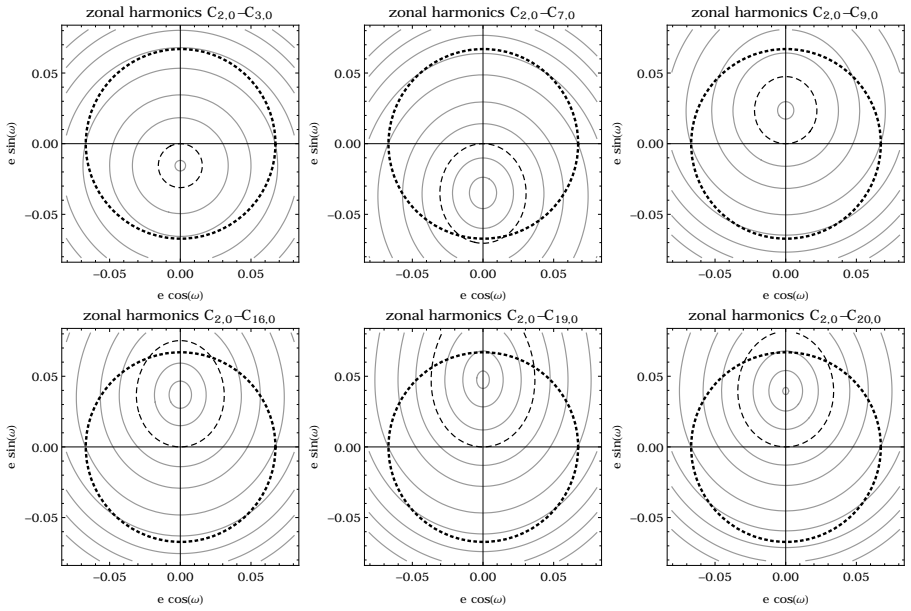
- For the Moon, the paper's examples show the required truncation rises with decreasing altitude: about $C_{2,0}$--$C_{30,0}$ for $a=1.3\,R_\oplus$ with $I=63.45^\circ$, $C_{2,0}$--$C_{33,0}$ for $a=1.07\,R_\oplus$ with $I=88^\circ$, and roughly $C_{2,0}$--$C_{20,0}$ for lower inclinations.
- The same recursion framework remains valid when expanded second-order $J_2$ terms are appended, so Earth-like bodies with a dominant flattening term can also be treated without abandoning Kaula's structure.
- Kaula's recursions should be the reference baseline for any future comparison of methods that construct the long-term gravity potential.
Reading between the lines
- The observed time ratios likely reflect a genuine difference in operation counts rather than symbolic-algebra overhead, since all three competitors were timed in the same system; a direct benchmark in compiled code should preserve the ranking, but only a carefully controlled re-implementation can confirm this.
- Because the averaged Hamiltonian is now cheap to evaluate, a natural extension is to scan grids of semi-major axis and inclination and automatically chart frozen-orbit existence and stability maps for arbitrary planetary satellites, a task the paper illustrates but does not automate.
- Extending the same recursion-based averaging to tesseral harmonics and resonance cases could bring the same speedup to mean-motion resonances and frozen-orbit design in rotating gravity fields.
- If the speedup holds on memory-limited platforms, onboard long-term orbit propagation using 50x0-class lunar gravity models becomes feasible for navigation or autonomy, an implication the paper does not state.
Signed reviews
Editorial analysis
A structured set of objections, weighed in public.
Referee Report
Summary. The paper proposes an efficient method for constructing the averaged (mean-elements) zonal Hamiltonian for perturbed Keplerian motion, using Kaula's classical eccentricity and inclination recursions in place of expanded literal expressions. The authors derive a compact first-order averaged zonal Hamiltonian, supplement it with the second-order J2 terms needed for Earth-like bodies, and benchmark the construction time against the recursions of De Saedeleer and an improved variant, as well as against a brute-force Lie-transform approach. They report that Kaula's recursions are clearly faster for high-degree truncations and illustrate the practical use of the method by computing eccentricity-vector diagrams for lunar orbits at various altitudes and inclinations.
Significance. If the performance claims are reliable, the paper offers a practical improvement for high-degree zonal averaging in satellite mission design: closed-form eccentricity recursions avoid large expanded Poisson series and enable rapid exploration of the phase space. The derivation follows standard Deprit Lie-transform procedures, and the closed-form eccentricity functions in Eq. (27)-(29) are a useful contribution. The coefficient-by-coefficient sensitivity study in Section 7, showing how the phase space changes as zonal harmonics are added, is also valuable. The paper does not fit free parameters, so the central comparison is not circular. However, the headline claim of 'clearly superior' performance rests entirely on uncontrolled wall-clock timings from private Mathematica code, and the second-order Hamiltonian involves a dropped term whose equivalence to the expanded Hamiltonian is not verified. These issues are load-bearing for the paper's central claims.
major comments (3)
- [Section 5, Figs. 1-4] The central performance claim that Kaula's recursions are 'clearly superior' is supported only by timing comparisons of private Mathematica implementations on a single machine, with no code, no implementation details, no repeated runs, and no confidence intervals. The paper itself concedes in Section 6 that the Lie-transforms leg was made 'unbalanced' by using the authors' experience; the same uncontrolled choices of simplification strategy, caching, and expression ordering could dominate the measured ratios for the recursion comparison as well. Since the abstract and conclusions assert superiority on the basis of these timings alone, the authors should either release the implementations, provide detailed pseudocode and operation counts, or otherwise substantiate that the compared implementations are comparably optimized.
- [Section 4, Eq. (34)] The compact second-order Hamiltonian is obtained by 'neglect[ing] the term ~q0,1' from Eq. (34) on the grounds that it is a consequence of an integration constant, but no proof or numerical check is given that the resulting expression equals the expanded Hamiltonian of [18]. If the omitted term is not truly a gauge artifact, or if the dropped contribution is dynamically significant for the Earth-like case the paper explicitly targets, the model is incomplete. The authors should either retain the term, demonstrate explicitly that it cancels or is a pure gauge effect by comparing with the expanded Hamiltonian, or numerically verify equivalence on a representative grid of (e, omega, I).
- [Section 7 and Section 5] The performance comparison in Section 5 measures only the time to construct the symbolic averaged Hamiltonian, not the time to evaluate it on the dense (e, omega) grids used for the eccentricity-vector diagrams in Section 7. The practical advantage claimed in the abstract and conclusions is about enabling efficient exploration and real-time rendering, but evaluation cost is not benchmarked. If the bottleneck for the mission-design workflow is evaluation rather than construction, the reported speedups may not translate to the claimed practical benefit. The authors should add evaluation-time comparisons or provide an analytical complexity argument showing that construction dominates.
minor comments (4)
- [Abstract and throughout] The phrase 'brut force' appears in the abstract and in Section 6; it should be 'brute force'.
- [Acknowledgements] The heading 'Acknowlwedgements' is misspelled; it should be 'Acknowledgements'.
- [Section 2] The word 'Kepelrian' in the discussion of Delaunay variables is a typo and should be 'Keplerian'.
- [Figures 1-4] The figure legends contain LaTeX artifacts such as 'Ref.@47D' and 'Ref.@22D', which should be rendered as proper citation labels for readability.
Circularity Check
No circularity: the central claim is a benchmark against prior recursions, not derived from them; self-citations are contextual and not load-bearing.
full rationale
The paper's central claim, that Kaula's recursion formulas are clearly superior to expanded expressions and to the recursions of [53] and [22] for constructing the mean-elements zonal Hamiltonian, rests on the timing comparisons in Section 5 (Figs. 1-4). Those comparisons are empirical benchmarks against prior published algorithms, not derivations from the paper's own fitted constants or target results. The construction of the averaged Hamiltonian in Eq. (36) is self-contained: Eq. (29) is obtained from Eq. (7) by explicit trigonometric recursions and yields Kaula's eccentricity functions, while the averaging is performed by standard Lie transforms as summarized in Appendix A. No free parameter is fitted, and no quantity used as input is defined in terms of the claimed prediction. The self-citations, such as [22] and [23] for lunar orbit sensitivity and [38]-[39] for coefficient-by-coefficient exploration, are contextual or serve as comparison targets; in particular, benchmarking against [22] is comparison with prior work, not reliance on an unverified premise. The paper's own admission that the Lie-transforms comparison was deliberately unbalanced, and the absence of implementation details for the recursion timings, are genuine threats to the reliability of the performance claim, but they are empirical-validation concerns rather than circularity. No specific reduction of a predicted result to its own inputs is exhibited, so the derivation chain is not circular.
Assumptions & free parameters
assumptions (3)
- standard math Deprit's Lie transforms perturbation method correctly computes the averaged Hamiltonians.
- domain assumption For the Moon and Venus, all zonal harmonic coefficients are of the same order, so a first-order averaging without special J2 scaling is appropriate.
- ad hoc to paper The term ~q0,1 in the second-order J2 Hamiltonian can be neglected to match the known expanded Hamiltonian.
Cite this review
Pith. "Pith review of Exploring the long-term dynamics of perturbed Keplerian motion in high degree potential fields." pith.science (2026). https://pith.science/paper/FZFDWVLE
@misc{pith2026190802597,
  author       = {Pith},
  title        = {Pith review of: Exploring the long-term dynamics of perturbed Keplerian motion in high degree potential fields},
  year         = {2026},
  howpublished = {\url{https://pith.science/paper/FZFDWVLE}},
  note         = {Machine review of arXiv:1908.02597}
}
read the original abstract
The long-term dynamics of perturbed Keplerian motion is usually analyzed in simplified models as part of the preliminary design of artificial satellites missions. It is commonly approached by averaging procedures that deal with literal expressions in expanded form. However, there are cases in which the correct description of the dynamics may require full, contrary to simplified, potential models, as is, for instance, the case of low-altitude, high-inclination lunar orbits. In these cases, dealing with literal expressions is yet possible with the help of modern symbolic algebra systems, for which memory handling is no longer an issue. Still, the efficient evaluation of the averaged expressions related to a high fidelity potential is often jeopardized for the expanded character of the output of the automatic algebraic process, which unavoidably provides huge expressions that commonly comprise tens of thousands of literal terms. Rearrangement of the output to generate an efficient numerical code may solve the problem, but automatization of this kind of post-processing is a non trivial task due to the ad-hoc heuristic simplification procedures involved in the optimization process. However, in those cases in which the coupling of different perturbations is not of relevance for the analysis, the averaging procedure may preserve the main features of the structure of the potential model, thus avoiding the need of the typical blind computer-based brut force perturbation approach. Indeed, we show how standard recursions in the literature may be used to efficiently replace the brut force approach, in this way avoiding the need of further simplification to improve performance evaluation. In particular, Kaula's seminal recursion formulas for the gravity potential reveal clearly superior to the use of both expanded expressions and other recursions more recently proposed in the literature.
Figures

Figures from the paper (4 more)


Reference graph
Works this paper leans on
-
[18]
S. L. Co ffey, A. Deprit, E. Deprit, Frozen orbits for satellites close to an earth-like planet, Celestial Mechanics and Dynamical Astronomy 59 (1) (1994) 37–72. doi:10.1007/BF00691970
-
[1]
Kozai, Motion of a lunar orbiter, Publications of the Astronomical Society of Japan 15 (1963) 301–312
Y . Kozai, Motion of a lunar orbiter, Publications of the Astronomical Society of Japan 15 (1963) 301–312
1963
-
[2]
Cutting, J
E. Cutting, J. C. Frautnick, G. H. Born, Orbit analysis for Seasat-A, Journal of the Astronautical Sciences 26 (1978) 315–342
1978
-
[3]
D. J. Scheeres, M. D. Guman, B. F. Villac, Stability Analysis of Planetary Satellite Orbiters: Application to the Europa Orbiter, Journal of Guidance Control Dynamics 24 (4) (2001) 778–787. doi:10.2514/2.4778
doi:10.2514/2.4778 2001
-
[4]
M. Lara, J. San-Juan, Dynamic Behavior of an Orbiter Around Europa, Journal of Guidance, Control and Dynamics 28 (2) (2005) 291–297. doi:10.2514/1.5686
doi:10.2514/1.5686 2005
-
[6]
R. Armellin, J. F. San-Juan, M. Lara, End-of-life disposal of high elliptical orbit missions: The case of INTEGRAL, Advances in Space Research 56 (3) (2015) 479–493, Advances in Asteroid and Space Debris Science and Technology - Part 1. doi:10.1016/j.asr.2015. 03.020. URL http://www.sciencedirect.com/science/article/pii/S0273117715002227
-
[7]
C. Colombo, E. M. Alessi, W. van der Weg, S. Soldini, F. Letizia, M. Vetrisano, M. Vasile, A. Rossi, M. Landgraf, End-of-life disposal concepts for libration point orbit and highly elliptical orbit missions, Acta Astronautica 110 (2015) 298 – 312, dynamics and Control of Space Systems. doi:http://dx.doi.org/10.1016/j.actaastro.2014.11.002. URL http://www....
-
[8]
R. A. Broucke, Numerical integration of periodic orbits in the main problem of artificial satellite theory, Celestial Mechanics and Dynamical Astronomy 58 (2) (1994) 99–123. doi:10.1007/BF00695787
Show all 91 references
-
[9]
Jorba, J
À. Jorba, J. Masdemont, Dynamics in the center manifold of the collinear points of the restricted three body problem, Physica D Nonlinear Phenomena 132 (1999) 189–213. doi:10.1016/S0167-2789(99)00042-1
1999 doi
-
[10]
Lara, Searching for Repeating Ground Track Orbits: A Systematic Approach, Journal of the Astronautical Sciences 47 (3-4) (1999) 177–188
M. Lara, Searching for Repeating Ground Track Orbits: A Systematic Approach, Journal of the Astronautical Sciences 47 (3-4) (1999) 177–188
1999
-
[11]
Gómez, J
G. Gómez, J. Mondelo, The dynamics around the collinear equilibrium points of the RTBP, Physica D: Nonlinear Phenomena 157 (4) (2001) 283 – 321. doi:https://doi.org/10.1016/S0167-2789(01)00312-8 . URL http://www.sciencedirect.com/science/article/pii/S0167278901003128
2001 doi
-
[12]
M. Lara, Repeat Ground Track Orbits of the Earth Tesseral Problem as Bifurcations of the Equatorial Family of Periodic Orbits, Celestial Mechanics and Dynamical Astronomy 86 (2) (2003) 143–162
2003
-
[13]
M. Lara, R. Russell, B. F. Villac, Classification of the Distant Stability Regions at Europa, Journal of Guidance Control Dynamics 30 (2007) 409–418. doi:10.2514/1.22372
2007 doi
-
[14]
Russell, M
R. Russell, M. Lara, Long-lifetime lunar repeat ground track orbits, Journal of Guidance, Control, and Dynamics 30 (4) (2007) 982–993
2007
-
[15]
M. Lara, R. P. Russell, B. Villac, Stability Maps, Global Dynamics and Transfers (AAS 05-378), in: B. G. Williams, L. A. D’Amario, K. C. Howell, F. R. Hoots (Eds.), AAS/AIAA Astrodynamics 2005, V ol. 123 of Advances in the Astronautical Sciences, American Astronautical Society...
2005
-
[16]
M. Lara, R. Russell, B. F. Villac, Fast estimation of stable regions in real models, Meccanica 42 (5) (2007) 511–515. doi:10.1007/ s11012-007-9060-z . URL https://link.springer.com/article/10.1007/s11012-007-9060-z
2007 doi
-
[17]
B. F. Villac, Using FLI maps for preliminary spacecraft trajectory design in multi-body environments, Celestial Mechanics and Dynamical Astronomy 102 (2008) 29–48. doi:10.1007/s10569-008-9158-1
2008 doi
-
[19]
J. F. San-Juan, M. Lara, S. Ferrer, Phase Space Structure Around Oblate Planetary Satellites, Journal of Guidance Control Dynamics 29 (2006) 113–120. doi:10.2514/1.13385
2006 doi
-
[20]
Konopliv, W
A. Konopliv, W. Sjogren, R. Wimberly, R. Cook, A. Vijayaraghavan, A High Resolution Lunar Gravity Field and Predicted Orbit Behavior (AAS 93-622), in: Advances in the astronautical Sciences, V ol. 85, American Astronautical Society, Univelt, Inc., P.O. Box 28130, San Diego, Ca...
1994
-
[21]
Roncoli, Lunar Constants and Models Document, Tech
R. Roncoli, Lunar Constants and Models Document, Tech. Rep. JPL D-32296, Jet Propulsion Laboratory, California Institute of Technology (Sep. 2005). 19
2005
-
[22]
M. Lara, B. de Saedeleer, S. Ferrer, Preliminary design of low lunar orbits, in: Proceedings of the 21st International Symposium on Space Flight Dynamics, Toulouse, France, ISSFD, 2009, pp. 1–15. URL http://issfd.org/ISSFD_2009/InterMissionDesignII/Lara.pdf
2009
-
[23]
Lara, Design of long-lifetime lunar orbits: A hybrid approach, Acta Astronautica 69 (3–4) (2011) 186–199
M. Lara, Design of long-lifetime lunar orbits: A hybrid approach, Acta Astronautica 69 (3–4) (2011) 186–199. doi:10.1016/j. actaastro.2011.03.009. URL http://www.sciencedirect.com/science/article/pii/S009457651100066X
2011 doi
-
[24]
G. E. Cook, Perturbations of near-circular orbits by the Earth’s gravitational potential, Planetary and Space Science 14 (1966) 433–444. doi:10.1016/0032-0633(66)90015-8
1966 doi
-
[25]
G. W. Rosborough, C. Ocampo, Influence of Higher Degree Zonals on the Frozen Orbit Geometry (AAS 91-428), in: B. Kaufman, K. T. Alfriend, R. L. Roehrich, R. R. Dasenbrock (Eds.), Astrodynamics 1991, V ol. 76 of Advances in the Astronautical Sciences, American Astronautical Soci...
1991
-
[26]
R. A. Cook, The long-term behavior of near-circular orbits in a zonal gravity field (AAS 91-463), in: B. Kaufman, K. T. Alfriend, R. L. Roehrich, R. R. Dasenbrock (Eds.), Astrodynamics 1991, V ol. 76 of Advances in the Astronautical Sciences, American Astronautical Society., Un...
1991
-
[27]
Lara, A Mathematica c©–based approach to the frozen orbits problem about arbitrary bodies
M. Lara, A Mathematica c©–based approach to the frozen orbits problem about arbitrary bodies. The case of a Lunar orbiter, in: Astrodynamics Beyond Borders, Proceedings of the 4th International Conference on Astrodynamics Tools and Techniques, ESA publication WPP-308, ICATT, 2...
2010
-
[28]
S. L. Co ffey, H. L. Neal, A. M. Segerman, J. J. Travisano, An analytic orbit propagation program for satellite catalog maintenance, in: K. T. Alfriend, I. M. Ross, A. K. Misra, C. F. Peters (Eds.), AAS/AIAA Astrodynamics Conference 1995, V ol. 90 of Advances in the Astronautic...
1995
-
[29]
D. E. Knuth, The Art of Computer Programming, Addison–Wesley–Longman, Reading, Massachusetts, 1997
1997
-
[30]
Co ffey, A
S. Co ffey, A. Deprit, Fast evaluation of Fourier series, Astronomy and Astrophysics 81 (1980) 310–315
1980
-
[31]
Deprit, Delaunay normalisations, Celestial Mechanics 26 (1982) 9–21
A. Deprit, Delaunay normalisations, Celestial Mechanics 26 (1982) 9–21. doi:10.1007/BF01233178
1982 doi
-
[32]
L. M. Healy, J. J. Travisano, Automatic rendering of astrodynamics expressions for efficient evaluation, Journal of the Astronautical Sciences 46 (1) (1998) 65–81
1998
-
[33]
E. Wnuk, S. Breiter, The motion of natural and artificial satellites in Mars gravity field, Advances in Space Research 11 (6) (1991) 183 – 188. doi:https://doi.org/10.1016/0273-1177(91)90251-E . URL http://www.sciencedirect.com/science/article/pii/027311779190251E
1991
-
[34]
Metris, P
G. Metris, P. Exertier, Y . Boudon, F. Barlier, Long period variations of the motion of a satellite due to non-resonant tesseral harmonics of a gravity, Celestial Mechanics and Dynamical Astronomy 57 (1993) 175–188. doi:10.1007/BF00692472
1993 doi
-
[35]
E. Wnuk, T. Jopek, Satellite orbit calculations using geopotential coe fficients up to high degree and order, Advances in Space Research 14
-
[36]
M. Lara, J. Palacián, R. Russell, Mission design through averaging of perturbed Keplerian systems: the paradigm of an Enceladus orbiter, Celestial Mechanics and Dynamical Astronomy 108 (1) (2010) 1–22. doi:10.1007/s10569-010-9286-2 . URL https://link.springer.com/article/10.10...
2010 doi
-
[37]
M. Lara, I. Pérez, R. López, Higher Order Approximation to the Hill Problem Dynamics about the Libration Points, Communications in Nonlinear Science and Numerical Simulation in press. doi:10.1016/j.cnsns.2017.12.007. URL http://www.sciencedirect.com/science/article/pii/S100757...
2017 doi
-
[38]
M. Lara, S. Ferrer, B. d. Saedeleer, Lunar analytical theory for polar orbits in a 50-degree zonal model plus third-body e ffect, The Journal of the Astronautical Sciences 57 (3) (2009) 561–577. doi:10.1007/BF03321517. URL http://dx.doi.org/10.1007/BF03321517
2009 doi
-
[39]
Lara, Exploring Sensitivity of Orbital Dynamics with Respect to Model Truncation: The Frozen Orbits Approach, in: M
M. Lara, Exploring Sensitivity of Orbital Dynamics with Respect to Model Truncation: The Frozen Orbits Approach, in: M. Vasile, E. Minisci, L. Summerer, P. McGinty (Eds.), Stardust Final Conference, V ol. 52 of Astrophysics and Space Science Proceedings, Springer International...
2018 doi
-
[40]
L. E. Cunningham, On the Computation of the Spherical Harmonic Terms Needed during the Numerical Integration of the Orbital Motion of an Artificial Satellite, Celestial Mechanics 2 (1970) 207–216. doi:10.1007/BF01229495
1970 doi
-
[41]
Pines, Uniform Representation of the Gravitational Potential and its Derivatives, AIAA Journal 11 (1973) 1508–1511
S. Pines, Uniform Representation of the Gravitational Potential and its Derivatives, AIAA Journal 11 (1973) 1508–1511. doi:10.2514/3. 50619
1973 doi
-
[42]
J. B. Lundberg, B. E. Schutz, Recursion formulas of Legendre functions for use with nonsingular geopotential models., Journal of Guidance Control Dynamics 11 (1988) 31–38. doi:10.2514/3.20266
1988 doi
-
[43]
Fantino, S
E. Fantino, S. Casotto, Methods of harmonic synthesis for global geopotential models and their first-, second- and third-order gradients, Journal of Geodesy 83 (2009) 595–619. doi:10.1007/s00190-008-0275-0
2009 doi
-
[44]
Kozai, The Motion of a Close Earth Satellite, The Astronomical Journal 64 (11) (1959) 367–377
Y . Kozai, The Motion of a Close Earth Satellite, The Astronomical Journal 64 (11) (1959) 367–377
1959
-
[45]
Lara, Simplified Equations for Computing Science Orbits Around Planetary Satellites, Journal of Guidance Control Dynamics 31 (1) (2008) 172–181
M. Lara, Simplified Equations for Computing Science Orbits Around Planetary Satellites, Journal of Guidance Control Dynamics 31 (1) (2008) 172–181. doi:10.2514/1.31107
2008 doi
-
[46]
M. Lara, J. F. Palacián, P. Yanguas, C. Corral, Analytical theory for spacecraft motion about Mercury, Acta Astronautica 66 (7-8) (2010) 1022–1038. doi:10.1016/j.actaastro.2009.10.011. URL http://www.sciencedirect.com/science/article/pii/S0094576509004974
2010 doi
-
[47]
W. M. Kaula, Analysis of Gravitational and Geometric Aspects of Geodetic Utilization of Satellites, Geophysical Journal 5 (1961) 104–133. doi:10.1111/j.1365-246X.1961.tb00417.x
1961 doi
-
[48]
W. M. Kaula, Theory of satellite geodesy. Applications of satellites to geodesy, Blaisdell, Waltham, Massachusetts, 1966
1966
-
[49]
P. A. Hansen, Expansions of the product of a power of the radius vector with the sinus or cosinus of a multiple of the true anomaly in terms of series containing the sinuses or cosinuses of the multiples of the true, eccentric or mean anomaly, Abhandlungen der Koniglich Sachsi...
1977
-
[50]
J. L. Arsenault, K. C. Ford, P. E. Koskela, Orbit determination using analytic partial derivatives of perturbed motion., AIAA Journal 8 (1970) 4–12. doi:10.2514/3.5597. 20
1970 doi
-
[51]
R. A. Broucke, P. J. Cefola, On the Equinoctial Orbit Elements, Celestial Mechanics 5 (3) (1972) 303–310. doi:10.1007/BF01228432
1972 doi
-
[52]
P. J. Cefola, R. Broucke, On the formulation of the gravitational potential in terms of equinoctial variables, in: 13th Aerospace Sciences Meeting, Pasadena, California, American Institute of Aeronautics and Astronautics, USA, 1975, pp. 1–25, AIAA Paper No. 75-9
1975
-
[53]
B. de Saedeleer, Complete Zonal Problem of the Artificial Satellite: Generic Compact Analytic First Order in Closed Form, Celestial Me- chanics and Dynamical Astronomy 91 (2005) 239–268. doi:10.1007/s10569-004-1813-6
2005 doi
-
[54]
W. M. Kaula, Development of the lunar and solar disturbing functions for a close satellite, The Astronomical Journal 67 (1962) 300. doi: 10.1086/108729
1962 doi
-
[55]
doi:10.1051/0004-6361/201014496
Laskar, J., Boué, G., Explicit expansion of the three-body disturbing function for arbitrary eccentricities and inclinations, Astronomy and Astrophysics 522 (2010) A60. doi:10.1051/0004-6361/201014496. URL https://doi.org/10.1051/0004-6361/201014496
2010 doi
-
[56]
J. F. Palacián, J. Vanegas, P. Yanguas, Compact normalisations in the elliptic restricted three body problem, Astrophysics and Space Science 362 (2017) 215. doi:10.1007/s10509-017-3195-8
2017 doi
-
[57]
Brouwer, Solution of the problem of artificial satellite theory without drag, The Astronomical Journal 64 (1959) 378–397
D. Brouwer, Solution of the problem of artificial satellite theory without drag, The Astronomical Journal 64 (1959) 378–397. doi:10.1086/ 107958
1959
-
[58]
Garfinkel, The orbit of a satellite of an oblate planet, The Astronomical Journal 64 (9) (1959) 353–367
B. Garfinkel, The orbit of a satellite of an oblate planet, The Astronomical Journal 64 (9) (1959) 353–367. doi:10.1086/107956
1959 doi
-
[59]
Deprit, The elimination of the parallax in satellite theory, Celestial Mechanics 24 (2) (1981) 111–153
A. Deprit, The elimination of the parallax in satellite theory, Celestial Mechanics 24 (2) (1981) 111–153. doi:10.1007/BF01229192
1981 doi
-
[60]
M. Lara, J. F. San-Juan, L. M. López-Ochoa, Proper Averaging Via Parallax Elimination (AAS 13-722), in: S. B. Broschart, J. D. Turner, K. C. Howell, F. R. Hoots (Eds.), Astrodynamics 2013, V ol. 150 of Advances in the Astronautical Sciences, American Astronautical Society, Uni...
2013
-
[61]
M. Lara, J. F. San-Juan, L. M. López-Ochoa, Delaunay variables approach to the elimination of the perigee in Artificial Satellite Theory, Celestial Mechanics and Dynamical Astronomy 120 (1) (2014) 39–56. arXiv:1312.7577, doi:10.1007/s10569-014-9559-2
2014 arXiv
-
[62]
Deprit, Canonical transformations depending on a small parameter, Celestial Mechanics 1 (1) (1969) 12–30
A. Deprit, Canonical transformations depending on a small parameter, Celestial Mechanics 1 (1) (1969) 12–30. doi:10.1007/BF01230629
1969 doi
-
[63]
Boccaletti, G
D. Boccaletti, G. Pucacco, Theory of orbits. V olume 2: Perturbative and geometrical methods, 1st Edition, Astronomy and Astrophysics Library, Springer-Verlag, Berlin Heidelberg New York, 2002
2002
-
[64]
K. R. Meyer, G. R. Hall, Introduction to Hamiltonian Dynamical Systems and the N-Body Problem, Springer, New York, 1992
1992
-
[65]
W. D. MacMillan, The Theory of the Potential, Dover Publishers Inc., New York, 1958
1958
-
[66]
(May 1987)
Defense Mapping Agency, Department of Defense World Geodetic System 1984: Its definition and relationship with local geodetic systems, DMA Technical Report 8350.2, Centre National d’Études Spatiales, Washington, D.C. (May 1987)
1984
-
[67]
Konopliv, W
A. Konopliv, W. Banerdt, W. Sjogren, Venus gravity: 180th degree and order model, Icarus 139 (1) (1999) 3 – 18. doi:https://doi.org/ 10.1006/icar.1999.6086. URL http://www.sciencedirect.com/science/article/pii/S0019103599960864
1999
-
[68]
A. S. Konopliv, R. S. Park, W. M. Folkner, An improved jpl mars gravity field and orientation from mars orbiter and lander tracking data, Icarus 274 (2016) 253 – 260. doi:https://doi.org/10.1016/j.icarus.2016.02.052. URL http://www.sciencedirect.com/science/article/pii/S0019103...
2016 doi
-
[69]
R. H. Battin, An Introduction to the Mathematics and Methods of Astrodynamics, American Institute of Aeronautics and Astronautics, Reston, V A, 1999
1999
-
[70]
A. H. Nayfeh, Perturbation Methods, Wiley-VCH Verlag GmbH & Co. KGaA, Weinheim, Germany, 2004
2004
-
[71]
Brouwer, G
D. Brouwer, G. M. Clemence, Methods of Celestial Mechanics, Academic Press, New York and London, 1961
1961
-
[72]
Ferraz-Mello, Canonical Perturbation Theories - Degenerate Systems and Resonance, V ol
S. Ferraz-Mello, Canonical Perturbation Theories - Degenerate Systems and Resonance, V ol. 345 of Astrophysics and Space Science Library, Springer, New York, 2007
2007
-
[73]
C. E. Delaunay, La Théorie du Mouvement de la Lune, Premier volume, V ol. 28 of Mémoires de l’Academie des Sciences de l’Institut Impérial de France., Mallet-Bachellier, Paris, 1860. URL http://gallica.bnf.fr/ark:/12148/cb343783130/date
-
[74]
Kozai, Second-Order Solution of Artificial Satellite Theory without Air Drag, The Astronomical Journal 67 (7) (1962) 446–461
Y . Kozai, Second-Order Solution of Artificial Satellite Theory without Air Drag, The Astronomical Journal 67 (7) (1962) 446–461
1962
-
[75]
Osácar, J
C. Osácar, J. F. Palacián, Decomposition of functions for elliptical orbits, Celestial Mechanics and Dynamical Astronomy 60 (2) (1994) 207–223. doi:10.1007/BF00693322
1994 doi
-
[76]
Deprit, A
A. Deprit, A. Rom, The Main Problem of Artificial Satellite Theory for Small and Moderate Eccentricities, Celestial Mechanics 2 (2) (1970) 166–206
1970
-
[77]
Wnuk, Highly eccentric satellite orbits, Advances in Space Research 19 (1997) 1735–1740
E. Wnuk, Highly eccentric satellite orbits, Advances in Space Research 19 (1997) 1735–1740. doi:10.1016/S0273-1177(97)00336-0
1997 doi
-
[78]
Brumberg, T
E. Brumberg, T. Fukushima, Expansions of elliptic motion based on elliptic function theory, Celestial Mechanics and Dynamical Astronomy 60 (1994) 69–89. doi:10.1007/BF00693093
1994 doi
-
[79]
Brumberg, V
E. Brumberg, V . A. Brumberg, T. Konrad, M. So ffel, Analytical Linear Perturbation Theory for Highly Eccentric Satellite Orbits, Celestial Mechanics and Dynamical Astronomy 61 (1995) 369–387. doi:10.1007/BF00049516
1995 doi
-
[80]
Fukushima, Elliptic functions and elliptic integrals for celestial mechanics and dynamical astronomy, in: S
T. Fukushima, Elliptic functions and elliptic integrals for celestial mechanics and dynamical astronomy, in: S. Kopeikin (Ed.), Frontiers in Relativistic Celestial Mechanics V olume 2: Applications and Experiments, V ol. 22 of De Gruyter Studies in Mathematical Physics, Walter...
2014
-
[81]
K. T. Alfriend, S. L. Co ffey, Elimination of the perigee in the satellite problem, Celestial Mechanics 32 (2) (1984) 163–172. doi:10.1007/ BF01231123
1984
-
[82]
Exertier, Orbitographie des satellites artificiels sur de grandes periodes de temps
A. Exertier, Orbitographie des satellites artificiels sur de grandes periodes de temps. Possibilites d’applications, PhD. Thesis, Observatoire de Paris, Paris, 1988
1988
-
[83]
M. Lara, J. F. San-Juan, L. M. López, P. J. Cefola, On the third-body perturbations of high-altitude orbits, Celestial Mechanics and Dynamical Astronomy 113 (2012) 435–452. doi:10.1007/s10569-012-9433-z
2012 doi
-
[84]
Co ffey, K
S. Co ffey, K. T. Alfriend, Short period elimination for the tesseral harmonics, in: A. L. Friedlander, P. J. Cefola, B. Kaufman, W. Williamson, G. Tseng (Eds.), AAS/AIAA Astrodynamics Conference 1981, V ol. 46 of Advances in the Astronautical Sciences, American Astronautical S...
1981
-
[85]
Co ffey, A
S. Co ffey, A. Deprit, Third-Order Solution to the Main Problem in Satellite Theory, Journal of Guidance, Control and Dynamics 5 (4) (1982) 366–371
1982
-
[86]
J. M. A. Danby, A. Deprit, A. R. M. Rom, The Symbolic Manipulation of Poisson Series, Mathematical Note No. 432 D1-82-0481, Boeing Scientific Research Laboratories, Seattle, Washington (1965)
1965
-
[87]
Deprit, A
A. Deprit, A. Rom, Lindstedt’s Series on a Computer, The Astronomical Journal 73 (1968) 210. doi:10.1086/110619
1968 doi
-
[88]
Lara, Three-body dynamics around the smaller primary
M. Lara, Three-body dynamics around the smaller primary. Application to the design of science orbits, Journal of Aerospace Engineering, Sciences and Applications 2 (1) (2010) 53–65. doi:10.7446/jaesa.0201.06. URL http://www.aeroespacial.org.br/jaesa/editions/repository/v02/n01...
2010 doi
-
[89]
M. Lara, J. F. San-Juan, L. M. López-Ochoa, Precise analytical computation of frozen-eccentricity, low Earth orbits in a tesseral potential, Mathematical Problems in Engineering 2013 (Article ID 191384) (2013) 1–13. doi:10.1155/2013/191384
2013 doi
-
[90]
B. E. Shapiro, Phase Plane Analysis and Observed Frozen Orbit for the Topex /Poseidon Mission, in: P. M. Bainum, G. L. May, Y . Ohkami, K. Uesugi, Q. Faren, L. Furong (Eds.), 6th AAS/JRS/CSA Symposium, International Space Conference of Pacific-Basin Societies, Strength- ening C...
1996
-
[91]
Folta, D
D. Folta, D. Quinn, Lunar Frozen Orbits, in: AIAA /AAS Astrodynamics Specialist Conference and Exhibit, 21 - 24 August 2006, Keystone, Colorado, American Institute of Aeronautics and Astronautics, 2006, pp. 1–18, AIAA Paper 2006-6749. doi:10.2514/6.2006-6749
2006 doi
-
[92]
A. S. Konopliv, S. W. Asmar, E. Carranza, W. L. Sjogren, D. N. Yuan, Recent Gravity Models as a Result of the Lunar Prospector Mission, Icarus 150 (2001) 1–18. doi:10.1006/icar.2000.6573. 22
2001
Reviewed August 14, 2026 · model on record in the stance chip above.
Discussion (0). Continue with ORCID to comment.