Galaxy formation in modified gravity -- II. galaxy halo connection and assembly bias
Pith reviewed 2026-06-27 08:21 UTC · model grok-4.3
The pith
Adding environment density to the halo occupation model reduces assembly bias effects to 2-3% at low redshifts in both standard and modified gravity.
A machine-rendered reading of the paper's core claim, the machinery that carries it, and where it could break.
Core claim
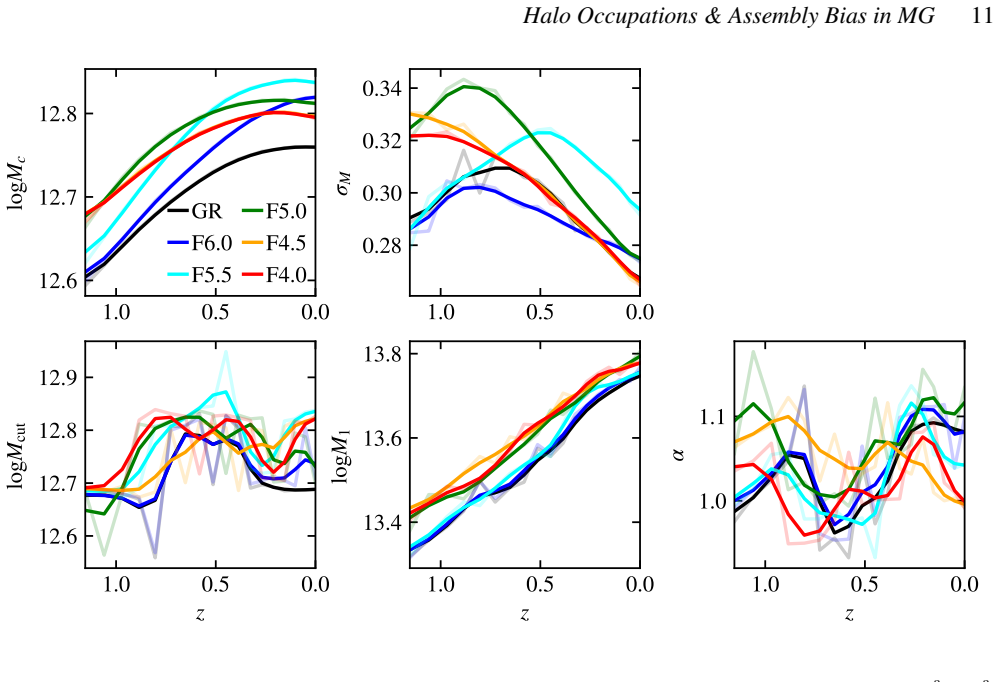
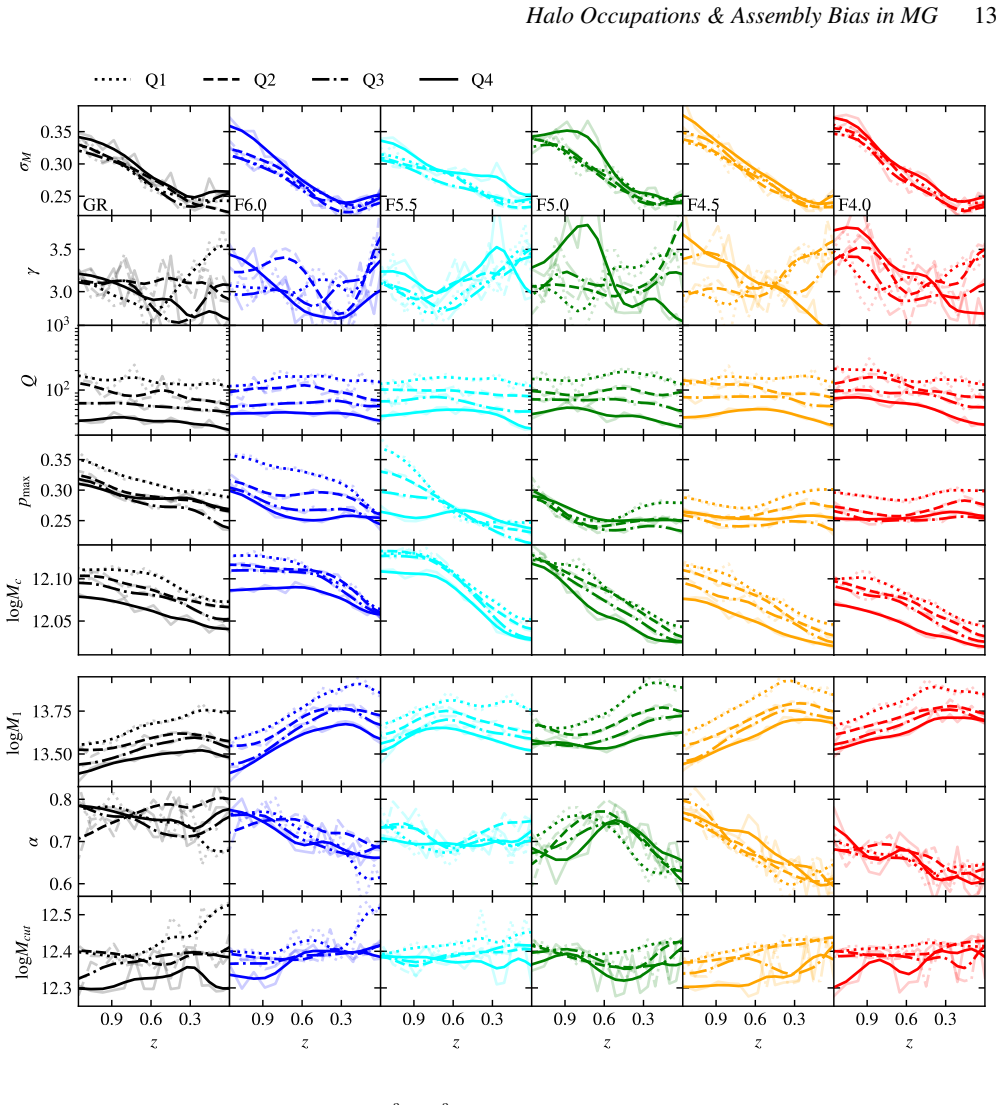
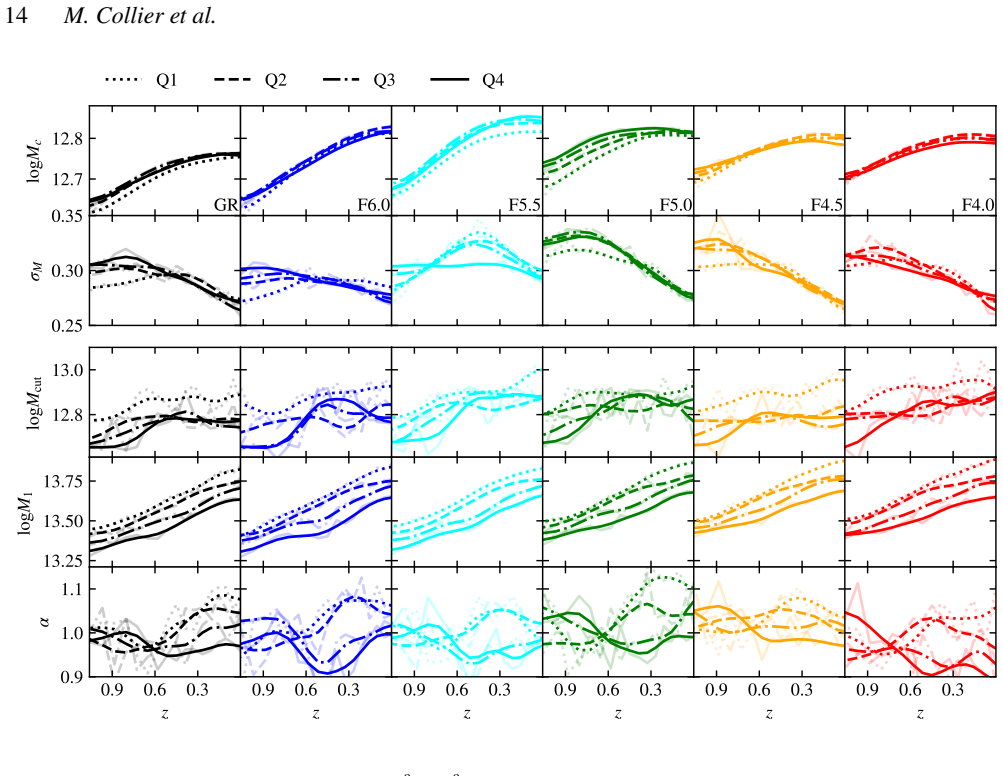
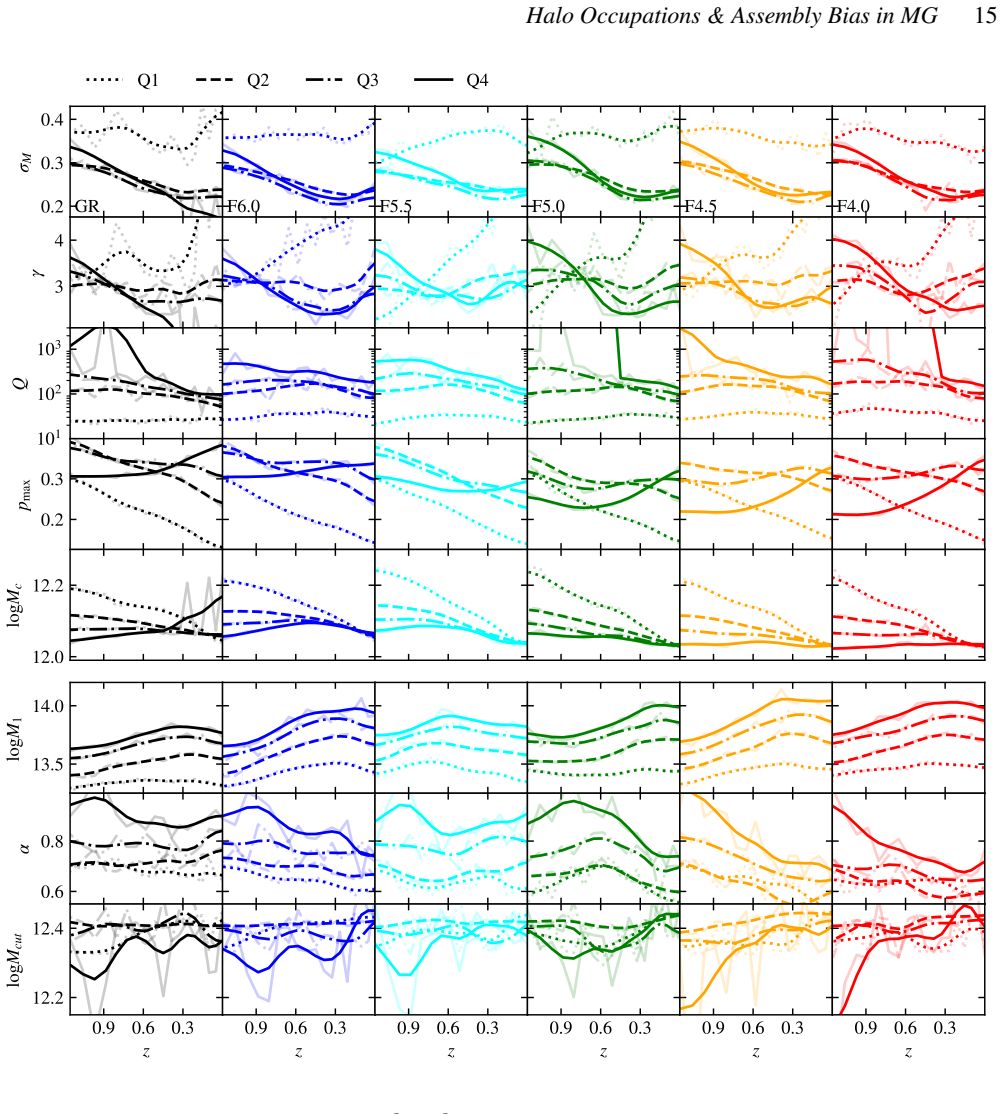
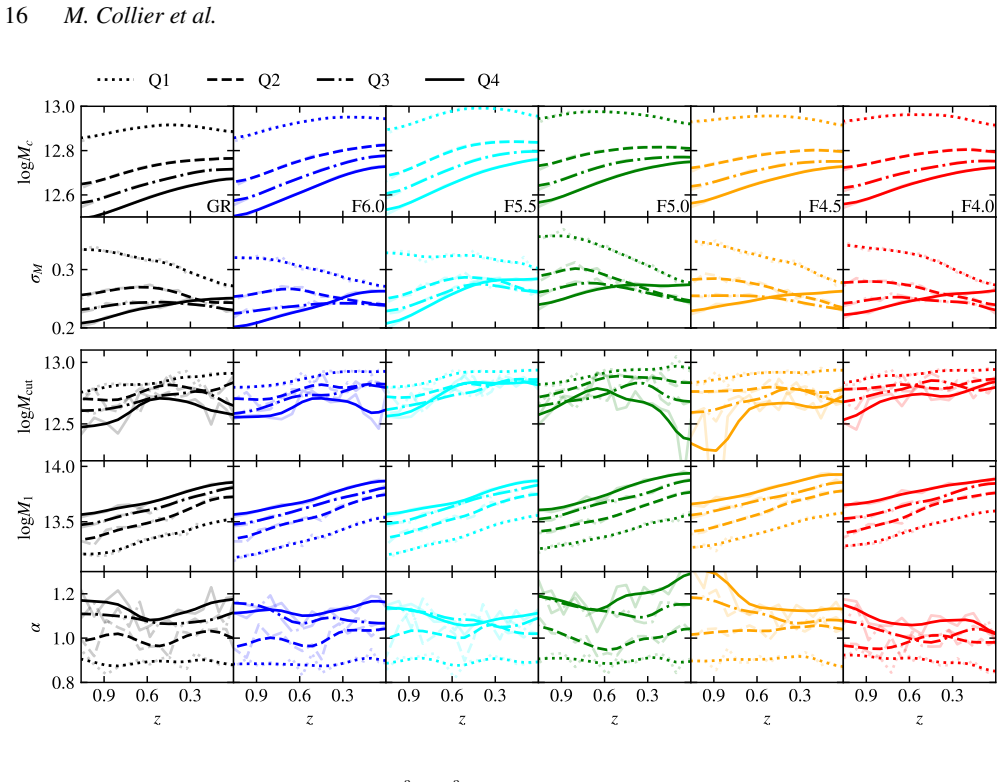
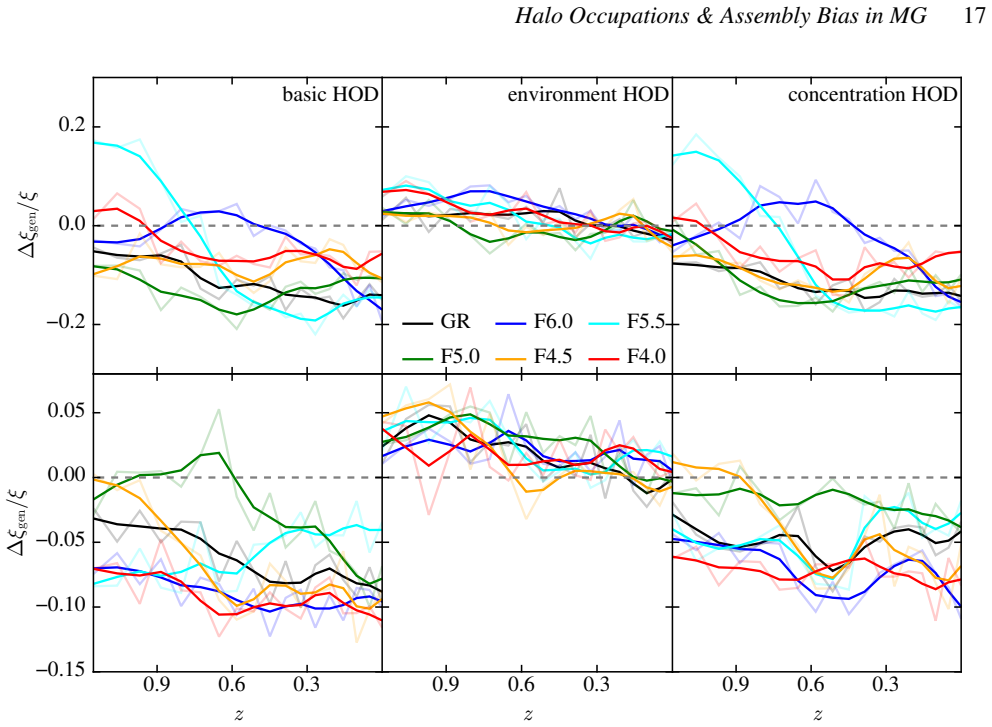
While the basic halo occupation distribution underestimates galaxy clustering by 10-20% in Lambda CDM when assembly bias is neglected, and introduces further complexity in f(R) gravity, extending the model with a suitably chosen environment density as a secondary HOD variable reduces the assembly bias effect in all models to 2-3% for z less than or equal to 0.5. The simulations show halo and galaxy formation enhanced for progressively more massive haloes over time under chameleon screening.
What carries the argument
the halo occupation distribution extended by environment density as a secondary variable to capture assembly bias
If this is right
- Standard mass-only HOD models underestimate clustering strength by 10-20% at z less than or equal to 1 when assembly bias is ignored.
- Modified gravity adds extra complexity to the galaxy-halo connection through the chameleon screening mechanism.
- Environment density as a secondary variable reduces the assembly bias residual to 2-3% for z less than or equal to 0.5 in every model examined.
- The adjusted model supplies a practical starting point for controlling assembly bias when testing non-standard cosmologies with large-scale structure surveys.
Where Pith is reading between the lines
- Survey analyses could adopt this secondary variable to obtain tighter limits on f(R) parameters from clustering measurements.
- Alternative environmental measures might be tested in the same simulations to see if the residual can be lowered further.
- The approach may generalise to other modified gravity scenarios where screening also depends on local density.
Load-bearing premise
The mock emission line galaxy and luminous red galaxy catalogues generated from the modified gravity hydrodynamical simulations accurately capture the effects of chameleon screening on galaxy and halo formation.
What would settle it
A direct measurement of the two-point clustering amplitude of emission line or luminous red galaxies in DESI or Euclid data at z less than or equal to 0.5 compared against the prediction from the environment-density HOD model; a deviation larger than a few percent would show the claimed reduction does not hold.
Figures
read the original abstract
Modern surveys such as DESI and \textit{Euclid}, which collect data for hundreds of millions of galaxies to map the large-scale structure (LSS) of the Universe, hold the key to determining the cosmological parameters and testing new physics. This ambition, however, is limited by uncertainties in the galaxy-halo connection: the link between observed galaxies and the underlying, unobservable matter field, by accounting for effects such as galaxy bias and assembly bias (AB). These are particularly poorly-understood for modified gravity (MG) models, which are popular alternatives to the cosmological constant to explain accelerated expansion. We approach this problem using mock emission line galaxy (ELG) and luminous red galaxy (LRG) catalogues in $f(R)$ gravity matching the specifications of ongoing Stage-IV galaxy surveys, generated from state-of-the-art MG hydrodynamical simulations. While the interplay between MG -- especially the chameleon screening mechanism -- and galaxy formation leaves complicated imprints in the galaxy-halo connection, a simple physical picture emerges in which halo and galaxy formation are enhanced for progressively more massive haloes over time. We confirm that the basic galaxy-halo connection model, the halo occupation distribution (HOD), in which galaxy occupation is determined solely by halo mass, underestimates galaxy clustering strength in $\Lambda$CDM by $10$--$20\%$ at $z\lesssim1$ when neglecting AB, and demonstrate that MG introduces further complexity. Extending this model with a suitably-chosen environment density as a secondary HOD variable reduces the AB effect in all models to $2$--$3\%$ for $z\lesssim0.5$. This provides a well-motivated starting point for further works on minimising the impact of AB when testing non-standard cosmological models with LSS.
Editorial analysis
A structured set of objections, weighed in public.
Referee Report
Summary. The paper uses state-of-the-art f(R) hydrodynamical simulations to generate mock ELG and LRG catalogs matching Stage-IV survey specifications. It examines the galaxy-halo connection via HOD modeling, shows that standard mass-only HOD underestimates clustering by 10-20% at z≲1 due to assembly bias (AB), and demonstrates that adding a suitably chosen environment density as a secondary HOD variable reduces the AB effect to 2-3% for z≲0.5 across ΛCDM and MG models.
Significance. If the mocks accurately capture chameleon screening, the result supplies a concrete, low-parameter extension to HOD modeling that mitigates AB contamination when testing gravity with upcoming LSS data. This is a practical advance for cosmological analyses in non-standard gravity.
major comments (2)
- [Sections 3 and 4] Sections 3 and 4: The central claim that environment density reduces AB to 2--3% at z≲0.5 in all models rests on the mocks faithfully encoding how chameleon screening modulates halo assembly and galaxy occupation. No quantitative isolation of the MG imprint is shown (e.g., direct comparison of screened vs. unscreened runs, resolution study of the scalar-field solver, or test against analytic screening thresholds), so it is unclear whether the measured reduction is robust or an artifact of the particular sub-grid galaxy model and numerical setup.
- [Abstract and results sections] Abstract and results sections: The reported 10--20% underestimation and 2--3% residual AB values are given without error bars, sample-variance estimates, or resolution-convergence tests. Because the headline percentages are load-bearing for the practical utility claim, the absence of these quantifications prevents assessment of whether the reduction is statistically significant or simulation-specific.
Simulated Author's Rebuttal
We thank the referee for the constructive and detailed report. The comments identify important areas where additional quantification and explicit tests can strengthen the robustness of our results on assembly bias mitigation in f(R) gravity. We address each major comment below and will revise the manuscript accordingly.
read point-by-point responses
-
Referee: [Sections 3 and 4] Sections 3 and 4: The central claim that environment density reduces AB to 2--3% at z≲0.5 in all models rests on the mocks faithfully encoding how chameleon screening modulates halo assembly and galaxy occupation. No quantitative isolation of the MG imprint is shown (e.g., direct comparison of screened vs. unscreened runs, resolution study of the scalar-field solver, or test against analytic screening thresholds), so it is unclear whether the measured reduction is robust or an artifact of the particular sub-grid galaxy model and numerical setup.
Authors: The hydrodynamical simulations used here solve the scalar-field equation to capture chameleon screening self-consistently, as detailed in Section 2 and validated against analytic thresholds in the simulation methodology papers and our companion Paper I. We acknowledge that an explicit isolation of the MG contribution would strengthen the presentation. In the revision we will add a direct comparison of halo assembly bias and galaxy occupation between the f(R) and ΛCDM runs (new panel or subsection in Section 3) to quantify the additional MG imprint. We will also cite the existing resolution and convergence tests for the scalar-field solver performed during simulation development. A new dedicated resolution study lies outside the scope of the present work but the cited tests address the concern that the reported reduction is an artifact. revision: partial
-
Referee: [Abstract and results sections] Abstract and results sections: The reported 10--20% underestimation and 2--3% residual AB values are given without error bars, sample-variance estimates, or resolution-convergence tests. Because the headline percentages are load-bearing for the practical utility claim, the absence of these quantifications prevents assessment of whether the reduction is statistically significant or simulation-specific.
Authors: We agree that error bars and sample-variance estimates are necessary to support the headline percentages. In the revised manuscript we will add jackknife resampling errors (over the simulation volume) to the clustering ratios and AB reduction values reported in the abstract and Sections 3–4. We will also include a short paragraph referencing the resolution convergence tests already performed for the underlying simulation suite. These additions will allow quantitative assessment of statistical significance. revision: yes
Circularity Check
No significant circularity; results from direct simulation outputs and empirical HOD fits
full rationale
The paper derives its claims about galaxy-halo connection, assembly bias, and the effect of adding environment density as a secondary HOD variable directly from outputs of MG hydrodynamical simulations and subsequent fitting to mock ELG/LRGs catalogs. No equations or steps reduce a claimed prediction to a fitted input by construction, nor do any load-bearing premises rely on self-citations whose content is unverified or equivalent to the target result. The derivation chain is self-contained against external benchmarks (the simulations themselves) with no renaming of known results or smuggling of ansatzes via citation.
Axiom & Free-Parameter Ledger
free parameters (1)
- HOD environment density threshold
axioms (1)
- domain assumption Chameleon screening mechanism operates as modeled in f(R) gravity simulations
Reference graph
Works this paper leans on
-
[1]
Dark Energy Survey Year 3 results: Cosmological constraints from galaxy clustering and weak lensing , author =. Phys. Rev. D , volume =. 2022 , month =. doi:10.1103/PhysRevD.105.023520 , url =
-
[12]
Journal of Mathematical Physics , volume =
Lovelock, David , title =. Journal of Mathematical Physics , volume =. 1972 , month =. doi:10.1063/1.1666069 , url =
-
[16]
Consistent modified gravity analysis of anisotropic galaxy clustering using BOSS DR11. , keywords =. doi:10.1103/PhysRevD.92.043522 , archivePrefix =. 1507.01592 , primaryClass =
-
[17]
Validating estimates of the growth rate of structure with modified gravity simulations. , keywords =. doi:10.1103/PhysRevD.94.084022 , archivePrefix =. 1605.03965 , primaryClass =
-
[18]
and Haberland, Matt and Reddy, Tyler and Cournapeau, David and Burovski, Evgeni and Peterson, Pearu and Weckesser, Warren and Bright, Jonathan and
Virtanen, Pauli and Gommers, Ralf and Oliphant, Travis E. and Haberland, Matt and Reddy, Tyler and Cournapeau, David and Burovski, Evgeni and Peterson, Pearu and Weckesser, Warren and Bright, Jonathan and. Nature Methods , year =
-
[19]
Hybrid P _ l (k): general, unified, non-linear matter power spectrum in redshift space. , keywords =. doi:10.1088/1475-7516/2020/09/001 , archivePrefix =. 1911.04391 , primaryClass =
-
[20]
A perturbative approach to the redshift space correlation function: beyond the Standard Model. , keywords =. doi:10.1088/1475-7516/2017/08/029 , archivePrefix =. 1705.09181 , primaryClass =
-
[21]
arXiv e-prints , keywords =
Fast full N -body simulations of generic modified gravity: derivative coupling models. arXiv e-prints , keywords =
-
[22]
arXiv , doi =:1812.03208 , keywords =
, year =. arXiv , doi =:1812.03208 , keywords =
-
[23]
Building a digital twin of a luminous red galaxy spectroscopic survey: galaxy properties and clustering covariance. , keywords =. doi:10.1093/mnras/stab434 , archivePrefix =. 2006.00612 , primaryClass =
-
[24]
arXiv , doi =:1110.1379 , keywords =
, year =. arXiv , doi =:1110.1379 , keywords =
-
[25]
arXiv e-prints , title =. 2016 , month = oct, pages =. arXiv , eid =:1611.00036 , keywords =
Pith/arXiv arXiv 2016
-
[26]
and Klypin, Anatoly and Prada, Francisco
Ruan, Cheng-Zong and Hernandez-Aguayo, Cesar and Li, Baojiu and Arnold, Christian and Baugh, Carlton M. and Klypin, Anatoly and Prada, Francisco. Fast full N-body simulations of generic modified gravity: conformal coupling models. 2021. arXiv:2109.xxxxx
2021
-
[27]
, title =. 2020 , month = oct, number =. arXiv , doi =:2002.02683 , keywords =
arXiv 2020
-
[28]
Towards testing the theory of gravity with DESI: summary statistics, model predictions and future simulation requirements. , keywords =. doi:10.1088/1475-7516/2021/11/050 , archivePrefix =. 2011.05771 , primaryClass =
-
[29]
, title =. 2019 , month = may, number =. arXiv , doi =:1811.09197 , keywords =
Pith/arXiv arXiv 2019
-
[30]
, title =. 2020 , month = jan, number =. arXiv , doi =:1909.05261 , keywords =
arXiv 2020
-
[31]
arXiv e-prints , title =. 2021 , month = mar, pages =. arXiv , eid =:2103.14019 , keywords =
arXiv 2021
-
[32]
, title =. 2011 , month = feb, number =. arXiv , doi =:1011.1257 , keywords =
Pith/arXiv arXiv 2011
-
[36]
, title =. 2017 , month = nov, number =. arXiv , doi =:1606.04106 , keywords =
Pith/arXiv arXiv 2017
-
[37]
, title =. 2019 , month = feb, number =. arXiv , doi =:1805.09824 , keywords =
Pith/arXiv arXiv 2019
-
[38]
, title =. 2013 , month = nov, number =. arXiv , doi =:1305.2418 , keywords =
Pith/arXiv arXiv 2013
-
[41]
Populating a cluster of galaxies-I
Springel, Volker and White, Simon DM and Tormen, Giuseppe and Kauffmann, Guinevere , journal =. Populating a cluster of galaxies-I. Results at [formmu2] z= 0 , year =
-
[42]
, title =. 2018 , month = may, number =. arXiv , doi =:1710.01730 , keywords =
Pith/arXiv arXiv 2018
-
[43]
, title =. 2002 , month = apr, pages =. arXiv , doi =:astro-ph/0111367 , keywords =
Pith/arXiv arXiv 2002
-
[44]
, title =. 2013 , month = may, number =. arXiv , doi =:1303.0008 , keywords =
Pith/arXiv arXiv 2013
-
[45]
, title =. 2013 , month = oct, number =. arXiv , doi =:1212.5226 , keywords =
Pith/arXiv arXiv 2013
-
[46]
, title =. 2013 , month = jan, number =. arXiv , doi =:1110.4372 , keywords =
Pith/arXiv arXiv 2013
-
[47]
, title =. 2019 , month = oct, number =. arXiv , doi =:1811.09504 , keywords =
arXiv 2019
-
[48]
Physics Letters B , title =. 2000 , month = jul, number =. arXiv , doi =:hep-th/0005016 , keywords =
Pith/arXiv arXiv 2000
-
[49]
Living Reviews in Relativity , title =. 2010 , month = sep, number =. arXiv , doi =:1004.3962 , keywords =
Pith/arXiv arXiv 2010
-
[50]
Classical and Quantum Gravity , keywords =
TOPICAL REVIEW: Ghosts in the self-accelerating universe. Classical and Quantum Gravity , keywords =. doi:10.1088/0264-9381/24/24/R01 , archivePrefix =. 0709.2399 , primaryClass =
-
[51]
The clustering of galaxies in the completed SDSS-III Baryon Oscillation Spectroscopic Survey: Cosmological implications of the configuration-space clustering wedges. , keywords =. doi:10.1093/mnras/stw2443 , archivePrefix =. 1607.03147 , primaryClass =
-
[52]
, title =. 2005 , month = dec, number =. arXiv , doi =:astro-ph/0505010 , keywords =
Pith/arXiv arXiv 2005
-
[53]
, title =. 2012 , month = mar, number =. arXiv , doi =:1108.3081 , keywords =
Pith/arXiv arXiv 2012
-
[54]
Wide-angle effects in future galaxy surveys. , keywords =. doi:10.1093/mnras/stu2491 , archivePrefix =. 1308.1093 , primaryClass =
-
[55]
, title =. 2011 , month = nov, number =. arXiv , doi =:1105.4165 , keywords =
Pith/arXiv arXiv 2011
-
[56]
, title =. 2004 , month = oct, number =. arXiv , doi =:astro-ph/0309300 , keywords =
Pith/arXiv arXiv 2004
-
[57]
, title =. 2004 , month = feb, number =. arXiv , doi =:astro-ph/0309411 , keywords =
Pith/arXiv arXiv 2004
-
[58]
On the streaming model for redshift-space distortions. , keywords =. 2018. doi:10.1093/mnras/sty1654 , archivePrefix =. 1710.09379 , primaryClass =
-
[59]
, title =. 2013 , month = jan, number =. arXiv , doi =:1206.4317 , keywords =
Pith/arXiv arXiv 2013
-
[60]
A bivariate Gaussian description for the galaxy pairwise velocity distributions
Improving the modelling of redshift-space distortions - I. A bivariate Gaussian description for the galaxy pairwise velocity distributions. , keywords =. 2015. doi:10.1093/mnras/stu2080 , archivePrefix =. 1407.4753 , primaryClass =
-
[61]
A pairwise velocity model covering large and small scales
Improving the modelling of redshift-space distortions- II. A pairwise velocity model covering large and small scales. , keywords =. 2016. doi:10.1093/mnras/stw2243 , archivePrefix =. 1602.02780 , primaryClass =
-
[62]
Reports on Progress in Physics , title =. 2015 , month = jul, number =. arXiv , doi =:1411.0115 , keywords =
Pith/arXiv arXiv 2015
-
[63]
, title =. 2013 , month = jun, number =. arXiv , doi =:1211.1379 , keywords =
Pith/arXiv arXiv 2013
-
[64]
arXiv e-prints , keywords =
Distributions generated by perturbation of symmetry with emphasis on a multivariate skew \ t\ distribution. arXiv e-prints , keywords =. 2009
2009
-
[65]
Non-linear Lagrangians and cosmological theory. Mon. Not. Roy. Astron. Soc. , year = 1970, volume = 150, pages =. doi:10.1093/mnras/150.1.1 , adsurl =
-
[66]
A.I. Vainshtein. To the problem of nonvanishing gravitation mass. Physics Letters B. 1972. doi:https://doi.org/10.1016/0370-2693(72)90147-5
-
[67]
Living Reviews in Relativity , title =. 2010 , month = jun, number =. arXiv , doi =:1002.4928 , keywords =
Pith/arXiv arXiv 2010
-
[68]
Braneworld models of dark energy. , keywords =. doi:10.1088/1475-7516/2003/11/014 , archivePrefix =. astro-ph/0202346 , primaryClass =
-
[70]
Chameleon Halo Modeling in f(R) Gravity
Li, Yin and Hu, Wayne. Chameleon Halo Modeling in f(R) Gravity. Phys. Rev. D. 2011. doi:10.1103/PhysRevD.84.084033. arXiv:1107.5120
-
[71]
Galaxy morphology rules out astrophysically relevant Hu-Sawicki f(R) gravity
Desmond, Harry and Ferreira, Pedro G. Galaxy morphology rules out astrophysically relevant Hu-Sawicki f(R) gravity. Phys. Rev. D. 2020. doi:10.1103/PhysRevD.102.104060. arXiv:2009.08743
-
[72]
Matter Power Spectrum Emulator for f(R) Modified Gravity Cosmologies
Ramachandra, Nesar and Valogiannis, Georgios and Ishak, Mustapha and Heitmann, Katrin. Matter Power Spectrum Emulator for f(R) Modified Gravity Cosmologies. Phys. Rev. D. 2021. doi:10.1103/PhysRevD.103.123525. arXiv:2010.00596
-
[73]
A recipe for galaxy formation. , keywords =. doi:10.1093/mnras/271.4.781 , archivePrefix =. astro-ph/9402001 , primaryClass =
-
[74]
A unified multiwavelength model of galaxy formation. , keywords =. doi:10.1093/mnras/stw1888 , archivePrefix =. 1509.08473 , primaryClass =
-
[75]
Conroy, Charlie and Wechsler, Risa H. and Kravtsov, Andrey V. Modeling luminosity-dependent galaxy clustering through cosmic time. Astrophys. J. 2006. doi:10.1086/503602. arXiv:astro-ph/0512234
-
[76]
Reddick and Risa H
Rachel M. Reddick and Risa H. Wechsler and Jeremy L. Tinker and Peter S. Behroozi , title=. The Astrophys. J. , volume=
-
[77]
Moster and Rachel S
Benjamin P. Moster and Rachel S. Somerville and Christian Maulbetsch and Frank C. van den Bosch and Andrea V. Macciò and Thorsten Naab and Ludwig Oser , title=. The Astrophys. J. , volume=
-
[78]
, year = 1993, month = sep, volume =
The formation and evolution of galaxies within merging dark matter haloes. , year = 1993, month = sep, volume =. doi:10.1093/mnras/264.1.201 , adsurl =
-
[79]
, title =. 2007 , month = mar, number =. arXiv , doi =:astro-ph/0606286 , keywords =
Pith/arXiv arXiv 2007
-
[80]
, title =. 2008 , month = nov, number =. arXiv , doi =:0808.2208 , keywords =
Pith/arXiv arXiv 2008
-
[81]
, title =. 1995 , month = aug, pages =. arXiv , doi =:astro-ph/9412081 , keywords =
Pith/arXiv arXiv 1995
-
[82]
, title =. 2020 , month = jul, number =. arXiv , doi =:2005.05331 , keywords =
arXiv 2020
-
[83]
, title =. 2012 , month = nov, number =. arXiv , doi =:1203.6641 , keywords =
Pith/arXiv arXiv 2012
-
[84]
, title =. 2014 , month = jan, number =. arXiv , doi =:1306.1804 , keywords =
Pith/arXiv arXiv 2014
-
[85]
, title =. 2014 , month = apr, number =. arXiv , doi =:1312.4899 , keywords =
Pith/arXiv arXiv 2014
-
[86]
, title =. 2017 , month = aug, number =. arXiv , doi =:1607.03148 , keywords =
Pith/arXiv arXiv 2017
-
[87]
, title =. 2020 , month = dec, number =. arXiv , doi =:2007.09009 , keywords =
arXiv 2020
-
[88]
, title =. 1983 , month = apr, pages =. doi:10.1086/160884 , keywords =
doi:10.1086/160884 1983
-
[89]
, title =. 2018 , month = aug, number =. arXiv , doi =:1701.05690 , keywords =
Pith/arXiv arXiv 2018
-
[90]
, title =. 2017 , month = may, number =. arXiv , doi =:1612.02355 , keywords =
Pith/arXiv arXiv 2017
-
[91]
, title =. 2019 , month = sep, number =. arXiv , doi =:1903.00154 , keywords =
Pith/arXiv arXiv 2019
-
[92]
, title =. 2019 , month = jun, number =. arXiv , doi =:1902.10692 , keywords =
arXiv 2019
-
[93]
Nature Astronomy , title =. 2019 , month = jul, pages =. arXiv , doi =:1907.02977 , keywords =
Pith/arXiv arXiv 2019
-
[94]
, title =. 2010 , month = jan, number =. arXiv , doi =:0901.4107 , keywords =
Pith/arXiv arXiv 2010
-
[95]
No evidence for modifications of gravity from galaxy motions on cosmological scales
He, Jian-hua and Guzzo, Luigi and Li, Baojiu and Baugh, Carlton M. No evidence for modifications of gravity from galaxy motions on cosmological scales. Nature Astron. 2018. doi:10.1038/s41550-018-0573-2. arXiv:1809.09019
-
[96]
, title =. 2011 , month = oct, number =. arXiv , doi =:1002.3660 , keywords =
Pith/arXiv arXiv 2011
-
[97]
, title =. 2011 , month = aug, number =. arXiv , doi =:1104.0949 , keywords =
Pith/arXiv arXiv 2011
-
[98]
, title =. 1998 , month = mar, number =. arXiv , doi =:astro-ph/9710107 , keywords =
Pith/arXiv arXiv 1998
-
[99]
The Dark Side of the Halo Occupation Distribution. , keywords =. doi:10.1086/420959 , archivePrefix =. astro-ph/0308519 , primaryClass =
discussion (0)
Sign in with ORCID, Apple, or X to comment. Anyone can read and Pith papers without signing in.