REVIEW 4 major objections 6 minor 151 references
Clumps as multiscale structures in cosmic noon galaxies
T0 review · 4 major / 6 minor · reviewed 2026-08-10 · deepseek-v4-flash
Pith's one-line read This paper establishes that star-forming clumps in massive main-sequence galaxies at z~1.5 form a single hierarchical population spanning 0.1–1 kpc, with mass–size and mass-function scalings that connect unlensed and lensed observations.
desk verdict A genuinely new unlensed sub-kpc clump census at z~1.5 whose headline mass-size and mass-function slopes need one more validation pass—size recovery and a stricter size cut—before fully convincing. read the letter →
The pith
A machine-rendered reading of the paper's core claim, the machinery that carries it, and where it could break.
The reading
What carries the argument
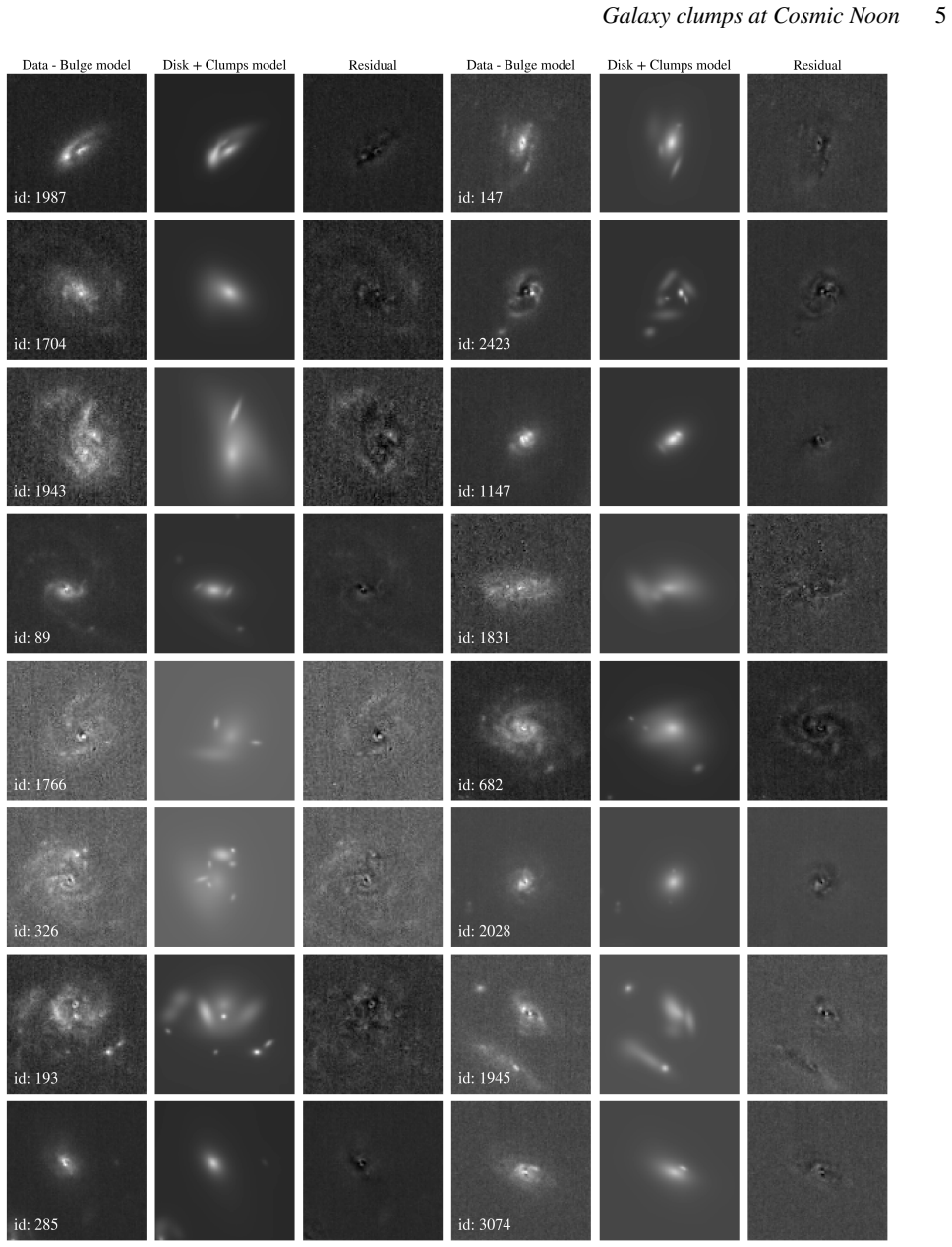
The central mechanism is the two-stage forward-model 'deconstruction' of each galaxy: a bulge+disk model is fit to the F444W image, clumps are detected on contrast images from F150W and added as elliptical Gaussians until the Bayesian information criterion stops improving, and the fixed composite model is then used to deblend photometry in all four NIRCam bands and the ALMA 870 $\mu$m image. This yields the fluxes and sizes that feed the SED fits, which in turn produce the stellar masses and star formation rates. The argument for hierarchy is carried by Eq. (1), the mass–size relation $r_e \propto M_\star^{0.52\pm0.07}$, combined with the completeness limit of about $10^{8.7}\,M_\odot$ below which the mass function is not fitted.
What would settle it
An injection–recovery test that re-fits artificial clumps through the full pipeline and checks whether the recovered half-light radii and fluxes match the injected values at 0.1–0.4 kpc, or an independent high-resolution observation of the same galaxies that resolves the clumps and directly measures their sizes.
Extended reading notes
Core claim
The paper claims that star-forming clumps in massive main-sequence galaxies at $z\sim1.5$ are coherent, multiscale structures: a single population with half-light radii $r_e \sim 0.1$–$1$ kpc and stellar masses $\sim10^{8.0}$–$10^{9.5}\,M_\odot$. It derives an empirical mass–size relation $\log(r_e/\mathrm{kpc}) = 0.52(\pm0.07)\log(M_\star/M_\odot) - 4.98$ and a clump stellar mass function with slope $\alpha=-1.85\pm0.19$, both consistent with the hierarchical, instability-driven picture of star-forming regions in the local universe. The paper interprets the agreement as evidence that clumps at all scales are part of a cascade bounded by the Toomre length (the largest scale on which a disk can fragment, $\sim1$–$5$ kpc) and the Jeans length (the smallest self-gravitating scale, $\sim10$–$500$ pc), and that the apparent divide between lensed and unlensed clump samples is a resolution effect rather than a physical difference. It also reports that over 70% of clumps lie along spiral features seen in the residual near-IR images.
Load-bearing premise
The load-bearing premise is that clump sizes measured down to about 0.1 kpc in F150W, where the point-spread function is about 0.4 kpc, are true sizes and not artifacts of the Gaussian model or of blending with disk and spiral residuals.
Editorial extensions
If this is right
- Clump masses and sizes measured here overlap and extend the lensed clump population, so lensed and unlensed studies can be combined into one mass–size plane.
- The mass–size slope above 0.5 means clump density decreases with size, consistent with gravity/turbulence-regulated structures rather than simple scaled-up star clusters.
- The mass function slope near -2 matches the prediction for disk fragmentation, supporting an in-situ, instability-driven origin for the clump population.
- With over 70% of clumps on spiral features, clump formation and spiral structure appear linked in these massive disks.
- Clumps contribute only 1–20% of stellar mass and 1–30% of SFR per galaxy, bounding their direct role in bulge growth.
Reading between the lines
- If the hierarchy is real, lower-resolution HST-era samples likely blended several sub-clumps into one, overestimating clump masses and sizes; degrading these JWST images to HST resolution and rerunning the pipeline should reproduce the older distributions.
- The similar mass–size scaling to giant molecular clouds suggests each massive clump may have a gas-cloud progenitor of comparable mass; ALMA CO or [CI] maps at matched resolution could test this link directly.
- The inferred hierarchy implies the clump stellar mass function should continue with the same slope below about 10^8 solar masses; deep lensed-field JWST observations can test that continuity.
- The preferential location on spiral arms raises the possibility that spiral-arm compression triggers or concentrates clump formation; resolved H-alpha kinematics could check whether clumps sit at predicted compression sites.
Editorial analysis
A structured set of objections, weighed in public.
Referee Report
Summary. The paper presents a two-stage spatial deconstruction of 32 massive (log M* > 10.5) main-sequence galaxies at z_spec ~ 1.5 using JWST/NIRCam (F115W, F150W, F277W, F444W) and ALMA 870 μm data. The authors fit a bulge+disk model in F444W, detect clumps in F150W contrast images, and then deblend all bands with a fixed-shape bulge+disk+clump model. They report clump stellar masses of 10^8.0–10^9.5 M_sun and half-light radii of 0.1–1 kpc, a mass–size relation r_e ∝ M_*^0.52±0.07 (Eq. 1), and a clump stellar mass function slope α = −1.85±0.19 (Fig. 15). They interpret these as evidence that high-redshift clumps are part of a hierarchical star-forming structure spanning from individual star clusters to kpc-scale complexes, and they find that clumps preferentially lie on residual spiral features. They also report that clumps contribute 1–30% of the host SFR and have elevated sSFR relative to the main sequence.
Significance. If the sub-PSF size measurements are reliable, this is an important step: it is among the first un-lensed studies to resolve clumps down to ~0.1 kpc at z ~ 1.5, bridging the gap between lensed and unlensed samples. The method of simultaneous bulge/disk/clump modeling in native-resolution filters is a genuine advance over aperture-based approaches, and the careful use of BIC for model selection and injection-based completeness is commendable. The mass–size relation and cSMF slope provide quantitative anchors for simulations of disk fragmentation and clump survival. However, the central quantitative claims rest on sizes measured well below the F150W PSF FWHM, and the current validation does not directly test size/flux recovery accuracy; this is the main load-bearing concern.
major comments (4)
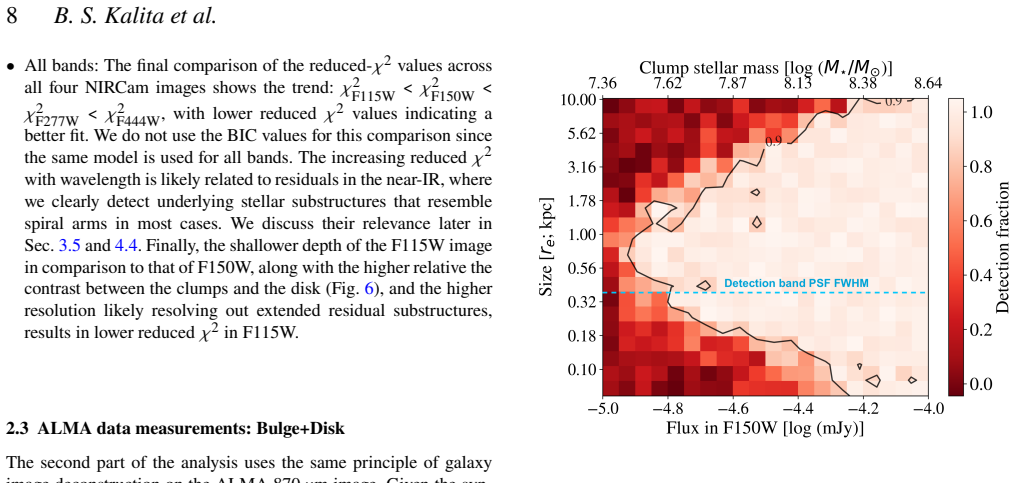
- [Sec. 2.4, Fig. 7] The completeness test in Sec. 2.4 (Fig. 7) determines detection completeness only. The text explicitly states that the artificial clumps are not re-fit after detection, so no information is provided on whether the fitted size and flux of recovered sub-PSF sources are accurate. Yet the paper claims in Sec. 2.4 that 'we can characterize sub-PSF scales' and that results are robust to inclusion/exclusion of sub-PSF clumps. Since Eq. (1) and the cSMF analysis (Sec. 3.4) use sizes in the range 0.2–1 kpc with F150W FWHM ≈ 0.4 kpc, a size–flux degeneracy or PSF mismatch could bias the slope 0.52±0.07 and the completeness-based mass cut of 10^8.7 M_sun. Please add an injection-recovery test that re-fits recovered clumps and reports bias and scatter in size and flux as a function of injected size, flux, and local background, or restrict the quantitative analysis to r_e ≳ 0.4 kpc and demonstrate that the conclusions are unchanged.
- [Sec. 2.2, Appendix A] The uncertainty procedure in Sec. 2.2 and Appendix A injects sources 'of the same size but varied flux' and then 'fixing the flux and varying the sizes.' This measures random uncertainty at the fitted parameter values but cannot detect a systematic bias in sub-PSF Gaussian sizes, which are degenerate with the local disk/spiral residual background and with errors in the PSF model. Because the validity of sizes below the PSF FWHM is a load-bearing premise for Eq. (1) and for the cSMF completeness cut, a direct validation of size recovery accuracy is required.
- [Sec. 3.3, Eq. (1)] The mass–size relation is fitted after discarding clumps with r_e < 0.2 kpc, but the range 0.2–0.4 kpc is still below the F150W PSF FWHM. The detection threshold in Fig. 7 is a strong function of size and flux, so the correlation between M* and r_e among detected clumps may be shaped by incompleteness even within the adopted cuts. The paper should test the stability of the fitted slope when using a size cut at the PSF FWHM (≈0.4 kpc), and/or apply an explicit completeness correction to the mass–size fit.
- [Appendix C, Sec. 3.2] The clump SEDs are fit with a constant star-formation history using only four JWST bands. In this setup, the SFR and sSFR are largely determined by the assumed SFH and the fitted age, and the reported Δlog sSFR offsets of 0–0.4 (Sec. 3.2, Fig. 11) may be partly an artifact of the SFH prior rather than an empirical measurement. The authors should test the sensitivity of the sSFR offsets to alternative SFH parameterizations (e.g., delayed-τ or two-component SFH), or explicitly state that the sSFR offsets are model-dependent.
minor comments (6)
- [Sec. 3.4] The cSMF fitting method is not fully specified; the text gives only 'log(dN/dM★)=α log(M★)−const'. Please state whether the fit is binned or a maximum-likelihood fit, the binning scheme, and how the uncertainty on α is obtained.
- [Sec. 2.1] The PSFs are described as created with PSFEx on the mosaic; please state the number of stars used and the estimated PSF model uncertainty, since PSF errors propagate directly into sub-PSF clump sizes.
- [Sec. 2.2] The phrase 'we use the major-axis value in order for projection effects to not influence our results' is unclear; if the clumps are assumed intrinsically round, the major axis is the deprojected size, but the text should spell this out.
- [Fig. 7] The top x-axis relates mass to size via the average mass-to-light ratio; the caption should note that this conversion carries the 0.5 dex uncertainty discussed in Sec. 2.4.
- [Sec. 3.2] The reduced-χ² cut of 4 is motivated by the behavior of the SED uncertainties; please show the distribution of reduced-χ² values or the uncertainty behavior in a figure, since this cut removes 65 of 167 detected clumps.
- [Sec. 4.2] There is a typo: 'contributution' should be 'contribution'.
Circularity Check
Secondary SFR–stellar mass correlation is partly imposed by the constant-SFH SED model; the central mass–size and mass-function results remain independent empirical fits.
-
self definitional
[Appendix C (SED fitting using CIGALE); Sec. 3.2 (Clump properties); Fig. 8]
"Star-formation history (SFH): Given that the galaxies are selected to be star-forming, with clumps particularly active, we adopt a constant SFR with varying duration (age of the main stellar population). ... We find that the SFR and stellar mass of the clumps are tightly correlated, consistent with the extrapolation of the star-forming main sequence (Fig. 8, with the main sequence from Schreiber et al. 2015)."
In the constant-SFH CIGALE templates, the fitted age ties the two derived quantities together: the present stellar mass is approximately SFR times the population age (times a return fraction), so log SFR and log M* are locked with unit slope once the age is chosen. Reporting a 'tight correlation' between clump SFR and M*, and the accompanying Δlog sSFR offsets up to 0.4, is therefore a restatement of the fitted age differences (Δlog sSFR ≈ −Δlog age) under the adopted SFH rather than an independent empirical measurement. The same constant-SFH assumption is used for bulges and disks, so the clump-versus-host sSFR offset is likewise a ratio of fitted ages.
full rationale
The central quantitative claims — the mass–size relation r_e ∝ M_*^0.52±0.07 (Sec. 3.3, Eq. 1) and the clump stellar mass function slope α = −1.85±0.19 (Sec. 3.4) — are empirical fits to measured F150W sizes and SED-based stellar masses; neither reduces to a fitted parameter renamed as a prediction. The completeness injection test (Sec. 2.4) measures detection only and does not re-fit recovered artificial clumps, so sub-PSF size accuracy remains a validation concern, but that is a robustness limitation rather than circularity. The comparison to lensed clump samples and to the theoretical α ≈ −2 expectation uses external data and theory, and the self-citations to Kalita et al. (2024a,b) enter mainly as methodology and comparison samples, not as the load-bearing justification for the central derivation. The one genuine circularity identified is secondary: the reported SFR–stellar mass correlation and the Δlog sSFR offsets are largely built into the constant-SFH CIGALE assumption, under which SFR and stellar mass are linked through the fitted age. Because the headline hierarchical conclusion rests on the mass–size relation and the mass-function slope rather than on this SFR result, the overall circularity score is moderate, not severe.
Assumptions & free parameters
free parameters (5)
- Fixed Sersic indices for bulge and disk =
n=2, n=1
- Contrast-image smoothing kernel sigma =
3 pixels
- SED reduced-chi2 inclusion cutoff =
4
- F150W mass-to-light conversion slope and intercept =
slope 0.78±0.21, intercept 10.74±1.94
- Clump SFH age in constant star-formation model =
up to ~700 Myr upper limits
assumptions (3)
- domain assumption Rest-frame near-infrared light in F444W traces the same spatial distribution as ALMA 870 micron dust emission.
- domain assumption Detected F150W clumps are coherent structures rather than projection blends of smaller unrelated sources.
- domain assumption Clump SEDs are well described by a constant star-formation history.
Cite this review
Pith. "Pith review of Clumps as multiscale structures in cosmic noon galaxies." pith.science (2026). https://pith.science/paper/FZSCVSAI
@misc{pith2026250103328,
  author       = {Pith},
  title        = {Pith review of: Clumps as multiscale structures in cosmic noon galaxies},
  year         = {2026},
  howpublished = {\url{https://pith.science/paper/FZSCVSAI}},
  note         = {Machine review of arXiv:2501.03328}
}
abstract
Star-forming clumps have been found to significantly influence the star formation of gas-rich $z>1$ galaxies. Using public data from JWST/NIRCam (COSMOS-Web) and ALMA (FMOS-COSMOS), we study a sample of 32 massive ($>10^{10.5}\,\rm M_{\odot}$) main-sequence galaxies at $z_{\rm spec}\sim1.5$ with $\sim0.3\,\rm kpc$ resolution. We create composite morphological models consisting of bulge, disk, and clumps to fully 'deconstruct' the galaxy images. With the resulting measurements of the flux and size of these components, we find the following: (I)The combined contribution of clumps is $1-30\%$ towards the net star formation rate (SFR) of the host while contributing $1-20\%$ to its stellar mass. The clumps show a correlation between their stellar mass and SFR, but have an increased specific-SFR (sSFR) relative to the star-forming main sequence, with offsets ranging from $0\lesssim\Delta\log\rm sSFR\lesssim 0.4$. They feature star formation surface densities of $10^{-2}-10^{2}\,\rm M_{\odot}/yr/kpc^{2}$, consistent with values observed in local star-forming and starburst galaxies. (II)The clumps span a large range of characteristic sizes ($r_{e}\sim0.1-1\,\rm kpc$) and stellar masses ($\sim 10^{8.0-9.5}\,\rm M_{\odot}$). We estimate a mass-size relation ($r_{e}\propto\rm M_{\star}^{\,0.52\pm0.07}$) along with a stellar mass function (slope, $\alpha=-1.85\pm 0.19$), both suggesting a hierarchical nature similar to that expected in star-forming regions in local galaxies. (III)Our measurements agree with the properties of stellar clumps in $z\gtrsim1$ lensed systems, bridging the gap between lensed and unlensed studies by detecting structures at sub-kpc scales.(IV)Clumps are found to be preferentially located along spiral features visible primarily in the residual rest-frame near-IR images. In conclusion, we present an observation-based, coherent picture of star-forming clumps at $z>1$.
Figures


Figures from the paper (14 more)




Reference graph
Works this paper leans on
-
[1]
write newline
" write newline "" before.all 'output.state := FUNCTION fin.entry write newline FUNCTION new.block output.state before.all = 'skip after.block 'output.state := if FUNCTION new.sentence output.state after.block = 'skip output.state before.all = 'skip after.sentence 'output.state := if if FUNCTION not #0 #1 if FUNCTION and 'skip pop #0 if FUNCTION or pop #1...
-
[2]
G., van den Bergh S., Glazebrook K., Ellis R
Abraham R. G., van den Bergh S., Glazebrook K., Ellis R. S., Santiago B. X., Surma P., Griffiths R. E., 1996, @doi [ ] 10.1086/192352 , https://ui.adsabs.harvard.edu/abs/1996ApJS..107....1A 107, 1
doi:10.1086/192352 1996
-
[3]
Adamo A., \"O stlin G., Bastian N., Zackrisson E., Livermore R. C., Guaita L., 2013, @doi [ ] 10.1088/0004-637X/766/2/105 , https://ui.adsabs.harvard.edu/abs/2013ApJ...766..105A 766, 105
-
[4]
Adamo A., et al., 2017, @doi [ ] 10.3847/1538-4357/aa7132 , https://ui.adsabs.harvard.edu/abs/2017ApJ...841..131A 841, 131
-
[5]
Adamo A., et al., 2024, @doi [ ] 10.1038/s41586-024-07703-7 , https://ui.adsabs.harvard.edu/abs/2024Natur.632..513A 632, 513
-
[6]
Astropy Collaboration et al., 2022, @doi [ ] 10.3847/1538-4357/ac7c74 , https://ui.adsabs.harvard.edu/abs/2022ApJ...935..167A 935, 167
-
[7]
Behrendt M., Burkert A., Schartmann M., 2016, @doi [ ] 10.3847/2041-8205/819/1/L2 , https://ui.adsabs.harvard.edu/abs/2016ApJ...819L...2B 819, L2
-
[8]
Behrendt M., Schartmann M., Burkert A., 2019, @doi [ ] 10.1093/mnras/stz1717 , https://ui.adsabs.harvard.edu/abs/2019MNRAS.488..306B 488, 306
Show all 151 references
-
[9]
A., Tafalla M., 2007, @doi [ ] 10.1146/annurev.astro.45.071206.100404 , https://ui.adsabs.harvard.edu/abs/2007ARA&A..45..339B 45, 339
Bergin E. A., Tafalla M., 2007, @doi [ ] 10.1146/annurev.astro.45.071206.100404 , https://ui.adsabs.harvard.edu/abs/2007ARA&A..45..339B 45, 339
2007
-
[10]
N., Accomazzi A., Mink D
Bertin E., 2011, in Evans I. N., Accomazzi A., Mink D. J., Rots A. H., eds, Astronomical Society of the Pacific Conference Series Vol. 442, Astronomical Data Analysis Software and Systems XX. p. 435
2011
-
[11]
B \'e thermin M., et al., 2015, @doi [ ] 10.1051/0004-6361/201425031 , https://ui.adsabs.harvard.edu/abs/2015A&A...573A.113B 573, A113
2015 doi
-
[12]
Bigiel F., Leroy A., Walter F., Brinks E., de Blok W. J. G., Madore B., Thornley M. D., 2008, @doi [ ] 10.1088/0004-6256/136/6/2846 , https://ui.adsabs.harvard.edu/abs/2008AJ....136.2846B 136, 2846
2008 doi
-
[13]
Birrer S., Amara A., 2018, @doi [Physics of the Dark Universe] 10.1016/j.dark.2018.11.002 , https://ui.adsabs.harvard.edu/abs/2018PDU....22..189B 22, 189
2018 doi
-
[14]
Birrer S., et al., 2021, @doi [The Journal of Open Source Software] 10.21105/joss.03283 , https://ui.adsabs.harvard.edu/abs/2021JOSS....6.3283B 6, 3283
2021 doi
-
[15]
K., Salas H., 2019, @doi [ ] 10.1051/0004-6361/201834156 , https://ui.adsabs.harvard.edu/abs/2019A&A...622A.103B 622, A103
Boquien M., Burgarella D., Roehlly Y., Buat V., Ciesla L., Corre D., Inoue A. K., Salas H., 2019, @doi [ ] 10.1051/0004-6361/201834156 , https://ui.adsabs.harvard.edu/abs/2019A&A...622A.103B 622, A103
2019 doi
-
[16]
418, Galactic Bulges
Bournaud F., 2016, in Laurikainen E., Peletier R., Gadotti D., eds, Astrophysics and Space Science Library Vol. 418, Galactic Bulges. p. 355 ( @eprint arXiv 1503.07660 ), @doi 10.1007/978-3-319-19378-6_13
2016 arXiv
-
[17]
G., 2009, @doi [ ] 10.1088/0004-637X/694/2/L158 , https://ui.adsabs.harvard.edu/abs/2009ApJ...694L.158B 694, L158
Bournaud F., Elmegreen B. G., 2009, @doi [ ] 10.1088/0004-637X/694/2/L158 , https://ui.adsabs.harvard.edu/abs/2009ApJ...694L.158B 694, L158
2009 doi
-
[18]
Y., 2021, @doi [ ] 10.1093/mnras/stab2907 , https://ui.adsabs.harvard.edu/abs/2021MNRAS.508.5935B 508, 5935
Brown G., Gnedin O. Y., 2021, @doi [ ] 10.1093/mnras/stab2907 , https://ui.adsabs.harvard.edu/abs/2021MNRAS.508.5935B 508, 5935
2021 doi
-
[19]
Bruzual G., Charlot S., 2003, @doi [ ] 10.1046/j.1365-8711.2003.06897.x , https://ui.adsabs.harvard.edu/abs/2003MNRAS.344.1000B 344, 1000
2003
-
[20]
V., Obreja A., Dutton A
Buck T., Macci \`o A. V., Obreja A., Dutton A. A., Dom \' nguez-Tenreiro R., Granato G. L., 2017, @doi [ ] 10.1093/mnras/stx685 , https://ui.adsabs.harvard.edu/abs/2017MNRAS.468.3628B 468, 3628
2017 doi
-
[21]
C., Kinney A
Calzetti D., Armus L., Bohlin R. C., Kinney A. L., Koornneef J., Storchi-Bergmann T., 2000, @doi [ ] 10.1086/308692 , https://ui.adsabs.harvard.edu/abs/2000ApJ...533..682C 533, 682
2000 doi
-
[22]
M., et al., 2023, @doi [ ] 10.3847/1538-4357/acc2bc , https://ui.adsabs.harvard.edu/abs/2023ApJ...954...31C 954, 31
Casey C. M., et al., 2023, @doi [ ] 10.3847/1538-4357/acc2bc , https://ui.adsabs.harvard.edu/abs/2023ApJ...954...31C 954, 31
2023 doi
-
[23]
G., Dessauges-Zavadsky M., Mayer L., Tamburello V., 2018, @doi [Nature Astronomy] 10.1038/s41550-017-0295-x , https://ui.adsabs.harvard.edu/abs/2018NatAs...2...76C 2, 76
Cava A., Schaerer D., Richard J., P \'e rez-Gonz \'a lez P. G., Dessauges-Zavadsky M., Mayer L., Tamburello V., 2018, @doi [Nature Astronomy] 10.1038/s41550-017-0295-x , https://ui.adsabs.harvard.edu/abs/2018NatAs...2...76C 2, 76
2018 doi
-
[25]
Ceverino D., Dekel A., Mandelker N., Bournaud F., Burkert A., Genzel R., Primack J., 2012, @doi [ ] 10.1111/j.1365-2966.2011.20296.x , https://ui.adsabs.harvard.edu/abs/2012MNRAS.420.3490C 420, 3490
2012
-
[26]
S., Trujillo-Gomez S., Churchill C
Ceverino D., Klypin A., Klimek E. S., Trujillo-Gomez S., Churchill C. W., Primack J., Dekel A., 2014, @doi [ ] 10.1093/mnras/stu956 , https://ui.adsabs.harvard.edu/abs/2014MNRAS.442.1545C 442, 1545
2014 doi
-
[27]
Chabrier G., 2003, @doi [ ] 10.1086/376392 , https://ui.adsabs.harvard.edu/abs/2003PASP..115..763C 115, 763
2003 doi
-
[28]
C., Calzetti D., O'Connell R., 2014, @doi [ ] 10.1088/0004-637X/787/1/17 , https://ui.adsabs.harvard.edu/abs/2014ApJ...787...17C 787, 17
Chandar R., Whitmore B. C., Calzetti D., O'Connell R., 2014, @doi [ ] 10.1088/0004-637X/787/1/17 , https://ui.adsabs.harvard.edu/abs/2014ApJ...787...17C 787, 17
2014 doi
-
[29]
Chevance M., et al., 2020, @doi [ ] 10.1093/mnras/stz3525 , https://ui.adsabs.harvard.edu/abs/2020MNRAS.493.2872C 493, 2872
2020 doi
-
[30]
Claeyssens A., Adamo A., Richard J., Mahler G., Messa M., Dessauges-Zavadsky M., 2023, @doi [ ] 10.1093/mnras/stac3791 , https://ui.adsabs.harvard.edu/abs/2023MNRAS.520.2180C 520, 2180
2023 doi
-
[31]
P., 2024, @doi [arXiv e-prints] 10.48550/arXiv.2410.10974 , https://ui.adsabs.harvard.edu/abs/2024arXiv241010974C p
Claeyssens A., Adamo A., Messa M., Dessauges-Zavadsky M., Richard J., Kramarenko I., Matthee J., Naidu R. P., 2024, @doi [arXiv e-prints] 10.48550/arXiv.2410.10974 , https://ui.adsabs.harvard.edu/abs/2024arXiv241010974C p. arXiv:2410.10974
-
[32]
O., Dale D
Cook D. O., Dale D. A., Lee J. C., Thilker D., Calzetti D., Kennicutt R. C., 2016, @doi [ ] 10.1093/mnras/stw1694 , https://ui.adsabs.harvard.edu/abs/2016MNRAS.462.3766C 462, 3766
2016 doi
-
[33]
L., Hu E
Cowie L. L., Hu E. M., Songaila A., 1995, @doi [ ] 10.1086/117631 , https://ui.adsabs.harvard.edu/abs/1995AJ....110.1576C 110, 1576
1995 doi
-
[34]
Daddi E., Dannerbauer H., Elbaz D., Dickinson M., Morrison G., Stern D., Ravindranath S., 2008, @doi [ ] 10.1086/527377 , https://ui.adsabs.harvard.edu/abs/2008ApJ...673L..21D 673, L21
2008 doi
-
[35]
Daddi E., et al., 2010, @doi [ ] 10.1088/0004-637X/713/1/686 , https://ui.adsabs.harvard.edu/abs/2010ApJ...713..686D 713, 686
2010 doi
-
[36]
Dekel A., Birnboim Y., 2006, @doi [ ] 10.1111/j.1365-2966.2006.10145.x , https://ui.adsabs.harvard.edu/abs/2006MNRAS.368....2D 368, 2
2006
-
[37]
Dessauges-Zavadsky M., Adamo A., 2018, @doi [ ] 10.1093/mnrasl/sly112 , https://ui.adsabs.harvard.edu/abs/2018MNRAS.479L.118D 479, L118
2018 doi
-
[38]
Dessauges-Zavadsky M., Schaerer D., Cava A., Mayer L., Tamburello V., 2017, @doi [ ] 10.3847/2041-8213/aa5d52 , https://ui.adsabs.harvard.edu/abs/2017ApJ...836L..22D 836, L22
2017 doi
-
[39]
Dessauges-Zavadsky M., et al., 2019, @doi [Nature Astronomy] 10.1038/s41550-019-0874-0 , https://ui.adsabs.harvard.edu/abs/2019NatAs...3.1115D 3, 1115
2019 doi
-
[40]
Dessauges-Zavadsky M., et al., 2023, @doi [ ] 10.1093/mnras/stad113 , https://ui.adsabs.harvard.edu/abs/2023MNRAS.519.6222D 519, 6222
2023 doi
-
[41]
D., Onoue M., 2022, @doi [ ] 10.3847/2041-8213/ac9c02 , https://ui.adsabs.harvard.edu/abs/2022ApJ...939L..28D 939, L28
Ding X., Silverman J. D., Onoue M., 2022, @doi [ ] 10.3847/2041-8213/ac9c02 , https://ui.adsabs.harvard.edu/abs/2022ApJ...939L..28D 939, L28
2022 doi
-
[42]
T., Li A., 2007, @doi [ ] 10.1086/511055 , https://ui.adsabs.harvard.edu/abs/2007ApJ...657..810D 657, 810
Draine B. T., Li A., 2007, @doi [ ] 10.1086/511055 , https://ui.adsabs.harvard.edu/abs/2007ApJ...657..810D 657, 810
2007 doi
-
[43]
Elbaz D., et al., 2018, @doi [ ] 10.1051/0004-6361/201732370 , https://ui.adsabs.harvard.edu/abs/2018A&A...616A.110E 616, A110
2018 doi
-
[44]
G., Burkert A., 2010, @doi [ ] 10.1088/0004-637X/712/1/294 , https://ui.adsabs.harvard.edu/abs/2010ApJ...712..294E 712, 294
Elmegreen B. G., Burkert A., 2010, @doi [ ] 10.1088/0004-637X/712/1/294 , https://ui.adsabs.harvard.edu/abs/2010ApJ...712..294E 712, 294
2010 doi
-
[46]
G., Efremov Y
Elmegreen B. G., Efremov Y. N., 1996b, @doi [ ] 10.1086/177554 , https://ui.adsabs.harvard.edu/abs/1996ApJ...466..802E 466, 802
-
[47]
M., Elmegreen B
Elmegreen D. M., Elmegreen B. G., 1987, @doi [ ] 10.1086/165034 , https://ui.adsabs.harvard.edu/abs/1987ApJ...314....3E 314, 3
1987 doi
-
[48]
G., Elmegreen D
Elmegreen B. G., Elmegreen D. M., 2005, @doi [ ] 10.1086/430514 , https://ui.adsabs.harvard.edu/abs/2005ApJ...627..632E 627, 632
2005 doi
-
[49]
M., Elmegreen B
Elmegreen D. M., Elmegreen B. G., 2014, @doi [ ] 10.1088/0004-637X/781/1/11 , https://ui.adsabs.harvard.edu/abs/2014ApJ...781...11E 781, 11
2014 doi
-
[50]
G., Scalo J., 2004, @doi [ ] 10.1146/annurev.astro.41.011802.094859 , https://ui.adsabs.harvard.edu/abs/2004ARA&A..42..211E 42, 211
Elmegreen B. G., Scalo J., 2004, @doi [ ] 10.1146/annurev.astro.41.011802.094859 , https://ui.adsabs.harvard.edu/abs/2004ARA&A..42..211E 42, 211
2004 arXiv
-
[51]
G., Elmegreen D
Elmegreen B. G., Elmegreen D. M., Chandar R., Whitmore B., Regan M., 2006, @doi [ ] 10.1086/503797 , https://ui.adsabs.harvard.edu/abs/2006ApJ...644..879E 644, 879
2006 doi
-
[52]
M., Elmegreen B
Elmegreen D. M., Elmegreen B. G., Ravindranath S., Coe D. A., 2007, @doi [ ] 10.1086/511667 , https://ui.adsabs.harvard.edu/abs/2007ApJ...658..763E 658, 763
2007 doi
-
[53]
G., Bournaud F., Elmegreen D
Elmegreen B. G., Bournaud F., Elmegreen D. M., 2008, @doi [ ] 10.1086/592190 , https://ui.adsabs.harvard.edu/abs/2008ApJ...688...67E 688, 67
2008 doi
-
[54]
M., Elmegreen B
Elmegreen D. M., Elmegreen B. G., Marcus M. T., Shahinyan K., Yau A., Petersen M., 2009, @doi [ ] 10.1088/0004-637X/701/1/306 , https://ui.adsabs.harvard.edu/abs/2009ApJ...701..306E 701, 306
2009 doi
-
[55]
G., Elmegreen D
Elmegreen B. G., Elmegreen D. M., S \'a nchez Almeida J., Mu \ n oz-Tu \ n \'o n C., Dewberry J., Putko J., Teich Y., Popinchalk M., 2013, @doi [ ] 10.1088/0004-637X/774/1/86 , https://ui.adsabs.harvard.edu/abs/2013ApJ...774...86E 774, 86
2013 doi
-
[56]
Epinat B., et al., 2012, @doi [ ] 10.1051/0004-6361/201117711 , https://ui.adsabs.harvard.edu/abs/2012A&A...539A..92E 539, A92
2012 doi
-
[57]
Faure B., Bournaud F., Fensch J., Daddi E., Behrendt M., Burkert A., Richard J., 2021, @doi [ ] 10.1093/mnras/stab272 , https://ui.adsabs.harvard.edu/abs/2021MNRAS.502.4641F 502, 4641
2021 doi
-
[58]
B., et al., 2017, @doi [ ] 10.1093/mnras/stw2281 , https://ui.adsabs.harvard.edu/abs/2017MNRAS.464..491F 464, 491
Fisher D. B., et al., 2017, @doi [ ] 10.1093/mnras/stw2281 , https://ui.adsabs.harvard.edu/abs/2017MNRAS.464..491F 464, 491
2017 doi
-
[59]
M., et al., 2011, @doi [ ] 10.1088/0004-637X/739/1/45 , https://ui.adsabs.harvard.edu/abs/2011ApJ...739...45F 739, 45
F \"o rster Schreiber N. M., et al., 2011, @doi [ ] 10.1088/0004-637X/739/1/45 , https://ui.adsabs.harvard.edu/abs/2011ApJ...739...45F 739, 45
2011 doi
- [60]
-
[61]
E., Smail I., Moran S
Geach J. E., Smail I., Moran S. M., MacArthur L. A., Lagos C. d. P., Edge A. C., 2011, @doi [ ] 10.1088/2041-8205/730/2/L19 , https://ui.adsabs.harvard.edu/abs/2011ApJ...730L..19G 730, L19
2011 doi
-
[62]
Genzel R., et al., 2006, @doi [ ] 10.1038/nature05052 , https://ui.adsabs.harvard.edu/abs/2006Natur.442..786G 442, 786
2006 doi
-
[63]
Genzel R., et al., 2011, @doi [ ] 10.1088/0004-637X/733/2/101 , https://ui.adsabs.harvard.edu/abs/2011ApJ...733..101G 733, 101
2011 doi
-
[64]
Genzel R., et al., 2023, @doi [ ] 10.3847/1538-4357/acef1a , https://ui.adsabs.harvard.edu/abs/2023ApJ...957...48G 957, 48
2023 doi
-
[65]
G \'o mez-Guijarro C., et al., 2018, @doi [ ] 10.3847/1538-4357/aab206 , https://ui.adsabs.harvard.edu/abs/2018ApJ...856..121G 856, 121
2018 doi
-
[66]
Grasha K., et al., 2017, @doi [ ] 10.3847/1538-4357/aa740b , https://ui.adsabs.harvard.edu/abs/2017ApJ...842...25G 842, 25
2017 doi
-
[67]
Guo Y., et al., 2015, @doi [ ] 10.1088/0004-637X/800/1/39 , https://ui.adsabs.harvard.edu/abs/2015ApJ...800...39G 800, 39
2015 doi
-
[68]
Guo Y., et al., 2018, @doi [ ] 10.3847/1538-4357/aaa018 , https://ui.adsabs.harvard.edu/abs/2018ApJ...853..108G 853, 108
2018 doi
-
[69]
M., 2015, @doi [ ] 10.1146/annurev-astro-082214-122324 , https://ui.adsabs.harvard.edu/abs/2015ARA&A..53..583H 53, 583
Heyer M., Dame T. M., 2015, @doi [ ] 10.1146/annurev-astro-082214-122324 , https://ui.adsabs.harvard.edu/abs/2015ARA&A..53..583H 53, 583
2015 doi
-
[70]
Hinojosa-Go \ n i R., Mu \ n oz-Tu \ n \'o n C., M \'e ndez-Abreu J., 2016, @doi [ ] 10.1051/0004-6361/201527066 , https://ui.adsabs.harvard.edu/abs/2016A&A...592A.122H 592, A122
2016 doi
- [71]
-
[73]
F., Kere s D., O \ n orbe J., Faucher-Gigu \`e re C.-A., Quataert E., Murray N., Bullock J
Hopkins P. F., Kere s D., O \ n orbe J., Faucher-Gigu \`e re C.-A., Quataert E., Murray N., Bullock J. S., 2014, @doi [ ] 10.1093/mnras/stu1738 , https://ui.adsabs.harvard.edu/abs/2014MNRAS.445..581H 445, 581
2014 doi
-
[74]
F., et al., 2023, @doi [ ] 10.1093/mnras/stad1902 , https://ui.adsabs.harvard.edu/abs/2023MNRAS.525.2241H 525, 2241
Hopkins P. F., et al., 2023, @doi [ ] 10.1093/mnras/stad1902 , https://ui.adsabs.harvard.edu/abs/2023MNRAS.525.2241H 525, 2241
2023 doi
-
[75]
Huertas-Company M., et al., 2020, @doi [ ] 10.1093/mnras/staa2777 , https://ui.adsabs.harvard.edu/abs/2020MNRAS.499..814H 499, 814
2020 doi
-
[76]
Immeli A., Samland M., Gerhard O., Westera P., 2004, @doi [ ] 10.1051/0004-6361:20034282 , https://ui.adsabs.harvard.edu/abs/2004A&A...413..547I 413, 547
2004 doi
-
[77]
L., et al., 2017, @doi [ ] 10.3847/2041-8213/aa7516 , https://ui.adsabs.harvard.edu/abs/2017ApJ...843L..21J 843, L21
Johnson T. L., et al., 2017, @doi [ ] 10.3847/2041-8213/aa7516 , https://ui.adsabs.harvard.edu/abs/2017ApJ...843L..21J 843, L21
2017 doi
-
[79]
S., et al., 2022, @doi [ ] 10.1051/0004-6361/202243100 , https://ui.adsabs.harvard.edu/abs/2022A&A...666A..44K 666, A44
Kalita B. S., et al., 2022, @doi [ ] 10.1051/0004-6361/202243100 , https://ui.adsabs.harvard.edu/abs/2022A&A...666A..44K 666, A44
2022 doi
- [80]
-
[81]
S., Silverman J
Kalita B. S., Silverman J. D., Daddi E., Bottrell C., Ho L. C., Ding X., Yang L., 2024b, @doi [ ] 10.3847/1538-4357/acfee4 , https://ui.adsabs.harvard.edu/abs/2024ApJ...960...25K 960, 25
-
[82]
Kashino D., et al., 2013, @doi [ ] 10.1088/2041-8205/777/1/L8 , 777, L8
2013 doi
-
[83]
Kashino D., et al., 2019, @doi [ ] 10.3847/1538-4365/ab06c4 , https://ui.adsabs.harvard.edu/abs/2019ApJS..241...10K 241, 10
2019 doi
-
[84]
Kawamura A., et al., 2009, @doi [ ] 10.1088/0067-0049/184/1/1 , https://ui.adsabs.harvard.edu/abs/2009ApJS..184....1K 184, 1
2009 doi
-
[85]
, @doi 10.1109/ICNN.1995.488968
Kennedy J., Eberhart R., 1995, in Proceedings of ICNN'95 - International Conference on Neural Networks. , @doi 10.1109/ICNN.1995.488968
1995
-
[86]
J., De Los Reyes M
Kennicutt Robert C. J., De Los Reyes M. A. C., 2021, @doi [ ] 10.3847/1538-4357/abd3a2 , https://ui.adsabs.harvard.edu/abs/2021ApJ...908...61K 908, 61
2021 doi
-
[87]
Khochfar S., Silk J., 2009, @doi [ ] 10.1088/0004-637X/700/1/L21 , https://ui.adsabs.harvard.edu/abs/2009ApJ...700L..21K 700, L21
2009 doi
-
[88]
C., Filippova N., 2021, @doi [ ] 10.3847/1538-4357/abe934 , https://ui.adsabs.harvard.edu/abs/2021ApJ...911..128K 911, 128
Kim J.-G., Ostriker E. C., Filippova N., 2021, @doi [ ] 10.3847/1538-4357/abe934 , https://ui.adsabs.harvard.edu/abs/2021ApJ...911..128K 911, 128
2021 doi
-
[89]
M., et al., 2007, @doi [ ] 10.1086/520086 , https://ui.adsabs.harvard.edu/abs/2007ApJS..172..196K 172, 196
Koekemoer A. M., et al., 2007, @doi [ ] 10.1086/520086 , https://ui.adsabs.harvard.edu/abs/2007ApJS..172..196K 172, 196
2007 doi
-
[90]
Kruijssen J. M. D., Pfeffer J. L., Reina-Campos M., Crain R. A., Bastian N., 2019, @doi [ ] 10.1093/mnras/sty1609 , https://ui.adsabs.harvard.edu/abs/2019MNRAS.486.3180K 486, 3180
2019 doi
-
[91]
Krumholz M., Burkert A., 2010, @doi [ ] 10.1088/0004-637X/724/2/895 , https://ui.adsabs.harvard.edu/abs/2010ApJ...724..895K 724, 895
2010 doi
-
[92]
R., Dekel A., 2010, @doi [ ] 10.1111/j.1365-2966.2010.16675.x , https://ui.adsabs.harvard.edu/abs/2010MNRAS.406..112K 406, 112
Krumholz M. R., Dekel A., 2010, @doi [ ] 10.1111/j.1365-2966.2010.16675.x , https://ui.adsabs.harvard.edu/abs/2010MNRAS.406..112K 406, 112
2010
-
[93]
B., 1981, @doi [ ] 10.1093/mnras/194.4.809 , https://ui.adsabs.harvard.edu/abs/1981MNRAS.194..809L 194, 809
Larson R. B., 1981, @doi [ ] 10.1093/mnras/194.4.809 , https://ui.adsabs.harvard.edu/abs/1981MNRAS.194..809L 194, 809
1981 doi
-
[94]
L., et al., 2020, @doi [ ] 10.3847/1538-4357/ab5dc3 , https://ui.adsabs.harvard.edu/abs/2020ApJ...888...92L 888, 92
Larson K. L., et al., 2020, @doi [ ] 10.3847/1538-4357/ab5dc3 , https://ui.adsabs.harvard.edu/abs/2020ApJ...888...92L 888, 92
2020 doi
-
[95]
H., Calzetti D., Heckman T
Leitherer C., Li I. H., Calzetti D., Heckman T. M., 2002, @doi [ ] 10.1086/342486 , https://ui.adsabs.harvard.edu/abs/2002ApJS..140..303L 140, 303
2002 doi
-
[96]
K., Walter F., Brinks E., Bigiel F., de Blok W
Leroy A. K., Walter F., Brinks E., Bigiel F., de Blok W. J. G., Madore B., Thornley M. D., 2008, @doi [ ] 10.1088/0004-6256/136/6/2782 , https://ui.adsabs.harvard.edu/abs/2008AJ....136.2782L 136, 2782
2008 doi
-
[97]
K., et al., 2015, @doi [ ] 10.1088/0004-637X/814/2/83 , https://ui.adsabs.harvard.edu/abs/2015ApJ...814...83L 814, 83
Leroy A. K., et al., 2015, @doi [ ] 10.1088/0004-637X/814/2/83 , https://ui.adsabs.harvard.edu/abs/2015ApJ...814...83L 814, 83
2015 doi
-
[98]
Liu Z., et al., 2024, @doi [ ] 10.3847/1538-4357/ad4096 , https://ui.adsabs.harvard.edu/abs/2024ApJ...968...15L 968, 15
2024 doi
-
[99]
C., et al., 2012, @doi [ ] 10.1111/j.1365-2966.2012.21900.x , https://ui.adsabs.harvard.edu/abs/2012MNRAS.427..688L 427, 688
Livermore R. C., et al., 2012, @doi [ ] 10.1111/j.1365-2966.2012.21900.x , https://ui.adsabs.harvard.edu/abs/2012MNRAS.427..688L 427, 688
2012
-
[100]
C., et al., 2015, @doi [ ] 10.1093/mnras/stv686 , https://ui.adsabs.harvard.edu/abs/2015MNRAS.450.1812L 450, 1812
Livermore R. C., et al., 2015, @doi [ ] 10.1093/mnras/stv686 , https://ui.adsabs.harvard.edu/abs/2015MNRAS.450.1812L 450, 1812
2015 doi
-
[101]
E., et al., 2012, @doi [ ] 10.1088/0004-637X/760/1/6 , https://ui.adsabs.harvard.edu/abs/2012ApJ...760....6M 760, 6
Magdis G. E., et al., 2012, @doi [ ] 10.1088/0004-637X/760/1/6 , https://ui.adsabs.harvard.edu/abs/2012ApJ...760....6M 760, 6
2012 doi
-
[102]
E., Primack J., 2014, @doi [ ] 10.1093/mnras/stu1340 , https://ui.adsabs.harvard.edu/abs/2014MNRAS.443.3675M 443, 3675
Mandelker N., Dekel A., Ceverino D., Tweed D., Moody C. E., Primack J., 2014, @doi [ ] 10.1093/mnras/stu1340 , https://ui.adsabs.harvard.edu/abs/2014MNRAS.443.3675M 443, 3675
2014 doi
-
[103]
Mandelker N., Dekel A., Ceverino D., DeGraf C., Guo Y., Primack J., 2017, @doi [ ] 10.1093/mnras/stw2358 , https://ui.adsabs.harvard.edu/abs/2017MNRAS.464..635M 464, 635
2017 doi
-
[104]
J., Haeussler B., Casteels K., Lintott C., Masters K., Simmons B., 2022, @doi [ ] 10.1093/mnras/stac080 , https://ui.adsabs.harvard.edu/abs/2022MNRAS.511.1502M 511, 1502
Margalef-Bentabol B., Conselice C. J., Haeussler B., Casteels K., Lintott C., Masters K., Simmons B., 2022, @doi [ ] 10.1093/mnras/stac080 , https://ui.adsabs.harvard.edu/abs/2022MNRAS.511.1502M 511, 1502
2022 doi
-
[105]
Martig M., Bournaud F., Teyssier R., Dekel A., 2009, @doi [ ] 10.1088/0004-637X/707/1/250 , https://ui.adsabs.harvard.edu/abs/2009ApJ...707..250M 707, 250
2009 doi
-
[106]
F., Ostriker E
McKee C. F., Ostriker E. C., 2007, @doi [ ] 10.1146/annurev.astro.45.051806.110602 , https://ui.adsabs.harvard.edu/abs/2007ARA&A..45..565M 45, 565
2007 arXiv
-
[107]
Mehta V., et al., 2021, @doi [ ] 10.3847/1538-4357/abed5b , https://ui.adsabs.harvard.edu/abs/2021ApJ...912...49M 912, 49
2021 doi
-
[108]
E., 2022, @doi [ ] 10.3847/1538-4357/ac86ce , https://ui.adsabs.harvard.edu/abs/2022ApJ...937...88M 937, 88
Meidt S. E., 2022, @doi [ ] 10.3847/1538-4357/ac86ce , https://ui.adsabs.harvard.edu/abs/2022ApJ...937...88M 937, 88
2022 doi
-
[109]
E., et al., 2023, @doi [ ] 10.3847/2041-8213/acaaa8 , https://ui.adsabs.harvard.edu/abs/2023ApJ...944L..18M 944, L18
Meidt S. E., et al., 2023, @doi [ ] 10.3847/2041-8213/acaaa8 , https://ui.adsabs.harvard.edu/abs/2023ApJ...944L..18M 944, L18
2023 doi
-
[110]
S., Cannon J., 2019, @doi [ ] 10.1093/mnras/stz1337 , https://ui.adsabs.harvard.edu/abs/2019MNRAS.487.4238M 487, 4238
Messa M., Adamo A., \"O stlin G., Melinder J., Hayes M., Bridge J. S., Cannon J., 2019, @doi [ ] 10.1093/mnras/stz1337 , https://ui.adsabs.harvard.edu/abs/2019MNRAS.487.4238M 487, 4238
2019 doi
-
[111]
Messa M., Dessauges-Zavadsky M., Richard J., Adamo A., Nagy D., Combes F., Mayer L., Ebeling H., 2022, @doi [ ] 10.1093/mnras/stac2189 , https://ui.adsabs.harvard.edu/abs/2022MNRAS.516.2420M 516, 2420
2022 doi
- [112]
-
[113]
Messa M., Dessauges-Zavadsky M., Adamo A., Richard J., Claeyssens A., 2024b, @doi [ ] 10.1093/mnras/stae565 , https://ui.adsabs.harvard.edu/abs/2024MNRAS.529.2162M 529, 2162
-
[114]
Me s tri \'c U., et al., 2022, @doi [ ] 10.1093/mnras/stac2309 , https://ui.adsabs.harvard.edu/abs/2022MNRAS.516.3532M 516, 3532
2022 doi
- [115]
-
[116]
A., 2010, @doi [ ] 10.1088/0004-637X/709/1/191 , https://ui.adsabs.harvard.edu/abs/2010ApJ...709..191M 709, 191
Murray N., Quataert E., Thompson T. A., 2010, @doi [ ] 10.1088/0004-637X/709/1/191 , https://ui.adsabs.harvard.edu/abs/2010ApJ...709..191M 709, 191
2010 doi
-
[117]
F., Feldmann R., Kere s D., Faucher-Gigu \`e re C.-A., Murray N., 2017, @doi [ ] 10.1093/mnras/stw2754 , https://ui.adsabs.harvard.edu/abs/2017MNRAS.465..952O 465, 952
Oklop c i \'c A., Hopkins P. F., Feldmann R., Kere s D., Faucher-Gigu \`e re C.-A., Murray N., 2017, @doi [ ] 10.1093/mnras/stw2754 , https://ui.adsabs.harvard.edu/abs/2017MNRAS.465..952O 465, 952
2017 doi
-
[118]
Pan H.-A., et al., 2022, @doi [ ] 10.3847/1538-4357/ac474f , https://ui.adsabs.harvard.edu/abs/2022ApJ...927....9P 927, 9
2022 doi
-
[119]
C., 2014, @doi [ ] 10.1051/0004-6361/201322395 , https://ui.adsabs.harvard.edu/abs/2014A&A...562A...1P 562, A1
Perret V., Renaud F., Epinat B., Amram P., Bournaud F., Contini T., Teyssier R., Lambert J. C., 2014, @doi [ ] 10.1051/0004-6361/201322395 , https://ui.adsabs.harvard.edu/abs/2014A&A...562A...1P 562, A1
2014 doi
-
[120]
Puglisi A., et al., 2019, @doi [ ] 10.3847/2041-8213/ab1f92 , https://ui.adsabs.harvard.edu/abs/2019ApJ...877L..23P 877, L23
2019 doi
-
[121]
Rahman N., et al., 2012, @doi [ ] 10.1088/0004-637X/745/2/183 , https://ui.adsabs.harvard.edu/abs/2012ApJ...745..183R 745, 183
2012 doi
-
[122]
Reina-Campos M., Kruijssen J. M. D., 2017, @doi [ ] 10.1093/mnras/stx790 , https://ui.adsabs.harvard.edu/abs/2017MNRAS.469.1282R 469, 1282
2017 doi
-
[123]
J., Baume G., Feinstein C., 2020, @doi [ ] 10.1051/0004-6361/202038970 , https://ui.adsabs.harvard.edu/abs/2020A&A...644A.101R 644, A101
Rodr \' guez M. J., Baume G., Feinstein C., 2020, @doi [ ] 10.1051/0004-6361/202038970 , https://ui.adsabs.harvard.edu/abs/2020A&A...644A.101R 644, A101
2020 doi
-
[124]
Rujopakarn W., et al., 2023, @doi [ ] 10.3847/2041-8213/accc82 , https://ui.adsabs.harvard.edu/abs/2023ApJ...948L...8R 948, L8
2023 doi
- [125]
-
[126]
Schreiber C., et al., 2015, @doi [ ] 10.1051/0004-6361/201425017 , https://ui.adsabs.harvard.edu/abs/2015A&A...575A..74S 575, A74
2015 doi
-
[127]
Scoville N., et al., 2007, @doi [ ] 10.1086/516585 , https://ui.adsabs.harvard.edu/abs/2007ApJS..172....1S 172, 1
2007 doi
-
[128]
M., Dye S., 2018, @doi [ ] 10.1093/mnras/sty886 , https://ui.adsabs.harvard.edu/abs/2018MNRAS.477.4380S 477, 4380
Sharda P., Federrath C., da Cunha E., Swinbank A. M., Dye S., 2018, @doi [ ] 10.1093/mnras/sty886 , https://ui.adsabs.harvard.edu/abs/2018MNRAS.477.4380S 477, 4380
2018 doi
-
[129]
Sheth K., et al., 2010, @doi [ ] 10.1086/657638 , https://ui.adsabs.harvard.edu/abs/2010PASP..122.1397S 122, 1397
2010 doi
-
[130]
Shibuya T., Ouchi M., Kubo M., Harikane Y., 2016, @doi [ ] 10.3847/0004-637X/821/2/72 , https://ui.adsabs.harvard.edu/abs/2016ApJ...821...72S 821, 72
2016 doi
-
[131]
D., et al., 2015, @doi [ ] 10.1088/0067-0049/220/1/12 , https://ui.adsabs.harvard.edu/abs/2015ApJS..220...12S 220, 12
Silverman J. D., et al., 2015, @doi [ ] 10.1088/0067-0049/220/1/12 , https://ui.adsabs.harvard.edu/abs/2015ApJS..220...12S 220, 12
2015 doi
-
[132]
Soto E., et al., 2017, @doi [ ] 10.3847/1538-4357/aa5da3 , https://ui.adsabs.harvard.edu/abs/2017ApJ...837....6S 837, 6
2017 doi
-
[133]
N., 2010, @doi [ ] 10.1088/0067-0049/191/1/58 , https://ui.adsabs.harvard.edu/abs/2010ApJS..191...58S 191, 58
Spergel D. N., 2010, @doi [ ] 10.1088/0067-0049/191/1/58 , https://ui.adsabs.harvard.edu/abs/2010ApJS..191...58S 191, 58
2010 doi
-
[134]
J., et al., 2010, @doi [ ] 10.1038/nature08773 , https://ui.adsabs.harvard.edu/abs/2010Natur.463..781T 463, 781
Tacconi L. J., et al., 2010, @doi [ ] 10.1038/nature08773 , https://ui.adsabs.harvard.edu/abs/2010Natur.463..781T 463, 781
2010 doi
-
[135]
J., et al., 2013, @doi [ ] 10.1088/0004-637X/768/1/74 , https://ui.adsabs.harvard.edu/abs/2013ApJ...768...74T 768, 74
Tacconi L. J., et al., 2013, @doi [ ] 10.1088/0004-637X/768/1/74 , https://ui.adsabs.harvard.edu/abs/2013ApJ...768...74T 768, 74
2013 doi
-
[136]
Tamburello V., Mayer L., Shen S., Wadsley J., 2015, @doi [ ] 10.1093/mnras/stv1695 , https://ui.adsabs.harvard.edu/abs/2015MNRAS.453.2490T 453, 2490
2015 doi
-
[137]
Tamburello V., Rahmati A., Mayer L., Cava A., Dessauges-Zavadsky M., Schaerer D., 2017, @doi [ ] 10.1093/mnras/stx784 , https://ui.adsabs.harvard.edu/abs/2017MNRAS.468.4792T 468, 4792
2017 doi
- [138]
-
[139]
Tan Q.-H., et al., 2024b, @doi [ ] 10.1051/0004-6361/202347255 , https://ui.adsabs.harvard.edu/abs/2024A&A...684A..23T 684, A23
-
[140]
\"U bler H., et al., 2019, @doi [ ] 10.3847/1538-4357/ab27cc , https://ui.adsabs.harvard.edu/abs/2019ApJ...880...48U 880, 48
2019 doi
-
[141]
Vanzella E., et al., 2017a, @doi [ ] 10.1093/mnras/stx351 , https://ui.adsabs.harvard.edu/abs/2017MNRAS.467.4304V 467, 4304
-
[142]
Vanzella E., et al., 2017b, @doi [ ] 10.3847/1538-4357/aa74ae , https://ui.adsabs.harvard.edu/abs/2017ApJ...842...47V 842, 47
-
[143]
Vanzella E., et al., 2022a, @doi [ ] 10.1051/0004-6361/202141590 , https://ui.adsabs.harvard.edu/abs/2022A&A...659A...2V 659, A2
-
[144]
Vanzella E., et al., 2022b, @doi [ ] 10.3847/2041-8213/ac8c2d , https://ui.adsabs.harvard.edu/abs/2022ApJ...940L..53V 940, L53
-
[145]
C., Zamora-Avil \'e s M., 2019, @doi [ ] 10.1093/mnras/stz2736 , https://ui.adsabs.harvard.edu/abs/2019MNRAS.490.3061V 490, 3061
V \'a zquez-Semadeni E., Palau A., Ballesteros-Paredes J., G \'o mez G. C., Zamora-Avil \'e s M., 2019, @doi [ ] 10.1093/mnras/stz2736 , https://ui.adsabs.harvard.edu/abs/2019MNRAS.490.3061V 490, 3061
2019 doi
-
[146]
V., Donkov S., Klessen R
Veltchev T. V., Donkov S., Klessen R. S., 2013, @doi [ ] 10.1093/mnras/stt699 , https://ui.adsabs.harvard.edu/abs/2013MNRAS.432.3495V 432, 3495
2013 doi
-
[147]
R., et al., 2022, @doi [ ] 10.3847/1538-4365/ac3078 , https://ui.adsabs.harvard.edu/abs/2022ApJS..258...11W 258, 11
Weaver J. R., et al., 2022, @doi [ ] 10.3847/1538-4365/ac3078 , https://ui.adsabs.harvard.edu/abs/2022ApJS..258...11W 258, 11
2022 doi
-
[148]
H., Keto E., Ho L
Wei L. H., Keto E., Ho L. C., 2012, @doi [ ] 10.1088/0004-637X/750/2/136 , https://ui.adsabs.harvard.edu/abs/2012ApJ...750..136W 750, 136
2012 doi
-
[149]
Welch B., et al., 2022, @doi [ ] 10.3847/2041-8213/ac9d39 , https://ui.adsabs.harvard.edu/abs/2022ApJ...940L...1W 940, L1
2022 doi
-
[150]
Wuyts S., et al., 2012, @doi [ ] 10.1088/0004-637X/753/2/114 , https://ui.adsabs.harvard.edu/abs/2012ApJ...753..114W 753, 114
2012 doi
-
[151]
Zanella A., et al., 2015, @doi [ ] 10.1038/nature14409 , https://ui.adsabs.harvard.edu/abs/2015Natur.521...54Z 521, 54
2015 doi
-
[152]
Zhou J.-w., Kroupa P., Dib S., 2024, @doi [ ] 10.1051/0004-6361/202450412 , https://ui.adsabs.harvard.edu/abs/2024A&A...688L..19Z 688, L19
2024 doi
-
[153]
O., Weisz D
Zick T. O., Weisz D. R., Ribeiro B., Kriek M. T., Johnson B. D., Ma X., Bouwens R., 2020, @doi [ ] 10.1093/mnras/staa543 , https://ui.adsabs.harvard.edu/abs/2020MNRAS.493.5653Z 493, 5653
2020 doi
-
[154]
G., Ellis R
van den Bergh S., Abraham R. G., Ellis R. S., Tanvir N. R., Santiago B. X., Glazebrook K. G., 1996, @doi [ ] 10.1086/118020 , https://ui.adsabs.harvard.edu/abs/1996AJ....112..359V 112, 359
1996 doi
-
[155]
write newline
" write newline "" before.all 'output.state := FUNCTION fin.entry write newline FUNCTION new.block output.state before.all = 'skip after.block 'output.state := if FUNCTION new.sentence output.state after.block = 'skip output.state before.all = 'skip after.sentence 'output.stat...
Reviewed August 10, 2026 · model on record in the stance chip above.
Discussion (0). Continue with ORCID to comment.