Ultrafast Fluence-Reversal Fingerprint of Fragile Kondo Hybridization in CePt₂In₇
Pith reviewed 2026-07-01 03:29 UTC · model grok-4.3
The pith
Femtosecond reflectivity in CePt₂In₇ shows fluence reversal that fingerprints photoinduced redistribution of fragile Kondo hybridization.
A machine-rendered reading of the paper's core claim, the machinery that carries it, and where it could break.
Core claim
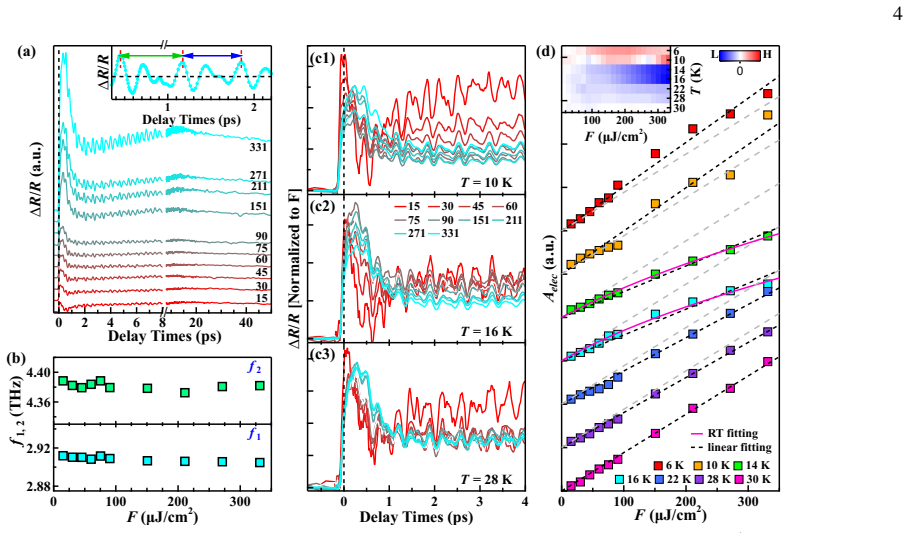
In CePt₂In₇ the phonon-free electronic amplitude A_elec evolves from weak-linear fluence dependence to Rothwarf-Taylor-like suppression and then to anomalous high-fluence enhancement upon cooling through the hybridization crossover. This fluence-reversal fingerprint cannot be produced by a rigid fixed-gap bottleneck and is instead interpreted as an ultrafast optical signature of photoinduced redistribution of a fragile Kondo-hybridized electronic response.
What carries the argument
The fluence-reversal fingerprint observed in the temperature-dependent electronic amplitude A_elec after subtraction of coherent-phonon contributions, which tracks the crossover from bottleneck suppression to high-fluence enhancement.
If this is right
- The Kondo hybridization gap behaves as a dynamically reconfigurable many-body state rather than a fixed electronic structure.
- Ultrafast optical probes can detect photoinduced redistribution of hybridized quasiparticles on femtosecond timescales.
- The 7.4 meV scale extracted from the bottleneck matches the low-energy hybridization gap inferred from other spectroscopies.
- Similar fluence-reversal signatures should appear in other weakly hybridized Kondo lattices near quantum criticality.
Where Pith is reading between the lines
- The same pump-probe protocol could be applied to related Ce- or Yb-based compounds to map how hybridization fragility varies with distance to magnetic order.
- If the reversal is confirmed as a general signature, fluence-dependent measurements might offer a route to optically tune effective masses in heavy-fermion systems.
- The method supplies an independent check on whether the 40 K crossover is dominated by Kondo hybridization or by competing orders.
Load-bearing premise
The Rothwarf-Taylor bottleneck and its fluence reversal arise specifically from the Kondo hybridization gap rather than from other relaxation channels or residual heating.
What would settle it
Observation of identical fluence reversal in a non-Kondo material, or absence of any correlation between the reversal onset and the known hybridization temperature T*, would falsify the assignment to fragile Kondo hybridization.
Figures
read the original abstract
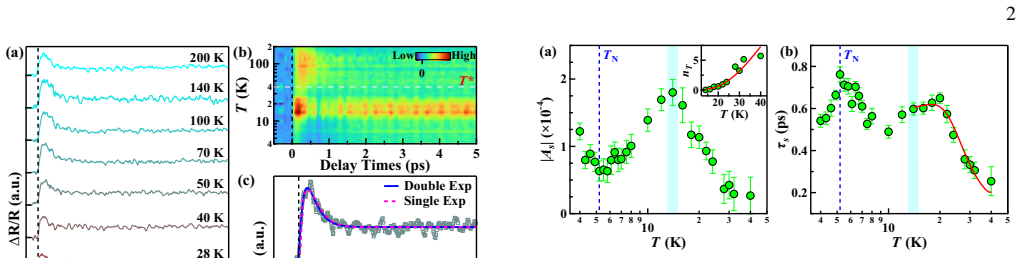
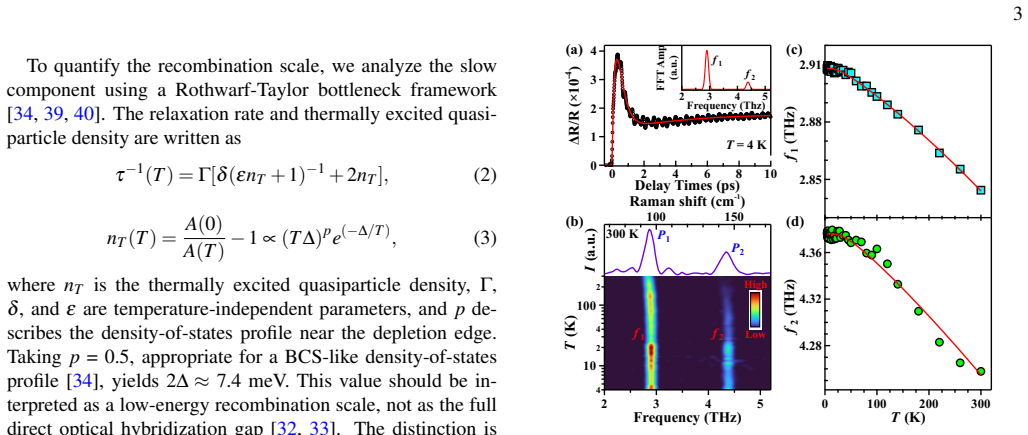
The emergence of heavy quasiparticles in a Kondo lattice is usually viewed as the formation of a low-energy hybridization gap. Whether this gap represents a rigid electronic structure or a fragile many-body state that can be dynamically reconfigured remains a central question for heavy-fermion systems near magnetic order, quantum criticality, and unconventional superconductivity. Here we use femtosecond pump-probe reflectivity to interrogate this problem in the weakly hybridized Kondo-lattice compound CePt$_2$In$_7$. At low fluence, a slow quasiparticle relaxation channel emerges below $T^* \sim$ 40 K and follows a Rothwarf-Taylor bottleneck response with a low-energy recombination scale 2$\Delta \approx$ 7.4 meV. Coherent optical phonons, independently identified by Raman spectroscopy, act as an internal lattice thermometer and rule out large quasi-equilibrium lattice heating as the origin of the nonlinear electronic response. The phonon-free electronic amplitude $A_{\rm elec}$ reveals a fluence-reversal fingerprint: with cooling from the hybridization-crossover regime, the response evolves from weak-linear behavior to Rothwarf-Taylor-like bottleneck suppression and finally to anomalous high-fluence enhancement at the lowest temperatures. This reversal cannot be accounted for by a rigid fixed-gap bottleneck alone and instead identifies an ultrafast optical signature of photoinduced redistribution of a fragile Kondo-hybridized electronic response.
Editorial analysis
A structured set of objections, weighed in public.
Referee Report
Summary. The manuscript reports femtosecond pump-probe reflectivity measurements on CePt₂In₇, identifying a slow quasiparticle relaxation channel below T*∼40 K that follows a Rothwarf-Taylor bottleneck with recombination scale 2Δ≈7.4 meV. Coherent optical phonons (cross-checked by Raman) are used as an internal thermometer to exclude large quasi-equilibrium lattice heating. The phonon-subtracted electronic amplitude A_elec exhibits a fluence-reversal: from weak-linear at higher T, to bottleneck suppression, to anomalous high-fluence enhancement at the lowest temperatures. This reversal is interpreted as an ultrafast optical signature of photoinduced redistribution within a fragile Kondo-hybridized electronic response rather than a rigid fixed-gap bottleneck.
Significance. If the central claim holds, the work supplies a new ultrafast optical fingerprint for the dynamic, reconfigurable character of Kondo hybridization in a weakly hybridized lattice near magnetic order. The phonon-thermometer approach is a clear methodological strength that directly constrains heating artifacts. The result, if robust, would be relevant to ongoing questions about many-body gap fragility in heavy-fermion systems.
major comments (2)
- [Discussion] Abstract and Discussion: the assertion that the observed high-fluence enhancement of A_elec at lowest T 'cannot be accounted for by a rigid fixed-gap bottleneck alone' is load-bearing for the central claim yet is not accompanied by any numerical integration of the Rothwarf-Taylor rate equations with fixed Δ=7.4 meV. No fluence-dependent solutions for A_elec(T, fluence) under the rigid-gap assumption are shown, nor is a direct comparison to the measured reversal presented. This leaves open whether fluence-dependent scattering rates, partial gap filling, or other channels within a fixed-gap model could reproduce the data.
- [Results] Results section on A_elec extraction: the mapping of the 7.4 meV scale and the temperature-dependent amplitude changes specifically to the Kondo hybridization crossover (rather than other relaxation channels) relies on the assumption that the Rothwarf-Taylor form uniquely identifies the hybridization gap; no quantitative test or exclusion of alternative low-energy scales is provided to support this assignment.
minor comments (2)
- Figure captions and Methods: fluence values and temperature ranges corresponding to each regime of the reversal should be explicitly labeled on all relevant panels for immediate readability.
- [Methods] The error analysis and fitting details for the Rothwarf-Taylor parameters (including how the phonon contribution is subtracted to isolate A_elec) are only briefly described; expanding this would aid reproducibility.
Simulated Author's Rebuttal
We thank the referee for their careful reading and constructive comments on our manuscript. We address each major comment below and indicate where revisions will be made to strengthen the presentation.
read point-by-point responses
-
Referee: [Discussion] Abstract and Discussion: the assertion that the observed high-fluence enhancement of A_elec at lowest T 'cannot be accounted for by a rigid fixed-gap bottleneck alone' is load-bearing for the central claim yet is not accompanied by any numerical integration of the Rothwarf-Taylor rate equations with fixed Δ=7.4 meV. No fluence-dependent solutions for A_elec(T, fluence) under the rigid-gap assumption are shown, nor is a direct comparison to the measured reversal presented. This leaves open whether fluence-dependent scattering rates, partial gap filling, or other channels within a fixed-gap model could reproduce the data.
Authors: We agree that explicit numerical solutions of the Rothwarf-Taylor equations under a fixed-gap assumption would provide a stronger quantitative foundation for the claim. In the revised manuscript we will add fluence-dependent integrations (with Δ fixed at 7.4 meV) showing that the model predicts monotonic suppression of the bottleneck amplitude at high fluence, in clear contrast to the observed high-fluence enhancement. This comparison will be presented as a new supplementary figure with direct overlay on the experimental A_elec data. revision: yes
-
Referee: [Results] Results section on A_elec extraction: the mapping of the 7.4 meV scale and the temperature-dependent amplitude changes specifically to the Kondo hybridization crossover (rather than other relaxation channels) relies on the assumption that the Rothwarf-Taylor form uniquely identifies the hybridization gap; no quantitative test or exclusion of alternative low-energy scales is provided to support this assignment.
Authors: The assignment rests on the precise coincidence between the onset of the slow relaxation channel and the independently established hybridization crossover temperature T* ≈ 40 K, together with the extracted gap magnitude being consistent with hybridization scales reported for CePt₂In₇ and related weakly hybridized compounds. The Rothwarf-Taylor form itself is the standard signature of a gapped quasiparticle spectrum with recombination bottleneck. We acknowledge that a more systematic exclusion of alternative gapped channels would be desirable. In revision we will add a short paragraph discussing possible alternative low-energy scales from the literature and why they are inconsistent with the observed temperature onset and fluence-reversal phenomenology. revision: partial
Circularity Check
Purely experimental study with no derivation chain or self-referential reductions
full rationale
The manuscript is an experimental pump-probe reflectivity study that extracts relaxation scales (e.g., 2Δ ≈ 7.4 meV) and amplitudes (A_elec) directly from measured transients, compares them to the Rothwarf-Taylor phenomenology, and interprets the fluence-reversal as evidence for fragile Kondo hybridization. No equations, ansatzes, or fitted parameters are introduced that are then relabeled as independent predictions; the central interpretive claim rests on the observed temperature- and fluence-dependent trends rather than any mathematical loop that reduces to its own inputs. No self-citations serve as load-bearing uniqueness theorems, and the Rothwarf-Taylor reference is used only as a standard phenomenological benchmark. The paper is therefore self-contained against external experimental benchmarks with no circularity.
Axiom & Free-Parameter Ledger
free parameters (1)
- 2Δ =
7.4 meV
axioms (1)
- domain assumption The slow quasiparticle relaxation channel below T* is governed by a Rothwarf-Taylor bottleneck arising from the hybridization gap
Reference graph
Works this paper leans on
-
[1]
Gegenwart, Q
P. Gegenwart, Q. Si, and F. Steglich,Quantum Criticality in Heavy-Fermion Metals, Nature Physics4, 186 (2008)
2008
-
[2]
Kirchner, S
S. Kirchner, S. Paschen, Q. Chen, S. Wirth, D. Feng, J. D. Thompson, and Q. Si, Colloquium: Heavy-electron quantum criticality and single-particle spectroscopy, Rev. Mod. Phys.92, 011002 (2020)
2020
-
[3]
Doniach, The Kondo lattice and weak antiferromagnetism, Physica B+C91, 231 (1977)
S. Doniach, The Kondo lattice and weak antiferromagnetism, Physica B+C91, 231 (1977)
1977
-
[4]
Y . F. Yang, Z. Fisk, H. O. Lee, J. D. Thompson, and D. Pines, Scaling the Kondo lattice, Nature454, 611 (2008)
2008
-
[5]
Y . F. Yang and D. Pines, Emergent states in heavy-electron ma- terials, Proc. Natl. Acad. Sci.109, E3060 (2012)
2012
-
[6]
Aynajian, E
P. Aynajian, E. H. da Silva Neto, A. Gyenis, R. E. Baumbach, J. D. Thompson, Z. Fisk, E. D. Bauer, and A. Yazdani, Visualizing heavy fermions emerging in a quantum critical Kondo lattice, Nature486, 201 (2012)
2012
-
[7]
Q. Y . Chen, D. F. Xu, X. H. Niu, J. Jiang, R. Peng, H. C. Xu, C. H. P. Wen, Z. F. Ding, K. Huang, L. Shu, Y . J. Zhang, H. Lee, V . N. Strocov, M. Shi, F. Bisti, T. Schmitt, Y . B. Huang, P. Dudin, X. C. Lai, S. Kirchner, H. Q. Yuan, and D. L. Feng, Direct observation of how the heavy-fermion state develops in CeCoIn5, Phys. Rev. B96, 045107 (2017)
2017
-
[8]
Q. Y . Chen, D. F. Xu, X. H. Niu, R. Peng, H. C. Xu, C. H. P. Wen, X. Liu, L. Shu, S. Y . Tan, X. C. Lai, Y . J. Zhang, H. Lee, V . N. Strocov, F. Bisti, P. Dudin, J. X. Zhu, H. Q. Yuan, S. Kirchner, and D. L. Feng, Band dependent interlayerf-electron hybridization in CeRhIn5, Phys. Rev. Lett.120, 066403 (2018)
2018
-
[9]
Q. Y . Chen, X. B. Luo, D. H. Xie, M. L. Li, X. Y . Ji, R. Zhou, Y . B. Huang, W. Zhang, W. Feng, Y . Zhang, L. Huang, Q. Q. Hao, Q. Liu, X. G. Zhu, Y . Liu, P. Zhang, X. C. Lai, Q. Si, and S. Y . Tan, Orbital-selective Kondo entanglement and antiferro- magnetic order in USb2, Phys. Rev. Lett.123, 106402 (2019)
2019
-
[10]
Y . Z. Zhao, J. J. Song, Q. Y . Wu, H. Liu, C. Zhang, B. Chen, H. Y . Zhang, Z. H. Chen, Y . B. Huang, X. Q. Ye, Y . H. Yuan, Y . X. Duan, J. He, and J. Q. Meng, Experimental observation of the significant difference between surface and bulk Kondo processes in Kondo lattice YbCu 2Si2, Sci. China Phys. Mech. Astron.67, 247413 (2024)
2024
-
[11]
Y . Wu, Y . J. Zhang, F. Du, B. Shen, H. Zheng, Y . Fang, M. Smidman, C. Cao, F. Steglich, H. Q. Yuan, J. D. Denlinger, and Y . Liu, Anisotropicc-fhybridization in the ferromagnetic quantum critical metal CeRh6Ge4, Phys. Rev. Lett.126, 216406 (2021)
2021
-
[12]
Y . Luo, C. Zhang, Q. Y . Wu, F. Y . Wu, J. J. Song, W. Xia, Y . F. Guo, J. A. Rusz, P. M. Oppeneer, T. Durakiewicz, Y . Z. Zhao, H. Liu, S. Zhu, Y . H. Yuan, X. F. Tang, J. He, S. Y . Tan, Y . B. Huang, Z. Sun, Y . Liu, H. Y . Liu, Y . X. Duan, and J. Q. Meng, Three-dimensional and temperature- dependent electronic structure of the heavy-fermion com- pou...
2020
-
[13]
P. Li, H. Q. Ye, Y . Hu, Y . Fang, Z. G. Xiao, Z. Z. Wu, Z. Y . Shan, R. P. Singh, G. Balakrishnan, D. W. Shen, Y . F. Yang, C. Cao, N. C. Plumb, M. Smidman, M. Shi, J. Kroha, H. Q. Yuan, F. Steglich, and Y . Liu, Photoemission signature of the compe- tition between magnetic order and Kondo effect in CeCoGe 3, Phys. Rev. B107, L201104 (2023)
2023
-
[14]
F. Y . Wu, Q. Y . Wu, C. Zhang, Y . Luo, X. Q. Liu, Y . F. Xu, D. H. Lu, H. Makoto, H. Liu, Y . Z. Zhao, J. J. Song, Y . H. Yuan, H. Y . Liu, J. He, Y . X. Duan, Y . F. Guo, and J. Q. Meng, Itinerant to relocalized transition offelectrons in the Kondo Insulator CeRu4Sn6, Front. Phys.18, 53304 (2023)
2023
-
[15]
Azari, M
N. Azari, M. R. Goeks, M. Yakovlev, M. Abedi, S. R. Dun- siger, S. M. Thomas, J. D. Thompson, P. F. S. Rosa, and J. E. Sonier,µ + Knight shift in UTe2: Evidence for relocalization in a Kondo lattice, Phys. Rev. B108, L081103 (2023). 6
2023
-
[16]
J. J. Song, C. Zhang, Q. Y . Wu, Y . Z. Zhao, J. Rusz, J. J. Joyce, K. S. Graham, P. S. Riseborough, C. G. Olson, H. Liu, B. Chen, Y . H. Yuan, Y . X. Duan, P. H. Tobash, E. D. Bauer, P. M. Op- peneer, T. Durakiewicz, and J. Q. Meng, Relocalization of ura- nium 5felectrons in the antiferromagnetic heavy-fermion su- perconductor UPd 2Al3: Insights from ang...
2024
-
[17]
apRoberts-Warren, A
N. apRoberts-Warren, A. P. Dioguardi, A. C. Shockley, C. H. Lin, J. Crocker, P. Klavins, D. Pines, Y . F. Yang, and N. J. Curro, Kondo liquid emergence and relocalization in the ap- proach to antiferromagnetic ordering in CePt2In7, Phys. Rev. B 83, 060408(R) (2011)
2011
-
[18]
apRoberts-Warren, A
N. apRoberts-Warren, A. P. Dioguardi, A. C. Shockley, C. H. Lin, J. Crocker, P. Klavins, and N. J. Curro, Commensurate an- tiferromagnetism in CePt2In7, a nearly two-dimensional heavy fermion system, Phys. Rev. B81, 180403(R) (2010)
2010
-
[19]
Shishido, T
H. Shishido, T. Yoshihara, D. Nagamiya, S. Noguchi, H. Fuji- wara, and T. Ishida, Single crystal growth of new heavy fermion compounds CePt2In7 and Ce2PtIn8, J. Phys.: Conf. Ser.592, 012007 (2015)
2015
-
[20]
P. H. Tobash, F. Ronning, J. D. Thompson, B. L. Scott, P. J. W. Moll, B. Batlogg, and E. D. Bauer, Single crystal study of the heavy-fermion antiferromagnet CePt 2In7, J. Phys.: Condens. Matter24, 015601 (2012)
2012
-
[21]
Klimczuk, O
T. Klimczuk, O. Walter, L. M ¨uchler, J. W. Krizan, F. Kinnart, and R. J. Cava, Crystal structure and electronic structure of CePt2In7, J. Phys.: Condens. Matter26, 402201 (2014)
2014
-
[22]
M ˚ansson, K
M. M ˚ansson, K. Pr ˇsa, Y . Sassa, P. H. Tobash, E. D. Bauer, C. Rusu, D. Andreica, O. Tjernberg, K. Sedlak, M. Grioni, T. Du- rakiewicz, and J. Sugiyama, Magnetic order in the 2D heavy- fermion system CePt2In7 studied byµ +SR, J. Phys.: Conf. Ser. 551, 012028 (2014)
2014
-
[23]
Sakai, Y
H. Sakai, Y . Tokunaga, S. Kambe, H. Lee, V . A. Sidorov, P. H. Tobash, F. Ronning, E. D. Bauer, and J. D. Thomp- son, NMR/NQR study of pressure-induced superconductor CePt2In7, J. Phys.: Conf. Ser.391, 012057 (2012)
2012
-
[24]
Sakai, Y
H. Sakai, Y . Tokunaga, S. Kambe, H. Lee, V . A. Sidorov, P. H. Tobash, F. Ronning, E. D. Bauer, and J. D. Thompson, Sta- bilization of commensurate antiferromagnetism in CePt2In7 by pressure up to 2.4 GPa: 115In NMR and NQR under zero field, Phys. Rev. B83, 140408(R) (2011)
2011
-
[25]
Sakai, Y
H. Sakai, Y . Tokunaga, S. Kambe, F. Ronning, E. D. Bauer, and J. D. Thompson, Coexistence of antiferromagnetism with superconductivity in CePt2In7: Microscopic phase diagram de- termined by 115In NMR and NQR, Phys. Rev. Lett.112, 206401 (2014)
2014
-
[26]
E. D. Bauer, H. O. Lee, V . A. Sidorov, N. Kurita, K. Gofryk, J. X. Zhu, F. Ronning, R. Movshovich, J. D. Thompson, and T. Park, Pressure-induced superconducting state and effective mass enhancement near the antiferromagnetic quantum critical point of CePt2In7, Phys. Rev. B81, 180507(R) (2010)
2010
-
[27]
B. Shen, L. Yu, K. Liu, S. P. Lyu, X. W. Jia, E. D. Bauer, J. D. Thompson, Y . Zhang, C. L. Wang, C. Hu, Y . Ding, X. Sun, Y . Hu, J. Liu, Q. Gao, L. Zhao, G. D. Liu, Z. Y . Xu, C. T. Chen, Z. Y . Lu, and X. J. Zhou, Electronic structure of heavy fermion system CePt 2In7 from angle-resolved photoemission spectroscopy, Chin. Phys. B26, 077401 (2017)
2017
-
[28]
Demsar, R
J. Demsar, R. D. Averitt, K. H. Ahn, M. J. Graf, S. A. Trug- man, V . V . Kabanov, J. L. Sarrao, and A. J. Taylor, Quasipar- ticle relaxation dynamics in heavy fermion compounds, Phys. Rev. Lett.91, 027401 (2003)
2003
-
[29]
Y . P. Liu, Y . J. Zhang, J. J. Dong, H. Lee, Z. X. Wei, W. L. Zhang, C. Y . Chen, H. Q. Yuan, Y . Yang, and J. Qi, Hybridiza- tion dynamics in CeCoIn 5 revealed by ultrafast optical spec- troscopy, Phys. Rev. Lett.124, 057404 (2020)
2020
-
[30]
Y . H. Pei, Y . J. Zhang, Z. X. Wei, Y . X. Chen, K. Hu, Y . Yang, H. Q. Yuan, and J. Qi, Unveiling the hybridization process in a quantum critical ferromagnet by ultrafast optical spectroscopy, Phys. Rev. B103, L180409 (2021)
2021
-
[31]
B. L. Tan, C. Zhang, Q. Y . Wu, G. H. Dong, H. Liu, B. Chen, J. J. Song, X. Y . Tian, Y . Zhou, H. Y . Liu, Y . X. Duan, Y . G. Shi, and J. Q. Meng, Anisotropic hybridization dynamics in the quasi-one-dimensional Kondo lattice CeCo2Ga8 revealed by ul- trafast optical spectroscopy, Front. Phys.20, 044208 (2025)
2025
-
[32]
Y . Z. Zhao, Q. Y . Wu, C. Zhang, B. Chen, W. Xia, J. J. Song, Y . H. Yuan, H. Liu, F. Y . Wu, X. Q. Ye, H. Y . Zhang, H. Huang, H. Y . Liu, Y . X. Duan, Y . F. Guo, J. He, and J. Q. Meng, Coupling of optical phonons with Kondo effect and mag- netic order in the antiferromagnetic Kondo-lattice compound CeAuSb2, Phys. Rev. B108, 075115 (2023)
2023
-
[33]
R. Y . Chen, S. J. Zhang, E. D. Bauer, J. D. Thompson, and N. L. Wang, Optical spectroscopy and ultrafast pump-probe studies on the heavy-fermion compound CePt 2In7, Phys. Rev. B94, 035161 (2016)
2016
-
[34]
Demsar, J
J. Demsar, J. L. Sarrao, and A. J. Taylor, Dynamics of pho- toexcited quasiparticles in heavy electron compounds, J. Phys.: Condens. Matter18, R281 (2006)
2006
-
[35]
X. Q. Ye, H. Liu, Q. Y . Wu, C. Zhang, X. F. Tang, B. Chen, C. C. Shu, H. Y . Liu, Y . X. Duan, P. M. Oppeneer, and J. Q. Meng, Ultrafast phonon hardening and nonthermal lattice po- tential reconstruction in the charge-density-wave material 1T- TiSe2, Sci. China Phys. Mech. Astron.69, 267412 (2026)
2026
-
[36]
Zhang, Q
C. Zhang, Q. Y . Wu, W. S. Hong, H. Liu, S. X. Zhu, J. J. Song, Y . Z. Zhao, F. Y . Wu, Z. T. Liu, S. Y . Liu, Y . H. Yuan, H. Huang, J. He, S. L. Li, H. Y . Liu, Y . X. Duan, H. Q. Luo, and J. Q. Meng, Ultrafast optical spectroscopy evidence of pseudogap and electron-phonon coupling in an iron-based superconductor KCa2Fe4As4F2, Sci. China Phys. Mech. Ast...
2022
-
[37]
Q. Y . Wu, C. Zhang, B. Z. Li, H. Liu, J. J. Song, B. Chen, H. Y . Liu, Y . X. Duan, J. He, J. Liu, G. H. Cao, and J. Q. Meng, Interplay of electron-phonon coupling, pseudogap, and super- conductivity in CsCa2Fe4As4F2 studied using ultrafast optical spectroscopy, Phys. Rev. B111, L081110 (2025)
2025
-
[38]
See Supplemental Material for additional data of CePt 2In7
-
[39]
Rothwarf and B
A. Rothwarf and B. N. Taylor, Measurement of Recombination Lifetimes in Superconductors, Phys. Rev. Lett.19, 27 (1967)
1967
-
[40]
V . V . Kabanov, J. Demsar, B. Podobnik, and D. Mi- hailovic, Quasiparticle relaxation dynamics in superconduc- tors with different gap structures: Theory and experiments on YBa2Cu3O7−δ , Phys. Rev. B59, 1497 (1999)
1999
-
[41]
K. H. Ahn, M. J. Graf, S. A. Trugman, J. Demsar, R. D. Averitt, J. L. Sarrao, and A. J. Taylor, Ultrafast quasiparticle relaxation dynamics in normal metals and heavy-fermion materials, Phys. Rev. B69, 045114 (2004)
2004
-
[42]
Balkanski, R
M. Balkanski, R. F. Wallis, and E. Haro, Anharmonic effects in light scattering due to optical phonons in silicon, Phys. Rev. B 28, 1928 (1983)
1928
-
[43]
Men ´endez and M
J. Men ´endez and M. Cardona, Temperature dependence of the first-order Raman scattering by phonons in Si, Ge, andα-Sn: Anharmonic effects, Phys. Rev. B29, 2051 (1984)
2051
discussion (0)
Sign in with ORCID, Apple, or X to comment. Anyone can read and Pith papers without signing in.