REVIEW 3 major objections 6 minor 74 references
Multiband topological group-velocity control from slow light to light stopping
T0 review · 3 major / 6 minor · reviewed 2026-07-10 · glm-5.2
Pith's one-line read Long-range coupling flattens topological edge states to stop light
desk verdict NNN couplings in a Harper-Hofstadter lattice flatten edge-state dispersions across three band gaps, giving multiband topological slow light and, at a slightly different coupling, zero-group-velocity 'light stopping.' The theory is clean and the result is genuinely new, but the light-stopping claim needs a gap-separation check and the experimental section is hand-wavy. read the letter →
The pith
A machine-rendered reading of the paper's core claim, the machinery that carries it, and where it could break.
The reading
What carries the argument
Harper-Hofstadter lattice with NNN couplings; band-gap Chern number C_gap^(r) = sum of occupied band Chern numbers; group velocity v_g = dE/dk_x; coupled-mode equation i dA/dt = H A; auxiliary-state-mediated virtual tunneling for experimental realization
What would settle it
If the required coupling regime (delta ~ 0.3, eta ~ 0.3 relative to nearest-neighbor coupling ~ 1) cannot be experimentally realized with sufficient precision and low loss in photonic waveguide arrays, the slow-light and light-stopping claims remain purely theoretical predictions.
Extended reading notes
Core claim
The central mechanism is the introduction of anisotropic long-range NNN couplings into a Harper-Hofstadter lattice. The vertical coupling parameter eta opens a closed band gap, creating additional topological edge channels, while the horizontal coupling parameter delta reshapes and flattens edge-state dispersions. In the regime 0.26 < delta <= 0.3, all slow-light modes maintain positive group velocity, enabling unidirectional topological slow-light transport. At delta = 0.32, zero-group-velocity points emerge where edge-state dispersions become locally flat, causing wave packets to stop propagating while remaining topologically protected. The band-gap Chern numbers (C1_gap = -1, C2_gap = -2,
Load-bearing premise
The feasibility of independently engineering the required long-range coupling ratios via auxiliary-state-mediated virtual tunneling in femtosecond-laser-written waveguides is argued qualitatively without quantitative estimates of achievable detuning, coupling strengths, or loss budgets.
Editorial extensions
If this is right
- Topological delay lines and optical buffers could be built using stopped-light edge states, combining robustness against disorder with controllable storage.
- The counter-chiral slow-light channels in different band gaps could enable bidirectional optical signal routing on a single chip.
- Tuning delta between 0.26 and 0.32 provides a continuous knob from slow-light to light-stopping regimes, useful for reconfigurable photonic circuits.
- The mechanism of flattening edge-state dispersion via long-range coupling may generalize to other topological lattice models beyond Harper-Hofstadter.
Reading between the lines
- If the required coupling ratios (delta, eta ~ 0.3 relative to NN coupling) are experimentally achievable, this could yield on-chip optical memories where light is stored in topologically protected states indefinitely.
- The appearance of negative group velocity regions at delta = 0.32 suggests a transition regime where edge-state transport reverses direction, which could be exploited for directional switching.
- The reliance on auxiliary-state-mediated coupling introduces potential loss channels that may degrade topological protection in practice; quantitative loss analysis would determine whether the light-stopping effect survives realistic imperfections.
Signed reviews
Editorial analysis
A structured set of objections, weighed in public.
Referee Report
Summary. This manuscript introduces long-range next-nearest-neighbor (NNN) couplings into a Harper–Hofstadter (HH) photonic lattice to engineer the group velocity of topological edge states. The authors show that vertical NNN coupling (η) opens a previously closed band gap, while horizontal NNN coupling (δ) flattens edge-state dispersions, enabling topologically protected slow-light transport across all three band gaps. By tuning δ beyond the unidirectional slow-light regime (to δ = 0.32), the group velocity can be reduced to zero at specific operating points, yielding 'topological light-stopping' states. The band-structure calculations, Chern-number assignments, and propagation simulations are internally consistent, and the counter-chiral nature of edge transport in different gaps is verified under both ribbon and fully open boundary conditions. The central theoretical framework is sound and the results represent a meaningful contribution to topological slow-light engineering.
Significance. The simultaneous group-velocity control of multiple counter-chiral edge states in a multiband topological system is a non-trivial extension of existing topological slow-light work, which has largely focused on single edge channels. The use of long-range NNN couplings as a tuning mechanism is physically motivated and the demonstration of broadband slow light across three band gaps is a clear advance. The light-stopping claim, if verified to retain topological protection, would be a notable result. The falsifiable prediction of specific zero-group-velocity operating points (P4–P7) and the quantitative slow-light regime (0.26 < δ ≤ 0.3) are strengths. However, the significance of the light-stopping result is currently tempered by the absence of verification that the stopped states remain topologically isolated from the bulk (see Major Comments).
major comments (3)
- Section V, Fig. 7: The claim of 'topological light stopping' at δ = 0.32 rests on the emergence of zero-group-velocity points (P4–P7) in the edge-state dispersion. However, the manuscript does not verify that these zero-velocity edge states remain energetically separated from the nearest bulk bands. At δ = 0.3, the authors already acknowledge that edge state lx4 hybridizes with nearby bulk states (Section III). At δ = 0.32, where dispersions are flatter, the risk of edge-bulk hybridization is greater. The propagation simulations at t = 80 (Figs. 7(c1–f2)) show 'moderate spatial broadening,' which could signal incipient coupling to bulk modes or significant group-velocity dispersion. Without computing the minimum energy separation ΔE between the zero-velocity edge states and the nearest bulk bands at P4–P7, and confirming that this separation exceeds the wave-packet bandwidth, the 'topo-'
- Section V, Figs. 7(c1–f2): The propagation simulations for the light-stopping regime show spatial broadening of the wave packet over t = 80. The manuscript does not quantify this broadening or distinguish between broadening due to group-velocity dispersion (GVD) within the edge band and broadening due to leakage into bulk states. Since the central claim is topological protection of the stopped state, a quantitative analysis of the wave-packet fidelity (e.g., overlap with the initial edge-state eigenmode as a function of time) would strengthen the claim that the light-stopping effect is genuinely topologically protected.
- Section V: The transition from δ = 0.3 (unidirectional slow light, 0.26 < δ ≤ 0.3) to δ = 0.32 (light stopping) is described, but the manuscript does not discuss whether the band-gap Chern numbers remain unchanged at δ = 0.32. Since the NNN coupling breaks chiral symmetry and redistributes topological invariants, a topological phase transition could occur between δ = 0.3 and δ = 0.32. The authors should verify that the band-gap Chern numbers (C1_gap, C2_gap, C3_gap) = (−1, −2, 1) are unchanged at δ = 0.32, or discuss the implications if they are not.
minor comments (6)
- Section VI: The feasibility discussion for auxiliary-state-mediated long-range coupling is qualitative. A brief quantitative estimate of the required detuning and coupling ratios (δ/κ ≈ 0.3, η/κ ≈ 0.3) in realistic waveguide parameters would substantially improve the experimental outlook.
- Eq. (2): The diagonal elements h_t = 2κ cos(k_x − φ_t) + 2δ cos(2k_x) are defined, but the off-diagonal η terms appear as 'η + η e^{−ik_y}' without explicit factoring. A brief clarifying sentence would help readers parse the matrix structure.
- Section III: The condition 0.26 < δ ≤ 0.3 is stated as ensuring positive group velocity, but the origin of the lower bound 0.26 is not derived or referenced. A brief justification or pointer to a calculation would improve reproducibility.
- Fig. 2 caption: The labels lx1–lx6 are referenced in the caption but their correspondence to specific edge-state branches in panels (c1–e2) is not fully explicit. A direct mapping in the caption would aid the reader.
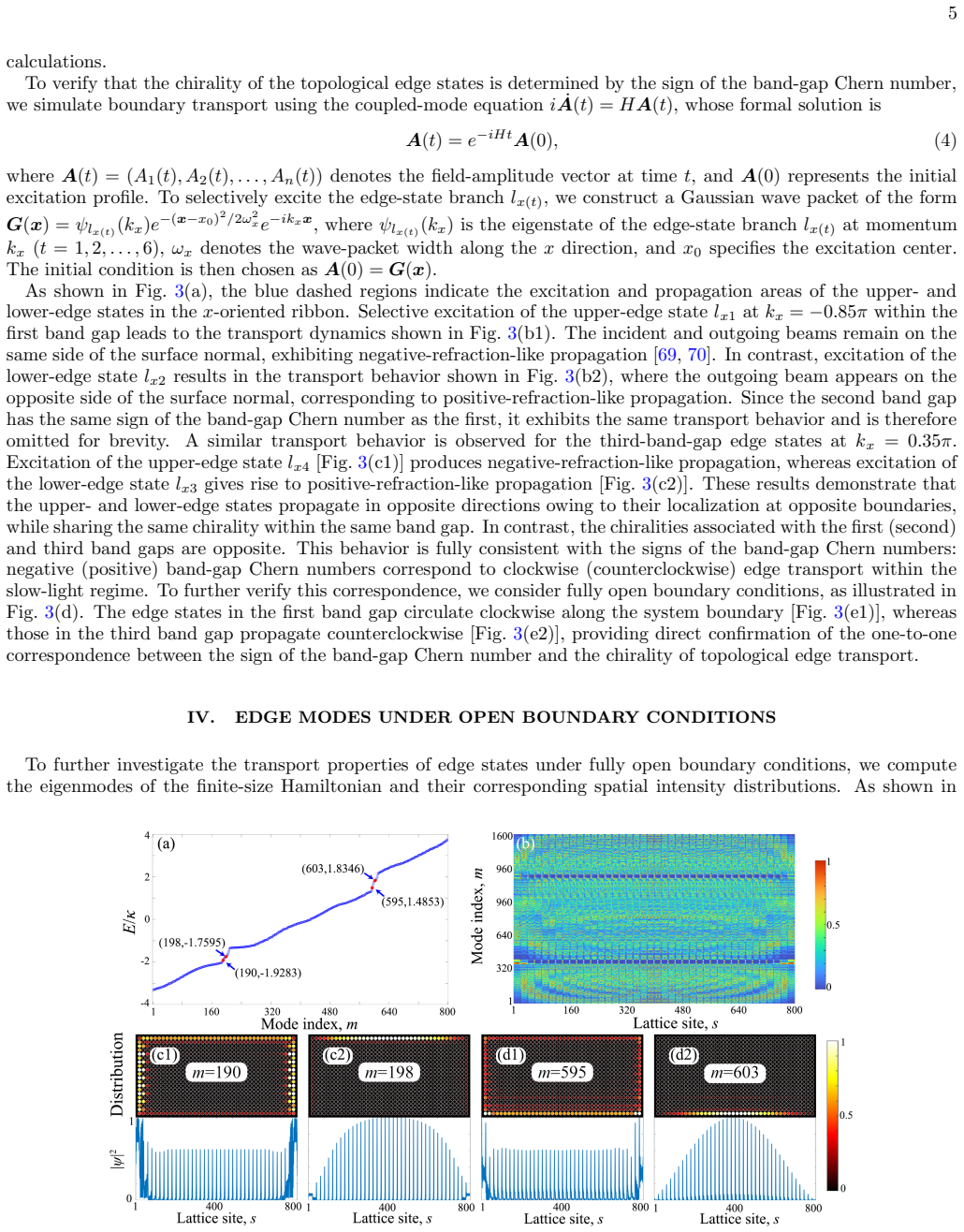
- Section IV: The statement that the second band gap does not support edge transport under fully open boundary conditions, but can be approximated by a ribbon geometry 'over a finite length scale,' is somewhat vague. A quantitative criterion for the required system size would be helpful.
- Reference [8] (J. Liu and S. Lin, Phys. Rev. A 113, 053514 (2026)) appears to be a future date; please verify.
Circularity Check
No circularity detected: the derivation chain is self-contained and no prediction reduces to its inputs by construction
full rationale
The paper's derivation chain is self-contained and does not exhibit circularity. The Hamiltonian (Eq. 2) is constructed from standard tight-binding principles with NNN couplings, not fitted to a target result. The band-gap Chern numbers (Eq. 3) are computed from the band structure via standard topological invariants, not defined in terms of the edge-state properties they aim to explain. The slow-light and light-stopping conditions follow from the definition v_g = ∂E/∂k_x, which is a standard physical definition applied to the computed dispersion, not a fitted model renamed as a prediction. The correspondence between band-gap Chern number signs and edge-state chirality is verified by independent propagation simulations (Figs. 3, 5, 6, 7), not assumed by construction. No 'prediction' or 'first-principles result' reduces to a fitted parameter or to a self-citation chain. The self-citations present (e.g., Refs. 60–67 for NNN coupling mechanisms) provide context and motivation but are not load-bearing for the central mathematical claims, which are derived directly from the stated Hamiltonian. The feasibility discussion (Section VI) is qualitative but does not create circularity—it describes a possible experimental implementation without claiming the theoretical results are confirmed by that implementation. The skeptic's concern about whether zero-velocity edge states remain energetically separated from bulk bands at δ=0.32 is a correctness/verification issue, not a circularity issue.
Assumptions & free parameters
free parameters (4)
- δ (horizontal NNN coupling) =
0.3 (slow-light regime); 0.32 (light-stopping regime)
- η (vertical NNN coupling) =
0.3
- φ (Peierls phase) =
π/2
- κ, g (NN couplings) =
1, 1
assumptions (4)
- domain assumption Tight-binding approximation for photonic waveguide arrays
- domain assumption Adiabatic elimination of auxiliary waveguide modes in large-detuning regime
- standard math Band-gap Chern number determines number and chirality of edge states
- domain assumption Floquet-averaged Hamiltonian equivalent to static HH model
Cite this review
Pith. "Pith review of Multiband topological group-velocity control from slow light to light stopping." pith.science (2026). https://pith.science/paper/G2CWFKEI
@misc{pith2026260708055,
  author       = {Pith},
  title        = {Pith review of: Multiband topological group-velocity control from slow light to light stopping},
  year         = {2026},
  howpublished = {\url{https://pith.science/paper/G2CWFKEI}},
  note         = {Machine review of arXiv:2607.08055}
}
read the original abstract
We introduce next-nearest-neighbor (NNN) couplings into a Harper--Hofstadter photonic lattice to establish a long-range topological photonic platform for group-velocity engineering. We show that the NNN couplings not only open a previously closed band gap but also flatten the dispersion of the edge states, thereby offering a potential route toward topological slow-light control. Theoretical calculations reveal that the band gaps support band-gap Chern numbers with opposite signs. Propagation simulations demonstrate robust, topologically protected slow-light transport of counter-chiral edge states, while the presence of slow-light edge states in all three topological band gaps enables broadband topological slow light. By further tuning the NNN coupling parameter, multiple topological light-stopping states can be realized. These results establish long-range NNN coupling as an effective mechanism for topological group-velocity engineering and provide new design principles for topological slow-light devices, optical delay lines, and integrated multiband photonic systems.
Figures


Figures from the paper (4 more)


Reference graph
Works this paper leans on
-
[1]
A. Yariv and P. Yeh,Optical Waves in Crystals: Propagation and Control of Laser Radiation, A Wiley interscience publication (Wiley, 1984)
work page 1984
-
[2]
M. Born, E. Wolf, and A. Bhatia,Principles of Optics: Electromagnetic Theory of Propagation, Interference and Diffraction of Light(Cambridge University Press, 1999)
work page 1999
-
[3]
T. F. Krauss, Why do we need slow light?, Nature Photonics2, 448 (2008)
work page 2008
-
[4]
E. Parra and J. R. Lowell, Toward applications of slow light technology, Opt. Photon. News18, 40 (2007)
work page 2007
-
[5]
T. F. Krauss, Slow light in photonic crystal waveguides, Journal of Physics D: Applied Physics40, 2666 (2007)
work page 2007
-
[6]
C. Liu, Z. Dutton, C. H. Behroozi, and L. V. Hau, Observation of coherent optical information storage in an atomic medium using halted light pulses, Nature409, 490 (2001)
work page 2001
-
[7]
Baba, Slow light in photonic crystals, Nature Photonics2, 465 (2008)
T. Baba, Slow light in photonic crystals, Nature Photonics2, 465 (2008)
work page 2008
- [8]
Show all 74 references
-
[9]
L. V. Hau, S. E. Harris, Z. Dutton, and C. H. Behroozi, Light speed reduction to 17 metres per second in an ultracold atomic gas, Nature397, 594 (1999)
1999
-
[10]
Fleischhauer, A
M. Fleischhauer, A. Imamoglu, and J. P. Marangos, Electromagnetically induced transparency: Optics in coherent media, Reviews of Modern Physics77, 633 (2005)
2005
-
[11]
Piredda and R
G. Piredda and R. W. Boyd, Slow light by means of coherent population oscillations: laser linewidth effects, J. Eur. Opt. Soc.-Rapid Publ.2, 07004 (2007)
2007
-
[12]
R. W. Boyd and D. J. Gauthier, Controlling the velocity of light pulses, Science326, 1074 (2009)
2009
-
[13]
Cheng, Z
P. Cheng, Z. Xiao, X. Jiang, Y. Liu, and X. Cai, A reconfigurable three-dimensional electromagnetically induced trans- parency metamaterial with low loss and large group delay, Electronics12, 4930 (2023)
2023
-
[14]
J. B. Khurgin, Optical buffers based on slow light in electromagnetically induced transparent media and coupled resonator structures: comparative analysis, Journal of the Optical Society of America B22, 1062 (2005)
2005
-
[15]
Chuang, Significant enhancement of group delay in electromagnetically induced transparency with a spatially partially coherent coupling field, Physical Review A108, 063707 (2023)
Y.-L. Chuang, Significant enhancement of group delay in electromagnetically induced transparency with a spatially partially coherent coupling field, Physical Review A108, 063707 (2023)
2023
-
[16]
A. H. Safavi-Naeiniet al., Electromagnetically induced transparency and slow light with optomechanics, Nature472, 69 (2011)
2011
-
[17]
Lederer, G
F. Lederer, G. I. Stegeman, D. N. Christodoulides, G. Assanto, M. Segev, and Y. Silberberg, Discrete solitons in optics, Physics Reports463, 1 (2008)
2008
-
[18]
L. H. F. et al., Photonic crystal waveguides with semi-slow light and tailored dispersion properties, Optics Express14, 9444 (2006)
2006
-
[19]
S. Lin, Y. Liang, J. Zhang, M. K. Chen, and D. P. Tsai, Controllable flatbands via non-hermiticity, Applied Physics Letters 123, 221103 (2023)
2023
-
[20]
Mori and T
D. Mori and T. Baba, Wideband and low dispersion slow light by chirped photonic crystal waveguide, Optics Express13, 9398 (2005)
2005
-
[21]
Y. H. et al., Slow light with low dispersion in a lattice-shifted photonic crystal waveguide, Optics Letters34, 1072 (2009)
2009
-
[22]
Y. A. V. et al., Active control of slow light on a chip with photonic crystal waveguides, Nature438, 65 (2005)
2005
-
[23]
N. Zhu, Y. Wang, Q. Ren, L. Zhu, M. Yuan, and G. An, Slow light in nonlinear photonic crystal coupled-cavity waveguides, Optics & Laser Technology57, 154 (2014)
2014
-
[24]
Katti, Photonic delay lines based on silicon coupled resonator optical waveguide structures, Silicon10, 2793 (2018)
R. Katti, Photonic delay lines based on silicon coupled resonator optical waveguide structures, Silicon10, 2793 (2018)
2018
-
[25]
Notomi, K
M. Notomi, K. Yamada, A. Shinya, J. Takahashi, C. Takahashi, and I. Yokohama, Extremely large group-velocity dispersion of line-defect waveguides in photonic crystal slabs, Phys. Rev. Lett.87, 253902 (2001)
2001
-
[26]
A. E. Miroshnichenko and Y. S. Kivshar, Sharp bends in photonic crystal waveguides as nonlinear fano resonators., Optics express13 11, 3969 (2005)
2005
-
[27]
F. D. M. Haldane and S. Raghu, Possible realization of directional optical waveguides in photonic crystals with broken time-reversal symmetry, Physical Review Letters100, 013904 (2008)
2008
-
[28]
Z. Wang, Y. D. Chong, J. D. Joannopoulos, and M. Soljaˇ ci´ c, Observation of unidirectional backscattering-immune topo- logical electromagnetic states, Nature461, 772 (2009). 10
2009
-
[29]
Poo, R.-x
Y. Poo, R.-x. Wu, Z. Lin, Y. Yang, and C. T. Chan, Experimental realization of self-guiding unidirectional electromagnetic edge states, Phys. Rev. Lett.106, 093903 (2011)
2011
-
[30]
L. Lu, J. D. Joannopoulos, and M. Soljaˇ ci´ c, Topological photonics, Nature Photonics8, 821 (2014)
2014
-
[31]
Ozawa, H
T. Ozawa, H. M. Price, A. Amo, N. Goldman, M. Hafezi, L. Lu, M. C. Rechtsman, D. Schuster, J. Simon, O. Zilberberg, and I. Carusotto, Topological photonics, Reviews of Modern Physics91, 015006 (2019)
2019
-
[32]
A. B. Khanikaev and A. Al` u, Topological photonics: robustness and beyond, Nature Communications15, 931 (2024)
2024
-
[33]
Cui, R.-Y
X. Cui, R.-Y. Zhang, Z.-Q. Zhang, and C. T. Chan, Photonic𭟋 2 topological anderson insulators, Phys. Rev. Lett.129, 043902 (2022)
2022
-
[34]
Guglielmon and M
J. Guglielmon and M. C. Rechtsman, Broadband topological slow light through higher momentum-space winding, Phys. Rev. Lett.122, 153904 (2019)
2019
-
[35]
L. Yu, H. Xue, and B. Zhang, Topological slow light via coupling chiral edge modes with flatbands, Applied Physics Letters 118, 071102 (2021)
2021
-
[36]
M. C. Rechtsman, J. M. Zeuner, Y. Plotnik, Y. Lumer, D. Podolsky, F. Dreisow, S. Nolte, and M. Segev, Photonic floquet topological insulators, Nature496, 196 (2013)
2013
-
[37]
S. A. Mann and A. Al` u, Broadband topological slow light through brillouin zone winding, Phys. Rev. Lett.127, 123601 (2021)
2021
-
[38]
Ma and G
T. Ma and G. Shvets, All-si valley-hall photonic topological insulator, New Journal of Physics18, 025012 (2016)
2016
-
[39]
Kumar, Y
A. Kumar, Y. J. Tan, N. Navaratna, M. Gupta, P. Pitchappa, and R. Singh, Slow light topological photonics with counter- propagating waves and its active control on a chip, Nature Communications15, 926 (2024)
2024
-
[40]
C. Peng, G. Li, J. Yang, C. Ma, and X. Qi, Tunable slow light in valley-locked topological photonic crystal waveguide, Photonics12, 332 (2025)
2025
-
[41]
Kitagawa, E
T. Kitagawa, E. Berg, M. Rudner, and E. Demler, Topological characterization of periodically driven quantum systems, Physical Review B82, 235114 (2010)
2010
-
[42]
Hafezi, S
M. Hafezi, S. Mittal, J. Fan, A. Migdall, and J. Taylor, Imaging topological edge states in silicon photonics, Nature Photonics7, 1001 (2013)
2013
-
[43]
W. Wang, Z. Shen, Y. J. Tan, K. Chen, and R. Singh, On-chip topological edge state cavities, Light: Science & Applications 14, 330 (2025)
2025
-
[44]
P. G. Harper, Single Band Motion of Conduction Electrons in a Uniform Magnetic Field, Proceedings of the Physical Society A68, 874 (1955)
1955
-
[45]
D. R. Hofstadter, Energy levels and wave functions of bloch electrons in rational and irrational magnetic fields, Phys. Rev. B14, 2239 (1976)
1976
-
[46]
Harper, S
F. Harper, S. H. Simon, and R. Roy, Perturbative approach to flat chern bands in the hofstadter model, Phys. Rev. B90, 075104 (2014)
2014
-
[47]
M¨ oller and N
G. M¨ oller and N. R. Cooper, Fractional chern insulators in harper-hofstadter bands with higher chern number, Phys. Rev. Lett.115, 126401 (2015)
2015
-
[48]
M. M. Wauters and G. E. Santoro, Quantization of the hall conductivity in the harper-hofstadter model, Phys. Rev. B98, 205112 (2018)
2018
-
[49]
Xiang, K
Z.-C. Xiang, K. Huang, Y.-R. Zhang, T. Liu, Y.-H. Shi, C.-L. Deng, T. Liu, H. Li, G.-H. Liang, Z.-Y. Mei, H. Yu, G. Xue, Y. Tian, X. Song, Z.-B. Liu, K. Xu, D. Zheng, F. Nori, and H. Fan, Simulating chern insulators on a superconducting quantum processor, Nature Communications...
2023
-
[50]
Ye and X
F. Ye and X. Sun, Hofstadter butterfly and topological edge states in a quasiperiodic photonic crystal cavity array, Opt. Express30, 26620 (2022)
2022
-
[51]
X. Han, F. Li, D.-X. Qiu, K. Xue, and X. X. Yi, Quantized fields induced topological features in harper-hofstadter model, AAPPS Bulletin33, 1 (2023)
2023
-
[52]
Dutra, M
R. Dutra, M. Vasconcelos, and D. Anselmo, Hofstadter butterfly in optical multilayers, Optical Materials144, 114338 (2023)
2023
-
[53]
S. Lin, L. Wang, L. Yuan, and X. Chen, All-optical control of the photonic hall lattice in a pumped waveguide array, Phys. Rev. Appl.17, 064029 (2022)
2022
-
[54]
Secl` ı, M
M. Secl` ı, M. Capone, and I. Carusotto, Theory of chiral edge state lasing in a two-dimensional topological system, Phys. Rev. Res.1, 033148 (2019)
2019
-
[55]
Amelio and I
I. Amelio and I. Carusotto, Theory of the coherence of topological lasers, Phys. Rev. X10, 041060 (2020)
2020
-
[56]
S. Chen, L. Zheng, L. Zhao, S. Ke, B. Wang, and P. Lu, Photonic skin-topological effects in microring lattices, Opt. Lett. 48, 5763 (2023)
2023
-
[57]
Li, Y.-P
L. Li, Y.-P. Wang, and A.-X. Chen, Hofstadter butterfly and topological edge states in a one-dimensional cavity magnonic lattice, Phys. Rev. A112, 043721 (2025)
2025
-
[58]
M. E. Tai, A. Lukin, M. Rispoli, R. Schittko, T. Menke, D. Borgnia, P. M. Preiss, F. Grusdt, A. M. Kaufman, and M. Greiner, Microscopy of the interacting harper–hofstadter model in the two-body limit, Nature546, 519 (2017)
2017
-
[59]
C. Vega, D. Porras, and A. Gonz´ alez-Tudela, Topological multimode waveguide QED, Phys. Rev. Res.5, 023031 (2023)
2023
-
[60]
G. Kim, J. Suh, D. Lee, N. Park, and S. Yu, Long-range-interacting topological photonic lattices breaking channel- bandwidth limit, Light: Science & Applications13, 189 (2024)
2024
-
[61]
Li, Z.-M
J.-Q. Li, Z.-M. Gao, W.-X. Liu, and X. Wang, Light-matter interactions in a hofstadter lattice with next-nearest-neighbor couplings, Phys. Rev. A108, 043708 (2023)
2023
-
[62]
H. C. Wu, L. Jin, and Z. Song, Nontrivial topological phase with a zero chern number, Phys. Rev. B102, 035145 (2020). 11
2020
-
[63]
Leykam, S
D. Leykam, S. Mittal, M. Hafezi, and Y. D. Chong, Reconfigurable topological phases in next-nearest-neighbor coupled resonator lattices, Phys. Rev. Lett.121, 023901 (2018)
2018
-
[64]
B. A. Bell, K. Wang, A. S. Solntsev, D. N. Neshev, A. A. Sukhorukov, and B. J. Eggleton, Spectral photonic lattices with complex long-range coupling, Optica4, 1433 (2017)
2017
-
[65]
Pellerin, R
F. Pellerin, R. Houvenaghel, W. A. Coish, I. Carusotto, and P. St-Jean, Wave-function tomography of topological dimer chains with long-range couplings, Phys. Rev. Lett.132, 183802 (2024)
2024
-
[66]
P. Wang, L. Huang, H. Zhang, H. Yang, and D. Yan, Unconventional light-matter interactions between giant atoms and structured baths with next-nearest-neighbor couplings, Annalen der Physik536, 2400165 (2024)
2024
-
[67]
C.-X. Du, N. Xu, L. Du, Y. Zhang, and J.-H. Wu, Topological edge states controlled by next-nearest-neighbor coupling and peierls phase in a p t-symmetric trimerized lattice, Opt. Express29, 37722 (2021)
2021
-
[68]
R. Keil, B. Pressl, R. Heilmann, M. Gr¨ afe, G. Weihs, and A. Szameit, Direct measurement of second-order coupling in a waveguide lattice, Applied Physics Letters107(2015)
2015
-
[69]
Pertsch, T
T. Pertsch, T. Zentgraf, U. Peschel, A. Br¨ auer, and F. Lederer, Anomalous refraction and diffraction in discrete optical systems, Phys. Rev. Lett.88, 093901 (2002)
2002
-
[70]
C. Qin, M. Liu, B. Wang, S. Longhi, and P. Lu, Regulating light refraction and reflection using speed-tailored optical potentials, Laser & Photonics Reviews19, e00206 (2025)
2025
-
[71]
L. J. Maczewsky, J. M. Zeuner, S. Nolte, and A. Szameit, Observation of photonic anomalous floquet topological insulators, Nature Communications8, 13756 (2017)
2017
-
[72]
Mukherjee and M
S. Mukherjee and M. C. Rechtsman, Observation of floquet solitons in a topological bandgap, Science368, 856 (2020)
2020
-
[73]
Szameit and S
A. Szameit and S. Nolte, Discrete optics in femtosecond-laser-written photonic structures, Journal of Physics B: Atomic, Molecular and Optical Physics43, 163001 (2010)
2010
-
[74]
Mrejen, H
M. Mrejen, H. Suchowski, T. Hatakeyama, C. Wu, L. Feng, K. O’Brien, Y. Wang, and X. Zhang, Adiabatic elimination- based coupling control in densely packed subwavelength waveguides, Nature Communications6, 7565 (2015)
2015
Reviewed July 10, 2026 · model on record in the stance chip above.
Discussion (0). Continue with ORCID to comment.