REVIEW 3 major objections 4 minor 1 cited by
Landau theory of the density wave transition in trilayer Ruddlesden-Popper nickelates
T0 review · 3 major / 4 minor · reviewed 2026-08-07 · deepseek-v4-flash
Pith's one-line read The paper argues that the intertwined charge and spin density waves in trilayer Ruddlesden-Popper nickelates are driven by spin order, with the charge order appearing primary only because the system sits in or near the first-order region…
desk verdict A clean Landau application that makes a conditional case for SDW-driven order in the trilayer nickelates, undercut mainly by the untested b(T) assumption. read the letter →
The pith
A machine-rendered reading of the paper's core claim, the machinery that carries it, and where it could break.
The reading
What carries the argument
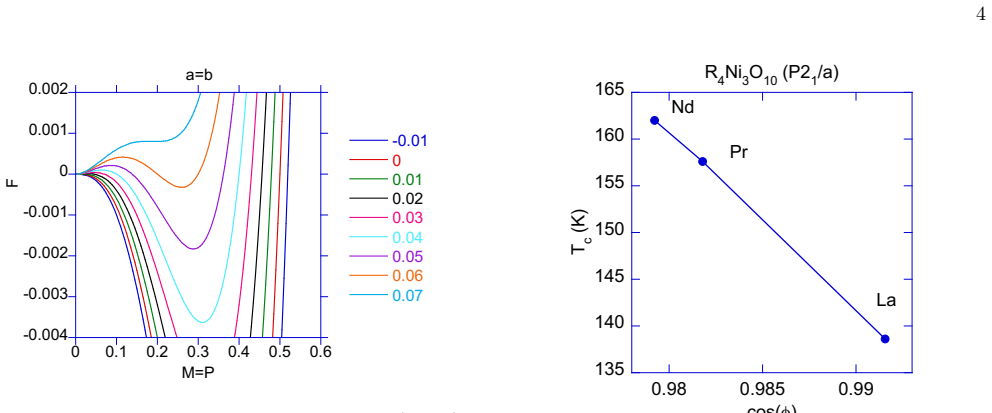
The central object is the two-order-parameter Landau free energy $$F = $aM^{2}$ + $M^{4}$ + $bP^{2}$ + $P^{4}$ - \gamma $M^{2}$ P,$$ with $M$ the SDW order parameter and $P$ the CDW order parameter; the form of the coupling is fixed by the wavevector relation $q_{\rm CDW}=2q_{\rm SDW}$. Because $\gamma$ can be absorbed by rescaling $a$ and $b$, the phase diagram is universal in the plane $(a/\gamma^2, b/\gamma^2)$. Its key feature is a first-order line bounded by $T_1=(0,1/4)$ and $T_2=(1/4,-1/8)$, with simultaneous condensation of both order parameters between $T_1$ and $E_1=(1/8,0)$ and a split transition to the right of $E_1$. The argument then takes horizontal cuts, setting $a = r_{\rm SDW}(T-T_{\rm SDW})$ with $b$ temperature independent, so that the system can enter the coexistence region.
What would settle it
Cool a single crystal of the trilayer nickelate and measure the CDW order parameter intensity with high resolution near Tc. If the CDW and SDW condense at measurably different temperatures, or if the CDW intensity follows a clean square-root law in Tc - T over a wide range rather than the linear or one-third-power behavior predicted near T1, the SDW-driven horizontal-cut scenario would be falsified. A second decisive check is the isotope shift: if replacing 16O with 18O decreased Tc rather than increasing it, the b proportional to 1/M mechanism would fail.
Extended reading notes
Core claim
The central claim is that the density wave transition in the trilayer nickelates is a spin-driven metal-to-metal transition whose charge and spin order parameters are intertwined by a linear-quadratic Landau coupling. Because the CDW wavevector is twice the SDW wavevector, the lowest-order allowed coupling is $-\gamma M^2 P$; after rescaling, the phase diagram is universal, with a first-order line along which $M$ and $P$ condense together. In or near that first-order region, the CDW order parameter $P$ condenses at the same temperature as $M$, so the CDW appears to be a primary order parameter even if the SDW is the true driver. The paper argues that the trilayer materials sit between the special points $T_1$ and $E_1$ of the phase diagram, which is why scattering sees simultaneous, seemingly primary order, and it uses the same picture to explain the observed $T_c$ shifts with tilt angle and oxygen mass.
Load-bearing premise
The analysis assumes b, the coefficient controlling the bare CDW instability, is temperature independent, so the system follows horizontal cuts of the Landau phase diagram; if b itself varies with temperature, the SDW-driven conclusion and the Tc-variation explanation would need modification.
Editorial extensions
If this is right
- If the SDW-driven picture is correct, the apparent primary character of the CDW is a proximity effect from sitting in or near the simultaneous-condensation region, so no independent charge instability is required.
- In the first-order region, the boost of the transition temperature above the bare SDW scale $T_{\rm SDW}$ grows with $\gamma^2/r_{\rm SDW}$, reaching tens of kelvin for the illustrative parameters, which explains why the observed $T_c$ is elevated.
- The rare earth size and pressure trends reduce to the tilt-angle dependence of $b$: smaller rare earths increase the octahedral tilt and raise $T_c$, while pressure reduces the tilt and lowers $T_c$.
- The oxygen isotope shift follows because $b\propto 1/M_{\rm O}$; substituting $^{18}$O for $^{16}$O lowers $b$ by about 11%, raising $T_c$ by roughly 2 K as observed.
- If rare earths smaller than Nd are synthesized and a split transition with the CDW condensing first appears, that would mean $b$ has crossed zero and the horizontal-cut assumption would only be approximate.
Reading between the lines
- An implication the paper leaves implicit: the same phase diagram predicts a signature in critical exponents — linear-in-$(T_c-T)$ CDW order above $T_1$, a $1/3$-power law at $T_1$, and a jump in the first-order region — so precise order-parameter measurements could locate the trilayer material on the diagram without new samples.
- A testable extension: the linear-quadratic mechanism should apply to any system with the 2:1 wavevector relation, so measuring the CDW order parameter exponent in a related nickelate with a different rare earth size would map out where along the $T_1$–$E_1$ segment the material sits.
- The paper notes that the bilayer nickelates, where SDW condenses first, cannot be described by this coupling alone; an editorial extension would be to derive the competing biquadratic coupling microscopically for the bilayer to see which interaction stabilizes the split transition.
Editorial analysis
A structured set of objections, weighed in public.
Referee Report
Summary. The paper presents a Landau theory with a linear-quadratic coupling between a spin density wave order parameter M and a charge density wave order parameter P (Eq. 1), following the phase diagram of Ref. 22. The author argues that in trilayer Ruddlesden-Popper nickelates, the experimental observations are consistent with an SDW-driven transition in which the CDW appears as a primary order parameter only because the system lies in or near the first-order coexistence region between points T1 and E1 of the phase diagram (Sec. III, Figs. 1-3). The paper further proposes that the variation of Tc with rare-earth size, pressure, and oxygen isotope substitution can be understood by assuming b, the bare CDW quadratic coefficient, decreases with increasing octahedral tilt and is proportional to 1/M_O (Sec. IV, Fig. 5). The central claim is explicitly framed as a consistency argument, with the paper conceding in Sec. V that 'more general cuts cannot be ruled out.'
Significance. If the proposed scenario is correct, the paper resolves a genuine puzzle raised in Ref. 8: how both CDW and SDW can appear as primary order parameters even though only the SDW wavevector has significant Fermi-surface nesting. The demonstration that a linear-quadratic coupling near a first-order boundary can make the CDW appear primary is conceptually valuable and directly relevant to the nickelate and cuprate communities. Strengths of the manuscript include the transparent analytic treatment of the cubic equation for P (Eqs. 4-5), the clear presentation of the universal phase diagram, and the explicit falsifiable prediction that a split transition (CDW first, then SDW) may appear for rare earths smaller than Nd. A significant weakness is that the main conclusion is underdetermined: the SDW-driven interpretation rests on the untested assumption of temperature-independent b and on illustrative parameter choices rather than on a quantitative fit to data.
major comments (3)
- [Sec. III, Eq. (1), Fig. 2] The central claim that the data favor an SDW-driven transition depends entirely on the assumption that b is temperature independent, so that a temperature sweep traces a horizontal cut in Fig. 1. This is stated explicitly in Sec. III ('let us first assume that the transition is SDW driven ... b is independent of temperature'), and Sec. V concedes that 'more general cuts cannot be ruled out.' If b has its own temperature dependence, the system follows a diagonal cut and can cross the T1-E1 first-order boundary even when the CDW is the driving instability; in that case the simultaneous condensation of M and P is a generic feature of crossing a first-order line and does not identify the SDW as primary. The paper provides no experimental test of b(T). This is a load-bearing gap because the abstract and introduction present the SDW-driven scenario as the main conclusion, whereas the manuscript only establishes consistency under a specific, untested assumption.
- [Sec. IV] The explanation of the Tc variation with rare-earth size, pressure, and isotope substitution relies on two additional assumptions: that b decreases with increasing octahedral tilt angle, and that b is proportional to 1/M_O. The latter is asserted in Sec. IV ('b should be proportional to 1/M') without microscopic justification or reference. The quantitative match to the observed ~2 K isotope shift is not a parameter-free test: Fig. 2 uses γ=2 and r_SDW=2 chosen for illustration, and the magnitude of the effect is sensitive to these choices. The authors should either provide a microscopic argument for the b ∝ 1/M_O scaling or explicitly label the isotope-shift discussion as a plausibility argument rather than a quantitative prediction.
- [Secs. I and V] The proposed mechanism for the systematic Tc variation (via changes in b) requires the system to be in the first-order region between T1 and E1, because Sec. V notes that above T1 the transition temperature is independent of b. However, the experimental order of the transition is disputed: neutron and x-ray data are consistent with a continuous transition, while specific heat and µSR data suggest first-order or weakly first-order behavior (Sec. I). If the transition turns out to be continuous, the system must lie above T1, and the presented explanation of the Tc variation with rare-earth size, pressure, and isotope substitution would not operate. The paper mentions this conditional in passing but does not discuss how the central claim would be affected if the transition is continuous. A more explicit treatment of this scenario is needed to assess the robustness of the SDW-driven interpretation.
minor comments (4)
- [Sec. II, text above Eq. (1)] The rescaling definition 'a = a2/√a4, b = b2/√b4' implicitly assumes positive quartic coefficients; for the first-order regime this is valid, but it would be helpful to state this explicitly.
- [Fig. 1 caption] The caption says 'Above T1 (with x=0), both order parameters also condense simultaneously but in a continuous fashion'; this is correct but could be confusing because in Fig. 2 the x-axis label is 'a, b' while Fig. 1 uses a/γ^2 and b/γ^2. Please ensure the axes and parameter definitions are consistent across figures.
- [Sec. IV] The statement 'since b should be proportional to 1/M' should cite a specific microscopic model or else be marked as an assumption; as written it appears as a derivation but is not supported by any calculation.
- [Sec. V] The phrase 'This clears up a major mystery' is a bit strong for a consistency argument that rests on untested assumptions; consider tempering the language to match the level of evidence presented.
Circularity Check
No significant circularity: the Landau analysis is a conditional consistency study, and the SDW-driven premise is explicitly assumed rather than derived from the data.
full rationale
The paper's free energy and universal phase diagram are taken from independent prior work (Ref. 22, Zachar-Kivelson-Emery), not generated by the present claim. The central analysis is explicitly conditional: Section III states 'let us first assume that the transition is SDW driven' and defines that assumption as temperature-independent b (horizontal cuts). The subsequent comparison with data is a consistency test, not a reduction: the model produces specific M(T) and P(T) forms (Figures 3a-3d) that could in principle disagree with the observed simultaneous condensing, and the paper notes that a vertical or diagonal cut would place the system in a different regime (e.g., split transition). The explanation of Tc variation with tilt, pressure, and isotope mass is also conditional on assumed b-dependences (b decreasing with tilt, b proportional to 1/M_O); these are underdetermined auxiliary hypotheses, not inputs that already contain the output. The paper explicitly concedes the limitation: 'more general cuts [23, 26] of the phase diagram cannot be ruled out' (Section V). The author's coauthorship on Refs. 8/9/19 provides experimental context and the original SDW conjecture, but the paper does not rely on a uniqueness theorem or on a fitted parameter renamed as a prediction; gamma=2 and r=2 are illustrative choices, not fitted to the isotope shift or Tc. No equation is shown to be identical, by construction, to its own input, so under the hard rules no circular step can be quoted. The concern about underdetermination and untested b(T) independence belongs to correctness/evidence risk, not circularity.
Assumptions & free parameters
free parameters (4)
- r_SDW =
2 (choice for Figures 2-3)
- gamma =
2 (choice for Figures 2-3)
- T_SDW =
140 K
- b =
varied 0 to 1 in figures
assumptions (6)
- standard math Cubic equation root formulas and free-energy minimization.
- domain assumption Only linear-quadratic coupling -gamma M^2 P is included; biquadratic and higher-order terms are neglected.
- domain assumption M and P are real scalars and density waves are unidirectional with a single wavevector, q_CDW = 2 q_SDW.
- domain assumption Layer indices are implicit because the SDW occurs only on outer planes and CDW is uniform within planes.
- ad hoc to paper The transition is SDW driven, so b is temperature independent (horizontal cuts).
- ad hoc to paper b decreases with increasing tilt angle and is proportional to 1/M_oxygen.
Cite this review
Pith. "Pith review of Landau theory of the density wave transition in trilayer Ruddlesden-Popper nickelates." pith.science (2026). https://pith.science/paper/G2HOMQIE
@misc{pith2026250607870,
  author       = {Pith},
  title        = {Pith review of: Landau theory of the density wave transition in trilayer Ruddlesden-Popper nickelates},
  year         = {2026},
  howpublished = {\url{https://pith.science/paper/G2HOMQIE}},
  note         = {Machine review of arXiv:2506.07870}
}
read the original abstract
This paper presents a Landau treatment of the incommensurate density wave transition observed in trilayer Ruddlesden-Popper nickelates and uses this to address the nature of the transition. The data are consistent with a spin driven transition with the distinct intertwining of charge and spin order due to being in or proximate to the first order transition region of the Landau phase diagram. From this approach, one also obtains an understanding of the variation of the transition temperature with rare earth size, pressure, and oxygen isotope substitution.
Figures


Forward citations
Cited by 1 Pith paper
-
Multiorbital character of the density wave in trilayer nickelate superconductors
Polarized Raman scattering on trilayer nickelate La4Ni3O10 identifies 114 meV as the density wave gap, with a multiorbital origin involving both Ni-3d orbitals.
Reference graph
Works this paper leans on
-
[1]
This clears up a major mystery that was raised in Ref
or one is close enough to point T1 in the second order region. This clears up a major mystery that was raised in Ref. 8. Note that above T1, the phase transition temper- ature is independent of b, the coefficient of the quadratic CDW term in the free energy. Rather, in the data, Tc is seen to vary as the rare earth size is varied, pressure is varied, or u...
-
[2]
H. Sun, M. Huo, X. Hu, J. Li, Z. Liu, Y. Han, L. Tang, Z. Mao, P. Yang, B. Wang, J. Cheng, D.-X. Yao, G.-M. Zhang, and M. Wang, Signatures of superconductivity near 80 K in a nickelate under high pressure, Nature621, 493 (2023)
2023
-
[3]
Y. Zhu, D. Peng, E. Zhang, B. Pan, X. Chen, L. Chen, H. Ren, F. Liu, Y. Hao, N. Li, Z. Xing, F. Lan, J. Han, J. Wang, D. Jia, H. Wo, Y. Gu, Y. Gu, L. Ji, W. Wang, H. Gou, Y. Shen, T. Ying, X. Chen, W. Yang, H. Cao, C. Zheng, Q. Zeng, J.-g. Guo, and J. Zhao, Superconduc- tivity in pressurized trilayer La4Ni3O10−δ single crystals, Nature 631, 531 (2024)
work page 2024
-
[4]
P. W. Anderson, The resonating valence bond state in La 2CuO4 and superconductivity, Science 235, 1196 (1987)
1987
-
[5]
P. A. Lee, N. Nagaosa, and X.-G. Wen, Doping a mott in- sulator: Physics of high-temperature superconductivity, Rev. Mod. Phys. 78, 17 (2006)
2006
-
[6]
D. J. Scalapino, A common thread: The pairing inter- action for unconventional superconductors, Rev. Mod. Phys. 84, 1383 (2012)
2012
-
[7]
M. Shi, Y. Li, Y. Wang, D. Peng, S. Yang, H. Li, K. Fan, K. Jiang, J. He, Q. Zeng, D. Song, B. Ge, Z. Xiang, Z. Wang, J. Ying, T. Wu, and X. Chen, Absence of su- perconductivity and density-wave transition in ambient- pressure tetragonal La 4Ni3O10, Nature Communications 16, 2887 (2025)
work page 2025
-
[8]
M. Shi, D. Peng, Y. Li, Z. Xing, Y. Wang, K. Fan, H. Li, R. Wu, Z. Zeng, Q. Zeng, J. Ying, T. Wu, and X. Chen, Prerequisite of superconductivity: SDW rather than tetragonal structure in double-layer La 3Ni2O7−x (2025), arXiv:2501.14202
arXiv 2025
Show all 33 references
-
[9]
Zhang, D
J. Zhang, D. Phelan, A. S. Botana, Y.-S. Chen, H. Zheng, M. Krogstad, S. G. Wang, Y. Qiu, J. A. Rodriguez- Rivera, R. Osborn, S. Rosenkranz, M. R. Norman, and J. F. Mitchell, Intertwined density waves in a metallic nickelate, Nature Communications 11, 6003 (2020)
2020
-
[10]
A. M. Samarakoon, J. Strempfer, J. Zhang, F. Ye, Y. Qiu, J.-W. Kim, H. Zheng, S. Rosenkranz, M. R. Norman, J. F. Mitchell, and D. Phelan, Bootstrapped dimensional crossover of a spin density wave, Phys. Rev. X13, 041018 (2023)
2023
-
[11]
Q. Li, C. He, X. Zhu, J. Si, X. Fan, and H.-H. Wen, Contrasting physical properties of the trilayer nickelates Nd4Ni3O10 and Nd 4Ni3O8, Science China Physics, Me- chanics & Astronomy 64, 227411 (2020)
2020
-
[12]
G. A. Pan, Q. Song, D. Ferenc Segedin, M.-C. Jung, H. El-Sherif, E. E. Fleck, B. H. Goodge, S. Doyle, D. C´ ordova Carrizales, A. T. N’Diaye, P. Shafer, H. Paik, L. F. Kourkoutis, I. El Baggari, A. S. Botana, C. M. Brooks, and J. A. Mundy, Synthesis and electronic prop- erties...
2022
-
[13]
M. Li, J. Gong, Y. Zhu, Z. Chen, J. Zhang, E. Zhang, Y. Li, R. Yin, S. Wang, J. Zhao, D.-L. Feng, Z. Du, and Y.-J. Yan, Direct visualization of an incommensurate unidirectional charge density wave in La 4Ni3O10, Phys. Rev. B 112, 045132 (2025)
2025
-
[14]
Huangfu, G
S. Huangfu, G. D. Jakub, X. Zhang, O. Blacque, P. Puphal, E. Pomjakushina, F. O. von Rohr, and A. Schilling, Anisotropic character of the metal-to-metal transition in Pr 4Ni3O10, Phys. Rev. B 101, 104104 (2020)
2020
-
[15]
Zhang, H
J. Zhang, H. Zheng, Y.-S. Chen, Y. Ren, M. Yonemura, A. Huq, and J. F. Mitchell, High oxygen pressure floating zone growth and crystal structure of the metallic nicke- lates R4Ni3O10(R=La, Pr), Phys. Rev. Mater. 4, 083402 (2020)
2020
-
[16]
D. Rout, S. R. Mudi, M. Hoffmann, S. Spachmann, R. Klingeler, and S. Singh, Structural and physical prop- erties of trilayer nickelates R 4Ni3O10 (R=La, Pr, and Nd), Phys. Rev. B 102, 195144 (2020)
2020
-
[17]
Khasanov, T
R. Khasanov, T. J. Hicken, I. Plokhikh, V. Sazgari, L. Keller, V. Pomjakushin, M. Bartkowiak, S. Kr´ olak, M. J. Winiarski, J. A. Krieger, H. Luetkens, T. Klimczuk, D. J. Gawryluk, and Z. Guguchia, Identical suppression of spin and charge density wave transitions in La4Ni3O10 ...
2025
-
[18]
J. M. Tranquada, B. J. Sternlieb, J. D. Axe, Y. Naka- mura, and S. Uchida, Evidence for stripe correlations of spins and holes in copper oxide superconductors, Nature 375, 561 (1995). 6
1995
-
[19]
Fawcett, Spin-density-wave antiferromagnetism in chromium, Rev
E. Fawcett, Spin-density-wave antiferromagnetism in chromium, Rev. Mod. Phys. 60, 209 (1988)
1988
-
[20]
X. Jia, Y. Shen, H. LaBollita, X. Chen, J. Zhang, Y. Li, H. Zhao, M. G. Kanatzidis, M. Krogstad, H. Zheng, A. Said, A. Alatas, S. Rosenkranz, D. Phe- lan, M. P. M. Dean, M. R. Norman, J. F. Mitchell, A. S. Botana, and Y. Cao, Lattice-charge coupling in a trilayer nickelate wit...
2025
-
[21]
Khasanov, V
R. Khasanov, V. Sazgari, I. Plokhikh, M. Medarde, E. Pomjakushina, T. Klimczuk, S. Kr´ olak, M. J. Winiarski, T. J. Hicken, H. Luetkens, Z. Guguchia, and D. J. Gawryluk, Oxygen-isotope effect on the density wave transitions in La 3Ni2O7 and La 4Ni3O10 (2025), arXiv:2504.08290
2025
-
[22]
S. Lee, R. Chen, and L. Balents, Landau theory of charge and spin ordering in the nickelates, Phys. Rev. Lett.106, 016405 (2011)
2011
-
[23]
Zachar, S
O. Zachar, S. A. Kivelson, and V. J. Emery, Landau the- ory of stripe phases in cuprates and nickelates, Phys. Rev. B 57, 1422 (1998)
1998
-
[24]
Shi and L.-Q
Y. Shi and L.-Q. Chen, Sublattice-dependent antiferro- magnetic transitions in rare earth nickelates, Phys. Rev. Lett. 130, 186801 (2023)
2023
-
[25]
Holakovsk´ y, A new type of the ferroelectric phase tran- sition, Physica Status Solidi (b) 56, 615 (1973)
J. Holakovsk´ y, A new type of the ferroelectric phase tran- sition, Physica Status Solidi (b) 56, 615 (1973)
1973
-
[26]
Etxebarria, J
I. Etxebarria, J. M. Perez-Mato, and P. B. and, The role of trilinear couplings in the phase transitions of aurivillius compounds, Ferroelectrics 401, 17 (2010)
2010
-
[27]
K. W. Post, A. S. McLeod, M. Hepting, M. Bluschke, Y. Wang, G. Cristiani, G. Logvenov, A. Charnukha, G. X. Ni, P. Radhakrishnan, M. Minola, A. Pasupathy, A. V. Boris, E. Benckiser, K. A. Dahmen, E. W. Carl- son, B. Keimer, and D. N. Basov, Coexisting first- and second-order el...
2018
-
[28]
Shen and G.-W
L. Shen and G.-W. Chern, Cell dynamics simulations of coupled charge and magnetic phase transformation in correlated oxides, Phys. Rev. E 103, 032134 (2021)
2021
-
[29]
Medarde, P
M. Medarde, P. Lacorre, K. Conder, F. Fauth, and A. Furrer, Giant 16O−18O isotope effect on the metal- insulator transition of RNiO 3 perovskites (R = Rare Earth), Phys. Rev. Lett. 80, 2397 (1998)
1998
-
[30]
Huangfu, X
S. Huangfu, X. Zhang, and A. Schilling, Correlation between the tolerance factor and phase transition in A4−xBxNi3O10 (A and B = La, Pr and Nd; x = 0, 1, 2, and 3), Phys. Rev. Res. 2, 033247 (2020)
2020
-
[31]
Catalano, M
S. Catalano, M. Gibert, J. Fowlie, J. ´I˜ niguez, J.-M. Triscone, and J. Kreisel, Rare-earth nickelates RNiO 3: thin films and heterostructures, Reports on Progress in Physics 81, 046501 (2018)
2018
-
[32]
Olafsen, H
A. Olafsen, H. Fjellv ˚ ag, and B. C. Hauback, Crys- tal structure and properties of Nd 4Co3O10+δ and Nd4Ni3O10−δ, Journal of Solid State Chemistry 151, 46 (2000)
2000
-
[33]
Khasanov, T
R. Khasanov, T. J. Hicken, D. J. Gawryluk, V. Saz- gari, I. Plokhikh, L. P. Sorel, M. Bartkowiak, S. B¨ otzel, F. Lechermann, I. M. Eremin, H. Luetkens, and Z. Guguchia, Pressure-enhanced splitting of density wave transitions in La 3Ni2O7−δ, Nature Physics 21, 430 (2025)
2025
Reviewed August 7, 2026 · model on record in the stance chip above.
Discussion (0). Continue with ORCID to comment.