REVIEW 3 major objections 3 minor 48 references
WFRFT-aided Power-efficient Multi-beam Directional Modulation Schemes Based on Frequency Diverse Array
T0 review · 3 major / 3 minor · reviewed 2026-08-14 · deepseek-v4-flash
Pith's one-line read Weighted Fourier transform saves power and blocks eavesdroppers
desk verdict A plausible power-efficiency trick (replace AN with a keyed WFRFT) with a clean Bob-side story, but the printed WFRFT definition doesn't add up and the 'same location' security claim is sold too hard. read the letter →
The pith
A machine-rendered reading of the paper's core claim, the machinery that carries it, and where it could break.
The reading
What carries the argument
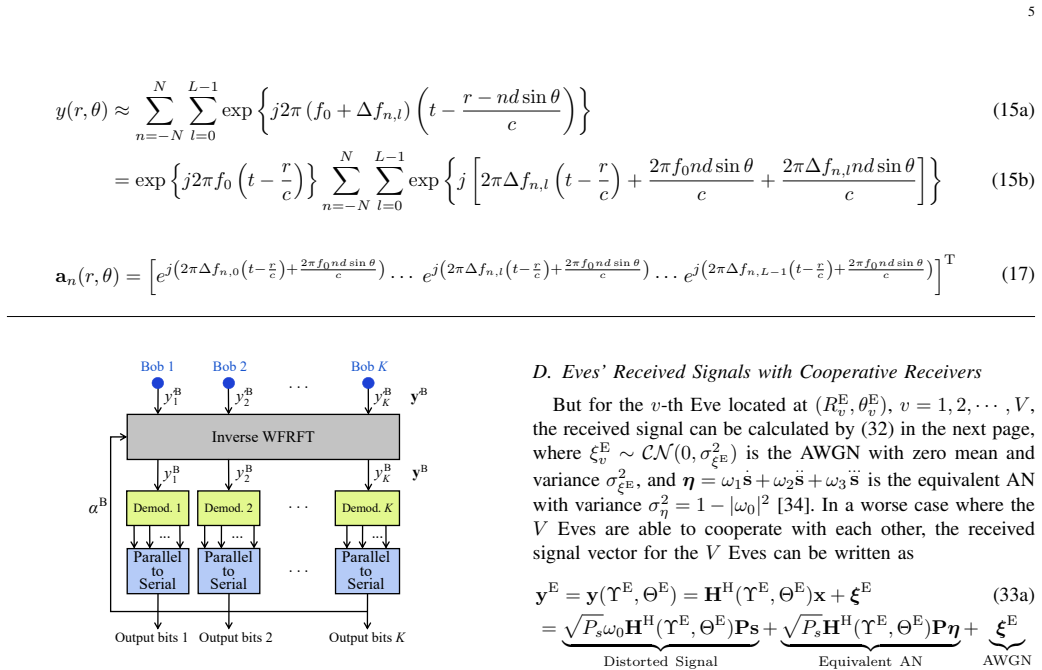
The load-bearing object is the 4-order weighted fractional Fourier transform $F^\alpha(s)=\omega_0 s+\omega_1\dot{s}+\omega_2\ddot{s}+\omega_3\dddot{s}$, in which $\dot{s}$ is the normalized discrete Fourier transform of the symbol vector and the four weights $\omega_i$ are functions of one real parameter $\alpha$ and two integer vectors $(M_V,N_V)$ via Eq. (3). What carries the argument is the claimed additive property $F^{-\alpha}F^{\alpha}=I$, which makes Bob's receiver a simple inverse transform, and the claimed preservation of complex Gaussian noise statistics, which keeps the noise in Eqs. (31) and (45) white with the same variance. The secret parameters serve as the key; for anyone without them the same transform splits the signal into a distorted part and an equivalent-noise part with variance $1-|\omega_0|^2$, exactly mimicking the role of injected AN but at zero power cost.
What would settle it
Evaluate the coefficients of Eq. (3) at $M_V=N_V=[0\,0\,0\,0]^T$ and compare them with Eq. (4), then compute $F^{-0.5}F^{0.5}$ on a random QPSK vector using the same coefficient formula the simulations use. If the inverse transform does not return the original vector to machine precision, the receiver equations (30b) and (44b) are not valid, and the claimed SNR saving and neighbor-security results would need to be recomputed with a transform whose inverse property actually holds.
Extended reading notes
Core claim
The paper's central claim is that WFRFT can replace artificial noise without sacrificing the directional-modulation guarantee. After Alice computes $u=F^{\alpha_A}(s)$ and precodes with the Moore-Penrose pseudo-inverse of the Bob steering matrix, a Bob who knows $\alpha_A$ applies $F^{-\alpha_A}$ and obtains exactly $\sqrt{P_s}s_k+\xi_k$ for his own symbol, with Gaussian noise of unchanged variance. An Eve who does not know the WFRFT key receives $\sqrt{P_s}\omega_0 h_E^H P s + \sqrt{P_s}h_E^H P\eta + \xi_E$, where the second term is the equivalent AN; even an Eve at the same range and angle as a Bob is left with the $\omega_1\dot{s}+\omega_2\ddot{s}+\omega_3\dddot{s}$ component and cannot demodulate. This yields the paper's two headline results: power efficiency (about 1 dB SNR gain at BER $10^{-3}$ for $\beta_1=0.9$, with the gain tied to the AN power split) and neighbor security (positive secrecy rate when an AN-based scheme's secrecy rate collapses to zero because an Eve shares a Bob's location).
Load-bearing premise
The entire recovery and equivalent-noise analysis depends on the multi-parameter WFRFT of Eq. (3) being a genuine invertible transform: $F^{-\alpha}F^{\alpha}$ must be the identity, and it must send complex Gaussian noise to complex Gaussian noise; as written, Eq. (3) does not reduce to the single-parameter coefficients in Eq. (4) when $M_V=N_V=[0\,0\,0\,0]^T$, so the paper does not actually demonstrate that the transform used in its simulations has these properties.
Editorial extensions
If this is right
- A transmitter can remove the artificial-noise branch entirely and spend all transmit power on the information-bearing precoded signal, which is the source of the roughly 1 dB SNR gain at BER $10^{-3}$ with $\beta_1=0.9$.
- An Eve located at exactly a Bob's position no longer receives an unscrambled copy of that Bob's symbols, because the WFRFT's equivalent-AN term remains in her observation unless the WFRFT parameters have been leaked.
- Independent receivers can be served in the same frame with different modulations (BPSK, QPSK, 8PSK in the paper's simulations) and with different WFRFT block lengths, so the scheme supports heterogeneous multi-user traffic without per-user AN allocation.
- The secrecy rate of the proposed scheme stays positive when the secrecy rate of the AN baseline is zero (an Eve sharing a Bob's location), and it degrades more slowly than the AN scheme's as the number of cooperating Eves grows.
- Practical robustness is claimed within a window: about 0.5 dB SNR loss for a $2^\circ$ angle error or a 1 km range error, about 1 dB for both together, and about 0.5 dB for a WFRFT parameter mismatch of $\Delta\alpha=0.05$.
Reading between the lines
- Inference: The same 'substitute a keyed transform for injected noise' trick need not be tied to FDA; any null-space precoder (phased array, MIMO) could host it, so the power-efficiency result likely generalizes to other multi-beam DM architectures.
- Inference: Neighbor security is keyed security, not unconditional information-theoretic security: a collocated Eve who obtains the WFRFT parameters would decode as well as Bob unless parameters are refreshed, so the scheme's guarantee in practice rests on the key-establishment layer and on refreshing the parameters regularly.
- Inference: The 1 dB figure is quoted at one operating point ($\beta_1=0.9$, BER $10^{-3}$); at smaller $\beta_1$ the AN overhead is larger, so the WFRFT scheme's advantage should widen, and a parametric curve of the saving versus $\beta_1$ would make the comparison complete.
- Inference: Because the WFRFT is computed via FFT, the added complexity is $O(Q\log Q)$ per data path, which suggests the scheme scales to long blocks and large arrays; extending it to multi-path channels would require the Bobs to equalize the channel before the inverse transform, which is a natural next test.
Signed reviews
Editorial analysis
A structured set of objections, weighed in public.
Referee Report
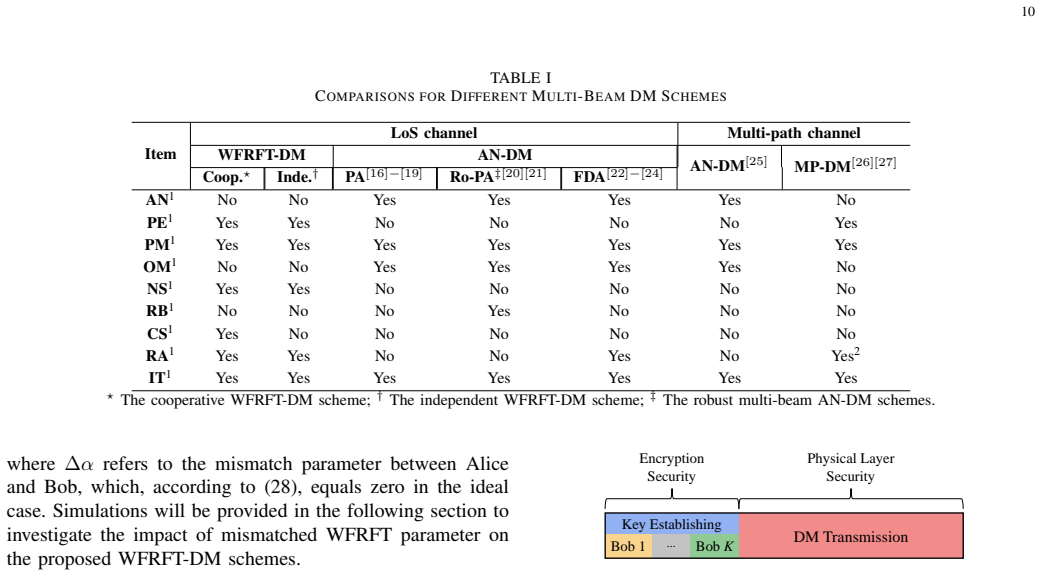
Summary. The paper proposes two power-efficient multi-beam directional modulation schemes for FDA LoS channels, replacing artificial noise with a secret-parameter weighted fractional Fourier transform. In the cooperative scheme, Alice applies one WFRFT to the K-symbol vector and precodes it to K Bobs; Bobs share their received signals and apply the inverse WFRFT. In the independent scheme, each data stream is WFRFT-transformed with its own length and parameters, padded to a common block length, and transmitted row-by-row. The paper derives BER, secrecy-rate, and robustness expressions and compares the schemes with conventional AN-DM through simulations, claiming an approximately 1 dB SNR saving at BER = 10^-3, positive secrecy rates even for co-located eavesdroppers, and support for independent modulations per Bob.
Significance. If the derivation were fully supported, the proposed approach would be a useful contribution to physical-layer security for FDA-based multi-beam directional modulation: it removes the power split needed for artificial noise, preserves a clean AWGN channel at the legitimate receivers, and provides neighbor security through secret WFRFT parameters. The paper is clearly organized at the system level, gives closed-form BER and secrecy-rate expressions, and addresses parameter leakage, robustness to location errors, and implementation complexity. However, the mathematical foundation of the WFRFT is internally inconsistent as printed, and the independent-scheme derivation contains a dimension mismatch. These issues are load-bearing for the central recovery and security claims, so the current version cannot be accepted without substantial revision.
major comments (3)
- [Section II, Eqs. (3) and (4)] Equation (4) is not the M_V = N_V = 0 specialization of Eq. (3). Setting M_V = N_V = 0 in Eq. (3) gives omega_i = (1/4) sum_{k=0}^3 exp{-j pi/2 [k alpha - k i]}, which is complex for non-integer alpha; for alpha = 0.5 and i = 0 this equals 0.25 - j(1+sqrt(2))/4, not the real product in Eq. (4). The product-form coefficients in Eq. (4) are not unitary: for alpha = 0.5 all four coefficients equal 0.25, so F^{-alpha}F^alpha is not I and the DFT eigenspace with eigenvalue -1 is annihilated. Consequently, the Bob-recovery steps in Eqs. (30b) and (44b), as well as the claim that WFRFT preserves complex Gaussian noise statistics, do not follow from the printed definitions. The authors must state which definition was implemented; if the standard complex-coefficient WFRFT of Eq. (3) was used, Eq. (4) and the robustness discussion based on M_V = N_V = 0 need to be corrected and the simulations re-examined.
- [Section IV.C, Eqs. (49) and (63)] The derivation of the independent-case Eve signal conflates the WFRFT sequence length Q_k with the padded length Q. In Eq. (35), \tilde{u}_k = F^{alpha_k}(s_k) has length Q_k, while u_k in Eq. (37) is length Q after padding. Equation (49b) then replaces u_{k'} with F^{alpha_{k'}}(s_{k'}) and Eq. (49c) writes eta_{k'} = omega_{1,k'} dot{s}_{k'} + omega_{2,k'} ddot{s}_{k'} + omega_{3,k'} ddot{dot{s}}_{k'} as a length-Q vector, although each term has length Q_{k'}. Because of this dimension mismatch, the equivalent-AN power used in the Eve SINR of Eq. (63) is not established for the padded block. The authors should reformulate the padding/overlap structure and rederive Eqs. (49)-(63) consistently.
- [Section V.B, Eqs. (58) and (63)] The secrecy-rate analysis treats the 'equivalent AN' eta as zero-mean Gaussian noise independent of the message, with variance 1 - |omega_0|^2. However, eta is a deterministic linear combination of the same data symbols s (and their DFTs/permutations), so it is neither independent of the message nor Gaussian in general. Without an explicit threat model in which the WFRFT parameter is a secret key, or a proof that the equivalent-AN term is statistically indistinguishable from Gaussian noise for an uninformed Eve, the expressions log2(1 + SINR) in Eqs. (58)-(65) are not justified as information-theoretic secrecy rates. The authors should state the security model and either justify the SINR-based metric under that model or provide a proper achievable secrecy analysis.
minor comments (3)
- [Section I, contribution list] The first contribution contains a typo: 'WFRFTT technology' should be 'WFRFT technology'.
- [Eqs. (32) and (33)] The underbraces in Eq. (32) use 'Ps' both for the transmit power and for the product P s of the precoding matrix and the symbol vector, which is confusing and should be disambiguated with different notation.
- [Section VI, Table II] The caption of Fig. 8 and the related text state the SNR saving 'approximately 1 dB' at BER = 10^-3; it would be helpful to state the simulation marker density or confidence intervals, since the curves in Fig. 8(a) appear to cross within a fraction of a dB.
Circularity Check
No significant circularity; the central Bob-recovery and Eve-interference expressions follow from the cited WFRFT inverse property and the precoding identity, not from a fitted or self-cited input.
full rationale
No circular step was found. Bob recovery in Eqs. (30a)-(30b) and (44a)-(44b) follows from the WFRFT inverse property F^{-alpha}F^alpha = I, which is cited to [28] as an external transform property, combined with the precoding normalization H^H P = I_K in Eq. (23); no parameter is fitted to make the target BER or secrecy-rate results come true. The Eve-side 'equivalent AN' in Eqs. (32b)-(32c) and (49c) is explicitly defined as the non-omega0 WFRFT components, and the later SINR expressions treat those components as additional interference; this is a modeling convention rather than a fitted input disguised as a prediction. The power-efficiency comparison at beta1 = 0.9 follows directly from Eqs. (52)-(53) and the standard M-PSK BER formula, so it is a stipulated comparison with the AN-DM scheme, not a hidden prediction. The self-citations ([22], [37]) are bibliographic or appear in the robustness discussion of dynamic WFRFT parameter updating; they are not load-bearing for the main derivation. The internal inconsistency between the multi-parameter coefficient formula in Eq. (3) and the single-parameter product formula in Eq. (4), and the non-unitarity that would follow if Eq. (4) were used, is a correctness and consistency defect in the printed derivation of F^{-alpha}F^alpha = I; it is not a circular reduction to the paper's own inputs. No load-bearing step is equivalent by construction to its input, so the appropriate finding is no circularity.
Assumptions & free parameters
free parameters (6)
- WFRFT parameter alpha_A (cooperative) =
0.5
- WFRFT parameters alpha_A1, alpha_A2, alpha_A3 (independent) =
0.5, 1, 1.5
- Multi-parameter vectors M_V and N_V =
[1 2 3 4], [5 6 7 8]
- FDA frequency-increment control factor p =
1
- AN-DM power splitting factor beta1 =
0.9
- WFRFT sequence lengths Q1, Q2, Q3 =
3, 4, 5
assumptions (6)
- standard math WFRFT is linear, additive, boundary-valued, and invertible via F^{-alpha} F^{alpha} = I (Eqs. (5)-(8))
- domain assumption WFRFT preserves complex Gaussian noise statistics
- ad hoc to paper The WFRFT residual eta = omega1 s-dot + omega2 s-dot-dot + omega3 s-dot-dot-dot behaves as zero-mean Gaussian equivalent AN with variance 1 - |omega0|^2
- domain assumption Bob steering vectors are linearly independent so H^H(Theta_B) P = I_K holds
- domain assumption Eves are passive and do not know WFRFT parameters or sequence lengths
- domain assumption Free-space LoS channel with far-field approximation r_n approximately r - n d sin(theta)
invented entities (1)
-
Equivalent AN (eta = omega1 s-dot + omega2 s-dot-dot + omega3 s-dot-dot-dot)
Cite this review
Pith. "Pith review of WFRFT-aided Power-efficient Multi-beam Directional Modulation Schemes Based on Frequency Diverse Array." pith.science (2026). https://pith.science/paper/G2IGCTCN
@misc{pith2026190804633,
  author       = {Pith},
  title        = {Pith review of: WFRFT-aided Power-efficient Multi-beam Directional Modulation Schemes Based on Frequency Diverse Array},
  year         = {2026},
  howpublished = {\url{https://pith.science/paper/G2IGCTCN}},
  note         = {Machine review of arXiv:1908.04633}
}
read the original abstract
The artificial noise (AN) aided multi-beam directional modulation (DM) technology is capable of wireless physical layer secure (PLS) transmissions for multiple desired receivers in free space. The application of AN, however, makes it less power-efficient for such a DM system. To address this problem, the weighted fractional Fourier transform (WFRFT) technology is employed in this paper to achieve power-efficient multi-beam DM transmissions. Specifically, a power-efficient multi-beam WFRFT-DM scheme with cooperative receivers and a power-efficient multi-beam WFRFT-DM scheme with independent receivers are proposed based on frequency diverse array (FDA), respectively. The bit error rate (BER), secrecy rate, and robustness of the proposed multi-beam WFRFT-DM schemes are analyzed. Simulations demonstrate that 1) the proposed multi-beam WFRFT-DM schemes are more power-efficient than the conventional multi-beam AN-DM scheme; 2) the transmission security can also be guaranteed even if the eavesdroppers are located close to or the same as the desired receivers; and 3) the proposed multi-beam WFRFT-DM schemes are capable of independent transmissions for different desired receivers with different modulations.
Figures


Figures from the paper (9 more)




Reference graph
Works this paper leans on
-
[1]
A review of directional modulation technology,
Y . Ding and V . Fusco, “A review of directional modulation technology,” Int. J. Microw. Wirel. Tech. , vol. 8, no. 7, pp. 981-993, Nov. 2016
work page 2016
-
[2]
Directional modulation technique for phased arrays,
M. P. Daly and J. T. Bernhard, “Directional modulation technique for phased arrays,” IEEE Trans. Ante. & Propag. , vol. 57, no. 9, pp. 2633- 2640, Sep. 2009
work page 2009
-
[3]
Demonstration of directional modulation using a phased array,
M. P. Daly and J. T. Bernhard, “Demonstration of directional modulation using a phased array,” IEEE Trans. Ante. & Propag. , vol. 58, no. 5, pp. 1545-1550, May 2010
work page 2010
-
[4]
BER-driven synthesis for directional modulation secured wireless communication,
Y . Ding and V . Fusco, “BER-driven synthesis for directional modulation secured wireless communication,” Int. J. Microw. Wirel. Tech., vol. 6, no. 2, pp. 139-149, 2014
work page 2014
-
[5]
T. Hong, M.-Z. Song, and Y . Liu, “RF directional modulation technique using a switched antenna array for physical layer secure communication applications,” Progress In Electr . Research, vol. 116, pp. 363-379, May 2011
work page 2011
-
[6]
Dual-beam directional modulation technique for physical-layer secure communication,
T. Hong, M.-Z. Song, and Y . Liu, “Dual-beam directional modulation technique for physical-layer secure communication,” IEEE Ante. & Wirel. Propag. Lett., vol. 10, pp. 1417-1420, Dec. 2011
work page 2011
-
[7]
Synthesis of sparse linear array for directional modulation via convex optimization,
T. Hong, X.-P. Shi, and X.-S. Liang, “Synthesis of sparse linear array for directional modulation via convex optimization,” IEEE Trans. Ante. & Propag., vol. 66, no. 8, pp. 3959-3972, Aug. 2018
work page 2018
-
[8]
DM using FDA antenna for secure transmission,
W.-Q. Wang, “DM using FDA antenna for secure transmission,” IET Microw., Ante. & Propag. , vol. 11, no. 3, pp. 336-345, Apr. 2017
work page 2017
Show all 48 references
-
[9]
Directional modulation using frequency diverse array for secure communications,
J. Xiong, S. Y . Nusenu, and W.-Q. Wang, “Directional modulation using frequency diverse array for secure communications,” Wirel. Personal Commun., vol. 95, no. 3, pp. 2679-2689, Aug. 2017
2017
-
[10]
Time-invariant angle-range dependent directional modulation based on time-modulated frequency diverse arrays,
Q. Cheng, J. Zhu, T. Xie, J. Luo, and Z. Xu, “Time-invariant angle-range dependent directional modulation based on time-modulated frequency diverse arrays,” IEEE Access , vol. 5, pp. 26279-26290, Dec. 2017
2017
-
[11]
A vector approach for the analysis and synthesis of directional modulation transmitters,
Y . Ding and V . Fusco, “A vector approach for the analysis and synthesis of directional modulation transmitters,” IEEE Trans. Ante. & Propag. , vol. 62, no. 1, pp. 361-370, Jan. 2014
2014
-
[12]
Robust synthesis method for secure directional modulation with imperfect direction angle,
J. Hu, F. Shu, and J. Li, “Robust synthesis method for secure directional modulation with imperfect direction angle,” IEEE Commun. Lett., vol. 20, no. 6, pp. 1084-1087, Jun. 2016
2016
-
[13]
Artificial-noise- aided secure transmission with directional modulation based on random frequency diverse arrays,
J. Hu, S. Yan, F. Shu, J. Wang, J. Li, and Y . Zhang, “Artificial-noise- aided secure transmission with directional modulation based on random frequency diverse arrays,” IEEE Access , vol. 5, no. 99, pp. 1658-1667, Jan. 2017
2017
-
[14]
Secrecy capacity analysis of AN-aided FDA communication over Nakagami- m fading,
S. Ji, W. Wang, H. Chen, and Z. Zheng, “Secrecy capacity analysis of AN-aided FDA communication over Nakagami- m fading,” IEEE Wirel. Commun. Lett. , vol. 7, no. 6, pp. 1034-1037, Dec. 2018
2018
-
[15]
Artificial-noise-aided secure transmission for proximal legitimate user and eavesdropper based on frequency diverse arrays,
B. Qiu, J. Xie, L. Wang, and Y . Wang, “Artificial-noise-aided secure transmission for proximal legitimate user and eavesdropper based on frequency diverse arrays,” IEEE Access , vol. 6, pp. 52531-52543, 2018
2018
-
[16]
Orthogonal vector approach for synthesis of multi-beam directional modulation transmitters,
Y . Ding and V . Fusco, “Orthogonal vector approach for synthesis of multi-beam directional modulation transmitters,” IEEE Ante. & Wirel. Propag. Lett., vol. 14, pp. 1330-1333, Feb. 2015
2015
-
[17]
Artificial-noise-aided zero-forcing synthesis approach for secure multi-beam directional modulation,
T. Xie, J. Zhu, and Y . Li, “Artificial-noise-aided zero-forcing synthesis approach for secure multi-beam directional modulation,” IEEE Commun. Lett., vol. 22, no. 2, pp. 276-279, Feb. 2018
2018
-
[18]
Artificial-noise-aided secure multicast precoding for directional modulation systems,
F. Shu, L. Xu, J. Wang, W. Zhu, and X. Zhou, “Artificial-noise-aided secure multicast precoding for directional modulation systems,” IEEE Trans. V eh. Tech., vol. 67, no. 7, pp. 6658-6662, Jul. 2018
2018
-
[19]
Iterative convex optimization of multi-beam directional modulation with artificial noise,
R. M. Christopher and D. K. Borah, “Iterative convex optimization of multi-beam directional modulation with artificial noise,” IEEE Commun. Lett., vol. 22, no. 8, pp. 1712-1715, Aug. 2018
2018
-
[20]
Robust synthesis scheme for secure multi-beam directional modulation in broadcasting systems,
F. Shu, X. Wu, J. Li, R. Chen, and B. Vucetic, “Robust synthesis scheme for secure multi-beam directional modulation in broadcasting systems,” IEEE Access , vol. 4, pp. 6614-6623, Oct. 2016
2016
-
[21]
Robust secure transmission of using main-lobe-integration-based leakage beamforming in directional modulation MU-MIMO systems,
F. Shu, W. Zhu, X. Zhou, J. Li, and J. Lu, “Robust secure transmission of using main-lobe-integration-based leakage beamforming in directional modulation MU-MIMO systems,” IEEE Syst. J. , vol. 12, no. 4, pp. 3775- 3785, Dec. 2018
2018
-
[22]
SVD-aided multi- beam directional modulation scheme based on frequency diverse array,
Q. Cheng, V . Fusco, J. Zhu, S. Wang, and C. Gu, “SVD-aided multi- beam directional modulation scheme based on frequency diverse array,” arXiv:1907.11972v1, Jul. 2019
1907 arXiv
-
[23]
Secure point-to-multipoint communication using the spread spectrum assisted orthogonal frequency diverse array in free space,
T. Xie, J. Zhu, Q. Cheng, and Y . Guan, “Secure point-to-multipoint communication using the spread spectrum assisted orthogonal frequency diverse array in free space,” IEICE Trans. Commun. , vol. E102.B, no. 6, pp. 1188-1197, Jun. 2019
2019
-
[24]
Multi-beam directional modulation synthesis scheme based on frequency diverse array,
B. Qiu, M. Tao, L. Wang, J. Xie, and Y . Wang, “Multi-beam directional modulation synthesis scheme based on frequency diverse array,” IEEE Trans. Info. F oren. & Sec. , vol. 14, no. 10, pp. 2593-2606, Oct. 2019
2019
-
[25]
A synthesis-free directional modulation trans- mitter using retrodirective array,
Y . Ding and V . Fusco, “A synthesis-free directional modulation trans- mitter using retrodirective array,”IEEE J. Sel. Topics Sig. Processing , vol. 11, no. 2, pp. 428-441, Mar. 2017
2017
-
[26]
Secure multiple-users transmission using multi-path directional modulation,
M. Hafez, T. Khattab, T. Elfouly, and H. Arslan, “Secure multiple-users transmission using multi-path directional modulation,” in Proc. IEEE Int. Conf. Commun. (ICC) , Kuala Lumpur, Malaysia, May 2016, pp. 1-5
2016
-
[27]
Secure spatial multiple access using directional modulation,
M. Hafez, M. Yusuf, T. Khattab, T. Elfouly, and H. Arslan, “Secure spatial multiple access using directional modulation,” IEEE Trans. Wirel. Commun., vol. 17, no. 1, pp. 563-573, Jan. 2018
2018
-
[28]
Research on the application of 4-weighted fractional Fourier transform in communication system,
L. Mei, X. Sha, Q. Ran, and N. Zhang, “Research on the application of 4-weighted fractional Fourier transform in communication system,” Sci. China: Info. Sci. , vol. 53, no. 6, pp. 1251-1260, Jun. 2010
2010
-
[29]
Guaranteeing wireless communication secrecy via a WFRFT-based cooperative system,
X. Fang, X. Sha, and L. Mei, “Guaranteeing wireless communication secrecy via a WFRFT-based cooperative system,” China Commun. , vol. 12, no. 9, pp. 76-82, Sep. 2015
2015
-
[30]
Secret communication using parallel combinatory spreading WFRFT,
X. Fang, X. Sha, and Y . Li, “Secret communication using parallel combinatory spreading WFRFT,” IEEE Commun. Let. , vol. 19, no. 1, pp. 62-65, Jan. 2015
2015
-
[31]
Combined constellation rotation with weighted FRFT for secure transmission in polarization modulation based dual-polarized satellite communications,
Z. Luo, H. Wang, K. Zhou, and W. Lv, “Combined constellation rotation with weighted FRFT for secure transmission in polarization modulation based dual-polarized satellite communications,” IEEE Access , vol. 5, pp. 27061-27073, Nov. 2017
2017
-
[32]
Physical layer security scheme based on polarization modulation and WFRFT processing for dual-polarized satellite systems,
Z. Luo, H. Wang, and K. Zhou, “Physical layer security scheme based on polarization modulation and WFRFT processing for dual-polarized satellite systems,” KSII Trans. Internet & Info. Syst. , vol. 11, no. 11, pp. 5610-5624, Nov. 2017
2017
-
[33]
Physical layer security: a WFRFT-based cooperation approach,
X. Fang, N. Zhang, X. Sha, D. Chen, X. Wu, and X. S. Shen, “Physical layer security: a WFRFT-based cooperation approach,” in Proc. IEEE Int. Conf. Commun. (ICC) , Paris, France, May 2017, pp. 1-6
2017
-
[34]
On physical layer security: weighted fractional Fourier transform based user cooperation,
X. Fang, N. Zhang, S. Zhang, D. Chen, X. Sha, and X. Shen, “On physical layer security: weighted fractional Fourier transform based user cooperation,” IEEE Trans. Wirel. Commun., vol. 16, no. 8, pp. 5498-5510, Aug. 2017
2017
-
[35]
Secure communication system based on alterable-parameter 4-weighted fractional Fourier transform,
B. Ding, L. Mei, and X. Sha, “Secure communication system based on alterable-parameter 4-weighted fractional Fourier transform,” Info. Tech. Journal, vol. 9, pp. 158-163, 2010
2010
-
[36]
Research on constellation-splitting criterion in multiple parameters WFRFT modula- tions,
Y . Liang, X. Da, R. Xu, L. Ni, D. Zhai, and Y . Pan, “Research on constellation-splitting criterion in multiple parameters WFRFT modula- tions,” IEEE Access , vol. 6, pp. 34354-34364, Jun. 2018
2018
-
[37]
Secure spatial modulation based on dynamic multi-parameter WFRFT,
Q. Cheng, J. Zhu, and J. Luo, “Secure spatial modulation based on dynamic multi-parameter WFRFT,” IEICE Trans. Commun., vol. E101.B, No. 11, pp. 2304-2312, 2018
2018
-
[38]
Hybrid carrier CDMA communication system based on weighted-type fractional Fourier transform,
X. Sha, X. Qiu, and L. Mei, “Hybrid carrier CDMA communication system based on weighted-type fractional Fourier transform,” IEEE Commun. Let. , vol. 16, no. 4, pp. 432-435, Apr. 2012
2012
-
[39]
BER analysis of hybrid carrier system based on WFRFT with carrier frequency offset,
L. Mei, Z. Wang, X. Sha, X. Wang, and N. Zhang, “BER analysis of hybrid carrier system based on WFRFT with carrier frequency offset,” Electro. Let., vol. 51, no. 21, pp. 1708-1709, Oct. 2015
2015
-
[40]
On the performance of hybrid carrier system based on WFRFT with power allocation,
Z. Wang, L. Mei, X. Wang, X. Sha, and V . C. M. Leung, “On the performance of hybrid carrier system based on WFRFT with power allocation,” IEEE Access , vol. 6, pp. 29231-29240, May 2018
2018
-
[41]
Performance of uplink WFRFT-based hybrid carrier systems with non-orthogonal multiple access,
X. Wang, F. Labeau, L. Mei, Z. Wang, and X. Sha, “Performance of uplink WFRFT-based hybrid carrier systems with non-orthogonal multiple access,” IET Commun. , vol. 12, no. 15, pp. 1891-1899, Sep. 2018
2018
-
[42]
Dot-shaped range- angle beampattern synthesis for frequency diverse array,
H. Shao, J. Dai, J. Xiong, H. Chen, and W.-Q. Wang, “Dot-shaped range- angle beampattern synthesis for frequency diverse array,” IEEE Ante. & Wirel. Propag. Lett. , vol. 15, pp. 1703-1706, Feb. 2016
2016
-
[43]
Frequency diverse array antennas: from their origin to their application in wireless communication systems,
S. Y . Nusenu and A. Basit, “Frequency diverse array antennas: from their origin to their application in wireless communication systems,” J. Computer Networks & Commun. , vol. 2018, no. 1, pp. 1-12, May 2018
2018
-
[44]
Establishing metrics for assessing the perfor- mance of directional modulation systems,
Y . Ding and V . Fusco, “Establishing metrics for assessing the perfor- mance of directional modulation systems,” IEEE Trans. Ante. & Propag. , vol. 62, no. 5, pp. 2745-2755, May 2014
2014
-
[45]
Optimum receivers for AWGN channels,
J. G. Proakis and M. Salehi, “Optimum receivers for AWGN channels,” in Digital Commun. , 5 th ed., New York, NY , USA: McGraw-Hill, 2007, pp. 190-195
2007
-
[46]
Low- complexity and high-resolution DOA estimation for hybrid analog and digital massive MIMO receive array,
F. Shu, Y . Qin, T. Liu, L. Gui, Y . Zhang, J. Li, and Z. Han, “Low- complexity and high-resolution DOA estimation for hybrid analog and digital massive MIMO receive array,” IEEE Trans. Commun. , vol. 66, no. 6, pp. 2487-2501, Jun. 2018
2018
-
[47]
On the hybrid TOA/RSS range estimation in wireless sensor networks,
A. Coluccia and A. Fascista, “On the hybrid TOA/RSS range estimation in wireless sensor networks,” IEEE Trans. Wirel. Commun. , vol. 17, no. 1, pp. 361-371, Jan. 2018
2018
-
[48]
Digital computation of the weighted-type fractional Fourier transform,
L. Mei, Q. Zhang, X. Sha, and N. Zhang, “Digital computation of the weighted-type fractional Fourier transform,” Sci. China: Info. Sci. , vol. 56, no. 7, pp. 1-12, Jul. 2013. 16 Qian Cheng received his B.S. and M.S. degrees in Information and Communication Engineering from Xid...
2013
Reviewed August 14, 2026 · model on record in the stance chip above.
Discussion (0). Continue with ORCID to comment.