REVIEW 4 major objections 4 minor 7 references
"LOADS of Space": Local Order Agnosticism and Bit Flip Efficient Data Structure Codes
T0 review · 4 major / 4 minor · reviewed 2026-08-14 · deepseek-v4-flash
Pith's one-line read The paper argues that ordinary data structures with order-agnostic blocks and single-cell updates hide enough redundancy to write bit-flip-saving codes at no extra memory cost.
desk verdict A clear, honest senior thesis that introduces a useful taxonomy of data-structure memory models, but stops at two unproved conjectures, so the advertised bit-flip win is not established. read the letter →
The pith
A machine-rendered reading of the paper's core claim, the machinery that carries it, and where it could break.
The reading
What carries the argument
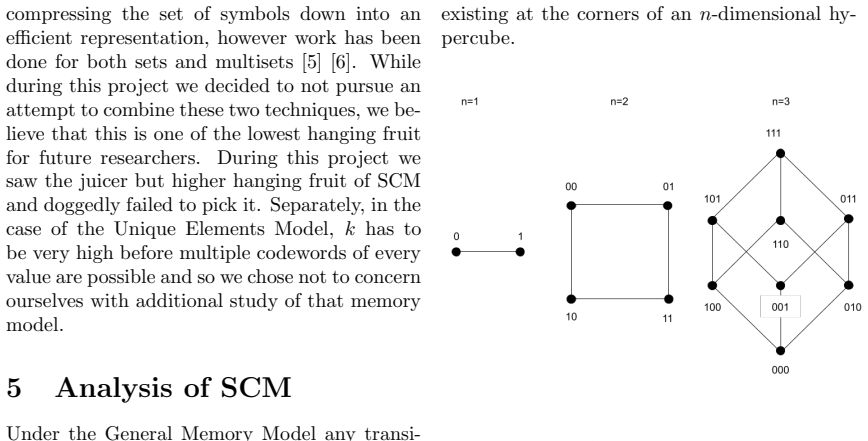
The load-bearing machinery is the eight-model lattice generated by three properties of a block of $k$ cells: Local Order Agnosticism (LOA, order within the block conveys no information), Uniqueness of Elements (UoE, no duplicate values in a block), and Single Cell Modifications (SCM, each update adds or deletes at most one cell). For each model the paper counts valid states and legal transitions; the key numbers are $2^{nk}$ possible bit-strings, $\sum_{i=0}^k \binom{2^n}{i}$ and $\sum_{i=0}^k \binom{2^n+i-1}{i}$ meaningful values under uniqueness and order agnosticism, and $k(2^n-1)$ legal overwrite transitions under SCM. The hypercube representation of bit-strings then carries the argument: the number of bit-strings within Hamming distance $d$ of a codeword is $\sum_{i=0}^d \binom{nk}{i}$, and comparing this with the legal-transition count shows whether a small-radius code is even information-theoretically possible. Conjectures 1 and 2 are expressed in write-efficient memory rate language, as statements about the minimum achievable transition distance at rate $1$ and at rate $\log(|M|)/(nk)$, respectively.
What would settle it
Exhaustively search all bijective encodings for a small pure-SCM instance such as $n=3, k=3$: if any code's maximum or average Hamming cost over legal single-cell transitions is strictly below the trivial encoding's maximum of $n$ bit flips, Conjecture 1 is false. For Conjecture 2, a concrete witness would be an explicit LOADS or Set-model code with multiple codewords per value whose worst-case single-cell update costs less than $n$ bit flips; finding one would confirm the paper's headline possibility, while a proof that no such code exists for all small $n,k$ would refute it.
Extended reading notes
Core claim
The paper's central discovery is that data structure constraints create "free" bits. A block of $k$ cells, each holding an $n$-bit value, is a string of $nk$ bits, but under Local Order Agnosticism combined with Uniqueness of Elements the number of meaningful block values is $\sum_{i=0}^k \binom{2^n}{i}$ rather than $2^{nk}$, because order is irrelevant and duplicates are forbidden. Under the Single Cell Modifications model, each overwrite changes exactly one cell, so from any state there are only $k(2^n - 1)$ legal transitions; with order agnosticism and uniqueness this drops to $(v+1)(2^n - 1)$, where $v$ is the number of distinct values present. Comparing these counts with the sizes of Hamming balls on the $nk$-dimensional hypercube suggests that a write-efficient code could place every legal successor within a much smaller radius than the trivial encoding: with $n=4, k=4$, sixty legal successors can in principle all sit within distance $2$, halving the worst-case bit flips, and once $k > 2^n$ every transition could in principle be a single bit flip. The paper also proves (Theorem 1) that no compact encoding of the form $M\,t(x)$, with a matrix and any nonlinear compression $t$, can realize these codes, so efficient constructions must be genuinely nonlinear. Both conjectures about actually achieving the promised wins are left open: Conjecture 1 says pure SCM offers no gain over the trivial encoding, and Conjecture 2 says SCM with redundancy does offer gains.
Load-bearing premise
The entire proposed win rests on the Single Cell Modifications assumption that each cached block is written at most once before being flushed, since repeated cached writes make the legal-transition counts revert to the general memory model and the savings vanish.
Editorial extensions
If this is right
- If the counting bounds are correct, linear-probing hash tables and similar LOADS carry enough redundancy to absorb bit-flip-efficient codes without dedicating any extra memory bits.
- If Conjecture 2 is true, SCM combined with local order agnosticism or uniqueness lowers the worst-case or average number of bit flips per update below the trivial per-slot encoding's cost of $n$.
- If Conjecture 1 is true, pure SCM without any redundancy cannot beat the trivial encoding, which would direct future code design toward models with LOA or UoE.
- Theorem 1 rules out every compact linear-then-nonlinear encoding, so any working LOADS code must be nonlinear in the slot values.
- The write-efficient memory rate formulation gives future work a precise target: show whether the minimum achievable transition distance at the LOADS rate is strictly larger than at the LOADS-plus-SCM rate.
Reading between the lines
- (Inference) The same counted redundancy could be spent on error correction or compression instead of bit-flip reduction; the paper mentions this in its appendix, and the counting bounds suggest the two goals compete for the same "free" bits.
- (Inference) Because the SCM assumption breaks when a block receives multiple cached writes, the practical value of the idea depends on cache-flush policies; a workload simulation or memory-controller trace could measure how often blocks are written more than once while resident.
- (Inference) The regime $k > 2^n$ is the most promising place to hunt for a Conjecture 2 construction, since the transition count then falls below the number of Hamming-distance-1 neighbors, so every legal update could in principle cost a single bit flip.
Signed reviews
Editorial analysis
A structured set of objections, weighed in public.
Referee Report
Summary. The paper introduces Local Order Agnostic Data Structures (LOADS) and two companion properties, Uniqueness of Elements (UoE) and Single Cell Modifications (SCM), and counts the valid states and transitions for the resulting eight memory models. It argues that SCM greatly restricts the set of legal transitions for a block of memory, and that this restriction, combined with redundancy from local order agnosticism or uniqueness, should allow bit-flip-efficient codes without extra hardware. The paper presents two conjectures about the existence of such codes, describes unsuccessful attempts to prove them, and includes an appendix claiming an impossibility result for semi-linear LOADS codes.
Significance. The conceptual framing—harvesting redundancy from data-structure invariants for bit-flip efficiency—is a reasonable direction, and the state/transition counting in Sections 4 and 5 and Appendix A is a useful first step. The paper also credits its own limitations explicitly. However, the central claim is not established: both main conjectures are explicitly left unproved, and the author states that no code exploiting the supposed wins was found. If the conjectures were true, the work would be a meaningful contribution to write-efficient memory coding, but in its current form it is a set of counting observations and open problems rather than a proven result.
major comments (4)
- [Abstract and §8] The abstract's claim that 'bit flipping wins should be possible' is not supported by the paper's own content. Section 8 states: 'we failed to prove our two main conjectures about the achievability of those wins, and failed to find codes which took advantage of those wins.' Conjecture 1 even asserts the opposite for pure SCM. Thus the headline claim is a conjecture, not a result.
- [§5.2] The counting argument for the n=k=4 example does not imply the existence of a code. The fact that there are 60 legal transition targets and 136 bit-strings within Hamming distance 2 shows only that each codeword has a large local neighborhood; it does not show that there is a global injective assignment of codewords to states such that every legal transition moves to a codeword within distance 2, nor that average or maximum cost improves. The statement that 'we have an opportunity to halve our maximum cost' is therefore not justified.
- [Appendix B, Theorem 1] The proof of Theorem 1 is invalid. The step 'F^{-1}_R t(x) must be equal to the indicator vector that is 0 at all indexes and 1 at index x' assumes that F^{-1}_R F is the identity on each standard basis vector e_x, but F^{-1}_R is only a right inverse of F, so F^{-1}_R F is a projection onto the row space of F, not necessarily the identity. The theorem is in fact false: for n=3, k=1, take E whose columns are all 8 binary vectors of length 3, set M=I_3 and t(x) equal to the x-th column of E; then M t(x)=E\bar{x} with m=3<2^{n-1}=4, contradicting the claimed impossibility.
- [§3] The SCM property is load-bearing for both conjectured wins, but Section 3 concedes that SCM 'typically requires assumptions about the memory hierarchy' and that in the presence of a cache hierarchy the model applies only to programs with bad cache locality where each block is flushed at most once. If a block receives multiple updates while cached, the legal-transition counts collapse toward the general model and the argued savings disappear. The paper provides no argument that the conjectured codes exist even under this restrictive assumption, and no discussion of how the wins would survive a relaxation of SCM.
minor comments (4)
- [§1] There is a duplicated word in the first paragraph: 'has has re-motivated'.
- [Appendix A, LOA table row] The formula for the number of LOA states uses a summation index that does not match the displayed multiset binomial: it should be \binom{2^n + i - 1}{i}, not \binom{2^n + i - 1}{k}. The current text has a typo.
- [§6, Conjecture 1] The wording 'there do not exists codes' should read 'there do not exist codes'.
- [Appendix C, Conjecture 1 formalization] The formal statement reads 'minimum distance that can be achieved with rate 1 is 1/k'; it would be helpful to define the distance measure and the trivial encoding explicitly, since the informal conjecture refers to average and maximum cost relative to the trivial encoding.
Circularity Check
The paper's derivation is self-contained; its unsupported conjectures are a correctness limitation, not circularity.
full rationale
No circular step is present. The paper defines three data-structure properties (LOA, UoE, SCM) in Section 3 and then computes the resulting numbers of valid states and transitions from elementary combinatorics in Section 4 and Appendix A. The central motivating observation in Section 5.2 is a counting comparison: for n=k=4, overwrite SCM allows 60 legal transitions while a radius-2 Hamming ball contains 136 strings, suggesting room for a code with maximum cost halved. That counting argument is independent of the conclusion: it is a necessary-volume condition, not a construction. The paper explicitly concedes in Section 8 that the advertised wins are not established: 'we spent most of our energy focused on the biggest and most interesting potential win: taking advantage of SCM, and failed to prove our two main conjectures about the achievability of those wins, and failed to find codes which took advantage of those wins.' Thus the abstract's 'bit flipping wins should be possible' is a conjecture, not a derived result. There is no fitted parameter renamed as a prediction, no self-citation chain carrying the argument, and no imported uniqueness theorem from the authors' prior work. The SCM assumption is acknowledged in Section 3 to 'typically require assumptions about the memory hierarchy' and to model only bad-cache-locality workloads; this is a modeling limitation and a correctness risk, not a circularity. Because the paper presents its claims as conjectures and its counting bounds are independently derived, the appropriate circularity score is 0.
Assumptions & free parameters
assumptions (3)
- domain assumption The Ahlswede-Zhang write-efficient memory model and its optimality results for polar codes are taken as background assumptions.
- domain assumption Data structures can be partitioned into blocks of k slots such that local order agnosticism, uniqueness of elements, and single-cell modification apply.
- standard math Standard combinatorial identities for counting ordered subsets, multisets, and sets are used without proof.
invented entities (1)
-
Local Order Agnosticism (LOA) as a source of free redundancy
Cite this review
Pith. "Pith review of "LOADS of Space": Local Order Agnosticism and Bit Flip Efficient Data Structure Codes." pith.science (2026). https://pith.science/paper/G2WRJGYQ
@misc{pith2026190805415,
  author       = {Pith},
  title        = {Pith review of: "LOADS of Space": Local Order Agnosticism and Bit Flip Efficient Data Structure Codes},
  year         = {2026},
  howpublished = {\url{https://pith.science/paper/G2WRJGYQ}},
  note         = {Machine review of arXiv:1908.05415}
}
read the original abstract
Algorithms, data structures, coding techniques, and other methods that reduce bit-flips are being sought to best utilize hardware where flipping bits is the dominating cost. Write efficient memories were introduced by Ahlswede and Zhang as a model for storage systems with these kinds of arbitrary read, write, and update costs. The introduction of non-volatile Random Access Memories like phase-change RAM, which have asymmetric read-write costs has re-motivated the field. Our work focuses on potential bit-flip efficiencies to be gained at the data structure layer. We examine Local Order Agnostic Data Structures (LOADS), data structures in which local order does not convey information and in which cells are modified individually. We found that because these data structures have a limited set of valid values and transitions, that bit flipping wins should be possible without the use of additional hardware.
Figures

Reference graph
Works this paper leans on
-
[1]
Coding for write-efficient memory,
R. Ahlswede and Z. Zhang, “Coding for write-efficient memory,” Information and Computation, vol. 83, no. 1, p. 80–97, 1989
work page 1989
-
[2]
Coset coding to extend the lifetime of memory,
A. N. Jacobvitz, R. Calderbank, and D. J. Sorin, “Coset coding to extend the lifetime of memory,” in 2013 IEEE 19th International Symposium on High Performance Computer Architecture (HPCA), pp. 222–233, IEEE, 2013
work page 2013
-
[3]
S. Cho and H. Lee, “Flip-n-write: A sim- ple deterministic technique to improve pram write performance, energy and endurance,” 2009 42nd Annual IEEE/ACM International Symposium on Microarchitecture (MICRO), pp. 347–357, 2009
work page 2009
-
[4]
Polar codes are opti- mal for write-efficient memories,
Q. Li and A. Jiang, “Polar codes are opti- mal for write-efficient memories,” 2013 51st Annual Allerton Conference on Communi- cation, Control, and Computing (Allerton) , 2013
work page 2013
-
[5]
Codes in the space of multisets—coding for per- mutation channels with impairments,
M. Kovacevic and V. Y. F. Tan, “Codes in the space of multisets—coding for per- mutation channels with impairments,” IEEE 9 Transactions on Information Theory, vol. 64, no. 7, p. 5156–5169, 2018
work page 2018
-
[6]
Compressing sets and mul- tisets of sequences,
C. Steinruecken, “Compressing sets and mul- tisets of sequences,” 2014 Data Compression Conference, 2014
work page 2014
-
[7]
N. Alon and J. H. Spencer, The probabilistic method. John Wiley & Sons, 2004. 10
work page 2004
Reviewed August 14, 2026 · model on record in the stance chip above.
Discussion (0). Continue with ORCID to comment.