REVIEW 4 major objections 5 minor 37 references
COSMOS: A Data-Driven Probabilistic Time Series simulator for Chemical Plumes across Spatial Scales
T0 review · 4 major / 5 minor · reviewed 2026-08-07 · deepseek-v4-flash
Pith's one-line read COSMOS generates odor time series statistically similar to real plumes at roughly 35 times lower computational cost than CFD.
desk verdict A useful resampling simulator whose central validation is in-sample, so the transferability claims outrun the evidence. read the letter →
The pith
A machine-rendered reading of the paper's core claim, the machinery that carries it, and where it could break.
The reading
What carries the argument
The load-bearing mechanism is a sequence of modular resampling steps driven by a spatial template. First, whiff onsets from the template are converted to a 50 by 50 empirical grid, then smoothed by fitting a modified Gaussian plume model, $\bar{P}(w_o|x,y)$, in streakline coordinates. Onset probability is then a posterior $P_t(w_o)=\alpha \bar{P}(w_o|x_t,y_t)H_t$, where $H_t$ is a short memory term that boosts probability after recent whiffs and after long blanks. Whiff durations, mean concentrations, concentration variability, and intermittency gaps are drawn from empirical distributions conditioned on the spatial bin; concentrations are passed through a logistic transform into unbounded logit space, shaped by a second-order autoregressive process with distance-dependent noise, then inverted back to sensor units. A memory of the last seven intermittencies prevents the unnatural long bursts that naive resampling would produce. This machinery is what lets the simulator reproduce distance-dependent whiff statistics without resolving plume physics.
What would settle it
Take a trajectory whose movement speed is substantially different from the template trajectory (a case the paper says is not covered) and compare COSMOS-generated whiff duration and intermittency distributions to real sensor data collected along such a trajectory; if the Wasserstein distances fall outside the bootstrapped null distributions, the transferability assumption fails. More generally, the central claim would be falsified by any template dataset whose whiff statistics, when resampled, produce simulated distributions that a one-thousand-sample bootstrap test rejects.
Extended reading notes
Core claim
On the paper's own terms, the discovery is that the full spatiotemporal structure of an odor encounter—when whiffs begin, how long they last, how concentrated they are, and how the gaps between them feel—can be synthesized by resampling spatially binned statistics from a template dataset, without simulating the plume physics. The template statistics are encoded as a smoothed Gaussian-plume spatial probability of whiff onset in a coordinate frame aligned with the streakline; a history-dependent posterior then decides when a whiff starts, empirical distributions supply its duration, concentration, and intermittency, and an AR(2) process in logit space smooths the concentration values. Against real desert data (high and low wind), forest data, and a CFD plume dataset, COSMOS produced whiff statistics whose Wasserstein distances to the real distributions fell inside bootstrapped null distributions, and agents running a cast-and-surge strategy produced overlapping trajectory-feature clusters in a two-dimensional manifold projection. The paper concludes that COSMOS provides naturalistic odor experiences at a fraction of CFD cost.
Load-bearing premise
The load-bearing assumption is that the statistics measured in the template dataset—whiff onset probabilities, durations, concentrations, and intermittencies—are representative enough to transfer to the new trajectory, wind condition, and movement speed being simulated, since the simulator resamples those statistics rather than simulating the physics.
Editorial extensions
If this is right
- Odor-tracking agents can be developed and evaluated against naturalistic odor experiences at roughly 35 times lower computational cost than CFD-based readout, enabling rapid prototyping over large spatial domains.
- Agents trained or evaluated in COSMOS should show similar tracking behavior to agents in CFD plumes, because the odor encounter statistics that drive navigation decisions are preserved.
- The framework transfers to different flow regimes and spatial scales: similar distributional matches are reported for high-wind, low-wind, forest, and CFD-derived template datasets.
- Because COSMOS is stochastic and cheap, it is a plausible training environment for reinforcement-learning navigation policies, where many episodes are needed and overfitting to a fixed plume is a risk.
- The simulator's tunable hyperparameters, such as density scaler, transition probability, AR coefficients, and memory terms, allow users to adjust whiff density and temporal correlation without changing the underlying empirical statistics.
Reading between the lines
- The same resampling recipe could serve as a generative data-augmentation layer for learned odor models: synthesize large volumes of labeled time series from a small field dataset, then train downstream encoders or predictors on them.
- The speedup suggests a closed-loop use the paper does not develop: COSMOS could run in real time as the odor environment for an embodied agent or drone-in-the-loop test, something CFD cannot do at scale.
- The validation strategy, which matches statistics on trajectories and conditions close to the template, leaves open whether the statistics generalize; a natural extension is to measure how the Wasserstein p-values degrade as trajectory speed, crossing angle, or wind variability moves away from the template.
- If the template statistics were replaced by a parametric model of whiff onset, duration, and intermittency, COSMOS could interpolate between flow regimes without requiring a new field dataset for each condition.
Editorial analysis
A structured set of objections, weighed in public.
Referee Report
Summary. The paper introduces COSMOS, a data-driven probabilistic simulator that generates odor concentration time series for an agent moving through a chemical plume. Rather than solving transport physics, COSMOS builds a spatial whiff-onset probability map from a template dataset and then, at run time, draws whiff durations, mean concentrations, concentration standard deviations, and intermittency intervals directly from empirical distributions of that same template, while using an AR(2) process in logit space to smooth concentrations. The authors validate COSMOS against three outdoor field datasets (high- and low-wind desert, forest) and one CFD-generated plume dataset, using Wasserstein-distance permutation tests on five whiff statistics, and they demonstrate an application in which cast-and-surge agents navigate using either CFD-derived or COSMOS-generated odor experiences. They report similar trajectory statistics and roughly 35x lower CPU time for reading odor experiences from COSMOS than from CFD data.
Significance. If the validation were independent, COSMOS would be a practically valuable tool for generating large numbers of naturalistic odor time series for training and evaluating odor-tracking algorithms, reinforcement-learning policies, and robotic controllers. The method is transparent, modular, and computationally cheap, and the paper includes code and data availability statements and an explicit discussion of limitations such as the neglect of agent-relative movement speed. The agent-behavior comparison, using trajectories different from the template trajectory, is a useful outcome-oriented check beyond histogram matching. However, the central statistical validation is in-sample and partly circular, so the strength of the evidence for the paper's headline claims is substantially weaker than presented; the work is best read as a promising framework whose external validity remains to be demonstrated.
major comments (4)
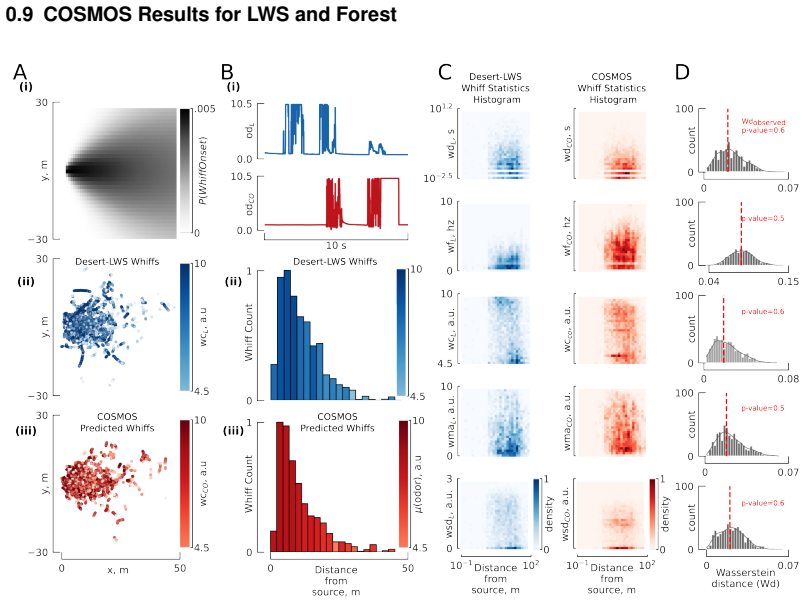
- [Methods, 'Whiff durations are picked from empirical values', 'Whiff concentrations are picked from empirical values'…] The validation for WD, WC, WSD, and WI is circular by construction. These quantities are not predicted by the model; they are randomly resampled from the empirical distributions of the very template dataset that is then used as the comparison reference in Figs. 2, 6, and 7. Matching those histograms is therefore expected regardless of whether the underlying plume physics is captured. To support the claim that COSMOS generates realistic statistics, the authors should use held-out trajectories or held-out spatial bins, refit the empirical tables and the spatial prior (Eq. 1) on a training subset, and then compare simulated statistics with a test subset; they should also report the Wasserstein p-values under this proper cross-validation scheme.
- [Results, 'COSMOS Can Simulate Real-World Spatiotemporal Odor Statistics'; Fig. 2A-ii/iii, Fig. 3A-v/vi, Figs. 6, 7] In every validation case the simulated trajectory is the same trajectory used to build the simulator, and the spatial prior and empirical whiff tables are estimated from the complete dataset. This tests internal consistency, not the paper's central claim of transferability across trajectories, wind regimes, and spatial scales. The Discussion correctly notes that movement-speed differences are not modeled, but the paper does not perform any experiment in which the template was constructed from one environment and tested on a different environment or even on a different trajectory from the same environment. Such a test is load-bearing for the abstract and introduction claims, and its absence is a major gap.
- [Results, 'COSMOS is Scalable and Can Learn Other Computational Simulators'] The whiff threshold for the CFD dataset (6.5 a.u.) was chosen post hoc, with the text stating that this value 'did a good job of preserving the whiff dynamics,' after using 4.5 a.u. for the desert data. Because the threshold defines what counts as a whiff, it directly determines WD, WF, WC, WMA, and WSD and therefore all reported Wasserstein distances and p-values. The authors should either fix the threshold a priori using a defensible criterion (e.g., sensor noise floor or detection probability), or provide a sensitivity analysis showing that the similarity conclusions are robust over a plausible range of thresholds.
- [Eq. (2), Eq. (3), Table 1] The whiff onset probability includes tunable parameters—the density scaler α and the memory term H_t—whose values materially affect whiff frequency and intermittency. Since the simulator can be tuned to produce more or fewer whiffs, the reported agreement on WF and WI is not a fixed model prediction. The authors should fit these parameters on a training split or justify defaults by a principled rule, and they should report how sensitive the Wasserstein p-values are to these parameters; this would also clarify how much of the reported agreement is attributable to model structure rather than to tuning.
minor comments (5)
- [Supplementary, Sec. 0.2] The acronym 'LGBFS' should be 'L-BFGS' (limited-memory Broyden-Fletcher-Goldfarb-Shanno).
- [Results, 'COSMOS is Scalable and Can Learn Other Computational Simulators'] The sentence referring to 'Fig. 2A-iv' in this section should apparently refer to Fig. 3A-iv, since the CFD heatmap is shown in Fig. 3, not Fig. 2.
- [Supplementary, Sec. 0.3, Eq. (15)] The notation 'C −t' after Eq. (15) appears to be a typo for C_t; also, the equation itself and the surrounding text should define the inverse-logit output consistently.
- [Throughout] There are several small typos and punctuation inconsistencies (e.g., 'throughout' misspelled, inconsistent use of 'whiff' versus 'odor'), which should be corrected in a final pass.
- [Results, statistical test description] The p-value interpretation is nonstandard: a high p-value is described as evidence of similarity, but it is actually the probability of observing the Wasserstein distance under a null generated by permuting labels between real and simulated samples. Given the circular sampling, these p-values should be interpreted with caution; please state clearly what null hypothesis is being tested.
Circularity Check
Validation is in-sample: COSMOS draws WD, WC, WSD, and intermittency from the same empirical bins it compares against, so the headline 'statistically indistinguishable' is largely forced by construction.
-
self definitional
[Methods, 'Whiff durations are picked from empirical values'; Results, Fig. 2C-D]
"When a whiff is initiated, as seen in red in Fig. 1D, Wt=1, the whiff duration (WD) is selected from the empirical distribution of whiff durations from the template dataset (e.g. Fig. 5A(i)). To account for the fact that the whiff duration is a function of location within the plume, we first determine the spatial bin that corresponds to the location of the whiff onset (xt ,yt ), and then randomly choose an empirical whiff duration from all the durations that lie in that bin."
The validation explicitly compares whiff duration (WD) distributions between real and simulated data via 2D histograms and Wasserstein distances. But the simulator's WD is generated by randomly drawing from the empirical WD values in the same spatial bins of the same template dataset used for validation. Thus agreement on WD is guaranteed up to sampling noise and bin-counting choices; it is a resampling consistency check, not evidence that COSMOS predicts plume physics or generalizes to new conditions.
-
self definitional
[Methods, 'Whiff concentrations are picked from empirical values, and filtered'; Results, Fig. 2C and Fig. 3C]
"At the onset of a whiff, the location (xt ,yt ) is used to pick the mean whiff concentration (WC) and whiff standard deviation (WSD) values from the corresponding spatial bin in the template dataset (e.g. Fig. 5A(ii-iii))."
Validation compares WC and WSD distributions, yet both are directly resampled from the template bins: the selected empirical WC becomes the target concentration and the selected empirical WSD scales the AR(2) noise. The logistic/AR filtering alters dynamics but does not introduce concentration statistics independent of the empirical draws. Agreement on WC and WSD is therefore largely by construction, not an independent test of the model's generative assumptions.
3 more flagged steps
-
fitted input called prediction
[Methods, 'Whiff intermittencies are picked from empirical values'; Results, Fig. 2C (WF panel)]
"When a whiff ends, as seen at the end of the time series from Fig. 1E, the simulator identifies the spatial bin corresponding to the location (xt ,yt ) and draws a random value from the empirical distribution of intermittencies corresponding to that bin (e.g. Fig. 5A-iv). When no template data exists for a spatial bin, we use the median of all intermittency values. This value sets the minimum number of time steps before the next whiff is allowed to start."
The whiff frequency statistic is the rate of whiff onsets after gaps. COSMOS sets the gap length by resampling empirical intermittencies from the same template bins used in validation, and it sets onset probability with the empirical bin counts via Eq. (1) multiplied by a tunable gain alpha. Hence WF similarity is strongly forced by fitted inputs; additional tunable hyperparameters (alpha, 'whiff transition prob') provide further slack.
-
fitted input called prediction
[Results, 'COSMOS is Scalable and Can Learn Other Computational Simulators']
"Because of the different dynamics between the desert and CFD data we chose a slightly different threshold for defining whiffs: 6.5 a.u. instead of 4.5 a.u., as we found this value did a good job of preserving the whiff dynamics in the CFD data."
The threshold that defines a 'whiff' is itself a fitted choice made per dataset. Since the same threshold determines both the template statistics and the validation statistics, the threshold is an additional degree of freedom that inflates apparent agreement; the statement 'we found this value did a good job' indicates post hoc selection rather than an a priori, transferable criterion.
-
fitted input called prediction
[Results, 'COSMOS Can Simulate Real-World Spatiotemporal Odor Statistics'; Fig. 2A-ii/iii]
"We used these data to generate the spatial probability map (Fig. 2A), and whiff concentration, duration, and intermittency distributions needed by COSMOS. Fig. 2A-ii shows the actual whiffs experienced along the trajectory, whereas Fig. 2A-iii shows the COSMOS simulated whiff experience for the same trajectory."
The validation for HWS/LWS/forest and the CFD conversion simulates the very trajectory from which the template was built. The spatial prior (Eq. 1), empirical WD/WC/WSD/WI tables, and the AR coefficients fitted to the same logit-transformed signal are all estimated from the same odor time series then assessed against that same series. This is in-sample validation; it does not test whether template statistics transfer to held-out trajectories, altered wind conditions, or different movement speeds, which is the transferability claim made in the abstract and introduction.
full rationale
The central claim that COSMOS generates distributions 'statistically indistinguishable from real data' rests on comparisons against the same data used to construct the simulator. The derivation chain makes this explicit: Eq. (1) estimates onset probabilities from empirical bin counts, and the Methods state that whiff durations, concentrations, standard deviations, and intermittencies are 'picked from empirical values' in the corresponding spatial bins. The validation then compares exactly those statistics (WD, WC, WSD, WF) via Wasserstein distances, so the high p-values are largely a resampling consistency check rather than independent evidence of predictive power. The post hoc per-dataset whiff threshold (4.5 vs 6.5 a.u.) and tunable onset gain add further fitted slack. This is partial, not total, circularity: the AR(2) smoothing is an independent dynamical element, WMA is not directly resampled, the 150-agent cast-and-surge comparison uses novel trajectories not identical to the template trajectory, and the CPU-time measurement is external. Self-citation is not the primary problem here; the circularity is in the construction, not in the reference list. The paper's own limitations (no relative movement-speed modeling; 2D only) further weaken the cross-regime transferability claim. Overall score 7: multiple validation 'predictions' reduce by construction, while some applied results remain independent.
Assumptions & free parameters
free parameters (5)
- Gaussian plume parameters A, sigma_y0, d_y, lambda =
A in [0,1]; sigma_y0 in [0.2,5.0]; d_y in [0.55,2.0]; lambda in [0.02,1.0]
- AR(2) coefficients phi1 and phi2 =
phi1 = 0.85, phi2 = -0.17
- Whiff threshold =
4.5 a.u. for desert; 6.5 a.u. for CFD
- Density scaler alpha (whiff transition probability) =
0.85 default
- Memory and smoothing heuristics =
lookback 50 steps, 1.5 boost after 50 steps, intermittency memory 7, low threshold 0.05 s, window 14, sigma 0.8
assumptions (4)
- domain assumption Whiff onset probability follows a smooth modified Gaussian plume with exponential decay along the streakline and sigma_y growing with distance as exponent 0.8.
- domain assumption The empirical statistics of the template dataset are representative and transferable across trajectories, wind regimes, and spatial scales.
- domain assumption A binary whiff/no-whiff classification via a fixed concentration threshold captures the odor experience adequately.
- ad hoc to paper An AR(2) process in logit space, with template-fitted coefficients, reproduces realistic concentration fluctuations within whiffs.
Cite this review
Pith. "Pith review of COSMOS: A Data-Driven Probabilistic Time Series simulator for Chemical Plumes across Spatial Scales." pith.science (2026). https://pith.science/paper/G3CT4LCQ
@misc{pith2026250522436,
  author       = {Pith},
  title        = {Pith review of: COSMOS: A Data-Driven Probabilistic Time Series simulator for Chemical Plumes across Spatial Scales},
  year         = {2026},
  howpublished = {\url{https://pith.science/paper/G3CT4LCQ}},
  note         = {Machine review of arXiv:2505.22436}
}
read the original abstract
The development of robust odor navigation strategies for automated environmental monitoring applications requires realistic simulations of odor time series for agents moving across large spatial scales. Traditional approaches that rely on computational fluid dynamics (CFD) methods can capture the spatiotemporal dynamics of odor plumes, but are impractical for large-scale simulations due to their computational expense. On the other hand, puff-based simulations, although computationally tractable for large scales and capable of capturing the stochastic nature of plumes, fail to reproduce naturalistic odor statistics. Here, we present COSMOS (Configurable Odor Simulation Model over Scalable Spaces), a data-driven probabilistic framework that synthesizes realistic odor time series from spatial and temporal features of real datasets. COSMOS generates similar distributions of key statistical features such as whiff frequency, duration, and concentration as observed in real data, while dramatically reducing computational overhead. By reproducing critical statistical properties across a variety of flow regimes and scales, COSMOS enables the development and evaluation of agent-based navigation strategies with naturalistic odor experiences. To demonstrate its utility, we compare odor-tracking agents exposed to CFD-generated plumes versus COSMOS simulations, showing that both their odor experiences and resulting behaviors are quite similar.
Figures


Figures from the paper (4 more)



Reference graph
Works this paper leans on
-
[1]
Husnain, A. u. et al. Gas concentration mapping and source localization for environmental monitoring through unmanned aerial systems using model-free reinforcement learning agents. Plos one 19, e0296969 (2024)
work page 2024
-
[2]
Autonomous Drone for Dynamic Smoke Plume Tracking
Pal, S. K., Sharma, S., Krishnakumar, N. & Hong, J. Autonomous drone for dynamic smoke plume tracking. arXiv preprint arXiv:2504.12664 (2025)
work page Pith review arXiv 2025
- [3]
- [4]
-
[5]
Soldan, S., Bonow, G. & Kroll, A. Robogasinspector-a mobile robotic system for remote leak sensing and localization in large industrial environments: Overview and first results. IFAC Proceedings Volumes 45, 33–38 (2012)
work page 2012
-
[6]
Murlis, J., Elkinton, J. S., Carde, R. T. et al. Odor plumes and how insects use them. Annual review of entomology 37, 505–532 (1992)
work page 1992
-
[7]
Anderson, J. D. & Wendt, J. Computational fluid dynamics, vol. 206 (Springer, 1995)
work page 1995
-
[8]
Ferziger, J. H., Peri´c, M. & Street, R. L. Computational methods for fluid dynamics (Springer, 2019)
work page 2019
Show all 37 references
-
[9]
& Seminara, A
Rigolli, N., Magnoli, N., Rosasco, L. & Seminara, A. Learning to predict target location with turbulent odor plumes. Elife 11, e72196 (2022)
2022
-
[10]
Lionetti, S., Hedrick, T. L. & Li, C. Numerical investigation of olfactory performance in upwind surging hawkmoth flight. In AIAA AVIATION 2023 Forum, 4242 (2023)
2023
-
[11]
Clements, D. et al. Comparing large-eddy simulation and gaussian plume model to sensor measure- ments of an urban smoke plume. Atmosphere 15 (2024)
2024
-
[12]
Pompy - puff-based odour plume model in python (2018)
Graham, M. Pompy - puff-based odour plume model in python (2018). URL https://zenodo.org/ records/1481589
2018
-
[13]
A., Murlis, J., Long, X., Li, W
Farrell, J. A., Murlis, J., Long, X., Li, W. & Card ´e, R. T. Filament-based atmospheric dispersion model to achieve short time-scale structure of odor plumes. In Environmental Fluid Mechanics, vol. 2, 143–169 (Springer, 2002)
2002
-
[14]
& van Breugel, F
Nag, A. & van Breugel, F. Odour source distance is predictable from a time history of odour statistics for large scale outdoor plumes. Journal of the Royal Society Interface 21, 20240169 (2024)
2024
-
[15]
Rangapuram, S. S. et al. Deep state space models for time series forecasting. Advances in neural information processing systems 31 (2018)
2018
-
[16]
& Thome, N
Le Guen, V . & Thome, N. Probabilistic time series forecasting with shape and temporal diversity. Advances in neural information processing systems 33, 4427–4440 (2020)
2020
-
[17]
& Matteson, D
Tang, B. & Matteson, D. S. Probabilistic transformer for time series analysis. Advances in Neural Information Processing Systems 34, 23592–23608 (2021)
2021
-
[18]
Kollovieh, M. et al. Predict, refine, synthesize: Self-guiding diffusion models for probabilistic time series forecasting. Advances in Neural Information Processing Systems 36, 28341–28364 (2023)
2023
-
[19]
Pang, R., van Breugel, F., Dickinson, M., Riffell, J. A. & Fairhall, A. History dependence in insect flight decisions during odor tracking. PLoS Computational Biology 14, e1005969 (2018). 9/16
2018
-
[20]
Ramdya, P. et al. Mechanosensory interactions drive collective behaviour in drosophila. Nature 519, 233–236 (2015)
2015
-
[21]
smellicopter,
Anderson, M. J. et al. The “smellicopter,” a bio-hybrid odor localizing nano air vehicle. In 2019 IEEE/RSJ International Conference on Intelligent Robots and Systems (IROS) , 6077–6082 (IEEE, 2019)
2019
-
[22]
& Hosoda, K
Shigaki, S., Yoshimura, Y ., Kurabayashi, D. & Hosoda, K. Palm-sized quadcopter for three- dimensional chemical plume tracking. IEEE Transactions on Instrumentation and Measurement 71, 1–12 (2022)
2022
-
[23]
H., van Breugel, F., Rao, R
Singh, S. H., van Breugel, F., Rao, R. P. & Brunton, B. W. Emergent behaviour and neural dynamics in artificial agents tracking odour plumes. Nature machine intelligence 5, 58–70 (2023)
2023
-
[24]
& Vergassola, M
Celani, A., Villermaux, E. & Vergassola, M. Odor landscapes in turbulent environments. Physical Review X 4, 041015 (2014)
2014
-
[25]
& van Breugel, F
Nag, A. & van Breugel, F. Odor source distance is predictable from time-histories of odor statistics for large scale outdoor plumes (2024). URL https://doi.org/10.5061/dryad.2547d7wvr
2024 doi
-
[26]
Kantorovich, L. V . On the translocation of masses. InDokl. Akad. Nauk. USSR (NS), vol. 37, 199–201 (1942)
1942
-
[27]
& Kempa-Liehr, A
Christ, M., Braun, N., Neuffer, J. & Kempa-Liehr, A. W. Time series feature extraction on basis of scalable hypothesis tests (tsfresh–a python package). Neurocomputing 307, 72–77 (2018)
2018
-
[28]
& Melville, J
McInnes, L., Healy, J. & Melville, J. Umap: Uniform manifold approximation and projection for dimension reduction. arXiv preprint arXiv:1802.03426 (2018)
2018 arXiv
-
[29]
& Großberger, L
McInnes, L., Healy, J., Saul, N. & Großberger, L. Umap: Uniform manifold approximation and projection (2018). URL https://github.com/lmcinnes/umap
2018
-
[30]
Computational fluid dynamics with hdf5
The HDF Group. Computational fluid dynamics with hdf5. https://www.hdfgroup.org/solutions/hdf5/ computational-fluid-dynamics/ (2025). Accessed: March 03, 2025
2025
-
[31]
Patwary, M. M. A. et al. Bd-cats: big data clustering at trillion particle scale. In Proceedings of the International Conference for High Performance Computing, Networking, Storage and Analysis, 1–12 (2015)
2015
-
[32]
Moore, P. A. & Atema, J. Spatial information in the three-dimensional fine structure of an aquatic odor plume. The Biological Bulletin 181, 408–418 (1991)
1991
-
[33]
B., List, J
Fischer, H. B., List, J. E., Koh, C. R., Imberger, J. & Brooks, N. H. Mixing in inland and coastal waters (Elsevier, 2013)
2013
-
[34]
& Shraiman, B
Vergassola, M., Villermaux, E. & Shraiman, B. I. ‘infotaxis’ as a strategy for searching without gradients. Nature 445, 406–409 (2007)
2007
-
[35]
Practical methods of optimization (John Wiley & Sons, 2000)
Fletcher, R. Practical methods of optimization (John Wiley & Sons, 2000)
2000
-
[36]
H., Lu, P., Nocedal, J
Byrd, R. H., Lu, P., Nocedal, J. & Zhu, C. A limited memory algorithm for bound constrained optimization. SIAM Journal on scientific computing 16, 1190–1208 (1995)
1995
-
[37]
statsmodels.tsa.ar model.autoreg — statsmodels documentation (2025)
Statsmodels Developers. statsmodels.tsa.ar model.autoreg — statsmodels documentation (2025). URL https://www.statsmodels.org/stable/generated/statsmodels.tsa.ar model.AutoReg.html. 10/16 SUPPLEMENTARY MATERIAL 0.2 Gaussian Plume Model The spatial model was modeled like a smoot...
2025
Reviewed August 7, 2026 · model on record in the stance chip above.
Discussion (0). Sign in to comment.