REVIEW 3 major objections 5 minor 44 references
Dynamics of neural fields with exponential temporal kernel
T0 review · 3 major / 5 minor · reviewed 2026-08-14 · deepseek-v4-flash
Pith's one-line read A neural field equation with exponentially fading temporal memory cannot undergo static Turing bifurcations, but it can produce traveling waves through Turing-Hopf bifurcations.
desk verdict Correct no-static-bifurcation theorem and plausible Hopf analysis, but the Turing-Hopf result is not proven: the proof truncates a divergent expansion and the numerics use the wrong kernel. read the letter →
The pith
A machine-rendered reading of the paper's core claim, the machinery that carries it, and where it could break.
The reading
What carries the argument
The central object is the exponential temporal kernel $\kappa(t-s)=\alpha e^{-\alpha(t-s)}$, an $\alpha$-function that replaces the Green's function kernel of earlier neural-field models and yields the characteristic equation (3.7) for perturbations of the form $e^{\lambda t}e^{ikx}$. The no-static-bifurcation result follows from the factor $\lambda/(\alpha+\lambda)$: at $\lambda=0$ the right-hand side vanishes while the left-hand side is $1$. For the dynamic bifurcations, the machinery is a power-series expansion of the phase factor $e^{i|z|(\omega/\nu \pm k)}$, keeping the first three moments $J_0=\int J(z)dz$, $J_1=\int J(z)|z|dz$, and $J_2=\int J(z)|z|^2dz$ of the Mexican-hat spatial kernel (short-range excitation, mid-range inhibition); equating real and imaginary parts then turns the characteristic equation into the quartic Turing-Hopf condition and its Hopf counterpart.
What would settle it
At the paper's example parameters ($\alpha=5$, $\nu=1$, $\tau=0.75$, $r=5$, $a_e=10$, $a_i=2$) and for the claimed mode $k=25$, solve the full characteristic equation (5.2) for $\lambda$: if the purely imaginary root does not occur at $\omega=2.573$, the truncated condition does not match the exact spectral problem. More directly, simulate the full integro-differential equation with the Mexican-hat kernel (2.4) at parameter values satisfying (5.25) and check whether a traveling-wave solution actually emerges.
Extended reading notes
Core claim
The paper's central claims are Theorem 1 and Theorem 3. Theorem 1 states that the neural field equation with the normalized exponential kernel $\kappa(t-s)=\alpha e^{-\alpha(t-s)}$ does not admit static Turing patterns: the linearized characteristic equation is $\tau\lambda+1=\beta \frac{\lambda}{\alpha+\lambda}\int J(z)e^{-\lambda|z|/\nu}e^{-ikz}\,dz$, and setting $\lambda=0$ gives $1=0$, so no zero eigenvalue exists. Theorem 3 states that a Turing-Hopf bifurcation occurs when the parameters satisfy a quartic equation in the temporal frequency $\omega$ (equation (5.25)) with nonzero wavenumber $k$ and frequency $\omega$, and that this bifurcation generates spatially and temporally nonconstant solutions, in particular traveling waves. The Hopf case $k=0$ is treated separately, with a positive-root condition and an explicit parametric region for the bifurcation. In the authors' framing, the exponential kernel's finite memory is exactly what makes dynamic, rather than static, instabilities the only route to pattern formation.
Load-bearing premise
The load-bearing premise is that the connectivity kernel's higher spatial moments are negligible, so the expansion in (5.19) can be stopped after $J_2$; if that premise fails, Theorem 3's explicit Turing-Hopf threshold is only approximate.
Editorial extensions
If this is right
- Static Turing patterns are impossible for any parameter choice in this model, because the characteristic equation has no zero eigenvalue.
- Hopf bifurcations generate only spatially uniform temporal oscillations, so spatial structure requires a Turing-Hopf bifurcation.
- Increasing the kernel decay rate $\alpha$ and the transmission speed $\nu$ in the Hopf region raises the amplitude and frequency of the resulting oscillations.
- The Turing-Hopf condition gives explicit parameter curves in the $(\alpha,\nu,\tau,r)$ space, allowing the emergence of traveling waves to be predicted before simulation.
- The exponential kernel's finite memory is what excludes static instabilities while leaving dynamic instabilities intact, making dynamic bifurcations the only route to pattern formation in this model.
Reading between the lines
- Because the factor $\lambda/(\alpha+\lambda)$ is what kills the zero eigenvalue, the same no-static-Turing conclusion should extend to any single-population neural field whose temporal kernel has this form; this goes beyond the paper's literal statement.
- The paper's numerical space-time plots use a Gaussian connectivity kernel, whereas the analytic condition is derived for the Mexican-hat kernel in (2.4); rerunning those simulations with the Mexican-hat kernel at the same parameters is the direct numerical test of the Turing-Hopf claim.
- If the higher moments $J_3, J_4, \ldots$ of the spatial kernel are not negligible, the quartic condition (5.25) will shift or lose individual roots, so the theorem should be read as a second-order approximation until a full spectral check is done.
Signed reviews
Editorial analysis
A structured set of objections, weighed in public.
Referee Report
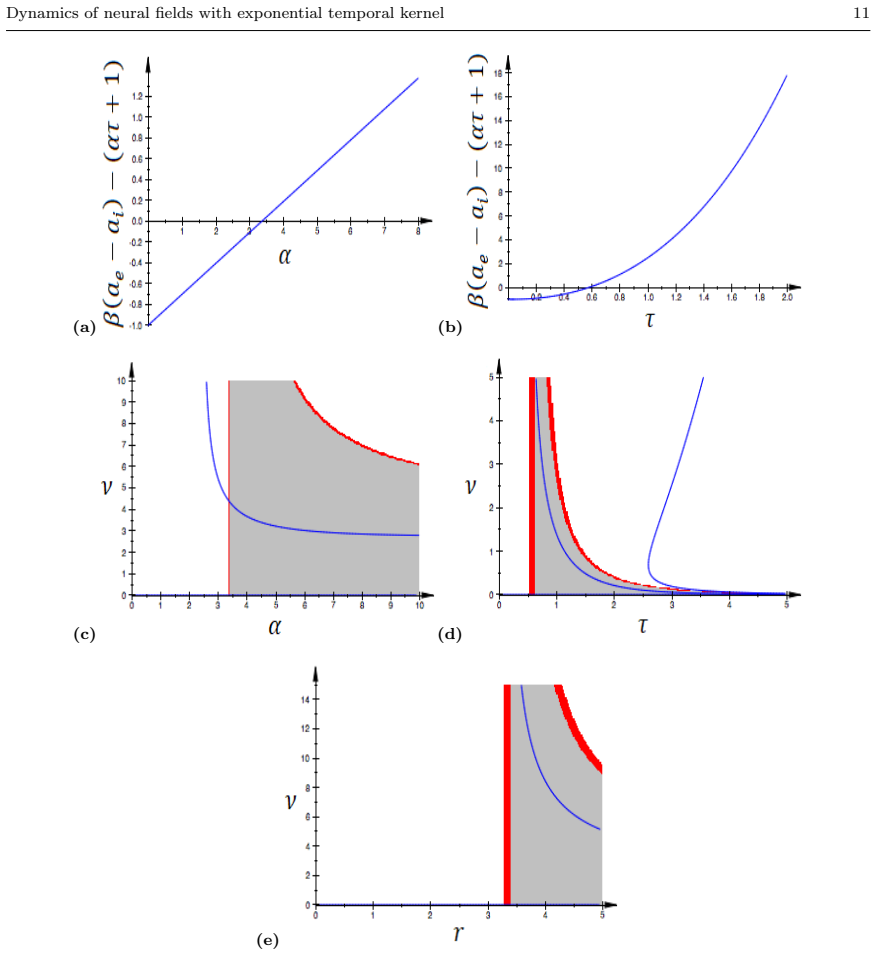
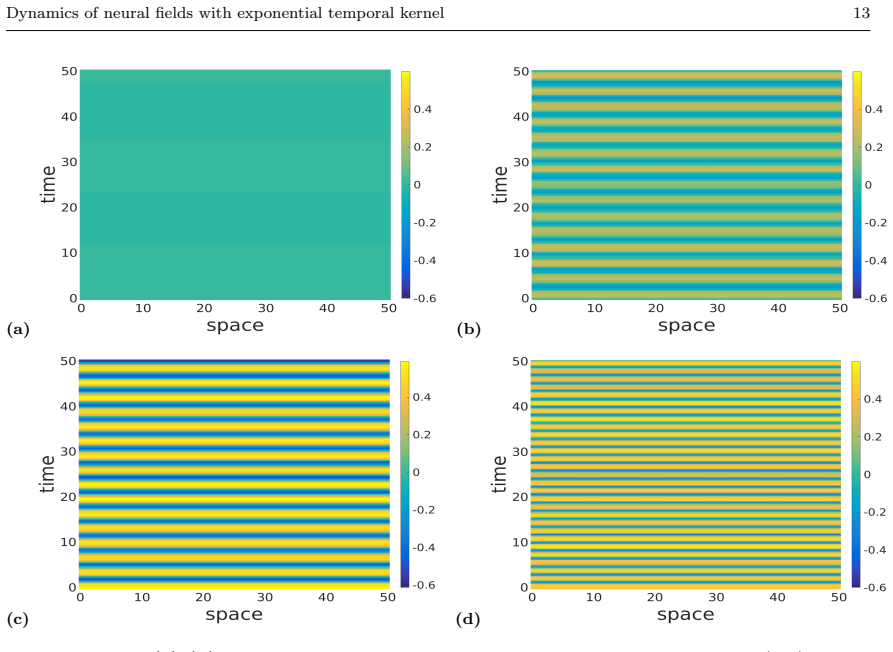
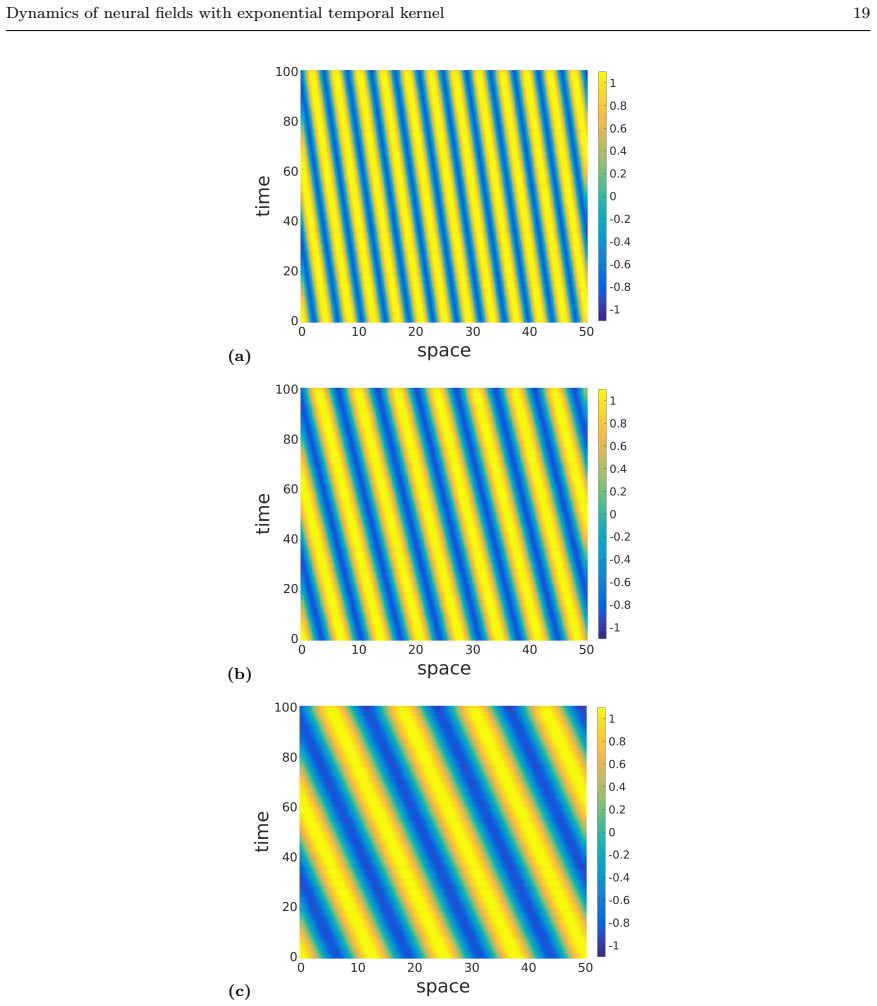
Summary. The paper studies a scalar neural field equation on R with an exponential temporal kernel, a Mexican-hat spatial kernel, and finite transmission speed. It linearizes around the constant equilibrium v0 = τE and proves three results: Theorem 1 rules out static bifurcations (in particular static Turing patterns) because λ = 0 cannot solve the characteristic equation; Theorem 2 gives a sufficient condition for asymptotic stability based on a weighted L1 norm of the connectivity kernel; and Theorem 3 derives a Turing-Hopf bifurcation condition from a moment expansion of the characteristic equation. The paper also derives Hopf bifurcation conditions for k = 0, presents bifurcation diagrams, and shows space-time patterns for Hopf and Turing-Hopf instabilities, including traveling waves.
Significance. If Theorem 3 were established, the paper would make a useful contribution to neural field bifurcation theory: it would show a clear contrast with Green's-function temporal kernels regarding static instabilities, and it would give explicit parameter conditions for Hopf and Turing-Hopf bifurcations that generate spatially and temporally nonconstant solutions. The no-static-bifurcation result (Theorem 1) is elementary, clean, and correct, and the stability condition in Theorem 2 is a reasonable sufficient condition. The analytical derivations are mostly transparent, and the bifurcation diagrams are helpful. The main advertised new result, however, the Turing-Hopf condition, is not proven as stated, and the numerical validation used for it does not match the analyzed kernel. These issues are substantive but appear fixable within the manuscript's scope.
major comments (3)
- [Section 5.2, Eq. (5.16)] The algebraic rewriting of the characteristic integral is incorrect. Starting from Eq. (5.15), the factor is e^{-iω|z|/ν} e^{ikz}. For real z, e^{-iω|z|/ν} cos(kz) equals 1/2 [e^{i|z|(k - ω/ν)} + e^{-i|z|(k + ω/ν)}], not 1/2 [e^{i|z|(ω/ν + k)} + e^{i|z|(ω/ν - k)}] as written in (5.16). Consequently the J1 term in the expansion (5.19) has the wrong sign, and all equations derived from it, including (5.20)–(5.25) and the theorem's condition (5.14), inherit this error. This sign error alone invalidates Theorem 3 as a derivation from the characteristic equation.
- [Section 5.2, Eqs. (5.17)–(5.25)] The proof of Theorem 3 truncates the power series for e^{i|z|(ω/ν ± k)} at the J2 term with no justification. For the connectivity kernel (2.4), the moments are J_n = n! (a_e - a_i / r^n), so the higher-order terms do not vanish, and the resulting series does not converge termwise when |ω/ν ± k| ≥ 1. The paper's own Fig. 4 uses values such as |ω/ν + k| = |2.573/1 + 25| = 27.573, far outside any plausible radius of uniform convergence. Thus Eq. (5.14) is at best an approximation, while Theorem 3 states it as an exact bifurcation condition. An exact treatment is readily available: one can substitute λ = iω into the characteristic equation (5.1) (or (3.7)) and separate real and imaginary parts to obtain two real equations. The authors should replace the moment expansion with this exact computation.
- [Figs. 6 and 8; Section 5.2] The numerical space-time patterns in Figs. 6 and 8 are explicitly stated in their captions to be obtained with a Gaussian connectivity kernel, which is not the kernel (2.4) for which the analytical Turing-Hopf condition (5.14) was derived. These simulations therefore do not validate Theorem 3. The figures should be redone with the actual kernel (2.4), or the text must clearly state that the numerics illustrate a different model. As it stands, the evidence for the claimed traveling-wave patterns is not connected to the analytical result.
minor comments (5)
- [Section 5.2, Theorem 3] In the statement of Theorem 3, the condition is written as 'with k≠ and ω≠0', where a symbol after the first inequality is missing; it should be k≠0.
- [Section 5.2, Eqs. (5.14) and (5.25)] The theorem states Eq. (5.14), but the proof derives Eq. (5.25); the two should be cross-referenced consistently, and the theorem should state the equation in the same form as the displayed derivation.
- [Section 3 and Section 4, Eq. (3.7) and Theorem 2] The symbol L(λ) is used ambiguously: in (3.7) it is defined as τλ+1 and equated to the integral expression, but in the proof of Theorem 2 it is treated as the full right-hand side when bounding |L(σ+iω)| and then as τλ+1 when computing |L(iω)|^2 = 1+τ^2ω^2. This notational inconsistency should be fixed by defining the characteristic function explicitly.
- [Throughout] There are several typographical errors, e.g., 'paramter' in Section 5.1, 'in In Sect. 6' near the end of the Introduction, and 'decrease' instead of 'decrease' in the caption of Fig. 6. A careful proofreading pass is needed.
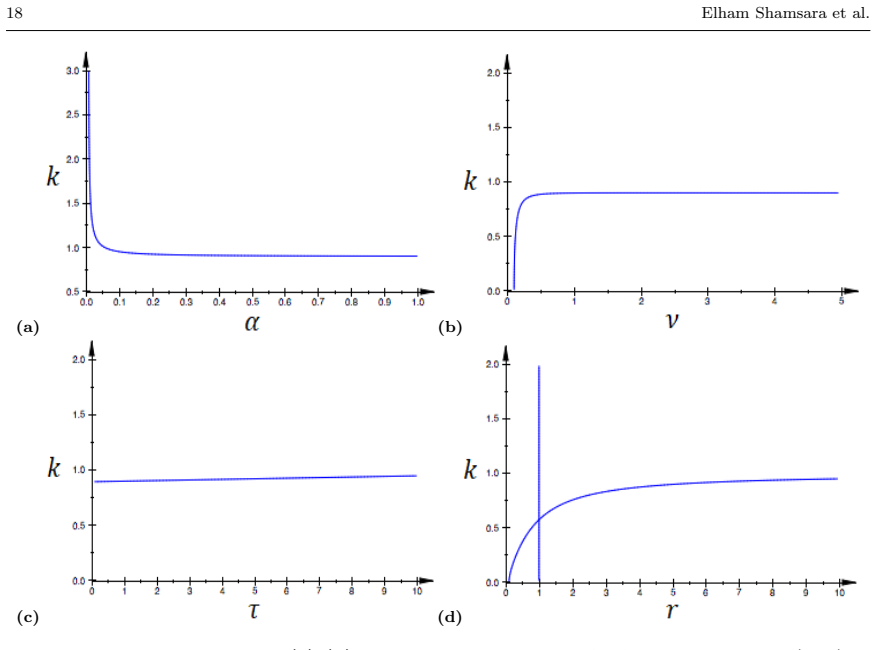
- [Figs. 4 and 5] The dispersion relation in Fig. 4 is computed from (5.25), whose derivation is already suspect; once the exact characteristic equation is used, the figure and the bifurcation curves in Fig. 5 should be recomputed, and the choice of parameter values (e.g., k=25, ω=2.573) should be revisited in light of the convergence issue raised in the major comments.
Circularity Check
No significant circularity: the bifurcation conditions are derived from the characteristic equation, and the one imported lemma is independent.
full rationale
The paper's claims are derived from the linearized characteristic equation (3.7), obtained by substituting the Fourier-Laplace ansatz (3.3) into the model (2.7). Theorem 1 follows from setting lambda = 0 in (3.7), where the left side equals 1 and the right side vanishes, so no static eigenvalue exists; this is a direct calculation, not an assumed conclusion. The Hopf condition in Section 5.1 is obtained from the exact k = 0 polynomial (5.3)-(5.9), and the Turing-Hopf condition (5.25) is obtained by inserting lambda = i omega into the same characteristic equation. The power-series truncation at J2 in (5.19) and the sign of the exponential factors are substantive correctness concerns, but they do not make the argument circular: the target bifurcation condition is not assumed or fitted, and the derivation can in principle be checked by exact evaluation of the integral. Lemma 1 is imported from [22] with a proof omitted, and [22] shares an author (Atay) with this paper; however, the lemma is a general inequality for polynomials with roots in the closed left half-plane, used only for the auxiliary stability theorem (Theorem 2), and it does not encode any of the paper's fitted or predicted quantities. No parameter is fitted to the claimed patterns, no uniqueness theorem is invoked to force a choice, and no known result is merely renamed. Therefore no circular step is present, and the appropriate score is 0.
Assumptions & free parameters
assumptions (6)
- domain assumption The temporal kernel is normalized so that alpha1 = alpha2 = alpha and has the exponential form in Eq (2.2).
- domain assumption The input currents are constant, I1 = E and I2 = I0, giving the unique constant equilibrium v0 = tau E.
- domain assumption The transfer function F is smooth, so linearization around the equilibrium is valid.
- domain assumption The spatial kernel J in Eq (2.4) and sigmoid in Eq (2.5) are used for the numerical simulations.
- standard math Lemma 1 from Atay and Hutt [22] applies to the characteristic function L(lambda).
- ad hoc to paper The power series expansion in Eq (5.19) can be truncated after the J2 term.
Cite this review
Pith. "Pith review of Dynamics of neural fields with exponential temporal kernel." pith.science (2026). https://pith.science/paper/G3FHOS2L
@misc{pith2026190806324,
  author       = {Pith},
  title        = {Pith review of: Dynamics of neural fields with exponential temporal kernel},
  year         = {2026},
  howpublished = {\url{https://pith.science/paper/G3FHOS2L}},
  note         = {Machine review of arXiv:1908.06324}
}
read the original abstract
We consider the standard neural field equation with an exponential temporal kernel. We analyze the time-independent (static) and time-dependent (dynamic) bifurcations of the equilibrium solution and the emerging spatiotemporal wave patterns. We show that an exponential temporal kernel does not allow static bifurcations such as saddle-node, pitchfork, and in particular, static Turing bifurcations. However, the exponential temporal kernel possesses the important property that it takes into account the finite memory of past activities of neurons, which Green's function does not. Through a dynamic bifurcation analysis, we give explicit bifurcation conditions. Hopf bifurcations lead to temporally non-constant, but spatially constant solutions, but Turing-Hopf bifurcations generate spatially and temporally non-constant solutions, in particular, traveling waves. Bifurcation parameters are the coefficient of the exponential temporal kernel, the transmission speed of neural signals, the time delay rate of synapses, and the ratio of excitatory to inhibitory synaptic weights.
Figures

Figures from the paper (5 more)


Reference graph
Works this paper leans on
-
[1]
J.Y.Wu, X.Y. Huang, C. Zhang. Propagating waves of activity in the neocortex: what they are, what they do. Neuroscientist. 2008 Oct;14(5):487-502. doi: 10.1177/1073858408317066. PMID: 18997124; PMCID: PMC2679998
-
[2]
Townsend, R.G., Solomon, S.S., Chen, S.C., Pietersen, A.N., Martin, P.R., Solomon, S.G. and Gong, P., 2015. Emergence of complex wave patterns in primate cerebral cortex. Journal of Neuroscience, 35(11), pp.4657-4662
work page 2015
-
[3]
Hippocampal theta oscillations are traveling waves
Lubenov, E., Siapas, A. Hippocampal theta oscillations are traveling waves. Nature 459, 534–539 (2009). https://doi.org/10.1038/nature08010
-
[4]
von der Malsburg, C. (1981). The correlation theory of brain function. Internal report 81-2, MPI biophysical chemistry. Reprinted in E. Domany, J. L. van Hemmen, & K. Schulten (Eds.), Models of neural networks II, chap. 2 (pp. 95–119). Berlin: Springer (1994)
work page 1981
-
[5]
Abeles, M. (1982). Studies of brain function: Vol. 6. Local cortical circuits: An electro- physiological study. Berlin: Springer
work page 1982
-
[6]
Brain Waves: Emergence of Localized, Persistent, Weakly Evanescent Cortical Loops
Galinsky VL, Frank LR. Brain Waves: Emergence of Localized, Persistent, Weakly Evanescent Cortical Loops. J Cogn Neurosci. 2020 Nov;32(11):2178-2202. doi: 10.1162/jocn-a-01611. Epub 2020 Jul 21. PMID: 32692294; PMCID: PMC7541648
-
[7]
E.R. Kandel, J.H. Schwartz, T.M. Jessell, Department of Biochemistry, Molecular Bio- physics Thomas Jessell, S. Siegelbaum, A.J. Hudspeth, Principles of neural science, vol 4, McGraw-hill, New York, 2000
work page 2000
-
[8]
H.R. Wilson, J.D. Cowan, A mathematical theory of the functional dynamics of cortical and thalamic nervous tissue, Biol. Cybernet. 13 (1973) 55-80
work page 1973
Show all 44 references
-
[9]
Wilson, J.D
H.R. Wilson, J.D. Cowan, Excitatory and inhibitory interactions in localized populations of model neurons, Biophys. J. 12 (1972) 1-24. Dynamics of neural fields with exponential temporal kernel 21
1972
-
[10]
Amari, Dynamics of pattern formation in lateral-inhibition type neural fields, Biol
S.-I. Amari, Dynamics of pattern formation in lateral-inhibition type neural fields, Biol. Cyber- net. 27 (1977) 77-87
1977
-
[11]
Veltz, O
R. Veltz, O. Faugeras, Stability of the stationary solutions of neural field equations with propa- gation delays, J. Math. Neurosci. 1 (2011) 1
2011
-
[12]
Perlovsky, Toward physics of the mind: Concepts, emotions, consciousness, and symbols, Phys
L.I. Perlovsky, Toward physics of the mind: Concepts, emotions, consciousness, and symbols, Phys. Life Rev. 3 (2006) 23–55
2006
-
[13]
Alswaihli, R
J. Alswaihli, R. Potthast, I. Bojak, D. Saddy, A. Hutt, Kernel reconstruction for delayed neural field equations, J. Math. Neurosci. 8 (2018) 3
2018
-
[14]
Abbassian, M
A.H. Abbassian, M. Fotouhi, M. Heidari, Neural fields with fast learning dynamic kernel, Biol. Cybernet. 106 (2012) 15–26
2012
-
[15]
Bressloff, Spatiotemporal dynamics of continuum neural fields, J
P.C. Bressloff, Spatiotemporal dynamics of continuum neural fields, J. Phys. A. Math. Theor. 45 (2011) 033001
2011
-
[16]
Haken, Brain dynamics: an introduction to models and simulations, Springer-Verlag, Berlin, 2007
H. Haken, Brain dynamics: an introduction to models and simulations, Springer-Verlag, Berlin, 2007
2007
-
[17]
Karbowski, N
J. Karbowski, N. Kopell, Multispikes and synchronization in a large neural network with tem- poral delays, Neural Comput. 12 (2000) 1573-1606
2000
-
[18]
Morelli, G
L.G. Morelli, G. Abramson, M.N. Kuperman, Associative memory on a small-world neural net- work, Eur. Phys. J. B 38 (2004) 495-500
2004
-
[19]
Prager, L.S Geier, Stochastic resonance in a non-markovian discrete state model for excitable systems, Phys
T. Prager, L.S Geier, Stochastic resonance in a non-markovian discrete state model for excitable systems, Phys. Rev. Lett. 91 (2003) 230601
2003
-
[20]
Spiridon, W
M. Spiridon, W. Gerstner, Effect of lateral connections on the accuracy of the population code for a network of spiking neurons, Network 12 (2001) 409-421
2001
-
[21]
W.Gerstner, W.Kistler, Spiking neuron models, Cambridge Univ.Press, 2002
2002
-
[22]
F.M. Atay, A. Hutt, Stability and bifurcations in neural fields with finite propagation speed and general connectivity, SIAM J. Appl. Math. 65 (2004) 644-666
2004
-
[23]
F.M. Atay, A. Hutt, Neural fields with distributed transmission speeds and long-range feedback delays, SIAM J. Appl. Dyn. Syst. 5 (2006) 670-698
2006
-
[24]
Hutt, F.M
A. Hutt, F.M. Atay, Analysis of nonlocal neural fields for both general and gamma-distributed connectivities, Physica D. 203 (2005) 30-54
2005
-
[25]
Hutt, F.M
A. Hutt, F.M. Atay, Effects of distributed transmission speeds on propagating activity in neural populations, Phys. Rev. E 73 (2006) 021906
2006
-
[26]
Korvasov´ a, J
J.Senk, K. Korvasov´ a, J. Schuecker, E. Hagen, T. Tetzlaff, M. Diesmann, M. Helias, Conditions for traveling waves in spiking neural networks, arXiv preprint arXiv:1801.06046(2018)
2018 arXiv
-
[27]
Polner, J.J.W
M. Polner, J.J.W. Van der Vegt, S.V. Gils, A space-time finite element method for neural field equations with transmission delays, SIAM J. Sci. Comput. 39 (2017) B797-B818
2017
-
[28]
O. A. Arqub, Adaptation of reproducing kernel algorithm for solving fuzzy fredholm–volterra integrodifferential equations, Neural Comput. Appl. 28 (2017) 1591-1610
2017
-
[29]
Faugeras, J
O. Faugeras, J. Inglis, Stochastic neural field equations: a rigorous footing, J. Math. Biol. 71 (2015) 259-300
2015
-
[30]
Rankin, D
J. Rankin, D. Avitabile, J. Baladron, G. Faye, D.J. Lloyd, Continuation of localized coherent structures in nonlocal neural field equations, SIAM J. Sci. Comput. 36 (2014) B70-B93
2014
-
[31]
J. Fang, G. Faye, Monotone traveling waves for delayed neural field equations, Math. Models Methods Appl. Sci. 26 (2016) 1919-1954
2016
-
[32]
Breakspear, Dynamic models of large-scale brain activity, Nat
M. Breakspear, Dynamic models of large-scale brain activity, Nat. Neurosci. 20 (2017) 340
2017
-
[33]
Pinto and G.B
D.J. Pinto and G.B. Ermentrout, Spatially structured activity in synaptically coupled neuronal networks: I. traveling fronts and pulses, SIAM J. Appl. Math. 62 (2001) 206-225
2001
-
[34]
Coombes, N
S. Coombes, N. Venkov, L. Shiau, I. Bojak, D.T. Liley, C.R. Laing, Modeling electrocortical activity through improved local approximations of integral neural field equations, Phys. Rev. E 76 (2007) 051901. 22 Elham Shamsara et al
2007
-
[35]
A. Hutt, M. Bestehorn, T. Wennekers, Pattern formation in intracortical neuronal fields, Network 14 (2003) 351-368
2003
-
[36]
P. A. Robinson, C. J. Rennie, and J. J. Wright, Propagation and stability of waves of electrical activity in the cerebral cortex, Phys. Rev. E, 56 (1997), 826-840
1997
-
[37]
Folias, P.C
S.E. Folias, P.C. Bressloff, Breathers in two-dimensional neural media, Phys. Rev. Lett. 95 (2005) 208107
2005
-
[38]
Laing, Spiral waves in nonlocal equations, SIAM J
C.R. Laing, Spiral waves in nonlocal equations, SIAM J. Appl. Dyn. Syst. 4 (2005) 588-606
2005
-
[39]
Folias, P.C
S.E. Folias, P.C. Bressloff, Breathing pulses in an excitatory neural network, SIAM J. Appl. Dyn. Syst. 3 (2004) 378-407
2004
-
[40]
Venkov, S
N.A. Venkov, S. Coombes, P.C. Matthews. Dynamic instabilities in scalar neural field equations with space-dependent delays. Physica D 232 (2007) 1-15
2007
-
[41]
Touboul, Mean-field equations for stochastic firing-rate neural fields with delays: Derivation and noise-induced transitions, Physica D 241 (2012) 1223-1244
J. Touboul, Mean-field equations for stochastic firing-rate neural fields with delays: Derivation and noise-induced transitions, Physica D 241 (2012) 1223-1244
2012
-
[42]
Bojak, D.T
I. Bojak, D.T. Liley, Axonal velocity distributions in neural field equations. PLoS Comput. Biol. 6 (2010) e1000653
2010
-
[43]
A. Hutt, A. Longtin, L. Schimansky-Geier, Additive noise-induced turing transitions in spatial systems with application to neural fields and the Swift-Hohenberg equation. Physica D 237 (2008) 755-773
2008
-
[44]
Coombes, Waves, bumps, and patterns in neural field theories
S. Coombes, Waves, bumps, and patterns in neural field theories. Biol. Cybernet. 93 (2005) 91-108
2005
Reviewed August 14, 2026 · model on record in the stance chip above.
Discussion (0). Continue with ORCID to comment.