REVIEW 2 major objections 3 minor 36 references
Variational Bayesian Channel Estimation and Data Detection for Cell-Free Massive MIMO with Low-Resolution Quantized Fronthaul Links
T0 review · 2 major / 3 minor · reviewed 2026-08-15 · deepseek-v4-flash
Pith's one-line read A variational Bayesian receiver lets 3-bit fronthaul links beat an unquantized linear baseline in cell-free massive MIMO.
desk verdict Useful extension of VB-JED to quantized cell-free MIMO with a genuinely new E-Q variant, but Eq. (19) adds cross-AP residual terms that do not follow from the factorized likelihood, so the simulated algorithm is not the claimed variational Bayes solution. read the letter →
The pith
A machine-rendered reading of the paper's core claim, the machinery that carries it, and where it could break.
The reading
What carries the argument
The load-bearing object is the mean-field variational family $q(R_p,R_d,X_d,H,\gamma_p,\gamma_d)$ and the coordinate-ascent updates that cycle through its factors. The critical update is the one for $r_t$: conditioned on the quantized bin, the variational posterior of the unquantized signal is a truncated complex Gaussian whose mean and variance are computed from Gaussian pdf/cdf functions. This step lets the method treat quantization as an exact likelihood rather than a Bussgang linearization. The second piece is the Gamma prior on the precision parameters $\gamma_p$ and $\gamma_{d,t}$; their VB updates use Lemma 1 to evaluate expectations of squared residuals, and setting the Gamma parameters to zero recovers the EM-based precision estimate of [35].
What would settle it
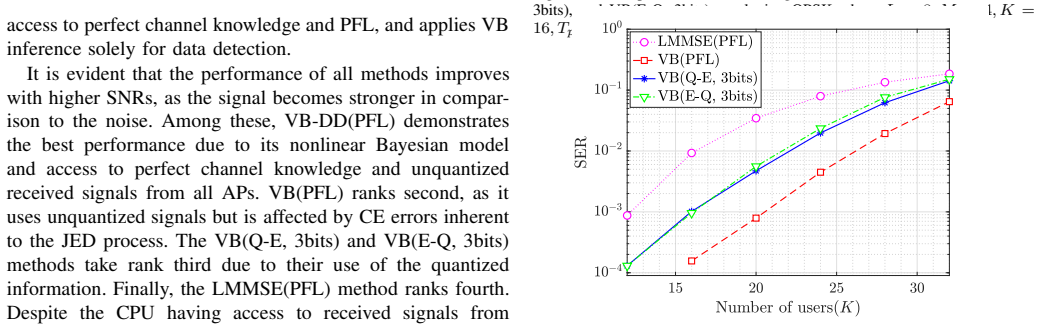
Reproduce the paper's main simulation (L=8, M=4, K=16, Tp=32, Td=128, QPSK) and check whether VB(Q-E, 3 bits) really holds about a 2 dB SER advantage over LMMSE(PFL) at 1e-3; if the gap vanishes or reverses, the central claim fails. A second probe targets the weakest assumption: rerun with mismatched or estimated covariance matrices and see whether the advantage disappears.
Extended reading notes
Core claim
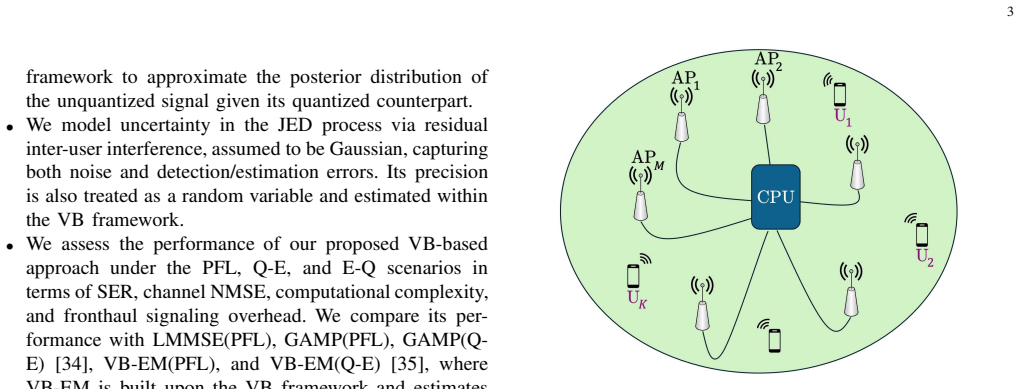
The paper's central discovery is that the nonlinear quantization operation can be absorbed into a fully variational Bayesian joint estimation and detection loop without linearizing the quantizer. The method approximates the intractable posterior over channel, data symbols, and precision parameters by a mean-field distribution, then cycles through coordinate-ascent updates. At each access point the received signal is quantized to a few bits; at the CPU, each unquantized receive sample is given a truncated Gaussian variational distribution whose support is the quantization bin, so the quantizer enters as an exact likelihood rather than an approximation. The precision of the residual inter-user interference, which contains noise plus estimation and detection errors, is treated as a Gamma random variable and updated inside the loop, and the authors show this contains the earlier VB-EM scheme as a special case. In simulations, VB(Q-E, 3 bits) and VB(E-Q, 3 bits) each gain about 2 dB over LMMSE with perfect fronthaul at symbol error rate 1e-3, VB with perfect fronthaul gains about 4 dB, and VB(Q-E) slightly beats VB(E-Q), which the authors attribute to local channel-estimation errors in the E-Q approach. Under correlated channels, the proposed VB methods converge while GAMP-based benchmarks can diverge.
Load-bearing premise
The method assumes the statistics of every user–AP channel (the covariance matrices) are known exactly in advance; if they are wrong or must be learned, the reported gains may shrink.
Editorial extensions
If this is right
- Low-resolution fronthaul no longer forces a linear-processing penalty: a 3-bit quantized link can outperform an unquantized link running LMMSE, which changes the cost–bandwidth trade-off in cell-free network design.
- Because VB(E-Q) needs fewer fronthaul bits than VB(Q-E) yet suffers only a small SER loss, it is the preferred scheme when both fronthaul bandwidth and computational complexity are tight.
- The fully VB precision updates make the method stable under spatially correlated channels, where AMP/GAMP-type receivers may diverge, so the receiver is usable in realistic correlated propagation.
- Joint estimation and detection benefits compound with data-block length: longer data phases improve SER for the VB methods while LMMSE plateaus, so iterative refinement is most valuable in long coherence blocks.
Reading between the lines
- If the channel covariance matrices must be estimated rather than given, the 2 dB advantage could shrink or vanish; a natural test is to feed the VB receiver estimated or mismatched covariances and measure the SER gap to LMMSE(PFL).
- The truncated-Gaussian quantization update is a modular ingredient: the same treatment could be dropped into other Bayesian receivers, such as expectation propagation or bilinear inference, to replace Bussgang linearization, and that substitution can be tested directly.
- The reported saturation of SER at high SNR for 1- and 2-bit quantizers implies a design rule the paper does not state: choose quantizer resolution according to the operating SNR, since quantization noise dominates above a few dB.
- The E-Q comparison assumes the local channel-estimation error variance is known; in deployment that variance would need tracking, and a mismatch could change the ordering between Q-E and E-Q.
Signed reviews
Editorial analysis
A structured set of objections, weighed in public.
Referee Report
Summary. The manuscript studies uplink joint channel estimation and data detection (JED) in a cell-free massive MIMO network in which access points (APs) forward low-resolution quantized signals to a central processing unit (CPU). It proposes a variational Bayesian (VB) inference framework with a mean-field factorization, deriving coordinate-ascent variational inference (CAVI) updates for the channel coefficients, data symbols, and precision parameters under three scenarios: perfect fronthaul links (PFL), quantization-and-estimation (Q-E), and estimation-and-quantization (E-Q). The paper reports that the proposed VB methods outperform LMMSE with perfect fronthaul, with about 2 dB SER gain at 1e-3 for 3-bit quantization, and also compares against GAMP-based and VB-EM-based nonlinear benchmarks. Complexity and fronthaul signaling overhead are analyzed.
Significance. If the derived updates were the true CAVI fixed points and the numerical results were reproducible, the paper would make a useful contribution by demonstrating that nonlinear VB-based JED can overcome low-resolution fronthaul limitations and outperform linear processing with perfect fronthaul, while providing a unified treatment of PFL, Q-E, and E-Q. The manuscript includes extensive simulations, comparisons with state-of-the-art nonlinear methods, and complexity/overhead analysis. However, the central derivation contains an error that invalidates the claim that the implemented algorithm is the variational Bayesian solution of the stated probabilistic model; the reported numerical gains therefore cannot be attributed to the method as described.
major comments (2)
- [III-A1, Eq. (17)-(19)] The update for q(h_{i,ℓ}) in Eq. (17) and the mean update in Eq. (19) include cross-AP residual terms Σ_{ℓ'≠ℓ}(r_{ℓ',t} − ⟨H_{ℓ'}⟩x_t) that do not follow from the factorized likelihood. Since p(r_t|H, γ_p; x_t) = CN(r_t; Hx_t, γ_p^{-1} I_{ML}) factorizes over AP blocks, the channel h_{i,ℓ} appears only in the ℓ-th block, and the expectation in Eq. (6) can only produce the local residual r_{ℓ,t} − Σ_{j≠i}⟨h_{j,ℓ}⟩x_{j,t}. The cross-AP residuals are constant with respect to h_{i,ℓ} and cancel in the normalization of q(h_{i,ℓ}). Their inclusion in Eq. (19), in the data-phase terms of Eq. (17), in Eq. (47) for the E-Q scenario, and in Algorithm 1 step 14 means that the implemented update is not the CAVI fixed point of the stated model. The paper provides no alternative model or justification for these terms. This is load-bearing because the claimed SER gains of VB(Q-E) and VB(E-Q) over LMMSE(PFL) are obtained with this heuristic update, not with the variational Bayesian solution described in Sections II-C and III-A.
- [IV-A, Fig. 7] The comparison against VB-EM in Fig. 7 tunes the Gamma hyperparameters a_p, b_p, a_{d,t}, b_{d,t} via bisection over the same SNR range on which performance is reported, whereas the VB-EM baseline uses the limiting case a_p = b_p = a_{d,t} = b_{d,t} = 0. This gives the proposed method an additional fitted degree of freedom and makes the claimed improvement over VB-EM not an apples-to-apples comparison. The paper should either fix the hyperparameters a priori, report sensitivity to their choice, or clearly state that the reported curves use hyperparameters tuned to the evaluation setting.
minor comments (3)
- [IV-C] The complexity of VB(PFL) and VB(Q-E) is stated as O(Itr [M^3 L^3 K + ...]); since the matrix inversion in Eq. (18) is performed per (i,ℓ) pair on an M×M matrix, the leading term should be O(K L M^3), which overstates the cost by a factor of L^2.
- [II-C] The residual terms ζ_p and ζ_d are defined in Eqs. (10)-(13) using estimated values Ĥ and X̂_d that are not yet available when the probabilistic model is specified; the subsequent Gaussian assumption is a modeling choice that should be clearly stated as part of the variational approximation rather than presented as a consequence of the definitions.
- [Algorithms 1 and 2] The hard-decision step 'Compute ˆx_{i,t} = arg max_{a∈S} q_i(a)' is written outside the iterative loop but does not specify whether the variational distribution from the final iteration is used; this should be stated explicitly, and the same applies to the final channel estimate in each algorithm.
Circularity Check
No significant circularity: VB updates are derived from the stated probabilistic model; no target quantity is pre-fitted or defined in terms of itself.
full rationale
The paper's derivation chain is self-contained with respect to the stated inputs. The joint model in (14)/(16) fixes the likelihood and priors; the mean-field factorization in (15) and the CA-VI update in (6) determine each variational factor by completing the square or normalizing over the constellation. The channel, symbol, precision, and quantized-signal updates in (17)-(31) and (36)-(37) all follow from that same objective, and none of them is a fitted parameter renamed as a prediction. Lemma 1 from [35] is cited for an algebraic expectation identity; although D. H. N. Nguyen is a co-author of [35], the lemma is parameter-free and stands independently of the SER/NMSE results, so the citation is not load-bearing circularity. The known-covariance assumption on Σ_i,l is a stated modeling premise, and the bisection tuning of Gamma hyperparameters in Fig. 7 is a simulation choice rather than a definition of the target quantities. While Eq. (19) appears to include cross-AP residual terms that do not follow from the factorized likelihood in Eq. (16), that is a derivation-consistency concern, not a circular reduction of the claimed result to its inputs. No step of the paper defines X in terms of Y, fits the target quantity, or imports a uniqueness conclusion from the authors' prior work.
Assumptions & free parameters
free parameters (2)
- Gamma hyperparameters a_p, b_p, a_d,t, b_d,t =
Not reported; tuned via bisection for Fig. 7; set to 0 elsewhere
- Local CE error variance N_e,i,ℓ =
10^-2 for SNR ≤ 10 dB, 10^-4 for SNR > 10 dB
assumptions (5)
- standard math Lemma 1 of [35]: expectation of a quadratic form under a factorized variational distribution, used in (20), (24), (29), (31).
- domain assumption Residual inter-user interference ζ_p and ζ_d are i.i.d. zero-mean Gaussian with Gamma-distributed precision.
- domain assumption Channel covariance matrices Σ_i,ℓ are known at APs and CPU.
- domain assumption Mean-field factorization of the posterior over H, X_d, and precisions, Eq. (15).
- domain assumption Uniform scalar quantization with known thresholds and no automatic gain control.
Cite this review
Pith. "Pith review of Variational Bayesian Channel Estimation and Data Detection for Cell-Free Massive MIMO with Low-Resolution Quantized Fronthaul Links." pith.science (2026). https://pith.science/paper/G3HW4IDT
@misc{pith2026250618863,
  author       = {Pith},
  title        = {Pith review of: Variational Bayesian Channel Estimation and Data Detection for Cell-Free Massive MIMO with Low-Resolution Quantized Fronthaul Links},
  year         = {2026},
  howpublished = {\url{https://pith.science/paper/G3HW4IDT}},
  note         = {Machine review of arXiv:2506.18863}
}
read the original abstract
We study the joint channel estimation and data detection (JED) problem in a cell-free massive multiple-input multiple-output (CF-mMIMO) network, where access points (APs) communicate with a central processing unit (CPU) over fronthaul links. However, the bandwidth of these links is limited, and thus, presents challenges to the applicability of CF-mMIMO, especially with an ever-increasing number of users. To address this, we propose a method based on variational Bayesian (VB) inference for performing the JED process, where the APs forward low-resolution quantized versions of the signals to the CPU. We consider two approaches: \emph{quantization-and-estimation} (Q-E) and \emph{estimation-and-quantization} (E-Q). In the Q-E approach, each AP uses a low-bit quantizer to quantize the signal before forwarding it to the CPU, while in the E-Q approach, each AP first performs local channel estimation and then sends a low-bit quantized version of the estimated channel to the CPU. We evaluate the performance of our VB-based approach under perfect fronthaul link (PFL) with unquantized received signals, Q-E, and E-Q in terms of symbol error rate (SER), normalized mean square error (NMSE) of the channel estimation, computational complexity, and fronthaul signaling overhead. We also compare these results with those of the linear minimum mean squared error (LMMSE) method under the PFL scenario. Our numerical results show that both the VB(Q-E) and VB(E-Q) approaches achieve superior performance compared to LMMSE(PFL), benefiting from the nonlinear modeling inherent in VB. Furthermore, the VB(Q-E) method outperforms VB(E-Q) due to errors in the local channel estimation process at the APs within the VB(E-Q) approach.
Figures


Figures from the paper (6 more)


Reference graph
Works this paper leans on
-
[1]
Five disruptive technology directions for 5G,
F. Boccardi, R. W. Heath, A. Lozano, T. L. Marzetta, and P . Popovski, “Five disruptive technology directions for 5G,” IEEE Commun. Mag. , vol. 52, no. 2, pp. 74–80, 2014
2014
-
[2]
Spectral efficien cy of DFT- based processing hybrid architectures in massive MIMO,
W. Tan, M. Matthaiou, S. Jin, and X. Li, “Spectral efficien cy of DFT- based processing hybrid architectures in massive MIMO,” IEEE Wireless Commun. Lett. , vol. 6, no. 5, pp. 586–589, 2017
work page 2017
-
[3]
An overview of massive MIMO: Benefits and challenges,
L. Lu, G. Y . Li, A. L. Swindlehurst, A. Ashikhmin, and R. Zh ang, “An overview of massive MIMO: Benefits and challenges,” IEEE J. Sel. Topics in Signal Process. , vol. 8, no. 5, pp. 742–758, 2014
work page 2014
-
[4]
Powe r-efficient analog front-end interference suppression with binary ant ennas,
S. Nassirpour, A. Gupta, A. V ahid, and D. Bharadia, “Powe r-efficient analog front-end interference suppression with binary ant ennas,” IEEE Trans. Wireless Commun. , vol. 22, no. 4, pp. 2592–2605, 2022
work page 2022
-
[5]
GreenMO: Enabling virtualized, sustainable massive MIMO with a single RF chain,
A. Gupta, S. Nassirpour, M. Dunna, E. Patamasing, A. V ahi d, and D. Bharadia, “GreenMO: Enabling virtualized, sustainable massive MIMO with a single RF chain,” in Proc. Annual Int. Conf. Mob. Comput. and Netw., 2023, pp. 1–17
work page 2023
-
[6]
Cell-free massive MIMO: User- centric approach,
S. Buzzi and C. D’Andrea, “Cell-free massive MIMO: User- centric approach,” IEEE Wireless Commun. Lett. , vol. 6, no. 6, pp. 706–709, 2017
work page 2017
-
[7]
Scalable cell-free ma ssive MIMO systems,
E. Bj¨ ornson and L. Sanguinetti, “Scalable cell-free ma ssive MIMO systems,” IEEE Trans. Commun. , vol. 68, no. 7, pp. 4247–4261, 2020
work page 2020
-
[8]
On the total energy efficiency of cell-free massive MIMO,
H. Q. Ngo, L.-N. Tran, T. Q. Duong, M. Matthaiou, and E. G. L arsson, “On the total energy efficiency of cell-free massive MIMO,” IEEE Trans. Green Commun. Netw. , vol. 2, no. 1, pp. 25–39, 2017
work page 2017
Show all 36 references
-
[9]
Cell-free massive MIMO versus small cells,
H. Q. Ngo, A. Ashikhmin, H. Y ang, E. G. Larsson, and T. L. Ma rzetta, “Cell-free massive MIMO versus small cells,” IEEE Trans. Wireless Commun., vol. 16, no. 3, pp. 1834–1850, 2017
2017
-
[10]
Pre- coding and power optimization in cell-free massive MIMO sys tems,
E. Nayebi, A. Ashikhmin, T. L. Marzetta, H. Y ang, and B. D . Rao, “Pre- coding and power optimization in cell-free massive MIMO sys tems,” IEEE Trans. Wireless Commun. , vol. 16, no. 7, pp. 4445–4459, 2017
2017
-
[11]
Making cell-free mas sive MIMO competitive with MMSE processing and centralized implemen tation,
E. Bj¨ ornson and L. Sanguinetti, “Making cell-free mas sive MIMO competitive with MMSE processing and centralized implemen tation,” IEEE Trans. Wireless Commun. , vol. 19, no. 1, pp. 77–90, 2019
2019
-
[12]
Message-pas sing algo- rithms for compressed sensing,
D. L. Donoho, A. Maleki, and A. Montanari, “Message-pas sing algo- rithms for compressed sensing,” Proc. Nat. Academy Sci. , vol. 106, no. 45, pp. 18 914–18 919, 2009
2009
-
[13]
Optimality of large MIMO detection via approximate message passing,
C. Jeon, R. Ghods, A. Maleki, and C. Studer, “Optimality of large MIMO detection via approximate message passing,” in Proc. IEEE Int. Symp. Inf. Theory (ISIT) . IEEE, 2015, pp. 1227–1231
2015
-
[14]
A variational Bayesian perspective on massive MIMO detectio n,
D. H. N. Nguyen, I. Atzeni, A. T ¨ olli, and A. L. Swindlehu rst, “A variational Bayesian perspective on massive MIMO detectio n,” arXiv preprint arXiv:2205.11649, 2022
2022 arXiv
-
[15]
A low-complexity iterat ive GAMP- based detection for massive MIMO with low-resolution ADCs,
Y . Xiong, N. Wei, and Z. Zhang, “A low-complexity iterat ive GAMP- based detection for massive MIMO with low-resolution ADCs, ” in 2017 IEEE Wireless Communications and Networking Conference (W CNC). IEEE, 2017, pp. 1–6
2017
-
[16]
Bilinea r expectation propagation for distributed semi-blind joint channel esti mation and data detection in cell-free massive MIMO,
A. Karataev, C. Forsch, and L. Cottatellucci, “Bilinea r expectation propagation for distributed semi-blind joint channel esti mation and data detection in cell-free massive MIMO,” IEEE Open J. Signal Process. , 2024
2024
-
[17]
Subspace-based semi-bl ind channel estimation for user-centric cell-free massive MIMO system s,
B. Zhong, X. Zhu, and E. G. Lim, “Subspace-based semi-bl ind channel estimation for user-centric cell-free massive MIMO system s,” in Proc. IEEE V eh. Technol. Conf., 2024, pp. 1–5
2024
-
[18]
Channel estimation f or cell-free mmWave massive MIMO through deep learning,
Y . Jin, J. Zhang, S. Jin, and B. Ai, “Channel estimation f or cell-free mmWave massive MIMO through deep learning,” IEEE Trans. V eh. Technol., vol. 68, no. 10, pp. 10 325–10 329, 2019
2019
-
[19]
Graph coloring based pilot assignment for cell-free massive MIMO systems,
H. Liu, J. Zhang, S. Jin, and B. Ai, “Graph coloring based pilot assignment for cell-free massive MIMO systems,” IEEE Trans. V eh. Technol., vol. 69, no. 8, pp. 9180–9184, 2020
2020
-
[20]
Generalized superimposed t raining scheme in cell-free massive MIMO systems,
N. Garg and T. Ratnarajah, “Generalized superimposed t raining scheme in cell-free massive MIMO systems,” IEEE Trans. Wireless Commun. , vol. 21, no. 9, pp. 7668–7681, 2022
2022
-
[21]
Joint channel estimation and data detection in cell-free m assive MU- MIMO systems,
H. Song, T. Goldstein, X. Y ou, C. Zhang, O. Tirkkonen, an d C. Studer, “Joint channel estimation and data detection in cell-free m assive MU- MIMO systems,” IEEE Trans. Wireless Commun. , vol. 21, no. 6, pp. 4068–4084, 2021
2021
-
[22]
V ariational Bayes’ joint channel estimation and soft symbol decoding for uplink massive MIMO systems with low resolution ADCs,
S. S. Thoota and C. R. Murthy, “V ariational Bayes’ joint channel estimation and soft symbol decoding for uplink massive MIMO systems with low resolution ADCs,” IEEE Trans. Commun. , vol. 69, no. 5, pp. 3467–3481, 2021
2021
-
[23]
V ariational Bayes inference for data detection in cell-free massive MIMO,
L. V . Nguyen, H. Q. Ngo, L.-N. Tran, A. L. Swindlehurst, a nd D. H. Nguyen, “V ariational Bayes inference for data detection in cell-free massive MIMO,” in Proc. Asilomar Conf. Signals, Systems, and Comp. IEEE, 2022, pp. 727–732
2022
-
[24]
Joint CFO, gridless c hannel estimation and data detection for underwater acoustic OFDM systems,
L. Wan, J. Zhu, E. Cheng, and Z. Xu, “Joint CFO, gridless c hannel estimation and data detection for underwater acoustic OFDM systems,” IEEE J. Oceanic Eng. , vol. 47, no. 4, pp. 1215–1230, 2022
2022
-
[25]
C. M. Bishop and N. M. Nasrabadi, Pattern recognition and machine learning. Springer, 2006, vol. 4, no. 4
2006
-
[26]
Graphical models, exponential families, and variational inference,
M. J. Wainwright, M. I. Jordan et al. , “Graphical models, exponential families, and variational inference,” F oundations and Trends® in Ma- chine Learning , vol. 1, no. 1–2, pp. 1–305, 2008
2008
-
[27]
Joint activity detection and ch annel estima- tion in cell-free massive MIMO networks with massive connec tivity,
M. Guo and M. C. Gursoy, “Joint activity detection and ch annel estima- tion in cell-free massive MIMO networks with massive connec tivity,” IEEE Trans. Commun. , vol. 70, no. 1, pp. 317–331, 2021
2021
-
[28]
Grant-free massive conne ctivity in massive MIMO systems: Collocated versus cell-free,
H. Wang, J. Wang, and J. Fang, “Grant-free massive conne ctivity in massive MIMO systems: Collocated versus cell-free,” IEEE Wireless Commun. Lett. , vol. 10, no. 3, pp. 634–638, 2020
2020
-
[29]
Grant-free access via bilinear inference for cell-free MI MO with low- coherence pilots,
H. Iimori, T. Takahashi, K. Ishibashi, G. T. F. de Abreu, and W. Y u, “Grant-free access via bilinear inference for cell-free MI MO with low- coherence pilots,” IEEE Trans. Wireless Commun. , vol. 20, no. 11, pp. 7694–7710, 2021
2021
-
[30]
Uplink spectral and energy efficiency of c ell- free massive MIMO with optimal uniform quantization,
M. Bashar, H. Q. Ngo, K. Cumanan, A. G. Burr, P . Xiao, E. Bj ¨ ornson, and E. G. Larsson, “Uplink spectral and energy efficiency of c ell- free massive MIMO with optimal uniform quantization,” IEEE Trans. Commun., vol. 69, no. 1, pp. 223–245, 2020
2020
-
[31]
Joint activity detection and channel estimation in mixed-fronthaul cell-free massive M IMO,
T. Zhao, S. Chen, H.-H. Chen, and Q. Guo, “Joint activity detection and channel estimation in mixed-fronthaul cell-free massive M IMO,” IEEE Trans. V eh. Technol., 2024
2024
-
[32]
Bayesian receiver design via bilinear inference for cell- free massive MIMO with low-resolution ADCs,
T. Takahashi, H. Iimori, K. Ando, K. Ishibashi, S. Ibi, a nd G. T. F. de Abreu, “Bayesian receiver design via bilinear inference for cell- free massive MIMO with low-resolution ADCs,” IEEE Trans. Wireless Commun., vol. 22, no. 7, pp. 4756–4772, 2022
2022
-
[33]
Throughput analysis of massive MIMO uplink with low-resol ution ADCs,
S. Jacobsson, G. Durisi, M. Coldrey, U. Gustavsson, and C. Studer, “Throughput analysis of massive MIMO uplink with low-resol ution ADCs,” IEEE Trans. Wireless Commun. , vol. 16, no. 6, pp. 4038–4051, 2017
2017
-
[34]
B ayes-optimal joint channel-and-data estimation for massive MIMO with lo w-precision ADCs,
C.-K. Wen, C.-J. Wang, S. Jin, K.-K. Wong, and P . Ting, “B ayes-optimal joint channel-and-data estimation for massive MIMO with lo w-precision ADCs,” IEEE Trans. Signal Process. , vol. 64, no. 10, pp. 2541–2556, 2015
2015
-
[35]
V a riational Bayes for joint channel estimation and data detection in few -bit massive MIMO systems,
L. V . Nguyen, A. L. Swindlehurst, and D. H. N. Nguyen, “V a riational Bayes for joint channel estimation and data detection in few -bit massive MIMO systems,” IEEE Trans. Signal Process. , vol. 72, pp. 3408–3423, 2024
2024
-
[36]
Channel capacity of MIMO architecture usi ng the expo- nential correlation matrix,
S. L. Loyka, “Channel capacity of MIMO architecture usi ng the expo- nential correlation matrix,” IEEE Commun. Letters , vol. 5, no. 9, pp. 369–371, 2001
2001
Reviewed August 15, 2026 · model on record in the stance chip above.
Discussion (0). Continue with ORCID to comment.