REVIEW 3 major objections 5 minor 36 references
Clustered Hierarchical Entropy-Scaling Search of Astronomical and Biological Data
T0 review · 3 major / 5 minor · reviewed 2026-08-14 · deepseek-v4-flash
Pith's one-line read CHESS claims nearest-neighbor search whose coarse cost is logarithmic in cluster count, with exactness for metric distances.
desk verdict Useful empirical extension of entropy-scaling search with a sound exactness guarantee, but the O(log2 k) coarse-search bound is an empirical assumption presented as asymptotics and needs revision before the theory is credible. read the letter →
The pith
A machine-rendered reading of the paper's core claim, the machinery that carries it, and where it could break.
The reading
What carries the argument
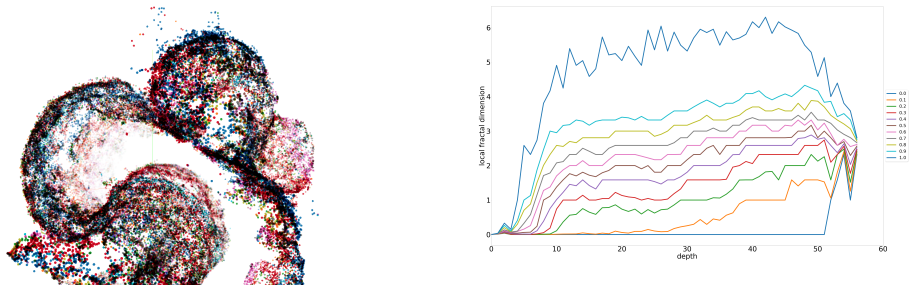
The central object is a binary divisive cluster tree: each node stores a center (a real data point chosen as one of the two farthest seeds), the cluster radius, and an estimate of the local fractal dimension $\log_2(|B_D(q,r_1)|/|B_D(q,r_2)|)$ at $r_1$ and $r_1/2$. Search descends the tree, recursing into any child whose center lies within $r + r_c$ of the query; the triangle inequality then guarantees no metric hit is pruned. The argument that low fractal dimension bounds the number of explored branches by a constant is what converts the coarse search from $O(k)$ to $O(\log_2 k)$; clustering itself costs $O(dn)$ distance comparisons.
What would settle it
Run CHESS on any data set with measured local fractal dimension below 2 at all cluster scales, count the number of leaf clusters visited by a query whose radius equals the mean leaf cluster radius, and see whether that count grows with tree depth or with $k$. If branch count grows faster than a constant while fractal dimension stays low, the claimed $O(\log_2 k)$ coarse search is falsified.
Extended reading notes
Core claim
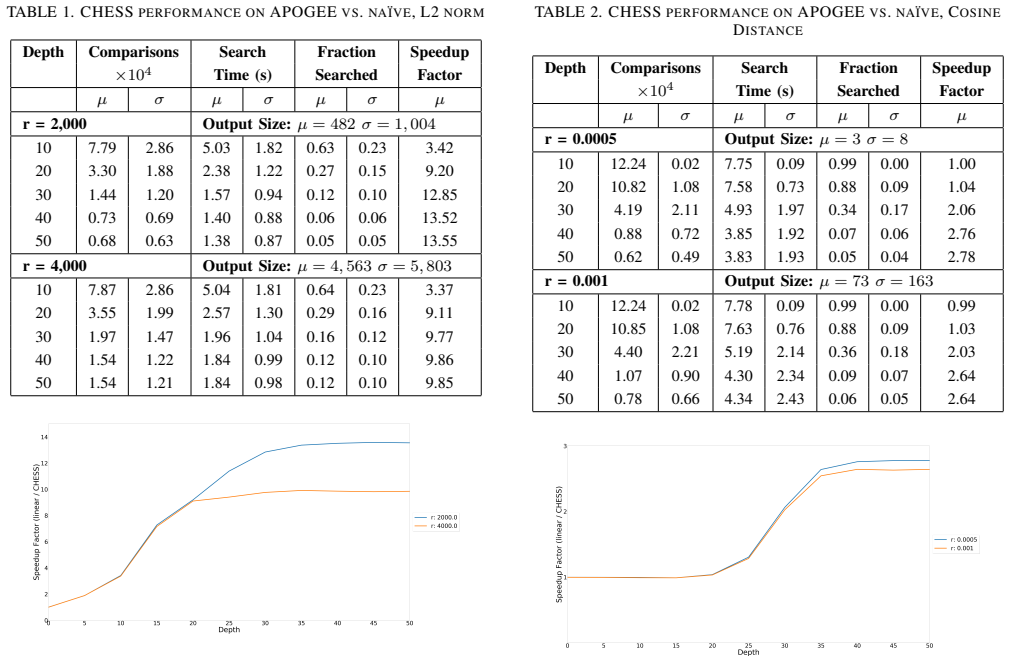
Equation (3) states CHESS's effective asymptotic complexity as $O(\log_2 k + |B_D(q,r)| ((r+2\hat{r}_c)/r)^d)$, where $k$ is the number of leaf clusters, $\hat{r}_c$ the mean leaf cluster radius, $d$ the local fractal dimension, and $|B_D(q,r)|$ the number of points within distance $r$ of the query. The paper claims this is an order-of-magnitude algorithmic improvement in distance comparisons over a flat entropy-scaling search and over a standard locality-sensitive hashing library on the same data, with virtually no loss in specificity or sensitivity. The tree traversal visits only a constant number of branches because low local fractal dimension keeps the number of overlapping clusters small; the reported measurements put that multiplier at 4 or less. For any metric distance function, the triangle inequality guarantees that pruning by $r + \text{cluster radius}$ loses no true matches, so the search is exact; for non-metric cosine distance the false-negative rate averages $4.4\times 10^{-4}$.
Load-bearing premise
The argument assumes that low local fractal dimension keeps the number of tree branches explored by a query at a small constant, so the coarse search is genuinely $\log_2 k$; the paper asserts this from measured fractal dimension figures rather than proving it.
Editorial extensions
If this is right
- On any data set with low local fractal dimension, query cost becomes effectively independent of database size, so the speedup over linear search widens as more data accumulate.
- Because CHESS accepts any user-defined distance, it can replace locality-sensitive hashing in applications where the distance is not L2 or cosine, and it gives exact results whenever the distance is a metric.
- The same tree can serve as a lossless compression scheme, since each point can be stored as its difference from its leaf cluster center.
- The k-nearest-neighbors extension has complexity $O(S \log r' + |B_D(q,\rho)| \log k)$, where $S$ is the CHESS search complexity, so KNN inherits the geometry-dependent scaling.
- CHESS's advantages are expected to grow on future larger surveys and metagenomic data sets, since the number of leaf clusters grows only logarithmically with $n$.
Reading between the lines
- The constant-branch multiplier is an empirical observation, not a theorem; a rigorous version would likely require an assumption such as bounded doubling dimension or a formal local intrinsic dimension bound.
- If the branch count is not actually constant for some query radii, the $\log_2 k$ term is an underestimate; the paper's own Section 3.1 admits there is no guarantee the fine search is over one cluster.
- The tree could plausibly be maintained under insertions, serving as a live database index; the paper sketches this but does not implement it.
- A direct comparison of CHESS against a C++ LSH library is skewed by implementation language; a fairer test would bench a native CHESS implementation, which the paper flags as future work.
Signed reviews
Editorial analysis
A structured set of objections, weighed in public.
Referee Report
Summary. The paper introduces CHESS, a divisive hierarchical clustering search algorithm for rho-nearest-neighbor queries. It extends the flat entropy-scaling search of Yu et al. by replacing the linear scan over k clusters with a binary tree traversal claimed to cost O(log2 k), yielding the effective complexity O(log2 k + |BD(q,r)| ((r + 2 rhat_c)/r)^d) in Eq. (3). The authors report 13.6x and 68x speedups over linear search on APOGEE and GreenGenes respectively, an order-of-magnitude reduction in distance comparisons relative to FALCONN on APOGEE, exact results under metric distances, and a lossless compression scheme based on cluster centers.
Significance. The exactness argument via the triangle inequality (Section 3.3) is sound, and the benchmark methodology reports means and standard deviations for both wall-clock time and distance comparisons. The availability of source code and the use of distance-comparison counts to mitigate language/implementation differences are positive features. If the O(log2 k) claim were proven, CHESS would be a practically useful index for high-dimensional, low-intrinsic-dimensional data with arbitrary metric distances. However, the paper's central theoretical contribution is currently an empirical hypothesis rather than a proven complexity bound, because the number of tree branches visited by a query is not formally controlled.
major comments (3)
- [Section 3.1, Eq. (3)] The derivation of the O(log2 k) coarse-search term is incomplete. The text concedes that "there is no guarantee that the fine search will be over only one leaf cluster" and then asserts, from the measured fractal dimension, that "the multiplier is bounded by 4." The local fractal dimension defined by Eq. (2) controls the growth in the number of data points inside balls of radii r1 and r2; it does not directly control the number of leaf clusters whose centers lie within r + rhat_c of the query. Even for data on a one-dimensional manifold, a query ball of radius r can intersect O((r + 2 rhat_c)/rhat_c) leaves when leaf radius rhat_c is small, and this factor is not constant as the tree deepens. In addition, the counting argument at the top of Section 3.1 assumes a perfectly balanced tree with n/2^d points per cluster, but the text states this assumption "will turn out to not be required" without providing a replacement; with skewed splits the tree depth may be larger than log2 k and the traversal cost can be correspondingly larger. To support Eq. (3) as an asymptotic claim, the authors need either a formal packing/covering argument that bounds the number of visited branches under their clustering construction, or a revision that explicitly presents Eq. (3) as an empirical model rather than a theorem.
- [Algorithm 1] The pseudocode for Cluster is not a valid terminating procedure. The variable d is initialized to 0, and the while loop "while d <= maxdepth" never increments d, so the loop either recurses indefinitely or, if recursion is meant to be conditional, never makes progress on depth. The algorithm should use an if/else on d < maxdepth and pass d+1 to recursive calls. As written, the pseudocode cannot be implemented as stated, which compromises the reproducibility of the method description.
- [Section 3.2, Table 4] The claim of "an order of magnitude algorithmic improvement over FALCONN" is based on a single fixed dataset (APOGEE) and a single FALCONN operating point, with no reported FALCONN hyperparameters (e.g., number of hash tables, number of probes) or recall values. FALCONN is an approximate search method whose speed and accuracy trade off with these parameters; a comparison of only distance comparisons at one configuration is insufficient to support the general algorithmic-improvement claim made in the abstract and Section 3.2. Report the parameter settings, a recall/precision curve, and ideally multiple datasets.
minor comments (5)
- [Abstract, Section 1, Section 3.3] The paper describes CHESS as "approximate search" throughout, but Section 3.3 reports that under metric distances the search is exact; the terminology should be reconciled.
- [Section 2.1.1 and Introduction] The Introduction cites 263,000 stars for APOGEE, while Section 2.1.1 says "approximately 130,000"; the discrepancy should be clarified.
- [Section 3.5, Eq. (4)] Equation (4) and the KNN extension use O(S·log(r′)) with a logarithm of a quantity that has units, and the definition of r′ ("rc0 when rc0 includes values greater than 1, and otherwise 1/rc0") is awkward; specify the base and avoid dimensioned logarithms.
- [Table 3] The table header says "Fraction Searched" while the surrounding text refers to both "fraction of the data set" and "fraction of leaf clusters searched"; the units should be consistent across the table and text.
- [Section 3.4] The compression result (4 GB to 3.4 GB) is modest; the discussion should state the quantization parameter used and avoid overstating the benefit without reporting the resulting accuracy or size trade-offs.
Circularity Check
No significant circularity: the O(log k) coarse-search claim is under-justified but not derived from its own inputs; benchmarks and exactness proof are independent.
full rationale
The paper's central new step is replacing k by log2 k in Eq. (3). This is argued in Section 3.1 from low measured fractal dimension and an asserted constant multiplier of 4. That inference is not circular: the fractal dimension d is measured from the same data sets, but the number of tree branches visited is a separate geometric quantity, and the paper does not define d so that the branch multiplier equals 4 by construction. The gap is a lack of proof that low d bounds the number of intersecting leaf clusters, not a reduction of the conclusion to its inputs. The empirical speedups over linear search and FALCONN are independent measurements, and the exactness argument in Section 3.3 rests on the triangle inequality, an external mathematical fact. Citations to the authors' own [7] supply the baseline flat entropy-scaling complexity and the fractal-dimension methodology, but the CHESS-specific claim is not justified by that citation alone; it is tested against external baselines. Under the stated standard, no self-definitional, fitted-input, or self-citation-driven circularity is present.
Assumptions & free parameters
free parameters (4)
- maxdepth (tree depth) =
10, 20, 30, 40, 50
- minsize (minimum cluster cardinality) =
10 (stated typically 10)
- local fractal dimension d =
Estimated per cluster; means below 2 except the top decile
- mean leaf cluster radius rhat_c =
Not reported numerically
assumptions (3)
- domain assumption APOGEE and GreenGenes data have low local fractal dimension and low metric entropy, so most clusters have local fractal dimension below 2.
- ad hoc to paper The number of tree branches a query ball overlaps is bounded by a small constant (said to be 4) when local fractal dimension is below 2.
- standard math L2 and Hamming distances satisfy the triangle inequality.
Cite this review
Pith. "Pith review of Clustered Hierarchical Entropy-Scaling Search of Astronomical and Biological Data." pith.science (2026). https://pith.science/paper/G3R3CNMV
@misc{pith2026190808551,
  author       = {Pith},
  title        = {Pith review of: Clustered Hierarchical Entropy-Scaling Search of Astronomical and Biological Data},
  year         = {2026},
  howpublished = {\url{https://pith.science/paper/G3R3CNMV}},
  note         = {Machine review of arXiv:1908.08551}
}
abstract
Both astronomy and biology are experiencing explosive growth of data, resulting in a "big data" problem that stands in the way of a "big data" opportunity for discovery. One common question asked of such data is that of approximate search ($\rho-$nearest neighbors search). We present a hierarchical search algorithm for such data sets that takes advantage of particular geometric properties apparent in both astronomical and biological data sets, namely the metric entropy and fractal dimensionality of the data. We present CHESS (Clustered Hierarchical Entropy-Scaling Search), a search tool with virtually no loss in specificity or sensitivity, demonstrating a $13.6\times$ speedup over linear search on the Sloan Digital Sky Survey's APOGEE data set and a $68\times$ speedup on the GreenGenes 16S metagenomic data set, as well as asymptotically fewer distance comparisons on APOGEE when compared to the FALCONN locality-sensitive hashing library. CHESS demonstrates an asymptotic complexity not directly dependent on data set size, and is in practice at least an order of magnitude faster than linear search by performing fewer distance comparisons. Unlike locality-sensitive hashing approaches, CHESS can work with any user-defined distance function. CHESS also allows for implicit data compression, which we demonstrate on the APOGEE data set. We also discuss an extension allowing for efficient k-nearest neighbors search.
Figures


Figures from the paper (3 more)


Reference graph
Works this paper leans on
-
[1]
Astronomy in the big data era,
Y . Zhang and Y . Zhao, “Astronomy in the big data era,” Data Science Journal, vol. 14, 2015
work page 2015
-
[2]
Extracting knowledge from massive astronomical data sets,
M. Brescia, S. Cavuoti, G. S. Djorgovski, C. Donalek, G. Longo, and M. Paolillo, “Extracting knowledge from massive astronomical data sets,” in Astrostatistics and Data Mining. Springer, 2012, pp. 31–45
work page 2012
-
[3]
Sloan Digital Sky Survey IV: Mapping the Milky Way, Nearby Galaxies, and the Distant Universe,
M. R. Blanton, M. A. Bershady, B. Abolfathi, F. D. Albareti, C. Al- lende Prieto, A. Almeida, J. Alonso-Garc´ıa, F. Anders, S. F. Anderson, B. Andrews, and et al., “Sloan Digital Sky Survey IV: Mapping the Milky Way, Nearby Galaxies, and the Distant Universe,” The Astronomical Journal, vol. 154, p. 28, Jul. 2017
work page 2017
-
[4]
The Apache Point Observatory Galactic Evolution Experiment (APOGEE),
S. R. Majewski, R. P. Schiavon, P. M. Frinchaboy, C. Allende Prieto, R. Barkhouser, D. Bizyaev, B. Blank, S. Brunner, A. Burton, R. Car- rera, S. D. Chojnowski, K. Cunha, C. Epstein, G. Fitzgerald, A. E. Garc´ıa P´erez, F. R. Hearty, C. Henderson, J. A. Holtzman, J. A. John- son, C. R. Lam, J. E. Lawler, P. Maseman, S. M ´esz´aros, M. Nelson, D. C. Nguyen...
work page 2017
-
[5]
Lsst: from science drivers to reference design and anticipated data products,
ˇZ. Ivezi´c, S. M. Kahn, J. A. Tyson, B. Abel, E. Acosta, R. Allsman, D. Alonso, Y . AlSayyad, S. F. Anderson, J. Andrewet al., “Lsst: from science drivers to reference design and anticipated data products,”The Astrophysical Journal, vol. 873, no. 2, p. 111, 2019
work page 2019
-
[6]
First data release of the all- sky noao source catalog,
D. L. Nidever, A. Dey, K. Olsen, S. Ridgway, R. Nikutta, S. Juneau, M. Fitzpatrick, A. Scott, and F. Valdes, “First data release of the all- sky noao source catalog,” The Astronomical Journal, vol. 156, no. 3, p. 131, 2018
work page 2018
-
[7]
Entropy-scaling search of massive biological data,
Y . W. Yu, N. Daniels, D. C. Danko, and B. Berger, “Entropy-scaling search of massive biological data,” Cell Systems , vol. 1, no. 2, pp. 130–140, 2015
work page 2015
-
[8]
Computational biology in the 21st century: Scaling with compressive algorithms,
B. Berger, N. M. Daniels, and Y . W. Yu, “Computational biology in the 21st century: Scaling with compressive algorithms,” Communica- tions of the ACM , vol. 59, no. 8, p. 72, 2016
work page 2016
Show all 36 references
-
[9]
Metagenomic analysis of the human distal gut microbiome,
S. R. Gill, M. Pop, R. T. DeBoy, P. B. Eckburg, P. J. Turnbaugh, B. S. Samuel, J. I. Gordon, D. A. Relman, C. M. Fraser-Liggett, and K. E. Nelson, “Metagenomic analysis of the human distal gut microbiome,” science, vol. 312, no. 5778, pp. 1355–1359, 2006
2006
-
[10]
Enterotypes of the human gut microbiome,
M. Arumugam, J. Raes, E. Pelletier, D. Le Paslier, T. Yamada, D. R. Mende, G. R. Fernandes, J. Tap, T. Bruls, J.-M. Batto et al. , “Enterotypes of the human gut microbiome,” nature, vol. 473, no. 7346, p. 174, 2011
2011
-
[11]
Human gut microbiome viewed across age and geography,
T. Yatsunenko, F. E. Rey, M. J. Manary, I. Trehan, M. G. Dominguez- Bello, M. Contreras, M. Magris, G. Hidalgo, R. N. Baldassano, A. P. Anokhin et al. , “Human gut microbiome viewed across age and geography,” nature, vol. 486, no. 7402, p. 222, 2012
2012
-
[12]
Characterization of the gut microbiome using 16s or shotgun metagenomics,
J. Jovel, J. Patterson, W. Wang, N. Hotte, S. O’Keefe, T. Mitchel, T. Perry, D. Kao, A. L. Mason, K. L. Madsen et al., “Characterization of the gut microbiome using 16s or shotgun metagenomics,” Frontiers in microbiology, vol. 7, p. 459, 2016
2016
-
[13]
Predictive functional profiling of microbial communities using 16S rRNA marker gene sequences,
M. G. Langille, J. Zaneveld, J. G. Caporaso, D. McDonald, D. Knights, J. A. Reyes, J. C. Clemente, D. E. Burkepile, R. L. V . Thurber, R. Knight, and C. Huttenhower, “Predictive functional profiling of microbial communities using 16S rRNA marker gene sequences,” Nature Biotechn...
2013
-
[14]
Green- genes, a chimera-checked 16s rrna gene database and workbench compatible with arb,
T. Z. DeSantis, P. Hugenholtz, N. Larsen, M. Rojas, E. L. Brodie, K. Keller, T. Huber, D. Dalevi, P. Hu, and G. L. Andersen, “Green- genes, a chimera-checked 16s rrna gene database and workbench compatible with arb,” Appl. Environ. Microbiol. , vol. 72, no. 7, pp. 5069–5072, 2006
2006
-
[15]
Sublinear time algorithms for metric space problems,
P. Indyk, “Sublinear time algorithms for metric space problems,” Symposium on Theory of Computing , 1999
1999
-
[16]
Efficient construction of an assembly string graph using the fm-index,
J. T. Simpson and R. Durbin, “Efficient construction of an assembly string graph using the fm-index,” Bioinformatics, vol. 26, no. 12, pp. i367–i373, 2010
2010
-
[17]
Nearest neighbor pattern classification,
T. M. Cover, P. Hart et al., “Nearest neighbor pattern classification,” IEEE transactions on information theory , vol. 13, no. 1, pp. 21–27, 1967
1967
-
[18]
Falconn: Similarity search over high-dimensional data,
I. Razenshteyn, L. Schmidt, A. Andoni, P. Indyk, and T. Laarhoven, “Falconn: Similarity search over high-dimensional data,” 2015
2015
-
[19]
Space-and time-efficient algorithm for maintaining dense subgraphs on one-pass dynamic streams,
S. Bhattacharya, M. Henzinger, D. Nanongkai, and C. Tsourakakis, “Space-and time-efficient algorithm for maintaining dense subgraphs on one-pass dynamic streams,” in Proceedings of the forty-seventh annual ACM symposium on Theory of computing . ACM, 2015, pp. 173–182
2015
-
[20]
On the exact space complexity of sketching and streaming small norms,
D. M. Kane, J. Nelson, and D. P. Woodruff, “On the exact space complexity of sketching and streaming small norms,” in Proceedings of the twenty-first annual ACM-SIAM symposium on Discrete Algo- rithms. Society for Industrial and Applied Mathematics, 2010, pp. 1161–1178
2010
-
[21]
A general method applicable to the search for similarities in the amino acid sequence of two proteins,
S. B. Needleman and C. D. Wunsch, “A general method applicable to the search for similarities in the amino acid sequence of two proteins,” Journal of molecular biology , vol. 48, no. 3, pp. 443–453, 1970
1970
-
[22]
¨Uber den zusammenhang von helligkeit und spektral- typus in den plejaden,
H. Rosenberg, “ ¨Uber den zusammenhang von helligkeit und spektral- typus in den plejaden,” Astronomische Nachrichten, vol. 186, p. 71, 1910
1910
-
[23]
Testing the manifold hypothesis,
C. Fefferman, S. Mitter, and H. Narayanan, “Testing the manifold hypothesis,” Journal of the American Mathematical Society , vol. 29, no. 4, pp. 983–1049, 2016
2016
-
[24]
The eleventh and twelfth data releases of the sloan digital sky survey: final data from sdss-iii,
S. Alam, F. D. Albareti, C. A. Prieto, F. Anders, S. F. Anderson, T. Anderton, B. H. Andrews, E. Armengaud, ´E. Aubourg, S. Bailey et al., “The eleventh and twelfth data releases of the sloan digital sky survey: final data from sdss-iii,” The Astrophysical Journal Supple- ment ...
2015
-
[25]
Visualizing data using t-sne,
L. v. d. Maaten and G. Hinton, “Visualizing data using t-sne,” Journal of machine learning research, vol. 9, no. Nov, pp. 2579–2605, 2008
2008
-
[26]
Image compression using adaptive vector quantization,
M. Goldberg, P. Boucher, and S. Shlien, “Image compression using adaptive vector quantization,” IEEE Transactions on Communica- tions, vol. 34, no. 2, pp. 180–187, 1986
1986
-
[27]
Valgrind: a framework for heavyweight dynamic binary instrumentation,
N. Nethercote and J. Seward, “Valgrind: a framework for heavyweight dynamic binary instrumentation,” in ACM Sigplan notices , vol. 42, no. 6. ACM, 2007, pp. 89–100
2007
-
[28]
Quality score compression improves genotyping accuracy,
Y . W. Yu, D. Yorukoglu, J. Peng, and B. Berger, “Quality score compression improves genotyping accuracy,” Nature Biotechnology, vol. 33, no. 3, pp. 240–243, 2015
2015
-
[29]
Fast approximate nearest neighbors with automatic algorithm configuration
M. Muja and D. G. Lowe, “Fast approximate nearest neighbors with automatic algorithm configuration.” VISAPP (1), vol. 2, no. 331-340, p. 2, 2009
2009
-
[30]
Fast approximate similarity search in extremely high-dimensional data sets,
M. E. Houle and J. Sakuma, “Fast approximate similarity search in extremely high-dimensional data sets,” in 21st International Confer- ence on Data Engineering (ICDE’05) . IEEE, 2005, pp. 619–630
2005
-
[31]
Fast approximate nearest-neighbor search with k-nearest neighbor graph,
K. Hajebi, Y . Abbasi-Yadkori, H. Shahbazi, and H. Zhang, “Fast approximate nearest-neighbor search with k-nearest neighbor graph,” in Twenty-Second International Joint Conference on Artificial Intel- ligence, 2011
2011
-
[32]
Scalable nearest neighbor algorithms for high dimensional data,
M. Muja and D. G. Lowe, “Scalable nearest neighbor algorithms for high dimensional data,” IEEE transactions on pattern analysis and machine intelligence, vol. 36, no. 11, pp. 2227–2240, 2014
2014
-
[33]
Basic local alignment search tool,
S. F. Altschul, W. Gish, W. Miller, E. W. Myers, and D. J. Lipman, “Basic local alignment search tool,” Journal of Molecular Biology , vol. 215, no. 3, pp. 403–410, 1990
1990
-
[34]
Similarity search in high dimensions via hashing,
A. Gionis, P. Indyk, R. Motwani et al. , “Similarity search in high dimensions via hashing,” in Vldb, vol. 99, no. 6, 1999, pp. 518–529
1999
-
[35]
Approximate nearest neighbor: Towards removing the curse of dimensionality,
S. Har-Peled, P. Indyk, and R. Motwani, “Approximate nearest neighbor: Towards removing the curse of dimensionality,” Theory of computing, vol. 8, no. 1, pp. 321–350, 2012
2012
-
[36]
Fundamental limits of search,
S. Kannan and D. Tse, “Fundamental limits of search,” Cell systems, vol. 1, no. 2, pp. 102–103, 2015
2015
Reviewed August 14, 2026 · model on record in the stance chip above.
Discussion (0). Continue with ORCID to comment.