REVIEW 4 major objections 7 minor 48 references
The de Rham-Hodge analysis and modeling of biomolecules
T0 review · 4 major / 7 minor · reviewed 2026-08-14 · deepseek-v4-flash
Pith's one-line read This paper proposes de Rham-Hodge spectral analysis as a unified framework for biomolecular geometry, topology, flexibility, and natural motion, reporting 0.580 average Pearson correlation for B-factor prediction across 364 proteins.
desk verdict A genuine new application of de Rham-Hodge theory to biomolecules with a real DEC implementation, but the B-factor and natural-mode claims rest on assumptions stated without derivation and on thin empirical validation. read the letter →
The pith
A machine-rendered reading of the paper's core claim, the machinery that carries it, and where it could break.
The reading
What carries the argument
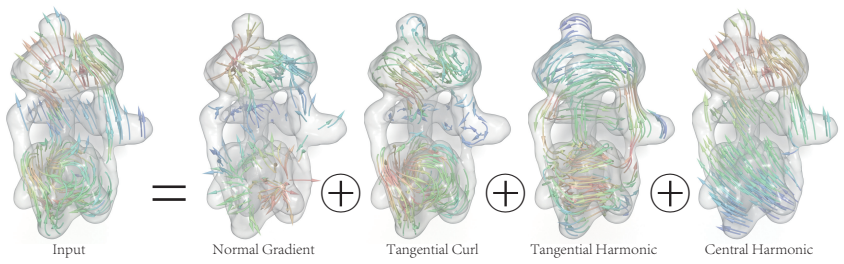
The load-bearing object is the discrete Hodge Laplacian $L_k = D_k^T S_{k+1} D_k + S_k D_{k-1} S_{k-1}^{-1} D_{k-1}^T S_k$, assembled by discrete exterior calculus on a tetrahedral mesh of the volume enclosed by the molecular surface. Here $D_k$ are signed incidence matrices satisfying $D_{k+1}D_k = 0$, and $S_k$ are diagonal Hodge star matrices converting primal to dual mesh elements; the generalized eigenvalue problem $L_k\omega_k = \lambda_k S_k\omega_k$ yields the spectral basis. The same construction gives the Helmholtz-Hodge decomposition of vector fields into orthogonal gradient, curl, and harmonic components. The 0-form spectrum drives the B-factor predictor through Eq. (11), and the 1-form spectrum with the added $G^T Q G$ Helfrich boundary term drives the Laplace-de Rham-Helfrich natural-mode operator of Eq. (16).
What would settle it
On the flexibility side, rerun the 364-protein benchmark with Eq. (11) using eigenmodes of the plain scalar Laplacian on the same tetrahedral mesh: if the average Pearson correlation remains near 0.580, the Hodge structure is not the source of the prediction. On the motion side, compare the lowest nontrivial modes of the Laplace-de Rham-Helfrich operator against an ensemble of experimentally observed conformations of one cryo-EM complex; if the predicted modes fail to span the observed displacement, the curvature-energy term is not capturing real collective motion.
Extended reading notes
Core claim
The paper's central claim is that the spectrum and eigenfields of the Hodge Laplacian on a biomolecular manifold contain the geometric and topological information of the molecule and, through a spectral inversion, its flexibility and natural modes. Topology is read from the zero-eigenvalue harmonic forms: the null space of the tangential 1-form operator counts tunnels and handles, the normal 1-form null space counts cavities, and the 0-form null space counts connected components. Geometry is read from the nonzero spectrum, organized into three independent groups—tangential gradient, normal gradient, and curl—that distinguish proteins by shape. The B-factor model sets the fluctuation at an atom to a times the sum over modes of $(1/\lambda_j)\,\omega_j(r)\,\omega_j(r')^T$ evaluated at that atom, which yields the reported 0.580 average Pearson correlation over the 364-protein benchmark. The natural-mode model replaces the 1-form Laplacian with $E_\mu = d_0\star_0^{-1} d_0^T \star_1 + \star_1^{-1} d_1^T \star_2 d_1 + G^T Q G$, where $Q$ is the quadratic form of the Helfrich curvature energy, and treats its eigenmodes as collective motions of X-ray structures and cryo-EM maps.
Load-bearing premise
The load-bearing premise is that an atom's thermal fluctuation is the inverse-spectrum sum of the Hodge Laplacian at that atom (Eq. 11), an identification assumed rather than derived; if the spectrum does not represent physical fluctuation, the reported accuracy does not validate the paradigm.
Editorial extensions
If this is right
- The 0-form spectral model estimates flexibility from a continuum molecular surface without atomic coordinates, so B-factor-like fluctuations become computable for very large complexes and for cryo-EM maps at any resolution.
- The same discretization returns topology (handles, cavities, connected components) and geometry (three independent spectral groups) from one pipeline, replacing separate persistent-homology and shape-analysis computations.
- The Laplace-de Rham-Helfrich operator yields natural modes directly from cryo-EM density, with two tunable weights separating divergence energy, curl energy, and curvature energy, and it permits larger anharmonic deformations than harmonic normal mode analysis.
- Because computational cost scales with mesh size rather than atom count, the approach remains feasible for problems with millions of atoms that are intractable for coordinate-based elastic models.
Reading between the lines
- The authors do not test this, but if Eq. (11) is a general spectral-to-fluctuation correspondence, then any shape model with a Laplace operator—coarse density maps, reconstructed organelles, or surface-only representations—becomes a flexibility predictor without force-field parameters.
- The harmonic eigenfields of the 1-form Laplacian carry not just the count of handles and cavities but also their spatial location and width; these fields could serve as differentiable topological features for machine learning, going beyond persistent-homology barcodes that discard geometric location.
- The natural-mode model's physical content could be checked against experimentally observed conformational ensembles of the same complex; a mismatch between the predicted low-order modes and observed displacements would show how much of the predictive content comes from the Helfrich term rather than the Laplacian itself.
Signed reviews
Editorial analysis
A structured set of objections, weighed in public.
Referee Report
Summary. The paper introduces de Rham-Hodge theory as a unified mathematical framework for analyzing biomolecular geometry, topology, flexibility, and natural modes. The authors construct tetrahedral-mesh domains from Gaussian-density level sets of proteins or cryo-EM maps, implement discrete exterior calculus (DEC) with tangential and normal boundary conditions, and compute spectra of Hodge Laplacians. For flexibility, Eq. (11) models the B-factor at an atom as a scale factor times the diagonal of the pseudoinverse of the 0-form Hodge Laplacian evaluated at that atom, and the method is tested on a 364-protein benchmark, reporting an average Pearson correlation of 0.580 versus 0.565 for GNM (Table 1). For natural modes, Eqs. (13)-(16) define a Laplace-de Rham-Helfrich operator that adds a Helfrich curvature energy boundary term to the 1-form Laplacian, and low-frequency eigenmodes are shown qualitatively for cryo-EM maps such as EMD 1258. The paper also illustrates Hodge decomposition of vector fields and topological analysis via harmonic forms.
Significance. If the proposed framework were fully validated, it would be a significant contribution: it offers a common mathematical language for geometry, topology, flexibility, and collective motion, and it can in principle operate directly on cryo-EM maps and at variable resolutions where coordinate-based elastic network models are impractical. The mathematical background on de Rham-Hodge theory and DEC is standard, and the exposition of the three independent spectra and their boundary-condition dualities is useful. The paper also provides a concrete algorithmic pathway—simplicial mesh generation, DEC matrices, and generalized eigenvalue problems—that is reproducible in principle. However, the central empirical claims are not yet established: the B-factor model is introduced as an assumption rather than derived, the reported accuracy gain over GNM is tiny and lacks statistical support, and the natural-mode results are only qualitative. The paper's value is therefore best assessed as a promising methodological proposal whose validation needs substantial additional work.
major comments (4)
- [§II.B, Eq. (11)] The B-factor model is load-bearing but is introduced with 'We assume' and no derivation. The sum over (1/lambda_j) omega_j(r) omega_j(r')^T is the diagonal of the pseudoinverse of the Hodge Laplacian, which is the equilibrium Green's function for a scalar field with Dirichlet energy. In GNM this quantity has a clear harmonic-spring Hamiltonian interpretation; here the field is a geometric density constructed from Gaussian kernels, not an atomic displacement field, so the identification of this Green's function with thermal atomic fluctuations (Debye-Waller factors) is not justified. Without a statistical-mechanics or elasticity derivation, or an independent dynamical test (e.g., comparison with molecular dynamics mean-square fluctuations), the reported correlation does not validate the de Rham-Hodge paradigm for flexibility. The authors should either supply such a derivation or explicitly reframe Eq. (11) as an empirical descriptor and provide the corresponding evidence.
- [Table 1 and §II.B (Flexibility analysis)] The hyperparameters c (level set), r (grid spacing), and d (cutoff radius) are chosen on the same 364-protein benchmark and the best result is reported as the headline accuracy. This is effectively model selection on the test set. Given that the improvement over GNM is only 0.580 versus 0.565 in average Pearson correlation, the claim of outperformance is not supported without cross-validation, a separate held-out test, or a statistical significance test over the 364 proteins. The paper should report the variability across proteins (e.g., standard deviation or distribution of per-protein correlations) and compare against GNM under identical evaluation protocols.
- [§II.B, Eqs. (13)-(16)] The Laplace-de Rham-Helfrich operator is asserted rather than derived. Equation (14) defines Q = ∂²V/∂X² but does not specify the function space or the discretization of this second variation, and Eq. (15) introduces X = Gω without defining the matrix G or explaining how the surface displacement is represented as a 1-form. Consequently, the claim that low-frequency eigenmodes of Eq. (16) are physical natural modes, and that the first three are translations, is not backed by a mathematical derivation or by quantitative comparison to known motions (e.g., overlap with ANM modes or domain motions). The authors should at least specify the discrete construction of G and Q, and validate the modes against a ground-truth deformation or an established elastic model.
- [§II.B (Natural mode analysis), Fig. 9] The natural-mode results are purely qualitative: the paper shows eigenmode visualizations for EMD 1258 but provides no quantitative measure of whether these modes correspond to functionally relevant or experimentally observed motions. The statement that 'the first three eigenmodes are associated with 3D translational motions' is also not demonstrated in the text or figures. A quantitative validation—for example, modal overlap with a known conformational change or with ANM-computed modes—is needed to support the central claim that the operator predicts natural modes.
minor comments (7)
- [§II.B, Eq. (11)] The notation omega_j^k(r)(omega_j^k(r'))^T is confusing for 0-forms, where the quantity is a scalar and the transpose is superfluous; for 1-forms and 2-forms the intended product (outer product or pointwise inner product) should be stated explicitly.
- [§II.B (Flexibility analysis)] The text says 'The cutoff radius is set to 7 Å' but later states the best parameters are c = 0.4, r = 1.6 Å, d = 4.0 Å, and Table 1 reports results at cutoff radius 4.0 Å. This inconsistency should be resolved.
- [§II.B (Natural mode analysis)] The sentence 'In contrast, the Laplace-de Rham-Helfrich operator does preserve these properties' appears to contradict the immediately preceding claim that the original operator admits an orthogonal Hodge decomposition while the new operator does not; likely 'does not preserve' is intended.
- [General] There are several typographical issues, including 'eigenfucntions' (Section II.A), 'PPC' for 'PCC' (Fig. 7 caption), and 'cutoff radius' throughout; these should be corrected.
- [§II.A (Reduction and analysis)] Several textual references such as 'as shown in 3 b' and '3 e left' are incomplete or missing the figure label; the cross-references to Figure 3 panels should be made consistent.
- [Table 1] The GNM baseline value 0.565 is taken from Ref. [35], but the implementation details (e.g., spring constant, cutoff) used for GNM are not stated here; for a fair comparison these should be specified or the baseline rerun with the same protein set and protocol.
- [Conclusion and Methods] The paper does not mention availability of code or data. Given that the method involves many implementation choices (mesh generation, DEC assembly, boundary-condition handling), a reproducibility statement or release of the code would materially strengthen the contribution.
Circularity Check
No significant circularity: the flexibility and natural-mode models are explicit assumptions evaluated against external data, and the parameter grid search is an overfitting concern, not a circular one.
full rationale
The paper's claimed derivations do not reduce to their own inputs by construction. Equation (11) is introduced explicitly as an assumption ('We assume that the de Rham-Hodge B factor at the ith atom estimated by the Lk is given by...'), not as a first-principles derivation, and the experimental PDB B-factors enter only as external targets; the fitted scale a is a single per-protein factor that does not affect Pearson correlation, so the reported 0.580 versus 0.565 comparison is not forced by the fit. The parameters c, r, and d are selected on the same 364-protein benchmark by grid search (Table 1, Fig. 7g), which is a model-selection and generalization concern, not a circular reduction of the prediction to its inputs. The natural-mode model in Eqs. (13)-(16) is also an explicit ansatz: a Helfrich curvature energy is added to the 1-form Laplace-de Rham operator to define a new operator E_mu, and the displayed modes are eigenvectors of that defined operator; there is no experimental mode set being reproduced through fitted parameters such that the output would equal the input by construction. The topological statements about null-space dimensions rely on standard de Rham-Hodge mathematics rather than on the paper's own fitted values. The cited prior work [35, 42, 34] supplies the FRI surface construction, the benchmark set, and a GNM baseline, but these are inputs and comparisons, not load-bearing conclusions whose content is identical to the target claims; no self-citation is used to exclude alternatives or to import a uniqueness theorem. Accordingly, any doubts about the physical justification of Eq. (11) or about in-sample parameter tuning should be treated as correctness and validation risks, not as circularity.
Assumptions & free parameters
free parameters (9)
- B-factor scale a =
not reported (least-squares fit in Eq. 11)
- Level set parameter c =
0.4 (best on 364-protein benchmark)
- Grid spacing r =
1.6 Å (best)
- B-factor cutoff radius d =
4.0 Å (best)
- Gaussian kernel width eta =
twice the atomic van der Waals radius
- Gaussian exponent kappa =
2 (Gaussian kernel)
- Laplace-de Rham-Helfrich weight lambda =
unspecified (chosen with mu > lambda > 1)
- Bending rigidity mu =
unspecified
- Spontaneous curvature H0 =
unspecified
assumptions (6)
- standard math Hodge decomposition and de Rham theorem hold on compact molecular manifolds with boundary under the chosen boundary conditions.
- domain assumption The level set of the Gaussian density (Eq. 10) is a smooth compact manifold sufficiently representing the macromolecular surface.
- domain assumption The diagonal discrete Hodge star on a tetrahedral mesh gives a faithful approximation of the continuous L2 inner product and spectra.
- ad hoc to paper B-factors are proportional to the diagonal of the pseudoinverse of the 0-form Hodge Laplacian (Eq. 11).
- ad hoc to paper Helfrich curvature energy on the molecular boundary is the relevant potential for internal natural modes and couples through G^T Q G (Eqs. 13-16).
- ad hoc to paper The low-frequency eigenmodes of the Laplace-de Rham-Helfrich operator represent physical natural modes, with the first three modes being translations.
Cite this review
Pith. "Pith review of The de Rham-Hodge analysis and modeling of biomolecules." pith.science (2026). https://pith.science/paper/G46CA2WR
@misc{pith2026190800572,
  author       = {Pith},
  title        = {Pith review of: The de Rham-Hodge analysis and modeling of biomolecules},
  year         = {2026},
  howpublished = {\url{https://pith.science/paper/G46CA2WR}},
  note         = {Machine review of arXiv:1908.00572}
}
read the original abstract
Recent years have witnessed a trend that advanced mathematical tools, such as algebraic topology, differential geometry, graph theory, and partial differential equations, have been developed for describing biological macromolecules. These tools have considerably strengthened our ability to understand the molecular mechanism of macromolecular function, dynamics and transport from their structures. However, currently, there is no unified mathematical theory to analyze, describe and characterize biological macromolecular geometry, topology, flexibility and natural mode at a variety of scales. We introduce the de Rham-Hodge theory, a landmark of 20th Century's mathematics, as a unified paradigm for analyzing biological macromolecular geometry and algebraic topology, for predicting macromolecular flexibility, and for modeling macromolecular natural modes at a variety of scales. In this paradigm, macromolecular geometric characteristic and topological invariants are revealed by de Rham-Hodge spectral analysis. By using the Helmholtz-Hodge decomposition, every macromolecular vector field is split into orthogonal divergence-free, curl-free, and harmonic components with a distinct physical interpretation. We organize the eigenvalues and eigenvectors of the 0-form Laplace-de Rham operator into one of the most accurate protein B-factor predictors. By combining the 1-form Laplace-de Rham operator and the Helfrich-type curvature energy, we predict the natural modes of both X-ray protein structures and cryo-EM maps. We construct accurate and efficient three-dimensional discrete exterior calculus algorithms for the aforementioned modeling and analysis of biological macromolecules. Using extensive experiments, we validate that the proposed paradigm is one of the most versatile and powerful tools for biological macromolecular studies.
Figures


Figures from the paper (10 more)




Reference graph
Works this paper leans on
-
[1]
D. N. Arnold, R. S. Falk, and R. Winther. Finite element exterior calculus, homological tech- niques, and applications. Acta numerica, 15:1–155, 2006
work page 2006
-
[2]
A. R. Atilgan, S. Durell, R. L. Jernigan, M. Demirel, O. Keskin, and I. Bahar. Anisotropy of fluctuation dynamics of proteins with an elastic network model. Biophysical journal, 80(1):505– 515, 2001
work page 2001
-
[3]
A. R. Atilgan, S. R. Durrell, R. L. Jernigan, M. C. Demirel, O. Keskin, and I. Bahar. Anisotropy of fluctuation dynamics of proteins with an elastic network model. Biophys. J. , 80:505 – 515, 2001
work page 2001
- [4]
-
[5]
P. W. Bates, G. W. Wei, and S. Zhao. Minimal molecular surfaces and their applications. Journal of Computational Chemistry , 29(3):380–91, 2008
work page 2008
- [6]
-
[7]
J. F. Blinn. A generalization of algebraic surface drawing. ACM Trans. Graph. , 1:235–256, 1982
work page 1982
- [8]
Show all 48 references
-
[9]
B. R. Brooks, R. E. Bruccoleri, B. D. Olafson, D. States, S. Swaminathan, and M. Karplus. Charmm: A program for macromolecular energy, minimization, and dynamics calculations. J. Comput. Chem., 4:187–217, 1983
1983
-
[10]
Z. X. Cang and G. W. Wei. TopologyNet: Topology based deep convolutional and multi- task neural networks for biomolecular property predictions. PLOS Computational Biology , 13(7):e1005690, https://doi.org/10.1371/journal.pcbi.1005690, 2017
-
[11]
Z. X. Cang and G. W. Wei. Integration of element specific persistent homology and machine learning for protein-ligand binding affinity prediction . International Journal for Numerical Methods in Biomedical Engineering, 34(2):DOI: 10.1002/cnm.2914, 2018
-
[12]
Carlsson, A
G. Carlsson, A. Zomorodian, A. Collins, and L. J. Guibas. Persistence barcodes for shapes. International Journal of Shape Modeling , 11(2):149–187, 2005
2005
-
[13]
M. Chen, B. Tu, and B. Lu. Triangulated manifold meshing method preserving molecular surface topology. J. Mole. Graph. Model. , 38:411–418, 2012. 25
2012
-
[14]
Cheng and X
H.-L. Cheng and X. Shi. Quality mesh generation for molecular skin surfaces using restricted union of balls. Computational Geometry, 42(3):196–206, 2009
2009
-
[15]
R. B. Corey and L. Pauling. Molecular models of amino acids, peptides, and proteins. Review of Scientific Instruments , 24(8):621–627, 1953
1953
-
[16]
J. G. De La Torre and V. A. Bloomfield. Hydrodynamic properties of macromolecular com- plexes. i. translation. Biopolymers: Original Research on Biomolecules , 16(8):1747–1763, 1977
1977
-
[17]
Demlow and A
A. Demlow and A. N. Hirani. A posteriori error estimates for finite element exterior calculus: the de rham complex. Found. Comput. Math., 14(6):1337–1371, 2014
2014
-
[18]
Desbrun, A
M. Desbrun, A. N. Hirani, M. Leok, and J. E. Marsden. Discrete exterior calculus. arXiv preprint math/0508341, 2005
2005 arXiv
-
[19]
T. K. Dey, F. Fan, and Y. Wang. An efficient computation of handle and tunnel loops via reeb graphs. ACM Trans. Graph., 32(4):32, 2013
2013
-
[20]
Q. Du, C. Liu, and X. Wang. A phase field approach in the numerical study of the elastic bending energy for vesicle membranes. Journal of Computational Physics , 198(2):450–468, 2004
2004
-
[21]
B. S. Duncan and A. D. Olson. Shape analysis of molecular surfaces. Biopolymers, 33 2:231–8, 1993
1993
-
[22]
Edelsbrunner and J
H. Edelsbrunner and J. Harer. Computational topology: An introduction. American Mathemat- ical Soc., 2010
2010
-
[23]
X. Feng, K. Xia, Y. Tong, and G.-W. Wei. Geometric modeling of subcellular structures, organelles and large multiprotein complexes. International Journal for Numerical Methods in Biomedical Engineering, 28:1198–1223, 2012
2012
-
[24]
N. Go, T. Noguti, and T. Nishikawa. Dynamics of a small globular protein in terms of low- frequency vibrational modes. Proc. Natl. Acad. Sci., 80:3696 – 3700, 1983
1983
-
[25]
Haslam, T
D. Haslam, T. Zeng, R. Li, and J. He. Exploratory studies detecting secondary structures in medium resolution 3d cryo-em images using deep convolutional neural networks. In Proceedings of the 2018 ACM International Conference on Bioinformatics, Computational Biology, and Healt...
2018
-
[26]
D. R. Hekstra, K. I. White, M. A. Socolich, R. W. Henning, V. ˇSrajer, and R. Ranganathan. Electric-field-stimulated protein mechanics. Nature, 540(7633):400, 2016
2016
-
[27]
Helfrich
W. Helfrich. Elastic properties of lipid bilayers: Theory and possible experiments. Zeitschrift f¨ ur Naturforschung Teil C, 28:693 – 703, 1973
1973
-
[28]
A. N. Hirani. Discrete exterior calculus. PhD thesis, California Institute of Technology, 2003
2003
-
[29]
Lee and F
B. Lee and F. M. Richards. The interpretation of protein structures: estimation of static accessibility. Journal of molecular biology , 55(3):379–IN4, 1971
1971
-
[30]
Levitt, C
M. Levitt, C. Sander, and P. S. Stern. Protein normal-mode dynamics: Trypsin inhibitor, crambin, ribonuclease and lysozyme. J. Mol. Biol. , 181(3):423 – 447, 1985. 26
1985
-
[31]
J. P. Ma. Usefulness and limitations of normal mode analysis in modeling dynamics of biomolec- ular complexes. Structure, 13:373 – 180, 2005
2005
-
[32]
D. Ming, Y. Kong, M. A. Lambert, Z. Huang, and J. Ma. How to describe protein motion without amino acid sequence and atomic coordinates. Proceedings of the National Academy of Sciences, 99(13):8620–8625, 2002
2002
-
[33]
Natarajan, P
V. Natarajan, P. Koehl, Y. Wang, and B. Hamann. Visual analysis of biomolecular surfaces. In L. Linsen, H. Hagen, and B. Hamann, editors, Mathematical Methods for Visualization in Medicine and Life Science , pages 237–256. Springer Verlag, 2008
2008
-
[34]
D. D. Nguyen, K. L. Xia, and G. W. Wei. Generalized flexibility-rigidity index. Journal of Chemical Physics, 144:234106, 2016
2016
-
[35]
Opron, K
K. Opron, K. L. Xia, and G. W. Wei. Fast and anisotropic flexibility-rigidity index for protein flexibility and fluctuation analysis. Journal of Chemical Physics , 140:234105, 2014
2014
-
[36]
F. M. Richards. Areas, volumes, packing, and protein structure. Annual review of biophysics and bioengineering, 6(1):151–176, 1977
1977
-
[37]
F. Tama, W. Wriggers, and C. L. Brooks III. Exploring global distortions of biological macro- molecules and assemblies from low-resolution structural information and elastic network theory. Journal of molecular biology , 321(2):297–305, 2002
2002
-
[38]
Tasumi, H
M. Tasumi, H. Takenchi, S. Ataka, A. M. Dwidedi, and S. Krimm. Normal vibrations of proteins: Glucagon. Biopolymers, 21:711 – 714, 1982
1982
-
[39]
Xia and G.-W
K. Xia and G.-W. Wei. A review of geometric, topological and graph theory apparatuses for the modeling and analysis of biomolecular data. arXiv preprint arXiv:1612.01735 , 2016
2016 arXiv
-
[40]
K. L. Xia, X. Feng, Y. Y. Tong, and G. W. Wei. Multiscale geometric modeling of macro- molecules i: Cartesian representation. Journal of Computational Physics , 275:912–936, 2014
2014
-
[41]
K. L. Xia, X. Feng, Y. Y. Tong, and G. W. Wei. Persistent homology for the quantitative prediction of fullerene stability. Journal of Computational Chemistry , 36:408–422, 2015
2015
-
[42]
K. L. Xia, K. Opron, and G. W. Wei. Multiscale multiphysics and multidomain models — Flexibility and rigidity. Journal of Chemical Physics , 139:194109, 2013
2013
-
[43]
K. L. Xia and G. W. Wei. Persistent homology analysis of protein structure, flexibility and folding. International Journal for Numerical Methods in Biomedical Engineering , 30:814–844, 2014
2014
-
[44]
Y. Yao, J. Sun, X. Huang, G. R. Bowman, G. Singh, M. Lesnick, L. J. Guibas, V. S. Pande, and G. Carlsson. Topological methods for exploring low-density states in biomolecular folding pathways. The Journal of chemical physics , 130(14):04B614, 2009
2009
-
[45]
Z. Y. Yu, M. Holst, Y. Cheng, and J. A. McCammon. Feature-preserving adaptive mesh generation for molecular shape modeling and simulation. Journal of Molecular Graphics and Modeling, 26:1370–1380, 2008
2008
-
[46]
R. Zhao, Z. Cang, Y. Tong, and G.-W. Wei. Protein pocket detection via convex hull surface evolution and associated reeb graph. Bioinformatics, 34 17:i830–i837, 2018. 27
2018
-
[47]
R. Zhao, Z. Cang, Y. Tong, and G.-W. Wei. Protein pocket detection via convex hull surface evolution and associated Reeb graph. Bioinformatics, 34 (17):i830–i837, 2018
2018
-
[48]
Zheng, S
Q. Zheng, S. Yang, and G.-W. Wei. Biomolecular surface construction by pde transform. International journal for numerical methods in biomedical engineering , 28(3):291–316, 2012. 28
2012
Reviewed August 14, 2026 · model on record in the stance chip above.
Discussion (0). Continue with ORCID to comment.