Highly improved staggered quarks on anisotropic lattices
Pith reviewed 2026-06-30 00:53 UTC · model grok-4.3
The pith
Anisotropic aHISQ quarks exhibit qualitatively different pion taste mass splitting behavior than naive staggered quarks.
A machine-rendered reading of the paper's core claim, the machinery that carries it, and where it could break.
Core claim
On pure gauge ensembles the renormalized gauge anisotropy is tuned via gradient flow, the fermion anisotropy parameters are fixed separately for naive staggered and aHISQ actions, and the resulting pion taste mass splittings are measured; these splittings display qualitatively different anisotropy dependence for the two actions, which is captured by a simple empirical model for the aHISQ case.
What carries the argument
The aHISQ action together with gradient-flow-based tuning of gauge and fermion anisotropies and the empirical parametrization of taste splittings.
If this is right
- An optimal gradient flow scheme for gauge anisotropy tuning can be selected for anisotropic aHISQ runs.
- Fermion anisotropy must be tuned differently for aHISQ than for the naive action.
- The empirical model supplies a practical description of aHISQ taste splittings across a range of anisotropies.
- Qualitatively different taste behavior suggests that aHISQ may suppress anisotropy-enhanced taste violations relative to the naive action.
Where Pith is reading between the lines
- The observed difference could reduce the need for additional improvement terms when simulating anisotropic systems with aHISQ.
- The empirical model might be tested by extending the anisotropy range beyond 8 on new ensembles.
- If the difference persists at finer lattice spacings, aHISQ would become the default choice for anisotropic thermodynamics or spectroscopy.
Load-bearing premise
The gradient flow schemes give reliable and optimal values for the gauge anisotropy on the pure gauge ensembles.
What would settle it
A direct side-by-side measurement on identical ensembles showing that the anisotropy dependence of the taste splittings is statistically indistinguishable between naive staggered and aHISQ quarks.
Figures
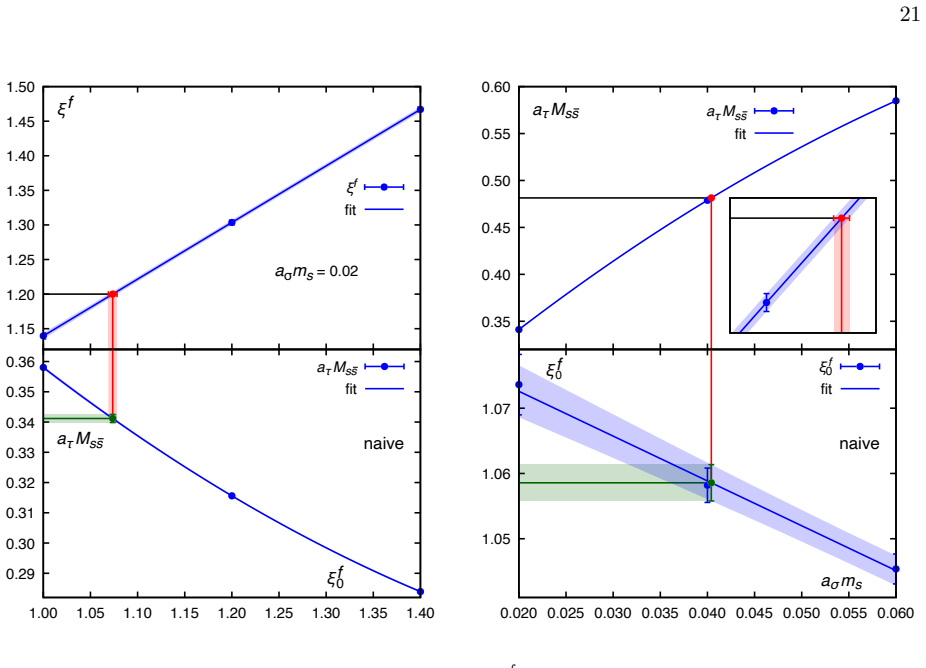
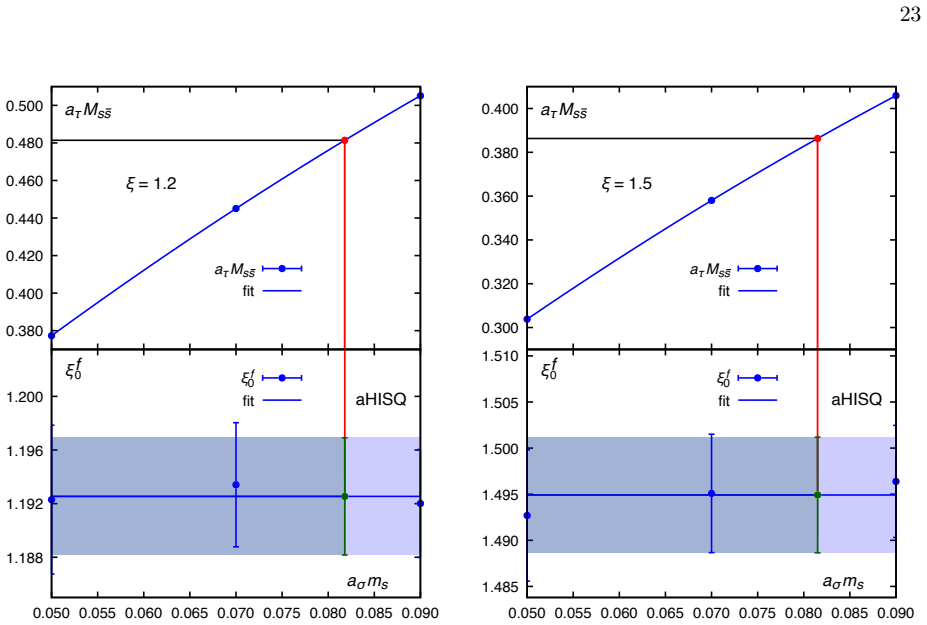
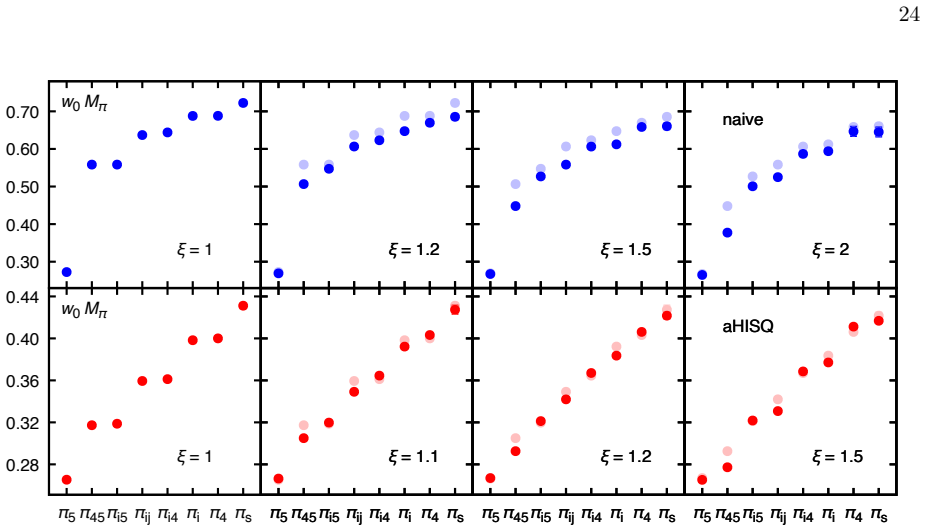
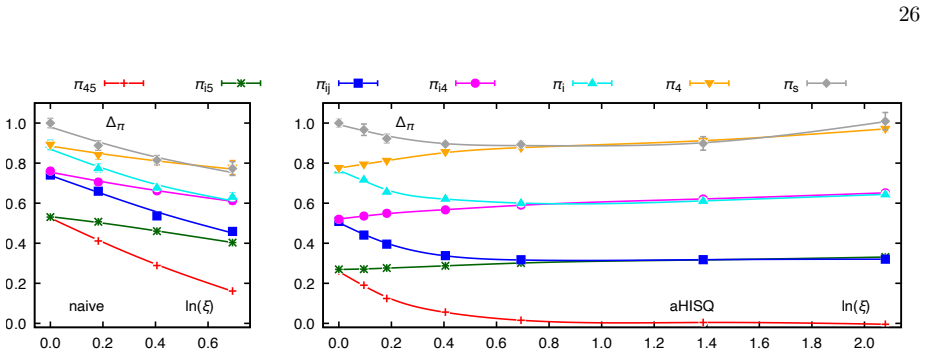
read the original abstract
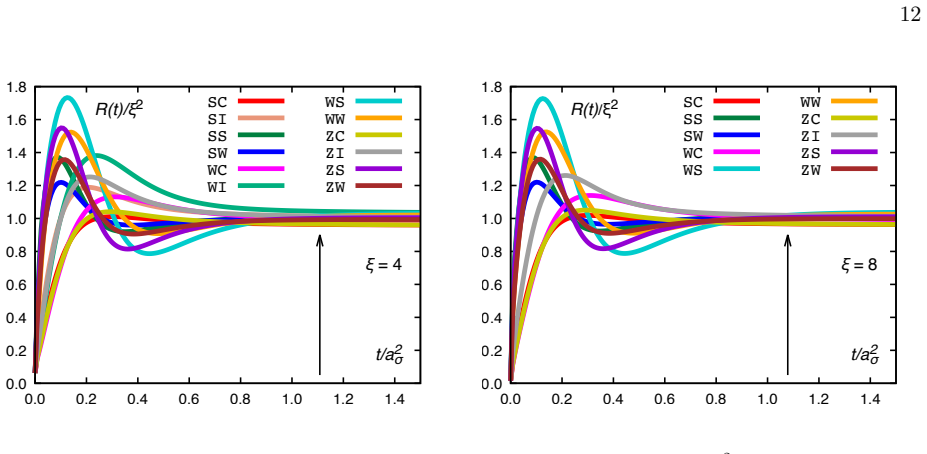
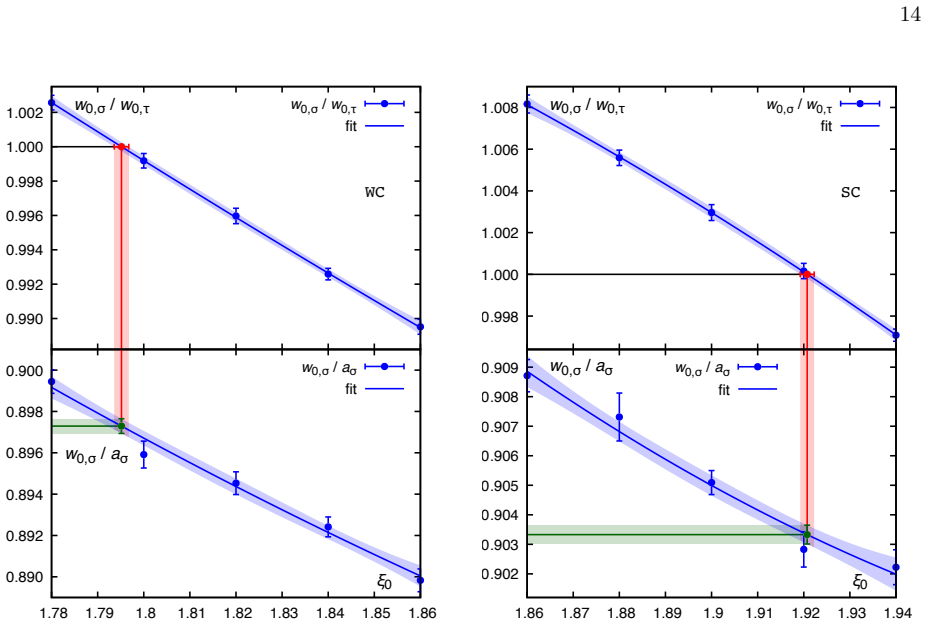
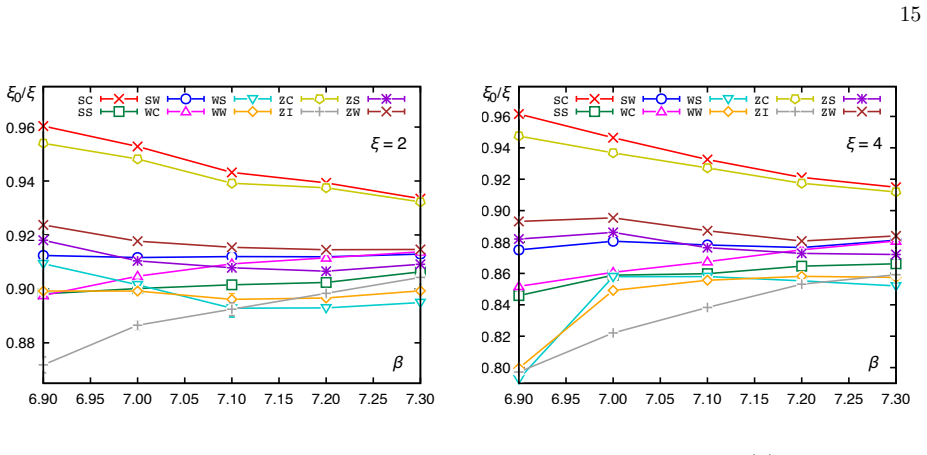
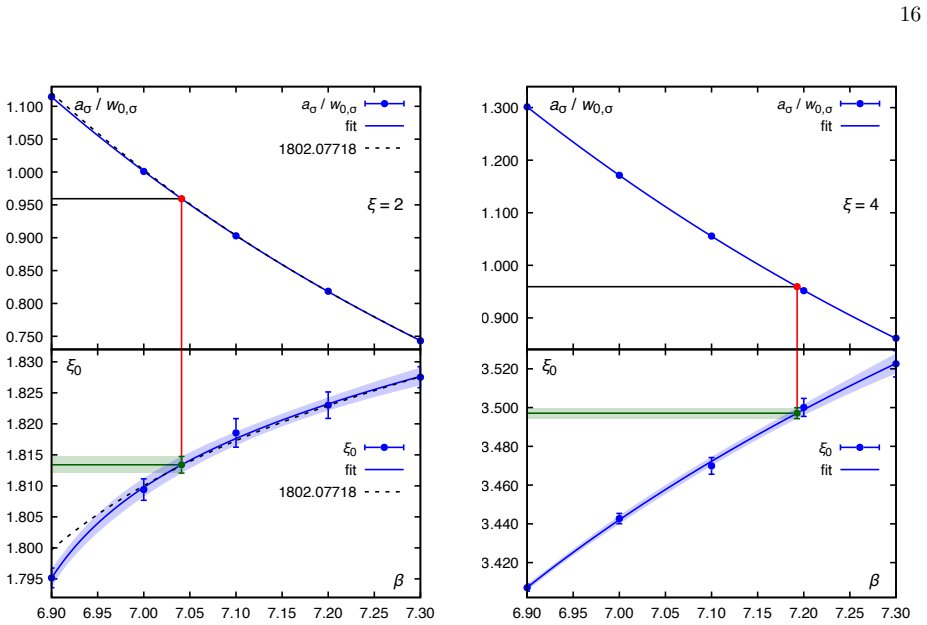
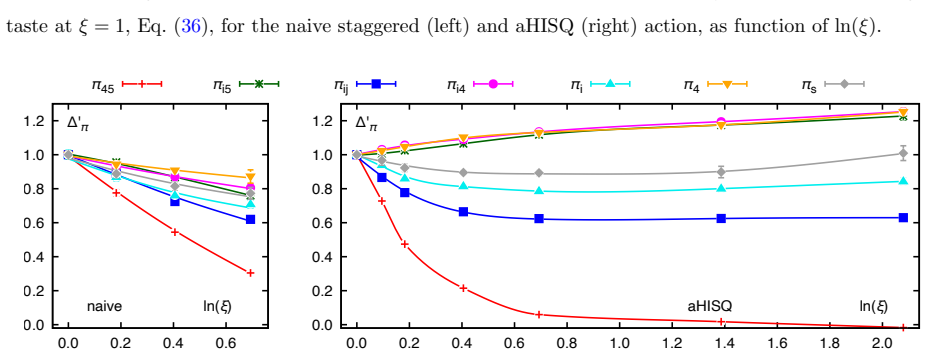
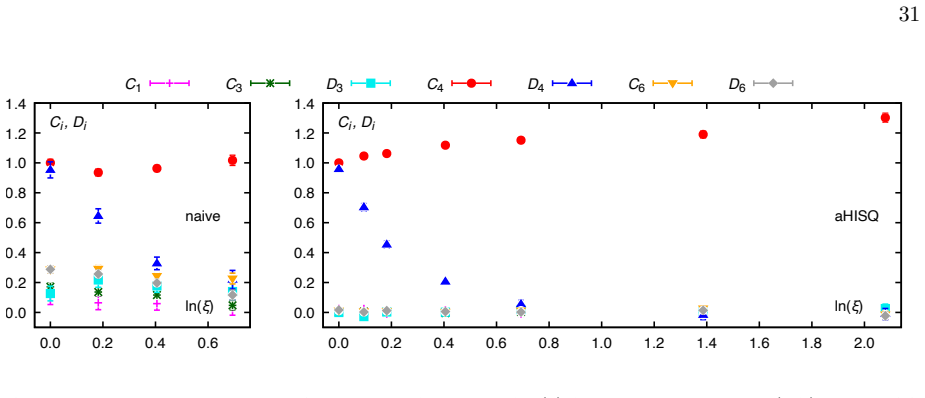
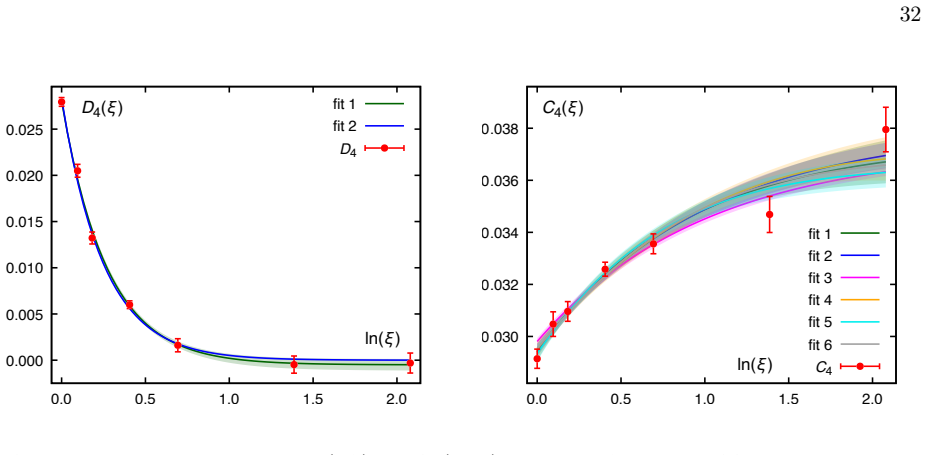
We present a study of tuning of the anisotropic highly improved staggered quark (aHISQ) action on pure gauge ensembles with the renormalized anisotropy ranging from 1 to 8. We discuss multiple gradient flow schemes for tuning the gauge anisotropy and comment on what scheme may be optimal for anisotropic simulations. Next, we compare tuning of the fermion anisotropy for the naive staggered and aHISQ actions. Finally, we study the dependence of the staggered pion taste mass splittings on anisotropy for the two actions and develop an empirical model that captures the main features of the aHISQ spectrum. We observe qualitatively different behavior of the naive and aHISQ taste spectrum with anisotropy.
Editorial analysis
A structured set of objections, weighed in public.
Referee Report
Summary. The manuscript studies tuning of the anisotropic highly improved staggered quark (aHISQ) action on pure-gauge ensembles with renormalized anisotropy ξ ranging from 1 to 8. It examines multiple gradient-flow definitions for determining the gauge anisotropy, compares the tuning of the fermion anisotropy parameter for naive staggered versus aHISQ actions, analyzes the anisotropy dependence of staggered pion taste-mass splittings for both actions, introduces an empirical model for the aHISQ taste spectrum, and reports qualitatively different anisotropy dependence between the naive and aHISQ taste spectra.
Significance. If the tuning of ξ is robust, the work supplies practical guidance on gradient-flow anisotropy determination for anisotropic lattice QCD and highlights action-dependent discretization effects in the taste spectrum that could inform the design of improved staggered actions for anisotropic simulations. The empirical model, if validated, offers a compact description of taste violations that may be useful for systematic-error estimates in future calculations.
major comments (2)
- [gradient-flow tuning discussion] Tuning discussion (gradient-flow section): the manuscript selects one gradient-flow scheme as potentially optimal but does not report quantitative cross-checks of the resulting ξ values against independent determinations such as Wilson-loop aspect ratios or static-potential fits on the same ensembles; because the central claim of qualitatively different taste-spectrum behavior rests on the horizontal-axis calibration by ξ, residual scheme dependence or uncontrolled systematics in the chosen definition would directly affect the interpretation of the plots.
- [taste spectrum dependence on anisotropy] Taste-splitting analysis: the figures comparing naive and aHISQ taste spectra versus ξ do not include error bands on the ξ values themselves or a sensitivity study showing how plausible variations in ξ (arising from flow-time window or operator choice) would shift the data points; without this, it is not possible to judge whether the reported qualitative distinction survives the uncertainty in the anisotropy calibration.
minor comments (2)
- [empirical model section] The abstract states that an empirical model is developed but the main text does not specify the functional form, the number of parameters, or the goodness-of-fit metrics used to capture the aHISQ spectrum features.
- [gauge anisotropy tuning] Notation for the renormalized anisotropy ξ is introduced without an explicit equation defining how it is extracted from the gradient-flow observables.
Simulated Author's Rebuttal
We thank the referee for their careful reading of the manuscript and for the constructive comments on the robustness of the anisotropy calibration. We address each major comment below and agree that the suggested additions will strengthen the presentation of the results.
read point-by-point responses
-
Referee: Tuning discussion (gradient-flow section): the manuscript selects one gradient-flow scheme as potentially optimal but does not report quantitative cross-checks of the resulting ξ values against independent determinations such as Wilson-loop aspect ratios or static-potential fits on the same ensembles; because the central claim of qualitatively different taste-spectrum behavior rests on the horizontal-axis calibration by ξ, residual scheme dependence or uncontrolled systematics in the chosen definition would directly affect the interpretation of the plots.
Authors: We agree that quantitative cross-checks against independent methods would provide valuable confirmation of the gradient-flow ξ determinations. In the revised manuscript we will add comparisons of the chosen gradient-flow ξ values with Wilson-loop aspect ratios computed on the same ensembles (where statistics permit) and include a brief discussion of any observed differences. This will directly address potential scheme dependence and support the interpretation of the taste-spectrum plots. revision: yes
-
Referee: Taste-splitting analysis: the figures comparing naive and aHISQ taste spectra versus ξ do not include error bands on the ξ values themselves or a sensitivity study showing how plausible variations in ξ (arising from flow-time window or operator choice) would shift the data points; without this, it is not possible to judge whether the reported qualitative distinction survives the uncertainty in the anisotropy calibration.
Authors: We accept this criticism. The revised version will include horizontal error bands on the ξ values in the relevant figures, derived from the observed variation across flow times and operators. We will also add a short sensitivity analysis (in the text or an appendix) that shifts the data points within the estimated ξ uncertainties and confirms that the qualitative difference between the naive and aHISQ taste spectra remains visible. revision: yes
Circularity Check
No significant circularity detected; tuning and spectral comparison are independent of target observables
full rationale
The paper tunes renormalized gauge anisotropy ξ via gradient-flow schemes applied to pure-gauge ensembles; these tuned ensembles then serve as fixed input for the subsequent aHISQ and naive staggered fermion runs. The taste-splitting comparison and the empirical model for the aHISQ spectrum are extracted from data generated on those ensembles, but neither the tuning procedure nor the model is defined in terms of the final taste-spectrum distinction. No self-citation chain, uniqueness theorem, or fitted parameter is relabeled as a prediction. The derivation therefore remains self-contained against external benchmarks (gradient-flow definitions and pure-gauge ensembles).
Axiom & Free-Parameter Ledger
Reference graph
Works this paper leans on
-
[1]
If necessary (for complicated cases such as heavier pion tastes), perform uncorrelated fits to find reasonable starting guesses for the fit parameters
-
[2]
Perform correlated fits on the full ensemble to find where the ground state energy reaches a plateau andχ 2/dof is about 1
-
[3]
Choose and keep constantτ min consistent with point 2, and keepτ max =N τ /2−1
-
[4]
Perform correlated fits (with the covariance matrix from the full ensemble) with fixedτ min, τmax in each jackknife bin
-
[5]
Thus, the final quoted errors are propagated with jackknife and they are typically large enough to accommodate the systematic errors coming from varyingτ min
Propagate errors on the ground state energies (and the functions thereof such as pion split- tings) with the jackknife procedure. Thus, the final quoted errors are propagated with jackknife and they are typically large enough to accommodate the systematic errors coming from varyingτ min. D. Fermion anisotropy and strange quark mass tuning In our setup, th...
-
[7]
M. Asakawa, T. Hatsuda, and Y. Nakahara, Prog. Part. Nucl. Phys.46, 459 (2001), arXiv:hep- lat/0011040
arXiv 2001
-
[8]
G. Aarts, C. Allton, T. Harris, S. Kim, M. P. Lombardo, S. M. Ryan, and J.-I. Skullerud, JHEP07, 097, arXiv:1402.6210 [hep-lat]
-
[9]
S. Kim, P. Petreczky, and A. Rothkopf, Phys. Rev. D91, 054511 (2015), arXiv:1409.3630 [hep-lat]. 52
Pith/arXiv arXiv 2015
-
[10]
H.-T. Ding, O. Kaczmarek, S. Mukherjee, H. Ohno, and H. T. Shu, Phys. Rev. D97, 094503 (2018), arXiv:1712.03341 [hep-lat]
Pith/arXiv arXiv 2018
-
[11]
E.-M. Ilgenfritz, J. M. Pawlowski, A. Rothkopf, and A. Trunin, Eur. Phys. J. C78, 127 (2018), arXiv:1701.08610 [hep-lat]
Pith/arXiv arXiv 2018
-
[12]
H.-T. Ding, O. Kaczmarek, A.-L. Kruse, R. Larsen, L. Mazur, S. Mukherjee, H. Ohno, H. Sandmeyer, and H.-T. Shu, Nucl. Phys. A982, 715 (2019), arXiv:1807.06315 [hep-lat]
Pith/arXiv arXiv 2019
-
[13]
S. Kim, P. Petreczky, and A. Rothkopf, JHEP11, 088, arXiv:1808.08781 [hep-lat]
-
[14]
S. Y. Chen, H. T. Ding, F. Y. Liu, G. Papp, and C. B. Yang, (2021), arXiv:2110.13521 [hep-lat]
arXiv 2021
-
[15]
L. Huang and S. Liang, Phys. Rev. D109, 054508 (2024), arXiv:2309.11114 [hep-lat]
arXiv 2024
-
[16]
S. Ali, D. Bala, A. Francis, G. Jackson, O. Kaczmarek, J. Turnwald, T. Ueding, and N. Wink (HotQCD), Phys. Rev. D110, 054518 (2024), arXiv:2403.11647 [hep-lat]
arXiv 2024
-
[17]
Bignell et al., PoSQCHSC24, 161 (2025), arXiv:2505.15601 [hep-lat]
R. Bignell et al., PoSQCHSC24, 161 (2025), arXiv:2505.15601 [hep-lat]
arXiv 2025
-
[18]
Skullerud et al., PoSQCHSC24, 160 (2025), arXiv:2503.17315 [hep-lat]
J.-I. Skullerud et al., PoSQCHSC24, 160 (2025), arXiv:2503.17315 [hep-lat]
arXiv 2025
-
[19]
J. Takahashi, H. Ohno, and A. Tomiya, Phys. Rev. D113, 034507 (2026), arXiv:2509.10386 [hep-lat]
arXiv 2026
-
[20]
M. P. Lombardo et al., J. Subatomic Part. Cosmol.3, 100049 (2025)
2025
-
[21]
Skullerud et al., in Excited QCD 2026 Workshop (2026) arXiv:2604.20449 [hep-lat]
J.-I. Skullerud et al., in Excited QCD 2026 Workshop (2026) arXiv:2604.20449 [hep-lat]
Pith/arXiv arXiv 2026
-
[22]
R. K. Bryan, European Biophysics Journal18, 165 (1990)
1990
-
[23]
Jarrell and J
M. Jarrell and J. Gubernatis, Physics Reports269, 133 (1996)
1996
-
[24]
Backus and F
G. Backus and F. Gilbert, Geophysical Journal16, 169 (1968)
1968
-
[25]
M. Hansen, A. Lupo, and N. Tantalo, Phys. Rev. D99, 094508 (2019), arXiv:1903.06476 [hep-lat]
Pith/arXiv arXiv 2019
-
[26]
Y. Burnier and A. Rothkopf, Phys. Rev. Lett.111, 182003 (2013), arXiv:1307.6106 [hep-lat]
Pith/arXiv arXiv 2013
-
[27]
A. S. Mishchenko, N. V. Prokof’ev, A. Sakamoto, and B. V. Svistunov, Phys. Rev. B62, 6317 (2000)
2000
-
[28]
Fuchs, T
S. Fuchs, T. Pruschke, and M. Jarrell, Phys. Rev. E81, 056701 (2010)
2010
-
[29]
K. Nomura, H. Matsufuru, and T. Umeda, Prog. Theor. Phys.111, 245 (2004), arXiv:hep-lat/0401009
Pith/arXiv arXiv 2004
-
[30]
L. Levkova, T. Manke, and R. Mawhinney, Phys. Rev. D73, 074504 (2006), arXiv:hep-lat/0603031
Pith/arXiv arXiv 2006
-
[31]
T. Blum, C. E. Detar, S. A. Gottlieb, K. Rummukainen, U. M. Heller, J. E. Hetrick, D. Toussaint, R. L. Sugar, and M. Wingate, Phys. Rev. D55, R1133 (1997), arXiv:hep-lat/9609036
Pith/arXiv arXiv 1997
-
[32]
K. Orginos, D. Toussaint, and R. L. Sugar (MILC), Phys. Rev. D60, 054503 (1999), arXiv:hep- lat/9903032
arXiv 1999
-
[33]
U. M. Heller, F. Karsch, and B. Sturm, Phys. Rev. D60, 114502 (1999), arXiv:hep-lat/9901010
Pith/arXiv arXiv 1999
-
[34]
C. Morningstar and M. J. Peardon, Phys. Rev. D69, 054501 (2004), arXiv:hep-lat/0311018
Pith/arXiv arXiv 2004
-
[35]
E. Follana, Q. Mason, C. Davies, K. Hornbostel, G. P. Lepage, J. Shigemitsu, H. Trottier, and K. Wong (HPQCD), Phys. Rev. D75, 054502 (2007), arXiv:hep-lat/0610092
Pith/arXiv arXiv 2007
-
[36]
A. Bazavov, D. Hoying, R. N. Larsen, S. Mukherjee, P. Petreczky, A. Rothkopf, and J. H. Weber (HotQCD), Phys. Rev. D109, 074504 (2024), arXiv:2308.16587 [hep-lat]
arXiv 2024
-
[37]
Hasenfratz and P
A. Hasenfratz and P. Hasenfratz, Nuclear Physics B193, 210 (1981)
1981
-
[38]
Karsch, Nucl
F. Karsch, Nucl. Phys. B205, 285 (1982). 53
1982
-
[39]
H. J. Rothe, Lattice Gauge Theories : An Introduction (Fourth Edition), Vol. 43 (World Scientific Publishing Company, 2012)
2012
- [40]
- [41]
-
[42]
Weisz, Nucl
P. Weisz, Nucl. Phys. B212, 1 (1983)
1983
-
[43]
Luscher and P
M. Luscher and P. Weisz, Commun. Math. Phys.98, 433 (1985), [Erratum: Commun.Math.Phys. 98, 433 (1985)]
1985
-
[44]
T. R. Klassen, Nucl. Phys. B533, 557 (1998), arXiv:hep-lat/9803010
Pith/arXiv arXiv 1998
-
[45]
L¨ uscher, JHEP08, 071, [Erratum: JHEP 03, 092 (2014)], arXiv:1006.4518 [hep-lat]
M. L¨ uscher, JHEP08, 071, [Erratum: JHEP 03, 092 (2014)], arXiv:1006.4518 [hep-lat]
Pith/arXiv arXiv 2014
-
[46]
S. Borsanyi, S. Durr, Z. Fodor, S. D. Katz, S. Krieg, T. Kurth, S. Mages, A. Schafer, and K. K. Szabo, (2012), arXiv:1205.0781 [hep-lat]
Pith/arXiv arXiv 2012
-
[47]
M. Luscher, Commun. Math. Phys.293, 899 (2010), arXiv:0907.5491 [hep-lat]
Pith/arXiv arXiv 2010
-
[48]
S. Bors´ anyi, Z. Fodor, M. Giordano, S. D. Katz, A. Pasztor, C. Ratti, A. Sch¨ afer, K. K. Szabo, and B. T´ oth, Phys. Rev. D98, 014512 (2018), arXiv:1802.07718 [hep-lat]
Pith/arXiv arXiv 2018
-
[49]
S. Bors´ anyi, S. D¨ urr, Z. Fodor, C. Hoelbling, S. D. Katz, S. Krieg, T. Kurth, L. Lellouch, T. Lippert, and C. McNeile (BMW), JHEP09, 010, arXiv:1203.4469 [hep-lat]
-
[50]
A. Bazavov et al. (MILC), Phys. Rev. D82, 074501 (2010), arXiv:1004.0342 [hep-lat]
Pith/arXiv arXiv 2010
-
[51]
van den Doel and J
C. van den Doel and J. Smit, Nucl. Phys. B228, 122 (1983)
1983
-
[52]
M. F. L. Golterman and J. Smit, Nucl. Phys. B245, 61 (1984)
1984
-
[53]
M. F. L. Golterman, Nucl. Phys. B273, 663 (1986)
1986
-
[54]
M. A. Clark and A. D. Kennedy, Nucl. Phys. B Proc. Suppl.129, 850 (2004), arXiv:hep-lat/0309084
Pith/arXiv arXiv 2004
-
[55]
M. A. Clark and A. D. Kennedy, Phys. Rev. Lett.98, 051601 (2007), arXiv:hep-lat/0608015
Pith/arXiv arXiv 2007
-
[56]
M. A. Clark and A. D. Kennedy, Phys. Rev. D75, 011502 (2007), arXiv:hep-lat/0610047
Pith/arXiv arXiv 2007
-
[57]
K. Y. Wong and R. M. Woloshyn, PoSLATTICE2007, 047 (2007), arXiv:0710.0737 [hep-lat]
Pith/arXiv arXiv 2007
-
[58]
Cabibbo and E
N. Cabibbo and E. Marinari, Phys. Lett. B119, 387 (1982)
1982
-
[59]
Fabricius and O
K. Fabricius and O. Haan, Phys. Lett. B143, 459 (1984)
1984
-
[60]
A. D. Kennedy and B. J. Pendleton, Phys. Lett. B156, 393 (1985)
1985
-
[61]
S. L. Adler, Phys. Rev. D37, 458 (1988)
1988
-
[62]
Duane, A
S. Duane, A. D. Kennedy, B. J. Pendleton, and D. Roweth, Phys. Lett. B195, 216 (1987)
1987
-
[63]
Y. Namekawa et al. (CP-PACS), Phys. Rev. D64, 074507 (2001), arXiv:hep-lat/0105012
Pith/arXiv arXiv 2001
-
[64]
Z. Fodor, K. Holland, J. Kuti, S. Mondal, D. Nogradi, and C. H. Wong, JHEP09, 018, arXiv:1406.0827 [hep-lat]
-
[65]
A. Ramos and S. Sint, Eur. Phys. J. C76, 15 (2016), arXiv:1508.05552 [hep-lat]
Pith/arXiv arXiv 2016
-
[66]
Sheikholeslami and R
B. Sheikholeslami and R. Wohlert, Nucl. Phys. B259, 572 (1985). 54
1985
-
[67]
S. O. Bilson-Thompson, D. B. Leinweber, and A. G. Williams, Annals Phys.304, 1 (2003), arXiv:hep- lat/0203008
arXiv 2003
-
[68]
C. R. Allton, Nucl. Phys. B Proc. Suppl.53, 867 (1997), arXiv:hep-lat/9610014
Pith/arXiv arXiv 1997
-
[69]
Y. Aoki et al. (Flavour Lattice Averaging Group (FLAG)), Phys. Rev. D113, 014508 (2026), arXiv:2411.04268 [hep-lat]
Pith/arXiv arXiv 2026
-
[70]
Berland, C
J. Berland, C. Bogey, and C. Bailly, Computers and Fluids35, 1459 (2006)
2006
-
[71]
Bazavov, BIT Numerical Mathematics62, 745–771 (2021)
A. Bazavov, BIT Numerical Mathematics62, 745–771 (2021)
2021
- [72]
-
[73]
Bazavov, BIT Numerical Mathematics66, 38 (2026), arXiv:2506.07359 [math.NA]
A. Bazavov, BIT Numerical Mathematics66, 38 (2026), arXiv:2506.07359 [math.NA]
arXiv 2026
-
[74]
Bazavov, (2025), arXiv:2506.08444 [math.NA]
A. Bazavov, (2025), arXiv:2506.08444 [math.NA]
arXiv 2025
-
[75]
A. Bazavov et al. (Fermilab Lattice, MILC), Phys. Rev. D113, 054501 (2026), arXiv:2509.14367 [hep- lat]
arXiv 2026
-
[76]
A. Bazavov et al. (MILC), Phys. Rev. D87, 054505 (2013), arXiv:1212.4768 [hep-lat]
Pith/arXiv arXiv 2013
-
[77]
Lepage and C
P. Lepage and C. Gohlke, gplepage/lsqfit: lsqfit version 13.3.1 (2025)
2025
-
[78]
C. T. H. Davies, E. Follana, I. D. Kendall, G. P. Lepage, and C. McNeile (HPQCD), Phys. Rev. D81, 034506 (2010), arXiv:0910.1229 [hep-lat]
Pith/arXiv arXiv 2010
- [79]
-
[80]
W.-J. Lee and S. R. Sharpe, Phys. Rev. D60, 114503 (1999), arXiv:hep-lat/9905023
Pith/arXiv arXiv 1999
-
[81]
C. Bernard (MILC), Phys. Rev. D65, 054031 (2002), arXiv:hep-lat/0111051
Pith/arXiv arXiv 2002
discussion (0)
Sign in with ORCID, Apple, or X to comment. Anyone can read and Pith papers without signing in.