REVIEW 3 major objections 5 minor 7 references
The smallest art gallery not guarded by every third vertex
T0 review · 3 major / 5 minor · reviewed 2026-08-14 · deepseek-v4-flash
Pith's one-line read A nine-sided polygon is the smallest art gallery that defeats the every-third-vertex guard strategy.
desk verdict A small, clean result: a nine-sided counterexample to the every-third-vertex guard strategy, with a solid minimality proof; the only real weakness is that the counterexample's geometry is left to the figure. read the letter →
The pith
A machine-rendered reading of the paper's core claim, the machinery that carries it, and where it could break.
The reading
What carries the argument
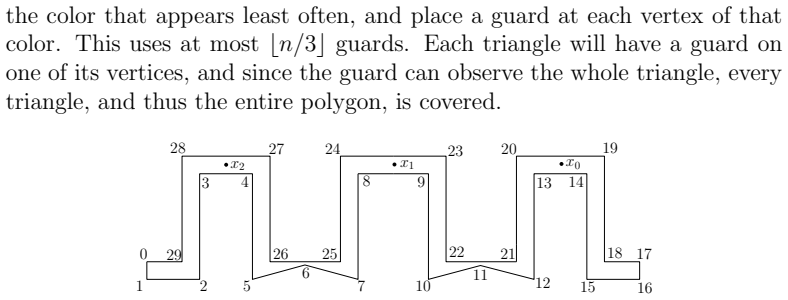
The load-bearing device is the "two ears theorem": every polygon with at least four sides has two non-overlapping ears, and removing an ear reduces the guarding question because the ear triangle is always seen by at least one of the vertices of an every-third-vertex placement. The minimality proof repeatedly removes ears until a pentagon remains, relies on the theorem that one vertex can watch a pentagon, and, for octagons, uses the weak dual tree of a triangulation to identify a small set of possible failing guard placements. The construction uses a cyclic three-coloring of vertices and the fact that if a triangulation triangle has no vertex of the guard color, that triangle is a candidate blind spot; the specific nonagon is assembled from a triangle, a quadrilateral, and a pentagon chosen so that each starting color leaves such a triangle uncovered.
What would settle it
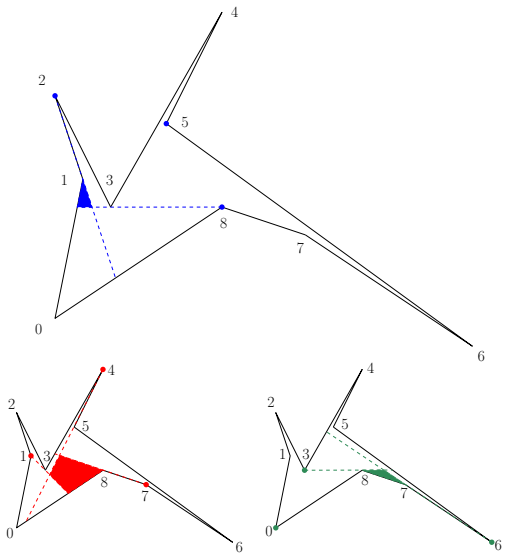
One concrete check is to compute the visibility polygon of each guard set $\{0,3,6\}$, $\{1,4,7\}$, and $\{2,5,8\}$ for the listed vertices and see whether every point of the polygon lies in their union; if any placement covers the whole nonagon, the main claim fails. A second check is to verify directly that the vertices in the listed order give a simple polygon and that the point sets shown shaded in Figure 3 are not visible to the corresponding guards.
Extended reading notes
Core claim
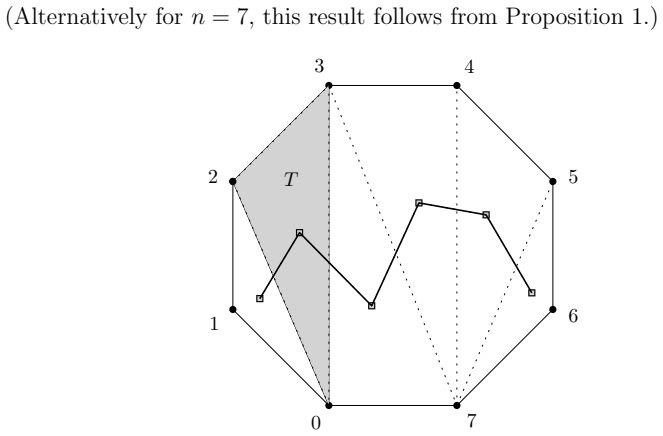
On its own terms, the paper claims that the polygon with cyclic vertices $(0,0),(1,5),(0,8),(2,4),(6,11),(4,7),(15,-1),(9,3),(6,4)$ is not fully observed when guards are set at every third vertex, regardless of whether one starts at vertex 0, 1, or 2; the shaded blind spots shown in the figure witness the failure for each starting choice. The complementary claim is minimality: Theorem 1 states that every $n$-gon with $n\le 8$ is covered for some starting vertex, so no smaller counterexample exists. The proof handles $n\le5$ by the single-guard guarantee, $n=6,7$ by removing ears down to a pentagon, and $n=8$ by a case analysis on the weak dual graph of a triangulation. The construction itself is guided by a coloring argument: cyclically color the nine vertices in three colors, force a triangulation triangle that contains no guard color, and shape the surrounding polygons to create the required blind spots.
Load-bearing premise
The counterexample rests on the unproved geometric assertion that the nine listed coordinate points form a simple polygon and that the shaded regions in Figure 3 are truly invisible to all three sets of guards; if that picture is trusted, the nonagon is a counterexample, but the proof does not supply a coordinate verification.
Editorial extensions
If this is right
- For every polygon with at most eight sides, some choice of starting vertex makes the every-third-vertex placement cover the whole polygon.
- Any polygon in which all three starting choices fail must have at least nine sides, and the displayed nonagon is the sharp example.
- If one instead stops after exactly $\lfloor n/3\rfloor$ guards, an octagon can fail while every heptagon is guarded, so the minimal failure size depends on which stopping rule is intended.
- Removing ears before analyzing a guard placement is a legitimate reduction because each removed ear triangle is automatically guarded by the every-third-vertex rule.
Reading between the lines
- The same ear-removal and coloring machinery could be tried for other fixed guard patterns, such as "every $k$-th vertex," with the minimal failure threshold likely depending on $k$; the paper does not explore that generalization.
- The nonagon was found by guided construction rather than exhaustive search, so a computational enumeration of simple nonagons could test whether many inequivalent minimal examples exist.
- The two stopping interpretations suggest a family of minimality questions indexed by the number of guards placed, and the paper settles two adjacent points in that family: nine sides for the generous reading and eight sides for the strict $\lfloor n/3\rfloor$ reading.
Signed reviews
Editorial analysis
A structured set of objections, weighed in public.
Referee Report
Summary. The paper studies the art-gallery strategy of placing guards at every third vertex of a simple polygon. It presents an explicit nine-vertex polygon with integer coordinates that, according to Figure 3, is not fully guarded for any of the three possible starting vertices, and it proves in Theorem 1 that every polygon with at most eight sides does admit some every-third-vertex placement that covers the whole polygon under the "more generous" interpretation of the strategy. The minimality proof combines Chvátal's theorem, the two-ears theorem, a degree-based argument for heptagons, and a weak-dual analysis for octagons. Section 2 describes the heuristic that led to the nonagon, and Section 4 lists related open problems.
Significance. If fully verified, the paper resolves a natural minimality question in the art-gallery literature with a concrete, explicit example and a compact proof. The construction is falsifiable and involves no fitted parameters or circular reasoning; the proof relies on standard, well-cited theorems. The main weaknesses are that the counterexample's geometric correctness is asserted through a figure rather than verified from the coordinates, and the proof of Theorem 1 contains an overbroad observation that makes the n=7 case invalid as written, though an alternative proof via Proposition 1 is available. These issues are local and fixable.
major comments (3)
- [Section 1, Figure 3] The central claim that the nonagon is not guarded by every third vertex is not actually proved in the text. The coordinates of the nine vertices are listed, but no argument is given that these points form a simple polygon, and no coordinate-based demonstration shows that the shaded regions are blind for all three every-third-vertex guard placements. Since the existence of this counterexample is the main result, the paper should include a verification, for example by providing the supporting visibility computations or a small computational certificate. As written, the claim rests entirely on the accuracy of the figure.
- [Section 3, observation before proof of Theorem 1] The observation that every ear triangle is guarded by an every-third-vertex placement is false when n is not a multiple of 3. For example, in a heptagon with guards at vertices 0 and 3, the ear triangle at vertex 5 has vertices 4, 5, and 6, none of which is a guard. The proof of Theorem 1 applies this observation to the n=7 case, so the proof is invalid for that case as written. The n=7 case should be handled exclusively by Proposition 1, or the observation should be restated with the precise hypotheses under which it holds (n=6 and n=8).
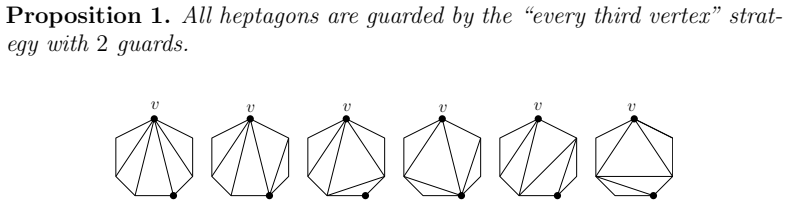
- [Section 3, Proposition 1] The proof of Proposition 1 asserts that in every possible triangulation of a heptagon, a vertex of degree at least 4 together with a vertex three edges away guards every triangle, but this is justified only by reference to Figure 5. The cases are not described in the text. Because Proposition 1 supplies the n=7 part of Theorem 1, the case analysis should be spelled out explicitly, or the figure should be accompanied by a precise description of each configuration and the corresponding guarding vertex pair.
minor comments (5)
- [Abstract and Section 1] The phrase "letting⌊x⌋ denotes" is ungrammatical and should be "letting ⌊x⌋ denote".
- [References] Reference [4] contains a typo: the author's name should be "Chvátal", not "Chvtal".
- [Section 3, Figure 4] The claim about the octagon that is not guarded by two vertices placed three apart under the non-generous interpretation is stated without proof; if this example is not needed for the main result, it could be removed, or a short verification could be added.
- [Section 2] The heuristic argument contains statements such as "the only possible color sequence" that are plausible but not fully justified; the paper should clarify that this section is not part of the formal proof of the counterexample.
- [Section 3, proof of Theorem 1] The phrase "the same argument from the n=6 and n=7 cases" is ambiguous because the n=7 case is ultimately handled by Proposition 1; the text should refer only to the ear-removal argument that is valid for n=6 and n=8.
Circularity Check
No circularity found: the counterexample is an explicit finite construction and the minimality proof rests on external cited theorems, not on the paper's own claims.
full rationale
The paper's central claim has two independent parts. First, the nine-vertex counterexample is given by explicit coordinates: "The vertices of this polygon have coordinates (0,0), (1,5), (0,8), (2,4), (6,11), (4,7), (15,-1), (9,3), and (6,4)." The claim that every-third-vertex guarding fails for starts 0, 1, and 2 is an assertion about this fixed finite object, not a quantity fitted from the data or defined in terms of the conclusion. Second, the minimality statement, Theorem 1, is argued by a case analysis using the Two Ears Theorem, Chvátal's theorem, and the weak dual of a triangulation, all attributed to external sources ([1], [2], [3], [4], [5]). The proof does not invoke the nonagon construction to prove the upper bound, and it does not invoke any self-citation or previously fitted parameter. The geometric correctness of the shaded blindspots in Figure 3 is not proved coordinate-wise, but that is a verification gap or correctness risk, not circular reasoning: nothing in the derivation is assumed from the target result or defined in terms of it. There are no fitted inputs called predictions, no uniqueness theorems imported from the authors' prior work, and no ansatz smuggled in via self-citation. The paper is self-contained relative to external benchmarks, so the appropriate circularity score is 0.
Assumptions & free parameters
assumptions (4)
- standard math Chvatal's theorem: floor(n/3) vertex guards suffice for every simple n-gon.
- standard math Two Ears Theorem: every simple polygon with n>=4 has at least two non-overlapping ears.
- standard math Fisk's 3-coloring argument that a triangulated polygon has a 3-coloring with one vertex of each color per triangle.
- standard math Any vertex of a triangle sees the whole triangle, and a convex polygon is guarded by a single vertex.
Cite this review
Pith. "Pith review of The smallest art gallery not guarded by every third vertex." pith.science (2026). https://pith.science/paper/G653NGYK
@misc{pith2026190801705,
  author       = {Pith},
  title        = {Pith review of: The smallest art gallery not guarded by every third vertex},
  year         = {2026},
  howpublished = {\url{https://pith.science/paper/G653NGYK}},
  note         = {Machine review of arXiv:1908.01705}
}
read the original abstract
A polygonal art gallery can be observed by guards placed at one third of its corners. However, the strategy of placing guards at every third corner does not work for all art galleries. In this note, we provide an example of a nine-sided art gallery for which this strategy fails, and prove that this example is minimal.
Figures

Figures from the paper (4 more)

Reference graph
Works this paper leans on
-
[1]
Chv´ atal, A combinatorial theorem in plane geometry, J
V. Chv´ atal, A combinatorial theorem in plane geometry, J. Combinato- rial Theory Ser. B. 18 (1975) 39–41
work page 1975
-
[2]
S. Devadoss, J. O’Rourke, Discrete and computational geometry, Prince- ton University Press, Princeton, NJ, 2011
work page 2011
-
[3]
Guggenheimer, The Jordan curve theorem and an unpublished manuscript by Max Dehn, Arch
H. Guggenheimer, The Jordan curve theorem and an unpublished manuscript by Max Dehn, Arch. Hist. Exact Sci. 17(2) (1977) 193–200
work page 1977
-
[4]
Fisk, A short proof of Chvtal’s watchman theorem, J
S. Fisk, A short proof of Chvtal’s watchman theorem, J. Combin. Theory Ser. B. 24(3) (1978) 374
work page 1978
-
[5]
Meisters, Polygons have ears, Amer
G. Meisters, Polygons have ears, Amer. Math. Monthly 82 (1975) 648– 651
work page 1975
-
[6]
T. S. Michael, How to Guard an Art Gallery and Other Discrete Math- ematical Adventures, Johns Hopkins University Press, Baltimore MD, 2009
work page 2009
-
[7]
J. O’Rourke, Art gallery theorems and algorithms, International Series of Monographs on Computer Science, The Clarendon Press, Oxford Uni- versity Press, New York, 1987. 9
work page 1987
Reviewed August 14, 2026 · model on record in the stance chip above.
Discussion (0). Continue with ORCID to comment.