REVIEW 2 major objections 2 minor 1 cited by
SN2023ixf: ultraviolet-to-infrared radiative-transfer modeling of the nebular-phase evolution until 1000 days
T0 review · 2 major / 2 minor · reviewed 2026-05-15 · grok-4.3
Pith's one-line read SN2023ixf's nebular light curve to 1000 days requires dust formation in the cold dense shell plus enhanced gamma-ray escape after 200 days.
desk verdict This paper pushes the same photospheric ejecta model for SN2023ixf out to 1000 days and concludes that post-200d dust plus extra gamma-ray escape are needed to match the V-band drop, but the necessity depends on holding those early parameters fixed. read the letter →
The pith
A machine-rendered reading of the paper's core claim, the machinery that carries it, and where it could break.
The reading
What carries the argument
The cold dense shell of 0.2 solar masses at 8000 km/s produced by ejecta-circumstellar material interaction, together with subsequent dust formation inside the shell and inner ejecta.
What would settle it
A direct measurement of cold dense shell velocity or dust mass at 300 days showing no deceleration or no dust increase would contradict the adjustments needed to match the V-band light curve.
Extended reading notes
Core claim
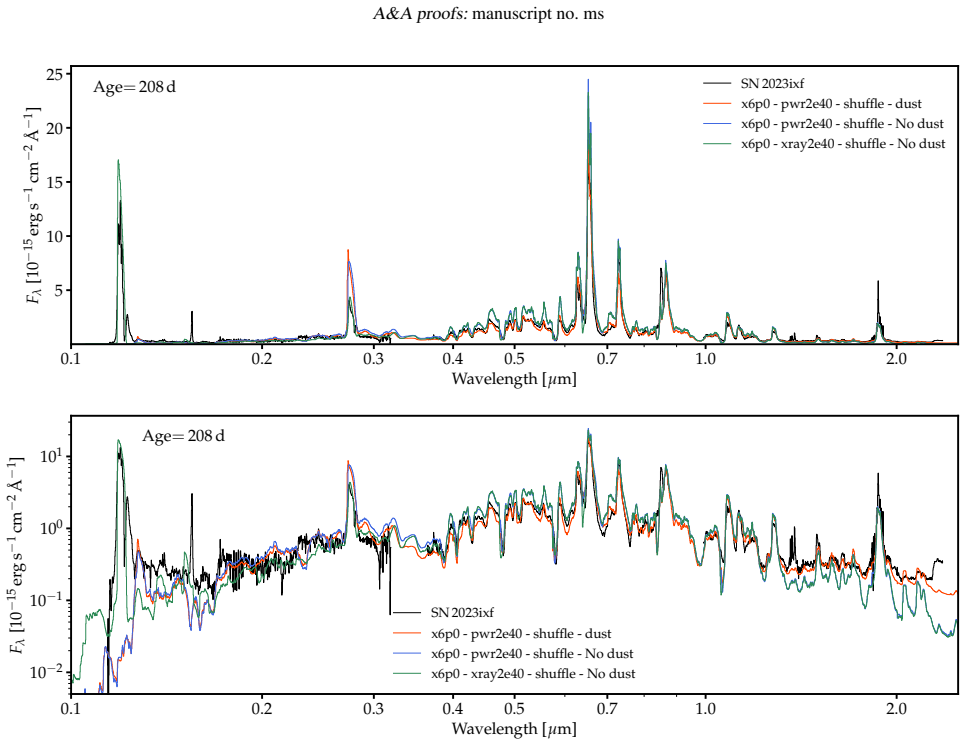
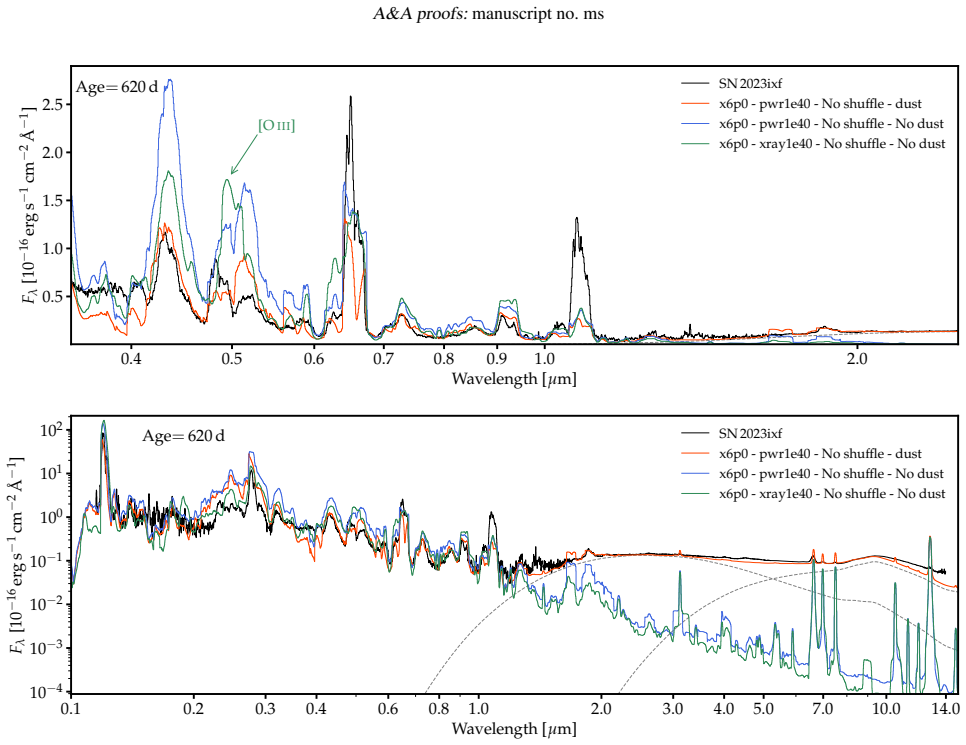
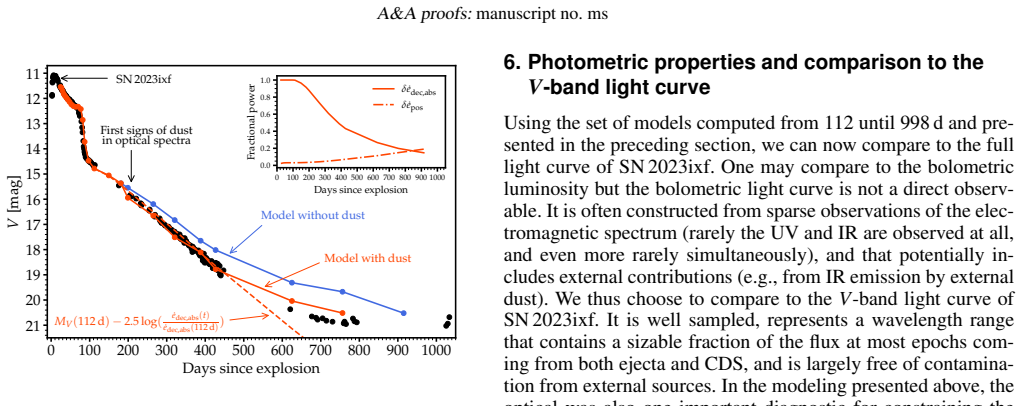
Non-local thermodynamic equilibrium radiative transfer models of SN2023ixf during the nebular phase to 1000 days, based on ejecta with 7-8 solar masses, 1.2 x 10^51 erg, 0.05 solar masses of nickel-56, and a 0.2 solar mass cold dense shell at 8000 km/s, match the data when enhanced gamma-ray escape and dust formation after 200 days are included. Dust forms first in the cold dense shell and subsequently in the inner ejecta, reaching up to 10^{-4} solar masses by 700 days, attenuating emission lines with possible blue-red asymmetries depending on location. The ultraviolet flux is powered by circumstellar material interaction, influenced by iron lines and strong blueshifted Ly alpha and Mg II
Load-bearing premise
The ejecta mass, kinetic energy, and nickel-56 mass fixed from the photospheric phase continue to apply without modification through the entire nebular phase to 1000 days.
Editorial extensions
If this is right
- The cold dense shell velocity decreases continuously from 8000 km/s at 112 days to 6500 km/s at 998 days, indicating mass growth of several 0.1 solar masses.
- Dust mass in the cold dense shell and inner ejecta rises to possibly 10^{-4} solar masses at 700 days as a carbon-rich and silicon-rich mixture.
- Emission lines are uniformly attenuated or show blue-red asymmetry depending on whether the dust lies interior or exterior to the line-forming gas.
- Ultraviolet radiation remains largely unaffected by dust and is powered by circumstellar interaction at all epochs, with strengthening blueshifted Ly alpha and Mg II emission after 200 days.
- The supernova is fainter and cooler than SN1993J at 1-3 years due to greater cold dense shell and ejecta masses plus dust extinction.
Reading between the lines
- Persistent circumstellar interaction through the nebular phase may be typical for Type IIb events and could bias nickel-mass estimates derived from late-time luminosity.
- If the same ejecta parameters work from early through late phases, early-time data become more reliable for inferring progenitor structure without needing major late-time revisions.
- The required external cold dust component implies either pre-existing circumstellar dust or dust formation outside the main ejecta, which could be tested with spatially resolved mid-infrared observations.
- Greater gamma-ray escape at late times suggests the ejecta become progressively more transparent, potentially verifiable if future gamma-ray telescopes can detect such events.
- keywords:[
- supernova
- SN2023ixf
- nebular phase
Editorial analysis
A structured set of objections, weighed in public.
Referee Report
Summary. The manuscript presents non-LTE radiative-transfer modeling of SN 2023ixf in the nebular phase out to 1000 days, employing the same ejecta parameters (7–8 M⊙, 1.2 × 10^51 erg, 0.05 M⊙ of 56Ni) that matched the photospheric phase, augmented by a 0.2 M⊙ cold dense shell (CDS) at 8000 km s⁻¹. Persistent CSM interaction is claimed to power the UV flux at all epochs and the optical after ~600 d. Matching the V-band decline is stated to require enhanced γ-ray escape plus dust formation (C-rich/Si-rich mixture) after ~200 d, first in the CDS and later in the inner ejecta, with an external cold dust component needed for the mid-IR; the CDS is reported to decelerate, implying mass growth of several 0.1 M⊙. The models also address UV line formation (Lyα, Mg II) and compare the event to SN 1993J.
Significance. If the necessity of the additional components can be shown to be robust rather than compensatory, the work would provide a valuable multi-epoch radiative-transfer framework for interacting supernovae, quantifying the roles of CDS dust formation, γ-ray leakage, and ongoing mass accretion in shaping nebular light curves and spectra. It would also strengthen the observational link between SN 2023ixf and events like SN 1993J while highlighting how dust extinction and CDS structure affect UV and optical diagnostics at late times.
major comments (2)
- [Abstract] Abstract: The claim that matching the V-band light curve 'requires' both enhanced gamma-ray escape and dust formation after ~200 d is load-bearing for the central conclusion, yet rests on holding the photospheric ejecta parameters (7–8 M⊙, 1.2 × 10^51 erg, 0.05 M⊙ 56Ni) exactly fixed. No sensitivity study or quantitative error analysis is presented to show that modest re-adjustments (e.g., ±0.01 M⊙ in 56Ni or small changes in energy redistribution) fail to reproduce the decline without these additions.
- [Abstract] Abstract: The reported CDS deceleration from 8000 km s⁻¹ at 112 d to ~6500 km s⁻¹ at 998 d is interpreted as evidence for mass growth of several 0.1 M⊙. Because CDS mass, velocity, and dust mass are themselves free parameters adjusted to fit the light curve and line profiles, this physical interpretation is circular; the fitted parameters define the conclusion rather than providing an independent test.
minor comments (2)
- [Abstract] Abstract: Numerical notation such as '1.2e51erg' and '1e-4Msun' should be rendered in standard scientific format (e.g., 1.2 × 10^{51} erg) for consistency with journal style.
- The manuscript would benefit from explicit reporting of goodness-of-fit metrics (e.g., reduced χ² or residual statistics) for the model–data comparisons rather than qualitative statements of agreement.
Simulated Author's Rebuttal
We thank the referee for the constructive and detailed report. We address each major comment below, providing clarifications on our modeling choices and noting revisions made to strengthen the presentation.
read point-by-point responses
-
Referee: [Abstract] Abstract: The claim that matching the V-band light curve 'requires' both enhanced gamma-ray escape and dust formation after ~200 d is load-bearing for the central conclusion, yet rests on holding the photospheric ejecta parameters (7–8 M⊙, 1.2 × 10^51 erg, 0.05 M⊙ 56Ni) exactly fixed. No sensitivity study or quantitative error analysis is presented to show that modest re-adjustments (e.g., ±0.01 M⊙ in 56Ni or small changes in energy redistribution) fail to reproduce the decline without these additions.
Authors: The ejecta parameters were deliberately held fixed to maintain consistency with our earlier photospheric-phase modeling of SN 2023ixf, which already constrained the 7–8 M⊙ mass, 1.2 × 10^51 erg energy, and 0.05 M⊙ 56Ni mass. The nebular models demonstrate that these fixed values cannot reproduce the observed V-band decline rate or the UV-optical spectral evolution without the additional components. We agree that a quantitative sensitivity study would be valuable; we have added a short paragraph in the revised discussion section exploring the effects of modest (±0.01 M⊙) variations in 56Ni and noting that they do not remove the requirement for enhanced γ-ray escape and dust formation. revision: partial
-
Referee: [Abstract] Abstract: The reported CDS deceleration from 8000 km s⁻¹ at 112 d to ~6500 km s⁻¹ at 998 d is interpreted as evidence for mass growth of several 0.1 M⊙. Because CDS mass, velocity, and dust mass are themselves free parameters adjusted to fit the light curve and line profiles, this physical interpretation is circular; the fitted parameters define the conclusion rather than providing an independent test.
Authors: The CDS velocity at each epoch is not a free parameter but is directly constrained by matching the observed Doppler shifts and line-profile shapes in the multi-epoch spectra. The model then evolves the CDS under ongoing CSM interaction, producing the deceleration that matches the data. This velocity evolution is therefore an independent spectral diagnostic that supports the inferred mass growth, rather than being defined solely by the light-curve fit. We have clarified this distinction in the revised methods and results sections. revision: yes
Circularity Check
CDS mass/velocity and dust mass fitted to match V-band and line profiles; deceleration then interpreted as mass growth, with 'requires' language applied to the fitted adjustments
-
fitted input called prediction
[Abstract]
"augmented with a cold dense shell (CDS) of 0.2Msun at 8000km/s. ... Matching the V-band light curve requires invoking both enhanced gamma-ray escape and dust formation after ~200d, first in the CDS and eventually in the inner ejecta as well. ... Our models suggest a rising dust mass ... possibly reaching 1e-4Msun at 700d"
CDS mass, initial velocity, and dust mass (C-rich/Si-rich mixture) are chosen/adjusted to reproduce the light curve and profiles; the statement that matching 'requires' enhanced escape and dust formation therefore follows by construction from those adjustments rather than emerging as a prediction.
-
self definitional
[Abstract]
"The CDS is continuously slowing down from 8000km/s at 112d to ~6500km/s at 998d, suggesting a growth in mass of several 0.1Msun."
The model is constructed with a fixed initial CDS mass of 0.2 Msun whose velocity evolution is computed under interaction; the observed deceleration is then interpreted as implying additional mass growth of several 0.1 Msun, making the physical conclusion a direct re-description of the fitted velocity trajectory.
full rationale
The derivation fixes photospheric ejecta (7-8 Msun, 1.2e51 erg, 0.05 Msun 56Ni) and augments with a CDS (0.2 Msun at 8000 km/s), then adjusts gamma-ray escape and dust mass to reproduce the observed V-band decline and line profiles. The resulting model velocity slowdown is presented as evidence for additional mass growth. This reduces the central claim (that enhanced escape and dust 'require' invocation) to a direct consequence of the fitting choices rather than an independent prediction. No sensitivity study on parameter variations is reported to test uniqueness.
Assumptions & free parameters
free parameters (5)
- ejecta mass
- kinetic energy
- 56Ni mass
- CDS mass
- dust mass
assumptions (2)
- domain assumption Non-local thermodynamic equilibrium radiative transfer accurately describes the nebular-phase emission
- domain assumption The same ejecta structure from the photospheric phase remains valid at 1000 days
invented entities (3)
-
Cold dense shell (CDS)
-
Internal dust component
-
External cold dust component
Cite this review
Pith. "Pith review of SN2023ixf: ultraviolet-to-infrared radiative-transfer modeling of the nebular-phase evolution until 1000 days." pith.science (2026). https://pith.science/paper/G6EA4TPP
@misc{pith2026260514081,
  author       = {Pith},
  title        = {Pith review of: SN2023ixf: ultraviolet-to-infrared radiative-transfer modeling of the nebular-phase evolution until 1000 days},
  year         = {2026},
  howpublished = {\url{https://pith.science/paper/G6EA4TPP}},
  note         = {Machine review of arXiv:2605.14081}
}
read the original abstract
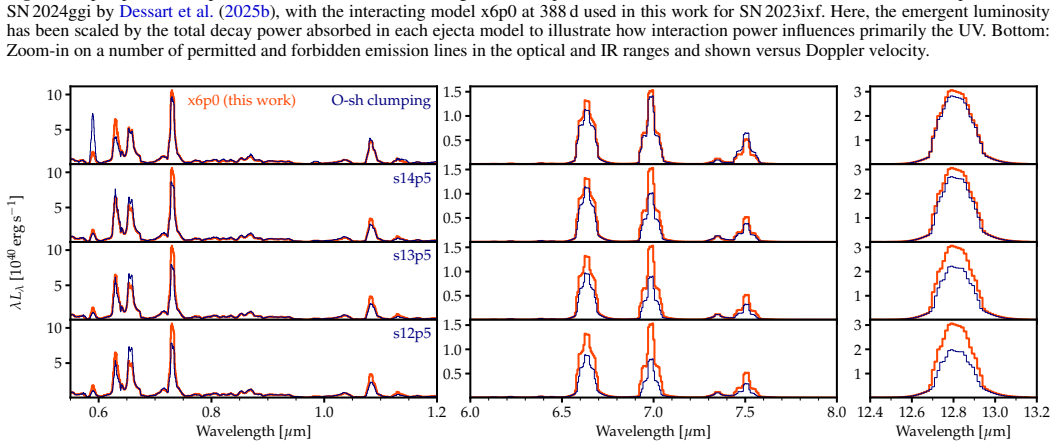
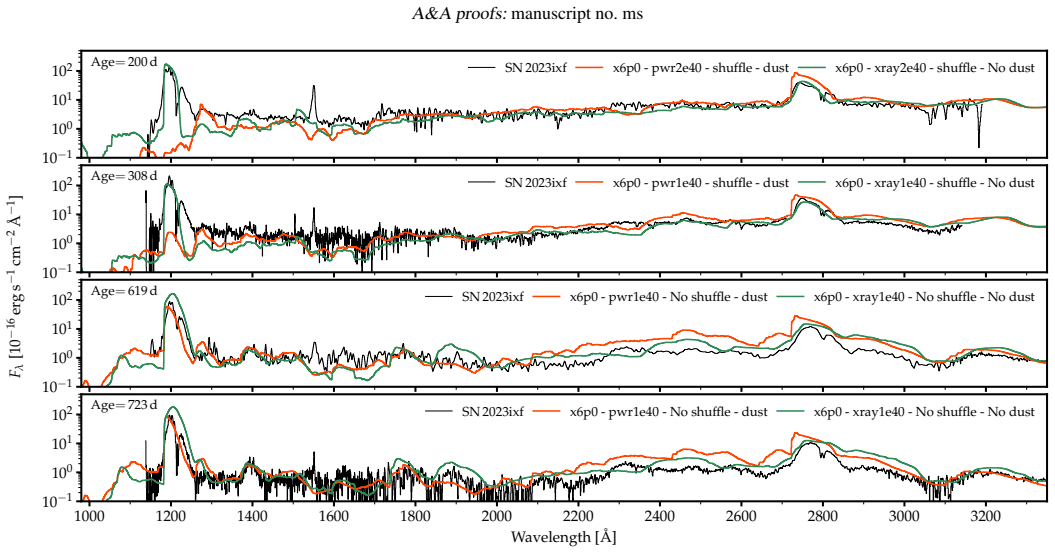
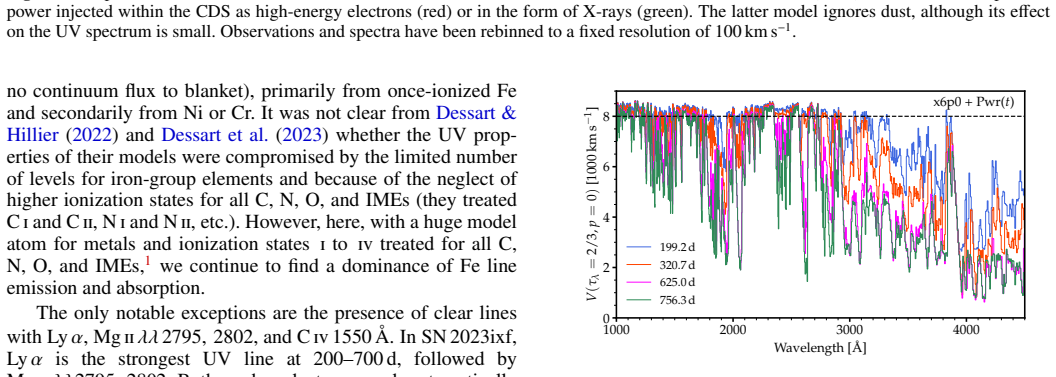
We present non-local thermodynamic equilibrium radiative-transfer modeling of SN2023ixf during the nebular phase out to 1000d, using the same ejecta that matched its photospheric evolution, namely a partially stripped red-supergiant star of initially 15Msun whose terminal explosion yielded ejecta with 7-8Msun, kinetic energy of 1.2e51erg, and 56Ni mass of 0.05Msun, augmented with a cold dense shell (CDS) of 0.2Msun at 8000km/s. Interaction with circumstellar material persists at all epochs, powering the ultraviolet (UV) flux at all times, but dominating the optical only after ~600d. Matching the V-band light curve requires invoking both enhanced gamma-ray escape and dust formation after ~200d, first in the CDS and eventually in the inner ejecta as well. Depending on where they form relative to the dust, emission lines are uniformly attenuated or skewed with a blue-red asymmetry. Our models suggest a rising dust mass (chosen as an C-rich and Si-rich mixture) in the CDS and inner ejecta, possibly reaching 1e-4Msun at 700d, while an external cold dust component is required to match the mid-infrared emission. The UV radiation, largely unaffected by dust, is influenced by the emission and absorption from Fe lines, together with strong, blueshifted emission from Lyalpha and MgII2800, both present at >~200d and with a strengthening fractional flux thereafter. Optical-depth effects play a critical role for the UV flux, and most notably on Lyalpha whose strength depends strongly on the CDS structure (mass and extent) and the treatment of power injection. The CDS is continuously slowing down from 8000km/s at 112d to ~6500km/s at 998d, suggesting a growth in mass of several 0.1Msun. SN2023ixf shares many similarities with SN1993J at 1-3yr, but it is eventually fainter due to dust extinction and cooler (i.e., weak [NII] and no [OIII] lines) likely as a result of greater CDS and ejecta masses.
Figures


Figures from the paper (23 more)









Forward citations
Cited by 1 Pith paper
-
Evidence for Asymmetric Ejecta and Circumstellar Material in SN 2023ixf Inferred from Extensive Nebular-phase Observations
Nebular spectra of SN 2023ixf reveal asymmetric ejecta with ≥2 Ni-rich plumes and initially aspherical dense CSM that has been swept up, producing intermediate-width and high-velocity Hα components.
Reference graph
Works this paper leans on
- [1]
-
[2]
C., Orellana, M., Folatelli, G., et al
Bersten, M. C., Orellana, M., Folatelli, G., et al. 2024, A&A, 681, L18
work page 2024
-
[3]
Bevan, A., Barlow, M. J., & Milisavljevic, D. 2017, MNRAS, 465, 4044
work page 2017
-
[4]
Blinnikov, S. I., Eastman, R., Bartunov, O. S., Popolitov, V . A., & Woosley, S. E. 1998, ApJ, 496, 454
work page 1998
-
[5]
A., Pearson, J., Shrestha, M., et al
Bostroem, K. A., Pearson, J., Shrestha, M., et al. 2023, ApJ, 956, L5
work page 2023
- [6]
-
[7]
Bostroem, K. A., Valenti, S., Sand, D. J., et al. 2025, submitted to ApJ, arXiv:2508.11756
-
[8]
Bronner, V . A., Laplace, E., Schneider, F. R. N., & Podsiadlowski, P. 2025, A&A, 703, A61
work page 2025
Show all 104 references
-
[9]
A., Maeda, K., Ray, A
Chandra, P., Chevalier, R. A., Maeda, K., Ray, A. K., & Nayana, A. J. 2024, ApJ, 963, L4
2024
-
[10]
& Blondin, J
Chevalier, R. & Blondin, J. M. 1995, ApJ, 444, 312
1995
-
[11]
A., Blondin, J
Chevalier, R. A., Blondin, J. M., & Emmering, R. T. 1992, ApJ, 392, 118
1992
-
[12]
M., Ashall, C., Baron, E., et al
DerKacy, J. M., Ashall, C., Baron, E., et al. 2026, ApJ, 997, 179
2026
-
[13]
2024, A&A, 692, A204
Dessart, L. 2024, A&A, 692, A204
2024
-
[14]
2025, A&A, 703, A287
Dessart, L. 2025, A&A, 703, A287
2025
-
[15]
& Audit, E
Dessart, L. & Audit, E. 2019, A&A, 629, A17
2019
-
[16]
P., Kuncarayakti, H., Fox, O
Dessart, L., Gutiérrez, C. P., Kuncarayakti, H., Fox, O. D., & Filippenko, A. V . 2023, A&A, 675, A33
2023
-
[17]
& Hillier, D
Dessart, L. & Hillier, D. J. 2019, A&A, 625, A9
2019
-
[18]
& Hillier, D
Dessart, L. & Hillier, D. J. 2020, A&A, 643, L13
2020
-
[19]
& Hillier, D
Dessart, L. & Hillier, D. J. 2022, A&A, 660, L9
2022
-
[20]
J., & Audit, E
Dessart, L., Hillier, D. J., & Audit, E. 2017, A&A, 605, A83
2017
-
[21]
J., & Wilk, K
Dessart, L., Hillier, D. J., & Wilk, K. D. 2018, A&A, 619, A30
2018
-
[22]
& Jacobson-Galán, W
Dessart, L. & Jacobson-Galán, W. V . 2023, A&A, 677, A105
2023
-
[23]
V ., Bostroem, K
Dessart, L., Jacobson-Galan, W. V ., Bostroem, K. A., et al. 2026, arXiv:2604.05145
2026 arXiv
-
[24]
2025, ApJ, 984, 71
Dickinson, D., Milisavljevic, D., Garretson, B., et al. 2025, ApJ, 984, 71
2025
-
[25]
J., Valenti, S., et al
Dong, Y ., Sand, D. J., Valenti, S., et al. 2023, ApJ, 957, 28
2023
-
[26]
Draine, B. T. & Li, A. 2007, ApJ, 657, 810
2007
-
[27]
J., et al
Fabbri, J., Otsuka, M., Barlow, M. J., et al. 2011, MNRAS, 418, 1285
2011
-
[28]
J., Ferrari, L., et al
Fang, Q., Moriya, T. J., Ferrari, L., et al. 2025, ApJ, 978, 36
2025
-
[29]
Ferrari, L., Folatelli, G., Ertini, K., Kuncarayakti, H., & Andrews, J. E. 2024, A&A, 687, L20
2024
-
[30]
Filippenko, A. V . 1997, ARA&A, 35, 309
1997
-
[31]
V ., Matheson, T., & Ho, L
Filippenko, A. V ., Matheson, T., & Ho, L. C. 1993, ApJ, 415, L103
1993
-
[32]
L., Hillier, D
Flores, B. L., Hillier, D. J., & Dessart, L. 2023, MNRAS, 518, 5001
2023
-
[33]
2025, A&A, 698, A213
Folatelli, G., Ferrari, L., Ertini, K., Kuncarayakti, H., & Maeda, K. 2025, A&A, 698, A213
2025
-
[34]
& Goldberg, J
Forde, S. & Goldberg, J. A. 2025, Research Notes of the American Astronomical Society, 9, 135
2025
-
[35]
M., Chevalier, R
Fransson, C., Challis, P. M., Chevalier, R. A., et al. 2005, ApJ, 622, 991
2005
-
[36]
A., Bildsten, L., & Paxton, B
Goldberg, J. A., Bildsten, L., & Paxton, B. 2019, ApJ, 879, 3
2019
-
[37]
W., Brightman, M., Earnshaw, H
Grefenstette, B. W., Brightman, M., Earnshaw, H. P., Harrison, F. A., & Margutti, R. 2023, ApJ, 952, L3
2023
-
[38]
Hillier, D. J. & Dessart, L. 2012, MNRAS, 424, 252
2012
-
[39]
Hillier, D. J. & Dessart, L. 2019, A&A, 631, A8
2019
-
[40]
Hillier, D. J. & Miller, D. L. 1998, ApJ, 496, 407
1998
-
[41]
A., et al
Hsu, B., Smith, N., Goldberg, J. A., et al. 2025, ApJ, 990, 148
2025
-
[42]
2023, Transient Name Server Discovery Report, 2023-1158, 1
Itagaki, K. 2023, Transient Name Server Discovery Report, 2023-1158, 1
2023
-
[43]
2025, ApJ, 978, 138 Jacobson-Galán, W
Iwata, Y ., Akimoto, M., Matsuoka, T., et al. 2025, ApJ, 978, 138 Jacobson-Galán, W. V ., Dessart, L., Davis, K. W., et al. 2025a, ApJ, 992, 100 Jacobson-Galán, W. V ., Dessart, L., Kilpatrick, C. D., et al. 2025b, ApJ, 994, L14 Jacobson-Galán, W. V ., Dessart, L., Margutti, R...
2025
-
[44]
E., Pearson, J., Beasor, E
Jencson, J. E., Pearson, J., Beasor, E. R., et al. 2023, ApJ, 952, L30
2023
-
[45]
2012, A&A, 546, A28
Jerkstrand, A., Fransson, C., Maguire, K., et al. 2012, A&A, 546, A28
2012
-
[46]
D., Foley, R
Kilpatrick, C. D., Foley, R. J., Jacobson-Galán, W. V ., et al. 2023, ApJ, 952, L23
2023
-
[47]
2006, ApJ, 651, L117
Kotak, R., Meikle, P., Pozzo, M., et al. 2006, ApJ, 651, L117
2006
-
[48]
D., Höflich, P
Kotak, R., Meikle, P., van Dyk, S. D., Höflich, P. A., & Mattila, S. 2005, ApJ, 628, L123
2005
-
[49]
Kotak, R., Meikle, W. P. S., Farrah, D., et al. 2009, ApJ, 704, 306
2009
-
[50]
2025, A&A, 694, A319
Kozyreva, A., Caputo, A., Baklanov, P., Mironov, A., & Janka, H.-T. 2025, A&A, 694, A319
2025
-
[51]
R., Singleton, A
Kumar, A., Dastidar, R., Maund, J. R., Singleton, A. J., & Sun, N.-C. 2025, MNRAS, 538, 659
2025
-
[52]
A., Schneider, F
Laplace, E., Bronner, V . A., Schneider, F. R. N., & Podsiadlowski, P. 2026, ApJ, 998, L40
2026
-
[53]
C., Filippenko, A
Leonard, D. C., Filippenko, A. V ., Gates, E. L., et al. 2002, PASP, 114, 35 Article number, page 25 of 29 A&A proofs:manuscript no. ms
2002
-
[54]
2024, Nature, 627, 754
Li, G., Hu, M., Li, W., et al. 2024, Nature, 627, 754
2024
-
[55]
2020, A&A, 642, A135
Liljegren, S., Jerkstrand, A., & Grumer, J. 2020, A&A, 642, A135
2020
-
[56]
& Dalgarno, A
Liu, W. & Dalgarno, A. 1995, ApJ, 454, 472
1995
-
[57]
B., Danziger, I
Lucy, L. B., Danziger, I. J., Gouiffes, C., & Bouchet, P. 1989, in IAU Colloq. 120: Structure and Dynamics of the Interstellar Medium, ed. G. Tenorio-Tagle, M. Moles, & J. Melnick, V ol. 350, 164
1989
-
[58]
2025, submitted to ApJL, arXiv:2510.14875
Ma, J.-Z., Justham, S., Pakmor, R., et al. 2025, submitted to ApJL, arXiv:2510.14875
2025
-
[59]
V ., Barth, A
Matheson, T., Filippenko, A. V ., Barth, A. J., et al. 2000, AJ, 120, 1487
2000
-
[60]
J., & Dessart, L
McLeod, C., Hillier, D. J., & Dessart, L. 2024, MNRAS, 532, 549
2024
-
[61]
2025, ApJ, 993, 191
Medler, K., Ashall, C., Hoeflich, P., et al. 2025, ApJ, 993, 191
2025
-
[62]
Meikle, W. P. S., Kotak, R., Farrah, D., et al. 2011, ApJ, 732, 109
2011
-
[63]
2026, ApJ, 997, 330
Mera, T., Ashall, C., Hoeflich, P., et al. 2026, ApJ, 997, 330
2026
-
[64]
2015, ApJ, 815, 120
Milisavljevic, D., Margutti, R., Kamble, A., et al. 2015, ApJ, 815, 120
2015
-
[65]
J., Chevalier, R
Milisavljevic, D., Patnaude, D. J., Chevalier, R. A., et al. 2018, ApJ, 864, L36
2018
-
[66]
Moriya, T. J. & Singh, A. 2024, PASJ, 76, 1050
2024
-
[67]
J., Margutti, R., Wiston, E., et al
Nayana, A. J., Margutti, R., Wiston, E., et al. 2025, ApJ, 985, 51
2025
-
[68]
Neustadt, J. M. M., Kochanek, C. S., & Smith, M. R. 2024, MNRAS, 527, 5366
2024
-
[69]
J., Bevan, A., et al
Niculescu-Duvaz, M., Barlow, M. J., Bevan, A., et al. 2022, MNRAS, 515, 4302
2022
-
[70]
R., et al
Niu, Z., Sun, N.-C., Maund, J. R., et al. 2023, ApJ, 955, L15
2023
-
[71]
1993, Nature, 364, 507
Nomoto, K., Suzuki, T., Shigeyama, T., et al. 1993, Nature, 364, 507
1993
-
[72]
H., Rho, J., Yoon, S.-C., et al
Park, S. H., Rho, J., Yoon, S.-C., et al. 2025, A&A, 703, A227
2025
-
[73]
J., et al
Pearson, J., Subrayan, B., Sand, D. J., et al. 2025, ApJ, 993, 213
2025
-
[74]
A., Gal-Yam, A., Irani, I., & Zimmerman, E
Perley, D. A., Gal-Yam, A., Irani, I., & Zimmerman, E. 2023, Transient Name Server AstroNote, 119, 1
2023
-
[75]
Podsiadlowski, P., Hsu, J. J. L., Joss, P. C., & Ross, R. R. 1993, Nature, 364, 509
1993
-
[76]
X., Hennawi, J., Cooke, R., et al
Prochaska, J. X., Hennawi, J., Cooke, R., et al. 2020, pypeit/PypeIt: Release 1.0.0
2020
-
[77]
X., Hennawi, J
Prochaska, J. X., Hennawi, J. F., Westfall, K. B., et al. 2020, Journal of Open Source Software, 5, 2308
2020
-
[78]
2024, MNRAS, 534, 271
Qin, Y .-J., Zhang, K., Bloom, J., et al. 2024, MNRAS, 534, 271
2024
-
[79]
L., Villar, V
Ransome, C. L., Villar, V . A., Tartaglia, A., et al. 2024, ApJ, 965, 93
2024
-
[80]
W., Treffers, R
Richmond, M. W., Treffers, R. R., Filippenko, A. V ., & Paik, Y . 1996, AJ, 112, 732
1996
-
[81]
W., Treffers, R
Richmond, M. W., Treffers, R. R., Filippenko, A. V ., et al. 1994, AJ, 107, 1022
1994
-
[82]
G., Yuan, W., Macri, L
Riess, A. G., Yuan, W., Macri, L. M., et al. 2022, ApJ, 934, L7
2022
-
[83]
2022, A&A, 668, A57
Sarangi, A. 2022, A&A, 668, A57
2022
-
[84]
2023, MNRAS, 523, 6048
Shahbandeh, M., Sarangi, A., Temim, T., et al. 2023, MNRAS, 523, 6048
2023
-
[85]
J., et al
Shrestha, M., DeSoto, S., Sand, D. J., et al. 2025, ApJ, 982, L32
2025
-
[86]
2026, arXiv e-prints, arXiv:2603.14137
Singh, A., Goto, S., Sarangi, A., et al. 2026, arXiv e-prints, arXiv:2603.14137
2026
-
[87]
S., Moriya, T
Singh, A., Teja, R. S., Moriya, T. J., et al. 2024, ApJ, 975, 132
2024
-
[88]
J., et al
Smith, N., Pearson, J., Sand, D. J., et al. 2023, ApJ, 956, 46
2023
-
[89]
D., Szalai, T., Van Dyk, S
Soraisam, M. D., Szalai, T., Van Dyk, S. D., et al. 2023, ApJ, 957, 64
2023
-
[90]
Spyromilio, J., Meikle, W. P. S., Learner, R. C. M., & Allen, D. A. 1988, Nature, 334, 327
1988
-
[91]
E., Brown, J
Sukhbold, T., Ertl, T., Woosley, S. E., Brown, J. M., & Janka, H.-T. 2016, ApJ, 821, 38
2016
-
[92]
2025, A&A, 697, A132
Szalai, T., Zsíros, S., Jencson, J., et al. 2025, A&A, 697, A132
2025
-
[93]
S., Singh, A., Basu, J., et al
Teja, R. S., Singh, A., Basu, J., et al. 2023, ApJ, 954, L12
2023
-
[94]
D., Shahbandeh, M., et al
Tinyanont, S., Fox, O. D., Shahbandeh, M., et al. 2025, ApJ, 985, 198 Van Dyk, S. D., Srinivasan, S., Andrews, J. E., et al. 2024a, ApJ, 968, 27 Van Dyk, S. D., Szalai, T., Cutri, R. M., et al. 2024b, ApJ, 977, 98 Van Dyk, S. D., Zheng, W., Maund, J. R., et al. 2019, ApJ, 875, 136
2025
-
[95]
S., Dessart, L., Yang, Y ., et al
Vasylyev, S. S., Dessart, L., Yang, Y ., et al. 2026, ApJ, 1000, 18
2026
-
[96]
S., Yang, Y ., Filippenko, A
Vasylyev, S. S., Yang, Y ., Filippenko, A. V ., et al. 2023, ApJ, 955, L37 Vinkó, J., Bodola, Z. R., G˝odény, Á., et al. 2025, ApJ, 993, 39
2023
-
[97]
E., Fesen, R
Weil, K. E., Fesen, R. A., Patnaude, D. J., & Milisavljevic, D. 2020, ApJ, 900, 11
2020
-
[98]
Weingartner, J. C. & Draine, B. T. 2001, ApJ, 563, 842
2001
-
[99]
H., Rank, D
Wooden, D. H., Rank, D. M., Bregman, J. D., et al. 1993, ApJS, 88, 477
1993
-
[100]
E., Eastman, R
Woosley, S. E., Eastman, R. G., Weaver, T. A., & Pinto, P. A. 1994, ApJ, 429, 300
1994
-
[101]
2004, AJ, 128, 1857
Zhang, T., Wang, X., Zhou, X., et al. 2004, AJ, 128, 1857
2004
-
[102]
V ., et al
Zheng, W., Dessart, L., Filippenko, A. V ., et al. 2025, ApJ, 988, 61
2025
-
[103]
A., Irani, I., Chen, P., et al
Zimmerman, E. A., Irani, I., Chen, P., et al. 2024, Nature, 627, 759
2024
-
[104]
vdep”), the maximum grid velocity (“vmax
Zubko, V ., Dwek, E., & Arendt, R. G. 2004, ApJS, 152, 211 Article number, page 26 of 29 Luc Dessart et al.: Nebular-phase modeling of SN 2023ixf Appendix A: Observations with the Gran Telescopio Canarias at 998 d The spectrum obtained on 2026-02-11 (MJD=61082.237) was acquire...
2004
Reviewed May 15, 2026 · model on record in the stance chip above.
Discussion (0). Sign in to comment.