Beyond Wireless Security: Covert Communications in Large Language Model-enabled Edge Networks
Pith reviewed 2026-07-01 00:42 UTC · model grok-4.3
The pith
Covert communications and computations improve privacy protection and execution efficiency in LLM-enabled edge networks.
A machine-rendered reading of the paper's core claim, the machinery that carries it, and where it could break.
Core claim
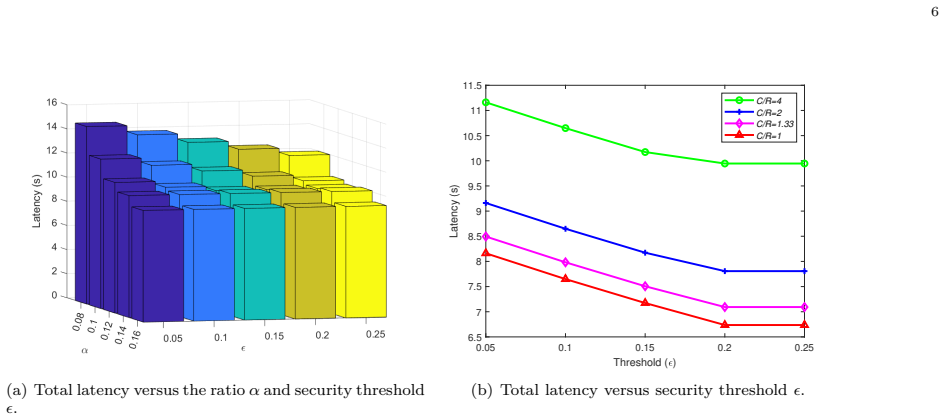
The paper claims that a covert communications (CC) and computations approach, augmented by various supplementary solutions to improve covertness, overcomes the drawbacks of existing countermeasures in LLMENs by simultaneously enhancing overall security and efficiency, as demonstrated through a case study that minimizes total latency while meeting stringent security requirements, with numerical results confirming the gains.
What carries the argument
covert communications (CC) and computations approach that combines low-detectability transmission with efficient computation scheduling to limit information leakage
If this is right
- Privacy protection improves against eavesdropping, jamming, prompt poisoning, and prompt injection.
- Execution efficiency of LLM tasks increases compared with prior countermeasures.
- Total latency can be minimized while satisfying both communication and computational security requirements.
- Holistic security and efficiency improvements become possible without separate high-cost defenses.
Where Pith is reading between the lines
- The same covert approach might simplify security architecture across other AI-driven edge systems.
- Energy consumption could decrease as a side effect of the reduced overhead, though this is not measured in the paper.
- Deployment on actual mobile devices would provide a direct test of whether the numerical latency gains hold under real channel conditions.
Load-bearing premise
The covert communications and computations approach can be realized with acceptable overhead in real LLMEN deployments.
What would settle it
Direct measurements from a hardware prototype or field deployment showing that the proposed approach produces overhead equal to or greater than existing countermeasures would falsify the central effectiveness claim.
Figures
read the original abstract
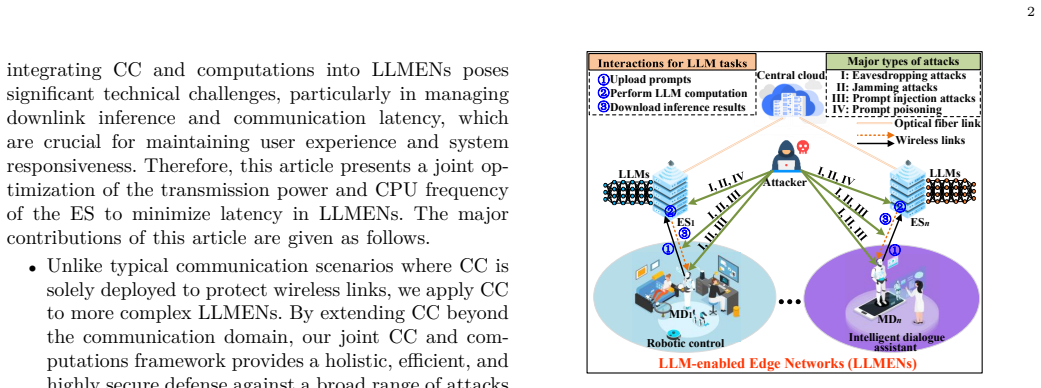
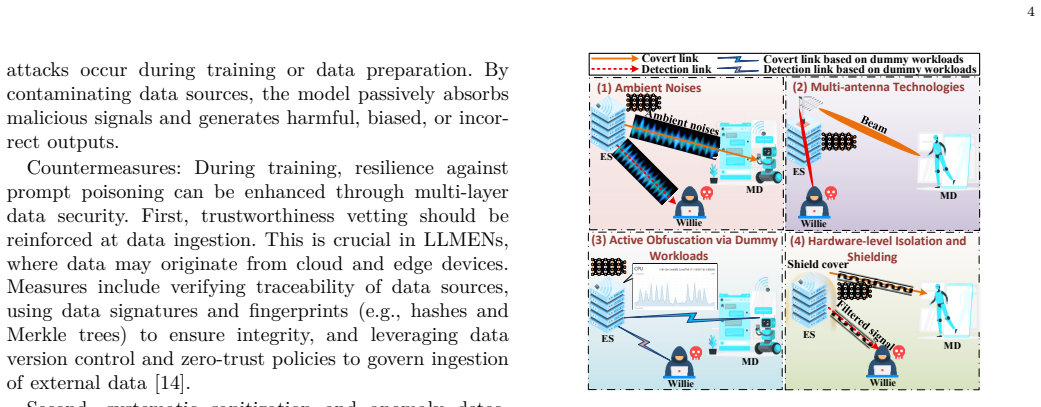
Large language model (LLM)-enabled edge networks (LLMENs) offer mobile users high-quality and low-latency AI-generated content services in the 6G era. However, unlike typical edge networks, LLMENs present unique security challenges due to the inherent complexity of LLMs, their high computational overhead, and continuous interactions with users. Specifically, both frequent user interactions (i.e., queries and responses) over wireless channels and potential electromagnetic information leakage from intensive LLM computations make LLMENs susceptible to various security threats, such as eavesdropping, jamming, prompt poisoning, and prompt injection attacks. Since existing countermeasures against these attacks often incur prohibitive overhead, developing holistic, efficient, and secure privacy protections for LLMENs is crucial. This article first reviews the vulnerabilities of LLMENs, outlines various attacks, and analyzes the drawbacks of existing countermeasures. To overcome these limitations, we propose a covert communications (CC) and computations approach to enhance both the overall security and efficiency of LLMENs. Furthermore, various supplementary solutions are developed to improve the covertness of this framework. Finally, our approach is further evaluated through a case study where the total latency is minimized under stringent communication and computational security requirements. Numerical results demonstrate the proposed approach's effectiveness in enhancing both privacy protection and the execution efficiency of LLM tasks.
Editorial analysis
A structured set of objections, weighed in public.
Referee Report
Summary. The manuscript reviews vulnerabilities and attacks specific to LLM-enabled edge networks (LLMENs), such as eavesdropping, jamming, prompt poisoning, and electromagnetic leakage from intensive computations. It proposes a covert communications and computations framework supplemented by additional solutions to improve covertness, then evaluates the approach in a case study that minimizes total latency subject to communication and computational security constraints, claiming that numerical results demonstrate gains in both privacy protection and LLM task execution efficiency.
Significance. If the latency-minimization results can be shown to hold once hardware-specific overheads are incorporated, the work would offer a concrete framework for efficient security in 6G LLMENs that avoids the prohibitive costs of prior countermeasures. The explicit joint treatment of covert communications and computations for LLM inference is a distinguishing contribution.
major comments (1)
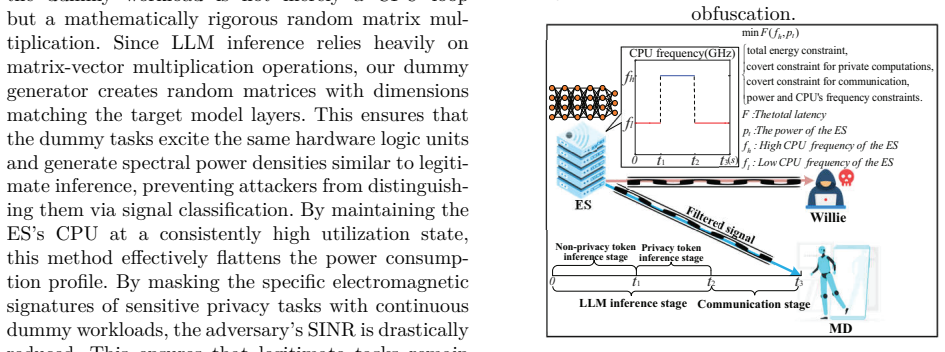
- [Case Study] Case Study section: the total-latency minimization is formulated under communication and computational security constraints, yet the optimization implicitly treats the overheads of the supplementary covertness solutions (e.g., added latency or energy from EM-leakage mitigation during continuous high-power LLM inference on GPUs/TPUs) as negligible or constant; no concrete mapping from these solutions to measurable hardware quantities is supplied, rendering the claim of acceptable overhead and realizability unverified.
minor comments (1)
- [Abstract] The abstract states that existing countermeasures incur prohibitive overhead but does not cite specific quantitative comparisons; adding one or two concrete references or numbers would strengthen the motivation.
Simulated Author's Rebuttal
We thank the referee for the constructive feedback and the opportunity to clarify the case study. We address the major comment below.
read point-by-point responses
-
Referee: [Case Study] Case Study section: the total-latency minimization is formulated under communication and computational security constraints, yet the optimization implicitly treats the overheads of the supplementary covertness solutions (e.g., added latency or energy from EM-leakage mitigation during continuous high-power LLM inference on GPUs/TPUs) as negligible or constant; no concrete mapping from these solutions to measurable hardware quantities is supplied, rendering the claim of acceptable overhead and realizability unverified.
Authors: We acknowledge that the case study optimizes total latency under the core covert communications and computations constraints, treating supplementary solutions' overheads (such as those from EM-leakage mitigation) as constants or negligible. This modeling choice isolates the impact of the proposed joint framework and follows standard practice for high-level security frameworks in wireless networks. However, we agree that the absence of explicit hardware mappings limits verification of realizability. In the revised manuscript, we will add a dedicated paragraph in the case study section that discusses representative hardware overhead models (drawing on published GPU/TPU power and latency profiles for LLM inference) and shows how these can be incorporated as additional linear or affine terms in the latency objective. We will also include a brief sensitivity analysis demonstrating that the reported gains remain directionally consistent under moderate overhead assumptions. This revision will directly address the concern while preserving the focus on the distinguishing joint treatment of covert communications and computations. revision: yes
Circularity Check
No circularity detected; proposal and case study lack load-bearing equations or self-referential reductions
full rationale
The provided manuscript text consists of the abstract and a high-level description of the structure (review of vulnerabilities, proposal of CC approach, supplementary solutions, latency-minimization case study under security constraints, and numerical results). No equations, parameter-fitting procedures, self-citations used as uniqueness theorems, or derivation steps are quoted or present that reduce a claimed prediction to its own inputs by construction. The central evaluation is described as a numerical case study, but without mathematical details that exhibit self-definition or fitted-input renaming, the content remains a self-contained proposal rather than a circular derivation.
Axiom & Free-Parameter Ledger
Reference graph
Works this paper leans on
-
[1]
Pushing large language models to the 6G edge: Vision, challenges, and opportunities,
Z. Lin, G. Qu, Q. Chen et al., “Pushing large language models to the 6G edge: Vision, challenges, and opportunities,” IEEE Commun. Mag., vol. 63, no. 9, pp. 52–59, Sep. 2025
2025
-
[2]
A security risk taxonomy for prompt-based interaction with large language models,
E. Derner, K. Batistič, J. Zahálka et al., “A security risk taxonomy for prompt-based interaction with large language models,” IEEE Access, vol. 12, pp. 126176–126187, Aug. 2024. 8
2024
-
[3]
Generative AI for secure physical layer communications: A survey,
C. Zhao, H. Du, D. Niyato et al., “Generative AI for secure physical layer communications: A survey,” IEEE Trans. Cogn. Commun. Netw., vol. 11, no. 1, pp. 3–26, Feb. 2025
2025
-
[4]
Introduction to the special section on electromagnetic information security,
Y.-I. Hayashi, N. Homma, T. Watanabe et al., “Introduction to the special section on electromagnetic information security,” IEEE Trans. Electromagn. Compat., vol. 55, no. 3, pp. 539–546, Jun. 2013
2013
-
[5]
Securing federated learn- ing: A covert communication-based approach,
Y.-A. Xie, J. Kang, D. Niyato et al., “Securing federated learn- ing: A covert communication-based approach,” IEEE Netw., vol. 37, no. 1, pp. 118–124, Jan. 2023
2023
-
[6]
Covert communications: A comprehensive survey,
X. Chen, J. An, Z. Xiong et al., “Covert communications: A comprehensive survey,” IEEE Commun. Surveys Tuts., vol. 25, no. 2, pp. 1173–1198, Sep. 2023
2023
-
[7]
DeepEM: Deep neural networks model recovery through EM side-channel in- formation leakage,
H. Yu, H. Ma, K. Yang, Y. Zhao, and Y. Jin, “DeepEM: Deep neural networks model recovery through EM side-channel in- formation leakage,” in Proc. IEEE Int. Symp. Hardw. Oriented Secur. Trust (HOST), pp. 209–218, 2020
2020
-
[8]
A survey on evaluation of large language models,
Y. Chang, X. Wang, J. Wang et al., “A survey on evaluation of large language models,” ACM Trans. Intell. Syst. Technol., vol. 15, no. 3, pp. 1–45, Jun. 2024
2024
-
[9]
When large language model agents meet 6G networks: Perception, grounding, and alignment,
M. Xu, D. Niyato, J. Kang et al., “When large language model agents meet 6G networks: Perception, grounding, and alignment,” IEEE Wireless Commun., vol. 23, no. 6, pp. 63–71, Dec. 2024
2024
-
[10]
Leveraging Large Language Models for Intelligent Control of 6G Integrated TN-NTN With IoT Service,
B. Rong and H. Rutagemwa, “Leveraging Large Language Models for Intelligent Control of 6G Integrated TN-NTN With IoT Service,” IEEE Netw., vol. 38, no. 4, pp. 136–142, 2024
2024
-
[11]
Software-defined vehicular networks (SDVN),
Z. G. Al-Mekhlafi, “Software-defined vehicular networks (SDVN),” Int. J. Comput. Sci. Netw. Secur., vol. 22, no. 9, pp. 231–243, 2022
2022
-
[12]
arXiv preprint arXiv:2305.06212 , year=
Y. Li, Z. Tan, and Y. Liu, “Privacy-preserving prompt tuning for large language model services,” arXiv preprint arXiv:2305.06212, May 2023
-
[13]
Differentially private decoding in large language models,
J. Majmudar, C. Dupuy, C. Peris et al., “Differentially private decoding in large language models,” arXiv preprint arXiv:2205.13621, Sep. 2022
-
[14]
Toward prompt chain de- ployment in zero trust-enabled compute first networks,
Y. Li, D. Zheng, H. Fang et al., “Toward prompt chain de- ployment in zero trust-enabled compute first networks,” IEEE Trans. Consum. Electron., vol. 71, no. 3, pp. 8163–8177, Aug. 2025
2025
-
[15]
Formula for the field excited in a Faraday cage with a graphite-epoxy closeout,
J. R. Solin, “Formula for the field excited in a Faraday cage with a graphite-epoxy closeout,” IEEE Trans. Electromagn. Compat., vol. 64, no. 2, pp. 590–594, Apr. 2022. Biographies Yuanai Xie (IEEE Member) is currently a lecturer at the School of Computer Science, South-Central Minzu University, Wuhan, China. He received the Ph.D. degree in control scienc...
2022
discussion (0)
Sign in with ORCID, Apple, or X to comment. Anyone can read and Pith papers without signing in.