A Data-Assimilation-Augmented Optimization Framework for Parameter Estimation in Dynamical Systems
Pith reviewed 2026-06-30 02:13 UTC · model grok-4.3
The pith
A nudged system driven by partial observations recovers ODE parameters via mismatch-cost optimization without needing accurate initial conditions.
A machine-rendered reading of the paper's core claim, the machinery that carries it, and where it could break.
Core claim
The central claim is that parameter estimation in ODEs reduces to minimizing a time-delayed mismatch cost between partial observations and the observed component of a nudged solution driven by those same observations; when parameters agree the nudged solution synchronizes with the true trajectory, when they disagree it remains stable, and the data-to-parameter map is well-posed under suitable nondegeneracy conditions, all without requiring knowledge of the initial state.
What carries the argument
The nudged dynamical system driven by the available observed component, with parameters recovered by minimizing the time-delayed mismatch cost functional over the admissible parameter space.
If this is right
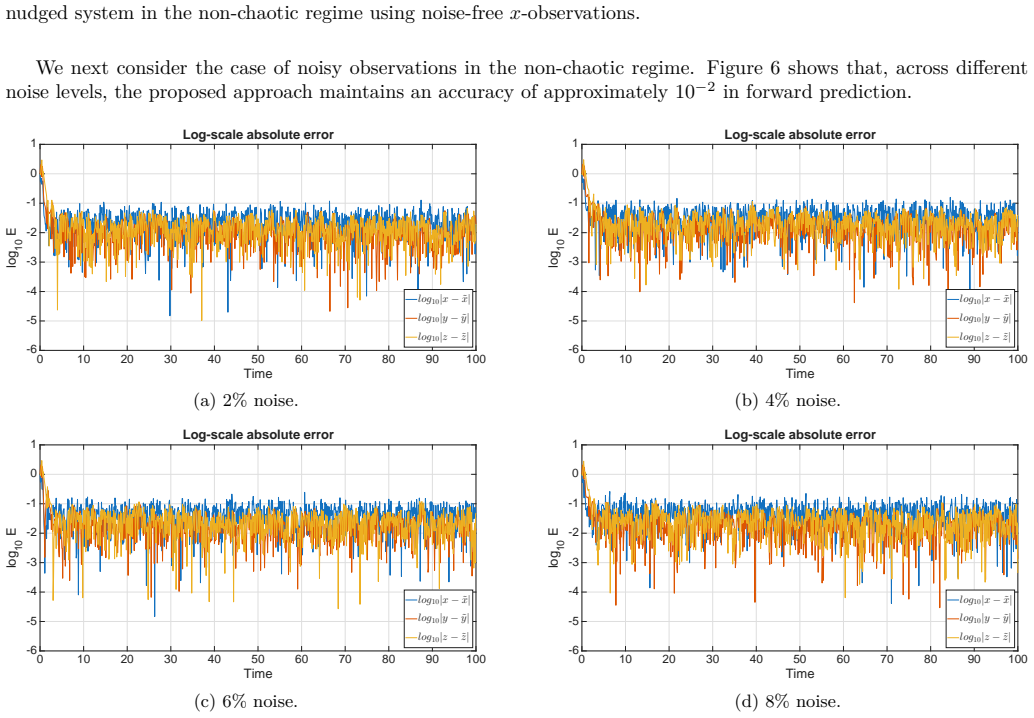
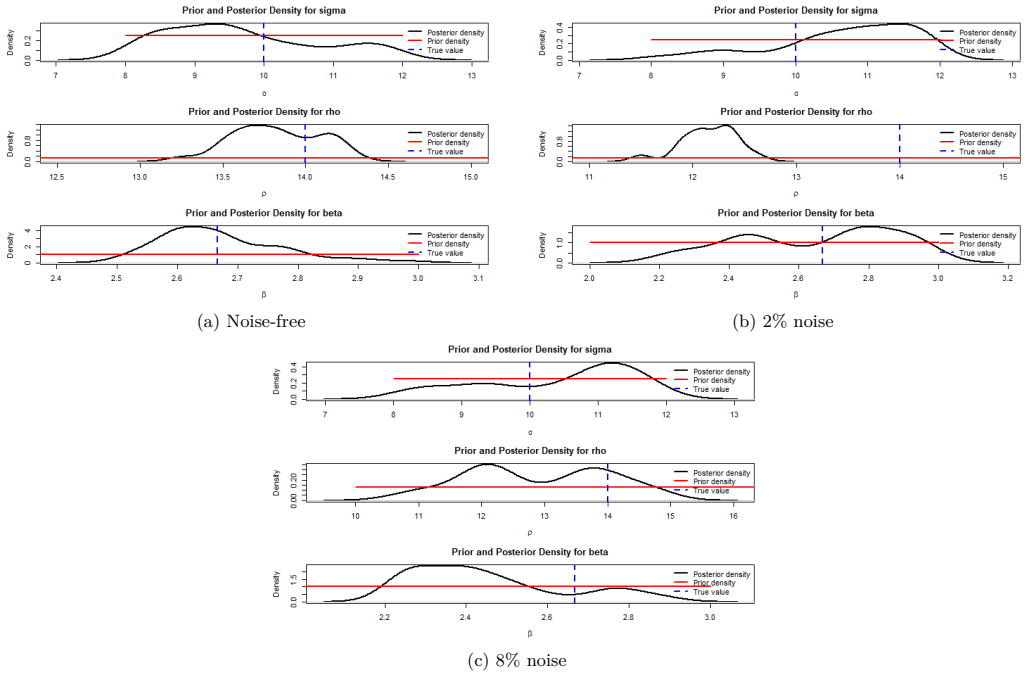
- Parameters are accurately recovered from noisy partial observations in both chaotic and non-chaotic regimes.
- Dependence on accurate initial conditions is eliminated because the nudged system can be arbitrarily initialized.
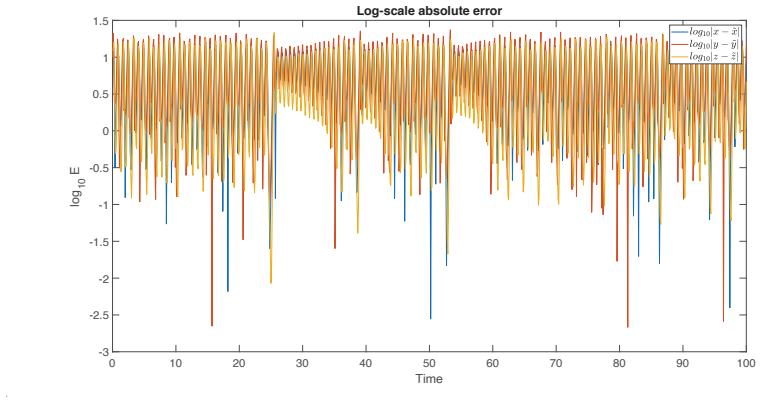
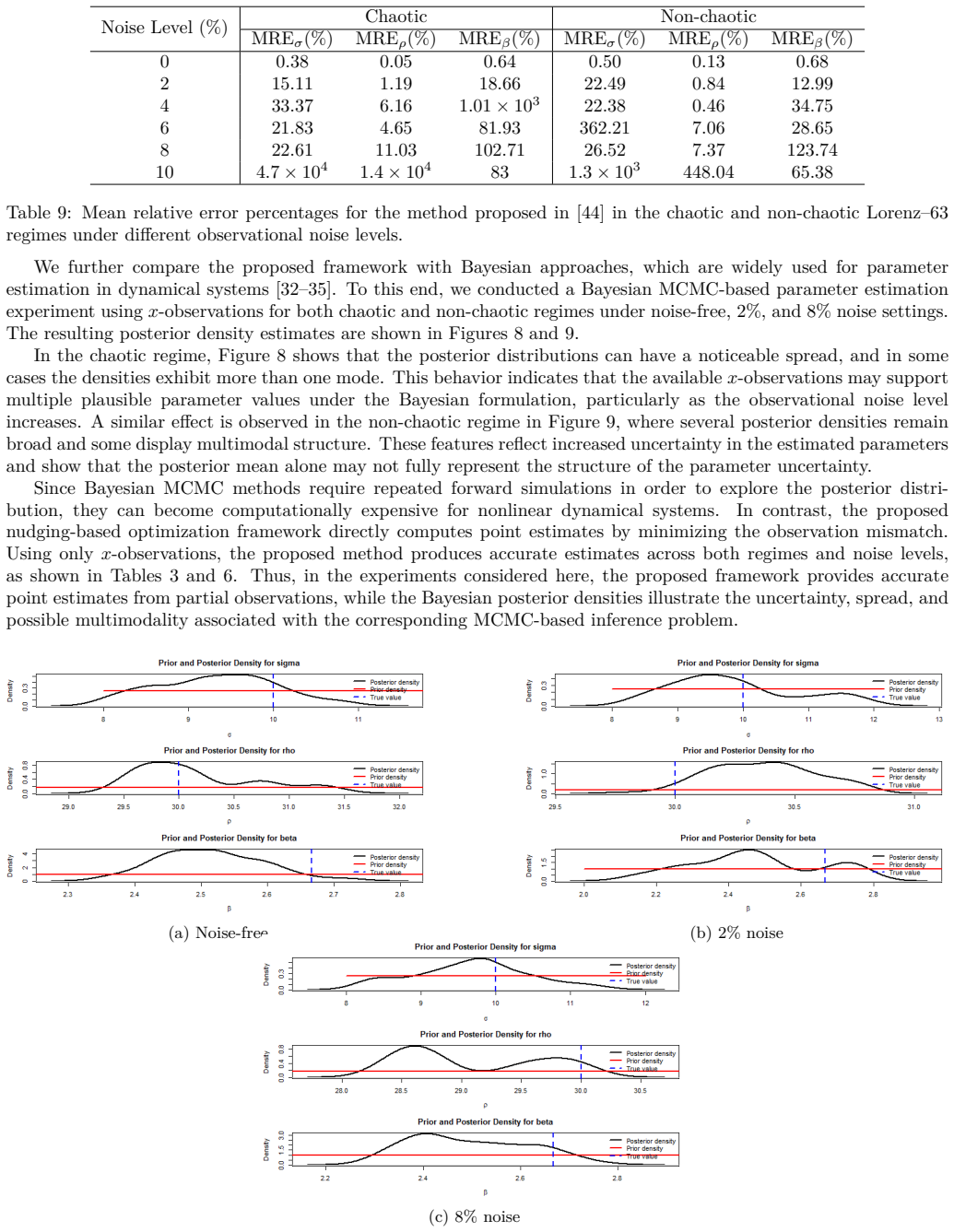
- Accuracy is maintained at higher noise levels than on-the-fly parameter learning or Bayesian MCMC estimation.
- Computational cost is substantially lower than MCMC estimation.
Where Pith is reading between the lines
- The synchronization property suggests the method could extend to other systems that admit similar nudging-driven convergence, such as certain reaction-diffusion models.
- Preceding the optimization with Sobol sensitivity analysis provides a practical way to screen which parameters are identifiable before collecting data.
- In sensor-limited settings such as biological networks or fluid flows, the framework could support online parameter updates from incomplete measurements without full-state reconstruction.
Load-bearing premise
The observations and system satisfy suitable nondegeneracy conditions that guarantee well-posedness of the data-to-parameter inverse map.
What would settle it
Numerical tests on the Lorenz-63 system with noisy partial observations would falsify the claim if the optimization fails to recover the true parameters even when the nondegeneracy conditions hold.
Figures
read the original abstract
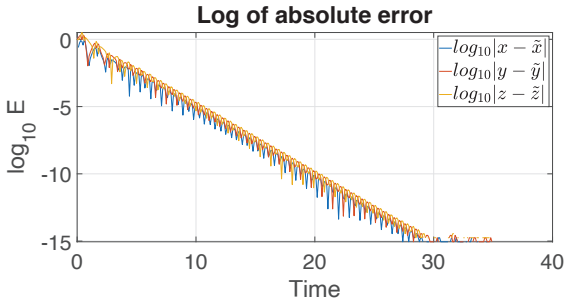
Parameter estimation in nonlinear dynamical systems from observational data is a fundamental inverse problem with applications in many disciplines. In practice, this is further complicated by the fact that observations are often noisy, sparse, and available only for a subset of the state variables. Furthermore, the initial condition (IC) may be unknown or inaccurate, causing further complications for chaotic systems with sensitive dependence on initial conditions. In this work, we develop a data-assimilation-augmented optimization framework for parameter estimation in ordinary differential equations using partial state observations. The method introduces a nudged system driven by the available observed component and estimates the unknown parameters by minimizing a cost functional, defined as a time-delayed mismatch between the observations and the corresponding observed component of the nudged solution over the admissible parameter space. Since the nudged system can be arbitrarily initialized, this approach eliminates the dependence on accurate IC. Using the Lorenz-63 system as a test case, we establish theoretical results showing synchronization of the nudged solution under parameter agreement, stability under parameter mismatch, and well-posedness of the data-to-parameter inverse map under suitable nondegeneracy conditions. Structural & practical identifiability, and Sobol sensitivity analyses are incorporated to assess which parameters can be reliably estimated from the observations. Numerical experiments in both chaotic and non-chaotic regimes show that this framework accurately recovers parameters from noisy partial observations. Comparisons with an on-the-fly parameter learning method and with Bayesian MCMC estimation demonstrate that the proposed method remains accurate under partial observations and higher noise levels while requiring substantially lower computational cost.
Editorial analysis
A structured set of objections, weighed in public.
Referee Report
Summary. The manuscript develops a data-assimilation-augmented optimization framework for parameter estimation in ODEs from noisy partial observations. A nudged system driven by the observed state components is introduced, and parameters are recovered by minimizing a time-delayed mismatch cost functional over the admissible parameter space; this eliminates dependence on the initial condition. Theoretical results establish synchronization of the nudged solution under parameter agreement, stability under mismatch, and well-posedness of the inverse map under nondegeneracy conditions, using the Lorenz-63 system as the test case. Structural and practical identifiability together with Sobol sensitivity analyses are performed, and numerical experiments in chaotic and non-chaotic regimes demonstrate accurate recovery, with comparisons to on-the-fly learning and Bayesian MCMC showing advantages in accuracy under partial observations and computational cost.
Significance. If the central claims hold, the work supplies a computationally efficient, theoretically supported method for inverse problems in dynamical systems that handles partial noisy data and unknown initial conditions. The combination of nudging, a mismatch cost, and identifiability/sensitivity analyses, together with explicit numerical validation on Lorenz-63 and direct comparisons to existing methods, constitutes a concrete contribution to parameter estimation in chaotic systems.
major comments (2)
- [Abstract] Abstract (theoretical results paragraph): well-posedness of the data-to-parameter inverse map is asserted under suitable nondegeneracy conditions, yet the numerical experiments section provides no explicit verification that these conditions hold for the chosen partial observations, nudging strength, time delay, or noise levels in the Lorenz-63 tests. Because the claim of accurate recovery from noisy partial observations rests on this well-posedness, the absence of such a check leaves open whether the reported accuracy is a general consequence of the framework or an artifact of the specific test cases.
- [Numerical experiments] Numerical experiments: the stability result under parameter mismatch is invoked to justify convergence of the optimization, but the manuscript does not quantify how the observed mismatch cost behaves as a function of parameter deviation for the partial-observation operator actually used; without this link the numerical recovery alone does not confirm that the theoretical stability translates to the inverse problem solved in practice.
minor comments (1)
- [Abstract] The abstract is dense; separating the statement of the method, the theoretical claims, and the numerical findings into distinct sentences would improve readability.
Simulated Author's Rebuttal
We thank the referee for the careful reading and constructive comments on our manuscript. We address each major comment below and indicate the revisions we will make.
read point-by-point responses
-
Referee: [Abstract] Abstract (theoretical results paragraph): well-posedness of the data-to-parameter inverse map is asserted under suitable nondegeneracy conditions, yet the numerical experiments section provides no explicit verification that these conditions hold for the chosen partial observations, nudging strength, time delay, or noise levels in the Lorenz-63 tests. Because the claim of accurate recovery from noisy partial observations rests on this well-posedness, the absence of such a check leaves open whether the reported accuracy is a general consequence of the framework or an artifact of the specific test cases.
Authors: The nondegeneracy conditions are stated explicitly in the theoretical analysis (Section 3) and are satisfied by the partial-observation operators and nudging strengths used in the Lorenz-63 experiments, as these choices ensure the required observability and controllability properties. The numerical recoveries are therefore consistent with the well-posedness result rather than artifacts. To make this link fully explicit, we will add a short verification subsection in the numerical experiments that confirms the conditions hold for the reported parameter values, nudging gains, and noise levels. revision: yes
-
Referee: [Numerical experiments] Numerical experiments: the stability result under parameter mismatch is invoked to justify convergence of the optimization, but the manuscript does not quantify how the observed mismatch cost behaves as a function of parameter deviation for the partial-observation operator actually used; without this link the numerical recovery alone does not confirm that the theoretical stability translates to the inverse problem solved in practice.
Authors: The stability theorem (Theorem 3.2) is stated for general partial observations satisfying the nondegeneracy assumptions, and the numerical cost functional is precisely the one analyzed in the theorem. While the manuscript does not include explicit plots of cost versus parameter deviation for the specific operator, the observed convergence of the optimizer is consistent with the stability bound. We will add a brief numerical illustration (e.g., a one-dimensional slice of the cost functional around the true parameter) to the experiments section to make the connection direct. revision: yes
Circularity Check
Method defined independently; minor self-citation not load-bearing for central claims.
full rationale
The nudged system and mismatch cost are introduced as independent constructions. Theoretical results invoke synchronization and well-posedness under external nondegeneracy conditions rather than deriving them from fitted quantities. Numerical recovery claims rest on experiments, not on any reduction of predictions to inputs by construction. Any self-citations present are peripheral and do not carry the load-bearing argument.
Axiom & Free-Parameter Ledger
free parameters (2)
- nudging strength
- time delay
axioms (1)
- domain assumption Suitable nondegeneracy conditions hold for the observations and system
Reference graph
Works this paper leans on
-
[1]
H. Miao, X. Xia, A. S. Perelson, and H. Wu. On identifiability of nonlinear ode models and applications in viral dynamics. SIAM Review , 53(1):3–39, 2011. doi:10.1137/090757009
-
[2]
Ljung and T
L. Ljung and T. Glad. On global identifiability for arbitrary model parametrizations. Automatica, 30(2):265–276, 1994
1994
-
[3]
Walter and L
E. Walter and L. Pronzato. Identification of Parametric Models: From Experimental Data . Communications and Control Engineering. Springer, 1997
1997
-
[4]
F. Anstett-Collin, L. Denis-Vidal, and G. Millérioux. A priori identifiability: An overview on definitions and approaches. Annual Reviews in Control , 50:139–149, 2020. doi:10.1016/j.arcontrol.2020.10.006
-
[5]
Meshkat and A
N. Meshkat and A. Shiu. Structural identifiability of compartmental models: Recent progress and future directions. Current Opinion in Systems Biology , page 100559, 2025
2025
-
[6]
Saucedo, A
O. Saucedo, A. Laubmeier, T. Tang, B. Levy, L. Asik, T. Pollington, and O. P. Feldman. Comparative analysis of practical identifiability methods for an SEIR model. AIMS Mathematics , 9(9):24722–24761, 2024. doi:10.3934/ math.20241204
2024
-
[7]
N. Tuncer and T. T. Le. Structural and practical identifiability analysis of outbreak models. Math. Biosci. , 299:1–18, 2018. doi:10.1016/j.mbs.2018.02.004
-
[8]
M. Rodriguez-Fernandez, P. Mendes, and J. R. Banga. A hybrid approach for efficient and robust parameter estimation in biochemical pathways. BioSystems, 83(2–3):248–265, 2006. doi:10.1016/j.biosystems.2005.06. 016
-
[9]
H. T. Banks, S. Hu, and W. C. Thompson. Modeling and Inverse Problems in the Presence of Uncertainty . CRC Press, 2014. doi:10.1201/b16760
-
[10]
D. Venzon and S. Moolgavkar. A method for computing profile-likelihood-based confidence intervals. Journal of the Royal Statistical Society: Series C (Applied Statistics) , 37(1):87–94, 1988. doi:10.2307/2347496
-
[11]
J. A. Jacquez and T. Perry. Parameter estimation: local identifiability of parameters. American Journal of Physiology-Endocrinology and Metabolism , 258(4):E727–E736, 1990. doi:10.1152/ajpendo.1990.258.4.E727
-
[12]
M. C. Eisenberg and M. A. Hayashi. Determining identifiable parameter combinations using subset profiling. Mathematical Biosciences, 256:116–126, 2014. doi:10.1016/j.mbs.2014.08.008
-
[13]
F. G. Wieland, A. L. Hauber, M. Rosenblatt, C. Tönsing, and J. Timmer. On structural and practical identifia- bility. Current Opinion in Systems Biology , 25:60–69, 2021
2021
-
[14]
A. F. Villaverde, A. Barreiro, and A. Papachristodoulou. Structural identifiability of dynamic systems biology models. PLoS Computational Biology , 12(10):e1005153, 2016. doi:10.1371/journal.pcbi.1005153
-
[15]
Marino, I
S. Marino, I. B. Hogue, C. J. Ray, and D. E. Kirschner. A methodology for performing global uncertainty and sensitivity analysis in systems biology. Journal of Theoretical Biology , 254(1):178–196, 2008
2008
-
[16]
Zhang, M
X.-Y. Zhang, M. N. Trame, L. J. Lesko, and S. Schmidt. Sobol sensitivity analysis: A tool to guide the development and evaluation of systems pharmacology models. CPT: Pharmacometrics & Systems Pharmacology , 4(2):69–79, 2015
2015
-
[17]
Bidah, O
S. Bidah, O. Zakary, and M. Rachik. Stability and global sensitivity analysis for an agree-disagree model: Par- tial rank correlation coefficient and Latin hypercube sampling methods. International Journal of Differential Equations, 2020:1–14, 2020
2020
-
[18]
I. M. Sobol. Global sensitivity indices for nonlinear mathematical models and their Monte Carlo estimates. Mathematics and Computers in Simulation , 55(1-3):271–280, 2001
2001
-
[19]
Hoare, D
A. Hoare, D. G. Regan, and D. P. Wilson. Sampling and sensitivity analyses tools (SaSAT) for computational modelling. Theoretical Biology and Medical Modelling , 5(1):4, 2008
2008
-
[20]
Saltelli and J
A. Saltelli and J. Marivoet. Nonparametric statistics in sensitivity analysis for model output: A comparison of selected techniques. Reliability Engineering & System Safety , 28(2):229–253, 1990. 39
1990
-
[21]
Saltelli, M
A. Saltelli, M. Ratto, S. Tarantola, and F. Campolongo. Sensitivity analysis for chemical models. Chemical Reviews, 105(7):2811–2827, 2005
2005
-
[22]
J. P. C. Kleijnen and J. C. Helton. Statistical analyses of scatterplots to identify important factors in large-scale simulations, 1: Review and comparison of techniques. Reliability Engineering & System Safety , 65(2):147–185, 1999
1999
-
[23]
Y. Yang and H. Li. Neural ordinary differential equations for robust parameter estimation in dynamic systems with physical priors. Applied Soft Computing , 169:112649, 2025. doi:10.1016/j.asoc.2024.112649
-
[24]
Q. He, L. Wang, and B. Liu. Parameter estimation for chaotic systems by particle swarm optimization. Chaos, Solitons & Fractals , 34(2):654–661, 2007. doi:10.1016/j.chaos.2006.03.079
-
[25]
M.J. Ahmad and K. Günel. Can neural networks estimate parameters in epidemiology models using real observed data? Applied Intelligence, 55(2):133, 2024. doi:10.1007/s10489-024-06012-w
-
[26]
H. Jo, K. Josić, and J. K. Kim. Neural network–based parameter estimation for nonautonomous differential equations with discontinuous signals. SIAM Journal on Applied Mathematics , 86(1):327–347, 2026. doi:10. 1137/25M1741340
2026
-
[27]
V. V. Alavani, P. Danumjaya, and P. Seshaiyer. Fractional-order prey- predator models with parameter estima- tion via fractional physics-informed neural networks (FPINNS). Journal of Machine Learning for Modeling and Computing, 7(1), 2026
2026
-
[28]
Y. Bard. Nonlinear Parameter Estimation . Academic Press, 1974
1974
-
[29]
R. C. Aster, B. Borchers, and C. H. Thurber. Parameter Estimation and Inverse Problems . Academic Press, 2005
2005
-
[30]
H. Liang and H. Wu. Parameter estimation for differential equation models using a framework of measurement error in regression models. Journal of the American Statistical Association , 103(484):1570–1583, 2008. PMID: 19956350. doi:10.1198/016214508000000797
-
[31]
J. O. Ramsay, G. Hooker, D. Campbell, and J. Cao. Parameter estimation for differential equations: A generalized smoothing approach. Journal of the Royal Statistical Society: Series B (Statistical Methodology) , 69(5):741–796,
-
[32]
doi:10.1111/j.1467-9868.2007.00610.x
-
[33]
P. H. Boersch-Supan, S. J. Ryan, and L. R. Johnson. deBInfer: Bayesian inference for dynamical models of biological systems. Methods in Ecology and Evolution , 8:511–518, 2017. doi:10.1111/2041-210X.12679
-
[34]
Ghasemi, M
O. Ghasemi, M. L. Lindsey, T. Yang, N. Nguyen, Y. Huang, and Y.-F. Jin. Bayesian parameter estimation for nonlinear modelling of biological pathways. BMC Systems Biology , 5(Suppl 3):S9, 2011. doi:10.1186/ 1752-0509-5-S3-S9
2011
-
[35]
Springer, H
S. Springer, H. Haario, J. Susiluoto, A. Bibov, A. Davis, and Y. Marzouk. Efficient bayesian inference for large chaotic dynamical systems. Geoscientific Model Development , 14(7):4319–4333, 2021. doi:10.5194/ gmd-14-4319-2021
2021
-
[36]
Huang, D
Y. Huang, D. Liu, and H. Wu. Hierarchical bayesian methods for estimation of parameters in a longitudinal HIV dynamic system. Biometrics, 62:413–423, 2006
2006
-
[37]
K. J. H. Law, A. M. Stuart, and K. C. Zygalakis. Data Assimilation: A Mathematical Introduction . Springer, Cham, 2015
2015
-
[38]
E. Kalnay. Atmospheric Modeling, Data Assimilation and Predictability . Cambridge University Press, 2003
2003
-
[39]
M. Asch, M. Bocquet, and M. Nodet. Data Assimilation: Methods, Algorithms, and Applications , volume 11 of Fundamentals of Algorithms . Society for Industrial and Applied Mathematics, Philadelphia, PA, 2016
2016
-
[40]
A. Carrassi, M. Bocquet, L. Bertino, and G. Evensen. Data assimilation in the geosciences: An overview of methods, issues, and perspectives. WIREs Climate Change , 9(5):e535, 2018. doi:10.1002/wcc.535
-
[41]
D. R. Stauffer and N. L. Seaman. Use of four-dimensional data assimilation in a limited-area mesoscale model. part I: Experiments with synoptic-scale data. Monthly Weather Review , 118(6):1250–1277, 1990. 40
1990
-
[42]
R. A. Anthes. Data assimilation and initialization of hurricane prediction models. Journal of Atmospheric Sciences, 31(3):702 – 719, 1974. doi:10.1175/1520-0469(1974)031<0702:DAAIOH>2.0.CO;2
-
[43]
Blayo, J
E. Blayo, J. Verron, and J.-M. Molines. Assimilation of TOPEX/POSEIDON altimeter data into a circulation model of the north atlantic. Journal of Geophysical Research: Oceans , 99(C12):24691–24705, 1994
1994
-
[44]
A. Azouani, E. Olson, and E. S. Titi. Continuous data assimilation using general interpolant observables. Journal of Nonlinear Science , 24(2):277–304, 2014. doi:10.1007/s00332-013-9189-y
-
[45]
Carlson, J
E. Carlson, J. Hudson, A. Larios, V. R. Martinez, E. Ng, and J. P. Whitehead. Dynamically learning the parame- ters of a chaotic system using partial observations. Discrete and Continuous Dynamical Systems , 42(8):3809–3839,
-
[46]
doi:10.3934/dcds.2022033
-
[47]
V. R. Martinez, J. Murri, and J. P. Whitehead. Relaxation-based schemes for on-the-fly parameter estimation in dissipative dynamical systems. Inverse Problems , 41(5):055001, Apr 2025. doi:10.1088/1361-6420/adc766
-
[48]
J. Newey, J. P. Whitehead, and E. Carlson. Model discovery on the fly using continuous data assimilation. Journal of Computational Physics , 537:114121, 2025. doi:10.1016/j.jcp.2025.114121
-
[49]
Biswas and J
A. Biswas and J. Hudson. Determining the viscosity of the Navier–Stokes equations from observations of finitely many modes. Inverse Problems , 39(12):125012, 2023
2023
-
[50]
A. F. Villaverde, D. Pathirana, F. Fröhlich, J. Hasenauer, and J. R. Banga. A protocol for dynamic model calibration. Briefings in Bioinformatics , 2022
2022
-
[51]
Y. R. Liyanage, O. Saucedo, N. Tuncer, and G. Chowell. A tutorial on structural identifiability of epidemic models using structuralidentifiability. jl. Bulletin of Mathematical Biology , 88(6):102, 2026
2026
-
[52]
Audoly, G
S. Audoly, G. Bellu, L. D’Angio, M. P. Saccomani, and C. Cobelli. Global identifiability of nonlinear models of biological systems. IEEE Trans. Biomed. Eng. , 48:55–65, 2001
2001
-
[53]
S. M. V. Lunel. Parameter identifiability of differential delay equations. Internat. J. Adapt. Control Signal Process., 15:655–678, 2001
2001
-
[54]
Ollivier
F. Ollivier. Le problème de l’identifiabilité globale: étude théorique, méthodes effectives et bornes de complexité . PhD thesis, École Polytechnique, Paris, France, 1990
1990
-
[55]
Xia and C
X. Xia and C. H. Moog. Identifiability of nonlinear systems with application to HIV/AIDS models. IEEE Transactions on Automatic Control , 48(2):330–336, 2003
2003
-
[56]
H. Wu, H. Zhu, H. Miao, and A. S. Perelson. Parameter identifiability and estimation of HIV/AIDS dynamic models. Bulletin of Mathematical Biology , 70:785–799, 2008
2008
-
[57]
Bellu, M
G. Bellu, M. P. Saccomani, S. Audoly, and L. D’Angiò. Daisy: A new software tool to test global identifiability of biological and physiological systems. Comput. Methods Programs Biomed. , 88:52–61, 2007
2007
-
[58]
H. Hong, A. Ovchinnikov, G. Pogudin, and C. E. Yap. SIAN: software for structural identifiability analysis of ODE models. Bioinformatics, 35:2873–2874, 2019
2019
-
[59]
S. Wang and W. Hao. A systematic computational framework for practical identifiability analysis in mathematical models arising from biology. Advanced Science, 12(35):e04346, 2025. doi:10.1002/advs.202504346
-
[60]
J. A. Nelder and R. Mead. A simplex method for function minimization. Computer Journal , 7:308–313, 1965
1965
-
[61]
H. Yuan, H. Dai, X. Wei, and P. Ming. Model-based observers for internal states estimation and control of proton exchange membrane fuel cell system: A review. Journal of Power Sources , 468:228376, 2020. doi: 10.1016/j.jpowsour.2020.228376
-
[62]
Foias and E
C. Foias and E. S. Titi. Determining nodes, finite difference schemes and inertial manifolds. Nonlinearity, 4(1):135–153, 1991
1991
-
[63]
D. A. Jones and E. S. Titi. Upper bounds on the number of determining modes, nodes, and volume elements for the navier–stokes equations. Indiana University Mathematics Journal , 42(3):875–887, 1993. 41
1993
-
[64]
E. Olson and E. S. Titi. Determining modes for continuous data assimilation in 2D turbulence. Journal of Statistical Physics , 113(5–6):799–840, 2003. doi:10.1023/A:1027312703252
-
[65]
C. Foias, M. S. Jolly, R. Kravchenko, and E. S. Titi. A determining form for the two-dimensional navier–stokes equations: The fourier modes case. Journal of Mathematical Physics , 53(11):115623, 2012. doi:10.1063/1. 4766459
work page doi:10.1063/1 2012
-
[66]
Foias and R
C. Foias and R. Temam. Determination of the solutions of the navier–stokes equations by a set of nodal values. Mathematics of Computation , 43(167):117–133, 1984
1984
-
[67]
E. D. Sontag. Mathematical control theory: deterministic finite dimensional systems , volume 6. Springer Science & Business Media, 2013
2013
-
[68]
E. N. Lorenz. Deterministic nonperiodic flow. Journal of Atmospheric Sciences , 20(2):130–141, 1963
1963
-
[69]
C. Sparrow. The Lorenz Equations: Bifurcations, Chaos, and Strange Attractors . Springer, 1982
1982
-
[70]
M. W. Hirsch, S. Smale, and R. L. Devaney. Differential Equations, Dynamical Systems, & An Introduction to Chaos. Academic Press, Boston, MA, 2 edition, 2003
2003
-
[71]
C. R. Doering and J. D. Gibbon. Applied Analysis of the Navier-Stokes Equations . Cambridge Texts in Applied Mathematics. Cambridge University Press, 1995
1995
-
[72]
S. G. Krantz and H. R. Parks. A Primer of Real Analytic Functions . Birkhäuser, 1992
1992
-
[73]
S. Kirkpatrick, C. D. Gelatt, and M. P. Vecchi. Optimization by simulated annealing. Science, 220:671–680, 1983. doi:10.1126/science.220.4598.671
-
[74]
J. Kennedy and R. Eberhart. Particle swarm optimization. In Proceedings of ICNN’95 - International Conference on Neural Networks , volume 4, pages 1942–1948, 1995. doi:10.1109/ICNN.1995.488968
-
[75]
Raissi, P
M. Raissi, P. Perdikaris, and G. E. Karniadakis. Physics-informed neural networks: A deep learning framework for solving forward and inverse problems involving nonlinear partial differential equations. Journal of Computational Physics, 378:686–707, 2019
2019
-
[76]
R. T. Q. Chen, Y. Rubanova, J. Bettencourt, and D. K. Duvenaud. Neural ordinary differential equations. In Advances in Neural Information Processing Systems , 2018
2018
-
[77]
Universal Differential Equations for Scientific Machine Learning
C. Rackauckas, Y. Ma, J. Martensen, C. Warner, K. Zubov, R. Supekar, D. Skinner, A. Ramadhan, and A. Edel- man. Universal differential equations for scientific machine learning. arXiv preprint arXiv:2001.04385 , 2020
work page internal anchor Pith review Pith/arXiv arXiv 2001
-
[78]
A Quantum Approximate Optimization Algorithm
E. Farhi, J. Goldstone, and S. Gutmann. A quantum approximate optimization algorithm. arXiv preprint arXiv:1411.4028, 2014
work page internal anchor Pith review Pith/arXiv arXiv 2014
-
[79]
K. Blekos, D. Brand, A. Ceschini, C.-H. Chou, R.-H. Li, K. Pandya, and A. Summer. A review on quantum approximate optimization algorithm and its variants. Physics Reports, 1068:1–66, 2024. doi:10.1016/j.physrep. 2024.03.002
-
[80]
Ahmad, M
M.J. Ahmad, M. Mohammadisiahroudi, A. Biswas, and K. Hoffman. A data-assimilation-informed quantum optimization framework for parameter estimation in dynamical systems. Manuscript in preparation, 2026
2026
discussion (0)
Sign in with ORCID, Apple, or X to comment. Anyone can read and Pith papers without signing in.