REVIEW 3 major objections 6 minor 118 references
Predicting Halo Formation Time Using Machine Learning
T0 review · 3 major / 6 minor · reviewed 2026-08-16 · deepseek-v4-flash
Pith's one-line read Galaxy observables, not merger trees, reveal when a dark matter halo formed.
desk verdict A useful set of linear fits for halo formation time from magnitude gaps, with a real but fixable validation flaw in the ML part. read the letter →
The pith
A machine-rendered reading of the paper's core claim, the machinery that carries it, and where it could break.
The reading
What carries the argument
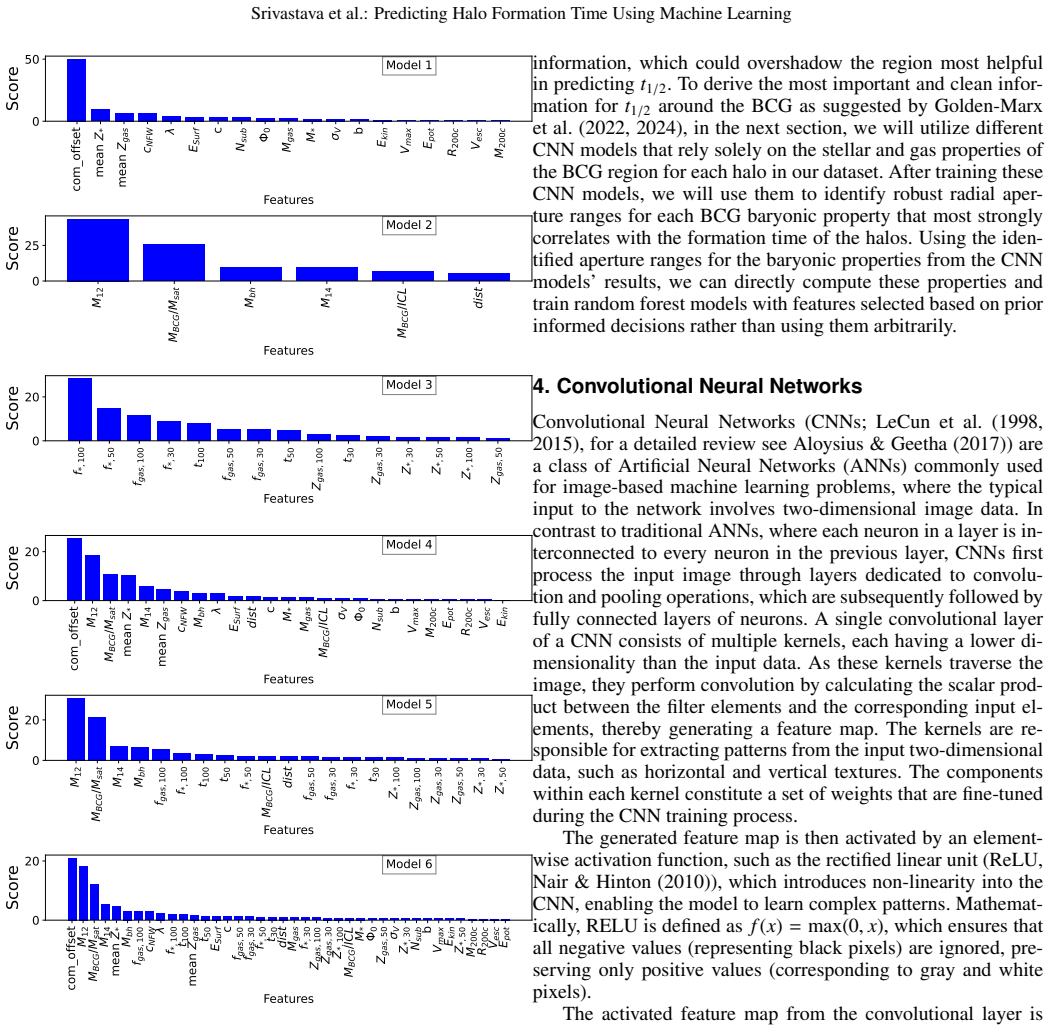
The load-bearing object is t1/2 itself, defined through AHF merger trees as the epoch when the main progenitor has accreted half the halo's current mass. The predictive machinery has three tiers: random forests over the full set of halo, BCG, and intracluster-light features, with permutation importance identifying com_offset and the magnitude gaps M12 and M14 as dominant; convolutional networks trained on 6×40 radial property maps of stellar and gas mass, metallicity, age, and temperature, interpreted afterwards with saliency maps; and three explicit least-squares formulas in M12, M14, and MBCG/Msat that observers can apply directly.
What would settle it
Take the linear model of Eq. (4), apply it to halos from a different hydrodynamical simulation with different feedback physics, or to field and group-mass halos in the same simulation, and compare the predicted t1/2 with that simulation's merger-tree half-mass times. If the median relative bias exceeds about 10% or the scatter grows well beyond 0.27, the claim of transferable prediction is falsified. A sharper test removes dynamically disturbed halos and checks whether M12 still predicts t1/2; if the predictive power largely vanishes, the apparent signal is mainly dynamical state rather than formation epoch.
Extended reading notes
Core claim
The central claim is that t1/2 is imprinted in baryonic observables, particularly the magnitude gaps between the brightest cluster galaxy and the second and fourth brightest substructures, the ratio of BCG stellar mass to satellite stellar mass, and the dynamical-state indicator com_offset. A random forest trained on all available halo and baryonic features reaches median relative errors between 4% and 9% with standard deviations of about 19% to 23%, while convolutional networks fed only six radially binned baryonic properties reach median biases of 0.4% to 4.1% with slightly larger scatter. Explicit linear relations—Eqs. 3, 4, and 5—give 3.5% to 5.3% bias and scatter of 0.25 to 0.27, matching random forest performance. The predicted formation times also reproduce the known correlations with halo mass and concentration.
Load-bearing premise
The load-bearing premise is that the relation between baryonic observables such as magnitude gaps and BCG-to-satellite mass ratio and halo assembly time is universal enough to survive outside the specific cluster zoom-in sample and baryonic feedback implementation on which the models were trained.
Editorial extensions
If this is right
- If the linear relations hold beyond this training sample, observers can estimate cluster formation times from photometric magnitude gaps and BCG-to-satellite mass ratios alone, with no spectral or dynamical data.
- The best random forest scatter of about 20% in t1/2 is enough to separate clusters into early- and late-forming samples for studies of environmental and assembly effects.
- Reproducing the M200c-t1/2 and cNFW-t1/2 correlations with predicted values means the models can assign formation-time labels without tracing merger trees.
- The low ranking of the ICL fraction in feature importance suggests surveys should prioritize magnitude gaps over intracluster-light fractions when targeting formation time.
Reading between the lines
- The strong correlations of com_offset and M12 with t1/2 suggest the models may be reading dynamical state rather than assembly epoch per se; a control experiment that holds dynamical state fixed would isolate how much true assembly signal remains.
- The linear calibration may be mass-dependent, so extending Eqs. 3-5 to group-mass halos below the cluster range would probably require refitting; this is testable on field or group simulations.
- The CNN saliency ranges lying largely outside the BCG/ICL transition radius hint that outer stellar envelopes carry assembly information, which could be checked by measuring ICL colours and ages at roughly 60 to 100 kpc in real clusters.
- Because only one baryonic feedback implementation was used, agreement of these relations with a different feedback model would be the strongest sign that the baryonic-to-assembly link is physical rather than simulation-specific.
Signed reviews
Editorial analysis
A structured set of objections, weighed in public.
Referee Report
Summary. The paper trains random forest (RF), convolutional neural network (CNN), and simple linear models to predict dark matter halo formation time t1/2 (the epoch when a halo has assembled half of its final mass) for 1,918 halos from the The300 Gizmo-Simba cluster zoom-in simulations. The RF models use six feature sets built from halo properties, BCG+ICL properties, and aperture-based baryonic properties; the CNNs take 2D radial maps of stellar and gas properties under three binning schemes; the linear models use the magnitude gaps M12 and M14 plus the mass ratio MBCG/Msat (Eqs. 3-5). Using a fixed 85/15 halo-level train/test split, the paper reports RF median relative biases of 4%-9% with ~20% scatter, CNN biases below 4% with somewhat larger scatter, and linear-model performance comparable to the RFs. The predictions are also shown to reproduce the M200c-t1/2 and cNFW-t1/2 trends and are compared with the Correa et al. (2015) EPS-based analytical relation.
Significance. If the reported accuracy is robust, the paper offers a practical, observationally motivated route to estimating halo formation time at cluster scales, and the simple linear relations in Eqs. 3-5 are directly usable by observers. The work is honest about its limitations: the results are explicitly stated to be specific to Gizmo-Simba physics (Section 7), the CNN saliency maps are acknowledged to be noisy and weakly correlated with t1/2 (Appendix B), and the ML pipeline is standard and well described. The main significance hinges on the credibility of the headline error metrics, which currently rest on a single halo-level split with no cluster-grouped validation and no quantitative baseline comparison; both issues are testable within the existing simulation suite and should be fixable in revision.
major comments (3)
- [Sec. 2, Sec. 3.1, Figs. 3 and 8] This is the most load-bearing issue because the central quantitative claims are the reported test-set accuracies, and the data structure makes the halo-independence assumption untenable.
- [Abstract, Sec. 5, Sec. 6, Eqs. 3-5] This is load-bearing because without a baseline the reported absolute scatter cannot be judged; the 'surpass' claim in the abstract is not quantitatively supported.
- [Sec. 3.1, Figs. 3, 8, and 12] This is a separate but related issue: even if the cluster-grouped split shows no leakage, the lack of error bars prevents any claim about which model is best.
minor comments (6)
- [Sec. 4.1] The handling of NaN values in the property maps is unclear: bins with absent gas particles are said to be 'excluded' from the maps, but the maps are then 'resized later on to have the same dimensions'; please specify whether the excluded bins are masked, imputed, or dropped before the resize, since this affects the CNN input data.
- [Sec. 4.1] The half-stellar-mass radius Rhalf from the CAESAR catalog is replaced by the linear-fit proxy Rhalf,fit because of a scatter of approximately 8.78 kpc, but the scatter is not characterized or propagated; please state whether this replacement biases the Binning Method 3 maps and whether the CNN results are sensitive to this choice.
- [Sec. 6] The brute-force selection of MBCG/Msat and M14 as additional linear-model features is described only qualitatively; please list the full set of candidate features tested and the specific scoring metric used to select each additional term.
- [Sec. 7 and Appendix B.2] The Conclusions quote biases of 7.3%-9.7% for the saliency-range RF models, but these results appear only in Appendix B.2 (Figure B.4); consider adding a one-line summary of these numbers in the main text so that the main-body conclusions are self-contained.
- [Figure B.4 caption] In the caption for the middle panel, 'as detailed in the first column of Table B.1' appears to be a typo; it should refer to the second column of Table B.1, since the panel corresponds to CNN Model 2.
- [Sec. 5] The Pearson correlation between M200c and predicted t1/2 is reported as ~0.52 for RF and ~0.46 for CNN, higher than the true correlation of 0.39; this regression-to-the-mean effect deserves a brief comment, as it indicates the models are somewhat more mass-driven than the actual t1/2 values.
Circularity Check
No circularity: test-set predictions are learned from independent features and held-out evaluation.
full rationale
The paper's derivation chain is not circular. The target t1/2 is computed independently from AHF MERGERTREE mass-accretion histories (Sec. 2.2) and is never used as an input feature. RF features (Tables 1-3) and CNN map rows (Z*, t_age, M*, M_gas, Z_gas, T_gas) are independent halo and baryonic properties. RF and CNN test metrics are evaluated on a held-out 15% split (Sec. 3.1) after fitting on the 85% training set, so the reported errors are not fitted-input predictions. The linear models (Eqs. 3-5) are least-squares fits to the training sample and are then assessed on the same held-out test set; their coefficients are not derived from t1/2. Self-citations to The300, Gizmo-Simba, and Golden-Marx et al. serve as data provenance and prior motivation, not as load-bearing derivations. The paper explicitly acknowledges the Gizmo-Simba-specific scope in Sec. 7, which is a generalizability caveat rather than circularity. The remaining concerns—Z-score normalization computed over train and test combined, saliency-range selection that includes test maps, and the random halo-level rather than cluster-grouped split—are validation or leakage issues that could affect the reliability of the reported errors, but they do not make any prediction equivalent to its input by construction.
Assumptions & free parameters
free parameters (10)
- Linear model 1: M12 slope =
-4.26 Gyr per dex
- Linear model 1: intercept =
8.91 Gyr
- Linear model 2: M12 coefficient =
-4.58 Gyr per dex
- Linear model 2: MBCG/Msat coefficient =
0.12 Gyr
- Linear model 2: intercept =
8.86 Gyr
- Linear model 3: M12 coefficient =
-3.53 Gyr per dex
- Linear model 3: MBCG/Msat coefficient =
0.19 Gyr
- Linear model 3: M14 coefficient =
-1.48 Gyr per dex
- Linear model 3: intercept =
9.91 Gyr
- Rhalf-fit coefficients from CAESAR catalog
assumptions (6)
- domain assumption The Gizmo-Simba baryonic physics implementation in The300 simulations provides a realistic mapping between baryonic properties and halo assembly history.
- domain assumption The AHF merger tree construction with the merit function N2ab/(NaNb) yields reliable main progenitor tracks for computing t1/2.
- domain assumption The fixed aperture radii (30, 50, 100 kpc) and the particle selection for BCG and ICL provide physically meaningful features.
- domain assumption The selected sample of 1,918 halos from cluster zoom-in regions is sufficiently representative for learning the mass range without significant environmental bias.
- standard math Standard supervised learning assumption: the training and test split is independent and identically distributed.
- domain assumption The CAESAR catalog's half-mass radius estimates and the linear fit used for Rhalf,fit are accurate enough for Binning Method 3.
Cite this review
Pith. "Pith review of Predicting Halo Formation Time Using Machine Learning." pith.science (2026). https://pith.science/paper/G77W4Q7R
@misc{pith2026250414426,
  author       = {Pith},
  title        = {Pith review of: Predicting Halo Formation Time Using Machine Learning},
  year         = {2026},
  howpublished = {\url{https://pith.science/paper/G77W4Q7R}},
  note         = {Machine review of arXiv:2504.14426}
}
read the original abstract
Context:Halo formation time, which quantifies the mass assembly history of dark-matter halos, directly impacts galaxy properties and evolution. Although not directly observable, it can be inferred through proxies like star formation history or galaxy spatial distributions. Recent advances in machine learning enable more accurate predictions of halo formation time using galaxy and halo properties. Aims:This study aims to investigate a machine learning-based approach to predict halo formation time-defined as the epoch when a halo accretes half of its current mass-using both halo and baryonic properties derived from cosmological simulations. By incorporating properties associated with the brightest cluster galaxy located at the cluster center, its associated intracluster light component and satellite galaxies, we aim to surpass these analytical predictions, improve prediction accuracy and identify key properties that can provide the best proxy for the halo assembly history. Methods:Using The Three Hundred cosmological simulations, we train Random Forest (RF) and Convolutional Neural Network (CNN) models on halo and baryonic properties, such as mass, concentration, stellar and gas masses, and features of the brightest cluster galaxy and intracluster light. CNN models are trained on two-dimensional radial property maps. We also construct simple linear models using only observationally accessible features. Results:RF models show median biases of 4%-9% with standard deviations of 20%. CNN models reduce median bias to <4%, although they have higher scatter. Simple linear models using a limited number of observables achieve prediction accuracy comparable to RF models. Traditional relations between halo formation time and mass/concentration are preserved.
Figures


Figures from the paper (9 more)



Reference graph
Works this paper leans on
-
[1]
, " * write output.state after.block = add.period write newline
ENTRY address archiveprefix author booktitle chapter edition editor howpublished institution eprint journal key month note number organization pages publisher school series title type volume year label extra.label sort.label short.list INTEGERS output.state before.all mid.sentence after.sentence after.block FUNCTION init.state.consts #0 'before.all := #1 ...
-
[2]
write newline
" write newline "" before.all 'output.state := FUNCTION n.dashify 't := "" t empty not t #1 #1 substring "-" = t #1 #2 substring "--" = not "--" * t #2 global.max substring 't := t #1 #1 substring "-" = "-" * t #2 global.max substring 't := while if t #1 #1 substring * t #2 global.max substring 't := if while FUNCTION word.in bbl.in " " * FUNCTION format....
-
[3]
M., Barnes , D
Alonso Asensio , I., Dalla Vecchia , C., Bah \'e , Y. M., Barnes , D. J., & Kay , S. T. 2020, , 494, 1859
2020
-
[4]
& Geetha, M
Aloysius, N. & Geetha, M. 2017, in 2017 international conference on communication and signal processing (ICCSP), IEEE, 0588--0592
2017
-
[5]
R., Perrott, Y
Arendt, A. R., Perrott, Y. C., Contreras-Santos, A., et al. 2024, Monthly Notices of the Royal Astronomical Society, 530, 20
2024
-
[6]
J., Kay, S
Armitage, T. J., Kay, S. T., & Barnes, D. J. 2019, Monthly Notices of the Royal Astronomical Society, 484, 1526
2019
-
[7]
2023, Astronomy & Astrophysics, 674, A179
Bartalucci, I., Molendi, S., Rasia, E., et al. 2023, Astronomy & Astrophysics, 674, A179
2023
-
[8]
2000, Dr
Bradski, G. 2000, Dr. Dobb's Journal of Software Tools
2000
Show all 118 references
-
[9]
2001, Machine learning, 45, 5
Breiman, L. 2001, Machine learning, 45, 5
2001
-
[10]
L., Bah \'e , Y
Brough, S., Ahad, S. L., Bah \'e , Y. M., et al. 2024, Monthly Notices of the Royal Astronomical Society, 528, 771
2024
-
[11]
S., Kolatt, T
Bullock, J. S., Kolatt, T. S., Sigad, Y., et al. 2001, Monthly Notices of the Royal Astronomical Society, 321, 559
2001
-
[12]
2015, Monthly Notices of the Royal Astronomical Society, 449, 2353
Burke, C., Hilton, M., & Collins, C. 2015, Monthly Notices of the Royal Astronomical Society, 449, 2353
2015
-
[13]
2021, Monthly Notices of the Royal Astronomical Society, 503, 6155
Capalbo, V., De Petris, M., De Luca, F., et al. 2021, Monthly Notices of the Royal Astronomical Society, 503, 6155
2021
-
[14]
2022, Monthly Notices of the Royal Astronomical Society, 514, 2692
Chen, X., Zu, Y., Shao, Z., & Shan, H. 2022, Monthly Notices of the Royal Astronomical Society, 514, 2692
2022
-
[15]
J., Li , C., et al
Chen , Y., Mo , H. J., Li , C., et al. 2020, The Astrophysical Journal, 899, 81
2020
-
[16]
2023, The Astrophysical Journal, 943, 148
Chun, K., Shin, J., Smith, R., Ko, J., & Yoo, J. 2023, The Astrophysical Journal, 943, 148
2023
-
[17]
2021, Galaxies, 9, 60
Contini, E. 2021, Galaxies, 9, 60
2021
-
[18]
2022, The Astrophysical Journal, 928, 99
Contini, E., Chen, H., & Gu, Q. 2022, The Astrophysical Journal, 928, 99
2022
-
[19]
2014, Monthly Notices of the Royal Astronomical Society, 437, 3787
Contini, E., De Lucia, G., Villalobos, \'A ., & Borgani, S. 2014, Monthly Notices of the Royal Astronomical Society, 437, 3787
2014
-
[20]
Contini, E. & Gu, Q. 2020, The Astrophysical Journal, 901, 128
2020
-
[21]
Contini, E. & Gu, Q. 2021, The Astrophysical Journal, 915, 106
2021
-
[22]
Contini, E., Rhee, J., Han, S., Jeon, S., & Sukyoung, K. Y. 2023, The Astronomical Journal, 167, 7
2023
-
[23]
2024, arXiv preprint arXiv:2401.08283
Contreras-Santos, A., Knebe, A., Cui, W., et al. 2024, arXiv preprint arXiv:2401.08283
2024 arXiv
-
[24]
2023, Monthly Notices of the Royal Astronomical Society, 522, 1270
Contreras-Santos, A., Knebe, A., Cui, W., et al. 2023, Monthly Notices of the Royal Astronomical Society, 522, 1270
2023
-
[25]
2022, Monthly Notices of the Royal Astronomical Society, 511, 2897
Contreras-Santos, A., Knebe, A., Pearce, F., et al. 2022, Monthly Notices of the Royal Astronomical Society, 511, 2897
2022
-
[26]
A., Wyithe, J
Correa, C. A., Wyithe, J. S. B., Schaye, J., & Duffy, A. R. 2015, Monthly Notices of the Royal Astronomical Society, 450, 1514
2015
-
[27]
J., Gao, L., & White, S
Croton, D. J., Gao, L., & White, S. D. 2007, Monthly Notices of the Royal Astronomical Society, 374, 1303
2007
-
[28]
2022, Monthly Notices of the Royal Astronomical Society, 514, 977
Cui, W., Dave, R., Knebe, A., et al. 2022, Monthly Notices of the Royal Astronomical Society, 514, 977
2022
-
[29]
A., Angl \'e s-Alc \'a zar , D., & Yang , X
Cui , W., Dav \'e , R., Peacock , J. A., Angl \'e s-Alc \'a zar , D., & Yang , X. 2021, Nature Astronomy, 5, 1069
2021
-
[30]
2024, Monthly Notices of the Royal Astronomical Society, 534, 1247
Cui, W., Jennings, F., Dave, R., Babul, A., & Gozaliasl, G. 2024, Monthly Notices of the Royal Astronomical Society, 534, 1247
2024
-
[31]
2018, Monthly Notices of the Royal Astronomical Society, 480, 2898
Cui, W., Knebe, A., Yepes, G., et al. 2018, Monthly Notices of the Royal Astronomical Society, 480, 2898
2018
-
[32]
2014, Monthly Notices of the Royal Astronomical Society, 437, 816
Cui, W., Murante, G., Monaco, P., et al. 2014, Monthly Notices of the Royal Astronomical Society, 437, 816
2014
-
[33]
2016, Monthly Notices of the Royal Astronomical Society, 464, 2502
Cui, W., Power, C., Borgani, S., et al. 2016, Monthly Notices of the Royal Astronomical Society, 464, 2502
2016
-
[34]
2017, Monthly Notices of the Royal Astronomical Society, 464, 2502
Cui, W., Power, C., Borgani, S., et al. 2017, Monthly Notices of the Royal Astronomical Society, 464, 2502
2017
-
[35]
B., Rasia , E., et al
Darragh-Ford , E., Mantz , A. B., Rasia , E., et al. 2023, , 521, 790
2023
-
[36]
2019, Monthly Notices of the Royal Astronomical Society, 486, 2827
Dav \'e , R., Angl \'e s-Alc \'a zar, D., Narayanan, D., et al. 2019, Monthly Notices of the Royal Astronomical Society, 486, 2827
2019
-
[37]
2022, Nature Astronomy, 6, 1325
de Andres, D., Cui, W., Ruppin, F., et al. 2022, Nature Astronomy, 6, 1325
2022
-
[38]
2024, Monthly Notices of the Royal Astronomical Society, 528, 1517
de Andres, D., Cui, W., Yepes, G., et al. 2024, Monthly Notices of the Royal Astronomical Society, 528, 1517
2024
-
[39]
2023, Monthly Notices of the Royal Astronomical Society, 518, 111
de Andres, D., Yepes, G., Sembolini, F., et al. 2023, Monthly Notices of the Royal Astronomical Society, 518, 111
2023
-
[40]
2021, Monthly Notices of the Royal Astronomical Society, 504, 5383
De Luca, F., De Petris, M., Yepes, G., et al. 2021, Monthly Notices of the Royal Astronomical Society, 504, 5383
2021
-
[41]
2018, Physics reports, 733, 1
Desjacques, V., Jeong, D., & Schmidt, F. 2018, Physics reports, 733, 1
2018
-
[42]
2023, Monthly Notices of the Royal Astronomical Society, 520, 4000
Ferragamo, A., de Andres, D., Sbriglio, A., et al. 2023, Monthly Notices of the Royal Astronomical Society, 520, 4000
2023
-
[43]
Gao, L., Springel, V., & White, S. D. 2005, Monthly Notices of the Royal Astronomical Society: Letters, 363, L66
2005
-
[44]
2023, Monthly Notices of the Royal Astronomical Society, 518, 4238
Gianfagna, G., Rasia, E., Cui, W., et al. 2023, Monthly Notices of the Royal Astronomical Society, 518, 4238
2023
-
[45]
B., Miller, C., Zhang, Y., et al
Golden-Marx, J. B., Miller, C., Zhang, Y., et al. 2022, The Astrophysical Journal, 928, 28
2022
-
[46]
Golden-Marx, J. B. & Miller, C. J. 2018, The Astrophysical Journal, 860, 2
2018
-
[47]
Golden-Marx, J. B. & Miller, C. J. 2019, The Astrophysical Journal, 878, 14
2019
-
[48]
B., Zhang, Y., Ogando, R., et al
Golden-Marx, J. B., Zhang, Y., Ogando, R., et al. 2024, arXiv preprint arXiv:2409.02184
2024 arXiv
-
[49]
H., Zabludoff, A
Gonzalez, A. H., Zabludoff, A. I., & Zaritsky, D. 2005, The Astrophysical Journal, 618, 195
2005
-
[50]
E., Pearce, F
Haggar, R., Gray, M. E., Pearce, F. R., et al. 2020, Monthly Notices of the Royal Astronomical Society, 492, 6074
2020
-
[51]
2010, The Astrophysical Journal, 717, 420
Jee, M. 2010, The Astrophysical Journal, 717, 420
2010
-
[52]
& Dupke, R
Jim \'e nez-Teja, Y. & Dupke, R. 2016, The Astrophysical Journal, 820, 49
2016
-
[53]
2018, , 857, 79
Jim \'e nez-Teja , Y., Dupke , R., Ben \' tez , N., et al. 2018, , 857, 79
2018
-
[54]
2018, The Astrophysical Journal, 857, 79
Jim \'e nez-Teja, Y., Dupke, R., Ben \' tez, N., et al. 2018, The Astrophysical Journal, 857, 79
2018
-
[55]
C., Brough, S., Dolag, K., et al
Kimmig, L. C., Brough, S., Dolag, K., et al. 2025, arXiv preprint arXiv:2503.20857
2025 arXiv
-
[56]
Kingma, D. P. & Ba, J. 2014, arXiv preprint arXiv:1412.6980
2014 arXiv
-
[57]
2016, Monthly Notices of the Royal Astronomical Society, 457, 4340
Klypin, A., Yepes, G., Gottl \"o ber, S., Prada, F., & Hess, S. 2016, Monthly Notices of the Royal Astronomical Society, 457, 4340
2016
-
[58]
Knollmann, S. R. & Knebe, A. 2009, The Astrophysical Journal Supplement Series, 182, 608
2009
-
[59]
2018, Astronomy Letters, 44, 8
Kravtsov, A., Vikhlinin, A., & Meshcheryakov, A. 2018, Astronomy Letters, 44, 8
2018
-
[60]
& Bernstein, R
Krick, J. & Bernstein, R. 2007, The Astronomical Journal, 134, 466
2007
-
[61]
2015, nature, 521, 436
LeCun, Y., Bengio, Y., & Hinton, G. 2015, nature, 521, 436
2015
-
[62]
1998, Proceedings of the IEEE, 86, 2278
LeCun, Y., Bottou, L., Bengio, Y., & Haffner, P. 1998, Proceedings of the IEEE, 86, 2278
1998
-
[63]
2008, Monthly Notices of the Royal Astronomical Society, 389, 1419
Li, Y., Mo, H., & Gao, L. 2008, Monthly Notices of the Royal Astronomical Society, 389, 1419
2008
-
[64]
2016, Monthly Notices of the Royal Astronomical Society, 455, 499
Lim, S., Mo, H., Wang, H., & Yang, X. 2016, Monthly Notices of the Royal Astronomical Society, 455, 499
2016
-
[65]
2016, The Astrophysical Journal, 819, 119
Lin, Y.-T., Mandelbaum, R., Huang, Y.-H., et al. 2016, The Astrophysical Journal, 819, 119
2016
-
[66]
C., Wilkins, S
Lovell, C. C., Wilkins, S. M., Thomas, P. A., et al. 2022, Monthly Notices of the Royal Astronomical Society, 509, 5046
2022
-
[67]
2023, Monthly Notices of the Royal Astronomical Society, 524, 1746
Lucie-Smith, L., Barreira, A., & Schmidt, F. 2023, Monthly Notices of the Royal Astronomical Society, 524, 1746
2023
-
[68]
D., Navarro, J
Ludlow, A. D., Navarro, J. F., Li, M., et al. 2012, Monthly Notices of the Royal Astronomical Society, 427, 1322
2012
-
[69]
Mann, A. W. & Ebeling, H. 2012, Monthly Notices of the Royal Astronomical Society, 420, 2120
2012
-
[70]
A., et al
Matthee, J., Schaye, J., Crain, R. A., et al. 2016, Monthly Notices of the Royal Astronomical Society, stw2884
2016
-
[71]
G., Schaye, J., Ponman, T
McCarthy, I. G., Schaye, J., Ponman, T. J., et al. 2010, Monthly Notices of the Royal Astronomical Society, 406, 822
2010
-
[72]
C., Harding, P., Feldmeier, J., & Morrison, H
Mihos, J. C., Harding, P., Feldmeier, J., & Morrison, H. 2005, The Astrophysical Journal, 631, L41
2005
-
[73]
2016, Physical Review Letters, 116, 041301
Miyatake, H., More, S., Takada, M., et al. 2016, Physical Review Letters, 116, 041301
2016
-
[74]
2010, Galaxy formation and evolution (Cambridge University Press)
Mo, H., Van den Bosch, F., & White, S. 2010, Galaxy formation and evolution (Cambridge University Press)
2010
-
[75]
2020, Interpretable machine learning (Lulu
Molnar, C. 2020, Interpretable machine learning (Lulu. com)
2020
-
[76]
S., & Santucci, G
Montes, M., Brough, S., Owers, M. S., & Santucci, G. 2021, The Astrophysical Journal, 910, 45
2021
-
[77]
2016, The Astrophysical Journal, 825, 39
More, S., Miyatake, H., Takada, M., et al. 2016, The Astrophysical Journal, 825, 39
2016
-
[78]
2019, Monthly Notices of the Royal Astronomical Society, 483, 3390
Mostoghiu, R., Knebe, A., Cui, W., et al. 2019, Monthly Notices of the Royal Astronomical Society, 483, 3390
2019
-
[79]
& Hinton, G
Nair, V. & Hinton, G. E. 2010, in Proceedings of the 27th international conference on machine learning (ICML-10), 807--814
2010
-
[80]
F., Frenk, C
Navarro, J. F., Frenk, C. S., & White, S. D. 1997, The Astrophysical Journal, 490, 493
1997
-
[81]
2011, the Journal of machine Learning research, 12, 2825
Pedregosa, F., Varoquaux, G., Gramfort, A., et al. 2011, the Journal of machine Learning research, 12, 2825
2011
-
[82]
2018, Monthly Notices of the Royal Astronomical Society, 475, 648
Pillepich, A., Nelson, D., Hernquist, L., et al. 2018, Monthly Notices of the Royal Astronomical Society, 475, 648
2018
-
[83]
Planck Collaboration , e. a. 2016, Astronomy & Astrophysics, 594, A13
2016
-
[84]
Power, C., Knebe, A., & Knollmann, S. R. 2012, Monthly Notices of the Royal Astronomical Society, 419, 1576
2012
-
[85]
A., Cuesta, A
Prada, F., Klypin, A. A., Cuesta, A. J., Betancort-Rijo, J. E., & Primack, J. 2012, Monthly Notices of the Royal Astronomical Society, 423, 3018
2012
-
[86]
2014, Astronomy and Astrophysics, 565, A126
Presotto , V., Girardi , M., Nonino , M., et al. 2014, Astronomy and Astrophysics, 565, A126
2014
-
[87]
2022, Astronomy & Astrophysics, 666, A22
Ragagnin, A., Andreon, S., & Puddu, E. 2022, Astronomy & Astrophysics, 666, A22
2022
-
[88]
2013, The Astronomical Review, 8, 40
Rasia , E., Meneghetti , M., & Ettori , S. 2013, The Astronomical Review, 8, 40
2013
-
[89]
2017, Monthly Notices of the Royal Astronomical Society, 464, 3742
Remus, R.-S., Dolag, K., Naab, T., et al. 2017, Monthly Notices of the Royal Astronomical Society, 464, 3742
2017
-
[90]
S., Mihos, J
Rudick, C. S., Mihos, J. C., Harding, P., et al. 2010, The Astrophysical Journal, 720, 569
2010
-
[91]
2024, arXiv preprint arXiv:2405.17239
Santoni, S., De Petris, M., Yepes, G., et al. 2024, arXiv preprint arXiv:2405.17239
2024 arXiv
-
[92]
D., Weller, J., Ostriker, J
Shaw, L. D., Weller, J., Ostriker, J. P., & Bode, P. 2006, The Astrophysical Journal, 646, 815
2006
-
[93]
2013, arXiv preprint arXiv:1312.6034
Simonyan, K., Vedaldi, A., & Zisserman, A. 2013, arXiv preprint arXiv:1312.6034
2013 arXiv
-
[94]
R., et al
Srisawat, C., Knebe, A., Pearce, F. R., et al. 2013, Monthly Notices of the Royal Astronomical Society, 436, 150
2013
-
[95]
2024, Monthly Notices of the Royal Astronomical Society, 528, 4451
Srivastava, A., Cui, W., Meneghetti, M., et al. 2024, Monthly Notices of the Royal Astronomical Society, 528, 4451
2024
-
[96]
2010, The Astrophysical Journal, 718, 23
Stott, J., Collins, C., Sahl \'e n, M., et al. 2010, The Astrophysical Journal, 718, 23
2010
-
[97]
M., Prijon, T., & Seljak, U
Sullivan, J. M., Prijon, T., & Seljak, U. 2023, Journal of Cosmology and Astroparticle Physics, 2023, 004
2023
-
[98]
& More, S
Sunayama, T. & More, S. 2019, Monthly Notices of the Royal Astronomical Society, 490, 4945
2019
-
[99]
A., et al
Tojeiro , R., Eardley , E., Peacock , J. A., et al. 2017, , 470, 3720
2017
-
[100]
2016, , 821, 116
Umetsu , K., Zitrin , A., Gruen , D., et al. 2016, , 821, 116
2016
-
[101]
2021, The Astrophysical Journal, 915, 71
Villaescusa-Navarro, F., Angl \'e s-Alc \'a zar, D., Genel, S., et al. 2021, The Astrophysical Journal, 915, 71
2021
-
[102]
Z., Cypriano, E
Vitorelli, A. Z., Cypriano, E. S., Makler, M., et al. 2018, Monthly Notices of the Royal Astronomical Society, 474, 866
2018
-
[103]
2020, arXiv preprint arXiv:2012.00111
Wadekar, D., Villaescusa-Navarro, F., Ho, S., & Perreault-Levasseur, L. 2020, arXiv preprint arXiv:2012.00111
2020 arXiv
-
[104]
J., Chen , Y., et al
Wang , K., Mo , H. J., Chen , Y., et al. 2024, Monthly Notices of the Royal Astronomical Society, 528, 2046
2024
-
[105]
M., De Lucia, G., & Yang, X
Wang, L., Weinmann, S. M., De Lucia, G., & Yang, X. 2013, Monthly Notices of the Royal Astronomical Society, 433, 515
2013
-
[106]
F., Hearin, A
Watson, D. F., Hearin, A. P., Berlind, A. A., et al. 2015, Monthly Notices of the Royal Astronomical Society, 446, 651
2015
-
[107]
H., Bullock , J
Wechsler , R. H., Bullock , J. S., Primack , J. R., Kravtsov , A. V., & Dekel , A. 2002, , 568, 52
2002
-
[108]
Wechsler, R. H. & Tinker, J. L. 2018, Annual Review of Astronomy and Astrophysics, 56, 435
2018
-
[109]
H., Zentner , A
Wechsler , R. H., Zentner , A. R., Bullock , J. S., Kravtsov , A. V., & Allgood , B. 2006, , 652, 71
2006
-
[110]
White, S. D. M. & Rees, M. J. 1978, Monthly Notices of the Royal Astronomical Society, 183, 341
1978
-
[111]
Wong, A. W. & Taylor, J. E. 2012, The Astrophysical Journal, 757, 102
2012
-
[112]
Yang, X., Mo, H., & van den Bosch, F. C. 2006, The Astrophysical Journal, 638, L55
2006
-
[113]
2018, The Astrophysical Journal, 853, 84
Zehavi, I., Contreras, S., Padilla, N., et al. 2018, The Astrophysical Journal, 853, 84
2018
-
[114]
2022, Monthly Notices of the Royal Astronomical Society, 516, 26
Zhang, B., Cui, W., Wang, Y., Dave, R., & De Petris, M. 2022, Monthly Notices of the Royal Astronomical Society, 516, 26
2022
-
[115]
2019, The astrophysical journal, 874, 165
Zhang, Y., Yanny, B., Palmese, A., et al. 2019, The astrophysical journal, 874, 165
2019
-
[116]
D., Schneider, D
Zibetti, S., White, S. D., Schneider, D. P., & Brinkmann, J. 2005, Monthly Notices of the Royal Astronomical Society, 358, 949
2005
-
[117]
Zu, Y., Mandelbaum, R., Simet, M., Rozo, E., & Rykoff, E. S. 2017, Monthly Notices of the Royal Astronomical Society, 470, 551
2017
-
[118]
2021, Monthly Notices of the Royal Astronomical Society, 505, 5117
Zu, Y., Shan, H., Zhang, J., et al. 2021, Monthly Notices of the Royal Astronomical Society, 505, 5117
2021
Reviewed August 16, 2026 · model on record in the stance chip above.
Discussion (0). Continue with ORCID to comment.