REVIEW 3 major objections 4 minor 73 references
The Effect of Photorealism Consistency between the Virtual Hands and Environment on the Sense of Body Ownership and Presence in Virtual Reality
T0 review · 3 major / 4 minor · reviewed 2026-07-31 · deepseek-v4-flash
Pith's one-line read This paper reports that the photorealism of a virtual hand, and the match between hand and environment, does not change the sense of body ownership in VR, while the environment's photorealism strongly increases presence.
desk verdict A useful but overstated null: the new 3x3 design is solid and the environment→presence effect is real, but the hand-photorealism null rests on a partly failed manipulation and the design recommendations should be softened. read the letter →
The pith
A machine-rendered reading of the paper's core claim, the machinery that carries it, and where it could break.
The reading
What carries the argument
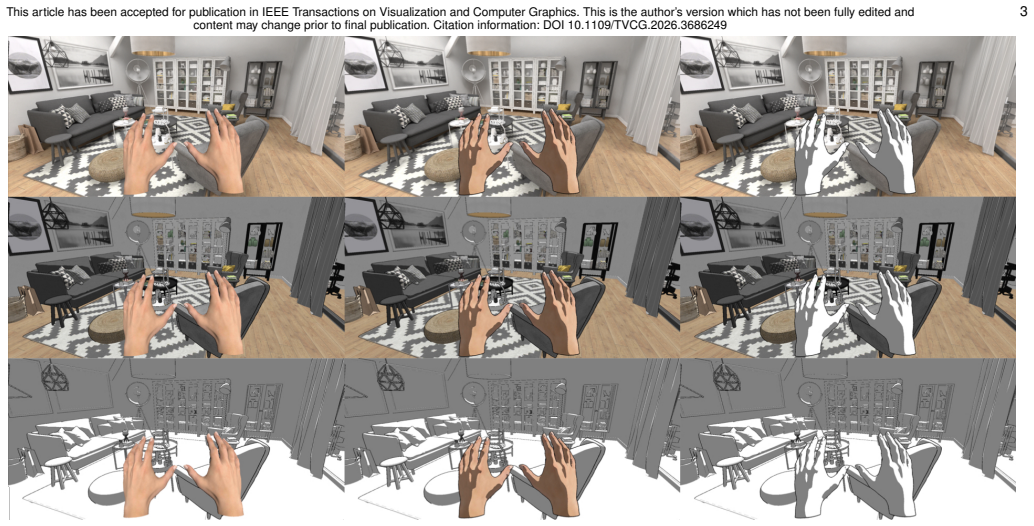
The load-bearing device is a 3x3 mixed factorial design that independently crosses hand rendering style (between participants) with environment rendering style (within participants), built from the same base 3D models so that anthropomorphic shape stays fixed across styles. Photorealism is manipulated only through materials, textures, and shading, yielding realistic, toon, and sketch levels. The measurement relies on the virtual hand illusion, driven by visuomotor synchrony from consumer hand tracking, and on seven-point Likert questionnaire items for body ownership and presence; the design would reveal a consistency effect (H1/H2) as an interaction between hand and environment factors, and
What would settle it
Run the same ownership questionnaire with a hand-realism manipulation whose three levels are each clearly perceptually distinct—for example a textured realistic hand, a flat-shaded toon hand, and a line-only or wireframe hand rated well below both—and compare ownership scores. If ownership no longer stays equal across all three levels, the paper's central null is overturned; if ownership remains flat while environment realism still raises presence, the claim survives.
Extended reading notes
Core claim
The central claim is negative but delimited: holding the hand's shape and personal resemblance constant, changing its rendering style from a textured realistic skin to a two-tone toon look to an untextured sketch does not change how strongly people feel the virtual hand is their own, and making the hand and environment share the same rendering style does not strengthen that illusion. Meanwhile, rendering the environment more photorealistically did increase presence, with all pairwise comparisons significant and a large effect size. The authors conclude that dimensions of realism affect different aspects of experience differently, and that prior inconsistencies in virtual-hand realism researc
Load-bearing premise
The load-bearing premise is that the three rendering styles are perceptually distinct levels of hand photorealism, so a null hand effect means photorealism truly does not affect ownership; the paper's own realism ratings separated only realistic from toon, leaving the sketch level perceptually ambiguous.
Editorial extensions
If this is right
- If the null results hold, developers can choose hand rendering independently of environment style without measurably changing users' sense of ownership or presence.
- Applications where presence is central—training, therapy, virtual tourism—should invest in environment photorealism, which produced the largest effect in the experiment.
- Stylized (toon) hands are a safe choice on resource-constrained standalone headsets: they preserve body ownership and avoid the negative appearance comments that the realistic hand attracted.
- The pattern supports treating realism as multidimensional rather than monolithic, and suggests that future virtual-hand studies should report anthropomorphism, photorealism, and truthfulness separately.
- The failure of the consistency hypotheses indicates that perceptual unification of body and scene along the photorealism axis is not required for the body ownership illusion in VR.
Reading between the lines
- Editorial extension: the null result for hand photorealism is only as strong as its manipulation—the sketch hand was not perceived as significantly less realistic than the toon hand, so the lowest photorealism level may not have registered as distinct.
- Editorial extension: real-time visuomotor synchrony may have created a ceiling effect that masked photorealism's contribution; testing with asynchronous hand tracking could reveal whether photorealism matters when bottom-up cues are weaker.
- Editorial extension: the realistic hand drew the most negative spontaneous comments yet did not lower ownership, hinting that affective responses (uncanny valley) and body ownership are separable; measuring eeriness alongside ownership could expose a non-monotonic relationship hidden in the means.
- Editorial extension: the paper measures hands only, and the authors themselves note the hand-limb discontinuity could make photorealism more consequential for full-body avatars, so the null result should not be generalized to whole-body ownership without further tests.
Signed reviews
Editorial analysis
A structured set of objections, weighed in public.
Referee Report
Summary. The paper investigates whether the photorealism of a user's virtual hand and the consistency between hand and environment rendering styles affect the sense of body ownership and presence in virtual reality. It presents a 3×3 mixed-design remote VR experiment (hand rendering style between-subjects: realistic, toon, sketch; environment rendering style within-subjects: the same three levels) with N=117 consumer HMD users. Participants performed a pointing task and reported body ownership, presence, and perceived realism via in-headset questionnaires. The authors report no significant main effect of hand rendering style and no hand×environment interaction on body ownership, no interaction on presence, and a robust main effect of environment rendering style on presence (F(2,228)=48.08, p<.001, η²p=.297), with more photorealistic environments yielding higher presence. They conclude that photorealism of the virtual hands and its consistency with the environment do not influence body ownership, while environmental photorealism enhances presence, and they draw design implications for VR content creation.
Significance. The study is a useful empirical contribution to an area with inconsistent evidence. Its strengths include a systematic operationalization of photorealism separately from anthropomorphism and truthfulness, a relatively large sample for a VR experiment, use of the same shaders for hand and environment in the non-realistic conditions, pre-specified data-quality screening for remote data collection, and candid reporting of null effects and limitations. The environment→presence result is strong and consistent with some recent work. However, the main novel null claim—that hand photorealism and hand-environment consistency do not affect body ownership—is weakened by the paper's own manipulation check, which shows only partial perceptual separation of the hand styles. The paper should be revised to limit its claims to the range actually tested and to provide precision/equivalence information for the null effects.
major comments (3)
- [§4.2 (Q8) and §5.2] The hand-realism manipulation was only partially successful: only the realistic and toon hand conditions differed significantly (p<.05); the sketch hand did not differ from realistic (p=.07) or toon (p=.63). Since H3 is a monotonic hypothesis across three levels, the failure of the sketch condition means the three-level test does not actually test the full monotonic hypothesis. More importantly, H1/H2 rely on participants perceiving the hand style categories; if the sketch hand was not reliably perceived as 'sketch,' then for participants in that group the 'matching' environment conditions are mismatched perceptually, which adds noise to the interaction tests. The abstract, §5.1, and §6 state categorically that hand rendering style did not influence body ownership; this is not supported by the manipulation check. I request a reanalysis restricted to the successfully separated realistic v
- [§3.1, §4.2] The paper reports null results for H1, H2, and H3 without any power analysis, equivalence test, or sensitivity analysis. With approximately 38–40 participants per between-subjects hand condition, the absence of a significant main effect or interaction does not license the conclusion that 'no effect exists'; the design may have low power to detect small-to-moderate effects, especially interactions. Please report effect sizes with confidence intervals for the non-significant effects and, if the goal is to support a null claim, provide an equivalence bound or a sensitivity analysis showing what effect sizes the design could detect. The design-implication conclusion that rendering styles can be optimized 'independently' is stronger than the data justify without such analysis.
- [§4.2 (scale reliability)] After item exclusions, Cronbach's alpha for body ownership is 0.70 (two items) and for presence is 0.59 (three items). The presence value is below customary reliability thresholds, and the body-ownership value is marginal. Since all conclusions rest on these questionnaire scores, low reliability attenuates statistical power and increases the risk of false-negative results. Please discuss this explicitly and, ideally, report item-level descriptive statistics or a robustness analysis (e.g., treating items as ordinal indicators).
minor comments (4)
- [References [58]] The author name 'S. Frlston' appears to be a typo for 'S. Friston'.
- [§3.4] The sentence 'the participants (N=117) completed 35.15±12.29 items on average per experiment' is confusing: 35.15 appears to be the total across the three 90-s conditions, not per condition. Please clarify the wording.
- [Table 1, §4.2] Q6 and Q7 were inverted as an attention check, but after excluding Q6 the final presence scale differs from the original SUS construct. Please clarify what the remaining three items are intended to measure and discuss the consequence for construct validity.
- [§5.2] The statement that possible tracking issues 'would not significantly influence' the conclusions because conditions were randomized addresses systematic bias but not statistical power: tracking failures could add noise and reduce sensitivity of the ownership measures in all groups. Please soften or support this claim.
Circularity Check
No circular derivation; empirical study with independently tested hypotheses.
full rationale
This paper is an empirical 3x3 VR experiment with no formal derivation, no fitted parameters, and no prediction that is constructed from its own inputs. The hypotheses (H1-H4) are operationalized as contrasts on questionnaire scores; the results (null for hand photorealism and consistency, positive environment effect on presence) are obtained from statistical tests of independent dependent measures (body ownership, presence) against independently manipulated factors (rendering style of hands/environment). The work's self-citations ([7], [67]) are used as background evidence about hand realism and avatar appearance, not as justification for the study's outcome, and the cited results are externally published empirical studies with stated methods; no load-bearing argument reduces to a self-citation. The paper's own limitation, that the sketch hand was not perceptually well separated from the other hand styles (Section 4.2, Q8; Section 5.2), is an experimental manipulation-validity concern and a possible explanation for a null result, but it is not circularity: the conclusion is not equivalent to its input by construction. No fitted parameter or definitional identity is invoked. Thus no specific circular step can be quoted, and the honest finding is no significant circularity.
Assumptions & free parameters
assumptions (4)
- domain assumption Subjective Likert questionnaire responses validly measure body ownership and presence.
- domain assumption The three rendering styles (realistic, toon, sketch) operationalize photorealism while holding anthropomorphism and truthfulness constant.
- domain assumption Visuomotor synchrony from Quest hand tracking is sufficient to induce the VHI, and tracking problems affect conditions approximately equally.
- domain assumption Cronbach's alpha values after post-hoc item deletion (α=0.70 for body ownership; α=0.59 for presence) are adequate for the composite scores.
Cite this review
Pith. "Pith review of The Effect of Photorealism Consistency between the Virtual Hands and Environment on the Sense of Body Ownership and Presence in Virtual Reality." pith.science (2026). https://pith.science/paper/G7HUROVM
@misc{pith2026260724047,
  author       = {Pith},
  title        = {Pith review of: The Effect of Photorealism Consistency between the Virtual Hands and Environment on the Sense of Body Ownership and Presence in Virtual Reality},
  year         = {2026},
  howpublished = {\url{https://pith.science/paper/G7HUROVM}},
  note         = {Machine review of arXiv:2607.24047}
}
read the original abstract
Virtual reality (VR) technology allows users to feel a virtual body as if it was their own (i.e., body ownership illusion). Previous studies have explored how the visual realism of the user's virtual body influences the sense of body ownership in VR, focusing on the aspect of anthropomorphism. However, the effect of photorealism, another element that characterizes the visual realism of a virtual human, has not been systematically examined in the context of body ownership illusion. Therefore, we investigate the effect of the rendering style of virtual hands on the sense of body ownership, hypothesizing that the effect is affected by the rendering style of the virtual environment. In addition, we examine the effect of photorealism on presence (i.e., the sense of being there), as existing studies have offered inconsistent evidence. To this aim, we conducted a 3 x 3 mixed-design remote VR experiment (N=117) that factored in the rendering styles of both the virtual hand and the environment and analyzed the subjective data from the questionnaire. The results suggest that neither the rendering style of virtual hands nor the consistency of the rendering style between the virtual hand and the environment influenced the sense of body ownership. Nevertheless, the more photorealistically the virtual environment was rendered, the stronger the presence. Our results indicate that different dimensions of virtual body realism affect the sense of body ownership differently, thereby highlighting the importance of applying a suitable classification of realism to understand the body ownership illusion for virtual bodies more in depth.
Figures


Figures from the paper (1 more)

Reference graph
Works this paper leans on
-
[1]
Body centred interaction in immersive virtual environments,
M. Slater and M. Usoh, “Body centred interaction in immersive virtual environments,”Artificial life and virtual reality, vol. 1, no. 1994, pp. 125–148, 1994
1994
-
[2]
Virtual Reality and Empathy Enhancement: Ethical Aspects,
J. Rueda and F. Lara, “Virtual Reality and Empathy Enhancement: Ethical Aspects,”Frontiers in robotics and AI, vol. 7, p. 506984, 2020
2020
-
[3]
The role of interaction in virtual embodiment: Effects of the virtual hand representation,
F. Argelaguet, L. Hoyet, M. Trico, and A. Lecuyer, “The role of interaction in virtual embodiment: Effects of the virtual hand representation,” in2016 IEEE Virtual Reality (VR), 2016, pp. 3–10
2016
-
[4]
Need a hand? how appearance affects the virtual hand illusion,
L. Lin and S. J ¨org, “Need a hand? how appearance affects the virtual hand illusion,” inProceedings of the ACM Symposium on Applied Perception, 2016, pp. 69–76
2016
-
[5]
Touch with foreign hands: the effect of virtual hand appearance on visual- haptic integration,
V . Schwind, L. Lin, M. Di Luca, S. J ¨org, and J. Hillis, “Touch with foreign hands: the effect of virtual hand appearance on visual- haptic integration,” inProceedings of the ACM Symposium on Applied Perception, 2018, pp. 1–8
2018
-
[6]
Is the rubber hand illusion induced by immersive virtual reality?
Y. Yuan and A. Steed, “Is the rubber hand illusion induced by immersive virtual reality?” in2010 IEEE Virtual Reality Conference (VR), 2010, pp. 95–102
2010
-
[7]
Virtual Hand Realism Affects Object Size Perception in Body-Based Scaling,
N. Ogawa, T. Narumi, and M. Hirose, “Virtual Hand Realism Affects Object Size Perception in Body-Based Scaling,” in2019 IEEE Conference on Virtual Reality and 3D User Interfaces (VR), 2019, pp. 519–528
2019
-
[9]
Hands only illusion: Multisensory integration elicits sense of ownership for body parts but not for non-corporeal objects,
M. Tsakiris, L. Carpenter, D. James, and A. Fotopoulou, “Hands only illusion: Multisensory integration elicits sense of ownership for body parts but not for non-corporeal objects,”Experimental brain research. Experimentelle Hirnforschung. Experimentation cere- brale, vol. 204, no. 3, pp. 343–352, 2010
2010
Show all 73 references
-
[10]
The effect of similarities in skin texture and hand shape on perceived owner- ship of a fake limb,
A. Haans, W. A. Ijsselsteijn, and Y. A. W. de Kort, “The effect of similarities in skin texture and hand shape on perceived owner- ship of a fake limb,”Body image, vol. 5, no. 4, pp. 389–394, 2008
2008
-
[11]
Over my fake body: body ownership illusions for studying the multisensory basis of own-body perception,
K. Kilteni, A. Maselli, K. P . Kording, and M. Slater, “Over my fake body: body ownership illusions for studying the multisensory basis of own-body perception,”Frontiers in human neuroscience, vol. 9, p. 141, 2015
2015
-
[12]
The Effect of the Agency and An- thropomorphism on users’ Sense of Telepresence, Copresence, and Social Presence in Virtual Environments,
K. L. Nowak and F. Biocca, “The Effect of the Agency and An- thropomorphism on users’ Sense of Telepresence, Copresence, and Social Presence in Virtual Environments,”Presence: Teleoperators and Virtual Environments, vol. 12, no. 5, pp. 481–494, 2003
2003
-
[13]
Render me real? in- vestigating the effect of render style on the perception of animated virtual humans,
R. McDonnell, M. Breidt, and H. H. B ¨ulthoff, “Render me real? in- vestigating the effect of render style on the perception of animated virtual humans,”ACM transactions on graphics, vol. 31, no. 4, pp. 1–11, 2012
2012
-
[14]
Does render style affect perception of personality in virtual humans?
K. Zibrek and R. McDonnell, “Does render style affect perception of personality in virtual humans?” inProceedings of the ACM Symposium on Applied Perception, 2014, pp. 111–115
2014
-
[15]
To stylize or not to stylize? the effect of shape and material stylization on the perception of computer-generated faces,
E. Zell, C. Aliaga, A. Jarabo, K. Zibrek, D. Gutierrez, R. McDonnell, and M. Botsch, “To stylize or not to stylize? the effect of shape and material stylization on the perception of computer-generated faces,”ACM transactions on graphics, vol. 34, no. 6, pp. 1–12, 2015
2015
-
[16]
The Effect of Realistic Appearance of Virtual Characters in Immersive Environments - Does the Character’s Personality Play a Role?
K. Zibrek, E. Kokkinara, and R. Mcdonnell, “The Effect of Realistic Appearance of Virtual Characters in Immersive Environments - Does the Character’s Personality Play a Role?”IEEE transactions on visualization and computer graphics, vol. 24, no. 4, pp. 1681–1690, 2018
2018
-
[17]
Is Photorealism Im- portant for Perception of Expressive Virtual Humans in Virtual Reality?
K. Zibrek, S. Martin, and R. McDonnell, “Is Photorealism Im- portant for Perception of Expressive Virtual Humans in Virtual Reality?”ACM transactions on applied perception, vol. 16, no. 3, pp. 1–19, 2019
2019
-
[18]
Differential effects of face-realism and emotion on event-related brain potentials and their implications for the uncanny valley theory,
S. Schindler, E. Zell, M. Botsch, and J. Kissler, “Differential effects of face-realism and emotion on event-related brain potentials and their implications for the uncanny valley theory,”Scientific reports, vol. 7, p. 45003, 2017
2017
-
[19]
The impact of avatar fidelity on social interaction in virtual environments,
M. Garau, “The impact of avatar fidelity on social interaction in virtual environments,” Ph.D. dissertation, University College London, 2003
2003
-
[20]
Over My Hand: Using a Personalized Hand in VR to Improve Object Size Estimation, Body Ownership, and Presence,
S. Jung, G. Bruder, P . J. Wisniewski, C. Sandor, and C. E. Hughes, “Over My Hand: Using a Personalized Hand in VR to Improve Object Size Estimation, Body Ownership, and Presence,” inPro- ceedings of the Symposium on Spatial User Interaction, 2018, pp. 60– 68
2018
-
[21]
The Impact of Avatar Personalization and Immersion on Virtual Body Ownership, Presence, and Emotional Response,
T. Waltemate, D. Gall, D. Roth, M. Botsch, and M. E. Latoschik, “The Impact of Avatar Personalization and Immersion on Virtual Body Ownership, Presence, and Emotional Response,”IEEE trans- actions on visualization and computer graphics, vol. 24, no. 4, pp. 1643–1652, 2018
2018
-
[22]
From robot to virtual doppelganger: Impact of visual fidelity of avatars controlled in third-person perspective on embodiment and be- havior in immersive virtual environments,
G. Gorisse, O. Christmann, S. Houzangbe, and S. Richir, “From robot to virtual doppelganger: Impact of visual fidelity of avatars controlled in third-person perspective on embodiment and be- havior in immersive virtual environments,”Frontiers Robotics AI, vol. 6, pp. 1–14, 2019
2019
-
[23]
”These are not my hands!
V . Schwind, P . Knierim, C. Tasci, P . Franczak, N. Haas, and N. Henze, “”These are not my hands!”: Effect of Gender on the Perception of Avatar Hands in Virtual Reality,” inProceedings of the 2017 CHI Conference on Human Factors in Computing Systems, 2017, pp. 1577–1582
2017
-
[24]
The influence of rendering quality on presence and task performance in a virtual environment,
P . Zimmons and A. Panter, “The influence of rendering quality on presence and task performance in a virtual environment,” in2003 IEEE Virtual Reality (VR), 2003, pp. 293–294
2003
-
[25]
The effect of quality of rendering on user lighting impressions and presence in virtual environments,
K. Mania and A. Robinson, “The effect of quality of rendering on user lighting impressions and presence in virtual environments,” inProceedings of the 2004 ACM SIGGRAPH international conference on Virtual Reality continuum and its applications in industry, 2004, pp. 200–205
2004
-
[26]
An investigation of presence response across variations in visual realism,
V . Vinayagamoorthy, A. Brogni, M. Gillies, M. Slater, and A. Steed, “An investigation of presence response across variations in visual realism,” inThe 7th Annual International Presence Workshop, 2004, pp. 148–155
2004
-
[27]
Presence in response to dynamic visual realism: a preliminary report of an experiment study,
P . Khanna, I. Yu, J. Mortensen, and M. Slater, “Presence in response to dynamic visual realism: a preliminary report of an experiment study,” inProceedings of the ACM symposium on Virtual reality software and technology, 2006, pp. 364–367
2006
-
[28]
Visual Realism En- hances Realistic Response in an Immersive Virtual Environment,
M. Slater, P . Khanna, J. Mortensen, and I. Yu, “Visual Realism En- hances Realistic Response in an Immersive Virtual Environment,” IEEE computer graphics and applications, vol. 29, no. 3, pp. 76–84, 2009
2009
-
[29]
Vi- sual realism enhances realistic response in an immersive vir- tual environment–part 2,
I. Yu, J. Mortensen, P . Khanna, B. Spanlang, and M. Slater, “Vi- sual realism enhances realistic response in an immersive vir- tual environment–part 2,”IEEE computer graphics and applications, vol. 32, no. 6, pp. 36–45, 2012
2012
-
[30]
Presence and discernability in conventional and non-photorealistic immersive augmented real- ity,
W. Steptoe, S. Julier, and A. Steed, “Presence and discernability in conventional and non-photorealistic immersive augmented real- ity,” in2014 IEEE International Symposium on Mixed and Augmented Reality (ISMAR), 2014, pp. 213–218
2014
-
[31]
Photorealism or/and non-photorealism in augmented reality,
M. Haller, “Photorealism or/and non-photorealism in augmented reality,” inProceedings of the 2004 ACM SIGGRAPH international conference on Virtual Reality continuum and its applications in indus- try, 2004, pp. 189–196
2004
-
[32]
Measuring the discernability of virtual objects in conventional and stylized augmented reality,
J. Fischer, D. Cunningham, D. Bartz, C. Wallraven, H. B ¨ulthoff, and W. Straßer, “Measuring the discernability of virtual objects in conventional and stylized augmented reality,” inProceedings of the 12th Eurographics conference on Virtual Environments, 2006, pp. 53–61
2006
-
[33]
Systematic review on realism research methodologies on immer- sive virtual, augmented and mixed realities,
G. Goncalves, P . Monteiro, H. Coelho, M. Melo, and M. Bessa, “Systematic review on realism research methodologies on immer- sive virtual, augmented and mixed realities,”IEEE Access, vol. 9, pp. 89 150–89 161, 2021
2021
-
[34]
Systematic review of comparative studies of the impact of realism in immersive virtual experiences,
G. Gonc ¸alves, H. Coelho, P . Monteiro, M. Melo, and M. Bessa, “Systematic review of comparative studies of the impact of realism in immersive virtual experiences,”ACM Comput. Surv., vol. 55, no. 6, pp. 1–36, Jul. 2023
2023
-
[35]
Unified concepts: a review and proposal for virtual reality terminology,
G. Gonc ¸alves, B. Peixoto, M. Miguel, and M. Bessa, “Unified concepts: a review and proposal for virtual reality terminology,” Virtual Reality, vol. 29, no. 3, pp. 1–20, 2025
2025
-
[36]
Three varieties of realism in computer graphics,
J. A. Ferwerda, “Three varieties of realism in computer graphics,” inHuman Vision and Electronic Imaging VIII, B. E. Rogowitz and T. N. Pappas, Eds. SPIE, Jun. 2003
2003
-
[37]
Rubber hands ‘feel’ touch that eyes see,
M. Botvinick and J. Cohen, “Rubber hands ‘feel’ touch that eyes see,”Nature, vol. 391, no. 6669, p. 756, 1998
1998
-
[38]
The Sense of Embodiment in Virtual Reality,
K. Kilteni, R. Groten, and M. Slater, “The Sense of Embodiment in Virtual Reality,”Presence: Teleoperators and Virtual Environments, vol. 21, no. 4, pp. 373–387, 2012
2012
-
[39]
Up to the Finger Tip: The Effect of Avatars on Mid-Air Pointing Accuracy in Virtual Reality,
V . Schwind, S. Mayer, A. Comeau-Vermeersch, R. Schweigert, and N. Henze, “Up to the Finger Tip: The Effect of Avatars on Mid-Air Pointing Accuracy in Virtual Reality,” inProceedings of the 2018 Annual Symposium on Computer-Human Interaction in Play, 2018, pp. 477–488
2018
-
[40]
Too real for comfort? Uncanny responses to computer generated faces,
K. F. MacDorman, R. D. Green, C.-C. Ho, and C. T. Koch, “Too real for comfort? Uncanny responses to computer generated faces,” Computers in human behavior, vol. 25, no. 3, pp. 695–710, 2009
2009
-
[41]
The Uncanny Valley,
M. Mori, “The Uncanny Valley,”Energy, vol. 7, no. 4, pp. 33–35, 1970
1970
-
[42]
The uncanny valley: Effect of realism on the impression of artificial human faces,
J. Seyama and R. S. Nagayama, “The uncanny valley: Effect of realism on the impression of artificial human faces,”Presence: Teleoperators and Virtual Environments, vol. 16, no. 4, pp. 337–351, 2007
2007
-
[43]
Effects of Virtual Human Appearance Fidelity on Emotion Contagion in Affective Inter- Personal Simulations,
M. Volonte, S. V . Babu, H. Chaturvedi, N. Newsome, E. Ebrahimi, T. Roy, S. B. Daily, and T. Fasolino, “Effects of Virtual Human Appearance Fidelity on Emotion Contagion in Affective Inter- Personal Simulations,”IEEE transactions on visualization and com- puter graphics, vol. ...
2016
-
[44]
Effects of a Virtual Human Appearance Fidelity Continuum on Visual Attention in Virtual Reality,
M. Volonte, A. T. Duchowski, and S. V . Babu, “Effects of a Virtual Human Appearance Fidelity Continuum on Visual Attention in Virtual Reality,” inProceedings of the 19th ACM International Con- ference on Intelligent Virtual Agents, 2019, pp. 141–147
2019
-
[45]
Don’t stand so close to me: investigating the effect of control on the appeal of virtual humans using immersion and a proximity-based behavioral task,
K. Zibrek, E. Kokkinara, and R. McDonnell, “Don’t stand so close to me: investigating the effect of control on the appeal of virtual humans using immersion and a proximity-based behavioral task,” inProceedings of the ACM Symposium on Applied Perception, no. Article 3, 2017, pp. 1–11
2017
-
[46]
Social presence and place illusion are affected by photorealism in embodied VR,
K. Zibrek and R. McDonnell, “Social presence and place illusion are affected by photorealism in embodied VR,” inMotion, Interac- tion and Games, 2019, pp. 1–7
2019
-
[47]
Garau, M
M. Garau, M. Slater, V . Vinayagamoorthy, A. Brogni, A. Steed, and M. A. Sasse, “The impact of avatar realism and eye gaze control on perceived quality of communication in a shared immersive virtual This article has been accepted for publication in IEEE Transactions on Visuali...
2026
-
[48]
The interactive effect of avatar visual fidelity and behavioral fidelity in the collaborative virtual reality environment on the perception of social interaction,
S. Mansour, M. El-Said, C. Rude-Parkins, and J. Nandigam, “The interactive effect of avatar visual fidelity and behavioral fidelity in the collaborative virtual reality environment on the perception of social interaction,” inProceedings of the 10th WSEAS international conferen...
2006
-
[49]
The effect of behavioral realism and form realism of real-time avatar faces on verbal disclosure, nonverbal disclosure, emotion recognition, and copresence in dyadic interaction,
J. N. Bailenson, N. Yee, D. Merget, and R. Schroeder, “The effect of behavioral realism and form realism of real-time avatar faces on verbal disclosure, nonverbal disclosure, emotion recognition, and copresence in dyadic interaction,”Presence: Teleoperators and Virtual Environ...
2006
-
[50]
The effect of avatar realism in immersive social virtual realities,
M. E. Latoschik, D. Roth, D. Gall, J. Achenbach, T. Waltemate, and M. Botsch, “The effect of avatar realism in immersive social virtual realities,” inProceedings of the 23rd ACM Symposium on Virtual Reality Software and Technology, 2017, pp. 1–10
2017
-
[51]
Place illusion and plausibility can lead to realistic behaviour in immersive virtual environments,
M. Slater, “Place illusion and plausibility can lead to realistic behaviour in immersive virtual environments,”Philosophical trans- actions of the Royal Society of London. Series B, Biological sciences, vol. 364, no. 1535, pp. 3549–3557, 2009
2009
-
[52]
Perspective: Does realism improve presence in VR? suggesting a model and metric for VR experience evaluation,
S. Jung and R. W. Lindeman, “Perspective: Does realism improve presence in VR? suggesting a model and metric for VR experience evaluation,”Front. Virtual Real., vol. 2, p. 693327, Jul. 2021
2021
-
[53]
Taxonomy of mixed reality visual displays,
P . Milgram and F. Kishino, “Taxonomy of mixed reality visual displays,”IEICE transactions on information and systems, vol. E77-D, no. 12, pp. 1321–1329, 1994
1994
-
[54]
Revisiting milgram and kishino’s reality-virtuality continuum,
R. Skarbez, M. Smith, and M. C. Whitton, “Revisiting milgram and kishino’s reality-virtuality continuum,”Front. Virtual Real., vol. 2, p. 647997, Mar. 2021
2021
-
[55]
Evaluation of the impact of different levels of self- representation and body tracking on the sense of presence and embodiment in immersive VR,
G. Gonc ¸alves, M. Melo, L. Barbosa, J. Vasconcelos-Raposo, and M. Bessa, “Evaluation of the impact of different levels of self- representation and body tracking on the sense of presence and embodiment in immersive VR,”Virtual reality, 2021
2021
-
[56]
Using Presence Questionnaires in Virtual Reality,
V . Schwind, P . Knierim, N. Haas, and N. Henze, “Using Presence Questionnaires in Virtual Reality,” inProceedings of the 2019 CHI Conference on Human Factors in Computing Systems, 2019, pp. 1–12
2019
-
[57]
Visual realism and presence in a virtual reality game,
J. Hvass, O. Larsen, K. Vendelbo, N. Nilsson, R. Nordahl, and S. Serafin, “Visual realism and presence in a virtual reality game,” in2017 3DTV Conference: The True Vision - Capture, Transmission and Display of 3D Video (3DTV-CON), 2017, pp. 1–4
2017
-
[58]
An ’in the wild’ experiment on presence and embod- iment using consumer virtual reality equipment,
A. Steed, S. Frlston, M. M. L ´opez, J. Drummond, Y. Pan, and D. Swapp, “An ’in the wild’ experiment on presence and embod- iment using consumer virtual reality equipment,”IEEE Trans. Vis. Comput. Graph., vol. 22, no. 4, pp. 1406–1414, 2016
2016
-
[59]
Anthropomorphism influences perception of computer-animated characters’ actions,
T. Chaminade, J. Hodgins, and M. Kawato, “Anthropomorphism influences perception of computer-animated characters’ actions,” Social cognitive and affective neuroscience, vol. 2, no. 3, pp. 206–216, 2007
2007
-
[60]
Multimodal speech-gesture in- terface for handfree painting on a virtual paper using partial recurrent neural networks as gesture recognizer,
A. Corradini and P . R. Cohen, “Multimodal speech-gesture in- terface for handfree painting on a virtual paper using partial recurrent neural networks as gesture recognizer,” inProceedings of the 2002 International Joint Conference on Neural Networks. IJCNN’02, vol. 3, 2002, p...
2002
-
[61]
Avatar Embodiment. To- wards a Standardized Questionnaire,
M. Gonzalez-Franco and T. C. Peck, “Avatar Embodiment. To- wards a Standardized Questionnaire,”Frontiers in Robotics and AI, vol. 5, p. 74, 2018
2018
-
[62]
Using presence questionnaires in reality,
M. Usoh, E. Catena, S. Arman, and M. Slater, “Using presence questionnaires in reality,”Presence: Teleoperators and Virtual Envi- ronments, vol. 9, no. 5, pp. 497–503, 2000
2000
-
[63]
An ’In the Wild’ Experiment on Presence and Embod- iment using Consumer Virtual Reality Equipment,
A. Steed, S. Frlston, M. M. Lopez, J. Drummond, Y. Pan, and D. Swapp, “An ’In the Wild’ Experiment on Presence and Embod- iment using Consumer Virtual Reality Equipment,”IEEE transac- tions on visualization and computer graphics, vol. 22, no. 4, pp. 1406– 1414, 2016
2016
-
[64]
Identifying careless responses in survey data,
A. W. Meade and S. B. Craig, “Identifying careless responses in survey data,”Psychological methods, vol. 17, no. 3, pp. 437–455, 2012
2012
-
[65]
The aligned rank transform for nonparametric factorial analyses using only anova procedures,
J. O. Wobbrock, L. Findlater, D. Gergle, and J. J. Higgins, “The aligned rank transform for nonparametric factorial analyses using only anova procedures,” inProceedings of the 2011 CHI Conference on Human Factors in Computing Systems, 2011, pp. 143–146
2011
-
[66]
Avatar anthropomor- phism and illusion of body ownership in VR,
J.-L. Lugrin, J. Latt, and M. E. Latoschik, “Avatar anthropomor- phism and illusion of body ownership in VR,” in2015 IEEE Virtual Reality (VR), 2015, pp. 229–230
2015
-
[67]
Do You Feel Like Passing Through Walls?: Effect of Self-Avatar Appearance on Facilitating Realistic Behavior in Virtual Environments,
N. Ogawa, T. Narumi, H. Kuzuoka, and M. Hirose, “Do You Feel Like Passing Through Walls?: Effect of Self-Avatar Appearance on Facilitating Realistic Behavior in Virtual Environments,” inPro- ceedings of the 2020 CHI Conference on Human Factors in Computing Systems, 2020, pp. 1–14
2020
-
[68]
The Ethics of Realism in Virtual and Augmented Reality,
M. Slater, C. Gonzalez-Liencres, P . Haggard, C. Vinkers, R. Gregory-Clarke, S. Jelley, Z. Watson, G. Breen, R. Schwarz, W. Steptoe, D. Szostak, S. Halan, D. Fox, and J. Silver, “The Ethics of Realism in Virtual and Augmented Reality,”Frontiers in Virtual Reality, vol. 1, p. 1, 2020
2020
-
[69]
Putting yourself in the skin of a black avatar reduces implicit racial bias,
T. C. Peck, S. Seinfeld, S. M. Aglioti, and M. Slater, “Putting yourself in the skin of a black avatar reduces implicit racial bias,” Consciousness and cognition, vol. 22, no. 3, pp. 779–787, 2013
2013
-
[70]
Any “Body
J.-L. Lugrin, M. Ertl, P . Krop, R. Kl ¨upfel, S. Stierstorfer, B. Weisz, M. R ¨uck, J. Schmitt, N. Schmidt, and M. E. Latoschik, “Any “Body” There? Avatar Visibility Effects in a Virtual Reality Game,” in2018 IEEE Conference on Virtual Reality and 3D User Interfaces (VR), 201...
2018
-
[71]
Remote and Collaborative Virtual Reality Experiments via Social VR Plat- forms,
D. Saffo, S. Di Bartolomeo, C. Yildirim, and C. Dunne, “Remote and Collaborative Virtual Reality Experiments via Social VR Plat- forms,” inProceedings of the 2021 CHI Conference on Human Factors in Computing Systems, no. Article 523, 2021, pp. 1–15
2021
-
[72]
DiVRsify: Break the cycle and develop VR for everyone,
T. C. Peck, K. A. McMullen, and J. Quarles, “DiVRsify: Break the cycle and develop VR for everyone,”IEEE Comput. Graph. Appl., vol. 41, no. 6, pp. 133–142, 2021
2021
-
[73]
Mere ob- servation of body discontinuity affects perceived ownership and vicarious agency over a virtual hand,
G. Tieri, E. Tidoni, E. F. Pavone, and S. M. Aglioti, “Mere ob- servation of body discontinuity affects perceived ownership and vicarious agency over a virtual hand,”Experimental brain research. Experimentelle Hirnforschung. Experimentation cerebrale, vol. 233, no. 4, pp. 1247...
2015
-
[74]
What you see isn’t necessarily what you get: testing the influence of polygon count on physical and self-presence in virtual environments,
T. Volkmann, D. Wessel, T. O. Caliebe, and N. Jochems, “What you see isn’t necessarily what you get: testing the influence of polygon count on physical and self-presence in virtual environments,” in Proceedings of the Conference on Mensch und Computer, 2020, pp. 119–128. Nami ...
2020
Reviewed July 31, 2026 · model on record in the stance chip above.
Discussion (0). Continue with ORCID to comment.