The Role of Semirings in Incremental View Maintenance
Pith reviewed 2026-06-27 20:04 UTC · model grok-4.3
The pith
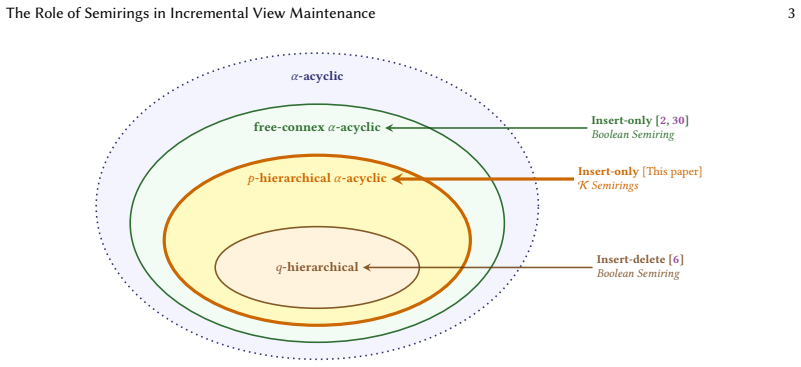
A conjunctive query without self-joins can be maintained with amortized constant update time and constant enumeration delay under inserts to K-databases if and only if it is α-acyclic p-hierarchical.
A machine-rendered reading of the paper's core claim, the machinery that carries it, and where it could break.
Core claim
For K-databases over semirings without additive inverses, a conjunctive query without self-joins admits amortized constant update time and constant enumeration delay under inserts if and only if the query is α-acyclic p-hierarchical.
What carries the argument
p-hierarchical queries, a structural class of conjunctive queries that permits hierarchical decomposition for incremental maintenance, together with α-acyclicity and the absence of additive inverses in the semiring.
If this is right
- Any α-acyclic p-hierarchical query admits constant amortized update time and constant delay enumeration for any semiring without additive inverses.
- A p-hierarchical query that is not α-acyclic requires amortized update time O(N^{fhtw-1}) where fhtw is its fractional hypertree width.
- Any conjunctive query without self-joins that is not p-hierarchical cannot be maintained with amortized constant update time and constant delay under the listed semirings.
- The dichotomy applies uniformly to the natural numbers semiring, provenance semiring, covariance semiring, and idempotent strictly ordered semirings such as the tropical semiring.
Where Pith is reading between the lines
- The restriction to insert-only sequences and semirings without additive inverses is what allows the algorithms to avoid cancellations that would otherwise require more expensive recomputation.
- Similar structural characterizations might exist for maintenance under deletions or mixed updates, though the paper does not address them.
- Query optimizers could use the p-hierarchical property as a syntactic check to decide whether constant-time view maintenance is feasible for a given workload.
Load-bearing premise
The lower-bound direction holds only for conjunctive queries without self-joins.
What would settle it
A conjunctive query without self-joins that is not α-acyclic p-hierarchical yet admits a data structure with amortized constant update time and constant enumeration delay for inserts over the natural semiring would falsify the claimed dichotomy.
Figures
read the original abstract
We study the problem of incremental view maintenance (IVM) under inserts to $K$-databases, where $K$ is a commutative semiring without additive inverse. The key observation put forward in this paper is that the complexity of the IVM problem depends fundamentally on the underlying semiring. We introduce a class of conjunctive queries called $p$-hierarchical and show that for any $p$-hierarchical query with fractional hypertree width $\fhtw$ and any insert-only update sequence of length $N$ to an initially empty $K$-database over an arbitrary semiring $K$ without additive inverse, we can construct a data structure that can be updated in amortized $\bigO(N^{\fhtw-1})$ time and can support constant delay enumeration of the query result. In particular, the amortized update time for any $\alpha$-acyclic $p$-hierarchical query is constant. We also give conditional lower bounds showing that any conjunctive query without self-joins that is not $p$-hierarchical cannot be maintained with amortized constant update time and constant enumeration delay under inserts to $K$-databases. Here, $K$ can be the natural semiring and its generalizations to the provenance and covariance semirings or any idempotent and strictly ordered semiring such as the tropical semiring. When put together, our upper and lower bounds imply a dichotomy for the insert-only maintenance of conjunctive queries without self-joins and the aforementioned semirings: A query can be maintained with amortized constant update time and constant enumeration delay if and only if it is $\alpha$-acyclic $p$-hierarchical.
Editorial analysis
A structured set of objections, weighed in public.
Referee Report
Summary. The manuscript claims to establish a dichotomy for the incremental maintenance of conjunctive queries without self-joins over commutative semirings without additive inverses. Specifically, such a query admits amortized constant update time and constant delay enumeration under insert-only updates to K-databases if and only if it is α-acyclic and p-hierarchical. The upper bound construction applies to any p-hierarchical query and depends on its fractional hypertree width, while conditional lower bounds are provided for non-p-hierarchical queries over the natural semiring and generalizations including provenance, covariance, and idempotent strictly ordered semirings like the tropical semiring.
Significance. If the results hold, this work provides a fundamental structural characterization of when IVM is tractable, showing that semiring choice (via axioms like absence of additive inverses or idempotence) directly governs complexity. The upper bounds rely on query hypergraph properties and semiring axioms for a data structure supporting updates and enumeration; the conditional lower bounds are scoped precisely to queries without self-joins. This offers a clean, falsifiable dichotomy that credits the use of structural query properties rather than fitted parameters.
minor comments (2)
- [Abstract] Abstract: the p-hierarchical class is introduced without even a one-sentence characterization or example, which reduces immediate readability of the central dichotomy claim.
- The manuscript would benefit from an explicit statement (perhaps in the introduction or a dedicated section) of the exact conditional hypotheses used in the lower-bound proofs, as the abstract only alludes to them.
Simulated Author's Rebuttal
We thank the referee for the positive summary of our results, the accurate characterization of the dichotomy, and the recommendation for minor revision. No specific major comments were raised in the report.
Circularity Check
No significant circularity identified
full rationale
The derivation relies on the newly introduced structural definition of p-hierarchical queries together with standard semiring axioms and known notions such as fractional hypertree width and α-acyclicity. Upper bounds are obtained by explicit data-structure constructions whose update and enumeration costs are bounded directly from the query structure; lower bounds are conditional hardness results scoped explicitly to conjunctive queries without self-joins. No step reduces a claimed bound to a quantity defined inside the paper by construction, no fitted parameter is relabeled as a prediction, and no load-bearing premise rests solely on a self-citation whose content is itself unverified. The result is therefore self-contained against external benchmarks.
Axiom & Free-Parameter Ledger
axioms (1)
- domain assumption K is a commutative semiring without additive inverse
invented entities (1)
-
p-hierarchical query
no independent evidence
Reference graph
Works this paper leans on
-
[1]
Mahmoud Abo Khamis, Eden Chmielewski, Andrei Draghici, Ahmet Kara, and Dan Olteanu. 2026. Maintaining Queries under Updates Using Heavy-Light Partitioning of the Input Relations.Proc. ACM Manag. Data4, 2, Article 109 (2026), 22 pages. doi:10.1145/3801905
-
[2]
Mahmoud Abo Khamis, Ahmet Kara, Dan Olteanu, and Dan Suciu. 2024. Insert-Only versus Insert-Delete in Dynamic Query Evaluation.Proc. ACM Manag. Data2, 5, Article 219 (Nov. 2024). doi:10.1145/3695837
-
[3]
Omer Abramovich, Daniel Deutch, Nave Frost, Ahmet Kara, and Dan Olteanu. 2024. Banzhaf Values for Facts in Query Answering.Proc. ACM Manag. Data2, 3 (2024), 123. doi:10.1145/3654926
-
[4]
Omer Abramovich, Daniel Deutch, Nave Frost, Ahmet Kara, and Dan Olteanu. 2025. Advancing Fact Attribution for Query Answering: Aggregate Queries and Novel Algorithms.Proc. VLDB Endow.18, 11 (2025), 3996–4008. doi:10.14778/3749646.3749670
-
[5]
Guillaume Bagan, Arnaud Durand, and Etienne Grandjean. 2007. On Acyclic Conjunctive Queries and Constant Delay Enumeration. InCSL. 208–222. doi:10.1007/978-3-540-74915-8_18
-
[6]
Christoph Berkholz, Jens Keppeler, and Nicole Schweikardt. 2017. Answering Conjunctive Queries Under Updates. In PODS. 303–318. doi:10.1145/3034786.3034789 28 Eden Chmielewski, Andrei Draghici, Dan Olteanu, and Haozhe Zhang
-
[7]
Leopoldo E. Bertossi, Benny Kimelfeld, Ester Livshits, and Mikaël Monet. 2023. The Shapley Value in Database Management.SIGMOD Rec.52, 2 (2023), 6–17. doi:10.1145/3615952.3615954
-
[8]
Mihai Budiu, Tej Chajed, Frank McSherry, Leonid Ryzhyk, and Val Tannen. 2023. DBSP: Automatic Incremental View Maintenance for Rich Query Languages.Proc. VLDB Endow.16, 7 (2023), 1601–1614. doi:10.14778/3587136.3587137
-
[9]
2008.Graphs, Dioids and Semirings: New Models and Algorithms (Operations Research/Computer Science Interfaces Series)(1 ed.)
Michel Gondran and Michel Minoux. 2008.Graphs, Dioids and Semirings: New Models and Algorithms (Operations Research/Computer Science Interfaces Series)(1 ed.)
2008
-
[10]
Todd J. Green. 2009. Containment of conjunctive queries on annotated relations. InICDT. 296–309. doi:10.1145/ 1514894.1514930
arXiv 2009
-
[11]
Todd J. Green, Zachary G. Ives, and Val Tannen. 2011. Reconcilable Differences.Theory of Computing Systems(2011), 460–488. doi:10.1007/s00224-011-9323-x
-
[12]
Green, Grigoris Karvounarakis, and Val Tannen
Todd J. Green, Grigoris Karvounarakis, and Val Tannen. 2007. Provenance semirings. InPODS. 31–40. doi:10.1145/ 1265530.1265535
arXiv 2007
-
[13]
Monika Henzinger, Sebastian Krinninger, Danupon Nanongkai, and Thatchaphol Saranurak. 2015. Unifying and Strengthening Hardness for Dynamic Problems via the Online Matrix-Vector Multiplication Conjecture. InSTOC. 21–30. doi:10.1145/2746539.2746609
-
[14]
Muhammad Idris, Martín Ugarte, and Stijn Vansummeren. 2017. The Dynamic Yannakakis Algorithm: Compact and Efficient Query Processing Under Updates. InSIGMOD. 1259–1274. doi:10.1145/3035918.3064027
-
[15]
Ngo, Milos Nikolic, Dan Olteanu, and Haozhe Zhang
Ahmet Kara, Hung Q. Ngo, Milos Nikolic, Dan Olteanu, and Haozhe Zhang. 2019. Counting Triangles under Updates in Worst-Case Optimal Time. InICDT. 4:1–4:18. doi:10.4230/LIPICS.ICDT.2019.4
-
[16]
Ahmet Kara, Milos Nikolic, Dan Olteanu, and Haozhe Zhang. 2024. F-IVM: Analytics over Relational Databases under Updates.VLDB J.33, 4 (2024), 903–929. doi:10.1007/S00778-023-00817-W
-
[17]
Ahmet Kara, Milos Nikolic, Dan Olteanu, and Haozhe Zhang. 2025. Conjunctive Queries with Free Access Patterns under Updates.LMCSVolume 21, Issue 2, Article 23 (2025). doi:10.46298/lmcs-21(2:23)2025
-
[18]
Ahmet Kara, Dan Olteanu, and Dan Suciu. 2024. From Shapley Value to Model Counting and Back.Proc. ACM Manag. Data2, 2 (2024), 79. doi:10.1145/3651142
-
[19]
Ngo, Reinhard Pichler, Dan Suciu, and Yisu Remy Wang
Mahmoud Abo Khamis, Hung Q. Ngo, Reinhard Pichler, Dan Suciu, and Yisu Remy Wang. 2024. Convergence of datalog over (Pre-) Semirings.J. ACM71, 2 (2024), 8:1–8:55. doi:10.1145/3643027
-
[20]
Mahmoud Abo Khamis, Hung Q. Ngo, and Atri Rudra. 2016. FAQ: Questions Asked Frequently. InPODS. 13–28. doi:10.1145/2902251.2902280
-
[21]
Christoph Koch, Yanif Ahmad, Oliver Kennedy, Milos Nikolic, Andres Nötzli, Daniel Lupei, and Amir Shaikhha. 2014. DBToaster: Higher-order Delta Processing for Dynamic, Frequently Fresh Views.VLDB J.23, 2 (2014), 253–278. doi:10.14778/2336664.2336670
-
[22]
Egor V. Kostylev and Peter Buneman. 2012. Combining Dependent Annotations for Relational Algebra. InICDT. 196–207. doi:10.1145/2274576.2274597
-
[23]
Mehryar Mohri. 2002. Semiring Frameworks and Algorithms for Shortest-Distance Problems.J. Autom. Lang. Comb.7, 3 (2002), 321–350. doi:10.25596/JALC-2002-321
-
[24]
Milos Nikolic and Dan Olteanu. 2018. Incremental View Maintenance with Triple Lock Factorization Benefits. In SIGMOD. 365–380. doi:10.1145/3183713.3183758
-
[25]
Dan Olteanu. 2024. Recent Increments in Incremental View Maintenance. InPODS. 8–17. doi:10.1145/3635138.3654763
-
[26]
Dan Olteanu and Jakub Závodný. 2015. Size Bounds for Factorised Representations of Query Results.ACM Trans. Database Syst.40, 1 (2015), 2:1–2:44. doi:10.1145/2656335
-
[27]
RAIVM Engine
RelationalAI, Inc 2026. RAIVM Engine. https://www.relational.ai
2026
-
[28]
Dan Suciu, Dan Olteanu, Christopher Ré, and Christoph Koch. 2011.Probabilistic Databases. Morgan & Claypool Publishers. doi:10.2200/S00362ED1V01Y201105DTM016
-
[29]
Qichen Wang. 2026. Towards Parameterized Hardness on Maintaining Conjunctive Queries.CoRRabs/2603.14754 (2026). arXiv:2603.14754 doi:10.48550/ARXIV.2603.14754
-
[30]
Qichen Wang, Xiao Hu, Binyang Dai, and Ke Yi. 2023. Change Propagation without Joins.Proc. VLDB Endow.16, 5 (2023), 1046–1058. doi:10.14778/3579075.3579080 A Appendix Proposition13[restated]For any p-hierarchical query, its fractional hypertree width equals the fractional hypertree width of its Boolean version. Proof. Let 𝑄( F) be a p-hierarchical query. ...
discussion (0)
Sign in with ORCID, Apple, or X to comment. Anyone can read and Pith papers without signing in.