REVIEW 4 major objections 4 minor 32 references
Kondo exhaustion and conductive surface states in antiferromagnetic YbIr$_3$Si$_7$
T0 review · 4 major / 4 minor · reviewed 2026-08-14 · deepseek-v4-flash
Pith's one-line read In YbIr3Si7, the few free carriers are all bound into Kondo singlets at low temperature.
desk verdict A well-executed study of a new Yb Kondo lattice candidate, but the central exhaustion claim is contradicted by the paper's own entropy data and lacks a carrier-density measurement. read the letter →
The pith
A machine-rendered reading of the paper's core claim, the machinery that carries it, and where it could break.
The reading
What carries the argument
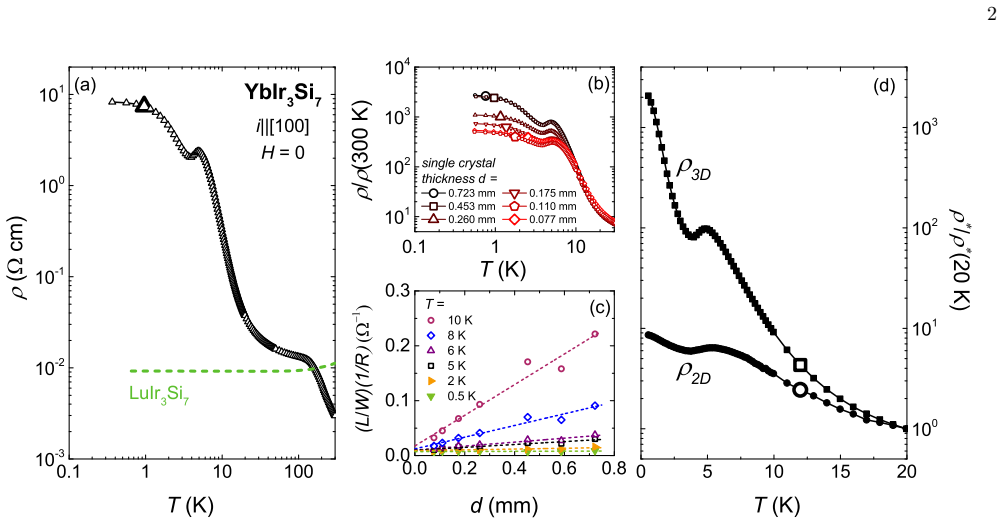
The central mechanism is the Kondo exhaustion scenario, where the control parameter is the ratio of conduction-electron density to local-moment density: when the ratio is far below one, the Kondo screening cloud cannot form around every moment and the system evolves into an insulating state as all available carriers are bound into singlets. The paper's experimental key is a thickness-dependent resistance analysis based on the parallel bulk and surface conduction formula 1/R = (W/L)(d/ρ3D + 1/ρ2D), whose linear fits in sample thickness d yield the bulk resistivity ρ3D(T) and surface resistivity ρ2D(T) separately. This decomposition shows that the bulk becomes insulating while the surface stays conductive, the signature of exhaustion plus a surface channel.
What would settle it
Measure the Hall coefficient on a bulk single crystal of YbIr3Si7 as a function of temperature down to dilution temperatures. If the extracted carrier density per unit cell is not much smaller than the Yb concentration, or if the bulk resistivity extracted from thickness-dependent measurements saturates to a finite value rather than diverging, the Kondo exhaustion claim is falsified.
Extended reading notes
Core claim
The paper's central claim is that YbIr3Si7 is a Kondo lattice in which the number of conduction carriers is much smaller than the number of Yb3+ local moments, driving the system into the exhaustion regime: the few carriers are consumed to form Kondo singlets, so the bulk electrical resistivity rises by roughly four orders of magnitude on cooling from 300 K to 0.3 K and the bulk conductivity tends to zero in the zero-temperature limit. The authors show that this happens despite the onset of antiferromagnetic long-range order at TN = 4.1 K, with moments along the c axis in a Γ1 configuration and an ordered moment of 1.51 μB, and they separate the intrinsic bulk resistivity from a more conductive surface channel by measuring the total resistance as a function of crystal thickness. They attribute the surface conduction to a valence change to nonmagnetic Yb2+ near the surface and/or to a possible topological surface state, and they note that the isostructural compound YbRh3Si7 does not show these surface states.
Load-bearing premise
The load-bearing premise is that the number of conduction carriers in YbIr3Si7 is much smaller than the number of Yb moments; the paper infers this from the large resistivity of the nonmagnetic analog LuIr3Si7 and the overall resistivity scale, but never measures the carrier density directly.
Editorial extensions
If this is right
- If the exhaustion claim holds, the low-temperature insulating gap of YbIr3Si7 is a many-body effect of Kondo physics, not captured by single-particle DFT, which predicts a metal.
- The coexistence of exhaustion with antiferromagnetic order shows that Kondo screening and magnetic ordering are not mutually exclusive here; the system orders magnetically and still runs out of carriers.
- The thickness-dependent transport provides a quantitative way to separate surface from bulk conduction, and the surface channel persists to the lowest temperatures while the bulk becomes insulating.
- The material is a candidate topological Kondo insulator; the presence of surface states in YbIr3Si7 but not in YbRh3Si7 points to stronger spin-orbit coupling or surface-valence effects as the origin.
- The large negative magnetoresistance (about -95% below TN) is consistent with magnetic field disrupting Kondo singlets and freeing carriers, supporting the exhaustion picture.
Reading between the lines
- A direct Hall-effect or quantum-oscillation measurement of carrier density would test the core premise: if the carrier count per Yb is not much less than one, the exhaustion interpretation would need to be replaced by a gap-formation or localization scenario.
- If the surface conduction indeed comes from nonmagnetic Yb2+ formed by reduced chemical pressure, then surface treatments such as argon-ion etching, gating, or capping could tune the surface channel and allow the bulk exhaustion to be observed in isolation.
- The DFT finding of a conduction band that fails to hybridize with the f band raises the possibility that exhaustion applies to only part of the Fermi surface; multi-band effects could be probed by doping or pressure experiments that change the carrier-to-moment ratio.
- Applying pressure or chemical substitution that increases the carrier density should drive YbIr3Si7 out of the exhaustion regime and toward a conventional heavy-fermion metal, providing a tunable test of the scenario.
Signed reviews
Editorial analysis
A structured set of objections, weighed in public.
Referee Report
Summary. Stavinoha et al. present a combined transport, thermodynamic, neutron diffraction, XPS, and DFT study of YbIr3Si7. The main experimental findings are a strongly insulating bulk resistivity that rises by about four orders of magnitude down to 0.3 K, a clear antiferromagnetic transition at TN = 4.1 K with a k = 0, Gamma_1 structure and ordered moment 1.51(5) mu_B, and a thickness-dependent resistivity that the authors decompose into a poorly conducting bulk and a more conductive surface channel. They interpret the vanishing bulk conductivity as a manifestation of 'Kondo exhaustion,' in which the number of free carriers is much smaller than the number of Yb moments and all carriers are consumed in forming Kondo singlets; the small magnetic entropy at TN is read as evidence of Kondo screening, and XPS suggests a surface valence change to Yb2+. The paper also reports DFT+U band structures that predict a metal, and it appends a note about a published study on Sb-flux-grown YbIr3Si7 with drastically different properties, attributed to Sb incorporation.
Significance. If the Kondo exhaustion scenario were established, YbIr3Si7 would be a rare, possibly first, magnetic Kondo-insulator-like material with a conductive surface, with implications for strong-correlation and topological physics. The paper's concrete strengths are the high-quality neutron refinement of the AFM structure, the careful extraction of the bulk/surface transport decomposition from the thickness scaling, and the clear field-temperature phase diagram. However, the central claim is not yet supported because no direct carrier-density measurement is presented, and the thermodynamic entropy appears quantitatively inconsistent with the strong-exhaustion limit as stated. The manuscript is valuable as a report of an unusual insulating antiferromagnet with surface conduction, but the exhaustion interpretation requires either new measurements or substantial reframing.
major comments (4)
- [Abstract and main text, Fig. 1(a)] The central claim that YbIr3Si7 has 'much less' free carriers than Yb moments is not supported by any carrier-counting measurement. The argument that the nonmagnetic analog LuIr3Si7 has a large, weakly temperature-dependent resistivity and therefore the RIr3Si7 class is low-carrier is not conclusive, because a large resistivity can also arise from low mobility or from a small gap in the Lu compound. A Hall coefficient, quantum oscillation, or optical conductivity measurement is needed to establish the carrier density n_c; without it, the 'Kondo exhaustion' interpretation is not distinguished from conventional gap or localization scenarios.
- [Main text, Fig. 2(a) and entropy discussion] The reported entropy at TN appears to contradict the strong-exhaustion limit. The authors find Smag(TN) approx 0.15 R ln2 and interpret this as Kondo screening. In the exhaustion regime with n_c << n_Yb, only a fraction of order n_c/n_Yb of the Yb moments can be screened by conduction electrons, so the unscreened moments that order at TN should release an entropy of order (1 - n_c/n_Yb) R ln2. A release of only ~15% R ln2 at TN would imply n_c/n_Yb approximately 0.85, i.e., not 'much less' than the moment density. Alternatively, using the conventional relation Smag(0.5 TK) = 0.5 R ln2 to extract TK approx 16 K presupposes n_c of order n_m. The authors need a quantitative exhaustion model that reproduces the entropy balance, or they should soften the exhaustion claim.
- [Eq. (1), Fig. 1(c), and Supplementary Fig. S7] The thickness-scaling analysis in Eq. (1) is a standard bulk/surface decomposition and does not by itself establish Kondo exhaustion; it shows only that the bulk is highly resistive and the surface is comparatively conductive. The DFT+U calculation (Supplementary Fig. S7) fails to reproduce an insulating gap, and the paper does not compare the extracted rho_3D(T) with quantitative predictions of the exhaustion scenario (e.g., the results of Meyer and Nolting). Because the bulk conductivity could vanish due to gap formation or carrier localization for reasons unrelated to carrier exhaustion, the central interpretation remains unverified by the presented data.
- [Appended note on Nakamura et al.] The appended note states that Nakamura et al. reported drastically different properties in YbIr3Si7 single crystals grown from Sb flux and attributes the difference to Sb incorporation. Since no compositional analysis of the present crystals or direct comparison with the Nakamura samples is provided, the possibility that the observed exhaustion behavior and surface states are sample-specific rather than intrinsic remains open. This concern should be addressed in the main text, ideally with compositional data or a side-by-side comparison of measured properties.
minor comments (4)
- [Title] The manuscript title contains typographical spacing issues: 'antiferr omagnetic' and 'YbIr 3Si7' should read 'antiferromagnetic' and 'YbIr3Si7'.
- [DFT section, Supplementary Material] The text says the calculation includes 'scalar spin-orbit coupling'; spin-orbit coupling is a vector interaction, so the intended phrase is likely 'scalar-relativistic' or simply 'spin-orbit coupling'.
- [Fig. 1(c) and extracted resistivities] Uncertainties on rho_3D(T) and rho_2D(T) obtained from the linear fits in Fig. 1(c) are not reported. Given that these values underpin the quantitative bulk/surface decomposition, the authors should give uncertainties or the fitting residuals.
- [Abstract] The abstract phrase 'the electrical conductivity tends to zero at low temperatures' is imprecise for the measured macroscopic crystal, since the total measured conductivity does not tend to zero because of the surface channel; the bulk conductivity is obtained only through the fitting model.
Circularity Check
No circularity: Kondo-exhaustion claim is an interpretation of independent transport and thermodynamic data against external theory, not a quantity fitted from its own equations.
full rationale
The paper's central claim—that YbIr3Si7 realizes Kondo exhaustion—is not derived by fitting a parameter that is then renamed as the prediction. The bulk/surface conductivity separation uses a standard geometric parallel-resistor model (Eq. 1), with both parameters extracted from thickness-dependent resistance data; this is a decomposition, not a fit of the exhaustion result. The low-carrier-density premise is inferred from the large, weakly temperature-dependent resistivity of the nonmagnetic analog LuIr3Si7 and from the overall scale of YbIr3Si7's resistivity; this inference is open to challenge (no Hall or quantum-oscillation carrier count is reported), but it is not circular. The comparison with Nozières and with Meyer–Nolting is external published theory, not a self-citation. The estimated TK from Smag(0.5TK)=0.5 R ln2 is a standard Kondo-model relation, and using it to interpret a resistivity inflection is a mild interpretive loop, but it is not load-bearing for the exhaustion claim and no quantitative prediction is forced by construction. The appended Nakamura note about drastically different properties in Sb-flux crystals is a sample-chemistry caveat rather than a circular dependency. No step in the paper reduces a claimed prediction to its own inputs by definition or by self-citation chain; hence the circularity score is 0.
Assumptions & free parameters
free parameters (1)
- Hubbard U on Yb f orbitals =
4 eV (chosen)
assumptions (4)
- domain assumption The RIr3Si7 material class has very low carrier density, so in YbIr3Si7 n_c << n_m.
- domain assumption The Nozieres/Meyer-Nolting Kondo exhaustion scenario applies to YbIr3Si7.
- domain assumption The two-channel conduction model (insulating bulk in parallel with a 2D conductive surface) is valid.
- domain assumption The 100 K resistivity inflection is due to Kondo correlations rather than CEF or structural effects.
Cite this review
Pith. "Pith review of Kondo exhaustion and conductive surface states in antiferromagnetic YbIr$_3$Si$_7$." pith.science (2026). https://pith.science/paper/GDP34QPC
@misc{pith2026190811336,
  author       = {Pith},
  title        = {Pith review of: Kondo exhaustion and conductive surface states in antiferromagnetic YbIr$_3$Si$_7$},
  year         = {2026},
  howpublished = {\url{https://pith.science/paper/GDP34QPC}},
  note         = {Machine review of arXiv:1908.11336}
}
abstract
The interplay of Kondo screening and magnetic ordering in strongly correlated materials containing local moments is a subtle problem.[1] Usually the number of conduction electrons matches or exceeds the number of moments, and a Kondo-screened heavy Fermi liquid develops at low temperatures.[2] Changing the pressure, magnetic field, or chemical doping can displace this heavy Fermi liquid in favor of a magnetically ordered state.[3,4] Here we report the discovery of a version of such a `Kondo lattice' material, YbIr$_3$Si$_7$, in which the number of free charge carriers is much less than the number of local moments. This leads to `Kondo exhaustion':[5] the electrical conductivity tends to zero at low temperatures as all the free carriers are consumed in the formation of Kondo singlets. This effect coexists with antiferromagnetic long-range order, with a N\'eel temperature $T\rm_N = 4.1\,{\rm K}$. Furthermore, the material shows conductive surface states with potential topological nature, and thus presents an exciting topic for future investigations.
Figures


Reference graph
Works this paper leans on
-
[1]
R. Schaffer, E. Kin-Ho Lee, B.-J. Yang, and Y. B. Kim, Reports on Progress in Physics 79, 094504 (2016)
work page 2016
-
[2]
On warming above TN, the H ‖[001] data (full diamonds in Fig
Temperature- dependent M /H measurements with µ 0H = 0.1 T con- firm the magnetic phase transition as small inflections are observed on cooling for both H ‖[100] (circles) and H ‖[001] (diamonds). On warming above TN, the H ‖[001] data (full diamonds in Fig. 2b) display a broad maximum centered around 10 K, while a similar feature at 10 K is absent in the [...
-
[3]
3) on YbIr 3Si7 confirm the trivalent state of the Yb ions in the bulk
and neutron diffraction data (Fig. 3) on YbIr 3Si7 confirm the trivalent state of the Yb ions in the bulk. However, XPS measure- ments probe a smaller volume-to-surface ratio than bulk measurements, and are more sensitive to surface valence changes. Our XPS data (Supplementary Materials, Fig. S8) on YbIr 3Si7 reveal mixed valence of the Yb ions in the measu...
-
[4]
H. Kontani and K. Yamada, Journal of the Physical So- ciety of Japan 74, 155 (2005)
work page 2005
-
[5]
G. R. Stewart, Review of Modern Physics 73, 797 (2001)
work page 2001
-
[6]
G. R. Stewart, Review of Modern Physics 78, 743 (2006)
work page 2006
- [7]
-
[8]
Dzero, J
M. Dzero, J. Xia, V. Galitski, and P. Coleman, Annual Review of Condensed Matter Physics 7, 249 (2016)
2016
Show all 32 references
-
[9]
Dzero, K
M. Dzero, K. Sun, V. Galitski, and P. Coleman, Physical review letters 104, 106408 (2010)
2010
-
[10]
Nakotte, N
H. Nakotte, N. Dilley, M. Torikachvili, H. Bordallo, M. Maple, S. Chang, A. Christianson, A. Schultz, C. Ma- jkrzak, and G. Shirane, Physica B: Condensed Matter 259, 280 (1999)
1999
-
[11]
Kawabata, T
J. Kawabata, T. Ekino, Y. Yamada, Y. Sakai, A. Sugi- moto, Y. Muro, and T. Takabatake, Physical Review B 92, 201113 (2015)
2015
-
[12]
B. K. Rai, S. Chikara, X. Ding, I. W. H. Oswald, R. Sch¨ onemann, V. Loganathan, A. M. Hallas, H. B. Cao, M. Stavinoha, T. Chen, H. Man, S. Carr, J. Sin- gleton, V. Zapf, K. A. Benavides, J. Y. Chan, Q. R. Zhang, D. Rhodes, Y. C. Chiu, L. Balicas, A. A. Aczel, Q. Huang, J. W. ...
2018
-
[13]
Nozi` ere, Ann
P. Nozi` ere, Ann. Phys. (Paris) 10, 19 (1985)
1985
-
[14]
Nozi` ere, Eur
P. Nozi` ere, Eur. Phys. J. B 6, 447 (1998)
1998
-
[15]
B. K. Rai, M. Stavinoha, J. Banda, D. Hafner, K. A. Be- navides, D. Sokolov, J. Chan, M. Brando, C.-L. Huang, and E. Morosan, Phys. Rev. B(R) 99, 121109 (2019)
2019
-
[16]
Hundley, P
M. Hundley, P. Canfield, J. Thompson, Z. Fisk, and J. Lawrence, Physical Review B 42, 6842 (1990)
1990
-
[17]
Das and E
I. Das and E. Sampathkumaran, Physical Review B 51, 1308 (1995)
1995
-
[18]
Menth, E
A. Menth, E. Buehler, and T. Geballe, Physical Review Letters 22, 295 (1969)
1969
-
[19]
Kasaya, F
M. Kasaya, F. Iga, K. Negishi, S. Nakai, and T. Kasuya, Journal of Magnetism and Magnetic Materials 31, 437 (1983)
1983
-
[20]
Kasaya, F
M. Kasaya, F. Iga, M. Takigawa, and T. Kasuya, Journal of Magnetism and Magnetic Materials 47, 429 (1985)
1985
-
[21]
Meisner, M
G. Meisner, M. Torikachvili, K. Yang, M. Maple, and R. Guertin, Journal of Applied Physics 57, 3073 (1985)
1985
-
[22]
Syers, D
P. Syers, D. Kim, M. S. Fuhrer, and J. Paglione, Physical review letters 114, 096601 (2015)
2015
-
[23]
Phelan, S
W. Phelan, S. Koohpayeh, P. Cottingham, J. Freeland, J. Leiner, C. Broholm, and T. McQueen, Physical Re- view X 4, 031012 (2014)
2014
-
[24]
Hafner, B
D. Hafner, B. K. Rai, J. Banda, K. Kliemt, C. Krellner, J. Sichelschmidt, E. Morosan, C. Geibel, and M. Brando, Physical Review B 99, 201109(R) (2019)
2019
-
[25]
Johansson, Physical Review B 19, 6615 (1979)
B. Johansson, Physical Review B 19, 6615 (1979)
1979
-
[26]
J. Lynn, Y. Chen, S. Chang, Y. Zhao, S. Chi, W. Ratcliff, et al. , Journal of research of the National Institute of Standards and Technology 117, 61 (2012)
2012
-
[27]
Rodr ´ ıguez-Carvajal, Physica B: Condensed Matter 192, 55 (1993)
J. Rodr ´ ıguez-Carvajal, Physica B: Condensed Matter 192, 55 (1993)
1993
-
[28]
Torikachvili, C
M. Torikachvili, C. Rossel, M. McElfresh, M. Maple, R. Guertin, and G. Meisner, journal of Magnetism and Magnetic Materials 54, 365 (1986)
1986
-
[29]
Cooley, C
J. Cooley, C. Mielke, W. Hults, J. Goettee, M. Honold, R. Modler, A. Lacerda, D. Rickel, and J. Smith, Journal of superconductivity 12, 171 (1999)
1999
-
[30]
J. P. Perdew, K. Burke, and M. Ernzerhof, Physical review letters 77, 3865 (1996)
1996
-
[31]
Blaha, K
P. Blaha, K. Schwarz, G. K. Madsen, D. Kvasnicka, and J. Luitz, An augmented plane wave+ local orbitals pro- gram for calculating crystal properties (2001)
2001
-
[32]
V. I. Anisimov, I. Solovyev, M. Korotin, M. Czy˙ zyk, and G. Sawatzky, Physical Review B 48, 16929 (1993). 6 SUPPLEMENTAR Y MATERIALS Crystallography Single crystals of YbIr 3Si7 were oriented using back scattering x-ray Laue diffraction along [100] and [001] in the equivalent ...
1993
Reviewed August 14, 2026 · model on record in the stance chip above.
Discussion (0). Continue with ORCID to comment.