REVIEW 4 major objections 3 minor 2 cited by
CRexit: how different cosmic ray transport modes affect thermal instability in the circumgalactic medium
T0 review · 4 major / 3 minor · reviewed 2026-08-09 · deepseek-v4-flash
Pith's one-line read Cosmic rays escape collapsing CGM clouds before they can block condensation.
desk verdict Solid, useful 3D CRMHD comparison whose qualitative conclusion — CRs escape collapsing clouds under 2-moment transport — likely holds, but the quantitative κ_eff rests on an untested Alfvén-wave seed and an under-resolved cold phase. read the letter →
The pith
A machine-rendered reading of the paper's core claim, the machinery that carries it, and where it could break.
The reading
What carries the argument
The load-bearing object is the effective CR diffusion coefficient $\kappa_{\rm eff} = f_{\rm cr}/(\mathbf{b}\cdot\nabla\varepsilon_{\rm cr})$, which condenses CR streaming and diffusion into a single number; in the purely diffusive limit it equals the intrinsic diffusion coefficient $\kappa_{\rm cr}$. It is paired with the escape-time ratio $t_{\rm cr}/t_{\rm collapse}$, where $t_{\rm cr} = r_{\rm cloud}^2/\kappa_{\rm eff}$ and the collapse time is approximated by the cloud's cooling time $t_{\rm cool}$. The two-moment transport scheme with the $P_1$ Eddington closure carries the argument: it evolves CR energy density and flux, letting the scattering rate emerge from gyroresonant Alfvén-wave generation balanced against non-linear Landau damping. From this scheme $\kappa_{\rm eff}$ spans roughly $10^{25}$ to $10^{35}\,\mathrm{cm^2\,s^{-1}}$, with CR-energy-weighted medians of $1.3\times10^{29}$ to $8\times10^{29}\,\mathrm{cm^2\,s^{-1}}$ depending on the initial CR pressure fraction, and the same machinery produces the open CR-motorway field topology that lets CRs drain out of clouds.
What would settle it
Rerun the highest-resolution run with $X_{\rm cr,0}=3$ at twice the resolution and track cloud radii and $\kappa_{\rm eff}$; if the escape-time ratio $t_{\rm cr}/t_{\rm collapse}$ moves above unity or the CR-energy-weighted $\kappa_{\rm eff}$ falls below roughly $3\times10^{28}\,\mathrm{cm^2\,s^{-1}}$, the claim that CRs always escape before collapse would fail. Observationally, gamma-ray or radio signatures of CRs trapped in cold CGM clouds, or absorption-line measurements implying sustained CR pressure support, would provide the same test.
Extended reading notes
Core claim
The central claim is that active cosmic-ray transport, not CR pressure itself, determines whether CRs affect thermally unstable circumgalactic gas. In the two-moment CR-magnetohydrodynamic model, CRs stream along magnetic field lines and diffuse with an effective coefficient $\kappa_{\rm eff} = f_{\rm cr}/(\mathbf{b}\cdot\nabla\varepsilon_{\rm cr})$, so the rate at which they leave a cloud is set by the escape time $t_{\rm cr} = r_{\rm cloud}^2/\kappa_{\rm eff}$. The open, flux-frozen field lines that pierce a collapsing cloud act as escape routes, which the authors call CR motorways, so CRs drain out before their pressure can build up. Comparing this escape time with the cloud collapse time, approximated by the cooling time $t_{\rm cool}$, gives median ratios around $6\times10^{-2}$ in the fast-transport runs, and the relative CR pressure inside clouds stays too low to halt contraction. The same ratio explains the apparent contradiction with earlier work: with slower diffusion ($\kappa_0 = 3\times10^{27}$ or $3\times10^{28}\,\mathrm{cm^2\,s^{-1}}$) or with the artificially large clouds of low-resolution runs, $t_{\rm cr}/t_{\rm collapse}$ rises toward or above unity and CR pressure support becomes significant. The authors conclude that in realistic CR transport models the cold phase of the CGM forms essentially as if CRs were absent.
Load-bearing premise
The conclusion relies on the two-moment cosmic-ray transport model, with non-linear Landau damping as the only wave-damping mechanism and a reduced speed of light of 3000 km/s, predicting the correct effective diffusion coefficient inside and around condensing clouds; if real clouds diffuse cosmic rays an order of magnitude more slowly, their pressure support could again become significant.
Editorial extensions
If this is right
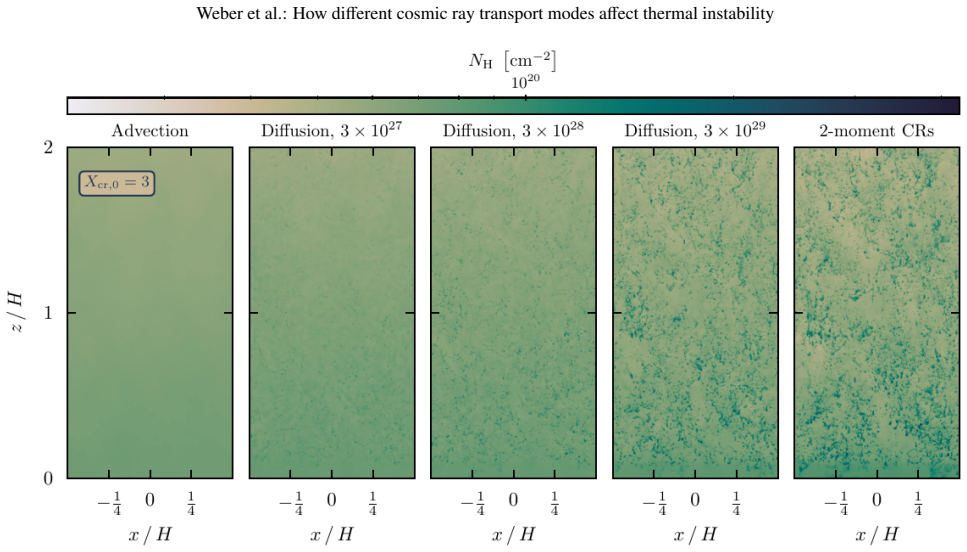
- In the two-moment model, the cold-gas morphology and cold-mass fraction barely depend on the initial CR pressure, from purely thermal ($X_{\rm cr,0}=0$) to strongly CR-dominated ($X_{\rm cr,0}=30$) atmospheres.
- A diffusion-only model with $\kappa_0 = 3\times10^{29}\,\mathrm{cm^2\,s^{-1}}$ reproduces the two-moment results, whereas slower diffusion ($3\times10^{27}$ or $3\times10^{28}$) delays or suppresses condensation.
- The onset of collapse is governed by the CR transport speed rather than by the CR pressure fraction, so conclusions about CR stabilization must be tied to a specific transport model.
- Numerical resolution changes cloud radii and therefore $t_{\rm cr}$ quadratically; low-resolution runs produce clouds up to about ten times larger, with relative CR pressures of $X_{\rm cr}\sim10$-$22$, while high-resolution runs yield $X_{\rm cr}\sim4$-$8$ and mostly escape-dominated clouds.
- Purely advective CR transport, which blocks escape, can suppress thermal instability entirely for $X_{\rm cr,0}=3$, but the authors identify this as an idealized limiting case rather than a realistic outcome.
Reading between the lines
- This suggests that galaxy-scale simulations that cannot resolve the cooling length should adopt CR transport with an effective diffusivity comparable to the two-moment values, otherwise they will overstate CR pressure support for cold clouds.
- The CR-motorway picture implies a testable condition: clouds whose internal magnetic field reconnects into closed loops should confine CRs longer and collapse more slowly, which could be checked with simulations using different initial magnetic topologies.
- Fast CR escape also weakens CR heating inside cold clouds, so the thermal balance of the cold CGM may be closer to radiative equilibrium than CR-regulated models assume; line-ratio observations sensitive to CR heating could constrain this.
- If observed CGM clouds sit near the cooling-length scale, they would belong to the fast-escape end of the distribution shown here, making CR pressure support small in real systems.
Editorial analysis
A structured set of objections, weighed in public.
Referee Report
Summary. This paper uses idealized 3D CRMHD simulations of a stratified, isocooling CGM box to study how cosmic ray transport affects thermal instability and cold cloud formation. It compares purely advective CR transport, constant-diffusion transport with three different diffusion coefficients, and a 2-moment streaming/diffusion model, across initial CR pressure fractions from X_cr,0 = 0 to 30. The main finding is that with 2-moment transport, the effective CR diffusion coefficient is large, the CR escape time from collapsing clouds is short compared with the cloud collapse time, and TI proceeds almost as if CRs were absent. Purely advective CRs, by contrast, strongly suppress or delay collapse. The paper also argues that numerical resolution controls cloud sizes and therefore strongly affects the CR escape time because t_cr ~ r_cloud^2.
Significance. If the central result holds, the paper is significant: it challenges the common expectation that CR pressure stabilizes cold CGM gas, and it offers a concrete physical explanation based on escape along open magnetic field lines combined with the effective diffusion coefficient. The systematic comparison of transport models, the use of the 2-moment CRMHD framework, and the explicit resolution study are strengths. The paper is also careful to state several limitations, including the unresolved cooling length in Appendix A and the dependence on the initial Alfvén wave energy. However, the quantitative central claim is sensitive to two unconstrained choices: the seed Alfvén wave energy and the numerical resolution of cold clouds. These choices directly set the value of kappa_eff inside the clouds and hence the controlling ratio t_cr/t_collapse. The result is therefore a compelling but not yet fully robust conclusion.
major comments (4)
- [§4, Fig. 5; §9 point 1] The claim that purely advective CRs suppress TI is entangled with the initialization. The turbulent velocity field is normalized to X_kin,0 = 0.3 in every run regardless of X_cr,0 (Sec. 3.4), so runs with larger CR pressure have weaker initial density perturbations. The text itself states in §4 that the complete suppression in the X_cr,0 = 3 advective run arises from the method used to generate the initial density perturbations, yet the abstract and Conclusion 1 attribute this suppression to CR pressure. This should be rephrased, or a control suite with the perturbation amplitude normalized to the total pressure should be added.
- [§6.3, Eq. (17)] The paper does not specify how kappa_eff is assigned to each cloud when computing t_cr = r_cloud^2/kappa. If the value used is the global CR-energy-weighted median from Sec. 6.1 rather than a value evaluated inside or immediately around the cold cloud, the resulting distribution of t_cr/t_collapse and the quoted median of about 0.06 may not measure escape from collapsing clouds. Because this ratio is the controlling parameter for the central claim, the exact cell selection and weighting used in Fig. 13 should be stated, and a cloud-local variant of kappa_eff should be provided.
- [§3.4, Eq. (13)] The central escape-time result is sensitive to the initial Alfvén wave energy density, which is set to epsilon_a,0 = 10^-3 epsilon_cr,0 in all 2-moment runs. Since kappa_cr is proportional to B^2/epsilon_a (Eq. 13), this small seed produces very weak initial scattering and a very large initial kappa_cr. A turbulent CGM could contain a larger pre-existing wave population; for example, increasing epsilon_a by a factor of 10 lowers kappa_cr by the same factor and raises t_cr/t_collapse from about 0.06 to about 0.6, which is the difference between prompt escape and marginal confinement. The discussion in Sec. 8.2 of additional damping mechanisms does not constrain the seed wave energy. A small parameter study around epsilon_a,0 is needed to establish robustness.
- [Appendix A; §7.2] Appendix A shows that gas below about 10^5 K has cooling lengths smaller than the cell size, and the resolution study in Sec. 7 does not demonstrate convergence at the highest-resolution run. Because t_cr depends quadratically on r_cloud (Eq. 17) and the simulated cloud radii decrease monotonically with resolution, the reported values of t_cr/t_collapse remain resolution-dependent. Under-resolution can also smooth CR pressure gradients inside the smallest clouds, suppress gyroresonant wave generation, and artificially increase kappa_eff. The net effect on the quoted median ratio is not quantified. The authors should either add a converged resolution or bracket kappa_eff and r_cloud using a model for the unresolved small-scale structure.
minor comments (3)
- [Fig. 13 caption] The caption contains typographical errors: 'tcr/tcollaspe' should be 't_cr/t_collapse', and 'clouds collapse is slower' should read 'cloud collapse is slower'.
- [Abstract; §6.1] The abstract states that the effective CR diffusion coefficient ranges from 10^29 to 10^30 cm^2/s, while Fig. 10 shows a full distribution spanning roughly 10^25 to 10^35 cm^2/s. The abstract is presumably referring to the CR-energy-weighted median values reported in Sec. 6.1; this should be clarified to avoid an apparent inconsistency.
- [§6.3] The collapse time is approximated by the cooling time estimated from the mean cloud density and mean internal energy. Since t_cool varies by orders of magnitude within a single cloud, a sensitivity test using the density-weighted cooling time or the cooling time of the densest cells would clarify whether the escape-time ratio is robust to this choice.
Circularity Check
No significant circularity: the escape-time conclusion is a diagnostic of an evolved simulation, not a fitted or self-referential input.
full rationale
The paper's derivation chain is: initialize an isocooling CGM with a stated CR pressure fraction, evolve with three transport models (advective, constant-diffusion, and 2-moment CRMHD), and diagnose cold clouds and the CR escape time t_cr = r_cloud^2/kappa_eff. No parameter is fitted to the target conclusion. kappa_eff is a model output defined by Eq. 15 (f_cr/(b·del eps_cr)), and the reported median values are computed from the simulation, not imposed. The constant-diffusion runs use independently chosen values (3e27, 3e28, 3e29 cm^2/s) that bracket the canonical ISM value and the 2-moment result, and the 2-moment run is compared with Butsky et al. (2020) and Tsung et al. (2023). The 2-moment CRMHD solver is cited from the authors' own papers (Thomas & Pfrommer 2019; Thomas et al. 2021, 2023), but the key equations are restated in the text and the method is not invoked as an external uniqueness theorem; this is ordinary method self-citation and is not load-bearing in the sense of making the conclusion true by construction. The freely chosen Alfven-wave seed eps_a,0 = 1e-3 eps_cr,0 and the under-resolution of T < 1e5 K gas noted in Appendix A are modeling uncertainties that could change the magnitude of kappa_eff, but an assumption that enters a simulation and a conclusion drawn from its output is not circularity unless the conclusion is used to justify the assumption, which does not happen here. Sec. 8.2 explicitly lists neglected damping mechanisms and positions the result as a bound; this is a stated limitation, not a hidden circularity. The central claim is therefore self-contained against the stated model and external comparisons, with no fitted parameter renamed as a prediction.
Assumptions & free parameters
free parameters (7)
- Initial CR pressure fraction X_cr,0 =
0.03, 0.3, 3, 30
- Initial kinetic-to-thermal pressure ratio X_kin,0 =
0.3
- Initial magnetic-to-thermal pressure ratio X_mag,0 =
0.01
- Cooling-to-free-fall time ratio tau =
0.3
- Constant diffusion coefficient kappa_0 in diffusion-only runs =
3e27, 3e28, 3e29 cm^2/s
- Reduced speed of light c_red =
3000 km/s
- Initial Alfven wave energy density eps_a,0 =
1e-3 eps_cr,0
assumptions (5)
- domain assumption CRs are tied to magnetic field lines and transported anisotropically along them, with gyroradii much smaller than CGM scales.
- domain assumption Non-linear Landau damping dominates wave damping in the CGM; other damping mechanisms are neglected.
- domain assumption The isocooling, hydrostatic, turbulent box with global heating balancing cooling is a representative CGM patch.
- domain assumption The cloud collapse time is approximately the cooling time, t_collapse ~ t_cool.
- domain assumption The reduced speed of light of 3000 km/s does not alter the effective CR transport in the simulated environments.
Cite this review
Pith. "Pith review of CRexit: how different cosmic ray transport modes affect thermal instability in the circumgalactic medium." pith.science (2026). https://pith.science/paper/GDWW45GB
@misc{pith2026250118678,
  author       = {Pith},
  title        = {Pith review of: CRexit: how different cosmic ray transport modes affect thermal instability in the circumgalactic medium},
  year         = {2026},
  howpublished = {\url{https://pith.science/paper/GDWW45GB}},
  note         = {Machine review of arXiv:2501.18678}
}
abstract
The circumgalactic medium (CGM) plays a critical role in galaxy evolution, influencing gas flows, feedback processes, and galactic dynamics. Observations show a substantial cold gas reservoir in the CGM, but the mechanisms driving its formation and evolution remain unclear. Cosmic rays (CRs), as a source of non-thermal pressure, are increasingly recognized as key regulators of cold gas dynamics. This study explores how CRs affect cold clouds that condense from the hot CGM via thermal instability (TI). Using 3D CR-magnetohydrodynamic (CRMHD) simulations with AREPO, we assess the impact of various CR transport models on cold gas evolution. Under purely advective CR transport, CR pressure significantly suppresses the collapse of thermally unstable regions, altering the CGM's structure. In contrast, realistic CR transport models reveal that CRs escape collapsing regions via streaming and diffusion along magnetic fields, diminishing their influence on the thermal and dynamic structure of the cold CGM. The ratio of the CR escape time to the cloud collapse time emerges as a critical factor in determining the impact of CRs on TI. CRs remain confined within cold clouds when effective CR diffusion is slow which maximizes their pressure support and inhibits collapse. Fast effective CR diffusion, as realized in our 2-moment CRMHD model, facilitates rapid CR escape, reducing their stabilizing effect. This realistic CR transport model shows a wide dynamic range of the effective CR diffusion coefficient, ranging from $10^{29}$ to $10^{30}\,\mathrm{cm^{2}\,s^{-1}}$ for thermally- to CR-dominated atmospheres, respectively. In addition to these CR transport-related effects, we demonstrate that high numerical resolution is crucial to avoid spuriously large clouds formed in low-resolution simulations, which would result in overly long CR escape times and artificially amplified CR pressure support.
Figures


Figures from the paper (14 more)




Forward citations
Cited by 2 Pith papers
-
Cosmic ray heating of cold streams: Implications for the gas supply and growth of massive galaxies
Externally entrained cosmic-web CRs weakly heat dense cold-stream cores but can strongly heat diffuse and mixed interface gas in massive haloes, adding selectivity to cold accretion.
-
CRexit observed: probing cosmic ray transport in the circumgalactic medium with absorption line spectra
Efficient cosmic-ray transport in CR-pressure-dominated CGM simulations produces stronger cool-gas absorption (MgII, SiII) and covering fractions matching star-forming galaxies, while slow transport underproduces them.
Reference graph
Works this paper leans on
-
[1]
, " * write output.state after.block = add.period write newline
ENTRY address archiveprefix author booktitle chapter edition editor howpublished institution eprint journal key month note number organization pages publisher school series title type volume year label extra.label sort.label short.list INTEGERS output.state before.all mid.sentence after.sentence after.block FUNCTION init.state.consts #0 'before.all := #1 ...
-
[2]
write newline
" write newline "" before.all 'output.state := FUNCTION n.dashify 't := "" t empty not t #1 #1 substring "-" = t #1 #2 substring "--" = not "--" * t #2 global.max substring 't := t #1 #1 substring "-" = "-" * t #2 global.max substring 't := while if t #1 #1 substring * t #2 global.max substring 't := if while FUNCTION word.in bbl.in " " * FUNCTION format....
-
[3]
, " * write output.state after.block = add.period write newline
ENTRY address archiveprefix author booktitle chapter edition editor howpublished institution eprint doi url journal key month note number organization pages publisher school series title type volume year adsurl label extra.label sort.label short.list INTEGERS output.state before.all mid.sentence after.sentence after.block FUNCTION init.state.consts #0 'be...
-
[4]
write newline
" write newline "" before.all 'output.state := FUNCTION n.dashify 't := "" t empty not t #1 #1 substring "-" = t #1 #2 substring "--" = not "--" * t #2 global.max substring 't := t #1 #1 substring "-" = "-" * t #2 global.max substring 't := while if t #1 #1 substring * t #2 global.max substring 't := if while FUNCTION word.in bbl.in " " * FUNCTION format....
-
[5]
Anderson , M. E. & Bregman , J. N. 2010, http://dx.doi.org/10.1088/0004-637X/714/1/320 magenta , 714, 320 https://ui.adsabs.harvard.edu/abs/2010ApJ...714..320A
-
[6]
C., Kim , C.-G., & Jiang , Y.-F
Armillotta , L., Ostriker , E. C., Kim , C.-G., & Jiang , Y.-F. 2024, http://dx.doi.org/10.3847/1538-4357/ad1e5c magenta , 964, 99 https://ui.adsabs.harvard.edu/abs/2024ApJ...964...99A
-
[7]
Asplund , M., Grevesse , N., Sauval , A. J., & Scott , P. 2009, http://dx.doi.org/10.1146/annurev.astro.46.060407.145222 magenta , 47, 481 https://ui.adsabs.harvard.edu/abs/2009ARA&A..47..481A
arXiv 2009
-
[8]
2024, http://dx.doi.org/10.21105/joss.06296 magenta Journal of Open Source Software , 9, 6296
Berlok, T., Jlassi, L., Puchwein, E., & Haugbølle, T. 2024, http://dx.doi.org/10.21105/joss.06296 magenta Journal of Open Source Software , 9, 6296
Show all 140 references
-
[9]
& Cox , D
Boulares , A. & Cox , D. P. 1990, http://dx.doi.org/10.1086/169509 magenta , 365, 544 https://ui.adsabs.harvard.edu/abs/1990ApJ...365..544B
1990 doi
-
[10]
& Subramanian , K
Brandenburg , A. & Subramanian , K. 2005, http://dx.doi.org/10.1016/j.physrep.2005.06.005 magenta , 417, 1 https://ui.adsabs.harvard.edu/abs/2005PhR...417....1B
2005 doi
-
[11]
Bregman , J. N. 1980, http://dx.doi.org/10.1086/157776 magenta , 236, 577 https://ui.adsabs.harvard.edu/abs/1980ApJ...236..577B
1980 doi
-
[12]
L., Norman, M
Bryan, G. L., Norman, M. L., O'Shea, B. W., et al. 2014, http://dx.doi.org/10.1088/0067-0049/211/2/19 magenta The Astrophysical Journal Supplement Series , 211, 19
2014 doi
-
[13]
Buck , T., Pfrommer , C., Pakmor , R., Grand , R. J. J., & Springel , V. 2020, http://dx.doi.org/10.1093/mnras/staa1960 magenta , 497, 1712 https://ui.adsabs.harvard.edu/abs/2020MNRAS.497.1712B
2020 doi
-
[14]
J., Scannapieco , E., & Safarzadeh , M
Buie , II, E., Gray , W. J., Scannapieco , E., & Safarzadeh , M. 2020, http://dx.doi.org/10.3847/1538-4357/ab9535 magenta , 896, 136 https://ui.adsabs.harvard.edu/abs/2020ApJ...896..136B
2020 doi
-
[15]
S., Fielding , D
Butsky , I. S., Fielding , D. B., Hayward , C. C., et al. 2020, http://dx.doi.org/10.3847/1538-4357/abbad2 magenta , 903, 77 https://ui.adsabs.harvard.edu/abs/2020ApJ...903...77B
2020 doi
-
[16]
Butsky , I. S. & Quinn , T. R. 2018, http://dx.doi.org/10.3847/1538-4357/aaeac2 magenta , 868, 108 https://ui.adsabs.harvard.edu/abs/2018ApJ...868..108B
2018 doi
-
[17]
1992, http://dx.doi.org/10.1086/191630 magenta , 78, 341 https://ui.adsabs.harvard.edu/abs/1992ApJS...78..341C
Cen , R. 1992, http://dx.doi.org/10.1086/191630 magenta , 78, 341 https://ui.adsabs.harvard.edu/abs/1992ApJS...78..341C
1992 doi
-
[18]
L., et al
Chen, H.-W., Wild, V., Tinker, J. L., et al. 2010, http://dx.doi.org/10.1088/2041-8205/724/2/L176 magenta The Astrophysical Journal Letters , 724, L176
2010 doi
-
[19]
Choudhury , P. P. & Sharma , P. 2016, http://dx.doi.org/10.1093/mnras/stw152 magenta , 457, 2554 https://ui.adsabs.harvard.edu/abs/2016MNRAS.457.2554C
2016 doi
-
[20]
P., Sharma , P., & Quataert , E
Choudhury , P. P., Sharma , P., & Quataert , E. 2019, http://dx.doi.org/10.1093/mnras/stz1857 magenta , 488, 3195 https://ui.adsabs.harvard.edu/abs/2019MNRAS.488.3195C
2019 doi
-
[21]
L., Bicknell, G
Cooper, J. L., Bicknell, G. V., Sutherland, R. S., & Bland-Hawthorn, J. 2009, http://dx.doi.org/10.1088/0004-637X/703/1/330 magenta The Astrophysical Journal , 703, 330
2009 doi
-
[22]
& Nepusz, T
Csardi, G. & Nepusz, T. 2005, InterJournal, Complex Systems, 1695
2005
-
[23]
K., Choudhury , P
Das , H. K., Choudhury , P. P., & Sharma , P. 2021, http://dx.doi.org/10.1093/mnras/stab382 magenta , 502, 4935 https://ui.adsabs.harvard.edu/abs/2021MNRAS.502.4935D
2021 doi
-
[24]
& Dubois , Y
Dashyan , G. & Dubois , Y. 2020, http://dx.doi.org/10.1051/0004-6361/201936339 magenta , 638, A123 https://ui.adsabs.harvard.edu/abs/2020A&A...638A.123D
2020 doi
-
[25]
2019, http://dx.doi.org/10.1093/mnras/stz1527 magenta , 487, 3377 https://ui.adsabs.harvard.edu/abs/2019MNRAS.487.3377D
Decataldo , D., Pallottini , A., Ferrara , A., Vallini , L., & Gallerani , S. 2019, http://dx.doi.org/10.1093/mnras/stz1527 magenta , 487, 3377 https://ui.adsabs.harvard.edu/abs/2019MNRAS.487.3377D
2019 doi
-
[26]
P., Landi , E., Mason , H
Dere , K. P., Landi , E., Mason , H. E., Monsignori Fossi , B. C., & Young , P. R. 1997, http://dx.doi.org/10.1051/aas:1997368 magenta , 125, 149 https://ui.adsabs.harvard.edu/abs/1997A&AS..125..149D
1997 doi
-
[27]
& Voit , G
Donahue , M. & Voit , G. M. 2022, http://dx.doi.org/10.1016/j.physrep.2022.04.005 magenta , 973, 1 https://ui.adsabs.harvard.edu/abs/2022PhR...973....1D
2022 doi
-
[28]
Dursi , L. J. & Pfrommer , C. 2008, http://dx.doi.org/10.1086/529371 magenta , 677, 993 https://ui.adsabs.harvard.edu/abs/2008ApJ...677..993D
2008 doi
-
[29]
2011, http://dx.doi.org/10.1051/0004-6361/201015652 magenta , 527, A99 https://ui.adsabs.harvard.edu/abs/2011A&A...527A..99E
En lin , T., Pfrommer , C., Miniati , F., & Subramanian , K. 2011, http://dx.doi.org/10.1051/0004-6361/201015652 magenta , 527, A99 https://ui.adsabs.harvard.edu/abs/2011A&A...527A..99E
2011 doi
-
[30]
J., Kravtsov , A
Esmerian , C. J., Kravtsov , A. V., Hafen , Z., et al. 2021, http://dx.doi.org/10.1093/mnras/stab1281 magenta , 505, 1841 https://ui.adsabs.harvard.edu/abs/2021MNRAS.505.1841E
2021 doi
-
[31]
Farber , R., Ruszkowski , M., Yang , H. Y. K., & Zweibel , E. G. 2018, http://dx.doi.org/10.3847/1538-4357/aab26d magenta , 856, 112 https://ui.adsabs.harvard.edu/abs/2018ApJ...856..112F
2018 doi
-
[32]
Farmer , A. J. & Goldreich , P. 2004, http://dx.doi.org/10.1086/382040 magenta , 604, 671 https://ui.adsabs.harvard.edu/abs/2004ApJ...604..671F
2004 doi
-
[33]
& Oh , S
Faucher-Gigu \`e re , C.-A. & Oh , S. P. 2023, http://dx.doi.org/10.1146/annurev-astro-052920-125203 magenta , 61, 131 https://ui.adsabs.harvard.edu/abs/2023ARA&A..61..131F
2023 doi
-
[34]
Ferri \`e re , K. M. 2001, http://dx.doi.org/10.1103/RevModPhys.73.1031 magenta Reviews of Modern Physics , 73, 1031 https://ui.adsabs.harvard.edu/abs/2001RvMP...73.1031F
2001 doi
-
[35]
Field , G. B. 1965, http://dx.doi.org/10.1086/148317 magenta , 142, 531 https://ui.adsabs.harvard.edu/abs/1965ApJ...142..531F
1965 doi
-
[36]
B., Ostriker , E
Fielding , D. B., Ostriker , E. C., Bryan , G. L., & Jermyn , A. S. 2020, http://dx.doi.org/10.3847/2041-8213/ab8d2c magenta , 894, L24 https://ui.adsabs.harvard.edu/abs/2020ApJ...894L..24F
2020 doi
- [37]
-
[38]
2016, http://dx.doi.org/10.3847/2041-8205/816/2/L19 magenta , 816, L19 https://ui.adsabs.harvard.edu/abs/2016ApJ...816L..19G
Girichidis , P., Naab , T., Walch , S., et al. 2016, http://dx.doi.org/10.3847/2041-8205/816/2/L19 magenta , 816, L19 https://ui.adsabs.harvard.edu/abs/2016ApJ...816L..19G
2016 doi
-
[39]
I., Jokipii , J
Gombosi , T. I., Jokipii , J. R., Kota , J., Lorencz , K., & Williams , L. L. 1993, http://dx.doi.org/10.1086/172209 magenta , 403, 377 https://ui.adsabs.harvard.edu/abs/1993ApJ...403..377G
1993 doi
-
[40]
& Oh , S
Gronke , M. & Oh , S. P. 2018, http://dx.doi.org/10.1093/mnrasl/sly131 magenta , 480, L111 https://ui.adsabs.harvard.edu/abs/2018MNRAS.480L.111G
2018 doi
-
[41]
& Oh , S
Gronke , M. & Oh , S. P. 2020, http://dx.doi.org/10.1093/mnrasl/slaa033 magenta , 494, L27 https://ui.adsabs.harvard.edu/abs/2020MNRAS.494L..27G
2020 doi
-
[42]
Guo, F. & Oh, S. P. 2008, http://dx.doi.org/10.1111/j.1365-2966.2007.12692.x magenta Monthly Notices of the Royal Astronomical Society , 384, 251
2008
-
[43]
2012, http://dx.doi.org/10.1088/2041-8205/756/1/L8 magenta , 756, L8 https://ui.adsabs.harvard.edu/abs/2012ApJ...756L...8G
Gupta , A., Mathur , S., Krongold , Y., Nicastro , F., & Galeazzi , M. 2012, http://dx.doi.org/10.1088/2041-8205/756/1/L8 magenta , 756, L8 https://ui.adsabs.harvard.edu/abs/2012ApJ...756L...8G
2012 doi
-
[44]
R., Millman, K
Harris, C. R., Millman, K. J., van der Walt, S. J., et al. 2020, http://dx.doi.org/10.1038/s41586-020-2649-2 magenta Nature , 585, 357
2020 doi
-
[45]
Holguin , F., Ruszkowski , M., Lazarian , A., Farber , R., & Yang , H. Y. K. 2019, http://dx.doi.org/10.1093/mnras/stz2568 magenta , 490, 1271 https://ui.adsabs.harvard.edu/abs/2019MNRAS.490.1271H
2019 doi
-
[46]
F., Chan , T
Hopkins , P. F., Chan , T. K., Garrison-Kimmel , S., et al. 2020, http://dx.doi.org/10.1093/mnras/stz3321 magenta , 492, 3465 https://ui.adsabs.harvard.edu/abs/2020MNRAS.492.3465H
2020 doi
-
[47]
F., Squire , J., Chan , T
Hopkins , P. F., Squire , J., Chan , T. K., et al. 2021, http://dx.doi.org/10.1093/mnras/staa3691 magenta , 501, 4184 https://ui.adsabs.harvard.edu/abs/2021MNRAS.501.4184H
2021 doi
-
[48]
D., & Weiner , B
Huang , Y.-H., Chen , H.-W., Johnson , S. D., & Weiner , B. J. 2016, http://dx.doi.org/10.1093/mnras/stv2327 magenta , 455, 1713 https://ui.adsabs.harvard.edu/abs/2016MNRAS.455.1713H
2016 doi
-
[49]
B., Smith , B
Hummels , C. B., Smith , B. D., Hopkins , P. F., et al. 2019, http://dx.doi.org/10.3847/1538-4357/ab378f magenta , 882, 156 https://ui.adsabs.harvard.edu/abs/2019ApJ...882..156H
2019 doi
-
[50]
Hunter, J. D. 2007, http://dx.doi.org/10.1109/MCSE.2007.55 magenta Computing in Science & Engineering , 9, 90
2007 doi
-
[51]
& Pfrommer, C
Jacob, S. & Pfrommer, C. 2017 a , http://dx.doi.org/10.1093/mnras/stx131 magenta Monthly Notices of the Royal Astronomical Society , 467, 1449
2017 doi
-
[52]
& Pfrommer, C
Jacob, S. & Pfrommer, C. 2017 b , http://dx.doi.org/10.1093/mnras/stx132 magenta Monthly Notices of the Royal Astronomical Society , 467, 1478
2017 doi
-
[53]
K., Hummels , C
Ji , S., Chan , T. K., Hummels , C. B., et al. 2020, http://dx.doi.org/10.1093/mnras/staa1849 magenta , 496, 4221 https://ui.adsabs.harvard.edu/abs/2020MNRAS.496.4221J
2020 doi
-
[54]
P., & McCourt , M
Ji , S., Oh , S. P., & McCourt , M. 2018, http://dx.doi.org/10.1093/mnras/sty293 magenta , 476, 852 https://ui.adsabs.harvard.edu/abs/2018MNRAS.476..852J
2018 doi
-
[55]
& Oh , S
Jiang , Y.-F. & Oh , S. P. 2018, http://dx.doi.org/10.3847/1538-4357/aaa6ce magenta , 854, 5 https://ui.adsabs.harvard.edu/abs/2018ApJ...854....5J
2018 doi
-
[56]
L., Grønnow, A., & McClure-Griffiths, N
Jung, S. L., Grønnow, A., & McClure-Griffiths, N. M. 2023, http://dx.doi.org/10.1093/mnras/stad1236 magenta Monthly Notices of the Royal Astronomical Society , 522, 4161
2023 doi
-
[57]
& Quataert , E
Kempski , P. & Quataert , E. 2020, http://dx.doi.org/10.1093/mnras/staa385 magenta , 493, 1801 https://ui.adsabs.harvard.edu/abs/2020MNRAS.493.1801K
2020 doi
-
[58]
Ko , C. M. 1992, , 259, 377 https://ui.adsabs.harvard.edu/abs/1992A&A...259..377K
1992
-
[59]
1941, Akademiia Nauk SSSR Doklady, 30, 301 https://ui.adsabs.harvard.edu/abs/1941DoSSR..30..301K
Kolmogorov , A. 1941, Akademiia Nauk SSSR Doklady, 30, 301 https://ui.adsabs.harvard.edu/abs/1941DoSSR..30..301K
1941
-
[60]
& Inutsuka , S.-i
Koyama , H. & Inutsuka , S.-i. 2004, http://dx.doi.org/10.1086/382478 magenta , 602, L25 https://ui.adsabs.harvard.edu/abs/2004ApJ...602L..25K
2004 doi
-
[61]
& Pearce , W
Kulsrud , R. & Pearce , W. P. 1969, http://dx.doi.org/10.1086/149981 magenta , 156, 445 https://ui.adsabs.harvard.edu/abs/1969ApJ...156..445K
1969 doi
-
[62]
Kulsrud , R. M. 2005, Plasma Physics for Astrophysics (Princeton University Press)
2005
-
[63]
2016, http://dx.doi.org/10.3847/1538-4357/833/2/131 magenta The Astrophysical Journal , 833, 131
Lazarian, A. 2016, http://dx.doi.org/10.3847/1538-4357/833/2/131 magenta The Astrophysical Journal , 833, 131
2016 doi
-
[64]
F., Squire , J., & Hummels , C
Li , Z., Hopkins , P. F., Squire , J., & Hummels , C. 2020, http://dx.doi.org/10.1093/mnras/stz3567 magenta , 492, 1841 https://ui.adsabs.harvard.edu/abs/2020MNRAS.492.1841L
2020 doi
-
[65]
Litvinenko , Y. E. & Noble , P. L. 2016, http://dx.doi.org/10.1063/1.4953564 magenta Physics of Plasmas , 23, 062901 https://ui.adsabs.harvard.edu/abs/2016PhPl...23f2901L
2016 doi
-
[66]
Litvinenko , Y. E. & Schlickeiser , R. 2013, http://dx.doi.org/10.1051/0004-6361/201321327 magenta , 554, A59 https://ui.adsabs.harvard.edu/abs/2013A&A...554A..59L
2013 doi
-
[67]
Malkov , M. A. & Sagdeev , R. Z. 2015, http://dx.doi.org/10.1088/0004-637X/808/2/157 magenta , 808, 157 https://ui.adsabs.harvard.edu/abs/2015ApJ...808..157M
2015 doi
-
[68]
Maller , A. H. & Bullock , J. S. 2004, http://dx.doi.org/10.1111/j.1365-2966.2004.08349.x magenta , 355, 694 https://ui.adsabs.harvard.edu/abs/2004MNRAS.355..694M
2004
-
[69]
2016, http://dx.doi.org/10.1088/0034-4885/79/4/046901 magenta Reports on Progress in Physics , 79, 046901
Marcowith, A., Bret, A., Bykov, A., et al. 2016, http://dx.doi.org/10.1088/0034-4885/79/4/046901 magenta Reports on Progress in Physics , 79, 046901
2016 doi
-
[70]
P., O'Leary , R., & Madigan , A.-M
McCourt , M., Oh , S. P., O'Leary , R., & Madigan , A.-M. 2018, http://dx.doi.org/10.1093/mnras/stx2687 magenta , 473, 5407 https://ui.adsabs.harvard.edu/abs/2018MNRAS.473.5407M
2018 doi
-
[71]
M., Madigan, A.-M., & Quataert, E
McCourt, M., O'Leary, R. M., Madigan, A.-M., & Quataert, E. 2015, http://dx.doi.org/10.1093/mnras/stv355 magenta Monthly Notices of the Royal Astronomical Society , 449, 2
2015 doi
-
[73]
& Werk, J
McQuinn, M. & Werk, J. K. 2018, http://dx.doi.org/10.3847/1538-4357/aa9d3f magenta The Astrophysical Journal , 852, 33
2018 doi
-
[74]
Miller , J. A. 1991, http://dx.doi.org/10.1086/170284 magenta , 376, 342 https://ui.adsabs.harvard.edu/abs/1991ApJ...376..342M
1991 doi
-
[75]
Miller , M. J. & Bregman , J. N. 2015, http://dx.doi.org/10.1088/0004-637X/800/1/14 magenta , 800, 14 https://ui.adsabs.harvard.edu/abs/2015ApJ...800...14M
2015 doi
-
[76]
2023, http://dx.doi.org/10.1093/mnras/stad2574 magenta , 525, 3831 https://ui.adsabs.harvard.edu/abs/2023MNRAS.525.3831M
Mohapatra , R., Sharma , P., Federrath , C., & Quataert , E. 2023, http://dx.doi.org/10.1093/mnras/stad2574 magenta , 525, 3831 https://ui.adsabs.harvard.edu/abs/2023MNRAS.525.3831M
2023 doi
-
[77]
& Ostriker , J
Naab , T. & Ostriker , J. P. 2017, http://dx.doi.org/10.1146/annurev-astro-081913-040019 magenta , 55, 59 https://ui.adsabs.harvard.edu/abs/2017ARA&A..55...59N
2017 doi
-
[78]
2020, http://dx.doi.org/10.1093/mnras/staa2419 magenta , 498, 2391 https://ui.adsabs.harvard.edu/abs/2020MNRAS.498.2391N
Nelson , D., Sharma , P., Pillepich , A., et al. 2020, http://dx.doi.org/10.1093/mnras/staa2419 magenta , 498, 2391 https://ui.adsabs.harvard.edu/abs/2020MNRAS.498.2391N
2020 doi
-
[79]
R., Wu , K., Inoue , Y., Yang , H
Owen , E. R., Wu , K., Inoue , Y., Yang , H. Y. K., & Mitchell , A. M. W. 2023, http://dx.doi.org/10.3390/galaxies11040086 magenta Galaxies , 11, 86 https://ui.adsabs.harvard.edu/abs/2023Galax..11...86O
2023 doi
-
[80]
A., Grand , R
Pakmor , R., G \'o mez , F. A., Grand , R. J. J., et al. 2017, http://dx.doi.org/10.1093/mnras/stx1074 magenta , 469, 3185 https://ui.adsabs.harvard.edu/abs/2017MNRAS.469.3185P
2017 doi
-
[81]
& Springel , V
Pakmor , R. & Springel , V. 2013, http://dx.doi.org/10.1093/mnras/stt428 magenta , 432, 176 https://ui.adsabs.harvard.edu/abs/2013MNRAS.432..176P
2013 doi
-
[82]
2016, http://dx.doi.org/10.1093/mnras/stv2380 magenta , 455, 1134 https://ui.adsabs.harvard.edu/abs/2016MNRAS.455.1134P
Pakmor , R., Springel , V., Bauer , A., et al. 2016, http://dx.doi.org/10.1093/mnras/stv2380 magenta , 455, 1134 https://ui.adsabs.harvard.edu/abs/2016MNRAS.455.1134P
2016 doi
-
[83]
2020, http://dx.doi.org/10.1093/mnras/staa2530 magenta , 498, 3125 https://ui.adsabs.harvard.edu/abs/2020MNRAS.498.3125P
Pakmor , R., van de Voort , F., Bieri , R., et al. 2020, http://dx.doi.org/10.1093/mnras/staa2530 magenta , 498, 3125 https://ui.adsabs.harvard.edu/abs/2020MNRAS.498.3125P
2020 doi
-
[84]
S., Corlies , L., Tumlinson , J., et al
Peeples , M. S., Corlies , L., Tumlinson , J., et al. 2019, http://dx.doi.org/10.3847/1538-4357/ab0654 magenta , 873, 129 https://ui.adsabs.harvard.edu/abs/2019ApJ...873..129P
2019 doi
-
[85]
M., & Springel , V
Pfrommer , C., Pakmor , R., Schaal , K., Simpson , C. M., & Springel , V. 2017, http://dx.doi.org/10.1093/mnras/stw2941 magenta , 465, 4500 https://ui.adsabs.harvard.edu/abs/2017MNRAS.465.4500P
2017 doi
-
[86]
Pfrommer , C., Werhahn , M., Pakmor , R., Girichidis , P., & Simpson , C. M. 2022, http://dx.doi.org/10.1093/mnras/stac1808 magenta , 515, 4229 https://ui.adsabs.harvard.edu/abs/2022MNRAS.515.4229P
2022 doi
-
[87]
G., Roe , P
Powell , K. G., Roe , P. L., Linde , T. J., Gombosi , T. I., & De Zeeuw , D. L. 1999, http://dx.doi.org/10.1006/jcph.1999.6299 magenta Journal of Computational Physics , 154, 284 https://ui.adsabs.harvard.edu/abs/1999JCoPh.154..284P
1999
-
[88]
X., Weiner, B., Chen, H.-W., Mulchaey, J., & Cooksey, K
Prochaska, J. X., Weiner, B., Chen, H.-W., Mulchaey, J., & Cooksey, K. 2011, http://dx.doi.org/10.1088/0004-637X/740/2/91 magenta The Astrophysical Journal , 740, 91
2011 doi
-
[89]
G., & Madau , P
Puchwein , E., Haardt , F., Haehnelt , M. G., & Madau , P. 2019, http://dx.doi.org/10.1093/mnras/stz222 magenta , 485, 47 https://ui.adsabs.harvard.edu/abs/2019MNRAS.485...47P
2019 doi
-
[90]
E., Staveley-Smith , L., Freeman , K
Putman , M. E., Staveley-Smith , L., Freeman , K. C., Gibson , B. K., & Barnes , D. G. 2003, http://dx.doi.org/10.1086/344477 magenta , 586, 170 https://ui.adsabs.harvard.edu/abs/2003ApJ...586..170P
2003 doi
- [91]
-
[92]
2024 [ Arxiv:2404.01370v1 ]
Ramesh, R., Nelson, D., Fielding, D., & Brüggen, M. 2024 [ Arxiv:2404.01370v1 ]
2024 arXiv
-
[93]
E., Fox , A
Richter , P., Nuza , S. E., Fox , A. J., et al. 2017, http://dx.doi.org/10.1051/0004-6361/201630081 magenta , 607, A48 https://ui.adsabs.harvard.edu/abs/2017A&A...607A..48R
2017 doi
-
[94]
Rodrigues , L. F. S., Snodin , A. P., Sarson , G. R., & Shukurov , A. 2019, http://dx.doi.org/10.1093/mnras/stz1354 magenta , 487, 975 https://ui.adsabs.harvard.edu/abs/2019MNRAS.487..975R
2019 doi
-
[95]
Rubin , K. H. R., Prochaska , J. X., Koo , D. C., Phillips , A. C., & Weiner , B. J. 2010, http://dx.doi.org/10.1088/0004-637X/712/1/574 magenta , 712, 574 https://ui.adsabs.harvard.edu/abs/2010ApJ...712..574R
2010 doi
-
[96]
& Pfrommer , C
Ruszkowski , M. & Pfrommer , C. 2023, http://dx.doi.org/10.1007/s00159-023-00149-2 magenta , 31, 4 https://ui.adsabs.harvard.edu/abs/2023A&ARv..31....4R
2023 doi
-
[97]
Ruszkowski , M., Yang , H. Y. K., & Zweibel , E. 2017, http://dx.doi.org/10.3847/1538-4357/834/2/208 magenta , 834, 208 https://ui.adsabs.harvard.edu/abs/2017ApJ...834..208R
2017 doi
-
[98]
& Bryan , G
Salem , M. & Bryan , G. L. 2014, http://dx.doi.org/10.1093/mnras/stt2121 magenta , 437, 3312 https://ui.adsabs.harvard.edu/abs/2014MNRAS.437.3312S
2014 doi
-
[99]
C., Wakker, B
Sameer, Charlton, J. C., Wakker, B. P., et al. 2024, Cloud-by-cloud Multiphase Investigation of the Circumgalactic Medium of Low-redshift Galaxies
2024
-
[100]
& Brüggen, M
Scannapieco, E. & Brüggen, M. 2015, http://dx.doi.org/10.1088/0004-637X/805/2/158 magenta The Astrophysical Journal , 805, 158
2015 doi
-
[101]
2023, http://dx.doi.org/10.1017/S0022377823001289 magenta Journal of Plasma Physics , 89, 175890603 https://ui.adsabs.harvard.edu/abs/2023JPlPh..89f1703S
Shalaby , M., Thomas , T., Pfrommer , C., Lemmerz , R., & Bresci , V. 2023, http://dx.doi.org/10.1017/S0022377823001289 magenta Journal of Plasma Physics , 89, 175890603 https://ui.adsabs.harvard.edu/abs/2023JPlPh..89f1703S
2023 doi
-
[102]
Sharma , P., McCourt , M., Quataert , E., & Parrish , I. J. 2012, http://dx.doi.org/10.1111/j.1365-2966.2011.20246.x magenta , 420, 3174 https://ui.adsabs.harvard.edu/abs/2012MNRAS.420.3174S
2012
-
[103]
J., & Quataert , E
Sharma , P., Parrish , I. J., & Quataert , E. 2010, http://dx.doi.org/10.1088/0004-637X/720/1/652 magenta , 720, 652 https://ui.adsabs.harvard.edu/abs/2010ApJ...720..652S
2010 doi
-
[104]
2024, https://ui.adsabs.harvard.edu/abs/2024arXiv241006988S http://dx.doi.org/10.48550/arXiv.2410.06988 magenta arXiv e-prints , arXiv:2410.06988
Sike , B., Thomas , T., Ruszkowski , M., Pfrommer , C., & Weber , M. 2024, https://ui.adsabs.harvard.edu/abs/2024arXiv241006988S http://dx.doi.org/10.48550/arXiv.2410.06988 magenta arXiv e-prints , arXiv:2410.06988
-
[105]
2020, http://dx.doi.org/10.1093/mnras/staa3177 magenta , 499, 4261 https://ui.adsabs.harvard.edu/abs/2020MNRAS.499.4261S
Sparre , M., Pfrommer , C., & Ehlert , K. 2020, http://dx.doi.org/10.1093/mnras/staa3177 magenta , 499, 4261 https://ui.adsabs.harvard.edu/abs/2020MNRAS.499.4261S
2020 doi
-
[106]
2019, http://dx.doi.org/10.1093/mnras/sty3063 magenta , 482, 5401 https://ui.adsabs.harvard.edu/abs/2019MNRAS.482.5401S
Sparre , M., Pfrommer , C., & Vogelsberger , M. 2019, http://dx.doi.org/10.1093/mnras/sty3063 magenta , 482, 5401 https://ui.adsabs.harvard.edu/abs/2019MNRAS.482.5401S
2019 doi
-
[107]
2010, http://dx.doi.org/10.1111/j.1365-2966.2009.15715.x magenta , 401, 791 https://ui.adsabs.harvard.edu/abs/2010MNRAS.401..791S
Springel , V. 2010, http://dx.doi.org/10.1111/j.1365-2966.2009.15715.x magenta , 401, 791 https://ui.adsabs.harvard.edu/abs/2010MNRAS.401..791S
2010
-
[108]
2024, http://dx.doi.org/10.1093/mnras/stae824 magenta https://ui.adsabs.harvard.edu/abs/2024MNRAS.tmp..841S [ [arXiv] 2306.00092 ]
Stern , J., Fielding , D., Hafen , Z., et al. 2024, http://dx.doi.org/10.1093/mnras/stae824 magenta https://ui.adsabs.harvard.edu/abs/2024MNRAS.tmp..841S [ [arXiv] 2306.00092 ]
2024 arXiv
-
[109]
M., Tomida, K., White, C
Stone, J. M., Tomida, K., White, C. J., & Felker, K. G. 2020, http://dx.doi.org/10.3847/1538-4365/ab929b magenta The Astrophysical Journal Supplement Series , 249, 4
2020 doi
-
[110]
& Pfrommer , C
Thomas , T. & Pfrommer , C. 2019, http://dx.doi.org/10.1093/mnras/stz263 magenta , 485, 2977 https://ui.adsabs.harvard.edu/abs/2019MNRAS.485.2977T
2019 doi
-
[111]
& Pfrommer , C
Thomas , T. & Pfrommer , C. 2022, http://dx.doi.org/10.1093/mnras/stab3079 magenta , 509, 4803 https://ui.adsabs.harvard.edu/abs/2022MNRAS.509.4803T
2022 doi
-
[112]
2021, http://dx.doi.org/10.1093/mnras/stab397 magenta , 503, 2242 https://ui.adsabs.harvard.edu/abs/2021MNRAS.503.2242T
Thomas , T., Pfrommer , C., & Pakmor , R. 2021, http://dx.doi.org/10.1093/mnras/stab397 magenta , 503, 2242 https://ui.adsabs.harvard.edu/abs/2021MNRAS.503.2242T
2021 doi
-
[113]
2023, http://dx.doi.org/10.1093/mnras/stad472 magenta , 521, 3023 https://ui.adsabs.harvard.edu/abs/2023MNRAS.521.3023T
Thomas , T., Pfrommer , C., & Pakmor , R. 2023, http://dx.doi.org/10.1093/mnras/stad472 magenta , 521, 3023 https://ui.adsabs.harvard.edu/abs/2023MNRAS.521.3023T
2023 doi
-
[114]
2024, https://ui.adsabs.harvard.edu/abs/2024arXiv240513121T http://dx.doi.org/10.48550/arXiv.2405.13121 magenta arXiv e-prints , arXiv:2405.13121
Thomas , T., Pfrommer , C., & Pakmor , R. 2024, https://ui.adsabs.harvard.edu/abs/2024arXiv240513121T http://dx.doi.org/10.48550/arXiv.2405.13121 magenta arXiv e-prints , arXiv:2405.13121
-
[115]
M., Greene , C
Thyng , K. M., Greene , C. A., Hetland , R. D., Zimmerle , H. M., & DiMarco , S. F. 2016, Oceanography
2016
-
[116]
Tsung , T. H. N., Oh , S. P., & Bustard , C. 2023, http://dx.doi.org/10.1093/mnras/stad2720 magenta , 526, 3301 https://ui.adsabs.harvard.edu/abs/2023MNRAS.526.3301T
2023 doi
-
[117]
S., & Werk , J
Tumlinson , J., Peeples , M. S., & Werk , J. K. 2017, http://dx.doi.org/10.1146/annurev-astro-091916-055240 magenta , 55, 389 https://ui.adsabs.harvard.edu/abs/2017ARA&A..55..389T
2017 doi
-
[118]
K., et al
Tumlinson , J., Thom , C., Werk , J. K., et al. 2013, http://dx.doi.org/10.1088/0004-637X/777/1/59 magenta , 777, 59 https://ui.adsabs.harvard.edu/abs/2013ApJ...777...59T
2013 doi
-
[119]
K., et al
Tumlinson , J., Thom , C., Werk , J. K., et al. 2011, http://dx.doi.org/10.1126/science.1209840 magenta Science , 334, 948 https://ui.adsabs.harvard.edu/abs/2011Sci...334..948T
2011 doi
-
[121]
C., & Pakmor , R
van de Voort , F., Springel , V., Mandelker , N., van den Bosch , F. C., & Pakmor , R. 2019, http://dx.doi.org/10.1093/mnrasl/sly190 magenta , 482, L85 https://ui.adsabs.harvard.edu/abs/2019MNRAS.482L..85V
2019 doi
-
[122]
D., & Aalto , S
Veilleux , S., Maiolino , R., Bolatto , A. D., & Aalto , S. 2020, http://dx.doi.org/10.1007/s00159-019-0121-9 magenta , 28, 2 https://ui.adsabs.harvard.edu/abs/2020A&ARv..28....2V
2020 doi
-
[123]
A., Ferland , G
Verner , D. A., Ferland , G. J., Korista , K. T., & Yakovlev , D. G. 1996, http://dx.doi.org/10.1086/177435 magenta , 465, 487 https://ui.adsabs.harvard.edu/abs/1996ApJ...465..487V
1996 doi
-
[124]
E., et al
Virtanen, P., Gommers, R., Oliphant, T. E., et al. 2020, http://dx.doi.org/10.1038/s41592-019-0686-2 magenta Nature Methods , 17, 261 https://rdcu.be/b08Wh
2020 doi
-
[125]
2012, http://dx.doi.org/10.1111/j.1365-2966.2012.21590.x magenta , 425, 3024 https://ui.adsabs.harvard.edu/abs/2012MNRAS.425.3024V
Vogelsberger , M., Sijacki , D., Kere s , D., Springel , V., & Hernquist , L. 2012, http://dx.doi.org/10.1111/j.1365-2966.2012.21590.x magenta , 425, 3024 https://ui.adsabs.harvard.edu/abs/2012MNRAS.425.3024V
2012
-
[126]
Voit , G. M. 2018, http://dx.doi.org/10.3847/1538-4357/aae8e2 magenta , 868, 102 https://ui.adsabs.harvard.edu/abs/2018ApJ...868..102V
2018 doi
-
[127]
Voit , G. M. & Donahue , M. 1990, http://dx.doi.org/10.1086/185801 magenta , 360, L15 https://ui.adsabs.harvard.edu/abs/1990ApJ...360L..15V
1990 doi
-
[128]
M., Donahue , M., Bryan , G
Voit , G. M., Donahue , M., Bryan , G. L., & McDonald , M. 2015, http://dx.doi.org/10.1038/nature14167 magenta , 519, 203 https://ui.adsabs.harvard.edu/abs/2015Natur.519..203V
2015 doi
-
[129]
M., Meece , G., Li , Y., et al
Voit , G. M., Meece , G., Li , Y., et al. 2017, http://dx.doi.org/10.3847/1538-4357/aa7d04 magenta , 845, 80 https://ui.adsabs.harvard.edu/abs/2017ApJ...845...80V
2017 doi
-
[130]
2014, http://dx.doi.org/10.1093/mnras/stu138 magenta , 439, 2822 https://ui.adsabs.harvard.edu/abs/2014MNRAS.439.2822W
Wagh , B., Sharma , P., & McCourt , M. 2014, http://dx.doi.org/10.1093/mnras/stu138 magenta , 439, 2822 https://ui.adsabs.harvard.edu/abs/2014MNRAS.439.2822W
2014 doi
-
[131]
P., Savage , B
Wakker , B. P., Savage , B. D., Fox , A. J., Benjamin , R. A., & Shapiro , P. R. 2012, http://dx.doi.org/10.1088/0004-637X/749/2/157 magenta , 749, 157 https://ui.adsabs.harvard.edu/abs/2012ApJ...749..157W
2012 doi
-
[132]
Wakker , B. P. & van Woerden , H. 1997, http://dx.doi.org/10.1146/annurev.astro.35.1.217 magenta , 35, 217 https://ui.adsabs.harvard.edu/abs/1997ARA&A..35..217W
1997 doi
-
[133]
Waskom, M. L. 2021, http://dx.doi.org/10.21105/joss.03021 magenta Journal of Open Source Software , 6, 3021
2021 doi
-
[134]
2020, http://dx.doi.org/10.3847/1538-4365/ab908c magenta , 248, 32 https://ui.adsabs.harvard.edu/abs/2020ApJS..248...32W
Weinberger , R., Springel , V., & Pakmor , R. 2020, http://dx.doi.org/10.3847/1538-4365/ab908c magenta , 248, 32 https://ui.adsabs.harvard.edu/abs/2020ApJS..248...32W
2020 doi
-
[135]
K., Prochaska, J
Werk, J. K., Prochaska, J. X., Tumlinson, J., et al. 2014, http://dx.doi.org/10.1088/0004-637X/792/1/8 magenta The Astrophysical Journal , 792, 8
2014 doi
-
[136]
Wiener , J., Pfrommer , C., & Oh , S. P. 2017, http://dx.doi.org/10.1093/mnras/stx127 magenta , 467, 906 https://ui.adsabs.harvard.edu/abs/2017MNRAS.467..906W
2017 doi
-
[137]
G., & Oh , S
Wiener , J., Zweibel , E. G., & Oh , S. P. 2018, http://dx.doi.org/10.1093/mnras/stx2603 magenta , 473, 3095 https://ui.adsabs.harvard.edu/abs/2018MNRAS.473.3095W
2018 doi
-
[138]
2018, http://dx.doi.org/10.1038/s41586-018-0564-6 magenta , 562, 229 https://ui.adsabs.harvard.edu/abs/2018Natur.562..229W
Wisotzki , L., Bacon , R., Brinchmann , J., et al. 2018, http://dx.doi.org/10.1038/s41586-018-0564-6 magenta , 562, 229 https://ui.adsabs.harvard.edu/abs/2018Natur.562..229W
2018 doi
-
[139]
S., Chen , H.-W., Johnson , S
Zahedy , F. S., Chen , H.-W., Johnson , S. D., et al. 2019, http://dx.doi.org/10.1093/mnras/sty3482 magenta , 484, 2257 https://ui.adsabs.harvard.edu/abs/2019MNRAS.484.2257Z
2019 doi
-
[140]
A., et al
Zhuravleva , I., Churazov , E., Schekochihin , A. A., et al. 2014, http://dx.doi.org/10.1038/nature13830 magenta , 515, 85 https://ui.adsabs.harvard.edu/abs/2014Natur.515...85Z
2014 doi
-
[141]
2018, http://dx.doi.org/10.1051/0004-6361/201834033 magenta , 620, A81 https://ui.adsabs.harvard.edu/abs/2018A&A...620A..81Z
Ziegler , U. 2018, http://dx.doi.org/10.1051/0004-6361/201834033 magenta , 620, A81 https://ui.adsabs.harvard.edu/abs/2018A&A...620A..81Z
2018 doi
-
[142]
Zweibel, E. G. 2013, http://dx.doi.org/10.1063/1.4807033 magenta Physics of Plasmas , 20, 055501
2013 doi
Reviewed August 9, 2026 · model on record in the stance chip above.
Discussion (0). Continue with ORCID to comment.