REVIEW 4 major objections 7 minor 47 references
LAKEGEN: A LLM-based Tabular Corpus Generator for Evaluating Dataset Discovery in Data Lakes
T0 review · 4 major / 7 minor · reviewed 2026-08-06 · deepseek-v4-flash
Pith's one-line read LAKEGEN shows that ontologies plus large language models can produce domain-specific tabular corpora whose joinability relationships challenge current dataset discovery methods.
desk verdict A genuinely new pipeline for generating domain-specific tabular benchmarks, but the central claim of benchmark hardness rests on unvalidated LLM-generated ground truth. read the letter →
The pith
A machine-rendered reading of the paper's core claim, the machinery that carries it, and where it could break.
The reading
What carries the argument
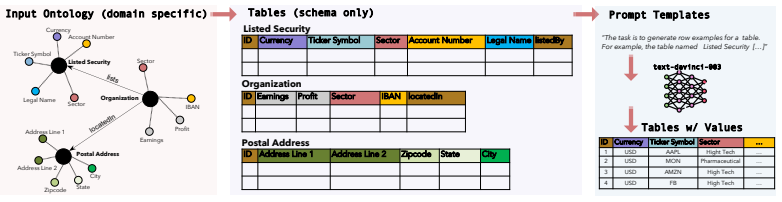
The central machinery is the ontology-to-table pipeline: each ontology concept becomes a table, each data property becomes a column, and each object property becomes a joinable column relationship. An LLM generates row values conditioned on dependent columns, and a set of perturbation functions (column-name cryptification, value synonyms, numeric noise, vertical and horizontal splitting) expands the corpus and creates semantically joinable pairs with divergent headers and cell contents.
What would settle it
Collect real-world domain-specific tables with human-annotated joinable pairs (for example from corporate data lakes or curated public sources), run the same four discovery methods on both the real pairs and LAKEGEN-generated pairs, and check whether the performance gap persists; if methods perform well on real pairs but poorly on synthetic ones, the benchmark's challenge does not transfer.
Extended reading notes
Core claim
LAKEGEN is claimed to be the first corpus generator to combine ontologies, LLMs, and semantic perturbations for tabular data discovery evaluation. The method maps ontology concepts to table schemas and object properties to joinable column relationships, then prompts an LLM to populate tables row by row while preserving cross-column dependencies. Semantic perturbations—cryptified column headers, synonyms, numeric jitter, and table splits—create non-exact but semantically joinable pairs. The paper reports that, across three domains, the generated corpora are more challenging than existing public benchmarks: semantic join discovery is hard, and methods that rely only on learned column embeddings perform especially poorly.
Load-bearing premise
The load-bearing premise is that tables and joinability ground truth produced by an LLM from an ontology are realistic stand-ins for domain-specific data lakes, so that poor method scores reflect genuine weaknesses rather than artifacts of synthetic data.
Editorial extensions
If this is right
- Domain-specific corpora can be produced with minimal human effort by drawing on existing ontologies such as FIBO, DrugBank, and MIMIC-III, giving dataset discovery researchers benchmarks for finance, pharma, and healthcare.
- Current discovery methods, including COMA, Jaccard-Levenshtein, Similarity Flooding, and Starmie, are not reliably stress-tested by generic open-data corpora; LAKEGEN-generated corpora expose particular weakness on semantically joinable pairs with different headers and values.
- The difficulty of semantic join discovery suggests that methods should combine traditional cell-overlap and schema signals with learned column representations rather than rely on embeddings alone.
- Ontology-driven generation can supply ground-truth joinability labels without the need for human annotation, avoiding a major bottleneck in building discovery benchmarks.
- The modular perturbation functions allow researchers to control difficulty by varying schema and value transformations, which could support training and hyperparameter tuning of discovery models before deployment.
Reading between the lines
- Editorial inference: The paper demonstrates that LLM-generated corpora are harder, but it does not show they are realistic proxies for real data lakes; a natural next step is validating against human-annotated real-world joinable pairs in the same domains.
- Editorial inference: The same pipeline could be extended beyond joinability to other discovery tasks such as union search, semantic data type detection, and table summarization, since the generated tables carry domain semantics at both schema and value levels.
- Editorial inference: The perturbation functions are described as modular, so testable variations could be tuned to simulate different levels of schema drift and value noise, making it possible to measure how method performance degrades as semantic distance increases.
- Editorial inference: The paper does not report releasing the generated corpora; public release would let other groups reproduce the difficulty rankings and test new methods against the same benchmarks.
Editorial analysis
A structured set of objections, weighed in public.
Referee Report
Summary. The paper presents LAKEGEN, a pipeline that takes a domain ontology, maps concepts and data properties to table schemas, uses an LLM (text-davinci-003) to populate rows while maintaining inter-table dependencies, and applies table-shape, schema, and column-value perturbations to create derived tables. Joinability ground truth is inferred from ontology object properties and from LLM-based semantic perturbations. The authors generate three corpora (finance, pharma, healthcare) and evaluate COMA, Jaccard-Levenshtein, Similarity Flooding, and Starmie on exact and semantic joinability, reporting low F1 and top-k scores and arguing that existing public corpora are too easy to expose these weaknesses.
Significance. If the semantic-join labels are correct, LAKEGEN would provide a practical way to generate domain-specific, ontology-driven benchmarks with controlled joinability relationships, and the experiments would reveal that current discovery methods, especially the embedding-based Starmie, underperform on semantic joins. The paper's use of MIMIC-III base tables for healthcare is a valuable realism anchor, and the perturbation catalogue in Table 7 is a useful systematization. However, the absence of any human evaluation of the semantic-join ground truth is a substantive gap that currently prevents the central difficulty claim from being accepted: the low scores could be label-noise artifacts rather than evidence of genuine failure on semantic joins. The paper also overstates its contributions with an unsubstantiated 'human-annotated' claim and a comparison only against three simple public benchmarks.
major comments (4)
- [Section 4.1, Tables 3–5] The ground truth for semantically joinable pairs is generated by the same LLM perturbation pipeline that creates the tables, but the paper never validates that the perturbed values remain semantically equivalent to the originals. The '123 Main Street' -> '123 Main St.' example is anecdotal. If a nontrivial fraction of the generated semantic-join pairs are not actually joinable, the low F1 and top-k scores in Tables 3–5 reflect label noise rather than genuine difficulty. This is particularly relevant for the 'difficult non-exactly joinable pairs' in Table 5 (e.g., 27 evaluated for pharma, 70 for healthcare), where no check is reported that the columns are truly semantically joinable. I request a label-quality study: sample about 100 semantic-join pairs per domain, have two annotators judge joinability, report inter-annotator agreement and the fraction of pairs judged non-joinable, and rerun the main tables excluding or re-labeling incorrect pairs.
- [Abstract, Table 1, Section 3.1] The abstract criticizes existing corpora for not containing human-annotated column pairs, and Table 1 marks a 'Human-annotated' checkmark for LAKEGEN, but Section 3.1 states that joinability is inferred from ontology object properties and no human annotation step is described anywhere in the paper. This is a factual overclaim that should be corrected or substantiated with an actual annotation procedure. Relatedly, the introduction claims 'As we show in Section 3.2, LLMs score equally well in generating domain-specific datasets,' but Section 3.2 contains no score comparison—only an anecdotal remark about city/zip matches. These claims should be removed or properly supported.
- [Section 5.1, Table 6] The conclusion that 'current datasets fail to evaluate these methods properly' is supported only by comparing performance on the generated base tables with Gosales, TPC-H, and TPC-DS. Those are not the corpora criticized in Section 1 (e.g., GitTables, Valentine, Magellan), and no experiments are run on those criticized corpora. Moreover, the abstract and introduction claim that LAKEGEN creates challenges for both 'union search and joinability discovery methods,' but the experimental section evaluates only joinability (exact and semantic). Either add union-search experiments and comparisons on the criticized corpora, or soften the conclusions to the specific settings actually tested.
- [Sections 1, 3.2, 5] The paper repeatedly describes the generated corpora as 'realistic' domain-specific data lakes, but it provides no validation that the finance and pharma tables are realistic in any measurable way (value distributions, semantic consistency, join patterns, or similarity to real data). The healthcare corpus is an anchor because it starts from real MIMIC-III base tables, but the fully synthetic finance and pharma corpora have no such anchor. Without a comparison between generated tables and real domain-specific data, the poor performance of discovery methods on LAKEGEN corpora could be an artifact of synthetic data rather than evidence of genuine difficulty. A focused realism study, even on a small set of real finance/pharma tables, would significantly strengthen the claim.
minor comments (7)
- [Section 2] The formal definition of column joinability is garbled: 'cR ▷ ◁h(cR)=cS ∨cR=h(cS ) cS)̸=∅' is not a well-formed formula. Please rewrite it using a clear mapping function and a non-empty intersection condition.
- [Table 1] The column layout of Table 1 is misaligned, making it difficult to determine which checkmarks correspond to which column. The 'Human-annotated' checkmark for LAKEGEN is especially confusing given Section 3.1; please clarify or remove it.
- [Tables 3, 4, 6 and text] 'Jaccard-Levenshiten' should be 'Jaccard-Levenshtein'.
- [Section 3.2] There is a typo in the sentence 'how the tables should are generated according to the inter-column dependencies'—it should read 'should be generated'.
- [Table 6] 'Gosalse' should be 'Gosales'.
- [Table 5] The table header is confusing: it mixes ratio notation ('Non-exact join pairs/All semantic join pairs') with raw counts and per-method correct-prediction counts. Please clarify that the method columns show the number of correct predictions.
- [Section 5.1] The claim that semantic joinability drops F1 'up to 10%' is not consistently supported by Table 3; for example, COMA Healthcare increases from 0.68 (exact) to 0.75 (semantic). Please quantify where the drop actually occurs.
Circularity Check
No significant circularity: LAKEGEN's benchmark generation is self-contained, and its performance results, while limited by unvalidated LLM ground truth, do not reduce by construction to a fitted or self-cited premise.
full rationale
LAKEGEN is an explicit benchmark generator: it takes an ontology, derives table schemas and joinability labels from that ontology, populates tables with an LLM, and then reports how existing discovery methods perform on the resulting corpus. The performance numbers are not predictions derived from the generation parameters; they are empirical measurements on a synthetic testbed. The ground-truth labels are indeed constructed from the same ontology and perturbation provenance that create the tables, and the absence of human-annotated validation for semantic joins is a legitimate threat to external validity and label quality. But that is a correctness or evaluation-quality concern, not a circularity: the paper does not fit a parameter to a subset of the data and then rename the fit as a prediction, and no uniqueness theorem or load-bearing self-citation forces the conclusions. The use of vertical splitting follows Valentine [6], a self-citation by a co-author, but only as a standard data-perturbation technique; the central contribution does not rest on that citation. The paper also compares against external corpora (Gosales, TPC-H, TPC-DS) and uses real MIMIC-III tables for healthcare, which grounds the evaluation outside the generation pipeline. The 'difficult' pairs in Table 5 are defined by having different headers and cells, so the finding that header/value-based methods struggle with them is partly a consequence of the definition, but it is reported as an experimental observation rather than derived as a theorem. Overall, the derivation chain from ontology to tables to ground truth to benchmark scores is transparent and does not collapse into an equation where output equals input by construction.
Assumptions & free parameters
free parameters (3)
- Perturbation overlap ranges =
vertical_split column_overlap [0.3, 0.4]; horizontal_split row_overlap [0, 0.15]; text_noise column_overlap [0.3, 0.4]
- Evaluation score threshold =
0.5
- Row caps =
1,000 (finance/pharma), 2,000 (healthcare)
assumptions (5)
- domain assumption LLMs generate factually consistent, domain-specific table values, e.g., zip code and city align.
- domain assumption Ontology object properties and data properties correspond to joinable column pairs and correct ground truth.
- domain assumption LLM-based semantic perturbations preserve meaning while changing surface form.
- ad hoc to paper text-davinci-003 is an adequate representative LLM for this generation task.
- domain assumption Existing public corpora (Gosales, TPC-H, TPC-DS) represent the true difficulty of current dataset discovery benchmarks.
Cite this review
Pith. "Pith review of LAKEGEN: A LLM-based Tabular Corpus Generator for Evaluating Dataset Discovery in Data Lakes." pith.science (2026). https://pith.science/paper/GE4TL2GM
@misc{pith2026250704687,
  author       = {Pith},
  title        = {Pith review of: LAKEGEN: A LLM-based Tabular Corpus Generator for Evaluating Dataset Discovery in Data Lakes},
  year         = {2026},
  howpublished = {\url{https://pith.science/paper/GE4TL2GM}},
  note         = {Machine review of arXiv:2507.04687}
}
abstract
How to generate a large, realistic set of tables along with joinability relationships, to stress-test dataset discovery methods? Dataset discovery methods aim to automatically identify related data assets in a data lake. The development and evaluation of such solutions for customers from a wide range of business domains, relies on diverse, high quality and domain-specific tabular benchmarks. Large language models (LLMs) are trained on a wide variety of text data, which can provide a strong foundation of general and domain-specific knowledge. In this paper, we ask the question -- \textit{can we leverage LLMs to generate a tabular benchmark adequate for evaluating the dataset discovery solutions?} In particular, we focus on the task of finding joinable tables which is the cornerstone of virtually every dataset discovery method. Current corpora for evaluating dataset discovery methods are mainly based on subsets of open data, and they suffer from three important issues: $i)$ they focus on very common and generic data types (e.g., address, id, name, etc.); $ii)$ they do not contain human-annotated column pairs; instead, practitioners synthesize ground truth using table splits (e.g., horizontal for table union search and vertical ones for joinability) and $iii)$ they do not focus on semantic column relationships.
Figures


Reference graph
Works this paper leans on
-
[1]
AnHai Doan, Alon Halevy, and Zachary Ives.Principles of data integration. Elsevier, 2012
work page 2012
-
[2]
Marylyn D Ritchie, Emily R Holzinger, Ruowang Li, Sarah A Pendergrass, and Dokyoon Kim. Methods of integrating data to uncover genotype–phenotype interactions.Nature Reviews Genetics, 16(2):85–97, 2015
work page 2015
-
[3]
Efficient joinable table discovery in data lakes: A high-dimensional similarity-based approach
Yuyang Dong, Kunihiro Takeoka, Chuan Xiao, and Masafumi Oyamada. Efficient joinable table discovery in data lakes: A high-dimensional similarity-based approach. In2021 IEEE 37th International Conference on Data Engineering (ICDE), pages 456–467. IEEE, 2021
work page 2021
-
[4]
Grace Fan, Jin Wang, Yuliang Li, Dan Zhang, and Renée Miller. Semantics-aware dataset discovery from data lakes with contextualized column-based representation learning.PVLDB, 2023
work page 2023
- [5]
-
[6]
Valentine: Evaluating matching techniques for dataset discovery
Christos Koutras, George Siachamis, Andra Ionescu, Kyriakos Psarakis, Jerry Brons, Marios Fragkoulis, Christoph Lofi, Angela Bonifati, and Asterios Katsifodimos. Valentine: Evaluating matching techniques for dataset discovery. In2021 IEEE 37th International Conference on Data Engineering (ICDE), pages 468–479. IEEE, 2021
work page 2021
-
[7]
Table union search on open data
Fatemeh Nargesian, Erkang Zhu, Ken Q Pu, and Renée J Miller. Table union search on open data. InVLDB, 2018
work page 2018
-
[8]
GitTables: A Large-Scale Corpus of Relational Tables
Madelon Hulsebos, Cagatay Demiralp, and Paul Groth. Gittables: A large-scale corpus of relational tables.arXiv preprint arXiv:2106.07258, 2021
work page Pith review arXiv 2021
Show all 47 references
-
[9]
TPC-DI: The first industry benchmark for data integration
Meikel Poess, Tilmann Rabl, Hans-Arno Jacobsen, and Brian Caufield. TPC-DI: The first industry benchmark for data integration. InVLDB, 2014
2014
-
[10]
Chembl: a large-scale bioactivity database for drug discovery.Nucleic acids research, 40(D1):D1100– D1107, 2012
Anna Gaulton, Louisa J Bellis, A Patricia Bento, Jon Chambers, Mark Davies, Anne Hersey, Yvonne Light, Shaun McGlinchey, David Michalovich, Bissan Al-Lazikani, et al. Chembl: a large-scale bioactivity database for drug discovery.Nucleic acids research, 40(D1):D1100– D1107, 2012
2012
-
[11]
C., Chaitanya Gokhale, Pradap Konda, Yash Govind, and Derek Paulsen
Sanjib Das, AnHai Doan, Paul Suganthan G. C., Chaitanya Gokhale, Pradap Konda, Yash Govind, and Derek Paulsen. The magellan data repository. https://sites.google.com/ site/anhaidgroup/useful-stuff/data. 9
-
[12]
Snomed-ct: The advanced terminology and coding system for ehealth
Kevin Donnelly et al. Snomed-ct: The advanced terminology and coding system for ehealth. Studies in health technology and informatics, 121:279, 2006
2006
-
[13]
The making of tpc-ds
Raghunath Othayoth Nambiar and Meikel Poess. The making of tpc-ds. InVLDB, volume 6, pages 1049–1058, 2006
2006
-
[14]
Synthetic data generation for tabular health records: A systematic review.Neurocomputing, 493:28–45, 2022
Mikel Hernandez, Gorka Epelde, Ane Alberdi, Rodrigo Cilla, and Debbie Rankin. Synthetic data generation for tabular health records: A systematic review.Neurocomputing, 493:28–45, 2022
2022
-
[15]
Language models are realistic tabular data generators, 2023
Vadim Borisov, Kathrin Seßler, Tobias Leemann, Martin Pawelczyk, and Gjergji Kasneci. Language models are realistic tabular data generators, 2023
2023
-
[16]
Fabio Petroni, Tim Rocktäschel, Sebastian Riedel, Patrick S. H. Lewis, Anton Bakhtin, Yuxiang Wu, and Alexander H. Miller. Language models as knowledge bases? InEMNLP-IJCNLP, pages 2463–2473, 2019
2019
-
[17]
The financial industry business ontology: Best practice for big data.Journal of Banking Regulation, 14(3-4):255–268, 2013
Mike Bennett. The financial industry business ontology: Best practice for big data.Journal of Banking Regulation, 14(3-4):255–268, 2013
2013
-
[18]
A survey of approaches to automatic schema matching
Erhard Rahm and Philip A Bernstein. A survey of approaches to automatic schema matching. VLDBJ, 10(4):334–350, 2001
2001
-
[19]
The gene ontology (go) database and informatics resource.Nucleic acids research, 32(suppl_1):D258–D261, 2004
Gene Ontology Consortium. The gene ontology (go) database and informatics resource.Nucleic acids research, 32(suppl_1):D258–D261, 2004
2004
-
[20]
Building a drug ontology based on rxnorm and other sources.Journal of biomedical semantics, 4:1–9, 2013
Josh Hanna, Eric Joseph, Mathias Brochhausen, and William R Hogan. Building a drug ontology based on rxnorm and other sources.Journal of biomedical semantics, 4:1–9, 2013
2013
-
[21]
Challenges and innovations in building a product knowledge graph
Xin Luna Dong. Challenges and innovations in building a product knowledge graph. In Proceedings of the 24th ACM SIGKDD International conference on knowledge discovery & data mining, pages 2869–2869, 2018
2018
-
[22]
Owl web ontology language overview
Deborah L McGuinness, Frank Van Harmelen, et al. Owl web ontology language overview. W3C recommendation, 10(10):2004, 2004
2004
-
[23]
Coma—a system for flexible combination of schema matching approaches
Hong-Hai Do and Erhard Rahm. Coma—a system for flexible combination of schema matching approaches. InVLDB’02: Proceedings of the 28th International Conference on Very Large Databases, pages 610–621. Elsevier, 2002
2002
-
[24]
Drugbank 5.0: a major update to the drugbank database for 2018.Nucleic acids research, 46(D1):D1074–D1082, 2018
David S Wishart, Yannick D Feunang, An C Guo, Elvis J Lo, Ana Marcu, Jason R Grant, Tanvir Sajed, Daniel Johnson, Carin Li, Zinat Sayeeda, et al. Drugbank 5.0: a major update to the drugbank database for 2018.Nucleic acids research, 46(D1):D1074–D1082, 2018
2018
-
[25]
Mimic-iii, a freely accessible critical care database.Scientific data, 3(1):1–9, 2016
Alistair EW Johnson, Tom J Pollard, Lu Shen, Li-wei H Lehman, Mengling Feng, Mohammad Ghassemi, Benjamin Moody, Peter Szolovits, Leo Anthony Celi, and Roger G Mark. Mimic-iii, a freely accessible critical care database.Scientific data, 3(1):1–9, 2016
2016
-
[26]
Mimic-iii clinical database demo (version 1.4).PhysioNet, 2019
Alistair EW Johnson, Tom J Pollard, and Roger G Mark. Mimic-iii clinical database demo (version 1.4).PhysioNet, 2019
2019
-
[27]
Similarity flooding: A versatile graph matching algorithm and its application to schema matching
Sergey Melnik, Hector Garcia-Molina, and Erhard Rahm. Similarity flooding: A versatile graph matching algorithm and its application to schema matching. InProceedings 18th international conference on data engineering, pages 117–128, 2002
2002
-
[28]
Analyzing and improving the image quality of stylegan
Tero Karras, Samuli Laine, Miika Aittala, Janne Hellsten, Jaakko Lehtinen, and Timo Aila. Analyzing and improving the image quality of stylegan. InProceedings of the IEEE/CVF Conference on Computer Vision and Pattern Recognition (CVPR, pages 8110–8119„ 2020
2020
-
[29]
Ad- versarial generation of natural language
Sandeep Subramanian, Sai Rajeswar, Francis Dutil, Christopher Pal, and Aaron Courville. Ad- versarial generation of natural language. InProceedings of the 2nd Workshop on Representation Learning for NLP, pages 241–251„ 2017. 10
2017
-
[30]
Stewart, and Jimeng Sun
Edward Choi, Siddharth Biswal, Bradley Malin, Jon Duke, Walter F. Stewart, and Jimeng Sun. Generating multi-label discrete patient records using generative adversarial networks. In Machine learning for healthcare conference, pages 286–305„ 2017
2017
-
[31]
Data synthesis based on generative adversarial networks.Proceedings of the VLDB Endowment, 11(10):1071–1083, 2018
Noseong Park, Mahmoud Mohammadi, Kshitij Gorde, Sushil Jajodia, Hongkyu Park, and Youngmin Kim. Data synthesis based on generative adversarial networks.Proceedings of the VLDB Endowment, 11(10):1071–1083, 2018
2018
-
[32]
Airline passenger name record generation using generative adversarial networks, 2018
Alejandro Mottini, Alix Lheritier, and Rodrigo Acuna-Agost. Airline passenger name record generation using generative adversarial networks, 2018. arXiv preprint arXiv:1807.06657,
2018 arXiv
-
[33]
Modeling tabular data using conditional gan
Lei Xu, Maria Skoularidou, Alfredo Cuesta-Infante, and Kalyan Veeramachaneni. Modeling tabular data using conditional gan. InAdvances in Neural Information Processing Systems (NeurIPS, volume 33. 2019
2019
-
[34]
Synthetic minority oversampling of vital statistics data with generative adversarial networks.Journal of the American Medical Informatics Association, 27(11):1667–1674, 2020
Aki Koivu, Mikko Sairanen, Antti Airola, and Tapio Pahikkala. Synthetic minority oversampling of vital statistics data with generative adversarial networks.Journal of the American Medical Informatics Association, 27(11):1667–1674, 2020
2020
-
[35]
Vaem: a deep generative model for heterogeneous mixed type data
Chao Ma, Sebastian Tschiatschek, Richard Turner, Jose Miguel Hernandez-Lobato, and Cheng Zhang. Vaem: a deep generative model for heterogeneous mixed type data. InAdvances in Neural Information Processing Systems (NeurIPS, volume 33. 2020
2020
-
[36]
Generating privacy-preserving synthetic tabular data using oblivious variational autoencoders
L.Vivek Harsha Vardhan and Stanley Kok. Generating privacy-preserving synthetic tabular data using oblivious variational autoencoders. InProceedings of the Workshop on Economics of Privacy and Data Labor at the 37th International Conference on Machine Learning (ICML, 2020
2020
-
[37]
Synthesising multi-modal minority samples for tabular data,
Sajad Darabi and Yotam Elor. Synthesising multi-modal minority samples for tabular data,
-
[38]
Tabnet: Attentive interpretable tabular learning
Sercan Ö Arik and Tomas Pfister. Tabnet: Attentive interpretable tabular learning. InPro- ceedings of the AAAI Conference on Artificial Intelligence, volume 35, pages 6679–6687, 2021
2021
-
[39]
Saint: Improved neural networks for tabular data via row attention and contrastive pre-training,
Gowthami Somepalli, Micah Goldblum, C.Bayan Bruss Avi Schwarzschild, and Tom Goldstein. Saint: Improved neural networks for tabular data via row attention and contrastive pre-training,
-
[40]
Self- attention between datapoints: Going beyond individual input-output pairs in deep learning
Jannik Kossen, Neil Band, Clare Lyle, Aidan Gomez, Tom Rainforth, and Yarin Gal. Self- attention between datapoints: Going beyond individual input-output pairs in deep learning. In Advances in Neural Information Processing Systems. 2021
2021
-
[41]
arXiv preprint arXiv:2106.01342,
-
[42]
Tabular transformers for modeling multivariate time series
Inkit Padhi, Yair Schiff, Igor Melnyk, Mattia Rigotti, Youssef Mroueh, Pierre Dognin, Jerret Ross, Ravi Nair, and Erik Altman. Tabular transformers for modeling multivariate time series. In ICASSP 2021-2021 IEEE International Conference on Acoustics, Speech and Signal Processi...
2021
-
[43]
Tabert: Pretraining for joint understanding of textual and tabular data
Pengcheng Yin, Graham Neubig, Wen-tau Yih, and Sebastian Riedel. Tabert: Pretraining for joint understanding of textual and tabular data. InProceedings of the 58th Annual Meeting of the Association for Computational Linguistics, page 8413–8426. Association for Computational Li...
2020
-
[44]
Language models are realistic tabular data generators.arXiv preprint arXiv:2210.06280, 2022
Vadim Borisov, Kathrin Seßler, Tobias Leemann, Martin Pawelczyk, and Gjergji Kasneci. Language models are realistic tabular data generators.arXiv preprint arXiv:2210.06280, 2022
2022 arXiv
-
[45]
Bert: Pre-training of deep bidirectional transformers for language understanding, 2018
Jacob Devlin, Ming-Wei Chang, Kenton Lee, and Kristina Toutanova. Bert: Pre-training of deep bidirectional transformers for language understanding, 2018. arXiv preprint arXiv:1810.04805,
2018 arXiv
-
[47]
Listed Security
Mrinal Kanti Baowaly, Chia-Ching Lin, Chao-Lin Liu, and Kuan-Ta Chen. Synthesizing electronic health records using improved generative adversarial networks.Journal of the American Medical Informatics Association, 26(3):228–241, 2019. 11 8 Appendix 8.1 Prompt to generate base t...
2019
-
[2021]
arXiv preprint arXiv:2105.08204,
Reviewed August 6, 2026 · model on record in the stance chip above.
Discussion (0). Sign in to comment.