REVIEW 4 major objections 5 minor 44 references
Primordial Black Holes as Coma Cluster Dark Matter and the Unresolved {\gamma}-Ray Background
T0 review · 4 major / 5 minor · reviewed 2026-08-06 · deepseek-v4-flash
Pith's one-line read Hawking radiation from tiny primordial black holes at 0.1% of Coma's dark matter can explain the cluster's GeV glow.
desk verdict The Coma fit rests on a factor-of-100 energy error—the claimed 5 GeV cutoff requires PBHs two orders of magnitude lighter than quoted—but the Draco X overdensity and the honest UGRB feasibility analysis give the paper salvageable pieces. read the letter →
The pith
A machine-rendered reading of the paper's core claim, the machinery that carries it, and where it could break.
The reading
What carries the argument
The machinery that carries the Coma argument is the Hawking evaporation rate $\dot{m}=-\alpha\hbar c^4/(G^2m^2)$, equivalently a fractional mass-loss rate of about $3\times10^{-23}\,\mathrm{s}^{-1}$, which makes lighter black holes evaporate faster and radiate at higher energies; when convolved with the assumed scale-invariant initial mass function $n(m)\propto m^{-1}$, it sets both the downward slope of the GeV spectrum and the $\sim5$ GeV cutoff. For the large-scale-structure test, the load-bearing object is the redshift-dependent PBH window function $W_{\mathrm{PBH}}$, a line-of-sight integral over the evaporation rate with $(1+z)^{-4}$ dimming and attenuation, whose poor overlap with the weak-lensing shear window functions is the reason the cross-correlation approach cannot see PBH evaporation.
What would settle it
A gamma-ray measurement of Coma that resolves the predicted spectral turnover just above 5 GeV would settle this: if the spectrum continues smoothly beyond 5 GeV instead of cutting off, the assumed one-over-mass distribution and the 0.1% abundance fit are ruled out.
Extended reading notes
Core claim
The paper's central claim is that a specific, modest abundance of evaporating PBHs can account for Coma's GeV emission. Using the Hawking mass-loss rate and an assumed initial mass function $n(m)\propto m^{-1}$, a dark-matter fraction $f=10^{-3}$ in the mass window $10^{-19}{-}10^{-17}\,M_\odot$ yields a spectrum that fits the cluster's measured GeV flux, with a turnover just above 5 GeV produced by the exhaustion of the lowest-mass black holes, whose evaporation rate scales as $m^{-2}$. Because a competing explanation (secondary emission from a giant radio halo) can also match the data, the paper frames $f=10^{-3}$ as an upper limit. Extrapolating the same evaporation model to cosmological scales with $f=1$ gives an unresolved gamma-ray background intensity roughly five orders of magnitude below the observed one, so the detected UGRB--lensing cross-correlation (signal-to-noise 8.9) is attributed to clustered astrophysical sources rather than PBHs, and the method is judged unable to constrain PBH evaporation. Separately, the paper reports the identification of Draco X, an overdensity of X-ray clusters at $z=0.12$ with mass around $7\times10^{16}\,M_\odot$, which shows no corresponding excess of extended gamma-ray sources.
Load-bearing premise
The calculation assumes the black holes are distributed in mass as one-over-mass, a power law taken from an earlier paper, and everything about the predicted spectrum and the 0.1% abundance limit follows from that choice; if the true mass distribution is different, the fit changes, and the paper gives no independent evidence for this power law.
Editorial extensions
If this is right
- If the Coma fit holds, the cluster's GeV glow can be powered by Hawking radiation from PBHs with masses $10^{-19}$ to $10^{-17}\,M_\odot$ at a dark-matter fraction $f=10^{-3}$, and that fraction is an upper limit if the giant-radio-halo model is correct.
- The predicted spectrum declines with decreasing energy according to the assumed $m^{-1}$ mass function and cuts off just above 5 GeV, giving future gamma-ray measurements a sharp feature to confirm or reject.
- Attributing a measurable part of the unresolved gamma-ray background to PBH evaporation would require PBH abundances far above what is plausible, so current UGRB--lensing cross-correlations cannot constrain evaporating PBHs in this mass range.
- Because the PBH gamma-ray window and the shear window overlap only weakly in redshift, deeper lensing surveys under these assumptions will not substantially improve sensitivity to PBH evaporation.
- A Coma-like Draco X should emit more than twice Coma's GeV flux, yet no extended gamma-ray source excess is seen there, implying that the GeV emission mechanism is not universal across massive clusters.
Reading between the lines
- The $f=10^{-3}$ limit is conditional on the assumed $n(m)\propto m^{-1}$ mass function; a different mass distribution would change the spectral slope and the inferred abundance, so the limit is only as secure as that external input.
- Because the predicted UGRB contribution sits about five orders of magnitude below the measured background, more sensitive cross-correlation analyses are unlikely to reveal PBH evaporation in this mass range; the Coma spectral cutoff and independent abundance probes would be sharper tests.
- Draco X's null GeV detection could mean that Coma's glow is produced by the radio halo rather than Hawking radiation, or that Draco X's dark-matter distribution differs from Coma's; matched X-ray and gamma-ray observations of the two systems would separate those options.
- A targeted search for the predicted 5 GeV turnover in Coma, with good energy resolution, would provide a nearly parameter-free test of the $m^{-1}$ mass function and the $10^{-3}$ abundance.
Editorial analysis
A structured set of objections, weighed in public.
Referee Report
Summary. The paper has three parts. First, it proposes that Hawking radiation from primordial black holes with masses 1e-19 to 1e-17 solar masses, at a fraction f=1e-3 of the Coma cluster dark matter, can explain the cluster's GeV emission measured by Baghmanyan et al. (2022); this fraction is presented as an upper limit because alternative emission from a giant radio halo may also explain the data. Second, it uses 12 years of Fermi-LAT data and DES Y3 weak-lensing measurements, together with a PBH window function, to argue that even with f=1 and a single PBH mass of 1e-18 solar masses, the predicted intensity is about five orders of magnitude below the unresolved gamma-ray background, so the cross-correlation approach cannot constrain PBH evaporation. Third, it identifies a cluster of X-ray clusters, Draco X, at z=0.12, estimates its mass and luminosity, and discusses the absence of corresponding GeV emission.
Significance. If the central calculation were sound, the Coma PBH interpretation would be an interesting application of Hawking radiation to cluster-scale dark matter, and the UGRB cross-correlation analysis would provide a useful null result. The manuscript is transparent that f is fitted and that the UGRB estimate uses f=1 as a conservative upper bound, and it makes use of real Fermi-LAT and DES data. However, the mass-energy mapping in the Coma fit is off by about two orders of magnitude, and the quoted UGRB peak energy is off by about three orders of magnitude. These errors invalidate the quantitative conclusions of Sections 3 and 4, so the paper's current significance is limited.
major comments (4)
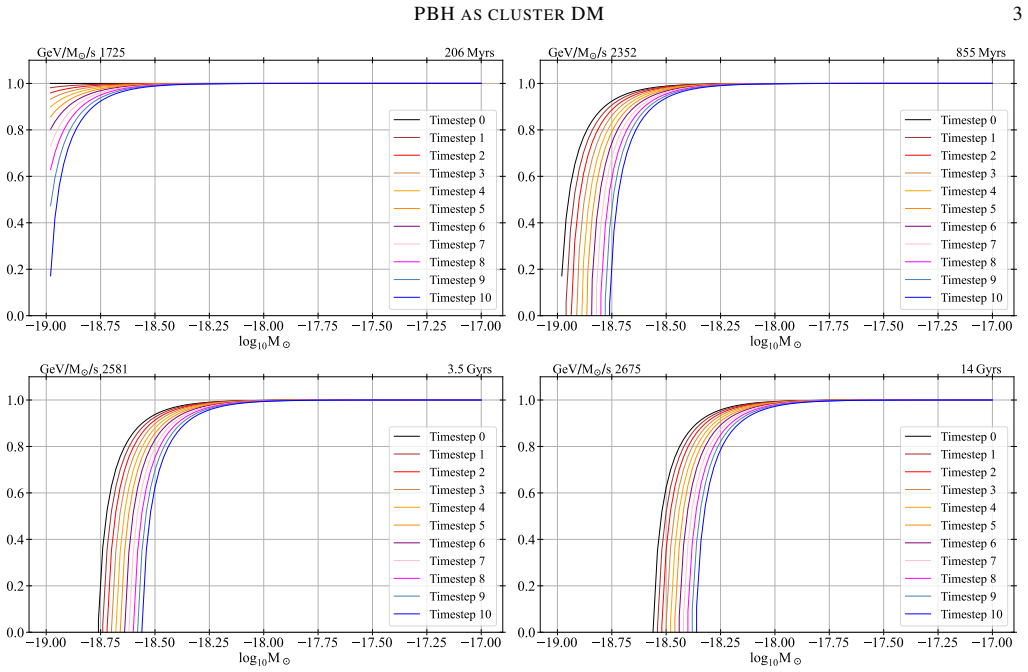
- [Sec. 3, Fig. 2] The central claim that PBHs with masses 1e-19 to 1e-17 solar masses can explain the Coma GeV emission is inconsistent with Hawking evaporation physics. For a Schwarzschild PBH, T = 1.06e13 (1 g/M) GeV, so the stated mass range corresponds to T between about 53 MeV and 0.53 MeV; the primary photon spectrum peaks below about 100 MeV and is exponentially suppressed at 5 GeV. The Figure 2 caption's cutoff 'just above 5 GeV' therefore cannot arise from the stated PBH population. The caption's explanation that the cutoff is due to exhaustion of lower-mass PBHs is also not viable: a 1e-19 solar mass PBH has an evaporation timescale of about 2e10 yr, longer than the age of the Universe. A PBH light enough to emit a 5 GeV peak (M about 1e-21 solar masses) would have evaporated in about 2e4 yr and would not be present at z=0. The mass range and the resulting fit need to be corrected before the Coma interpretation can be evaluated.
- [Sec. 4, Eq. (2)] The statement after Eq. (2) that for f=1 and m=1e-18 solar masses the average PBH intensity 'peaks at ~5 GeV' is incorrect by about three orders of magnitude: the Hawking temperature for 1e-18 solar masses is about 5.3 MeV, so the primary photon spectrum peaks in the MeV range, not at 5 GeV. Because Eq. (1) uses this spectrum to compute the PBH window function, the quoted intensity of about 1e-13 cm^-2 s^-1 sr^-1 and the conclusion that PBHs contribute negligibly to the UGRB must be recalculated with the correct energy assignment.
- [Sec. 5] The Draco X mass estimate is internally inconsistent and lacks derivation. The text gives an integrated mass of about 7.2e16 solar masses with a 90% confidence interval ranging from 0.66e16 to 2.0e16 solar masses, but this interval does not contain the quoted central value, and no method is given for either number. This needs to be corrected or substantiated before Draco X can be used as a cosmological probe.
- [Sec. 3] The agreement with the Baghmanyan et al. (2022) spectrum is not a quantitative fit: f=1e-3 is chosen to match the observed flux, and no error bars or statistical measure are presented for the predicted spectral shape. Since the assumed initial mass function n(m) proportional to m^-1 determines both the slope and the cutoff location, the reported agreement cannot by itself constrain the PBH fraction or distinguish this IMF from other choices.
minor comments (5)
- [Eq. (1)] The quantities dt/dz and e^-tau in Eq. (1) are not clearly defined; tau is said to be integrated along the line of sight for the DES source galaxies, but gamma-ray attenuation should also account for extragalactic background light absorption, which is not discussed.
- [Fig. 1] The y-axis label 'GeV/M /s' and the relation between the 'proportion of PBH fuel consumed' and the plotted curves are confusing; the color-bar labels 'Timestep' should be explained in the caption.
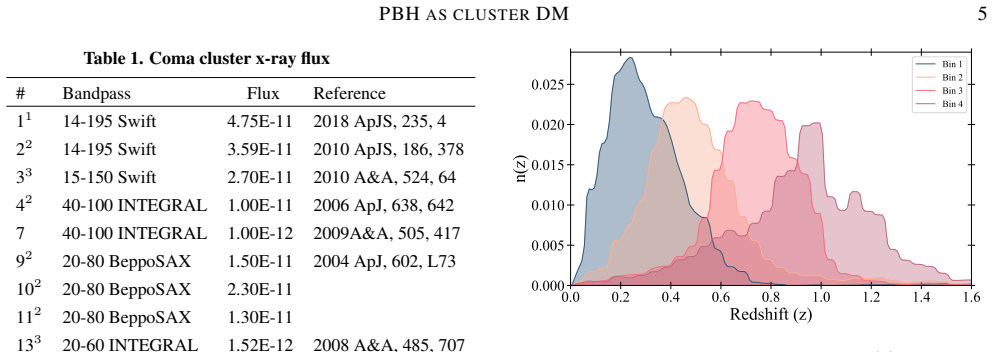
- [Table 1] The footnote spells the author name as 'Fusco-Fermiano', while the reference list has 'Fusco-Fermiano R.'; please check the correct spelling and make it consistent.
- [Abstract] The abstract states 'If 0.1% of the dark matter in the Coma cluster is PBH in this mass range, a fit to the cluster's GeV emission is obtained' as if it were a result; the conditional nature of the assumption should be explicit throughout the text.
- [Sec. 5] The phrase 'a lower limit on its X-ray luminosity, relative to Coma, is estimated to be 58 times greater' is grammatically ambiguous; please clarify whether the lower limit is 58 times the Coma luminosity.
Circularity Check
Central Coma 'fit' is a normalization fit: f=1e-3 is chosen to match the GeV data, so the amplitude claim reduces to the fitting condition.
-
fitted input called prediction
[Section 3, 'Source of the Emission']
"To fit the available GeV data, we set the fraction of DM that lies between 10−19 and 10−17 M⊙ to f = 10−3."
The predicted GeV flux from PBHs is directly proportional to f, with the same spatial template and distance for all energies. Setting f = 10^-3 so that the model matches the Baghmanyan et al. (2022) flux makes the statement 'If 0.1% of the Coma cluster’s dark matter is PBH ... a fit to the cluster’s GeV emission is obtained' true by construction for the normalization. The paper does not derive f from an independent constraint; the 'fit' is the fitting equation itself. The spectral shape and the separate UGRB calculation with f=1 are not circular, so this is a partial, amplitude-level circularity.
full rationale
The Coma section is a transparency-explicit fit: f=1e-3 is selected 'to fit the available GeV data', so the claim that a 0.1% PBH fraction reproduces the Coma GeV amplitude is an identity in normalization, not an independent prediction. The spectral shape is not fitted; it follows from the assumed Hawking spectrum and the n~m^-1 IMF taken from Mould (2025). We did not treat the IMF as a separate circularity because the paper does not derive it from the Coma data, and its status as an independent prior cannot be judged from this manuscript; at most it is an ansatz-dependent assumption. The UGRB cross-correlation section uses f=1 as a forward, non-circular upper-limit calculation, and its null conclusion is independent of the Coma fit. The paper itself acknowledges that 'such an interpretation is speculative', which supports treating the Coma section as an illustrative fit rather than a derived prediction. A separate physical inconsistency exists as written: 1e-19 to 1e-17 solar-mass PBHs have Hawking temperatures of roughly 0.5 to 50 MeV, not the 5 GeV cutoff claimed, and the low-mass end is not exhausted at z=0; that is a correctness concern rather than circularity. Overall score 6 reflects the central amplitude claim reducing to its fitted input, while the spectral shape remains independent.
Assumptions & free parameters
free parameters (4)
- PBH dark matter fraction f in Coma =
10^-3
- PBH mass range lower bound =
10^-19 M_sun
- PBH mass range upper bound =
10^-17 M_sun
- Single PBH mass for UGRB window function =
10^-18 M_sun at f=1
assumptions (4)
- domain assumption Hawking mass-loss rate from Mosbech and Picker (2022)
- ad hoc to paper PBH initial mass function n(m) proportional to m^-1
- domain assumption DM and hot baryons have the same spatial distribution in Coma
- domain assumption Coma is optically thin to electron scattering and pair production for GeV photons
Cite this review
Pith. "Pith review of Primordial Black Holes as Coma Cluster Dark Matter and the Unresolved {\gamma}-Ray Background." pith.science (2026). https://pith.science/paper/GE7B64L2
@misc{pith2026250701421,
  author       = {Pith},
  title        = {Pith review of: Primordial Black Holes as Coma Cluster Dark Matter and the Unresolved \gamma-Ray Background},
  year         = {2026},
  howpublished = {\url{https://pith.science/paper/GE7B64L2}},
  note         = {Machine review of arXiv:2507.01421}
}
read the original abstract
If 0.1% of the dark matter in the Coma cluster is constituted by primordial black holes (PBHs) with masses ranging from 10^-19 to 10^-17 solar masses, then the observed GeV {\gamma}-ray emission from the cluster could potentially be attributed to Hawking radiation. The emitted spectrum is inversely proportional to the black hole's mass, meaning lighter PBHs radiate at higher energies, potentially falling within the GeV range. If 0.1% of the Coma cluster's dark matter is PBH in this mass range, a fit to the cluster's GeV emission is obtained. We then investigate the potential for constraining evaporating PBHs through cross-correlations between the Unresolved Gamma-Ray Background and weak gravitational lensing. Utilizing 12 years of Fermi-LAT observations and weak lensing measurements from the Dark Energy Survey Year 3, we assess whether such correlations can reveal a PBH {\gamma}-ray component. While a statistically significant correlation between the UGRB and large-scale structure has been observed, this signal is consistent with emission from clustered astrophysical sources such as blazars. Attributing a measurable fraction of the UGRB to PBH evaporation would require unrealistically large PBH abundances. We also draw attention to a cluster of Coma-like X-ray clusters, designated Draco X, observed at a redshift of z = 0.12. These systems, characterized by their significant X-ray emission from hot, diffuse intracluster gas, represent massive gravitationally bound structures. The existence and properties of such clusters at these redshifts provide crucial cosmological probes, offering insights into the formation and evolution of large-scale structure and the underlying cosmological parameters. Further investigation of Draco X and similar high-redshift clusters would yield additional constraints on large scale structure.
Figures

Figures from the paper (3 more)


Reference graph
Works this paper leans on
-
[1]
Abdollahi F., et al., 2022, ApJS, 247, 33
work page 2022
-
[2]
Ade P., et al., 2013, Astronomy & Astrophysics, 554, A140
work page 2013
-
[3]
Aghanim N., et al., 2020, Astronomy & Astrophysics, 641, A6
work page 2020
-
[4]
Ammazzalorso S., et al., 2020, @doi [Phys. Rev. Lett.] 10.1103/PhysRevLett.124.101102 , 124, 101102
-
[5]
Baghmanyan V., Zargaryan D., Aharonian F., Yang R., Casanova S., Mackey J., 2022, Monthly Notices of the Royal Astronomical Society, 516, 562
work page 2022
-
[6]
Batten A., Mould J., 2025, MNRAS submitted
work page 2025
-
[7]
Bird A., et al., 2006, ApJ, 636, 765
work page 2006
-
[8]
B\" o hringer et al., 2025, A&A, in press, arxiv 2501.19236
work page Pith review arXiv 2025
Show all 44 references
-
[9]
Bonafede A., et al., 2010, A&A, 513, 30
2010
-
[10]
Branchini E., Camera S., Cuoco A., Fornengo N., Regis M., Viel M., Xia J.-Q., 2017, The Astrophysical Journal Supplement Series, 228, 8
2017
-
[11]
Camera S., Fornasa M., Fornengo N., Regis M., 2013, The Astrophysical Journal Letters, 771, L5
2013
-
[12]
Camera S., Fornasa M., Fornengo N., Regis M., 2015, Journal of Cosmology and Astroparticle Physics, 2015, 029
2015
-
[13]
A., 2023, MNRAS, 523, 1209
Churazov E., Khabibullin I., Dolag K., Lyskova N., Sunyaev R. A., 2023, MNRAS, 523, 1209
2023
-
[14]
Colavincenzo M., Tan X., Ammazzalorso S., Camera S., Regis M., Xia J.-Q., Fornengo N., 2020, Monthly Notices of the Royal Astronomical Society, 491, 3225
2020
-
[15]
Cuoco A., Xia J.-Q., Regis M., Branchini E., Fornengo N., Viel M., 2015, @doi [ ] 10.1088/0067-0049/221/2/29 , http://adsabs.harvard.edu/abs/2015ApJS..221...29C 221, 29
2015 doi
-
[16]
Di Mauro M., Manconi S., Zechlin H.-S., Ajello M., Charles E., Donato F., 2018, The Astrophysical Journal, 856, 106
2018
-
[17]
Dressler A., 1991, Nature, 350, 391
1991
-
[18]
Faber S., Gallagher J., 1976, ApJ, 204, 365
1976
-
[19]
Fornengo N., Perotto L., Regis M., Camera S., 2015, The Astrophysical journal letters, 802, L1
2015
-
[20]
Fusco-Fermiano R., et al., 2004, ApJ, 602, L73
2004
-
[21]
J., Shirasaki M., Macias O., Horiuchi S., Tashiro H., Oguri M., 2019, Monthly Notices of the Royal Astronomical Society, 484, 5256
Hashimoto D., Nishizawa A. J., Shirasaki M., Macias O., Horiuchi S., Tashiro H., Oguri M., 2019, Monthly Notices of the Royal Astronomical Society, 484, 5256
2019
-
[22]
W., 1974, Nature, 248, 30
Hawking S. W., 1974, Nature, 248, 30
1974
-
[23]
Korsmeier M., Pinetti E., Negro M., Regis M., Fornengo N., 2022, The Astrophysical Journal, 933, 221
2022
-
[24]
Kushnir D., Keshet U., Waxman E., 2024, arxiv 2404.13111
2024 arXiv
-
[25]
Mosbech M., Picker Z., 2022, SciPost, 13, 100
2022
-
[26]
Mould J., 2025, ApJ, 984, 59
2025
-
[27]
Myles J., et al., 2021, Monthly Notices of the Royal Astronomical Society, 505, 4249
2021
-
[28]
Oh K., et al., 2018, ApJS, 235, 4
2018
-
[29]
J., Bilicki M., 2024, Physical Review D, 109, 103517
Paopiamsap A., Alonso D., Bartlett D. J., Bilicki M., 2024, Physical Review D, 109, 103517
2024
-
[30]
Ponente P., et al., 2011, MNRAS, 410, 2353
2011
-
[31]
Randall S., Markevitch M., Clowe D., Gonzalez A., Bradac M., 2008, ApJ, 679, 1173
2008
-
[32]
Regis M., Xia J.-Q., Cuoco A., Branchini E., Fornengo N., Viel M., 2015, Physical Review Letters, 114, 241301
2015
-
[33]
Sadibekova T., et al., 2024, A&A, 688, 187
2024
-
[34]
Scolnic D., et al., 2025, The Astrophysical Journal Letters, 979, L9
2025
-
[35]
Shirasaki M., Horiuchi S., Yoshida N., 2014, Physical Review D, 90, 063502
2014
-
[36]
Shirasaki M., Macias O., Horiuchi S., Shirai S., Yoshida N., 2016, Physical Review D, 94, 063522
2016
-
[37]
J., 2018, Physical Review D, 97, 123015
Shirasaki M., Macias O., Horiuchi S., Yoshida N., Lee C.-H., Nishizawa A. J., 2018, Physical Review D, 97, 123015
2018
-
[38]
Tan X., Colavincenzo M., Ammazzalorso S., 2020, Monthly Notices of the Royal Astronomical Society, 495, 114
2020
-
[39]
Thakore B., et al., 2025, JCAP, 6, 37
2025
-
[40]
Tr \"o ster T., et al., 2017, Monthly Notices of the Royal Astronomical Society, 467, 2706
2017
-
[41]
Xia J.-Q., Cuoco A., Branchini E., Viel M., 2015, The Astrophysical Journal Supplement Series, 217, 15
2015
-
[42]
Zhou B., Bernal J., Pinetti E., Cruz H., Kamionkowski M., 2025, arXiv:2410.00375
2025 arXiv
-
[43]
Zwicky F., 1933, Helv Phys Acta, 6, 110
1933
-
[44]
write newline
" write newline "" before.all 'output.state := FUNCTION fin.entry write newline FUNCTION new.block output.state before.all = 'skip after.block 'output.state := if FUNCTION new.sentence output.state after.block = 'skip output.state before.all = 'skip after.sentence 'output.stat...
Reviewed August 6, 2026 · model on record in the stance chip above.
Discussion (0). Continue with ORCID to comment.