REVIEW 3 major objections 8 minor 22 references
Interest Changes: Considering User Interest Life Cycle in Recommendation System
T0 review · 3 major / 8 minor · reviewed 2026-08-15 · deepseek-v4-flash
Pith's one-line read This paper claims that a recommender can read the life-cycle phase of each user interest — emergent, stable, or declining — from activity histograms and use those phases to rerank items, yielding higher CTR, CVR, and duration in production.
desk verdict Plausible industrial module for modeling interest phase; the architecture is new enough to be worth a referee, but missing significance tests and baseline details leave the headline deployment claim under-supported. read the letter →
The pith
A machine-rendered reading of the paper's core claim, the machinery that carries it, and where it could break.
The reading
What carries the argument
The central mechanism is the interest life-cycle vector built from activity histograms. For each candidate item and each action type (exposure, click, interaction), a General Search Unit retrieves the N most relevant past behaviors; summing relevance scores per active day produces a length-K histogram of activity intensity. A 1-D CNN encodes the histogram, and a vector-quantization codebook of ten clusters turns the encoded vector into a discrete life-cycle label. That label drives two lightweight gates in the ranking model: a feature recalibrator that re-weights the shared-bottom features and neural fusion units that rescale each expert's hidden layers. The VQ label is what lets 'emergent' versus 'declining' contexts activate different experts for different tasks, which is the mechanism carrying the reported gains.
What would settle it
Design an A/B experiment in which one serving arm deliberately over-exposes declining-interest items for a week, then retrain DILN on that arm's logs and check whether the learned VQ clusters reassign those items to the 'declining' cluster more often than in a control arm. If cluster assignments move with the policy, the life-cycle features are policy artifacts; if they stay put, the features track the user's interest.
Extended reading notes
Core claim
DILN's central claim is that the trajectory of a user's activity toward a candidate item — ramping up, holding steady, or winding down — is a learnable signal that existing sequential-interest models leave unused. The Interest Life-cycle Encoder Module constructs, for each candidate item, histograms of recent exposure, click, and interaction activity, compresses them with a 1-D convolutional network, and maps them through a vector-quantization codebook of ten clusters, each acting as a life-cycle phase label. The Interest Life-cycle Fusion Module then uses that label to rescale input features and expert hidden states inside an MMOE multi-task model, so that emergent, stable, and declining phases get different expert behavior for CTR, CVR, and duration objectives. Against a SIM-based production baseline, the authors find consistent GAUC gains offline and, in a three-week A/B test on Lofter, significant online gains plus a dispatch shift of +5.11% impression share toward emergent interests and -4.4% away from declining interests.
Load-bearing premise
The load-bearing premise is that the exposure, click, and interaction histograms measure the user's underlying interest phase rather than the recommender's own prior serving policy, since exposure logs are themselves outputs of the ranking system.
Editorial extensions
If this is right
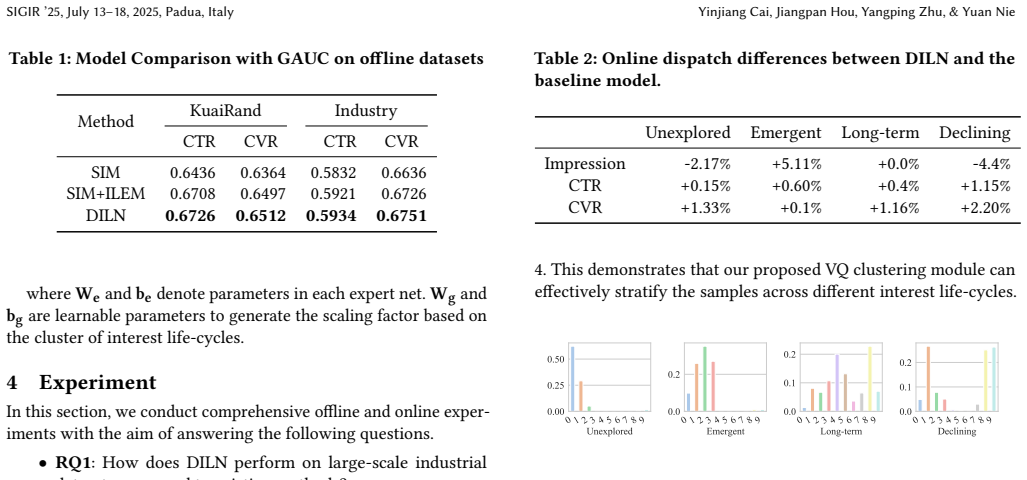
- Adding ILEM to the SIM baseline improves offline GAUC on both KuaiRand and the industrial dataset, and adding ILFM improves it further, so interest life-cycle features act as a plug-in upgrade to an existing ranking model.
- In production, DILN shifts impression share by +5.11% toward emergent interests, -4.4% away from declining interests, and -2.17% away from unexplored interests, while long-term interests hold steady.
- Emergent interests show the highest task efficiency despite sparse historical behaviors, so detecting the emergent phase early is where the largest untapped ranking gains lie.
- The VQ cluster assignments are interpretable: Unexplored interests primarily activate cluster 0 while emergent interests primarily activate clusters 3 and 4, which means the cluster label can serve as a continuous monitor of interest-phase distribution.
- A three-week online A/B test on over 20% of users shows +0.38% CTR, +1.04% CVR, and +0.25% duration per user against the production model.
Reading between the lines
- The authors do not test whether the learned life-cycle phases are stable under a change of serving policy: because histograms are built from the recommender's own exposure and click logs, a policy that over-serves declining interests could manufacture the 'declining' label. One test would rerun DILN with forced random exploration and compare cluster assignments.
- A natural extension is to use the VQ cluster as a structured control variable for exposure fairness or content auditing, since it gives every candidate item a discrete, interpretable life-cycle label.
- The larger CVR gain (+1.04%) than CTR gain (+0.38%) is a hint the life-cycle gating helps most at the later decision stage; a follow-up could test whether the effect concentrates in users whose interest recently emerged.
Signed reviews
Editorial analysis
A structured set of objections, weighed in public.
Referee Report
Summary. The paper proposes the Deep Interest Life-cycle Network (DILN) for industrial recommendation ranking. DILN consists of an Interest Life-cycle Encoder Module (ILEM), which builds per-candidate activity histograms over recent exposure/click/interaction events weighted by search relevance, encodes them with a CNN, and discretizes them with vector quantization, and an Interest Life-cycle Fusion Module (ILFM), which injects the resulting life-cycle embedding into an MMOE-style ranking model through a feature recalibrator and neural fusion units. The authors report offline GAUC improvements on the public KuaiRand dataset and on an industrial Lofter dataset, and an online A/B test on Lofter over three weeks on more than 20% of users yielding +0.38% CTR, +1.04% CVR, and +0.25% duration improvements, together with a dispatch analysis showing increased exposure of emergent interests. The paper states that DILN has been deployed on the Lofter App.
Significance. The contribution is practical and industrially relevant: DILN is a lightweight module that can be attached to an existing ranking model, and the ablation SIM vs SIM+ILEM vs DILN in Table 1 is directionally consistent with the module's usefulness. The use of a public dataset (KuaiRand) and the deployment statement are notable strengths, as is the dispatch analysis in Table 2, which gives insight into the mechanism of the method. However, the quantitative claims currently rest on point estimates without statistical inference, and the features built from exposure logs raise a potential feedback-loop concern that could affect the life-cycle interpretation. If the online gains survive proper significance testing and the life-cycle clusters are validated against randomized exposure data, this would be a solid industrial contribution; as presented, the evidence is suggestive rather than conclusive.
major comments (3)
- [Section 4.3, Online Result] The online A/B results are the central evidence for the deployment claim, but the paper reports only point estimates (+0.38% CTR, +1.04% CVR, +0.25% duration) with no p-values, confidence intervals, standard errors, daily or weekly time series, or description of randomization unit, control-group size, overlap handling, and metric definitions. Because metric fluctuations of tenths of a percent are common in large recommender systems, the word 'significant' is an unsupported assertion. The authors should describe the A/B setup and report bootstrap confidence intervals or a significance test, and ideally a daily time series to rule out novelty or concurrent-launch effects.
- [Section 3.1.1, Feature engineering; Table 2] The histograms that define interest life-cycle are constructed from exposure logs, but exposure is itself an output of the previous ranking policy. A model that learns to expose more emergent-interest content will increase future exposure histogram mass for emergent interests, making the VQ cluster assignments and the dispatch shift in Table 2 partly self-fulfilling. To support the claim that the clusters encode user interest phases rather than policy artifacts, the authors should compare cluster and histogram distributions on randomly exposed data (for example, KuaiRand's random-exposure setup, or a randomized traffic holdout) against logged exposure data; a substantial difference would indicate that the features capture the recommender's own prior behavior.
- [Section 4.1, Experimental Settings; Table 1] The offline comparison uses only a single baseline architecture (MMOE+SIM) and reports GAUC on a single test day for both datasets, with no confidence intervals, multiple seeds, or significance tests. The claimed 'significant improvement' in Section 4.2 is therefore not statistically supported, and the one-day test window is too short to assess GAUC stability. In addition, the pre-defined interest categories used in Figure 4 are never defined, so the alignment between learned VQ clusters and business categories cannot be checked. Please report multiple test days or seed-level variance, define the categories, and ideally add at least one stronger recent lifelong-interest baseline to situate the gains.
minor comments (8)
- [Section 3.2.1, Eq. (2)] The scaling factor gamma is fixed to 2 with no ablation or sensitivity analysis; please clarify whether this value was tuned and how sensitive the results are to it.
- [Abstract] 'a emergent phase' should be 'an emergent phase'.
- [Figure 2 caption] 'Exposure Active Histogram' should be 'Exposure Activity Histogram'.
- [Section 4.3] The baseline is described only as 'our latest production model'; name the model and version so that readers can assess the comparison.
- [Section 3.1.2] The CNN kernel sizes and filter counts are stated, but no rationale or ablation is given for this specific architecture.
- [Section 3.1.3, Eq. (1)] The stop-gradient notation sg is used without definition; please define it in the text.
- [Table 2] The units and denominators of the CTR/CVR changes within each interest category are unclear; state whether these are relative or absolute percentage-point changes and what the denominator is for each row.
- [Section 1] The claim of being 'the first to introduce interest life-cycle features' is broader than what can be verified from the cited related work; please narrow the novelty claim or add a comparison with interest-evolution methods.
Circularity Check
No significant circularity: DILN's claimed gains are measured on held-out and online A/B data, and the interest life-cycle labels are not used to supervise the learned clusters.
full rationale
The paper's derivation chain is self-contained rather than circular. The interest life-cycle histograms in Section 3.1.1 are constructed from GSU-retrieved user behaviors with relevance-score weights; this is a feature-engineering step, not a prediction derived from the target metrics. The VQ clusters in Section 3.1.3 are trained with a reconstruction loss on those histograms, and the fusion module in Section 3.2 reweights features and expert outputs. None of these components is fitted to CTR, CVR, or duration in a way that would make the later reported gains equal to the training objective by construction. The offline GAUC gains in Table 1 are evaluated on a separate test day, and the online A/B results in Section 4.3 are measured on held-out production traffic after training, so they are not fitted-input-as-prediction. The only mild interpretive concern is that Figure 4 maps learned VQ clusters onto pre-defined business categories (Unexplored, Emergent, Long-term, Declining) to claim life-cycle meaning; however, those categories did not supervise the clustering, and the mapping is post-hoc visualization rather than a load-bearing derivation. The exposure-histogram feedback loop noted in the reader's take is a real-world policy feedback phenomenon, not a logical circularity: the model changes exposure, which changes future histograms, but the reported metrics are measured after that change and are not equal to the model's inputs by construction. The absence of significance tests and confidence intervals is a statistical reporting weakness, not circularity. Consequently, no circular step meets the evidentiary bar of an equation or fitted parameter that reduces to its own input.
Assumptions & free parameters
free parameters (6)
- GSU result count N =
100
- Histogram length K =
20
- VQ cluster count M =
10
- Feature recalibrator scaling gamma =
2
- Hard Search histogram weight alpha =
0.1
- CNN kernel sizes and filters =
kernels 5,3,2; filters 8,16,32
assumptions (5)
- domain assumption User exposure, click, and interaction logs are reliable indicators of the user's underlying interest life-cycle phase.
- domain assumption The General Search Unit retrieves behaviors representative of the candidate interest.
- domain assumption Vector quantization of histogram encodings yields meaningful discrete interest life-cycle states.
- domain assumption Business-defined interest categories in Figure 1, and their measured efficiency differences, are causally attributable to life-cycle phase.
- standard math Standard supervised learning assumptions hold for offline training and online deployment.
Cite this review
Pith. "Pith review of Interest Changes: Considering User Interest Life Cycle in Recommendation System." pith.science (2026). https://pith.science/paper/GEC734Z6
@misc{pith2026250508471,
  author       = {Pith},
  title        = {Pith review of: Interest Changes: Considering User Interest Life Cycle in Recommendation System},
  year         = {2026},
  howpublished = {\url{https://pith.science/paper/GEC734Z6}},
  note         = {Machine review of arXiv:2505.08471}
}
read the original abstract
In recommendation systems, user interests are always in a state of constant flux. Typically, a user interest experiences a emergent phase, a stable phase, and a declining phase, which are referred to as the "user interest life-cycle". Recent papers on user interest modeling have primarily focused on how to compute the correlation between the target item and user's historical behaviors, without thoroughly considering the life-cycle features of user interest. In this paper, we propose an effective method called Deep Interest Life-cycle Network (DILN), which not only captures the interest life-cycle features efficiently, but can also be easily integrated to existing ranking models. DILN contains two key components: Interest Life-cycle Encoder Module constructs historical activity histograms of the user interest and then encodes them into dense representation. Interest Life-cycle Fusion Module injects the encoded dense representation into multiple expert networks, with the aim of enabling the specific phase of interest life-cycle to activate distinct experts. Online A/B testing reveals that DILN achieves significant improvements of +0.38% in CTR, +1.04% in CVR and +0.25% in duration per user, which demonstrates its effectiveness. In addition, DILN inherently increase the exposure of users' emergent and stable interests while decreasing the exposure of declining interests. DILN has been deployed on the Lofter App.
Figures


Figures from the paper (1 more)
Reference graph
Works this paper leans on
-
[1]
Shaojie Bai, J Zico Kolter, and Vladlen Koltun. 2018. An empirical evaluation of generic convolutional and recurrent networks for sequence modeling. arXiv preprint arXiv:1803.01271 (2018)
arXiv 2018
-
[2]
Anastasia Borovykh, Sander Bohte, and Cornelis W Oosterlee. 2017. Condi- tional time series forecasting with convolutional neural networks. arXiv preprint arXiv:1703.04691 (2017)
arXiv 2017
-
[3]
Yue Cao, Xiaojiang Zhou, Jiaqi Feng, Peihao Huang, Yao Xiao, Dayao Chen, and Sheng Chen. 2022. Sampling is all you need on modeling long-term user behaviors for CTR prediction. In Proceedings of the 31st ACM International Conference on Information & Knowledge Management . 2974–2983
2022
-
[4]
Yukuo Cen, Jianwei Zhang, Xu Zou, Chang Zhou, Hongxia Yang, and Jie Tang
-
[5]
Jianxin Chang, Chenbin Zhang, Zhiyi Fu, Xiaoxue Zang, Lin Guan, Jing Lu, Yiqun Hui, Dewei Leng, Yanan Niu, Yang Song, et al. 2023. TWIN: TWo-stage interest network for lifelong user behavior modeling in CTR prediction at kuaishou. In Proceedings of the 29th ACM SIGKDD Conference on Knowledge Discovery and Data Mining. 3785–3794
2023
-
[6]
Qiwei Chen, Changhua Pei, Shanshan Lv, Chao Li, Junfeng Ge, and Wenwu Ou
-
[7]
Yufei Feng, Fuyu Lv, Weichen Shen, Menghan Wang, Fei Sun, Yu Zhu, and Keping Yang. 2019. Deep session interest network for click-through rate prediction. arXiv preprint arXiv:1905.06482 (2019)
arXiv 2019
-
[8]
Chongming Gao, Shijun Li, Yuan Zhang, Jiawei Chen, Biao Li, Wenqiang Lei, Peng Jiang, and Xiangnan He. 2022. Kuairand: an unbiased sequential recom- mendation dataset with randomly exposed videos. In Proceedings of the 31st ACM International Conference on Information & Knowledge Management . 3953–3957
work page 2022
Show all 22 references
-
[9]
Chao Li, Zhiyuan Liu, Mengmeng Wu, Yuchi Xu, Huan Zhao, Pipei Huang, Guoliang Kang, Qiwei Chen, Wei Li, and Dik Lun Lee. 2019. Multi-interest network with dynamic routing for recommendation at Tmall. In Proceedings of the 28th ACM international conference on information and kn...
2019
-
[10]
Zihao Li, Yunfan Xie, Wei Emma Zhang, Pengfei Wang, Lixin Zou, Fei Li, Xi- angyang Luo, and Chenliang Li. 2024. Disentangle interest trend and diversity for sequential recommendation. Information Processing & Management 61, 3 (2024), 103619
2024
-
[11]
Bryan Lim, Sercan Ö Arık, Nicolas Loeff, and Tomas Pfister. 2021. Temporal fusion transformers for interpretable multi-horizon time series forecasting.International Journal of Forecasting 37, 4 (2021), 1748–1764
2021
-
[12]
Jiaqi Ma, Zhe Zhao, Xinyang Yi, Jilin Chen, Lichan Hong, and Ed H Chi. 2018. Modeling task relationships in multi-task learning with multi-gate mixture-of- experts. In Proceedings of the 24th ACM SIGKDD international conference on knowledge discovery & data mining . 1930–1939
2018
-
[13]
Qi Pi, Guorui Zhou, Yujing Zhang, Zhe Wang, Lejian Ren, Ying Fan, Xiaoqiang Zhu, and Kun Gai. 2020. Search-based user interest modeling with lifelong sequential behavior data for click-through rate prediction. In Proceedings of the 29th ACM International Conference on Informat...
2020
-
[14]
Aaron Van Den Oord, Oriol Vinyals, et al. 2017. Neural discrete representation learning. Advances in neural information processing systems 30 (2017)
2017
-
[15]
Xue Xia, Pong Eksombatchai, Nikil Pancha, Dhruvil Deven Badani, Po-Wei Wang, Neng Gu, Saurabh Vishwas Joshi, Nazanin Farahpour, Zhiyuan Zhang, and An- drew Zhai. 2023. Transact: Transformer-based realtime user action model for recommendation at pinterest. In Proceedings of the...
2023
-
[16]
Zeping Yu, Jianxun Lian, Ahmad Mahmoody, Gongshen Liu, and Xing Xie. 2019. Adaptive User Modeling with Long and Short-Term Preferences for Personalized Recommendation.. In IJCAI, Vol. 7. 4213–4219
2019
-
[17]
Yu Zheng, Chen Gao, Jianxin Chang, Yanan Niu, Yang Song, Depeng Jin, and Yong Li. 2022. Disentangling long and short-term interests for recommendation. In Proceedings of the ACM Web Conference 2022 . 2256–2267
2022
-
[18]
Guorui Zhou, Na Mou, Ying Fan, Qi Pi, Weijie Bian, Chang Zhou, Xiaoqiang Zhu, and Kun Gai. 2019. Deep interest evolution network for click-through rate prediction. In Proceedings of the AAAI conference on artificial intelligence , Vol. 33. 5941–5948
2019
-
[19]
Guorui Zhou, Xiaoqiang Zhu, Chenru Song, Ying Fan, Han Zhu, Xiao Ma, Yanghui Yan, Junqi Jin, Han Li, and Kun Gai. 2018. Deep interest network for click-through rate prediction. In Proceedings of the 24th ACM SIGKDD international conference on knowledge discovery & data mining ...
2018
-
[20]
Haoyi Zhou, Shanghang Zhang, Jieqi Peng, Shuai Zhang, Jianxin Li, Hui Xiong, and Wancai Zhang. 2021. Informer: Beyond efficient transformer for long se- quence time-series forecasting. In Proceedings of the AAAI conference on artificial intelligence, Vol. 35. 11106–11115
2021
-
[2020]
In Proceedings of the 26th ACM SIGKDD International Conference on Knowledge Discovery & Data Mining
Controllable multi-interest framework for recommendation. In Proceedings of the 26th ACM SIGKDD International Conference on Knowledge Discovery & Data Mining. 2942–2951
-
[2021]
arXiv preprint arXiv:2108.04468 (2021)
End-to-end user behavior retrieval in click-through rateprediction model. arXiv preprint arXiv:2108.04468 (2021)
2021 arXiv
Reviewed August 15, 2026 · model on record in the stance chip above.
Discussion (0). Continue with ORCID to comment.