Impact of Distributed Energy Resources on Frequency Regulation of the Bulk Power System
Pith reviewed 2026-05-25 18:33 UTC · model grok-4.3
The pith
Adding virtual inertia to inverter-based distributed energy resources increases stability margin and prevents relay tripping by improving frequency response in bulk power systems.
A machine-rendered reading of the paper's core claim, the machinery that carries it, and where it could break.
Core claim
Implementing virtual inertia through inverter controls on distributed energy resources increases the stability margin of the bulk system, enables tracking of the rated frequency, and supplies synchronized active power that improves the rate of change of frequency, thereby keeping protection relays from tripping.
What carries the argument
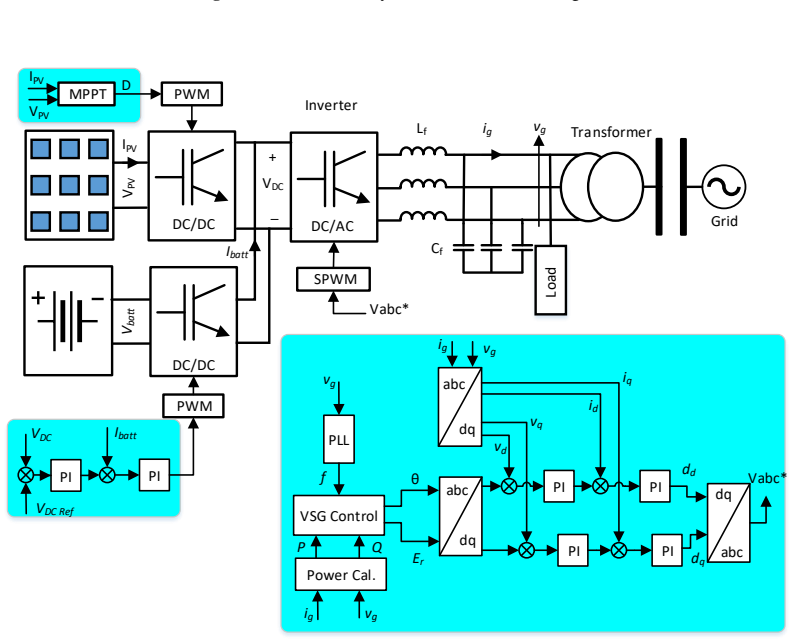
Virtual inertia emulation added to inverter-based DER controls, which supplies synchronized active power during frequency events.
If this is right
- The stability margin of the bulk power system increases under the proposed control.
- The system tracks its rated frequency more closely during transients.
- Rate of change of frequency improves, reducing the likelihood of protection relay trips.
- The control can be implemented on existing inverter-based resources in a sample grid with generation, transmission, and distribution.
Where Pith is reading between the lines
- Higher shares of DERs could be integrated without immediate upgrades to synchronous generation.
- Protection settings on the bulk system might eventually need revision if the new dynamics differ from those assumed in current relay design.
- Performance on very large interconnected grids would require testing beyond the sample system used here.
- The method could be combined with existing synchronous machines to manage overall system inertia more flexibly.
Load-bearing premise
Virtual inertia from DER inverters can sufficiently replicate the stabilizing behavior of synchronous generators without creating new instabilities or requiring changes to existing protection schemes.
What would settle it
A measurement on a real bulk power system showing that frequency nadir or rate of change of frequency still exceeds relay thresholds after the virtual inertia control is applied to a representative share of DER inverters.
Figures

read the original abstract
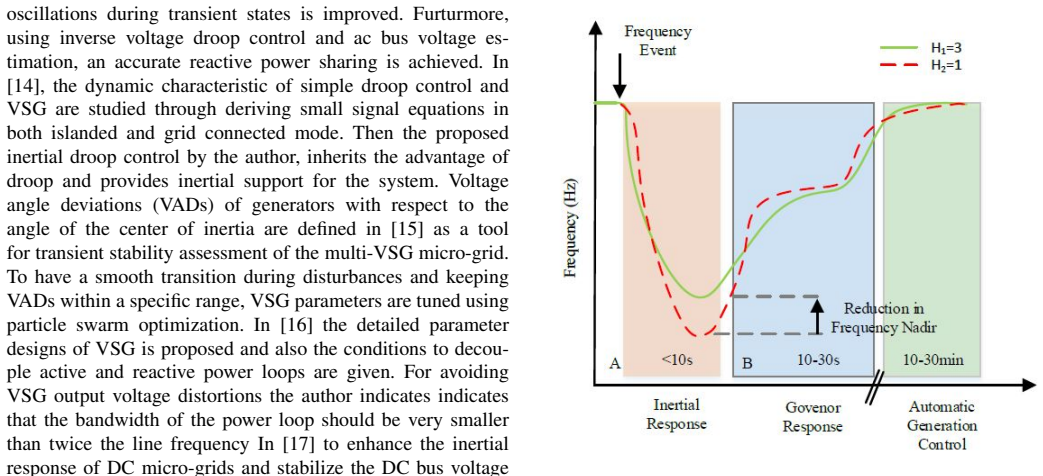
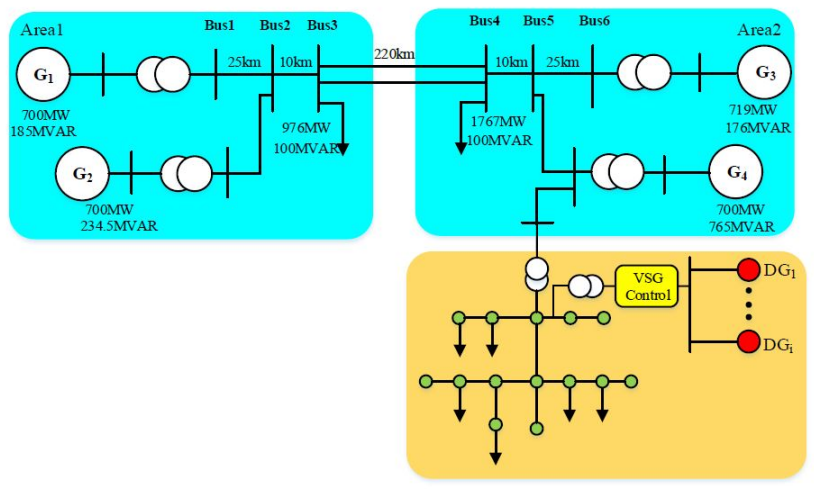
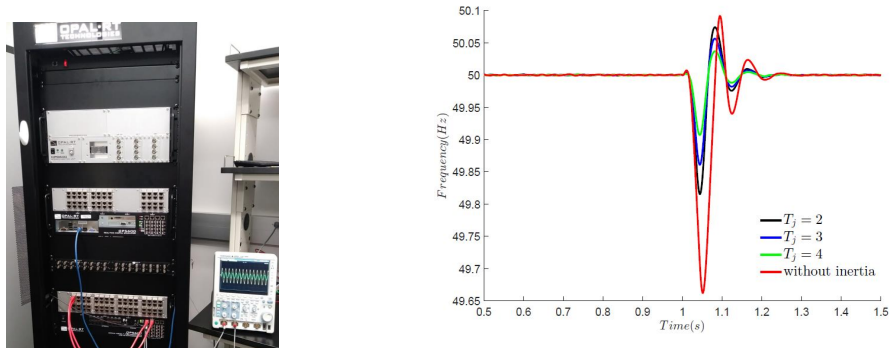
The growing penetration of distributed energy resources (DERs) has increased the complexity of the power system due to their intermittent characteristics and lower inertial response, such as photovoltaic (PV) systems and wind turbines. This restructuring of the power system has a considerable effect on the transient response of the system resulting in inter-area oscillations, less synchronized coupling and power swings. Furthermore, the concept of being distributed itself and generating electricity from multiple locations in the power system makes the transient impact of DERs even worse by raising issues such as reverse power flows. This paper studies some impacts of the changing nature of power system which are limiting the large scale integration of DERs. In addition, a solution to increase the inertial response of the system is addressed by adding virtual inertia to the inverter based DERs in the power system. The proposed control results in increasing the stability margin and tracking the rated frequency of the system. The injected synchronized active power to the system will prevent the protection relays from tripping by improving the rate of change of frequency. The proposed system operation is implemented on a sample power grid comprising of generation, transmission and distribution and results are verified experimentally through the Opal-RT real-time simulation system.
Editorial analysis
A structured set of objections, weighed in public.
Referee Report
Summary. The manuscript examines the impacts of rising DER penetration (e.g., PV and wind) on bulk power system frequency regulation, highlighting reduced inertial response, inter-area oscillations, weaker synchronization, power swings, and reverse power flows. It proposes a virtual-inertia control strategy implemented on inverter-based DERs that is claimed to enlarge the stability margin, track rated frequency, and raise RoCoF sufficiently to keep protection relays from tripping. The method is demonstrated on an unspecified sample grid comprising generation, transmission, and distribution and is validated via Opal-RT real-time simulation.
Significance. If the stability-margin and RoCoF improvements can be shown to hold under reproducible conditions, the work would address a practically relevant barrier to high renewable penetration. The choice of real-time simulation for verification is a methodological strength that could support claims of practical relevance, provided the grid model, control parameters, and relay thresholds are fully documented.
major comments (3)
- [Abstract] Abstract (and throughout): the central claim that virtual inertia 'increases the stability margin' and 'prevents the protection relays from tripping by improving the rate of change of frequency' is presented without any analytical derivation, small-signal stability analysis, or explicit RoCoF threshold calculation; the manuscript therefore provides no evidence that the improvement is load-bearing rather than an artifact of the chosen simulation scenario.
- [Simulation results section] Simulation results section: the sample power grid, DER penetration levels, virtual-inertia control parameters (e.g., inertia constant, damping), and protection-relay trip settings are never specified; without these quantities the reported frequency-tracking and relay-prevention outcomes cannot be reproduced or generalized beyond the single Opal-RT run.
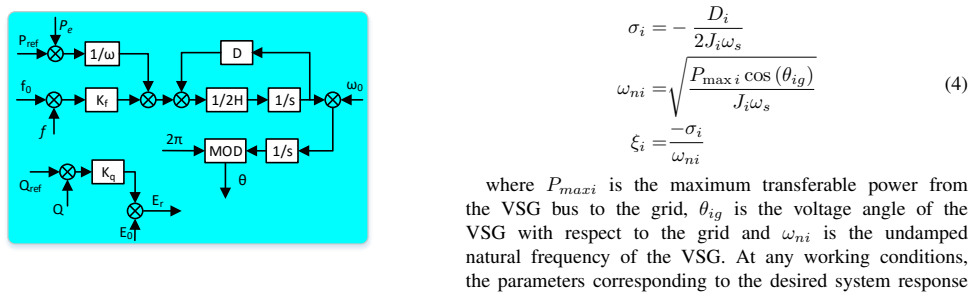
- [Proposed control description] Proposed control description: no block diagram, transfer-function, or differential-equation model of the virtual-inertia controller is supplied, so it is impossible to verify whether the added inertia mimics synchronous-machine behavior or introduces new oscillatory modes.
minor comments (1)
- [Abstract] The abstract states that DERs raise 'issues such as reverse power flows' but never returns to this topic when describing the virtual-inertia solution; a brief clarification of scope would improve readability.
Simulated Author's Rebuttal
We thank the referee for the constructive feedback on our manuscript. The comments highlight important areas for improving rigor, reproducibility, and clarity. We address each major comment below and will revise the manuscript accordingly.
read point-by-point responses
-
Referee: [Abstract] Abstract (and throughout): the central claim that virtual inertia 'increases the stability margin' and 'prevents the protection relays from tripping by improving the rate of change of frequency' is presented without any analytical derivation, small-signal stability analysis, or explicit RoCoF threshold calculation; the manuscript therefore provides no evidence that the improvement is load-bearing rather than an artifact of the chosen simulation scenario.
Authors: We agree that the manuscript relies on simulation evidence without accompanying analytical support such as small-signal analysis or explicit RoCoF calculations. The Opal-RT results demonstrate the frequency and RoCoF improvements, but this does not substitute for a derivation showing the effect is general. In revision we will add a small-signal stability analysis section comparing the system with and without virtual inertia to substantiate the stability-margin claims. revision: yes
-
Referee: [Simulation results section] Simulation results section: the sample power grid, DER penetration levels, virtual-inertia control parameters (e.g., inertia constant, damping), and protection-relay trip settings are never specified; without these quantities the reported frequency-tracking and relay-prevention outcomes cannot be reproduced or generalized beyond the single Opal-RT run.
Authors: We acknowledge that the manuscript does not provide the full set of parameters needed for reproducibility. The sample grid topology, exact DER penetration levels, virtual-inertia constants (inertia and damping), and relay trip thresholds are missing. We will include a dedicated section with the complete grid model, all numerical parameters, and relay settings in the revised manuscript. revision: yes
-
Referee: [Proposed control description] Proposed control description: no block diagram, transfer-function, or differential-equation model of the virtual-inertia controller is supplied, so it is impossible to verify whether the added inertia mimics synchronous-machine behavior or introduces new oscillatory modes.
Authors: The controller is described only in text. We agree a block diagram and mathematical model are required to allow verification of its inertial behavior and to check for introduced modes. In the revision we will add a block diagram together with the transfer-function or state-space representation of the virtual-inertia controller. revision: yes
Circularity Check
No circularity detected; paper presents simulation-based verification without analytical derivations or self-referential reductions.
full rationale
The manuscript describes DER impacts on frequency regulation and proposes virtual inertia via inverter controls, with results verified through Opal-RT simulation on a sample grid. No equations, derivations, fitted parameters presented as predictions, or self-citation chains appear in the abstract or described content. Central claims rest on simulation outcomes rather than any self-definitional, uniqueness-imported, or ansatz-smuggled steps. This is a standard non-finding for simulation-focused papers lacking load-bearing mathematical chains.
Axiom & Free-Parameter Ledger
axioms (2)
- domain assumption Inverter-based DERs can be controlled to emulate synchronous generator inertia through active power modulation.
- domain assumption The sample power grid model captures the relevant transient dynamics of real bulk systems with DERs.
invented entities (1)
-
virtual inertia
no independent evidence
Reference graph
Works this paper leans on
-
[1]
Small-sized loudspeaker equalization based svd-krylov model reduction and virtual bass enhancement,
Y . Fang, H. Zou, and Q. Huang, “Small-sized loudspeaker equalization based svd-krylov model reduction and virtual bass enhancement,” 2017
work page 2017
-
[2]
Reliability/cost implications of pv and wind energy utilization in small isolated power systems,
R. Karki and R. Billinton, “Reliability/cost implications of pv and wind energy utilization in small isolated power systems,” IEEE Transactions on Energy Conversion , vol. 16, no. 4, pp. 368–373, 2001
work page 2001
-
[3]
Steady-state model and power flow analysis of electronically-coupled distributed resource units,
H. Nikkhajoei and R. Iravani, “Steady-state model and power flow analysis of electronically-coupled distributed resource units,” IEEE Transactions on Power Delivery , vol. 22, no. 1, pp. 721–728, 2006
work page 2006
-
[4]
Power flow study and voltage stability analysis for distribution systems with distributed generation,
H. Chen, J. Chen, D. Shi, and X. Duan, “Power flow study and voltage stability analysis for distribution systems with distributed generation,” in 2006 IEEE Power Engineering Society General Meeting . IEEE, 2006, pp. 8–pp
work page 2006
-
[5]
The impact of large scale wind power gen- eration on power system oscillations,
J. Slootweg and W. Kling, “The impact of large scale wind power gen- eration on power system oscillations,” Electric Power Systems Research, vol. 67, no. 1, pp. 9–20, 2003
work page 2003
-
[6]
S. Dierkes, F. Bennewitz, M. Maercks, L. Verheggen, and A. Moser, “Impact of distributed reactive power control of renewable energy sources in smart grids on voltage stability of the power system,” in 2014 Electric Power Quality and Supply Reliability Conference (PQ) . IEEE, 2014, pp. 119–126
work page 2014
-
[7]
Virtual inertia: Current trends and future directions,
U. Tamrakar, D. Shrestha, M. Maharjan, B. Bhattarai, T. Hansen, and R. Tonkoski, “Virtual inertia: Current trends and future directions,” Applied Sciences , vol. 7, no. 7, p. 654, 2017
work page 2017
-
[8]
Virtual synchronous generators: A survey and new perspectives,
H. Bevrani, T. Ise, and Y . Miura, “Virtual synchronous generators: A survey and new perspectives,” International Journal of Electrical Power & Energy Systems , vol. 54, pp. 244–254, 2014
work page 2014
-
[9]
A battery energy storage based virtual synchronous generator,
A. Vassilakis, P. Kotsampopoulos, N. Hatziargyriou, and V . Karapanos, “A battery energy storage based virtual synchronous generator,” in 2013 IREP Symposium Bulk Power System Dynamics and Control-IX Optimization, Security and Control of the Emerging Power Grid . IEEE, 2013, pp. 1–6
work page 2013
-
[10]
Synchronverters: Inverters that mimic synchronous generators,
Q.-C. Zhong and G. Weiss, “Synchronverters: Inverters that mimic synchronous generators,” IEEE Transactions on industrial electronics , vol. 58, no. 4, pp. 1259–1267, 2010
work page 2010
-
[11]
Virtual synchronous machines: A unified interface for grid integration,
Q.-C. Zhong, “Virtual synchronous machines: A unified interface for grid integration,” IEEE Power Electronics Magazine , vol. 3, no. 4, pp. 18–27, 2016
work page 2016
-
[12]
K. Sakimoto, Y . Miura, and T. Ise, “Stabilization of a power system with a distributed generator by a virtual synchronous generator function,” in 8th International Conference on Power Electronics-ECCE Asia . IEEE, 2011, pp. 1498–1505
work page 2011
-
[13]
Enhanced virtual synchronous generator control for parallel inverters in microgrids,
J. Liu, Y . Miura, H. Bevrani, and T. Ise, “Enhanced virtual synchronous generator control for parallel inverters in microgrids,”IEEE Transactions on Smart Grid , vol. 8, no. 5, pp. 2268–2277, 2016
work page 2016
-
[14]
J. Liu, Y . Miura, and T. Ise, “Comparison of dynamic characteristics between virtual synchronous generator and droop control in inverter- based distributed generators,” IEEE Transactions on Power Electronics , vol. 31, no. 5, pp. 3600–3611, 2015
work page 2015
-
[15]
Stability assessment and optimization methods for microgrid with multiple vsg units,
J. Alipoor, Y . Miura, and T. Ise, “Stability assessment and optimization methods for microgrid with multiple vsg units,” IEEE Transactions on Smart Grid , vol. 9, no. 2, pp. 1462–1471, 2016
work page 2016
-
[16]
Small-signal modeling and parameters design for virtual synchronous generators,
H. Wu, X. Ruan, D. Yang, X. Chen, W. Zhao, Z. Lv, and Q.-C. Zhong, “Small-signal modeling and parameters design for virtual synchronous generators,” IEEE Transactions on Industrial Electronics , vol. 63, no. 7, pp. 4292–4303, 2016
work page 2016
-
[17]
A virtual inertia control strategy for dc microgrids analogized with virtual synchronous machines,
W. Wu, Y . Chen, A. Luo, L. Zhou, X. Zhou, L. Yang, Y . Dong, and J. M. Guerrero, “A virtual inertia control strategy for dc microgrids analogized with virtual synchronous machines,” IEEE Transactions on Industrial Electronics, vol. 64, no. 7, pp. 6005–6016, 2016
work page 2016
-
[18]
C. Andalib-Bin-Karim, X. Liang, and H. Zhang, “Fuzzy-secondary- controller-based virtual synchronous generator control scheme for in- terfacing inverters of renewable distributed generation in microgrids,” IEEE Transactions on Industry Applications , vol. 54, no. 2, pp. 1047– 1061, 2018
work page 2018
-
[19]
K. Shi, W. Song, P. Xu, R. Liu, Z. Fang, and Y . Ji, “Low-voltage ride- through control strategy for a virtual synchronous generator based on smooth switching,” IEEE Access , vol. 6, pp. 2703–2711, 2017
work page 2017
-
[20]
Comprehensive control strategy of virtual synchronous generator under unbalanced voltage conditions,
T. Zheng, L. Chen, Y . Guo, and S. Mei, “Comprehensive control strategy of virtual synchronous generator under unbalanced voltage conditions,” IET Generation, Transmission & Distribution , vol. 12, no. 7, pp. 1621– 1630, 2017
work page 2017
-
[21]
Multi-loop virtual synchronous generator control of inverter-based dgs under microgrid dynamics,
H. Zhao, Q. Yang, and H. Zeng, “Multi-loop virtual synchronous generator control of inverter-based dgs under microgrid dynamics,” IET Generation, Transmission & Distribution , vol. 11, no. 3, pp. 795–803, 2017
work page 2017
- [22]
-
[23]
Radial distribution test feeders,
W. H. Kersting, “Radial distribution test feeders,” IEEE Transactions on Power Systems, vol. 6, no. 3, pp. 975–985, 1991
work page 1991
-
[24]
Control of power converters in ac microgrids,
J. Rocabert, A. Luna, F. Blaabjerg, and P. Rodriguez, “Control of power converters in ac microgrids,” IEEE transactions on power electronics , vol. 27, no. 11, pp. 4734–4749, 2012
work page 2012
-
[25]
J. Alipoor, Y . Miura, and T. Ise, “Distributed generation grid integration using virtual synchronous generator with adoptive virtual inertia,” in 2013 IEEE Energy Conversion Congress and Exposition . IEEE, 2013, pp. 4546–4552
work page 2013
-
[26]
Oscillation damping of a distributed generator using a virtual synchronous generator,
T. Shintai, Y . Miura, and T. Ise, “Oscillation damping of a distributed generator using a virtual synchronous generator,” IEEE transactions on power delivery , vol. 29, no. 2, pp. 668–676, 2014
work page 2014
-
[27]
Robust frequency control of microgrids using an extended virtual synchronous generator,
A. Fathi, Q. Shafiee, and H. Bevrani, “Robust frequency control of microgrids using an extended virtual synchronous generator,” IEEE Transactions on Power Systems , vol. 33, no. 6, pp. 6289–6297, 2018
work page 2018
-
[28]
K. Sakimoto, Y . Miura, and T. Ise, “Stabilization of a power system including inverter type distributed generators by the virtual synchronous generator,” IEEJ Transactions on Power and Energy , vol. 132, pp. 341– 349, 2012
work page 2012
-
[29]
Review of virtual synchronous generator technology in distributed generation [j],
X. Zhang, D.-b. ZHU, and H.-z. XU, “Review of virtual synchronous generator technology in distributed generation [j],” Journal of Power Supply, vol. 3, pp. 1–6, 2012
work page 2012
-
[30]
Y . Du, J. M. Guerrero, L. Chang, J. Su, and M. Mao, “Modeling, analysis, and design of a frequency-droop-based virtual synchronous generator for microgrid applications,” in 2013 IEEE ECCE Asia Dow- nunder. IEEE, 2013, pp. 643–649
work page 2013
-
[31]
Mathematical model and strategic energy storage selection of virtual synchronous generators,
Z. Zeng, W. Shao, L. Ran, Z. Lyu, and R. Li, “Mathematical model and strategic energy storage selection of virtual synchronous generators,” Automation of Electric Power Systems , vol. 39, no. 13, pp. 22–31, 2015
work page 2015
-
[32]
Y . Hirase, K. Sugimoto, K. Sakimoto, and T. Ise, “Analysis of resonance in microgrids and effects of system frequency stabilization using a virtual synchronous generator,” IEEE Journal of Emerging and Selected Topics in Power Electronics , vol. 4, no. 4, pp. 1287–1298, 2016
work page 2016
-
[33]
A coherency-based equivalence method for mmc inverters using virtual synchronous generator control,
C. Li, J. Xu, and C. Zhao, “A coherency-based equivalence method for mmc inverters using virtual synchronous generator control,” IEEE Transactions on Power Delivery , vol. 31, no. 3, pp. 1369–1378, 2015
work page 2015
discussion (0)
Sign in with ORCID, Apple, or X to comment. Anyone can read and Pith papers without signing in.