REVIEW 3 major objections 4 minor 81 references
Multi-Objective Evolutionary Framework for Non-linear System Identification: A Comprehensive Investigation
T0 review · 3 major / 4 minor · reviewed 2026-08-14 · deepseek-v4-flash
Pith's one-line read The paper proposes a two-objective evolutionary framework that selects NARX model structures and reports that it recovers correct structures for all tested benchmark systems.
desk verdict A solid, reproducible empirical comparison of three MOEAs for NARX structure selection; the multi-model GFRF validation claim is overstated, but the central framework conclusion holds. read the letter →
The pith
A machine-rendered reading of the paper's core claim, the machinery that carries it, and where it could break.
The reading
What carries the argument
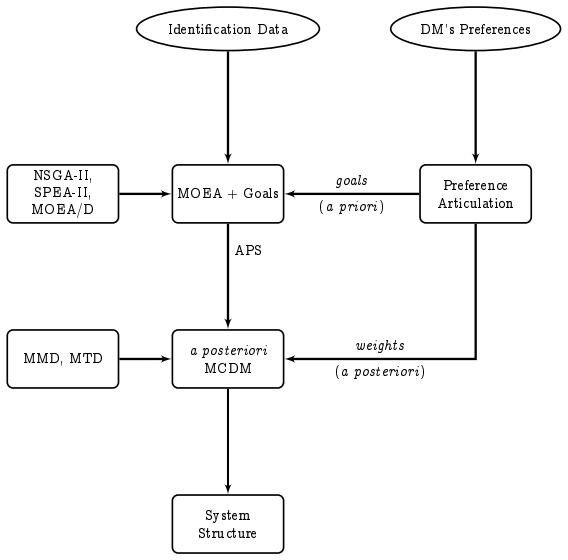
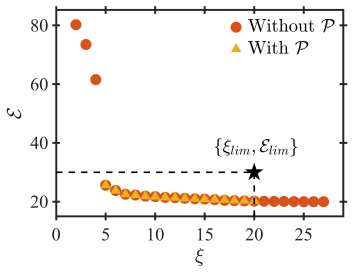
The load-bearing object is the Approximate Pareto Set of non-dominated NARX structures, obtained by minimizing the pair $\{\text{cardinality }\xi,\ \text{normalized mean-squared error }E\}$. The machinery combines a binary encoding of candidate term subsets; three multi-objective evolutionary algorithms, NSGA-II, SPEA-II and MOEA/D, that search the space; a goal-point penalty that focuses the search at $\xi\le 20$ and $E\le 30$; and the a posteriori ranking rules Minimum Manhattan Distance (MMD) and Multi-criteria Tournament Decision (MTD) that pick final models. The identity doing the validation work is the Generalized Frequency Response Function, computed from identified models by harmonic probing; the paper relies on these functions as invariant descriptors of the system dynamics that should match whenever two models describe the same system.
What would settle it
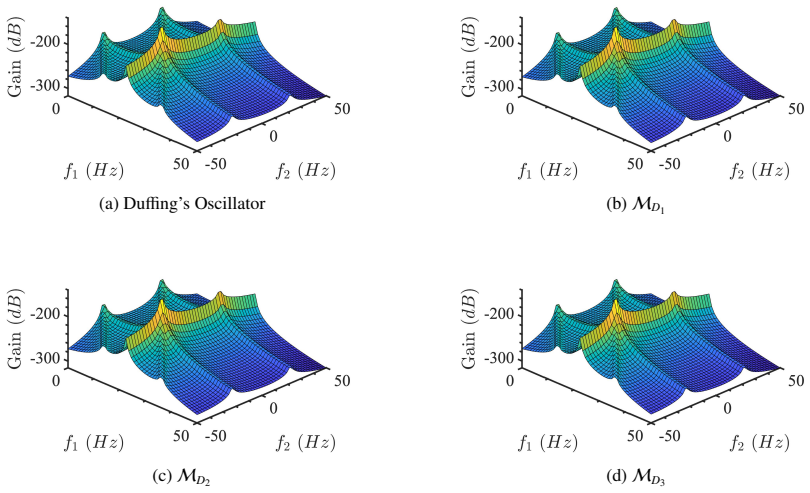
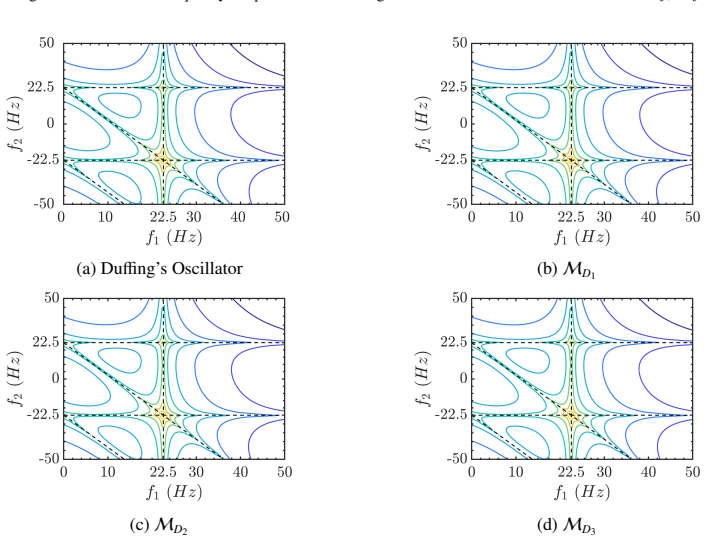
Compute the fifth-order Generalized Frequency Response Functions of the identified models MD1, MD2 and MD3 by the same harmonic-probing recursion and compare them with the continuous-time Duffing oscillator's fifth-order kernel; if the higher-order kernels diverge substantially while the first- and third-order kernels agree, then matching only the low-order responses is not enough to prove the models valid.
Extended reading notes
Core claim
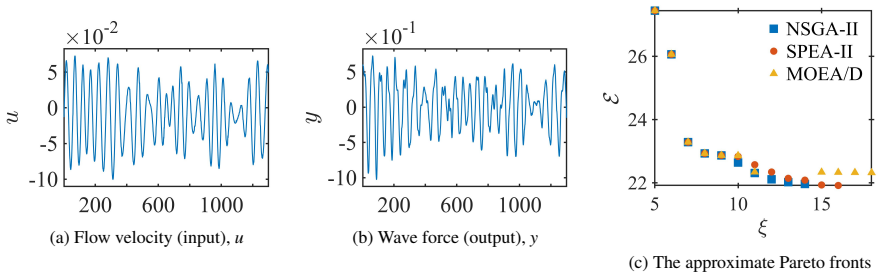
The central claim is that structure selection for polynomial NARX models can be solved as a two-objective optimization problem—minimize normalized mean-squared prediction error $E$ and number of terms $\xi$—and that the non-dominated set of structures, generated by NSGA-II, SPEA-II or MOEA/D with a goal point $\{\xi\le 20,\ E\le 30\}$ and ranked by Minimum Manhattan Distance or Multi-criteria Tournament Decision, contains the correct structure for every benchmark discrete-time system tested. For continuous-time systems, the framework discovers multiple distinct discrete-time NARX models, and the paper asserts these models are all valid because their first- and third-order Generalized Frequency Response Functions match those of the original system. On the search side, the paper claims NSGA-II is significantly better than SPEA-II and MOEA/D (Friedman test $p=0.0084$, with Hommel-adjusted post-hoc rejection of both null hypotheses), and that the algorithms are robust across a wide sweet spot of crossover and mutation probabilities.
Load-bearing premise
The paper treats matching of first- and third-order Generalized Frequency Response Functions between an identified discrete-time model and the original continuous-time system as sufficient evidence that the model is dynamically valid.
Editorial extensions
If this is right
- If the workflow is applied to a new nonlinear system, the user can expect an approximate Pareto set whose top-ranked structures by MMD or MTD include exact or near-exact structures for discrete-time systems.
- NSGA-II with uniform crossover and crossover/mutation probabilities around $p_c=0.9$, $p_m=0.006$ is a reasonable default, since it outperforms the other two algorithms on six of nine test systems.
- For continuous-time systems, multiple distinct discrete-time NARX models can be regarded as valid as long as their low-order Generalized Frequency Response Functions match, so parsimony can guide the final choice.
- The identified performance sweet spots in the parameter space can serve as rule-of-thumb starting points for tuning the same algorithms on other identification problems.
- Uniform crossover is preferable to single-point crossover for these MOEAs, and for MOEA/D the improvement is statistically significant on every test system.
Reading between the lines
- If matching low-order Generalized Frequency Response Functions is taken as a general validity test, the same framework could be extended to compare fourth- and fifth-order kernels, or to use frequency-domain coherence, as a stricter check for systems whose discrete representation is not unique.
- The multiple-valid-models result suggests a natural ensemble-identification extension: instead of selecting one model, average predictions of the top-ranked non-dominated structures, which the paper does not explore.
- The sensitivity analysis leaves MOEA/D's own parameters, such as neighborhood size, replacement pool size, and aggregation function, untested; those are plausible drivers of its weaker robustness, not just the crossover choice.
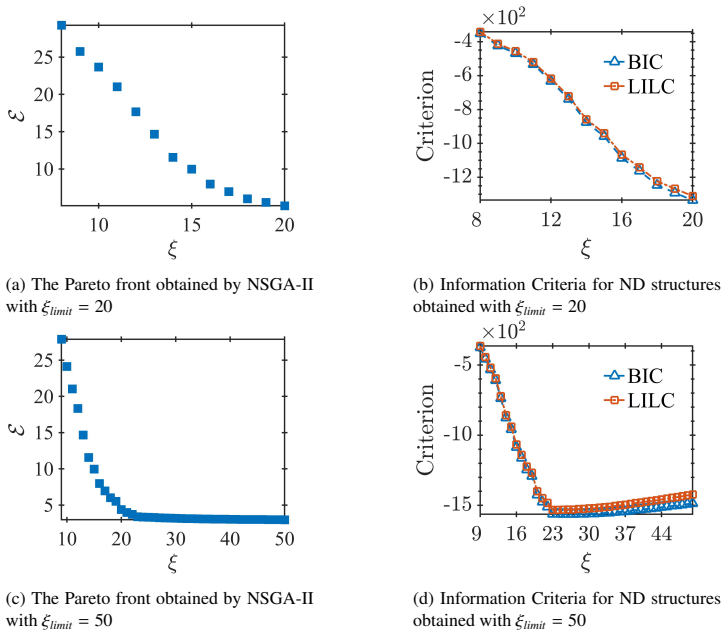
- The goal point $\{\xi\le 20,\ E\le 30\}$ needs updating when the true system has more than 20 terms, and the paper's Section 5.2 shows how to detect this via information criteria, so the preference-update step could be automated.
Signed reviews
Editorial analysis
A structured set of objections, weighed in public.
Referee Report
Summary. The paper proposes a Multi-Objective Structure Selection (MOSS) framework for polynomial NARX model identification, combining preference articulation, three MOEAs (NSGA-II, SPEA-II, MOEA/D), and a posteriori selection via MMD or MTD. The framework is evaluated on seven discrete-time benchmark systems, a Duffing oscillator case study, and a nonlinear wave-force identification case study. The main claims are that all compared MOEAs can identify the correct structure on the discrete benchmarks, that NSGA-II is significantly better than SPEA-II and MOEA/D in terms of hypervolume, that the algorithms are robust over large 'sweet-spot' regions in parameter space, and that frequency-domain GFRF analysis establishes the existence of multiple valid discrete-time models for continuous-time systems.
Significance. If the claims are fully substantiated, the paper would be a useful contribution: the MOSS formulation with a two-objective (cardinality, NMSE) problem, explicit goal-based preference articulation, and systematic MOEA comparison is sensible and fills a gap in the NARX structure-selection literature. The benchmark recovery results in Table 2 are clean and the sweet-spot analysis in Section 7 is a valuable practical addition, especially because the paper reports full parameter settings and identified model equations, which aids reproducibility. The main limitations are that the central 'multiple valid models' conclusion rests on a qualitative and truncated GFRF comparison, and the statistical comparison of MOEAs does not report run-to-run variability; both weaken the strength of the claimed conclusions.
major comments (3)
- [Section 5.3, Eqs. (30)-(32), Figs. 4-6] The conclusion that MD1-MD3 are conclusively valid discrete-time models of the Duffing oscillator is supported only by visual agreement of the first- and third-order GFRFs with the continuous-time model. The paper asserts that GFRFs are invariant descriptors, but it does not provide a theorem or quantitative bound showing that matching finitely many low-order kernels implies dynamic equivalence. Since a polynomial NARX model has Volterra kernels of all orders, two distinct models can agree on H1 and H3 while differing at higher orders. To support the central claim, the authors should report quantitative kernel errors (e.g., normalized L2 or max deviation over the plotted frequency ranges), compare at least one higher-order kernel or a nonlinear-response prediction test, or use an independent validation signal; as it stands, the evidence is suggestive rather than conclusive.
- [Section 6.2, Tables 6-7] The statistical claim that NSGA-II is significantly better than SPEA-II and MOEA/D is based on a single hypervolume value per algorithm per test system, obtained from the pooled approximate Pareto set of 40 runs. No run-to-run variance of the HV indicator is reported, so the Friedman test effectively has only nine blocks and does not account for the stochasticity of the algorithms. The authors should report the distribution of HV over independent runs and perform the test on per-run values, or carefully justify why pooling is valid for significance testing. In addition, Table 7 is internally unclear: SPEA-II is reported with p=0.0593 but an adjusted p-value of 0.050 and an apparently rejected null hypothesis; the test statistic, adjusted p-values, and decision rule need to be stated consistently.
- [Section 4.1 and Section 7.2] The crossover and mutation probabilities for each MOEA were selected from the sweet-spot analysis in Section 7.2, which was performed on the same benchmark systems (S1-S7) that are later used for the comparative evaluation in Sections 5 and 6. This is an in-sample parameter selection, so the reported comparisons and the robustness conclusion are not fully independent. The authors should either perform an out-of-sample or cross-validated parameter selection, or explicitly quantify how the conclusions depend on the selected parameters; at minimum, this limitation should be acknowledged in the text.
minor comments (4)
- [Table 2] The row and column alignment in Table 2 appears corrupted in the typeset version, especially for the 'Under-fitting' rows; the counts should be re-formatted so that each column clearly corresponds to NSGA-II, SPEA-II, and MOEA/D.
- [Section 5.3, Figs. 4-6] The GFRF figures lack color-bar scales and axis labels on several panels, making a quantitative reading difficult; adding color bars and consistent frequency grid labels would strengthen the qualitative comparison.
- [Section 6, Table 6] Several hypervolume values are identical across algorithms to four decimal places (e.g., S2 and the Duffing oscillator); the authors should report more decimal places or indicate the actual numerical differences so that ties are not merely artifacts of rounding.
- [Section 5.1] The statement that all MOEAs have been successful in identifying the correct structure is based on structures that are first refined by a null-hypothesis test on the coefficients; this should be stated in Section 5.1's concluding sentence to avoid overstating the raw search outcome.
Circularity Check
MOEA parameter tuning on the same benchmarks creates a mild fitted-input circularity for the NSGA-II superiority claim; the core identification and GFRF case studies remain externally validated.
-
fitted input called prediction
[Section 4.1, Section 7.1, Section 6.2]
"The following crossover and mutation probabilities for MOEAs are selected on the basis the performance sweet spot analysis discussed in Section 7.2: NSGA-II:{pc, pm} ={0.9, 0.006}; SPEA-II:{pc, pm} ={0.7, 0.008}; MOEA/D:{pc, pm} ={0.8, 0.008}. ... The search performance is evaluated on all the discrete time systems (S1−S7)."
The statistical claim that NSGA-II is significantly better than SPEA-II and MOEA/D is driven by the HV values in Table 6, computed from runs using the pc/pm settings selected in Section 4.1. Section 4.1 explicitly says these settings were chosen from the sweet-spot analysis in Section 7.2, and Section 7.1 states that this sweet-spot analysis was evaluated on the same S1–S7 systems later used in the Section 6 comparison. The parameter values are therefore fitted to the evaluation systems, and the subsequent significance test is not an out-of-sample comparison; it is the same data used both to tune and to rank the algorithms.
full rationale
The paper's central identification claims are self-contained against external benchmarks: the discrete-time systems in Table 1 have known structures, and 'exact-fitting' is scored against those known term sets rather than against the framework's own output. The Duffing and wave-force case studies are validated by comparing GFRFs computed from the identified models with the continuous-time model or data; although this check is qualitative and truncated at third order, it is a correctness risk, not a circular reduction, because the comparison target is an independent frequency-domain characterization. The one concrete circular step is the use of the same S1–S7 systems both to select MOEA control parameters (Section 7.2) and to generate the HV values used in the Friedman/Hommel claim that NSGA-II is significantly better (Section 6.2). That is a mild fitted-input-called-prediction issue confined to the algorithm-comparison conclusion. The main MOSS contributions—correct structure identification and multiple valid discrete models for continuous-time systems—do not reduce to this parameter tuning and would remain valid even if the MOEA ranking were withdrawn. Score 2 reflects one secondary, non-load-bearing circularity.
Assumptions & free parameters
free parameters (11)
- Crossover probability pc (NSGA-II) =
0.9
- Mutation probability pm (NSGA-II) =
0.006
- Crossover probability pc (SPEA-II) =
0.7
- Mutation probability pm (SPEA-II) =
0.008
- Crossover probability pc (MOEA/D) =
0.8
- Mutation probability pm (MOEA/D) =
0.008
- Goal point {xi_limit, E_limit} =
{20, 30} for S1-S6; {50, 30} for S7
- Preference intensity I for MTD weights =
5
- Population and archive size ps =
50
- SPEA-II kth-nearest neighbor density parameter k =
10
- MOEA/D neighborhood size T and replacement count nr =
T=5 (10% of ps), nr=2
assumptions (4)
- domain assumption The candidate NARX term set contains the true structure for each benchmark system, so exact-fitting is a well-defined outcome.
- domain assumption Agreement of linear and third-order GFRFs between an identified model and the original system is sufficient to conclude the model is valid.
- domain assumption NMSE on a single 300-point validation split is an adequate measure of predictive performance for structure selection.
- standard math Friedman test and Hommel post-hoc procedure are appropriate for comparing the three MOEAs on nine test systems.
Cite this review
Pith. "Pith review of Multi-Objective Evolutionary Framework for Non-linear System Identification: A Comprehensive Investigation." pith.science (2026). https://pith.science/paper/GF6MHEVJ
@misc{pith2026190806232,
  author       = {Pith},
  title        = {Pith review of: Multi-Objective Evolutionary Framework for Non-linear System Identification: A Comprehensive Investigation},
  year         = {2026},
  howpublished = {\url{https://pith.science/paper/GF6MHEVJ}},
  note         = {Machine review of arXiv:1908.06232}
}
read the original abstract
The present study proposes a multi-objective framework for structure selection of nonlinear systems which are represented by polynomial NARX models. This framework integrates the key components of Multi-Criteria Decision Making (MCDM) which include preference handling, Multi-Objective Evolutionary Algorithms (MOEAs) and a posteriori selection. To this end, three well-known MOEAs such as NSGA-II, SPEA-II and MOEA/D are thoroughly investigated to determine if there exists any significant difference in their search performance. The sensitivity of all these MOEAs to various qualitative and quantitative parameters, such as the choice of recombination mechanism, crossover and mutation probabilities, is also studied. These issues are critically analyzed considering seven discrete-time and a continuous-time benchmark nonlinear system as well as a practical case study of non-linear wave-force modeling. The results of this investigation demonstrate that MOEAs can be tailored to determine the correct structure of nonlinear systems. Further, it has been established through frequency domain analysis that it is possible to identify multiple valid discrete-time models for continuous-time systems. A rigorous statistical analysis of MOEAs via performance sweet spots in the parameter space convincingly demonstrates that these algorithms are robust over a wide range of control parameters.
Figures
Figures from the paper (8 more)



Reference graph
Works this paper leans on
-
[1]
S ¨oderstr¨om, P
T. S ¨oderstr¨om, P. Stoica, System Identification, Prentice-Hall, Inc., Upper Saddle River, NJ, USA, 1988
1988
-
[2]
L. Ljung, System Identification : Theory for the User, Prentice Hall PTR, Upper Saddle River, NJ, USA, 1999
work page 1999
-
[3]
O. Nelles, Nonlinear system identification : from classical approaches to neural networks and fuzzy models, Springer, Berlin ; New York, 2001
work page 2001
-
[4]
S. A. Billings, Nonlinear system identification: NARMAX methods in the time, frequency, and spatio-temporal domains, John Wiley & Sons, 2013
work page 2013
- [5]
-
[6]
J. Sj ¨oberg, Q. Zhang, L. Ljung, A. Benveniste, B. Delyon, P.-Y . Glorennec, H. Hjalmarsson, A. Juditsky, Nonlinear black-box modeling in system identification: a unified overview, Automatica 31 (12) (1995) 1691–1724
work page 1995
-
[7]
X. Hong, R. J. Mitchell, S. Chen, C. J. Harris, K. Li, G. W. Irwin, Model selection approaches for non-linear system identification: a review, International journal of systems science 39 (10) (2008) 925–946
work page 2008
-
[8]
K. Kar, A. K. Swain, R. Raine, Identification of time-varying time constants of thermocouple sensors and its application to temperature measurement, Journal of Dynamic Systems, Measurement, and Control 131 (1) (2009) 011005
work page 2009
Show all 81 references
-
[9]
Leontaritis, S
I. Leontaritis, S. A. Billings, Input-output parametric models for non-linear systems Part I: deterministic non-linear systems, International journal of control 41 (2) (1985) 303–328
1985
-
[10]
I. J. Leontaritis, S. A. Billings, Input-output parametric models for non-linear systems Part II: stochastic non-linear systems, International Journal of Control 41 (2) (1985) 329–344
1985
-
[11]
S. Chen, S. A. Billings, W. Luo, Orthogonal least squares methods and their application to non-linear system identification, International Journal of control 50 (5) (1989) 1873–1896
1989
-
[12]
Billings, K
S. Billings, K. Tsang, Spectral analysis for non-linear systems, part I: Parametric non-linear spectral analysis, Mechanical Systems and Signal Processing 3 (4) (1989) 319–339
1989
-
[13]
E. M. A. M. Mendes, Identification of nonlinear discrete systems with intelligent structure detection, Ph.D. thesis, University of She ffield, England, UK (1995)
1995
-
[14]
L. A. Aguirre, S. Billings, Dynamical e ffects of overparametrization in nonlinear models, Physica D: Nonlinear Phenomena 80 (1) (1995) 26 – 40
1995
-
[15]
L. A. Aguirre, E. M. Mendes, Global nonlinear polynomial models: Structure, term clusters and fixed points, International Journal of Bifurcation and Chaos 06 (02) (1996) 279–294
1996
-
[16]
Korenberg, S
M. Korenberg, S. Billings, Y . Liu, P. McIlroy, Orthogonal parameter estimation algorithm for non-linear stochastic systems, International Journal of Control 48 (1) (1988) 193–210
1988
-
[17]
Piroddi, W
L. Piroddi, W. Spinelli, An identification algorithm for polynomial NARX models based on simulation error minimization, International Journal of Control 76 (17) (2003) 1767–1781
2003
-
[18]
H. L. Wei, S. A. Billings, Model structure selection using an integrated forward orthogonal search algorithm interfered with squared correla- tion and mutual information, Automatic Control and Systems Engineering, University of Sheffield, 2006
2006
-
[19]
S. A. Billings, H.-L. Wei, Sparse model identification using a forward orthogonal regression algorithm aided by mutual information, IEEE Transactions on Neural Networks 18 (1) (2007) 306–310
2007
-
[20]
Y . Guo, L. Guo, S. Billings, H.-L. Wei, Ultra-orthogonal forward regression algorithms for the identification of non-linear dynamic systems, Neurocomputing 173 (2016) 715 – 723
2016
-
[21]
K. Mao, S. Billings, Algorithms for minimal model structure detection in nonlinear dynamic system identification, International journal of control 68 (2) (1997) 311–330
1997
-
[22]
Li, J.-X
K. Li, J.-X. Peng, E.-W. Bai, A two-stage algorithm for identification of nonlinear dynamic systems, Automatica 42 (7) (2006) 1189 – 1197
2006
-
[23]
Y . Guo, L. Guo, S. A. Billings, H.-L. Wei, An iterative orthogonal forward regression algorithm, International Journal of Systems Science 46 (5) (2015) 776–789. 31
2015
-
[24]
X. Tang, L. Zhang, Stability orthogonal regression for system identification, Systems & Control Letters 117 (2018) 30–36
2018
-
[25]
F. Hafiz, A. Swain, E. M. Mendes, Orthogonal floating search algorithms: From the perspective of nonlinear system identification, Neuro- computing 350 (2019) 221 – 236
2019
-
[26]
S. A. Billings, H.-L. Wei, An adaptive orthogonal search algorithm for model subset selection and non-linear system identification, Interna- tional Journal of Control 81 (5) (2008) 714–724
2008
-
[27]
Nakamura, K
T. Nakamura, K. Judd, A. I. Mees, M. Small, A comparative study of information criteria for model selection, International Journal of Bifurcation and Chaos 16 (08) (2006) 2153–2175
2006
-
[28]
C. M. Fonseca, E. Mendes, P. Fleming, S. A. Billings, Non-linear model term selection with genetic algorithms, in: Proceedings of IEE/IEEE Workshop on Natural Algorithms in Signal Processing, V ol. 2, 1993, pp. 271–278
1993
-
[29]
C. K. S. Ho, I. G. French, C. S. Cox, I. Fletcher, Genetic algorithms in structure identification for NARX models, in: Artificial Neural Nets and Genetic Algorithms, Springer Vienna, Vienna, 1998, pp. 597–600
1998
-
[30]
Rodriguez-Vazquez, C
K. Rodriguez-Vazquez, C. Fonseca, P. Fleming, An evolutionary approach to non-linear polynomial system identification, IFAC Proceedings V olumes 30 (11) (1997) 1339–1344
1997
-
[31]
Mad ´ar, J
J. Mad ´ar, J. Abonyi, F. Szeifert, Genetic programming for the identification of nonlinear input- output models, Industrial & engineering chemistry research 44 (9) (2005) 3178–3186
2005
-
[32]
Falsone, L
A. Falsone, L. Piroddi, M. Prandini, A randomized algorithm for nonlinear model structure selection, Automatica 60 (2015) 227–238
2015
-
[33]
Bianchi, A
F. Bianchi, A. Falsone, M. Prandini, L. Piroddi, A randomised approach for NARX model identification based on a multivariate bernoulli distribution, International Journal of Systems Science 48 (6) (2017) 1203–1216
2017
-
[34]
Avellina, A
M. Avellina, A. Brankovic, L. Piroddi, Distributed randomized model structure selection for NARX models, International Journal of Adaptive Control and Signal Processing 31 (12) (2017) 1853–1870
2017
-
[35]
Baldacchino, S
T. Baldacchino, S. R. Anderson, V . Kadirkamanathan, Structure detection and parameter estimation for NARX models in a unified em framework, Automatica 48 (5) (2012) 857–865
2012
-
[36]
Baldacchino, S
T. Baldacchino, S. R. Anderson, V . Kadirkamanathan, Computational system identification for bayesian NARMAX modelling, Automatica 49 (9) (2013) 2641–2651
2013
-
[37]
Dorigo, V
M. Dorigo, V . Maniezzo, A. Colorni, Ant system: optimization by a colony of cooperating agents, IEEE Transactions on Systems, Man, and Cybernetics, Part B (Cybernetics) 26 (1) (1996) 29–41
1996
-
[38]
K. Deb, A. Pratap, S. Agarwal, T. Meyarivan, A fast and elitist multiobjective genetic algorithm: NSGA-II, IEEE Transactions on Evolution- ary Computation 6 (2) (2002) 182–197
2002
-
[39]
Zitzler, M
E. Zitzler, M. Laumanns, L. Thiele, SPEA2: Improving the strength pareto evolutionary algorithm, TIK-report 103
-
[40]
Zhang, H
Q. Zhang, H. Li, MOEA /D: A multiobjective evolutionary algorithm based on decomposition, IEEE Transactions on evolutionary computation 11 (6) (2007) 712–731
2007
-
[41]
C. M. Fonseca, P. J. Fleming, Non-linear system identification with multiobjective genetic algorithms, IFAC Proceedings V olumes 29 (1) (1996) 1169–1174
1996
-
[42]
Rodriguez-Vazquez, C
K. Rodriguez-Vazquez, C. M. Fonseca, P. J. Fleming, Multiobjective genetic programming: A nonlinear system identification application, in: Late breaking papers at the 1997 genetic programming conference, 1997, pp. 207–212
1997
-
[43]
Rodr ´ıguez-V´azquez, P
K. Rodr ´ıguez-V´azquez, P. J. Fleming, Multi-objective genetic programming for nonlinear system identification, Electronics Letters 34 (9) (1998) 930–931
1998
-
[44]
C. M. Fonseca, P. J. Fleming, Genetic algorithms for multiobjective optimization: Formulation, discussion and generalization, in: Proceedings of the 5th International Conference on Genetic Algorithms, Morgan Kaufmann Publishers Inc., 1993, pp. 416–423
1993
-
[45]
Rodriguez-Vazquez, C
K. Rodriguez-Vazquez, C. M. Fonseca, P. J. Fleming, Identifying the structure of nonlinear dynamic systems using multiobjective genetic programming, IEEE Transactions on Systems, Man, and Cybernetics-Part A: Systems and Humans 34 (4) (2004) 531–545
2004
-
[46]
Rodr ´ıguez-V´azquez, P
K. Rodr ´ıguez-V´azquez, P. J. Fleming, Evolution of mathematical models of chaotic systems based on multiobjective genetic programming, Knowledge and Information Systems 8 (2) (2005) 235–256
2005
-
[47]
Ferariu, A
L. Ferariu, A. Patelli, Multiobjective genetic programming for nonlinear system identification, in: M. Kolehmainen, P. Toivanen, B. Beliczyn- ski (Eds.), Adaptive and Natural Computing Algorithms, Springer Berlin Heidelberg, Berlin, Heidelberg, 2009, pp. 233–242
2009
-
[48]
Ferariu, A
L. Ferariu, A. Patelli, Migration-based multiobjective genetic programming for nonlinear system identification, in: 2009 5th International Symposium on Applied Computational Intelligence and Informatics, IEEE, 2009, pp. 475–480
2009
-
[49]
M. Z. Zakaria, H. Jamaluddin, R. Ahmad, S. M. Loghmanian, Comparison between multi-objective and single-objective optimization for the modeling of dynamic systems, Proceedings of the Institution of Mechanical Engineers, Part I: Journal of Systems and Control Engineering 226 (7...
2012
-
[50]
D. E. Goldberg, The race, the hurdle, and the sweet spot, Evolutionary design by computers (1999) 105–118
1999
-
[51]
Purshouse, P
R. Purshouse, P. Fleming, On the evolutionary optimization of many conflicting objectives, IEEE Transactions on Evolutionary Computation 11 (6) (2007) 770–784
2007
-
[52]
F. Hafiz, A. Swain, E. M. Mendes, N. Patel, Structure selection of polynomial NARX models using two dimensional (2D) particle swarms, in: 2018 IEEE Congress on Evolutionary Computation (CEC), 2018, pp. 1–8
2018
-
[53]
F. Hafiz, A. Swain, E. M. Mendes, Two-dimensional (2D) particle swarms for structure selection of nonlinear systems, Neurocomputing (To Appear)
-
[54]
Deb, Multi-objective optimization using evolutionary algorithms, John Wiley & Sons, Chichester ; New York, 2001
K. Deb, Multi-objective optimization using evolutionary algorithms, John Wiley & Sons, Chichester ; New York, 2001
2001
-
[55]
S. A. Billings, W. S. F. V oon, Correlation based model validity tests for non-linear models, International Journal of Control 44 (1) (1986) 235–244
1986
-
[56]
D. E. Goldberg, Genetic Algorithms in Search, Optimization and Machine Learning, 1st Edition, Addison-Wesley Longman Publishing Co., Inc., Boston, MA, USA, 1989
1989
-
[57]
Zhou, B.-Y
A. Zhou, B.-Y . Qu, H. Li, S.-Z. Zhao, P. N. Suganthan, Q. Zhang, Multiobjective evolutionary algorithms: A survey of the state of the art, Swarm and Evolutionary Computation 1 (1) (2011) 32–49
2011
-
[58]
Zitzler, K
E. Zitzler, K. Deb, L. Thiele, Comparison of multiobjective evolutionary algorithms: Empirical results, Evolutionary computation 8 (2) (2000) 32 173–195
2000
-
[59]
C. M. Fonseca, P. J. Fleming, Multiobjective optimization and multiple constraint handling with evolutionary algorithms - Part I: A unified formulation, IEEE Transactions on Systems, Man, and Cybernetics - Part A: Systems and Humans 28 (1) (1998) 26–37
1998
-
[60]
Branke, Consideration of partial user preferences in evolutionary multiobjective optimization, in: Multiobjective optimization, Springer, 2008, pp
J. Branke, Consideration of partial user preferences in evolutionary multiobjective optimization, in: Multiobjective optimization, Springer, 2008, pp. 157–178
2008
-
[61]
C. A. C. Coello, Handling preferences in evolutionary multiobjective optimization: a survey, in: Proceedings of the 2000 Congress on Evolutionary Computation. CEC00 (Cat. No.00TH8512), V ol. 1, 2000, pp. 30–37 vol.1
2000
-
[62]
Cvetkovic, I
D. Cvetkovic, I. C. Parmee, Preferences and their application in evolutionary multiobjective optimization, IEEE Transactions on Evolutionary Computation 6 (1) (2002) 42–57
2002
-
[63]
Branke, K
J. Branke, K. Deb, Integrating user preferences into evolutionary multi-objective optimization, in: Knowledge incorporation in evolutionary computation, Springer, 2005, pp. 461–477
2005
-
[64]
Thiele, K
L. Thiele, K. Miettinen, P. J. Korhonen, J. Molina, A preference-based evolutionary algorithm for multi-objective optimization, Evolutionary computation 17 (3) (2009) 411–436
2009
-
[65]
Zhang, J
Q. Zhang, J. C. Chen, P. P. Chong, Decision consolidation: criteria weight determination using multiple preference formats, Decision Support Systems 38 (2) (2004) 247–258
2004
-
[66]
Parreiras, J
R. Parreiras, J. Vasconcelos, Decision making in multiobjective optimization aided by the multicriteria tournament decision method, Nonlin- ear Analysis: Theory, Methods & Applications 71 (12) (2009) e191–e198
2009
-
[67]
W.-Y . Chiu, G. G. Yen, T.-K. Juan, Minimum manhattan distance approach to multiple criteria decision making in multiobjective optimization problems, IEEE Transactions on Evolutionary Computation 20 (6) (2016) 972–985
2016
-
[68]
Bonin, V
M. Bonin, V . Seghezza, L. Piroddi, NARX model selection based on simulation error minimisation and lasso, IET control theory & applica- tions 4 (7) (2010) 1157–1168
2010
-
[69]
Piroddi, W
L. Piroddi, W. Spinelli, A pruning method for the identification of polynomial NARMAX models, IFAC Proceedings V olumes 36 (16) (2003) 1071–1076
2003
-
[70]
Zitzler, L
E. Zitzler, L. Thiele, M. Laumanns, C. M. Fonseca, V . G. da Fonseca, Performance assessment of multiobjective optimizers: An analysis and review, IEEE Transactions on Evolutionary Computation 7 (2) (2003) 117
2003
-
[71]
Zitzler, L
E. Zitzler, L. Thiele, Multiobjective optimization using evolutionary algorithmsa comparative case study, in: International conference on parallel problem solving from nature, Springer, 1998, pp. 292–301
1998
-
[72]
C. M. Fonseca, L. Paquete, M. L ´opez-Ib´anez, An improved dimension-sweep algorithm for the hypervolume indicator, in: 2006 IEEE international conference on evolutionary computation, IEEE, 2006, pp. 1157–1163
2006
-
[73]
Beume, C
N. Beume, C. M. Fonseca, M. L ´opez-Ib´a˜nez, L. Paquete, J. Vahrenhold, On the complexity of computing the hypervolume indicator, IEEE Transactions on Evolutionary Computation 13 (5) (2009) 1075–1082
2009
-
[74]
Ishibuchi, R
H. Ishibuchi, R. Imada, Y . Setoguchi, Y . Nojima, Reference point specification in hypervolume calculation for fair comparison and efficient search, in: Proceedings of the Genetic and Evolutionary Computation Conference, ACM, 2017, pp. 585–592
2017
-
[75]
S. A. Billings, J. C. P. Jones, Mapping non-linear integro-di fferential equations into the frequency domain, International Journal of Control 52 (4) (1990) 863–879
1990
-
[76]
Swain, S
A. Swain, S. Billings, P. Stansby, M. Baker, Accurate prediction of non-linear wave forces: Part I (fixed cylinder), Mechanical systems and signal processing 12 (3) (1998) 449–485
1998
-
[77]
Derrac, S
J. Derrac, S. Garc ´ıa, D. Molina, F. Herrera, A practical tutorial on the use of nonparametric statistical tests as a methodology for comparing evolutionary and swarm intelligence algorithms, Swarm and Evolutionary Computation 1 (1) (2011) 3–18
2011
-
[78]
Sheskin, Handbook of parametric and nonparametric statistical procedures, 3rd Edition, Chapman & Hall /CRC, Boca Raton, FL, 2003
D. Sheskin, Handbook of parametric and nonparametric statistical procedures, 3rd Edition, Chapman & Hall /CRC, Boca Raton, FL, 2003
2003
-
[79]
A. E. Eiben, R. Hinterding, Z. Michalewicz, Parameter control in evolutionary algorithms, IEEE Transactions on Evolutionary Computation 3 (2) (1999) 124–141
1999
-
[80]
Mitchell, An introduction to genetic algorithms, 1st Edition, MIT Press, Cambridge, Mass., 1998
M. Mitchell, An introduction to genetic algorithms, 1st Edition, MIT Press, Cambridge, Mass., 1998
1998
-
[81]
W. M. Spears, K. D. De Jong, On the Virtues of Parameterized Uniform Crossover, Naval Research Lab Washington DC, 1995. 33
1995
Reviewed August 14, 2026 · model on record in the stance chip above.
Discussion (0). Continue with ORCID to comment.