REVIEW 3 major objections 4 minor 23 references
Substructures in Minor Mergers' Tidal Streams
T0 review · 3 major / 4 minor · reviewed 2026-08-14 · deepseek-v4-flash
Pith's one-line read Gas-rich minor mergers can form globular-cluster-like clumps and high-velocity clouds directly in their tidal streams, with at least one clump retaining dark matter from the satellite galaxy.
desk verdict Plausible idea undercut by the paper's own resolution check—worth a referee, not yet worth believing. read the letter →
The pith
A machine-rendered reading of the paper's core claim, the machinery that carries it, and where it could break.
The reading
What carries the argument
The central object is the tidal-stream clump: a concentration of gas particles, in one case also satellite dark matter, that stands out as a peak in phase-space density and is then tracked by particle identification across snapshots. The decisive mechanism is that cold gas lets these overdensities become self-gravitating and stay bound for more than a billion years, whereas collisionless streams produce only transient overdensities. The paper's numerical guard is the minimum resolvable mass, defined as the mass of a fixed number of smoothed-particle-hydrodynamics (SPH) neighbours; requiring it to stay below the local Jeans mass is what lets the authors argue that the clumps are physical rather than products of SPH fragmentation.
What would settle it
A decisive test is to rerun the highest-resolution gas merger with more particles or with a different hydrodynamics implementation and require that the same clumps reappear with the same masses and lifetimes; if the number or masses of clumps keep changing with resolution or method, they are numerical fragments rather than physical structures.
Extended reading notes
Core claim
On the paper's own terms, the discovery is that star-cluster-like and cloud-like structures can be assembled from the tidal debris of a gas-rich minor merger rather than inherited from the satellite or formed in the host disk. Across a set of five merger orbits the amount of material stripped from the satellite is similar, and the highest-resolution gas run yields a population of dense clumps that are gravitationally bound, persist for more than about one billion years, and have total masses of $10^3$–$10^6$ solar masses, the ranges spanned by globular clusters and high-velocity clouds. The paper treats one clump that is dominated by satellite dark matter as evidence that such systems can contain dark matter. It does not claim that the clumps have already become star clusters: the gas in the simulation is hot enough to suppress star formation, so the conclusion is that these are viable cluster precursors whose later star-forming evolution is left for future work.
Load-bearing premise
The clumps seen in the gas simulations are real, self-gravitating gas clouds and not computational artifacts of the way the hydrodynamics is solved.
Editorial extensions
If this is right
- Gas-rich minor mergers become a plausible formation channel for globular-cluster-like objects and high-velocity clouds in the halo, in addition to in-situ collapse and accretion channels.
- At least one class of stream-born clump can retain dark matter from the satellite, so globular-cluster-like systems formed this way need not be purely baryonic.
- Because collisionless runs produce only transient overdensities, cold gas is a necessary ingredient for stream material to condense into bound, long-lived clumps.
- The clump masses, roughly $10^3$ to $10^6$ solar masses, overlap the observed mass scales of globular clusters and high-velocity clouds, so the simulated objects are of the right size to be their progenitors.
- The clumps orbit near the host disk for over a billion years, so a population of such objects would be distributed around the halo in a way that can be compared with observed globular cluster and HVC systems.
Reading between the lines
- Inference: if this mechanism is generic, stream-born clumps should appear around other galaxies with gas-rich dwarf companions; a targeted search for young, low-metallicity clumps in real tidal streams would test the idea outside the simulation.
- Inference: the high-resolution run was carried out for only one of the five orbital configurations, so a natural extension is to map clump formation efficiency across the other orbits; the paper's own stripped-mass curves suggest the amount of debris is similar, which would predict clumps in the other geometries too.
- Inference: since the simulated gas is initially hot and star formation is largely suppressed, the mechanism's most direct observable consequence remains untested here; models with colder gas or different feedback could show whether the clumps go on to form stars, which is the step that would turn them into true globular clusters.
Signed reviews
Editorial analysis
A structured set of objections, weighed in public.
Referee Report
Summary. The paper uses N-body and SPH simulations of a gas-rich satellite galaxy on several orbits around a Milky Way-like host to ask whether overdensities in tidal streams can become self-gravitating substructures. In dark-matter-only runs the stream overdensities are transient. In runs with gas, the authors identify 10 clumps in the highest-resolution simulation (GAS3), report masses between roughly 1e3 and 1e6 solar masses and lifetimes of at least 1 Gyr, and identify one candidate (Candidate 0) whose mass is dominated by satellite dark matter. They conclude that globular-cluster-like and high-velocity-cloud-like structures can form in the tidal streams of gas-rich minor mergers and that such systems may retain dark matter.
Significance. If the clumps are real, the result offers a plausible new formation channel for globular clusters and high-velocity clouds from tidal streams and suggests a way for some globular clusters to contain dark matter. The question is relevant to the interpretation of stream overdensities and of candidate dark-matter-bearing clusters. The paper includes good practices: the orbital parameters are drawn from cosmological distributions (Wetzel 2011), the initial conditions are relaxed in isolation before the merger, and the analysis computes binding properties and follows candidates across snapshots. However, the significance is conditional on the physical reality of the GAS3 clumps, and the evidence presented for that reality is currently incomplete in specific, checkable ways.
major comments (3)
- [Sec. 3.3, Eq. (6), Fig. 7] The resolution guard against SPH fragmentation is not demonstrated for GAS3. Using the parameters in Table 2 (M_gas = 5e9 M_sun, N_gas = 1e6, N_ngb = 128), Eq. (6) gives M_res ~ 1.28e6 M_sun, which is at the top of the candidate mass range quoted in Section 4 (1e3 to 1e6 M_sun). The text states that M_res remains much smaller than the local Jeans mass, but no Jeans mass is computed or displayed, and the caption of Fig. 7 only compares M_res to the candidates' total mass. For candidates with masses at or below M_res, the clumps may be unresolved SPH fragmentation artifacts rather than physical structures; this is load-bearing because the paper's central claim that the clumps are real long-standing physical structures rests on this test.
- [Sec. 2.2, Fig. 13] The resolution study does not demonstrate convergence. Figure 13 explicitly shows that the number of clumps increases from GAS1 to GAS3, which is the signature expected from numerically seeded fragmentation, and the paper provides no clump-by-clump matching across resolution levels or any quantitative measure of convergence in clump identity, mass, or orbit. The assertion in Section 2.2 that substructures in the lower-resolution simulation were recognizable in the higher-resolution runs is therefore unsupported. Without such a demonstration, the decision to study only GAS3 candidates because they are the most numerous biases the sample toward whatever fragmentation the resolution produces.
- [Sec. 3.2, Sec. 4.1] The dark-matter claim depends on a single object, Candidate 0, selected by the procedure of Section 3.2 that starts from density peaks above a per-simulation threshold and uses a fixed membership radius R_th = 0.7 kpc. Section 4.1 states that the dark matter in Candidate 0 is not circumstantial, but the paper does not show that the dark-matter particles are self-bound, nor that the dark-matter fraction is stable to the choice of R_th or to the initial candidate radius R0. Given that only one candidate shows this signature, the abstract's statement that the simulations provide evidence in favour of the presence of dark matter in these systems is overstated without such a robustness test.
minor comments (4)
- [Table 2] The gas particle mass listed for GAS2 (1.2e3 M_sun) is inconsistent with the stated total gas mass and particle number (5.0e9 M_sun / 4.0e5 = 1.25e4 M_sun); this appears to be a typographical factor-of-ten error.
- [Sec. 2.2] The star formation model description contains two placeholder citations ('as shown in ?'), leaving the model and feedback parameters unidentified.
- [Fig. 12 caption] The caption says 'This plot is exactly figure 10 but zooming to the internal region near the galactic disc for GAS2,' but it should refer to figure 11.
- [Throughout] There are numerous typographical errors (e.g., 'autogravitating,' 'hidrostatic,' 'sort life,' 'pannels') and inconsistent terminology between the Fig. 7 caption and the text (candidate total mass vs. local Jeans mass); a careful proofread is needed.
Circularity Check
Candidate census is partly built into the density-threshold selection, but binding-energy and lifetime analysis is independent; no fitted parameter is relabeled as a prediction.
-
self definitional
[Section 3.2 (identification of substructure candidates) and Sections 4-5 (results/conclusions)]
"First the candidates are identified by performing a selection of particles through a phase space density threshold ρth. Particles with phase-space densities below the density threshold are ruled out as potential center of some candidate clump. ... In GAS3 were identified 10 overdensities associated to the 10 most densest peaks that we label with numbers from 0 to 9. ... The density estimation clearly identifies overdensity regions in which a cluster-like structure could be formed."
The paper's count of substructures is obtained by applying a phase-space density threshold and then counting the surviving peaks; Section 4's '10 overdensities' and Section 5's 'density estimation clearly identifies overdensity regions' restate this selection as a formation result. If 'candidate clump' is defined as a density peak above ρth, then finding clumps in gas runs is partly guaranteed by the definition. However, the stronger claims (long-standing, bound structures, lifetimes >= 1 Gyr) are not produced by the threshold alone: they come from tracking the selected particles across snapshots and computing binding energy and center-of-mass orbits, so the circularity is limited to the census, not to the dynamical validation.
full rationale
The core derivation chain is largely self-contained: initial conditions are standard, the code is Gadget2, and the claimed physical structures are validated by orbit tracking and binding-energy evolution rather than by adjusting a parameter to a target value. No load-bearing self-citation or imported-uniqueness argument is present; Eq. (6) is a standard SPH resolution criterion, and its possible misuse (M_res near the top of the candidate mass range, no displayed M_J comparison) is a correctness/resolution concern, not a circularity. The one mild circular element is the candidate-identification step: the substructure census is the output of the same density-threshold cut used to define candidates, so reporting '10 overdensities' as evidence of clump formation is partly tautological. The paper's dark-matter inference is based on counting particles inside a fixed aperture and distinguishing satellite from host DM by origin; this is a measurement weakness rather than a definitional identity, because the aperture could in principle contain no satellite DM. Overall the central 'bound, long-lived structures form in gas-rich streams' claim retains independent dynamical content, so the circularity score is 2 rather than higher.
Assumptions & free parameters
free parameters (4)
- Satellite gas fraction =
~16% of total mass
- Phase-space density threshold rho_th =
Not stated; differs per simulation
- Initial candidate radius R0 =
~2 kpc
- Membership radius Rth =
0.7 kpc
assumptions (5)
- domain assumption Hernquist profiles with concentration parameters c=4.15 and c=4.26 adequately represent z=2 CDM halos.
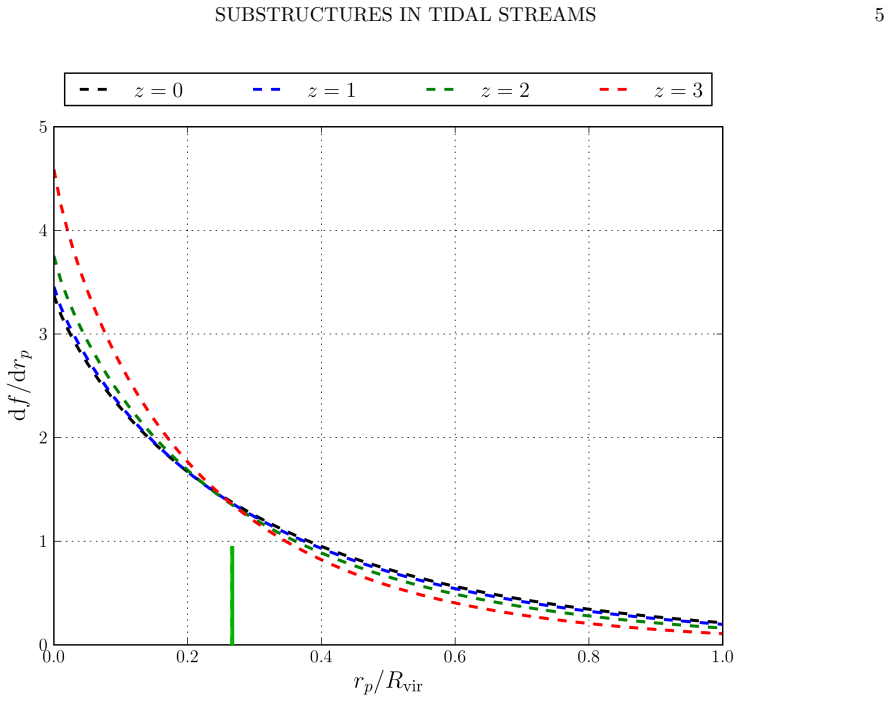
- domain assumption A single merger orbit set by mean Wetzel (2011) circularity eta=0.54 and pericenter 0.27 Rvir is representative of minor mergers at z=2.
- domain assumption The SPH implementation in Gadget2, with its star formation and feedback model, does not create spurious fragments at the scale of the claimed clumps.
- domain assumption The omission of gas in the host disk and hot halo does not change the main conclusions.
- domain assumption High gas temperature in the satellite prevents star formation, so gas clumps can be treated as cluster precursors.
Cite this review
Pith. "Pith review of Substructures in Minor Mergers' Tidal Streams." pith.science (2026). https://pith.science/paper/GFRHHMKE
@misc{pith2026190807114,
  author       = {Pith},
  title        = {Pith review of: Substructures in Minor Mergers' Tidal Streams},
  year         = {2026},
  howpublished = {\url{https://pith.science/paper/GFRHHMKE}},
  note         = {Machine review of arXiv:1908.07114}
}
abstract
In this work, we explore the idea that substructures like stellar clusters could be formed from the tidal stream produced in galactic minor mergers. We use $N$-body and SPH simulations of satellite galaxies interacting with a larger galaxy. We study the distribution of mass in streams to identify overdensity regions in which a substructure could be formed. We found that without gas, no substructure formed as none of the overdensities shows a definite morphology nor dynamical stability. Including gas we found that several clumps appear and proved to be real long standing physical structures ($t \geq$ 1 Gyr). We analyzed the orbits, ages and masses of these structures, finding its correspondence with the halo subsystems. We conclude that it is possible to form cluster-like structures from the material in tidal streams and found evidence in favour of the presence of dark matter in these systems.
Figures


Figures from the paper (11 more)




Reference graph
Works this paper leans on
- [1]
- [2]
- [3]
-
[4]
2003, MNRAS, 346, L11 Belokurov V., et al., 2006, ApJ, 642, L137
Bekki, K., & Freeman, K. 2003, MNRAS, 346, L11 Belokurov V., et al., 2006, ApJ, 642, L137
work page 2003
-
[5]
Binney, J. & Tremaine, S. Galactic Dynamics, 2008, Princeton University Press
work page 2008
-
[6]
Binney, J., Nipoti, C. & Fraternali F. 2009, MNRAS, 397, 1804 Blitz L., et al. 1999, ApJ, 514, 818
work page 2009
-
[7]
Carroll, B. W., & Ostlie, D. A, An Introduction to Mod- ern Astrophysics, 2008, Addison-Wesley Conroy C., et al. 2011, ApJ, 741
work page 2008
-
[8]
Draine, B. T. Physics of the Interstellar and Intergalactic Medium, 2011, Princeton University Press
work page 2011
Show all 23 references
-
[9]
G., & Efremov, Y
Elmegreen, B. G., & Efremov, Y. N. 1997, ApJ, 480, 235
1997
-
[10]
& Bridges, T
Forbes, D. & Bridges, T. 2010, MNRAS, 404, 1203
2010
-
[11]
E., et al
Forero-Romero, J. E., et al. 2010, MNRAS, 417, 1434 Fraternali F., et al., 2015, MNRAS, 447, L70 Georgiev I. Y., Puzia T. H., Goudfrooij P., Hilker M., 2010, MNRAS, 406, 1967 SUBSTRUCTURES IN TIDAL STREAMS 15
2010
- [12]
-
[13]
Harris, W. E. Globular Clusters Systems, 1998, Springer
1998
-
[14]
Harris, W. E. 1999, 10th Canary Islands Winter School of Astrophysics: Globular Clusters, 325 Hernquist L. 1993, MNRAS, 86, 389 Ibata R., et al., 2001, ApJ, 551, 294 K´ upper, A. H. W., Lane, R. R.,& Heggie, D. C. 2012, MNRAS, 420, 2700
1999
-
[15]
2004, ApJ, 614, L29 Lin L., et al., 2008, ApJ, 681, 232 Mastropietro, et al
Li, Y., Law, M., & Klessen, R. 2004, ApJ, 614, L29 Lin L., et al., 2008, ApJ, 681, 232 Mastropietro, et al. 2005, MNRAS, 363, 509
2004
-
[16]
J., Mao, S., White, S
Mo, H. J., Mao, S., White, S. D. M. 1998, MNRAS, 295, 319 Monaghan J. 1992, Annual Review of Astronomy and Antrophysics, 30, 543 Moster et al. 2001, ApJ, 710, 903
1998
-
[17]
& Kannapan S.J
Norris, M.A. & Kannapan S.J. 2011, MNRAS, 414, 739 Oppenheimer B. D., Dav´ e R., 2006, MNRAS, 373, 1265
2011
-
[18]
1968, ApJ, 154, 891 Price-Whelan A., et al 2018, Submitted to ApJ Reina-Campos M., et al 2019, MNRAS, 486, 5838-5852 Shapiro K
Peebles, P.J.E, & Dicke R.H. 1968, ApJ, 154, 891 Price-Whelan A., et al 2018, Submitted to ApJ Reina-Campos M., et al 2019, MNRAS, 486, 5838-5852 Shapiro K. L., Genzel R., F¨ orster Schreiber N. M., 2010, MNRAS, 403, L36 Sharma S. & Steinmetz, M. 2006, MNRAS, 373, 1293 Springe...
1968
-
[19]
2003, MNRAS, 339, 289 Springel V
Springel, V., & Hernquist, L. 2003, MNRAS, 339, 289 Springel V. & Hernquist, L. 2002, MNRAS, 333, 649
2003
-
[20]
2013, ASP Conference Proceedings, 477, 237
Torrey, P., et al. 2013, ASP Conference Proceedings, 477, 237
2013
-
[21]
P., & van Woerden, H
Wakker, B. P., & van Woerden, H. 1997, Annual Review of Astronomy and Astrophysics, 35, 217
1997
-
[22]
Wetzel, A. R. 2011, MNRAS, 412, 49
2011
-
[23]
& Ashman, K
Zepf, S. & Ashman, K. 1993, MNRAS, 264, 611 FACom - Instituto de F´ ısica, FCEN, Universidad de Antioquia (UdeA), Calle 70 No. 52-21, Medell´ ın, Colombia. (†david.norena@udea.edu.co). Leibniz-Institut f¨ ur Astrophysik Potsdam (AIP), An der Sternwarte 16, D-14482 Potsdam, Ger...
1993
Reviewed August 14, 2026 · model on record in the stance chip above.
Discussion (0). Continue with ORCID to comment.