REVIEW 4 major objections 3 minor 136 references
RIDEN pilot survey: broad-band selection of candidate quasars with extended Lyman-$\alpha$ nebulae using CLAUDS-HSC-SSP-DUNES$^2$ joint data
T0 review · 4 major / 3 minor · reviewed 2026-08-07 · deepseek-v4-flash
Pith's one-line read Extended Lyman-alpha nebulae around $z=1.9$--$3.0$ quasars can be found in ordinary broad-band images; this pilot finds 24 candidates across 13 square degrees and paves the path to a Rubin-LSST-wide census.
desk verdict A careful pilot of a known broad-band Ly-alpha selection method, useful for LSST planning, but the candidate list is not yet proven and a false-positive control is missing. read the letter →
The pith
A machine-rendered reading of the paper's core claim, the machinery that carries it, and where it could break.
The reading
What carries the argument
The broad-band colour selection is the mechanism: three images per quasar — one Ly$\alpha$-band ($u$, $u^*$, or $g$) and two redder continuum bands ($g,r$ or $r,i$) — are combined through empirical colour-term relations (Eqs. 1--6) to build a pseudo-continuum image of the Ly$\alpha$ band, which is then subtracted to leave a Ly$\alpha$ map. The colour terms and their small redshift dependences are fitted to thousands of spec-$z$ galaxies from the same imaging, and an SED-fitting photometric-redshift catalogue is used to mask projected neighbours outside $|\delta z| > 0.1$, rejecting about 95% of $i<25$ sources as irrelevant foreground or background objects. Residual flux is converted to Ly$\alpha$ surface brightness using the filter width, the filter transmission at the quasar's Ly$\alpha$ redshift, and a pixel area, then scaled by $(1+z)^4$ to a common $z=2.3$ for comparison. Detection requires a 2$\sigma$ excess in binned pixels, and a nebula is defined by an effective area above 40 arcsec$^2$ after masking.
What would settle it
Run the identical colour-term subtraction and nebula selection on thousands of random sky positions or on non-quasar galaxies matched to the same photometric-redshift distribution and imaging depth; if the rate of 50-170 kpc excess regions approaches the roughly 5% rate found around quasars, the candidates are dominated by colour-term systematics. Spectroscopy settles it directly: integral-field or narrow-band observations of the 24 candidates should show extended Ly-alpha with rest-frame equivalent width above roughly 100-200 A and spatial morphology matching the broad-band excess.
Extended reading notes
Core claim
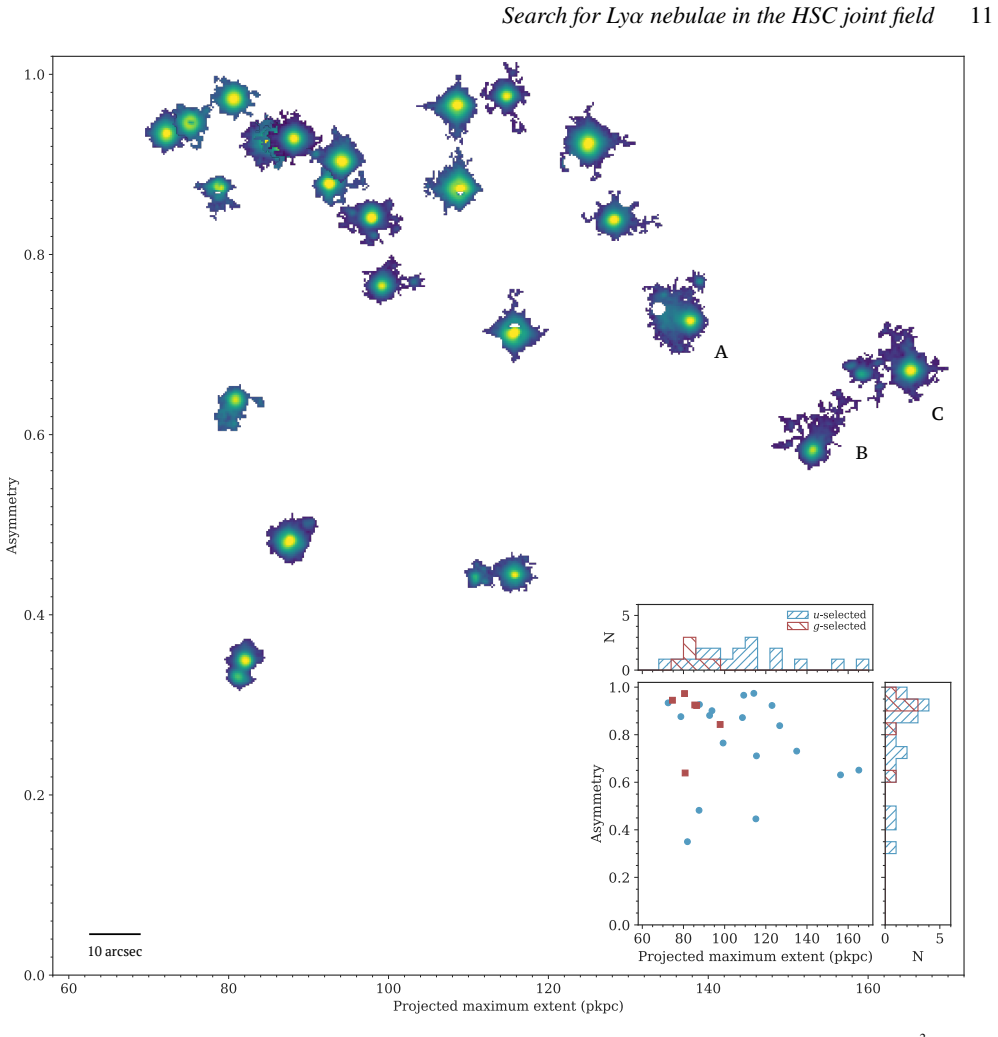
The central claim is that extended Lyman-$\alpha$ nebulae around $z=1.9$--$3.0$ quasars are detectable as a residual excess in a single broad-band image after subtracting an empirically extrapolated continuum. For quasars at $z=1.90$--$2.23$ the Ly$\alpha$ line falls in the $u$ (or $u^*$) band, and for $z=2.34$--$3.00$ in the $g$ band; the continuum at that wavelength is estimated from two redder bands using colour-term relations calibrated on 1,541--1,822 galaxies with spectroscopic redshifts, with a small redshift correction. Photometric-redshift masking removes foreground and background objects that would mimic nebulae, and the central quasar is masked. Applying this to 483 quasars yields 24 candidates with effective Ly$\alpha$ areas above 40 arcsec$^2$, corresponding to sizes of roughly 50--170 kpc, whose radial surface-brightness profiles agree with the exponential profiles measured by integral-field surveys, with scale lengths of about 15--17 kpc. The authors also report no significant difference in nebular asymmetry between the $z\sim2.1$ and $z\sim2.8$ samples, and no statistically significant environmental overdensity around quasars with large nebulae compared to control samples, although the largest nebula sits near a density peak.
Load-bearing premise
The colour-term relations that predict Ly-alpha-band flux from redder bands were fitted to ordinary galaxies, not quasars; the method assumes those relations hold for quasar host galaxies and their surroundings, so that any leftover u- or g-band light is genuinely extended Ly-alpha emission rather than a mismatch in the continuum extrapolation or light from other ultraviolet lines.
Editorial extensions
If this is right
- If the method is valid, the Rubin LSST's 18,000 square degrees in the same $u,g,r,i$ bands would allow the selection to run over roughly 200,000 quasars, expanding the surveyed volume by a factor of hundreds relative to current narrow-band surveys.
- A statistically meaningful census of giant (ELAN-like) nebulae becomes possible, including their number density and their association with protoclusters, which presently rests on a handful of objects.
- The $u$-band path extends Ly$\alpha$ searches to $z=1.9$--$2.3$, where the filter is about two times narrower than the $g$-band, giving better line contrast and reaching surface brightnesses as low as roughly $0.5\times10^{-17}\,\mathrm{erg\,s^{-1}\,cm^{-2}\,arcsec^{-2}}$.
- The three giant candidates, with projected extents beyond 130 kpc and asymmetric shapes, would join the rare Type I ELAN class if confirmed, providing targets for detailed studies of gas around massive haloes.
Reading between the lines
- The null environmental result may be a depth effect: the Monte Carlo simulations show the method recovers only about 10% of the Ly$\alpha$ flux beyond 40 pkpc, so any environmental trends acting on the outer nebular gas would largely escape this selection.
- A direct test of the systematics would be to apply the same colour-term subtraction to spectroscopically confirmed non-quasar galaxies at the same redshifts; the false-positive rate of 'nebulae' around those galaxies would calibrate how much of the 5% detection rate is continuum mismatch rather than real Ly$\alpha$ emission.
- Because the quasar sample is fainter than the integral-field-survey quasars ($-27.7 < M_i < -24.9$ versus $M_i < -27$), the absence of morphological evolution between $z\sim2.1$ and $z\sim2.8$ cannot yet be compared with earlier claims of evolving asymmetry; LSST's larger sample would allow a luminosity-matched comparison.
- The same broad-band trick could in principle be pushed to the $g$-band at $z=3$--$3.5$ or the $i$-band at $z\sim4$, but the paper's own colour-term analysis shows IGM absorption increasingly corrupts the continuum extrapolation beyond $z=3$, setting a practical boundary for the method.
Editorial analysis
A structured set of objections, weighed in public.
Referee Report
Summary. The paper presents a pilot broad-band search for extended Lyman-alpha nebulae around 483 SDSS/BOSS quasars at z=1.9-3.0, using deep u-to-K imaging from the CLAUDS-HSC-SSP-DUNES2 joint dataset. The method constructs a continuum image from two broad bands (Eqs. 1-6), subtracts it from the Ly-alpha band, masks foreground/background objects with photometric redshifts, and selects 24 candidate quasar nebulae with effective Ly-alpha area Area_eff>40 arcsec2. The authors then measure radial profiles, covering fractions, asymmetry, and environmental overdensities, concluding that there is no significant redshift evolution of asymmetry and no environmental dependence, while noting the lack of spectroscopic confirmation and various data limitations.
Significance. If validated, the broad-band Ly-alpha imaging technique would be a powerful way to discover giant Ly-alpha nebulae over very wide fields, including the upcoming Rubin/LSST survey. The paper is careful in tone: candidates are explicitly called candidates, the absence of spectroscopic confirmation is acknowledged, and several limitations are stated in the text. The public release of the candidate catalogue and processed images is a strength. However, the central claim that 24 candidate nebulae exhibit genuine u/g-band excess rests on an empirical continuum extrapolation and has not been tested against control samples or systematics. The paper is therefore a useful pilot and method demonstration, but its main quantitative result is not yet firmly established.
major comments (4)
- [Section 4.1, Area_eff selection] The selection of 24 quasar nebulae via Area_eff>40 arcsec2 is not accompanied by any control experiment using stars, random sky positions, or non-quasar galaxies processed through the same pipeline. The 5.9% detection fraction (24/409) therefore has no demonstrated excess over the expected rate of spurious extended residuals from PSF wings, colour-term mismatch, or unmasked projected neighbours. The central claim of the abstract depends on this comparison, so a control experiment should be added.
- [Section 3, Eqs. (1)-(6)] The colour-term relations are fitted to 1,541-1,822 spectroscopic galaxies, with SDSS/eBOSS quasars explicitly excluded. Quasar rest-UV continua are often AGN power laws rather than galaxy SEDs, so these galaxy-calibrated relations may be systematically offset when applied to the quasar targets. Because the continuum subtraction is performed pixel-by-pixel over the full cutout, even a small systematic offset will produce a spatially extended residual that survives the 2.5-arcsec central mask and mimics a low-surface-brightness nebula. The paper should validate the colour terms on quasar spectra, on quasars whose Ly-alpha does not fall in the Ly-alpha band, or on stars, and quantify the resulting spatial residual.
- [Section 3, Eq. (8) and Section 5.1] The photometric-redshift outlier rate is f_outlier=0.13 for i<25 sources at z=1.9-3.0, and the mask only removes objects with |delta z|>0.1. A substantial fraction of foreground/background galaxies therefore remains unmasked and can create asymmetric extended features in the Ly-alpha residual images. This concern is directly relevant to the morphology analysis: Section 5.1 notes that three of the nebulae with alpha<0.5 have bright companions in the Ly-alpha images, suggesting that their high asymmetry is not intrinsic. The paper should quantify the probability that an Area_eff>40 arcsec2 detection is produced by an unmasked interloper, for example by injecting fake galaxies into the images.
- [Section 5.2] The environmental analysis uses photometric redshifts with outlier rates of 0.3-0.4 at |delta z|>0.05, and the control and quasar samples are both subject to the same projection effects. The KS tests therefore have limited power, and the conclusion that there is 'no environmental dependence' is not strongly supported. This is acknowledged in the text, but given that the absence of environmental dependence is one of the three headline results, the limitation should be stated more prominently and the density measurement should include an uncertainty estimate arising from photo-z scatter.
minor comments (3)
- [Section 6] The Conclusions state that the authors obtain 39 and 17 quasars with large Ly-alpha nebulae in the two redshift intervals, but Section 4.1 and Table 2 report 8, 10, and 6 in the three selections, totaling 24. The abstract also says 24. This numerical inconsistency should be corrected.
- [Section 4.1] The notation for the background standard deviation is inconsistent: the text uses both bg_std and bg_std_z, and Figure 6 uses bd_std_z. Please unify the notation.
- [Section 5.1] The definition of 'Type I ELAN' from Li et al. (2024) is cited as '>100 pkpc with M_UV<-22', but M_UV is not defined at that point. Please define the absolute UV magnitude and specify the band or wavelength.
Circularity Check
No load-bearing circularity: the Ly-alpha maps are calibrated on an external spec-z galaxy sample with quasars excluded; the self-citation to Shimakawa (2022) supplies the method only, not the evidence for the detections.
full rationale
The derivation chain is not circular. The continuum images subtracted to form the Ly-alpha maps are built from empirical color-term relations (Eqs. 1-6) fitted to 1,541-1,822 spectroscopic galaxies from external surveys (3D-HST, DEIMOS 10k, GAMA DR3, PRIMUS, SDSS DR15, VVDS), and Section 3 explicitly states that SDSS/eBOSS quasars are removed from the fitting sample. Thus the residual u/g-band flux attributed to Ly-alpha is not forced by the target quasars' own photometry; any AGN-continuum color mismatch would be a systematic error, not a circular reduction. The candidate selection (Area_eff > 40 arcsec^2) is a measurement on these residual maps, not a prediction of a fitted quantity. The radial-profile fit and the Monte Carlo covering-fraction simulation reuse the same 24 detected nebulae, but the paper uses them as descriptive consistency tools and not as independent validation; the abstract's central claim is the detection itself. Self-citations to Shimakawa (2022) provide the methodological template and area definitions, but the present detections are new measurements on HCD-JF data and are not justified by that citation alone, and Prescott et al. (2012, 2013) are also cited as external confirmation of the broad-band technique. The paper explicitly flags the lack of spectroscopic confirmation and the ~13% photo-z outlier rate, which are correctness risks rather than circularity. Finding: no significant circularity beyond normal, non-load-bearing methodological self-citation.
Assumptions & free parameters
free parameters (5)
- Color-term coefficients (a,b) in Eqs 1-3 =
e.g., (1.763, -0.754) for u-band; (1.633, -0.618) for u*; (1.350, -0.338) for g
- Redshift-dependent color corrections (c,d) in Eqs 4-6 =
(-0.470, -0.908) for u; (-0.560, -1.184) for u*; (-0.422, +1.120) for g
- Effective area threshold Area_eff =
40 arcsec squared
- Background noise cut bg_std_z =
0.67 in units of 10^-17 erg/s/cm^2/arcsec^2
- Photo-z masking threshold |delta-z| =
0.1
assumptions (5)
- standard math Cosmology: flat Lambda-CDM with Omega_m=0.310, Omega_Lambda=0.689, H0=67.7 km/s/Mpc
- domain assumption Empirical color-term relations calibrated on non-quasar spec-z galaxies apply to quasar hosts and surrounding nebulae
- domain assumption Residual flux in the Ly-alpha band after continuum subtraction is dominated by Ly-alpha emission
- domain assumption Photometric redshifts from Mizuki with u-to-K photometry are accurate enough for masking and density estimates
- domain assumption Broad-band selection detects Ly-alpha only for equivalent widths greater than about 100-200 Angstroms
Cite this review
Pith. "Pith review of RIDEN pilot survey: broad-band selection of candidate quasars with extended Lyman-$\alpha$ nebulae using CLAUDS-HSC-SSP-DUNES$^2$ joint data." pith.science (2026). https://pith.science/paper/GGHP6XBE
@misc{pith2026250604570,
  author       = {Pith},
  title        = {Pith review of: RIDEN pilot survey: broad-band selection of candidate quasars with extended Lyman-$\alpha$ nebulae using CLAUDS-HSC-SSP-DUNES$^2$ joint data},
  year         = {2026},
  howpublished = {\url{https://pith.science/paper/GGHP6XBE}},
  note         = {Machine review of arXiv:2506.04570}
}
abstract
The Vera C. Rubin Observatory will conduct the Legacy Survey of Space and Time (LSST), delivering deep, multi-band ($ugrizy$) imaging data across 18,000 square degrees over the next decade. Before this ultra-wide-field survey, we constructed a broad-band Ly$\alpha$ imaging toward 483 SDSS/BOSS quasars at $z=$ 1.9-3.0, using deep, wide-field ultraviolet to near-infrared ($u$-to-$K$) data from the Hyper Suprime-Cam Subaru Strategic Survey (HSC-SSP), the CFHT Large Area U-band Deep Survey (CLAUDS), the Deep UKIRT Near-Infrared Steward Survey (DUNES$^2$), and additional public data covering 13 square degrees. Our broad-band selection allowed us to select 24 candidate quasar nebulae that exhibit $u$ or $g$ band excess over 50-170 kpc, some of which exhibit asymmetrical extended features similar to those seen in previously discovered giant nebulae. We then investigated whether the Ly$\alpha$ morphology of quasar nebulae differs between two redshift intervals, $z=$ 1.9-2.3 and $z=$ 2.3-3.0, and examined environmental dependence based on a control sample. Comparison results show no significant difference in asymmetry within Ly$\alpha$ nebulae between the two redshift intervals. Furthermore, we found no systematic differences in overdensities around the complete quasar samples, quasars with large Ly$\alpha$ nebulae, and control samples, while the most extended nebula appears to be located in the high-density region. Further verification analyses are required since the current dataset lacks spectroscopic confirmation for both quasar nebulae and their surrounding neighbours. Nevertheless, the results demonstrate the great potential of the Rubin LSST to discover giant Ly$\alpha$ nebulae on an unprecedented scale.
Figures


Figures from the paper (9 more)




Reference graph
Works this paper leans on
-
[1]
write newline
" write newline "" before.all 'output.state := FUNCTION fin.entry write newline FUNCTION new.block output.state before.all = 'skip after.block 'output.state := if FUNCTION new.sentence output.state after.block = 'skip output.state before.all = 'skip after.sentence 'output.state := if if FUNCTION not #0 #1 if FUNCTION and 'skip pop #0 if FUNCTION or pop #1...
-
[2]
S., Ahumada R., Almeida A., et al
Aguado D. S., Ahumada R., Almeida A., et al. 2019, @doi [ApJS] 10.3847/1538-4365/aaf651 , https://ui.adsabs.harvard.edu/abs/2019ApJS..240...23A 240, 23
-
[3]
2018, @doi [PASJ] 10.1093/pasj/psx066 , https://ui.adsabs.harvard.edu/abs/2018PASJ...70S...4A 70, S4
Aihara H., Arimoto N., Armstrong R., et al. 2018, @doi [PASJ] 10.1093/pasj/psx066 , https://ui.adsabs.harvard.edu/abs/2018PASJ...70S...4A 70, S4
-
[4]
Aihara H., AlSayyad Y., Ando M., et al. 2019, @doi [PASJ] 10.1093/pasj/psz103 , https://ui.adsabs.harvard.edu/abs/2019PASJ...71..114A 71, 114
-
[5]
Aihara H., AlSayyad Y., Ando M., et al. 2022, @doi [PASJ] 10.1093/pasj/psab122 , https://ui.adsabs.harvard.edu/abs/2022PASJ...74..247A 74, 247
-
[6]
S., De Propris R., Chung C., et al
Ali S. S., De Propris R., Chung C., et al. 2024, @doi [ApJ] 10.3847/1538-4357/ad3209 , https://ui.adsabs.harvard.edu/abs/2024ApJ...966...50A 966, 50
-
[7]
Arrigoni Battaia F., Prochaska J. X., Hennawi J. F., et al. 2018, @doi [MNRAS] 10.1093/mnras/stx2465 , https://ui.adsabs.harvard.edu/abs/2018MNRAS.473.3907A 473, 3907
-
[8]
Arrigoni Battaia F., Hennawi J. F., Prochaska J. X., et al. 2019, @doi [MNRAS] 10.1093/mnras/sty2827 , https://ui.adsabs.harvard.edu/abs/2019MNRAS.482.3162A 482, 3162
Show all 136 references
-
[9]
C., et al
Arrigoni Battaia F., Obreja A., Chen C. C., et al. 2023, @doi [ ] 10.1051/0004-6361/202245520 , https://ui.adsabs.harvard.edu/abs/2023A&A...676A..51A 676, A51
2023 doi
-
[10]
P., Tollerud E
Astropy Collaboration Robitaille T. P., Tollerud E. J., et al. 2013, @doi [A&A] 10.1051/0004-6361/201322068 , https://ui.adsabs.harvard.edu/abs/2013A&A...558A..33A 558, A33
2013 doi
-
[11]
2010, in McLean I
Bacon R., Accardo M., Adjali L., et al. 2010, in McLean I. S., Ramsay S. K., Takami H., eds, Society of Photo-Optical Instrumentation Engineers (SPIE) Conference Series Vol. 7735, Ground-based and Airborne Instrumentation for Astronomy III. p. 773508, @doi 10.1117/12.856027
2010 doi
-
[12]
2023, @doi [ ] 10.1051/0004-6361/202244187 , https://ui.adsabs.harvard.edu/abs/2023A&A...670A...4B 670, A4
Bacon R., Brinchmann J., Conseil S., et al. 2023, @doi [ ] 10.1051/0004-6361/202244187 , https://ui.adsabs.harvard.edu/abs/2023A&A...670A...4B 670, A4
2023 doi
-
[14]
K., Liske J., Brown M
Baldry I. K., Liske J., Brown M. J. I., et al. 2018, @doi [MNRAS] 10.1093/mnras/stx3042 , https://ui.adsabs.harvard.edu/abs/2018MNRAS.474.3875B 474, 3875
2018 doi
-
[15]
J., Lacey C
Benson A. J., Lacey C. G., Baugh C. M., et al. 2002, @doi [MNRAS] 10.1046/j.1365-8711.2002.05387.x , https://ui.adsabs.harvard.edu/abs/2002MNRAS.333..156B 333, 156
2002
-
[16]
M., Jarvis M., 2002, @doi [AJ] 10.1086/338085 , https://ui.adsabs.harvard.edu/abs/2002AJ....123..583B 123, 583
Bernstein G. M., Jarvis M., 2002, @doi [AJ] 10.1086/338085 , https://ui.adsabs.harvard.edu/abs/2002AJ....123..583B 123, 583
2002 doi
-
[17]
B., Ivezi \'c Z ., Jones R
Bianco F. B., Ivezi \'c Z ., Jones R. L., et al. 2022, @doi [ ] 10.3847/1538-4365/ac3e72 , https://ui.adsabs.harvard.edu/abs/2022ApJS..258....1B 258, 1
2022 doi
-
[18]
S., Schlegel D
Bolton A. S., Schlegel D. J., Aubourg \'E ., et al. 2012, @doi [AJ] 10.1088/0004-6256/144/5/144 , https://ui.adsabs.harvard.edu/abs/2012AJ....144..144B 144, 144
2012 doi
-
[19]
J., et al
Borisova E., Cantalupo S., Lilly S. J., et al. 2016, @doi [ApJ] 10.3847/0004-637X/831/1/39 , https://ui.adsabs.harvard.edu/abs/2016ApJ...831...39B 831, 39
2016 doi
-
[20]
2018, @doi [PASJ] 10.1093/pasj/psx080 , https://ui.adsabs.harvard.edu/abs/2018PASJ...70S...5B 70, S5
Bosch J., Armstrong R., Bickerton S., et al. 2018, @doi [PASJ] 10.1093/pasj/psx080 , https://ui.adsabs.harvard.edu/abs/2018PASJ...70S...5B 70, S5
2018 doi
-
[21]
Dobb's Journal of Software Tools
Bradski G., 2000, Dr. Dobb's Journal of Software Tools
2000
-
[22]
B., van Dokkum P
Brammer G. B., van Dokkum P. G., Franx M., et al. 2012, @doi [ApJS] 10.1088/0067-0049/200/2/13 , https://ui.adsabs.harvard.edu/abs/2012ApJS..200...13B 200, 13
2012 doi
-
[23]
J., Warren S
Bunker A. J., Warren S. J., Hewett P. C., et al. 1995, @doi [MNRAS] 10.1093/mnras/273.2.513 , https://ui.adsabs.harvard.edu/abs/1995MNRAS.273..513B 273, 513
1995 doi
-
[24]
2017, @doi [ApJ] 10.3847/1538-4357/aa5d14 , https://ui.adsabs.harvard.edu/abs/2017ApJ...837...71C 837, 71
Cai Z., Fan X., Yang Y., et al. 2017, @doi [ApJ] 10.3847/1538-4357/aa5d14 , https://ui.adsabs.harvard.edu/abs/2017ApJ...837...71C 837, 71
2017 doi
-
[25]
2018, @doi [ApJL] 10.3847/2041-8213/aacce6 , https://ui.adsabs.harvard.edu/abs/2018ApJ...861L...3C 861, L3
Cai Z., Hamden E., Matuszewski M., et al. 2018, @doi [ApJL] 10.3847/2041-8213/aacce6 , https://ui.adsabs.harvard.edu/abs/2018ApJ...861L...3C 861, L3
2018 doi
-
[26]
X., et al
Cai Z., Cantalupo S., Prochaska J. X., et al. 2019, @doi [ApJS] 10.3847/1538-4365/ab4796 , https://ui.adsabs.harvard.edu/abs/2019ApJS..245...23C 245, 23
2019 doi
-
[27]
430, Gas Accretion onto Galaxies
Cantalupo S., 2017, in Fox A., Dav \'e R., eds, Astrophysics and Space Science Library Vol. 430, Gas Accretion onto Galaxies. p. 195 ( @eprint arXiv 1612.00491 ), @doi 10.1007/978-3-319-52512-9_9
2017 arXiv
-
[28]
X., et al
Cantalupo S., Arrigoni-Battaia F., Prochaska J. X., et al. 2014, @doi [Natur] 10.1038/nature12898 , https://ui.adsabs.harvard.edu/abs/2014Natur.506...63C 506, 63
2014 doi
-
[29]
J., et al
Cantalupo S., Pezzulli G., Lilly S. J., et al. 2019, @doi [MNRAS] 10.1093/mnras/sty3481 , https://ui.adsabs.harvard.edu/abs/2019MNRAS.483.5188C 483, 5188
2019 doi
-
[30]
Cassata P., Tasca L. A. M., Le F \`e vre O., et al. 2015, @doi [A&A] 10.1051/0004-6361/201423824 , https://ui.adsabs.harvard.edu/abs/2015A&A...573A..24C 573, A24
2015 doi
-
[31]
B., 2013, @doi [ApJ] 10.1088/0004-637X/776/2/84 , https://ui.adsabs.harvard.edu/abs/2013ApJ...776...84C 776, 84
Chaudhuri A., Majumdar S., Nath B. B., 2013, @doi [ApJ] 10.1088/0004-637X/776/2/84 , https://ui.adsabs.harvard.edu/abs/2013ApJ...776...84C 776, 84
2013 doi
-
[32]
Chen C.-C., Arrigoni Battaia F., Emonts B. H. C., et al. 2021, @doi [ApJ] 10.3847/1538-4357/ac2b9d , https://ui.adsabs.harvard.edu/abs/2021ApJ...923..200C 923, 200
2021 doi
-
[33]
L., Newman J
Coil A. L., Newman J. A., Croton D., et al. 2008, @doi [ApJ] 10.1086/523639 , https://ui.adsabs.harvard.edu/abs/2008ApJ...672..153C 672, 153
2008 doi
-
[34]
L., Blanton M
Coil A. L., Blanton M. R., Burles S. M., et al. 2011, @doi [ApJ] 10.1088/0004-637X/741/1/8 , https://ui.adsabs.harvard.edu/abs/2011ApJ...741....8C 741, 8
2011 doi
-
[35]
2025, arXiv, https://ui.adsabs.harvard.edu/abs/2025arXiv250503897C p
Coloma Puga M., Balmaverde B., Capetti A., et al. 2025, arXiv, https://ui.adsabs.harvard.edu/abs/2025arXiv250503897C p. arXiv:2505.03897
2025 arXiv
-
[36]
J., Moustakas J., Blanton M
Cool R. J., Moustakas J., Blanton M. R., et al. 2013, @doi [ApJ] 10.1088/0004-637X/767/2/118 , https://ui.adsabs.harvard.edu/abs/2013ApJ...767..118C 767, 118
2013 doi
-
[37]
2018, @doi [PASJ] 10.1093/pasj/psx047 , https://ui.adsabs.harvard.edu/abs/2018PASJ...70S...7C 70, S7
Coupon J., Czakon N., Bosch J., et al. 2018, @doi [PASJ] 10.1093/pasj/psx047 , https://ui.adsabs.harvard.edu/abs/2018PASJ...70S...7C 70, S7
2018 doi
-
[38]
2023, @doi [A&A] 10.1051/0004-6361/202243363 , https://ui.adsabs.harvard.edu/abs/2023A&A...670A..82D 670, A82
Desprez G., Picouet V., Moutard T., et al. 2023, @doi [A&A] 10.1051/0004-6361/202243363 , https://ui.adsabs.harvard.edu/abs/2023A&A...670A..82D 670, A82
2023 doi
- [39]
-
[40]
B., Farina E
Drake A. B., Farina E. P., Neeleman M., et al. 2019, @doi [ApJ] 10.3847/1538-4357/ab2984 , https://ui.adsabs.harvard.edu/abs/2019ApJ...881..131D 881, 131
2019 doi
-
[41]
K., Bogosavljevi \'c M., Steidel C
Erb D. K., Bogosavljevi \'c M., Steidel C. C., 2011, @doi [ApJL] 10.1088/2041-8205/740/1/L31 , https://ui.adsabs.harvard.edu/abs/2011ApJ...740L..31E 740, L31
2011 doi
-
[42]
P., Arrigoni-Battaia F., Costa T., et al
Farina E. P., Arrigoni-Battaia F., Costa T., et al. 2019, @doi [ApJ] 10.3847/1538-4357/ab5847 , https://ui.adsabs.harvard.edu/abs/2019ApJ...887..196F 887, 196
2019 doi
-
[43]
2010, @doi [ApJ] 10.1088/0004-637X/725/1/633 , https://ui.adsabs.harvard.edu/abs/2010ApJ...725..633F 725, 633
Faucher-Gigu \`e re C.-A., Kere s D., Dijkstra M., et al. 2010, @doi [ApJ] 10.1088/0004-637X/725/1/633 , https://ui.adsabs.harvard.edu/abs/2010ApJ...725..633F 725, 633
2010 doi
-
[44]
K., et al
Fossati M., Fumagalli M., Lofthouse E. K., et al. 2021, @doi [MNRAS] 10.1093/mnras/stab660 , https://ui.adsabs.harvard.edu/abs/2021MNRAS.503.3044F 503, 3044
2021 doi
-
[45]
2018, @doi [PASJ] 10.1093/pasj/psx079 , https://ui.adsabs.harvard.edu/abs/2018PASJ...70S...3F 70, S3
Furusawa H., Koike M., Takata T., et al. 2018, @doi [PASJ] 10.1093/pasj/psx079 , https://ui.adsabs.harvard.edu/abs/2018PASJ...70S...3F 70, S3
2018 doi
-
[46]
2012, @doi [ApJ] 10.1088/0004-637X/749/2/169 , https://ui.adsabs.harvard.edu/abs/2012ApJ...749..169G 749, 169
Galametz A., Stern D., De Breuck C., et al. 2012, @doi [ApJ] 10.1088/0004-637X/749/2/169 , https://ui.adsabs.harvard.edu/abs/2012ApJ...749..169G 749, 169
2012 doi
-
[47]
2010, @doi [MNRAS] 10.1111/j.1365-2966.2010.16941.x , https://ui.adsabs.harvard.edu/abs/2010MNRAS.407..613G 407, 613
Goerdt T., Dekel A., Sternberg A., et al. 2010, @doi [MNRAS] 10.1111/j.1365-2966.2010.16941.x , https://ui.adsabs.harvard.edu/abs/2010MNRAS.407..613G 407, 613
2010
-
[48]
2007, @doi [ApJ] 10.1086/520324 , https://ui.adsabs.harvard.edu/abs/2007ApJ...667...79G 667, 79
Gronwall C., Ciardullo R., Hickey T., et al. 2007, @doi [ApJ] 10.1086/520324 , https://ui.adsabs.harvard.edu/abs/2007ApJ...667...79G 667, 79
2007 doi
-
[49]
2020, @doi [ApJ] 10.3847/1538-4357/ab9b7f , https://ui.adsabs.harvard.edu/abs/2020ApJ...898...26G 898, 26
Guo Y., Maiolino R., Jiang L., et al. 2020, @doi [ApJ] 10.3847/1538-4357/ab9b7f , https://ui.adsabs.harvard.edu/abs/2020ApJ...898...26G 898, 26
2020 doi
-
[50]
R., Millman K
Harris C. R., Millman K. J., van der Walt S. J., et al. 2020, @doi [Natur] 10.1038/s41586-020-2649-2 , https://ui.adsabs.harvard.edu/abs/2020Natur.585..357H 585, 357
2020 doi
-
[51]
2017, @doi [A&A] 10.1051/0004-6361/201731579 , https://ui.adsabs.harvard.edu/abs/2017A&A...608A..10H 608, A10
Hashimoto T., Garel T., Guiderdoni B., et al. 2017, @doi [A&A] 10.1051/0004-6361/201731579 , https://ui.adsabs.harvard.edu/abs/2017A&A...608A..10H 608, A10
2017 doi
-
[52]
2018, @doi [ApJ] 10.3847/1538-4357/aabacf , https://ui.adsabs.harvard.edu/abs/2018ApJ...858...77H 858, 77
Hasinger G., Capak P., Salvato M., et al. 2018, @doi [ApJ] 10.3847/1538-4357/aabacf , https://ui.adsabs.harvard.edu/abs/2018ApJ...858...77H 858, 77
2018 doi
-
[53]
A., Wylezalek D., Kurk J
Hatch N. A., Wylezalek D., Kurk J. D., et al. 2014, @doi [MNRAS] 10.1093/mnras/stu1725 , https://ui.adsabs.harvard.edu/abs/2014MNRAS.445..280H 445, 280
2014 doi
-
[54]
F., Prochaska J
Hennawi J. F., Prochaska J. X., Cantalupo S., et al. 2015, @doi [Sci] 10.1126/science.aaa5397 , https://ui.adsabs.harvard.edu/abs/2015Sci...348..779H 348, 779
2015 doi
-
[55]
D., 2007, @doi [CSE] 10.1109/MCSE.2007.55 , https://ui.adsabs.harvard.edu/abs/2007CSE.....9...90H 9, 90
Hunter J. D., 2007, @doi [CSE] 10.1109/MCSE.2007.55 , https://ui.adsabs.harvard.edu/abs/2007CSE.....9...90H 9, 90
2007 doi
-
[56]
B., et al
Iqbal A., Majumdar S., Nath B. B., et al. 2017, @doi [MNRAS] 10.1093/mnras/stx1999 , https://ui.adsabs.harvard.edu/abs/2017MNRAS.472..713I 472, 713
2017 doi
-
[57]
M., Tyson J
Ivezi \'c Z ., Kahn S. M., Tyson J. A., et al. 2019, @doi [ApJ] 10.3847/1538-4357/ab042c , https://ui.adsabs.harvard.edu/abs/2019ApJ...873..111I 873, 111
2019 doi
-
[58]
J., Bonfield D
Jarvis M. J., Bonfield D. G., Bruce V. A., et al. 2013, @doi [MNRAS] 10.1093/mnras/sts118 , https://ui.adsabs.harvard.edu/abs/2013MNRAS.428.1281J 428, 1281
2013 doi
-
[59]
F., Blain A
Jones S. F., Blain A. W., Lonsdale C., et al. 2015, @doi [MNRAS] 10.1093/mnras/stv214 , https://ui.adsabs.harvard.edu/abs/2015MNRAS.448.3325J 448, 3325
2015 doi
-
[60]
2007, @doi [ApJ] 10.1086/518410 , https://ui.adsabs.harvard.edu/abs/2007ApJ...663..765K 663, 765
Kashikawa N., Kitayama T., Doi M., et al. 2007, @doi [ApJ] 10.1086/518410 , https://ui.adsabs.harvard.edu/abs/2007ApJ...663..765K 663, 765
2007 doi
-
[61]
2018, @doi [PASJ] 10.1093/pasj/psy056 , https://ui.adsabs.harvard.edu/abs/2018PASJ...70...66K 70, 66
Kawanomoto S., Uraguchi F., Komiyama Y., et al. 2018, @doi [PASJ] 10.1093/pasj/psy056 , https://ui.adsabs.harvard.edu/abs/2018PASJ...70...66K 70, 66
2018 doi
-
[62]
2022, @doi [A&A] 10.1051/0004-6361/202141900 , https://ui.adsabs.harvard.edu/abs/2022A&A...659A.183K 659, A183
Kerutt J., Wisotzki L., Verhamme A., et al. 2022, @doi [A&A] 10.1051/0004-6361/202141900 , https://ui.adsabs.harvard.edu/abs/2022A&A...659A.183K 659, A183
2022 doi
-
[63]
S., Hennawi J
Khrykin I. S., Hennawi J. F., Worseck G., et al. 2021, @doi [MNRAS] 10.1093/mnras/stab1288 , https://ui.adsabs.harvard.edu/abs/2021MNRAS.505..649K 505, 649
2021 doi
-
[64]
2017, @doi [ApJ] 10.3847/1538-4357/aa72f0 , https://ui.adsabs.harvard.edu/abs/2017ApJ...841..128K 841, 128
Kikuta S., Imanishi M., Matsuoka Y., et al. 2017, @doi [ApJ] 10.3847/1538-4357/aa72f0 , https://ui.adsabs.harvard.edu/abs/2017ApJ...841..128K 841, 128
2017 doi
-
[65]
2019, @doi [PASJ] 10.1093/pasj/psz055 , https://ui.adsabs.harvard.edu/abs/2019PASJ...71L...2K 71, L2
Kikuta S., Matsuda Y., Cen R., et al. 2019, @doi [PASJ] 10.1093/pasj/psz055 , https://ui.adsabs.harvard.edu/abs/2019PASJ...71L...2K 71, L2
2019 doi
-
[66]
2021, @doi [ApJ] 10.3847/1538-4357/abbe89 , https://ui.adsabs.harvard.edu/abs/2021ApJ...909..119K 909, 119
Kimock B., Narayanan D., Smith A., et al. 2021, @doi [ApJ] 10.3847/1538-4357/abbe89 , https://ui.adsabs.harvard.edu/abs/2021ApJ...909..119K 909, 119
2021 doi
-
[67]
2025, @doi [ApJ] 10.3847/1538-4357/ada5f4 , https://ui.adsabs.harvard.edu/abs/2025ApJ...980..104K 980, 104
Kiyota T., Ando M., Tanaka M., et al. 2025, @doi [ApJ] 10.3847/1538-4357/ada5f4 , https://ui.adsabs.harvard.edu/abs/2025ApJ...980..104K 980, 104
2025 doi
-
[68]
2018, @doi [PASJ] 10.1093/pasj/psx069 , https://ui.adsabs.harvard.edu/abs/2018PASJ...70S...2K 70, S2
Komiyama Y., Obuchi Y., Nakaya H., et al. 2018, @doi [PASJ] 10.1093/pasj/psx069 , https://ui.adsabs.harvard.edu/abs/2018PASJ...70S...2K 70, S2
2018 doi
-
[69]
2022, @doi [ApJ] 10.3847/1538-4357/ac4cb1 , https://ui.adsabs.harvard.edu/abs/2022ApJ...927...53K 927, 53
Kooistra R., Inoue S., Lee K.-G., et al. 2022, @doi [ApJ] 10.3847/1538-4357/ac4cb1 , https://ui.adsabs.harvard.edu/abs/2022ApJ...927...53K 927, 53
2022 doi
-
[70]
W., Schlegel D
Lang D., Hogg D. W., Schlegel D. J., 2016, @doi [AJ] 10.3847/0004-6256/151/2/36 , https://ui.adsabs.harvard.edu/abs/2016AJ....151...36L 151, 36
2016 doi
-
[71]
M., Kulkarni S
Law N. M., Kulkarni S. R., Dekany R. G., et al. 2009, @doi [PASP] 10.1086/648598 , https://ui.adsabs.harvard.edu/abs/2009PASP..121.1395L 121, 1395
2009 doi
-
[72]
J., Almaini O., et al
Lawrence A., Warren S. J., Almaini O., et al. 2007, @doi [MNRAS] 10.1111/j.1365-2966.2007.12040.x , https://ui.adsabs.harvard.edu/abs/2007MNRAS.379.1599L 379, 1599
2007
-
[73]
2013, @doi [A&A] 10.1051/0004-6361/201322179 , https://ui.adsabs.harvard.edu/abs/2013A&A...559A..14L 559, A14
Le F \`e vre O., Cassata P., Cucciati O., et al. 2013, @doi [A&A] 10.1051/0004-6361/201322179 , https://ui.adsabs.harvard.edu/abs/2013A&A...559A..14L 559, A14
2013 doi
-
[74]
F., Stark C., et al
Lee K.-G., Hennawi J. F., Stark C., et al. 2014, @doi [ApJL] 10.1088/2041-8205/795/1/L12 , https://ui.adsabs.harvard.edu/abs/2014ApJ...795L..12L 795, L12
2014 doi
-
[75]
F., White M., et al
Lee K.-G., Hennawi J. F., White M., et al. 2016, @doi [ApJ] 10.3847/0004-637X/817/2/160 , https://ui.adsabs.harvard.edu/abs/2016ApJ...817..160L 817, 160
2016 doi
-
[76]
2018, @doi [ApJS] 10.3847/1538-4365/aace58 , https://ui.adsabs.harvard.edu/abs/2018ApJS..237...31L 237, 31
Lee K.-G., Krolewski A., White M., et al. 2018, @doi [ApJS] 10.3847/1538-4365/aace58 , https://ui.adsabs.harvard.edu/abs/2018ApJS..237...31L 237, 31
2018 doi
-
[77]
I., et al
Li X., Ragosta F., Clarkson W. I., et al. 2022, @doi [ ] 10.3847/1538-4365/ac3bca , https://ui.adsabs.harvard.edu/abs/2022ApJS..258....2L 258, 2
2022 doi
-
[78]
2024, @doi [ApJS] 10.3847/1538-4365/ad812c , https://ui.adsabs.harvard.edu/abs/2024ApJS..275...27L 275, 27
Li M., Zhang H., Cai Z., et al. 2024, @doi [ApJS] 10.3847/1538-4365/ad812c , https://ui.adsabs.harvard.edu/abs/2024ApJS..275...27L 275, 27
2024 doi
-
[79]
M., et al
Liu C., Gebhardt K., Cooper E. M., et al. 2022, @doi [ApJS] 10.3847/1538-4365/ac6ba6 , https://ui.adsabs.harvard.edu/abs/2022ApJS..261...24L 261, 24
2022 doi
-
[80]
W., Higley A
Lyke B. W., Higley A. N., McLane J. N., et al. 2020, @doi [ApJS] 10.3847/1538-4365/aba623 , https://ui.adsabs.harvard.edu/abs/2020ApJS..250....8L 250, 8
2020 doi
-
[81]
2021, @doi [MNRAS] 10.1093/mnras/staa3277 , https://ui.adsabs.harvard.edu/abs/2021MNRAS.502..494M 502, 494
Mackenzie R., Pezzulli G., Cantalupo S., et al. 2021, @doi [MNRAS] 10.1093/mnras/staa3277 , https://ui.adsabs.harvard.edu/abs/2021MNRAS.502..494M 502, 494
2021 doi
-
[82]
C., Darvish B., Lin Z., et al
Martin D. C., Darvish B., Lin Z., et al. 2023, @doi [Nature Astronomy] 10.1038/s41550-023-02054-1 , https://ui.adsabs.harvard.edu/abs/2023NatAs...7.1390M 7, 1390
2023 doi
-
[83]
2024, @doi [ApJ] 10.3847/1538-4357/ad3a67 , https://ui.adsabs.harvard.edu/abs/2024ApJ...969...56M 969, 56
Massingill K., Mason B., Lacy M., et al. 2024, @doi [ApJ] 10.3847/1538-4357/ad3a67 , https://ui.adsabs.harvard.edu/abs/2024ApJ...969...56M 969, 56
2024 doi
-
[84]
2004, @doi [AJ] 10.1086/422020 , https://ui.adsabs.harvard.edu/abs/2004AJ....128..569M 128, 569
Matsuda Y., Yamada T., Hayashino T., et al. 2004, @doi [AJ] 10.1086/422020 , https://ui.adsabs.harvard.edu/abs/2004AJ....128..569M 128, 569
2004 doi
-
[85]
2011, @doi [MNRAS] 10.1111/j.1745-3933.2010.00969.x , https://ui.adsabs.harvard.edu/abs/2011MNRAS.410L..13M 410, L13
Matsuda Y., Yamada T., Hayashino T., et al. 2011, @doi [MNRAS] 10.1111/j.1745-3933.2010.00969.x , https://ui.adsabs.harvard.edu/abs/2011MNRAS.410L..13M 410, L13
2011
-
[86]
J., 1993, @doi [ARA&A] 10.1146/annurev.aa.31.090193.003231 , https://ui.adsabs.harvard.edu/abs/1993ARA&A..31..639M 31, 639
McCarthy P. J., 1993, @doi [ARA&A] 10.1146/annurev.aa.31.090193.003231 , https://ui.adsabs.harvard.edu/abs/1993ARA&A..31..639M 31, 639
1993
-
[87]
J., Spinrad H., Djorgovski S., et al
McCarthy P. J., Spinrad H., Djorgovski S., et al. 1987, @doi [ApJL] 10.1086/184951 , https://ui.adsabs.harvard.edu/abs/1987ApJ...319L..39M 319, L39
1987 doi
-
[88]
J., Milvang-Jensen B., Dunlop J., et al
McCracken H. J., Milvang-Jensen B., Dunlop J., et al. 2012, @doi [A&A] 10.1051/0004-6361/201219507 , https://ui.adsabs.harvard.edu/abs/2012A&A...544A.156M 544, A156
2012 doi
-
[89]
Miley G., De Breuck C., 2008, @doi [A&ARv] 10.1007/s00159-007-0008-z , https://ui.adsabs.harvard.edu/abs/2008A&ARv..15...67M 15, 67
2008 doi
-
[90]
2018, @doi [PASJ] 10.1093/pasj/psx063 , https://ui.adsabs.harvard.edu/abs/2018PASJ...70S...1M 70, S1
Miyazaki S., Komiyama Y., Kawanomoto S., et al. 2018, @doi [PASJ] 10.1093/pasj/psx063 , https://ui.adsabs.harvard.edu/abs/2018PASJ...70S...1M 70, S1
2018 doi
-
[91]
G., Brammer G
Momcheva I. G., Brammer G. B., van Dokkum P. G., et al. 2016, @doi [ApJS] 10.3847/0067-0049/225/2/27 , https://ui.adsabs.harvard.edu/abs/2016ApJS..225...27M 225, 27
2016 doi
-
[92]
A., Eilers A.-C., Davies F
Morey K. A., Eilers A.-C., Davies F. B., et al. 2021, @doi [ApJ] 10.3847/1538-4357/ac1c70 , https://ui.adsabs.harvard.edu/abs/2021ApJ...921...88M 921, 88
2021 doi
-
[93]
C., et al
Morrissey P., Matuszewski M., Martin D. C., et al. 2018, @doi [ ] 10.3847/1538-4357/aad597 , https://ui.adsabs.harvard.edu/abs/2018ApJ...864...93M 864, 93
2018 doi
-
[94]
D., Palanque-Delabrouille N., Prakash A., et al
Myers A. D., Palanque-Delabrouille N., Prakash A., et al. 2015, @doi [ApJS] 10.1088/0067-0049/221/2/27 , https://ui.adsabs.harvard.edu/abs/2015ApJS..221...27M 221, 27
2015 doi
-
[95]
B., et al
Newville M., Stensitzki T., Allen D. B., et al. 2014, LMFIT: Non-Linear Least-Square Minimization and Curve-Fitting for Python , Zenodo, @doi 10.5281/zenodo.11813
2014 doi
-
[96]
A., et al
Nowotka M., Chen C.-C., Battaia F. A., et al. 2022, @doi [A&A] 10.1051/0004-6361/202040133 , https://ui.adsabs.harvard.edu/abs/2022A&A...658A..77N 658, A77
2022 doi
-
[97]
B., Martin C., Matuszewski M., et al
O'Sullivan D. B., Martin C., Matuszewski M., et al. 2020, @doi [ApJ] 10.3847/1538-4357/ab838c , https://ui.adsabs.harvard.edu/abs/2020ApJ...894....3O 894, 3
2020 doi
-
[98]
B., Gunn J
Oke J. B., Gunn J. E., 1983, @doi [ApJ] 10.1086/160817 , https://ui.adsabs.harvard.edu/abs/1983ApJ...266..713O 266, 713
1983 doi
-
[99]
B., Peebles P
Partridge R. B., Peebles P. J. E., 1967, @doi [ApJ] 10.1086/149079 , https://ui.adsabs.harvard.edu/abs/1967ApJ...147..868P 147, 868
1967 doi
-
[100]
2024, @doi [ ] 10.1051/0004-6361/202348659 , https://ui.adsabs.harvard.edu/abs/2024A&A...684A.119P 684, A119
Pensabene A., Cantalupo S., Cicone C., et al. 2024, @doi [ ] 10.1051/0004-6361/202348659 , https://ui.adsabs.harvard.edu/abs/2024A&A...684A.119P 684, A119
2024 doi
-
[101]
2020, @doi [A&A] 10.1051/0004-6361/201833910 , https://ui.adsabs.harvard.edu/abs/2020A&A...641A...6P 641, A6
Planck Collaboration Aghanim N., Akrami Y., et al. 2020, @doi [A&A] 10.1051/0004-6361/201833910 , https://ui.adsabs.harvard.edu/abs/2020A&A...641A...6P 641, A6
2020 doi
-
[102]
W., Arnaud M., Piffaretti R., et al
Pratt G. W., Arnaud M., Piffaretti R., et al. 2010, @doi [A&A] 10.1051/0004-6361/200913309 , https://ui.adsabs.harvard.edu/abs/2010A&A...511A..85P 511, A85
2010 doi
-
[103]
Prescott M. K. M., Dey A., Jannuzi B. T., 2012, @doi [ApJ] 10.1088/0004-637X/748/2/125 , https://ui.adsabs.harvard.edu/abs/2012ApJ...748..125P 748, 125
2012 doi
-
[104]
Prescott M. K. M., Dey A., Jannuzi B. T., 2013, @doi [ApJ] 10.1088/0004-637X/762/1/38 , https://ui.adsabs.harvard.edu/abs/2013ApJ...762...38P 762, 38
2013 doi
-
[105]
S., Kotilainen J., 2020, @doi [ApJS] 10.3847/1538-4365/ab99c5 , https://ui.adsabs.harvard.edu/abs/2020ApJS..249...17R 249, 17
Rakshit S., Stalin C. S., Kotilainen J., 2020, @doi [ApJS] 10.3847/1538-4365/ab99c5 , https://ui.adsabs.harvard.edu/abs/2020ApJS..249...17R 249, 17
2020 doi
-
[106]
H., et al
Ramakrishnan V., Moon B., Im S. H., et al. 2023, @doi [ApJ] 10.3847/1538-4357/acd341 , https://ui.adsabs.harvard.edu/abs/2023ApJ...951..119R 951, 119
2023 doi
-
[107]
R., Law N
Rau A., Kulkarni S. R., Law N. M., et al. 2009, @doi [PASP] 10.1086/605911 , https://ui.adsabs.harvard.edu/abs/2009PASP..121.1334R 121, 1334
2009 doi
-
[108]
2021, pandas-dev/pandas: Pandas 1.3.2 , Zenodo, @doi 10.5281/zenodo.5203279
Reback J., jbrockmendel McKinney W., et al. 2021, pandas-dev/pandas: Pandas 1.3.2 , Zenodo, @doi 10.5281/zenodo.5203279
2021 doi
-
[109]
A., Comparat J., Prada F., et al
Rodr \' guez-Torres S. A., Comparat J., Prada F., et al. 2017, @doi [MNRAS] 10.1093/mnras/stx454 , https://ui.adsabs.harvard.edu/abs/2017MNRAS.468..728R 468, 728
2017 doi
-
[110]
2019, @doi [MNRAS] 10.1093/mnras/stz2522 , https://ui.adsabs.harvard.edu/abs/2019MNRAS.489.5202S 489, 5202
Sawicki M., Arnouts S., Huang J., et al. 2019, @doi [MNRAS] 10.1093/mnras/stz2522 , https://ui.adsabs.harvard.edu/abs/2019MNRAS.489.5202S 489, 5202
2019 doi
-
[111]
J., Finkbeiner D
Schlegel D. J., Finkbeiner D. P., Davis M., 1998, @doi [ApJ] 10.1086/305772 , https://ui.adsabs.harvard.edu/abs/1998ApJ...500..525S 500, 525
1998 doi
-
[112]
Shimakawa R., 2022, @doi [MNRAS] 10.1093/mnras/stac1575 , https://ui.adsabs.harvard.edu/abs/2022MNRAS.514.3910S 514, 3910
2022 doi
-
[113]
A., Gunn J
Smee S. A., Gunn J. E., Uomoto A., et al. 2013, @doi [AJ] 10.1088/0004-6256/146/2/32 , https://ui.adsabs.harvard.edu/abs/2013AJ....146...32S 146, 32
2013 doi
-
[114]
C., Bogosavljevi \'c M., Shapley A
Steidel C. C., Bogosavljevi \'c M., Shapley A. E., et al. 2011, @doi [ApJ] 10.1088/0004-637X/736/2/160 , https://ui.adsabs.harvard.edu/abs/2011ApJ...736..160S 736, 160
2011 doi
-
[115]
A., Weinberg D
Strauss M. A., Weinberg D. H., Lupton R. H., et al. 2002, @doi [AJ] 10.1086/342343 , https://ui.adsabs.harvard.edu/abs/2002AJ....124.1810S 124, 1810
2002 doi
-
[116]
2024, @doi [ApJ] 10.3847/1538-4357/ad65d7 , https://ui.adsabs.harvard.edu/abs/2024ApJ...972...82S 972, 82
Suzuki Y., Uchiyama H., Matsuoka Y., et al. 2024, @doi [ApJ] 10.3847/1538-4357/ad65d7 , https://ui.adsabs.harvard.edu/abs/2024ApJ...972...82S 972, 82
2024 doi
-
[117]
S., Chiba M., et al
Takada M., Ellis R. S., Chiba M., et al. 2014, @doi [PASJ] 10.1093/pasj/pst019 , https://ui.adsabs.harvard.edu/abs/2014PASJ...66R...1T 66, R1
2014 doi
-
[118]
Tanaka M., 2015, @doi [ApJ] 10.1088/0004-637X/801/1/20 , https://ui.adsabs.harvard.edu/abs/2015ApJ...801...20T 801, 20
2015 doi
-
[119]
2018, @doi [PASJ] 10.1093/pasj/psx077 , https://ui.adsabs.harvard.edu/abs/2018PASJ...70S...9T 70, S9
Tanaka M., Coupon J., Hsieh B.-C., et al. 2018, @doi [PASJ] 10.1093/pasj/psx077 , https://ui.adsabs.harvard.edu/abs/2018PASJ...70S...9T 70, S9
2018 doi
-
[120]
B., 2005, in Shopbell P., Britton M., Ebert R., eds, Astronomical Society of the Pacific Conference Series Vol
Taylor M. B., 2005, in Shopbell P., Britton M., Ebert R., eds, Astronomical Society of the Pacific Conference Series Vol. 347, Astronomical Data Analysis Software and Systems XIV. p. 29
2005
-
[121]
2025, @doi [ApJL] 10.3847/2041-8213/adb0ba , https://ui.adsabs.harvard.edu/abs/2025ApJ...980L..43T 980, L43
Tornotti D., Fumagalli M., Fossati M., et al. 2025, @doi [ApJL] 10.3847/2041-8213/adb0ba , https://ui.adsabs.harvard.edu/abs/2025ApJ...980L..43T 980, L43
2025 doi
-
[122]
2024, @doi [MNRAS] 10.1093/mnras/stad3162 , https://ui.adsabs.harvard.edu/abs/2024MNRAS.527.6276T 527, 6276
Toshikawa J., Wuyts S., Kashikawa N., et al. 2024, @doi [MNRAS] 10.1093/mnras/stad3162 , https://ui.adsabs.harvard.edu/abs/2024MNRAS.527.6276T 527, 6276
2024 doi
-
[123]
S., Werk J
Tumlinson J., Peeples M. S., Werk J. K., 2017, @doi [ARA&A] 10.1146/annurev-astro-091916-055240 , https://ui.adsabs.harvard.edu/abs/2017ARA&A..55..389T 55, 389
2017 doi
-
[124]
2018, @doi [PASJ] 10.1093/pasj/psx112 , https://ui.adsabs.harvard.edu/abs/2018PASJ...70S..32U 70, S32
Uchiyama H., Toshikawa J., Kashikawa N., et al. 2018, @doi [PASJ] 10.1093/pasj/psx112 , https://ui.adsabs.harvard.edu/abs/2018PASJ...70S..32U 70, S32
2018 doi
-
[125]
2019, @doi [ApJ] 10.3847/1538-4357/aaef7b , https://ui.adsabs.harvard.edu/abs/2019ApJ...870...45U 870, 45
Uchiyama H., Kashikawa N., Overzier R., et al. 2019, @doi [ApJ] 10.3847/1538-4357/aaef7b , https://ui.adsabs.harvard.edu/abs/2019ApJ...870...45U 870, 45
2019 doi
-
[126]
2020, @doi [ApJ] 10.3847/1538-4357/abc47b , https://ui.adsabs.harvard.edu/abs/2020ApJ...905..125U 905, 125
Uchiyama H., Akiyama M., Toshikawa J., et al. 2020, @doi [ApJ] 10.3847/1538-4357/abc47b , https://ui.adsabs.harvard.edu/abs/2020ApJ...905..125U 905, 125
2020 doi
-
[127]
2019, @doi [Sci] 10.1126/science.aaw5949 , https://ui.adsabs.harvard.edu/abs/2019Sci...366...97U 366, 97
Umehata H., Fumagalli M., Smail I., et al. 2019, @doi [Sci] 10.1126/science.aaw5949 , https://ui.adsabs.harvard.edu/abs/2019Sci...366...97U 366, 97
2019 doi
-
[128]
L., Sabhlok S., et al
Vayner A., Zakamska N. L., Sabhlok S., et al. 2023, @doi [MNRAS] 10.1093/mnras/stac3537 , https://ui.adsabs.harvard.edu/abs/2023MNRAS.519..961V 519, 961
2023 doi
-
[129]
P., R \"o ttgering H
Venemans B. P., R \"o ttgering H. J. A., Miley G. K., et al. 2007, @doi [A&A] 10.1051/0004-6361:20053941 , https://ui.adsabs.harvard.edu/abs/2007A&A...461..823V 461, 823
2007 doi
-
[130]
Villar-Mart \' n M., 2007, @doi [NewAR] 10.1016/j.newar.2006.11.017 , https://ui.adsabs.harvard.edu/abs/2007NewAR..51..194V 51, 194
2007 doi
-
[131]
D., Ross N
White M., Myers A. D., Ross N. P., et al. 2012, @doi [MNRAS] 10.1111/j.1365-2966.2012.21251.x , https://ui.adsabs.harvard.edu/abs/2012MNRAS.424..933W 424, 933
2012
-
[132]
L., Eisenhardt P
Wright E. L., Eisenhardt P. R. M., Mainzer A. K., et al. 2010, @doi [AJ] 10.1088/0004-6256/140/6/1868 , https://ui.adsabs.harvard.edu/abs/2010AJ....140.1868W 140, 1868
2010 doi
-
[133]
H., et al
Zehavi I., Zheng Z., Weinberg D. H., et al. 2005, @doi [ApJ] 10.1086/431891 , https://ui.adsabs.harvard.edu/abs/2005ApJ...630....1Z 630, 1
2005 doi
-
[134]
H., et al
Zehavi I., Zheng Z., Weinberg D. H., et al. 2011, @doi [ApJ] 10.1088/0004-637X/736/1/59 , https://ui.adsabs.harvard.edu/abs/2011ApJ...736...59Z 736, 59
2011 doi
-
[135]
2025a, @doi [MNRAS] 10.1093/mnras/staf260 , https://ui.adsabs.harvard.edu/abs/2025MNRAS.538..503Z 538, 503
Zhang H., Behroozi P., Volonteri M., et al. 2025a, @doi [MNRAS] 10.1093/mnras/staf260 , https://ui.adsabs.harvard.edu/abs/2025MNRAS.538..503Z 538, 503
-
[136]
2025b, @doi [ApJ] 10.3847/1538-4357/adb41b , https://ui.adsabs.harvard.edu/abs/2025ApJ...981...70Z 981, 70
Zhang H., Cai Z., Li M., et al. 2025b, @doi [ApJ] 10.3847/1538-4357/adb41b , https://ui.adsabs.harvard.edu/abs/2025ApJ...981...70Z 981, 70
-
[137]
van Ojik R., Roettgering H. J. A., Miley G. K., et al. 1997, A&A, https://ui.adsabs.harvard.edu/abs/1997A&A...317..358V 317, 358
1997
Reviewed August 7, 2026 · model on record in the stance chip above.
Discussion (0). Sign in to comment.