REVIEW 5 major objections 7 minor 15 references
Graph-Fused Vision-Language-Action for Policy Reasoning in Multi-Arm Robotic Manipulation
T0 review · 5 major / 7 minor · reviewed 2026-08-04 · deepseek-v4-flash
Pith's one-line read The paper claims that a single RGB-D human demonstration, distilled into information-theoretic scene graphs, yields interpretable dual-arm policies with about 90 percent success on novel block-assembly variants.
desk verdict A real VLA system with a promising integration of scene graphs and CoT planning, but the evaluation is under-specified and the info-theoretic core has definitional errors that need fixing. read the letter →
The pith
A machine-rendered reading of the paper's core claim, the machinery that carries it, and where it could break.
The reading
What carries the argument
The carrier of the argument is the information-theoretic scene graph SR[k]=(G,F): a directed graph whose nodes are hands and objects annotated with 6D poses, and whose edges are interaction types inferred from sliding-window entropy and mutual information computed on positional signals. The graph plays two roles at once: it is the compression of the demonstration that determines what the planner may reason about, and it is the interpretable interface that lets the LLM head emit behavior trees and self-verification criteria. The graph's four interaction labels—Coupled-Motion, Docked, E-OO, T-OO—are the entire vocabulary of task-relevant physical relations in the framework.
What would settle it
Take several of the demonstration videos used in the evaluation and have two independent human annotators label every hand-object and object-object interaction and every subtask boundary, without seeing the method's output; then run GF-VLA's graph extraction on the same videos. If the method agrees with each annotator at roughly the same rate the annotators agree with each other, the representation claim is confirmed. If the method's labels match its own near-identical ground-truth source but diverge from the humans, the reported accuracy is an artifact of the annotation scheme.
Extended reading notes
Core claim
GF-VLA's central claim is that task-level policy reasoning can replace trajectory imitation in learning from demonstration. A single RGB-D human video is segmented into a temporally ordered scene graph: nodes for hands and objects, directed edges for four interaction types (Coupled-Motion, Docked, E-OO, T-OO) detected by sliding-window entropy and mutual information computed on positional signals. The graph, with selected keyframes, is fused into a language-conditioned transformer with two heads: an LLM head that decomposes the task into a chain-of-thought behavior tree with verification clauses, and an action head that streams 5 Hz Cartesian end-effector poses and gripper states. On the pap
Load-bearing premise
The whole pipeline stands on the assumption that the interaction-detection thresholds and the undisclosed ground-truth labels are unbiased; if the thresholds were tuned on the evaluation videos, or if the ground truth was generated by the same entropy/mutual-information segmentation the method uses, then the reported 95%/93% accuracy is circular.
Editorial extensions
If this is right
- A single demonstration can produce a complete dual-arm behavior tree plus 5 Hz Cartesian commands, so the cost of reprogramming an assembly task drops to the cost of recording and segmenting one video.
- Since the high-level plan is separated from low-level trajectories, the same behavior tree can be executed on hardware with different arms and grippers, as demonstrated with different end-effector types.
- The chain-of-thought and self-verification head attaches a written rationale and a sensor-based verification clause to every subtask, which enables local replanning when a step fails and makes the policy auditable by a human operator.
- The pattern across tasks (tower variants up to 93%, letter assembly 87-90%, plan transferability 83-89%) indicates the method transfers best to geometrically structured, symmetric tasks and degrades predictably as semantic ambiguity increases.
Reading between the lines
- The contralateral-prior fusion suggests a cheap transfer recipe: if the robot's arms have different kinematics, re-weight the prior term rather than retraining the selector.
- A natural stress test is cross-domain transfer: the current experiments vary poses and viewpoints within the same block-assembly setting, so the strongest version of the "single demo is enough" claim would be tested by changing camera height, lighting, or object appearance.
- The interaction vocabulary (coupled-motion, docked, efficient/transitory object-object) is generic; it could be evaluated as a reusable tokenizer for other bimanual tasks such as tool use, insertion, or deformable-object handling, where positional mutual information alone may need to be supplemented by force or orientation signals.
- Because the paper does not describe how the ground-truth annotations for graph and segmentation accuracy were produced, an independent human-labeled benchmark with inter-annotator agreement would tell whether the 95%/93% figures are a property of the representation or of the annotation pipeline.
Editorial analysis
A structured set of objections, weighed in public.
Referee Report
Summary. The paper introduces GF-VLA, a framework for transferring human RGB-D demonstrations into dual-arm robot manipulation policies. It extracts temporally ordered scene graphs from demonstrations using information-theoretic measures (entropy and mutual information computed on positional signals), detects hand-object and object-object interactions with hand-crafted thresholds, and fuses the graph-keyframe representation with a LLaMA-2-based VLA model featuring separate LLM and action heads, Chain-of-Thought prompting, self-verification, and a learned cross-arm selection policy. The authors report over 95% graph representation accuracy (GRA), over 93% task segmentation accuracy (TSA), and 90% overall task success on four dual-arm block-assembly benchmarks, claiming generalization from a single demonstration to novel spatial layouts, shapes, and instructions. The main claimed contributions are the information-theoretic graph extractor, the unified VLA integration, and interpretable CoT-based planning.
Significance. If substantiated, GF-VLA would be a meaningful step toward task-level policy transfer for bimanual manipulation without low-level trajectory replication. The proposed representation is interpretable, the system is evaluated on physical robot hardware, and the downstream task-success numbers are measured externally on held-out task configurations, providing some independent grounding for the central claim. The paper also makes useful connections between information-theoretic interaction detection and structured scene graphs for VLA policy generation. However, the empirical evaluation as presented is not verifiable at the level required for a journal publication: the representation metrics are not defined, the ground-truth annotation protocol is missing, detector thresholds are unreported, and no baselines are shown despite a claim of superiority over baselines. The central 'single demonstration' claim is also in tension with the reported training corpus of 250 videos and 240 robot trials.
major comments (5)
- [§II-A, Eqs. (1)-(3)] GRA and TSA are reported as 95-98% and 93-96%, respectively, but neither metric is defined. The ground-truth annotation process is not described, and the detector thresholds (α_ω, γ_ω, r_th^h,o, r_th^oo, window φ, quantization ζ) are never reported. Without these, the representation-accuracy claims are unverifiable, and there is a circularity risk if the 'ground truth' labels are produced by the same entropy/MI segmentation the method outputs. Please define GRA/TSA, specify the annotation protocol (who annotated, on what data, with what instructions), report all threshold values, and provide a sensitivity analysis or at least the stability of GRA/TSA to threshold choices. If thresholds were tuned on the evaluation videos, state this explicitly and assess its impact.
- [§III-D, Abstract, Table II] Eq. (1) is presented as Shannon entropy but includes an ε/N_x factor, making it a scaled version, not standard Shannon entropy. Eq. (3) defines joint entropy, not mutual information, and Eq. (2) labels the mutual information incorrectly. Since the interaction detector thresholds are defined relative to these quantities (e.g., 'near-zero threshold α_ω'), the numerical semantics are unclear. Please either correct the definitions to standard information-theoretic quantities or justify the nonstandard scaling and explain how thresholds were chosen in terms of the quantities actually used.
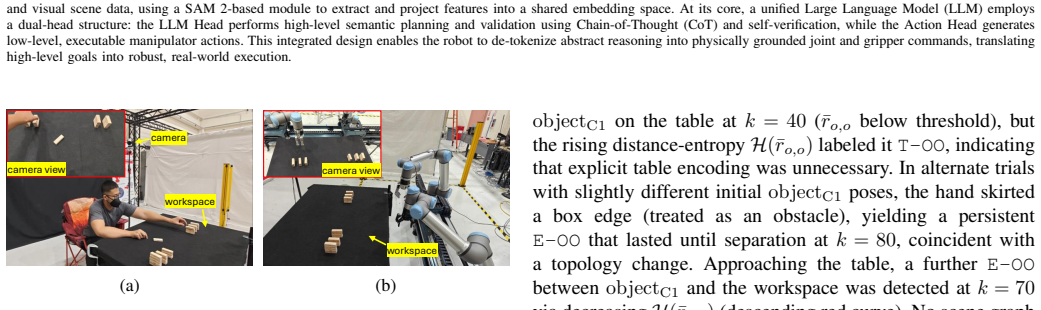
- [§V, Table I, Table II] The abstract and conclusion repeatedly claim that GF-VLA transfers a 'single human demonstration' into a generalizable dual-arm policy. However, §III-D reports fine-tuning on 250 RGB videos by 10 participants for the LLM head and 240 bimanual trials for the action head. Table II's 'overall average' success of 90% across six transfer tasks is presented as evidence of single-demonstration generalization, but the connection between the training corpus and the transfer tasks is not established. Please clarify what exactly constitutes a 'single demonstration' in the experiments, how many unique demonstrations underlie each reported task class, and whether the held-out tasks share objects or layouts with the training corpus.
- [§IV-A, Fig. 7(b)] The conclusion states that GF-VLA 'halved 6D-pose error versus imitation-learning and language-only baselines,' but no baseline experiments appear in Section IV. Tables I and II report only absolute success rates, pose errors, and subjective scores. Without a described comparison protocol, the baselines, and the actual numbers, this claim is unsupported. Please include the baseline comparisons or remove the claim. Also report the number of trials and variance for the success rates in Tables I and II; the current '0.94' and '0.90' aggregates lack trial counts and confidence intervals.
- [§II-B, §V] The LLM plan evaluation scores (PC, OA, IV, C) and interpretability ratings (e.g., 4.7/5) are presented as normalized values and averages, but the scales, annotation procedures, and inter-annotator agreement are not described. For example, what is the rubric for 'verification correctness' or 'chain-of-thought interpretability'? Without this, these numbers cannot be interpreted. Please report the evaluation protocol, the number of annotators or automated measures, and the raw scoring scale.
minor comments (7)
- [§II-B] The term 'RS-OO' appears in the graph specification ('if both a hand–object (HO) and a subsequent RS-OO relation are detected') but is never defined. Presumably it refers to the static OO relation (E-OO), but this should be stated. Also, 'temperoal' is a typo for 'temporal.'
- [§II-A, Eq. (4)] Eq. (4) sums mutual information across x, y, z axes. This is not the mutual information of the 3D position vector; it is a sum of marginal mutual informations. Please justify this choice or use a joint histogram over 3D positions, as the current definition may affect the interpretability of ϖ_h,o_i.
- [Fig. 6] The axes in Fig. 6 lack units and labels in several panels (e.g., 't', 's', 'K' are used without definition). The relationship between 'K' (frame index) and the temporal window φ should be clarified.
- [§III-B] The text refers to 'Fig. III-A' which does not exist; it probably refers to Fig. 4 or Fig. 1. Please correct the cross-reference.
- [§II-B.3] In the run-time rule, 'otherwise (4) is re-evaluated at each decision point' appears to refer to Eq. (10), not Eq. (4). The equation number is wrong.
- [Table II] The first row 'Etter: “VLM”' appears to contain a typo; likely 'Letter: “VLM”'.
- [§V] The conclusion acknowledges 'reliance on calibrated camera–arm alignment within a largely static workspace,' but the experimental section does not discuss calibration procedure or sensitivity to calibration error. A brief comment would help readers assess deployment constraints.
Circularity Check
No demonstrable circularity: robot task success and held-out plan/action evaluations provide external grounding; under-specified GRA/TSA protocol is a reporting gap, not a demonstrated self-reduction.
full rationale
The paper's central claims—94% grasp reliability, 89% placement accuracy, and 90% overall task success—are measured on a physical dual-arm platform under held-out task variants (Tables I and II: shape generalization, ambiguous spatial relations, absolute/relative 6D pose, letter variants, towers, shifted viewpoints). These numbers are externally grounded and are not forced by the representation-extraction fit. The LLM plan metrics are evaluated on 125 held-out demonstrations, and the Action Head on 120 held-out trials, providing an independent train/evaluation split. The internal GRA/TSA numbers in Fig. 7a are indeed presented without a stated ground-truth annotation protocol or the detector thresholds (α_ϖ, γ_ϖ, r_th^h,o, r_th^oo, window φ, quantization ζ), so that evaluation is unverifiable. However, absent evidence that the "ground truth" was produced by the same entropy/MI segmentation or that thresholds were tuned on the evaluation videos, this is a completeness/reporting risk rather than a demonstrated circular reduction. The mathematical definitions in Eqs. (1)–(3) are nonstandard—the ε/N_x factor makes Eq. (1) not Shannon entropy, and Eq. (3) is joint entropy, not the mutual information of Eq. (2)—but this is a correctness concern, not circularity. No load-bearing step in the derivation reduces by construction to its inputs, and the cited prior work (including the dataset reference [15]) is not by the same author set. The paper's own stated limitations (weaker temporal segmentation under dynamic contacts, reduced ordering accuracy for parallel/symmetric steps, reliance on calibrated camera–arm alignment) further indicate the representation is not treated as trivially self-confirming.
Assumptions & free parameters
free parameters (9)
- epsilon scaling in entropy (Eq. 1) =
not reported, stated epsilon in (0,1)
- sliding temporal window width phi =
not reported
- histogram quantization width zeta =
not reported
- Coupled-Motion threshold alpha_omega =
not reported ('near-zero')
- Docked threshold gamma_omega =
not reported
- hand-object distance threshold r_th^{h,o} =
not reported
- object-object distance threshold r_th^{oo} =
not reported
- prior-trust weight kappa (Eq. 10) =
not reported
- imitation rewards R_bonus, R_penalty (Eq. 8) =
not reported
assumptions (5)
- standard math Shannon entropy and mutual information definitions (Eqs. 1-3)
- ad hoc to paper At each time step, at most one hand-object and one object-object interaction involving the manipulated object are relevant; detection stops at the first positive match
- ad hoc to paper Docked is entered only following a Coupled-Motion phase
- domain assumption Hand-object coupling is captured by position-only mutual information summed over x,y,z
- domain assumption E-OO vs T-OO is decided by the sign of dH(mean distance)/dt during active manipulation
Cite this review
Pith. "Pith review of Graph-Fused Vision-Language-Action for Policy Reasoning in Multi-Arm Robotic Manipulation." pith.science (2026). https://pith.science/paper/GGWDDLHI
@misc{pith2026250907957,
  author       = {Pith},
  title        = {Pith review of: Graph-Fused Vision-Language-Action for Policy Reasoning in Multi-Arm Robotic Manipulation},
  year         = {2026},
  howpublished = {\url{https://pith.science/paper/GGWDDLHI}},
  note         = {Machine review of arXiv:2509.07957}
}
read the original abstract
Acquiring dexterous robotic skills from human video demonstrations remains a significant challenge, largely due to conventional reliance on low-level trajectory replication, which often fails to generalize across varying objects, spatial layouts, and manipulator configurations. To address this limitation, we introduce Graph-Fused Vision-Language-Action (GF-VLA), a unified framework that enables dual-arm robotic systems to perform task-level reasoning and execution directly from RGB-D human demonstrations. GF-VLA employs an information-theoretic approach to extract task-relevant cues, selectively highlighting critical hand-object and object-object interactions. These cues are structured into temporally ordered scene graphs, which are subsequently integrated with a language-conditioned transformer to produce hierarchical behavior trees and interpretable Cartesian motion primitives. To enhance efficiency in bimanual execution, we propose a cross-arm allocation strategy that autonomously determines gripper assignment without requiring explicit geometric modeling. We validate GF-VLA on four dual-arm block assembly benchmarks involving symbolic structure construction and spatial generalization. Empirical results demonstrate that the proposed representation achieves over 95% graph accuracy and 93% subtask segmentation, enabling the language-action planner to generate robust, interpretable task policies. When deployed on a dual-arm robot, these policies attain 94% grasp reliability, 89% placement accuracy, and 90% overall task success across stacking, letter-formation, and geometric reconfiguration tasks, evidencing strong generalization and robustness under diverse spatial and semantic variations.
Figures


Figures from the paper (4 more)



Reference graph
Works this paper leans on
-
[1]
Six-axis force/torque sensors for robotics applications: A review,
M. Y . Cao, S. Laws, and F. R. y Baena, “Six-axis force/torque sensors for robotics applications: A review,”IEEE Sensors Journal, vol. 21, no. 24, pp. 27238–27251, 2021
2021
-
[2]
HYPERmotion: Learning hybrid behavior planning for autonomous loco-manipulation,
J. Wang, R. Dai, W. Wang, L. Rossini, F. Ruscelli, and N. Tsagarakis, “HYPERmotion: Learning hybrid behavior planning for autonomous loco-manipulation,” in8th Annual Conference on Robot Learning, 2024
work page 2024
-
[3]
Hybridvla: Collaborative diffusion and au- toregression in a unified vision-language-action model,
J. Liu, H. Chen, P. An, Z. Liu, R. Zhang, C. Gu, X. Li, Z. Guo, S. Chen, M. Liu,et al., “Hybridvla: Collaborative diffusion and au- toregression in a unified vision-language-action model,”arXiv preprint arXiv:2503.10631, 2025
arXiv 2025
-
[4]
Rt-2: Vision-language-action models transfer web knowledge to robotic control,
A. Brohan, N. Chen, D. Fu,et al., “Rt-2: Vision-language-action models transfer web knowledge to robotic control,”arXiv preprint arXiv:2307.15818, 2023
arXiv 2023
-
[5]
Openvla: An open- source vision-language-action model,
M. J. Kim, K. Pertsch, S. Karamcheti, T. Xiao, A. Balakrishna, S. Nair, R. Rafailov, E. Foster, G. Lam, P. Sanketi,et al., “Openvla: An open- source vision-language-action model,”arXiv preprint arXiv:2406.09246, 2024
arXiv 2024
-
[6]
Pi0: Open-ended robotic manipulation with large language models and language-conditioned skills,
J. Black, A. Gokaslan,et al., “Pi0: Open-ended robotic manipulation with large language models and language-conditioned skills,”arXiv preprint arXiv:2402.00100, 2024
arXiv 2024
-
[7]
Cliport: What and where pathways for robotic manipulation,
M. Shridharet al., “Cliport: What and where pathways for robotic manipulation,”Conference on Robot Learning (CoRL), 2022
work page 2022
-
[8]
Deep reinforcement learning: An overview,
Y . Li, “Deep reinforcement learning: An overview,”arXiv preprint arXiv:1701.07274, 2018
arXiv 2018
Show all 15 references
-
[9]
Learning transferable robot skills with hierarchical latent variable models,
X. B. Peng, P. Abbeel, S. Levine, and M. van de Panne, “Learning transferable robot skills with hierarchical latent variable models,” in International Conference on Learning Representations (ICLR), 2020
2020
-
[10]
Transfer learning in robotics: An upcoming breakthrough? a review of promises and challenges,
N. Jaquier, M. C. Welle, A. Gams, K. Yao, B. Fichera, A. Billard, A. Ude, T. Asfour, and D. Kragic, “Transfer learning in robotics: An upcoming breakthrough? a review of promises and challenges,”The International Journal of Robotics Research, vol. 44, no. 3, pp. 465– 485, 2025
2025
-
[11]
Infobot: Transfer and exploration via the information bottleneck,
A. Goyal, R. Liu, T. Fotiadis, and et al., “Infobot: Transfer and exploration via the information bottleneck,” inInternational Conference on Machine Learning, pp. 2832–2842, PMLR, 2019
2019
-
[12]
A mathematical theory of communication,
C. E. Shannon, “A mathematical theory of communication,”The Bell system technical journal, vol. 27, no. 3, pp. 379–423, 1948
1948
-
[13]
Chain-of-thought prompting elicits reasoning in large language models,
J. Wei, X. Wang, D. Schuurmans, M. Bosma, B. Ichter, F. Xia, E. Chi, Q. Le, and D. Zhou, “Chain-of-thought prompting elicits reasoning in large language models,” 2023
2023
-
[14]
Lora: Low-rank adaptation of large language models,
E. J. Hu, Y . Shen, P. Wallis, Z. Allen-Zhu, Y . Li, S. Wang, L. Wang, and W. Chen, “Lora: Low-rank adaptation of large language models,” arXiv preprint arXiv:2106.09685, 2021
2021 arXiv
-
[15]
Exploiting information theory for intuitive robot programming of manual activities,
E. Merlo, M. Lagomarsino, E. Lamon, and A. Ajoudani, “Exploiting information theory for intuitive robot programming of manual activities,” IEEE Transactions on Robotics, 2025
2025
Reviewed August 4, 2026 · model on record in the stance chip above.
Discussion (0). Sign in to comment.