Discovery of sulfur oxides in the ejecta of a B[e] supergiant
Pith reviewed 2026-07-03 05:07 UTC · model grok-4.3
The pith
Sulfur oxides are detected for the first time in the ejecta of a B[e] supergiant, with abundances matched by chemical models in 10,000 years and an isotopic ratio indicating photochemistry-driven fractionation.
A machine-rendered reading of the paper's core claim, the machinery that carries it, and where it could break.
Core claim
The detection of SO and SO2 marks the first such molecules in an early-type evolved massive star. The SO2 fractional abundance relative to H2 is reproducible by chemical modelling in timescales as short as ~10^4 yr in an oxygen-rich environment. An anomalously low 32SO/33SO is attributed to mass-independent fractionation driven by intense photochemistry, mirroring processes proposed to explain 33S excesses in the atmosphere of the Archaean Earth.
What carries the argument
ALMA spectral detections of SO and SO2 lines in the ejecta of HD 87643, interpreted through time-dependent chemical models that track sulfur-bearing species under high-UV, oxygen-rich conditions.
If this is right
- The detected molecules trace a short-lived, rapidly evolving phase of out-of-equilibrium chemistry around the star.
- B[e] supergiants can sustain complex molecular chemistry in their disks despite intense UV fields.
- These environments provide laboratories for studying sulfur chemistry and isotopic fractionation under extreme radiation.
- The findings open avenues to investigate fractionation processes that may relate to isotopic signatures in the early geological record.
Where Pith is reading between the lines
- Similar molecular detections could be feasible in other high-mass evolved stars if observed at comparable sensitivity and resolution.
- The photochemistry-driven fractionation mechanism might operate in additional irradiated astrophysical settings beyond B[e] supergiants.
- Circumstellar material from these stars could deliver fractionated sulfur to forming planetary systems.
Load-bearing premise
The chemical models assume specific physical conditions and an oxygen-rich environment allow the observed abundances to be reproduced on short timescales, while the isotopic ratio interpretation assumes photochemistry is the dominant fractionation mechanism without competing processes.
What would settle it
A spatially resolved map of the molecular emission combined with measurements of additional sulfur isotopes or direct constraints on local density and temperature would test whether the abundance and fractionation claims hold.
Figures
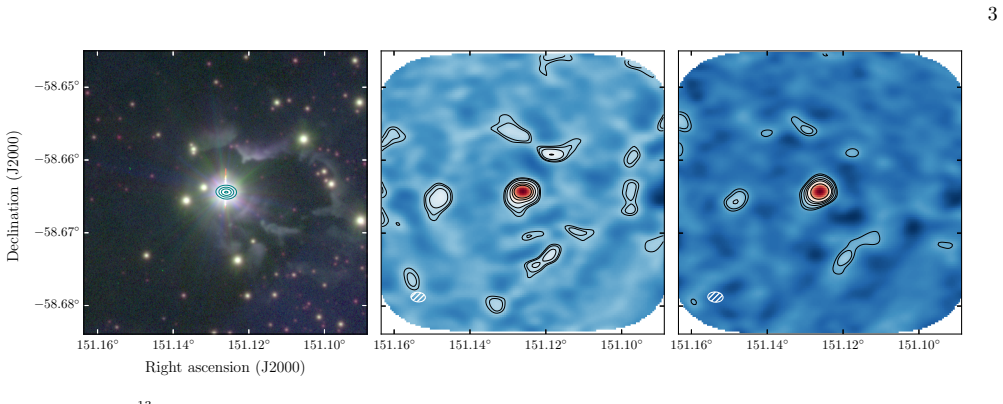
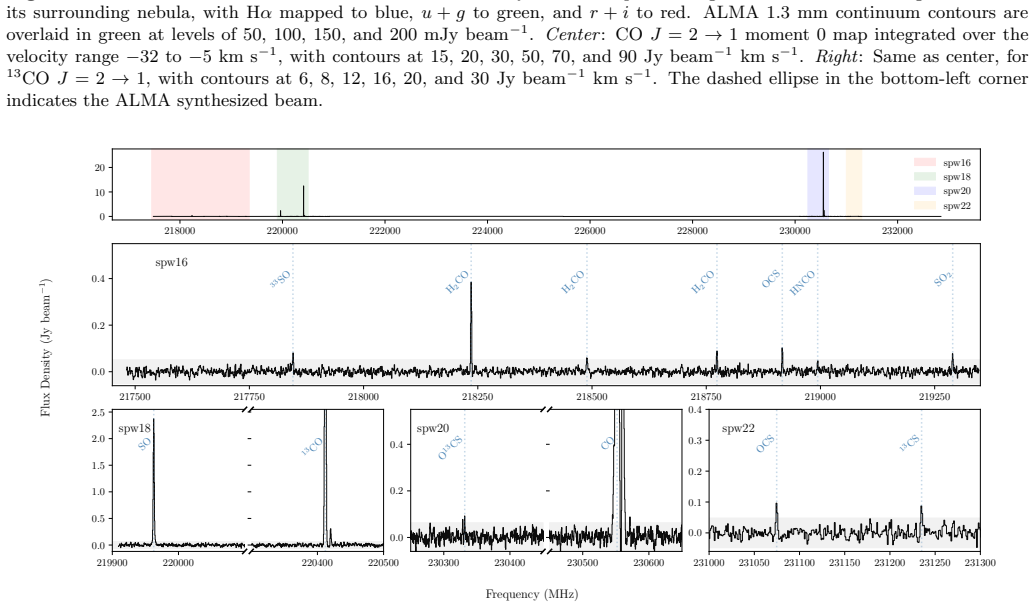
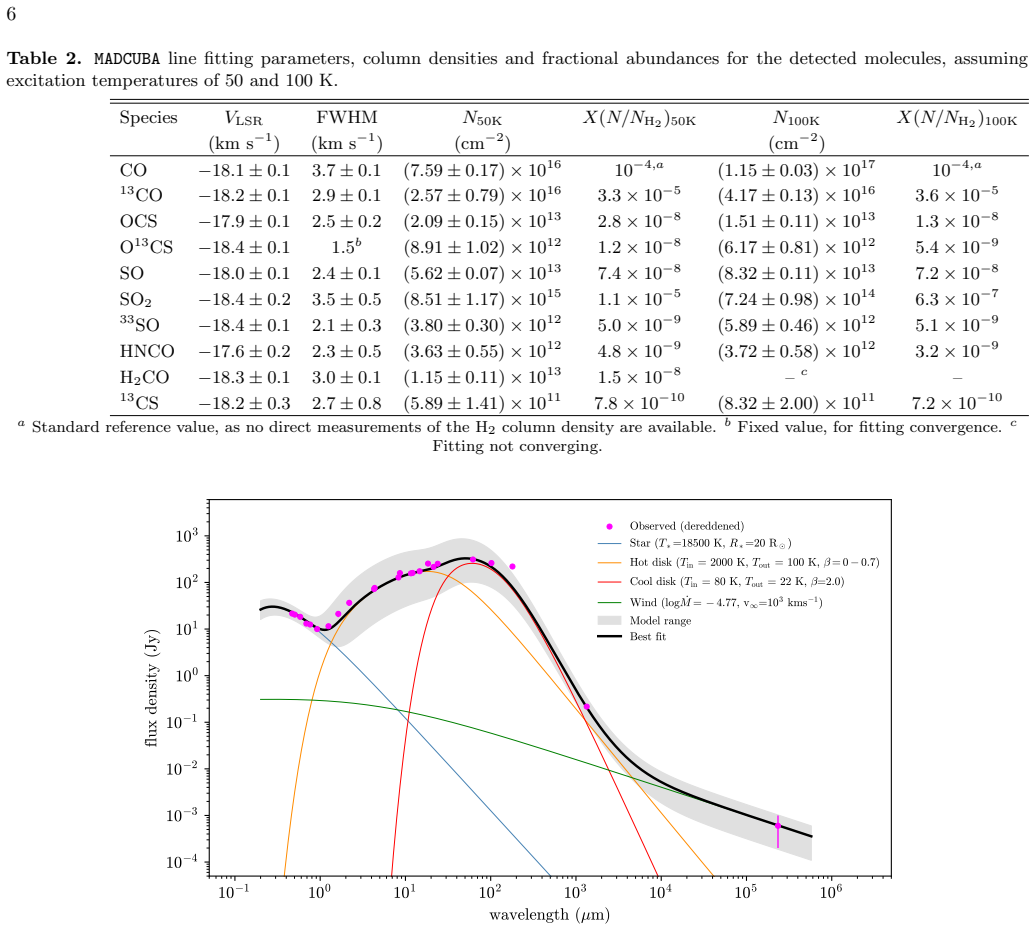
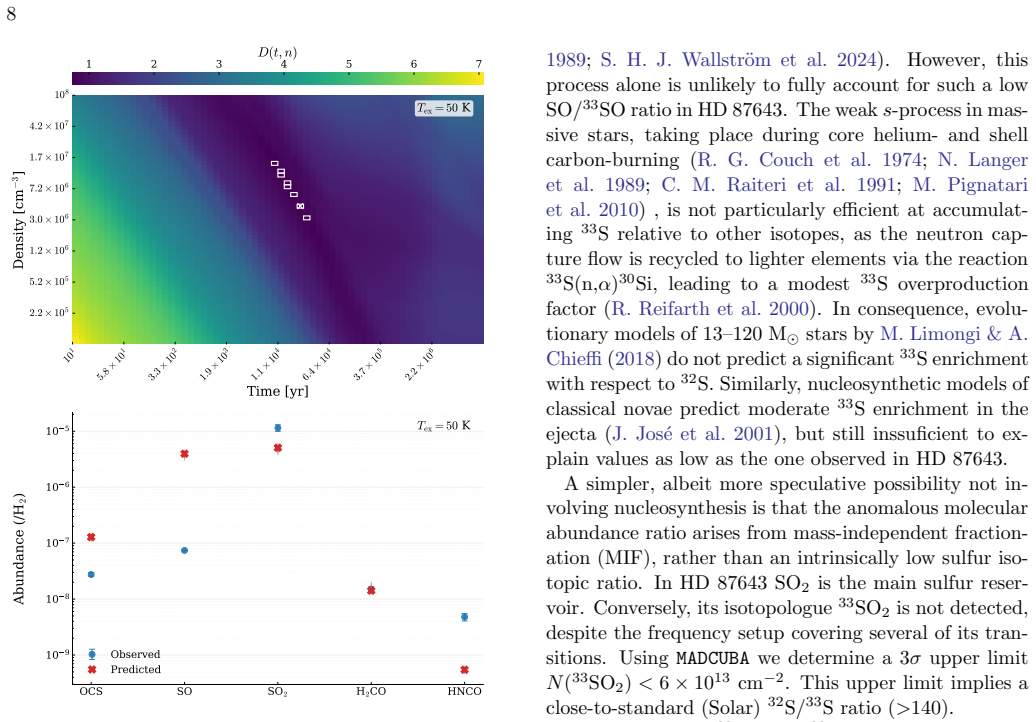
read the original abstract
B[e] supergiants represent a rare class of luminous, evolved massive stars surrounded by dusty circumstellar disks. Since their intense UV fields were long thought to sterilize their surroundings, molecular detections beyond carbon monoxide have remained elusive, leaving their chemical reservoirs largely unexplored. Whether these environments can sustain a complex molecular chemistry is a fundamental question with significant astrochemical implications. Here we report the detection of chemically rich molecular gas surrounding the B[e] supergiant HD~87643, using ALMA observations. Our data reveal the presence of the sulfur oxides SO and SO$_2$ and other sulfur-bearing species, marking the first detection of these molecules in an early-type evolved massive star. We find a high fractional abundance of SO$_2$ relative to H$_2$, which our chemical modelling can reproduce in timescales as short as $\sim$10$^4$ yr in an oxygen-rich environment. These results indicate that the detected molecules trace a short-lived, rapidly evolving phase of out-of-equilibrium chemistry. Furthermore, we measure an anomalously low $^{32}$SO/$^{33}$SO, that we attribute to mass-independent fractionation driven by intense photochemistry. This mechanism mirrors processes proposed to explain the $^{33}$S excesses in the atmosphere of the Archaean Earth. Our findings suggest that B[e] supergiants could serve as unique laboratories for studying sulfur chemistry under extreme radiation conditions, opening potential avenues to investigate the fractionation processes that shaped the isotopic signatures found in the early geological record.
Editorial analysis
A structured set of objections, weighed in public.
Referee Report
Summary. The paper reports ALMA detections of SO and SO2 (plus other sulfur-bearing species) in the circumstellar environment of the B[e] supergiant HD 87643, claimed as the first such molecules in an early-type evolved massive star. Chemical modeling is presented as reproducing the observed high SO2/H2 fractional abundance on timescales as short as ~10^4 yr in an oxygen-rich environment, interpreted as tracing a short-lived out-of-equilibrium phase. An anomalously low 32SO/33SO ratio is measured and attributed to mass-independent fractionation from intense photochemistry, with suggested links to Archaean Earth processes.
Significance. If the detections, modeling, and isotopic interpretation hold after details are provided, the result would establish B[e] supergiants as viable sites for complex sulfur chemistry despite strong UV fields, with potential as laboratories for extreme photochemistry and fractionation mechanisms. The short-timescale claim and isotopic attribution could inform models of circumstellar evolution in massive stars.
major comments (2)
- [Chemical modelling] Chemical modelling section: the reproduction of the observed SO2/H2 ratio in ~10^4 yr is presented as supporting a short-lived phase, but this hinges on specific (unstated) choices for density, temperature, UV intensity, and the oxygen-rich assumption; without showing these are independently constrained by observations of HD 87643 rather than tuned to match, the timescale conclusion is not load-bearing.
- [Isotopic ratio analysis] Isotopic analysis section: the attribution of the low 32SO/33SO to mass-independent fractionation by photochemistry assumes this channel dominates without quantitative exclusion of competing processes (e.g., other fractionation mechanisms); this is central to the fractionation claim but lacks the required comparison.
minor comments (2)
- The abstract refers to 'other sulfur-bearing species' without naming them; explicit identification would aid clarity.
- Error analysis, baseline comparisons, and full dataset details for the ALMA detections are referenced in the reader's assessment but not visible here; their inclusion is needed for reproducibility.
Simulated Author's Rebuttal
We thank the referee for their insightful comments on our manuscript. We address each major comment below and will incorporate revisions to strengthen the presentation of our results.
read point-by-point responses
-
Referee: [Chemical modelling] Chemical modelling section: the reproduction of the observed SO2/H2 ratio in ~10^4 yr is presented as supporting a short-lived phase, but this hinges on specific (unstated) choices for density, temperature, UV intensity, and the oxygen-rich assumption; without showing these are independently constrained by observations of HD 87643 rather than tuned to match, the timescale conclusion is not load-bearing.
Authors: We agree that the chemical modeling parameters should be more explicitly tied to observational constraints. In the revised version, we will add a new subsection in the chemical modelling section that details the sources of the adopted density, temperature, UV intensity, and oxygen-rich conditions. These will be justified using existing observational data on HD 87643, including its spectral energy distribution, disk properties from previous studies, and typical values for B[e] supergiant environments. This will demonstrate that the ~10^4 yr timescale is not the result of tuning but follows from observationally motivated inputs. revision: yes
-
Referee: [Isotopic ratio analysis] Isotopic analysis section: the attribution of the low 32SO/33SO to mass-independent fractionation by photochemistry assumes this channel dominates without quantitative exclusion of competing processes (e.g., other fractionation mechanisms); this is central to the fractionation claim but lacks the required comparison.
Authors: The manuscript attributes the low ratio to photochemistry based on the intense UV field in the B[e] supergiant environment, which is distinct from other astrophysical settings. However, to address the referee's concern, we will revise the isotopic analysis section to include a quantitative comparison with other potential fractionation mechanisms, such as equilibrium fractionation and ion-molecule reactions, using literature values to show why they are unlikely to produce the observed ratio under the conditions of HD 87643. This will provide a stronger basis for the mass-independent fractionation claim. revision: yes
Circularity Check
No significant circularity; modelling presented as independent reproduction under stated conditions
full rationale
The abstract reports an observational detection of SO and SO2 and states that chemical modelling reproduces the observed SO2/H2 abundance on ~10^4 yr timescales in an oxygen-rich environment. No equations, fitted parameters, or self-citations are quoted that reduce this reproduction to a tautology or input fit by construction. The isotopic attribution is an interpretive claim rather than a derived result shown to equal its premises. The derivation chain therefore remains self-contained against external benchmarks with no load-bearing step collapsing to its own inputs.
Axiom & Free-Parameter Ledger
free parameters (1)
- chemical model parameters
axioms (1)
- domain assumption The circumstellar environment is oxygen-rich
Reference graph
Works this paper leans on
-
[1]
Adande, G. R., Edwards, J. L., & Ziurys, L. M. 2013, ApJ, 778, 22, doi: 10.1088/0004-637X/778/1/22
-
[2]
A., & Swings, J
Allen, D. A., & Swings, J. P. 1976, A&A, 47, 293
1976
-
[3]
1989, GeoCoA, 53, 197, doi: 10.1016/0016-7037(89)90286-X
Anders, E., & Grevesse, N. 1989, GeoCoA, 53, 197, doi: 10.1016/0016-7037(89)90286-X
-
[4]
1997, ApJL, 487, L93, doi: 10.1086/310877
Bachiller, R., & P´ erez Guti´ errez, M. 1997, ApJL, 487, L93, doi: 10.1086/310877
-
[5]
Dishoeck, E. F., & Ohashi, S. 2021, A&A, 651, L6, doi: 10.1051/0004-6361/202141057
-
[6]
Bordiu, C., Rizzo, J. R., Bufano, F., et al. 2022, ApJL, 939, L30, doi: 10.3847/2041-8213/ac9b10
-
[7]
2006, A&A, 456, 1001, doi: 10.1051/0004-6361:20064827
Cherchneff, I. 2006, A&A, 456, 1001, doi: 10.1051/0004-6361:20064827
-
[8]
Claude, S. M. X., Avery, L. W., & Matthews, H. E. 2000, The Astrophysical Journal, 545, 379, doi: 10.1086/317773
-
[9]
Couch, R. G., Schmiedekamp, A. B., & Arnett, W. D. 1974, ApJ, 190, 95, doi: 10.1086/152851
-
[10]
Danielache, S. O., Eskebjerg, C., Johnson, M. S., Ueno, Y., & Yoshida, N. 2008, Journal of Geophysical Research (Atmospheres), 113, D17314, doi: 10.1029/2007JD009695
-
[11]
Sande, M., & Gottlieb, C. A. 2020, MNRAS, 494, 1323, doi: 10.1093/mnras/staa693 12 de Freitas Pacheco, J. A. 1998, in Astrophysics and Space Science Library, Vol. 233, B[e] stars, ed. A. M. Hubert & C. Jaschek, 221, doi: 10.1007/978-94-015-9014-3 30
-
[12]
Endo, Y., Danielache, S. O., Ueno, Y., et al. 2015, Journal of Geophysical Research (Atmospheres), 120, 2546, doi: 10.1002/2014JD021671
-
[13]
B., Tercero, B., Cernicharo, J., et al
Esplugues, G. B., Tercero, B., Cernicharo, J., et al. 2013, A&A, 556, A143, doi: 10.1051/0004-6361/201321285
-
[14]
2000, Science, 289, 756, doi: 10.1126/science.289.5480.756
Farquhar, J., Bao, H., & Thiemens, M. 2000, Science, 289, 756, doi: 10.1126/science.289.5480.756
-
[15]
Farquhar, J., Savarino, J., Airieau, S., & Thiemens, M. H. 2001, J. Geophys. Res., 106, 32829, doi: 10.1029/2000JE001437
-
[16]
Fuente, A., Trevi˜ no-Morales, S. P., Alonso-Albi, T., et al. 2021, MNRAS, 507, 1886, doi: 10.1093/mnras/stab2216
-
[17]
2016, A&A, 593, A94, doi: 10.1051/0004-6361/201628285
Fuente, A., Cernicharo, J., Roueff, E., et al. 2016, A&A, 593, A94, doi: 10.1051/0004-6361/201628285
-
[18]
H., Meynet, G., Ekstr¨ om, S., & Georgy, C
Groh, J. H., Meynet, G., Ekstr¨ om, S., & Georgy, C. 2014, A&A, 564, A30, doi: 10.1051/0004-6361/201322573
-
[19]
Hillier, D. J. 2006, in Astronomical Society of the Pacific Conference Series, Vol. 355, Stars with the B[e] Phenomenon, ed. M. Kraus & A. S. Miroshnichenko, 39
2006
-
[20]
2025, PASA, 42, e071, doi: 10.1017/pasa.2025.10042
Hopkins, A., Kapinska, A., Marvil, J., et al. 2025, PASA, 42, e071, doi: 10.1017/pasa.2025.10042 Jim´ enez-Serra, I., Zhang, Q., Viti, S., Mart´ ın-Pintado, J., & de Wit, W.-J. 2012, ApJ, 753, 34, doi: 10.1088/0004-637X/753/1/34 Jos´ e, J., Coc, A., & Hernanz, M. 2001, ApJ, 560, 897, doi: 10.1086/322979
-
[21]
2009, A&A, 494, 253, doi: 10.1051/0004-6361:200811020
Kraus, M. 2009, A&A, 494, 253, doi: 10.1051/0004-6361:200811020
-
[22]
2019, Galaxies, 7, 83, doi: 10.3390/galaxies7040083
Kraus, M. 2019, Galaxies, 7, 83, doi: 10.3390/galaxies7040083
-
[23]
Kraus, M., Oksala, M. E., Cidale, L. S., et al. 2015, ApJL, 800, L20, doi: 10.1088/2041-8205/800/2/L20
-
[24]
1989, A&A, 210, 187
Langer, N., Arcoragi, J.-P., & Arnould, M. 1989, A&A, 210, 187
1989
-
[25]
1944, Quarterly of Applied Mathematics, 2, 164
Levenberg, K. 1944, Quarterly of Applied Mathematics, 2, 164
1944
-
[26]
2018, ApJS, 237, 13, doi: 10.3847/1538-4365/aacb24
Limongi, M., & Chieffi, A. 2018, ApJS, 237, 13, doi: 10.3847/1538-4365/aacb24
-
[27]
Lyons, J. R. 2007, Geophys. Res. Lett., 34, L22811, doi: 10.1029/2007GL031031
-
[28]
Magalhaes, A. M. 1992, ApJ, 398, 286, doi: 10.1086/171856
-
[29]
Maravelias, G., Kraus, M., Cidale, L. S., et al. 2018, MNRAS, 480, 320, doi: 10.1093/mnras/sty1747
-
[30]
Marquardt, D. W. 1963, SIAM Journal on Applied Mathematics, 11, 431, doi: 10.1137/0111030 Mart´ ın, S., Mart´ ın-Pintado, J., Blanco-S´ anchez, C., et al. 2019, A&A, 631, A159, doi: 10.1051/0004-6361/201936144
-
[31]
Masterson, A. L., Farquhar, J., & Wing, B. A. 2011, Earth and Planetary Science Letters, 306, 253, doi: 10.1016/j.epsl.2011.04.004
-
[32]
2004, A&A, 426, 219, doi: 10.1051/0004-6361:20040451
Gallino, R. 2004, A&A, 426, 219, doi: 10.1051/0004-6361:20040451
-
[33]
McGregor, P. J., Hillier, D. J., & Hyland, A. R. 1988a, ApJ, 334, 639, doi: 10.1086/166867
-
[34]
McGregor, P. J., Hyland, A. R., & Hillier, D. J. 1988b, ApJ, 324, 1071, doi: 10.1086/165964
-
[35]
V., Ka ˚Auchov´ a, Z., Herczku, P., et al
Mifsud, D. V., Ka ˚Auchov´ a, Z., Herczku, P., et al. 2021, SSRv, 217, 14, doi: 10.1007/s11214-021-00792-0
-
[36]
2009, A&A, 507, 317, doi: 10.1051/0004-6361/200811592
Millour, F., Chesneau, O., Borges Fernandes, M., et al. 2009, A&A, 507, 317, doi: 10.1051/0004-6361/200811592
-
[37]
Miroshnichenko, A. S. 2007, ApJ, 667, 497, doi: 10.1086/520798
-
[38]
Oudmaijer, R. D., Proga, D., Drew, J. E., & de Winter, D. 1998, MNRAS, 300, 170, doi: 10.1046/j.1365-8711.1998.01875.x
-
[39]
1975, A&A, 39, 1
Panagia, N., & Felli, M. 1975, A&A, 39, 1
1975
-
[40]
2010, ApJ, 710, 1557, doi: 10.1088/0004-637X/710/2/1557 Pojma´ nski, G
Pignatari, M., Gallino, R., Heil, M., et al. 2010, ApJ, 710, 1557, doi: 10.1088/0004-637X/710/2/1557 Pojma´ nski, G. 2009, in Astronomical Society of the Pacific Conference Series, Vol. 403, The Variable Universe: A Celebration of Bohdan Paczynski, ed. K. Z. Stanek, 52
-
[41]
2016, A&A, 592, A51, doi: 10.1051/0004-6361/201527688
Quintana-Lacaci, G., Ag´ undez, M., Cernicharo, J., et al. 2016, A&A, 592, A51, doi: 10.1051/0004-6361/201527688
-
[42]
M., Busso, M., Gallino, R., & Picchio, G
Raiteri, C. M., Busso, M., Gallino, R., & Picchio, G. 1991, ApJ, 371, 665, doi: 10.1086/169932
-
[43]
2000, ApJ, 528, 573, doi: 10.1086/308175 Rivi` ere-Marichalar, P., Fuente, A., Goicoechea, J
Reifarth, R., Schwarz, K., & K¨ appeler, F. 2000, ApJ, 528, 573, doi: 10.1086/308175 Rivi` ere-Marichalar, P., Fuente, A., Goicoechea, J. R., et al. 2019, A&A, 628, A16, doi: 10.1051/0004-6361/201935354
-
[44]
Rizzo, J. R., Bordiu, C., & Ritacco, A. 2025, arXiv e-prints, arXiv:2509.05861, doi: 10.48550/arXiv.2509.05861
-
[45]
R., Palau, A., Jim´ enez-Esteban, F., & Henkel, C
Rizzo, J. R., Palau, A., Jim´ enez-Esteban, F., & Henkel, C. 2014, A&A, 564, A21, doi: 10.1051/0004-6361/201323170 Rodr´ ıguez-Fern´ andez, N. J., Tafalla, M., Gueth, F., &
-
[46]
2010, A&A, 516, A98, doi: 10.1051/0004-6361/201013997
Bachiller, R. 2010, A&A, 516, A98, doi: 10.1051/0004-6361/201013997
-
[47]
Ruaud, M., Wakelam, V., & Hersant, F. 2016, MNRAS, 459, 3756, doi: 10.1093/mnras/stw887 Sanchez Contreras, C., Bujarrabal, V., & Alcolea, J. 1997, A&A, 327, 689 13
-
[48]
B., Carciofi, A
Seriacopi, D. B., Carciofi, A. C., & Magalh˜ aes, A. M. 2017, in Astronomical Society of the Pacific Conference Series, Vol. 508, The B[e] Phenomenon: Forty Years of Studies, ed. A. Miroshnichenko, S. Zharikov, D. Korˇ c´ akov´ a, & M. Wolf, 109
2017
-
[49]
Shore, S. N., Brown, D. N., Bopp, B. W., et al. 1990, ApJS, 73, 461, doi: 10.1086/191476
-
[50]
Singh, A. P., Edwards, J. L., & Ziurys, L. M. 2022, AJ, 164, 230, doi: 10.3847/1538-3881/ac8df0
-
[51]
P., & Wamsteker, W
Surdej, A., Surdej, J., Swings, J. P., & Wamsteker, W. 1981, A&A, 93, 285
1981
-
[52]
Surdej, J., & Swings, J. P. 1983, A&A, 117, 359 van den Bergh, S. 1972, PASP, 84, 594, doi: 10.1086/129339 Velilla Prieto, L., S´ anchez Contreras, C., Cernicharo, J., et al. 2015, A&A, 575, A84, doi: 10.1051/0004-6361/201424768
-
[53]
2024, A&A, 689, A63, doi: 10.1051/0004-6361/202450606 Wallstr¨ om, S
Wakelam, V., Gratier, P., Loison, J.-C., et al. 2024, A&A, 689, A63, doi: 10.1051/0004-6361/202450606 Wallstr¨ om, S. H. J., Danilovich, T., M¨ uller, H. S. P., et al. 2024, A&A, 681, A50, doi: 10.1051/0004-6361/202347632 Weßmayer, D., Przybilla, N., & Butler, K. 2022, A&A, 668, A92, doi: 10.1051/0004-6361/202243973
-
[54]
Vink, J. S. 2012, A&A, 538, A6, doi: 10.1051/0004-6361/201117766
-
[55]
Whitehill, A. R., & Ono, S. 2012, Geochimica et Cosmochimica Acta, 94, 238, doi: https://doi.org/10.1016/j.gca.2012.06.014
-
[56]
Willacy, K., & Millar, T. J. 1997, A&A, 324, 237
1997
-
[57]
Wilson, T. L., & Rood, R. 1994, ARA&A, 32, 191, doi: 10.1146/annurev.aa.32.090194.001203
-
[58]
T., Henkel, C., Kobayashi, C., et al
Yan, Y. T., Henkel, C., Kobayashi, C., et al. 2023, A&A, 670, A98, doi: 10.1051/0004-6361/202244584
-
[59]
2018, Research in Astronomy and Astrophysics, 18, 015, doi: 10.1088/1674-4527/18/2/15
Yu, N.-P., Xu, J.-L., & Wang, J.-J. 2018, Research in Astronomy and Astrophysics, 18, 015, doi: 10.1088/1674-4527/18/2/15
-
[60]
2006, in Astronomical Society of the Pacific Conference Series, Vol
Zickgraf, F.-J. 2006, in Astronomical Society of the Pacific Conference Series, Vol. 355, Stars with the B[e] Phenomenon, ed. M. Kraus & A. S. Miroshnichenko, 135
2006
-
[61]
J., Wolf, B., Stahl, O., & Humphreys, R
Zickgraf, F. J., Wolf, B., Stahl, O., & Humphreys, R. M. 1989, A&A, 220, 206
1989
-
[62]
J., Wolf, B., Stahl, O., Leitherer, C., & Klare, G
Zickgraf, F. J., Wolf, B., Stahl, O., Leitherer, C., & Klare, G. 1985, A&A, 143, 421
1985
-
[63]
Ziurys, L. M., Milam, S. N., Apponi, A. J., & Woolf, N. J. 2007, Nature, 447, 1094, doi: 10.1038/nature05905
-
[64]
Ziurys, L. M., Tenenbaum, E. D., Pulliam, R. L., Woolf, N. J., & Milam, S. N. 2009, ApJ, 695, 1604, doi: 10.1088/0004-637X/695/2/1604
discussion (0)
Sign in with ORCID, Apple, or X to comment. Anyone can read and Pith papers without signing in.