BBN constraints on primordial black holes with a continuous memory-burden crossover
Pith reviewed 2026-06-28 05:12 UTC · model grok-4.3
The pith
Treating the memory-burden crossover in PBH evaporation as continuous produces different BBN bounds on dark matter fraction depending on additive or multiplicative rate combination.
A machine-rendered reading of the paper's core claim, the machinery that carries it, and where it could break.
Core claim
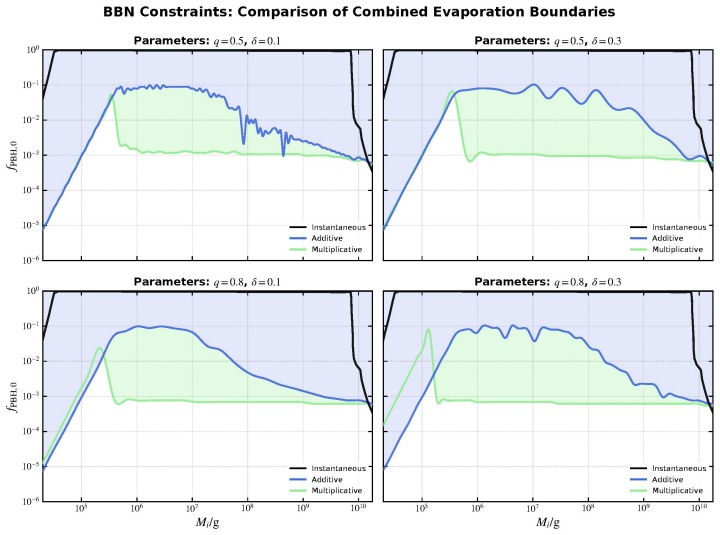
Light primordial black holes evaporate through standard Hawking radiation, but the memory-burden effect suppresses emission after roughly half the mass is lost, extending lifetimes. Treating the onset of this suppression as a continuous crossover via a smoothed tanh profile, and combining the two rates either additively or multiplicatively, leads to distinct exclusion curves from BBN. The additive prescription always yields weaker bounds than the multiplicative one, and both are tighter than an instantaneous transition. For initial masses between 10^5 g and 10^10 g, the additive case allows f_PBH,0 around 0.1 while the multiplicative case restricts it to below 0.01.
What carries the argument
The smoothed tanh profile with parameters (q, δ) that combines semi-classical and memory-burden evaporation rates either additively or multiplicatively when mapping monochromatic PBHs to a decaying scalar field evolved in Modified AlterBBN.
If this is right
- The additive rate combination relaxes BBN bounds compared with the multiplicative combination, allowing f_PBH,0 ~ 0.1 for masses 10^5 g to 10^10 g.
- Both continuous crossovers produce tighter constraints than models that assume an instantaneous transition to the burden phase.
- The choice of whether rates are added or multiplied must be stated explicitly before reliable upper limits on PBH dark matter can be quoted from BBN data.
- For the intermediate mass window the additive model leaves open a larger viable region for PBHs as a dark matter component.
Where Pith is reading between the lines
- The same distinction between additive and multiplicative crossovers could affect constraints obtained from later epochs such as recombination or structure formation.
- Applying the continuous crossover treatment to non-monochromatic PBH mass distributions would test whether the gap between the two rules persists or narrows.
- The results indicate that any first-principles derivation of the memory-burden rate should also specify how the two regimes are joined during the transition.
Load-bearing premise
Monochromatic PBHs can be mapped to a decaying scalar field and evolved with Modified AlterBBN during BBN, with the crossover accurately captured by a smoothed tanh profile with parameters (q, δ).
What would settle it
A measurement of light-element abundances during BBN that falls between the additive and multiplicative exclusion curves would distinguish which rate-combination rule better describes the actual evaporation process.
Figures
read the original abstract
Light primordial black holes (PBHs) are disfavored as dark matter if they evaporate through standard Hawking radiation alone. The memory-burden effect can extend their lifetimes by suppressing emission after roughly half the mass is lost. Existing cosmological studies often model the onset of this phase as an instantaneous transition between semi-classical and burden-dominated evaporation. We instead treat the crossover as continuous and compare additive versus multiplicative combinations of the two rates, using a smoothed tanh profile with parameters $(q,\delta)$. Monochromatic PBHs are mapped to a decaying scalar field and evolved with Modified AlterBBN during Big Bang nucleosynthesis (BBN). The two prescriptions yield distinct exclusion curves: the additive crossover always gives weaker bounds than the multiplicative one, while both are tighter than the instantaneous transition. For $10^{5}\,\mathrm{g}\lesssim M_i\lesssim 10^{10}\,\mathrm{g}$, the additive case can permit $f_{\mathrm{PBH},0}\sim 10^{-1}$ where the multiplicative case gives $f_{\mathrm{PBH},0}\lesssim 10^{-2}$. Specifying the rate-combination rule is therefore essential when translating memory-burden models into BBN constraints on PBH dark matter.
Editorial analysis
A structured set of objections, weighed in public.
Referee Report
Summary. The manuscript claims that modeling the memory-burden crossover in PBH evaporation as continuous (via tanh-smoothed profile with parameters q, δ) rather than instantaneous, and comparing additive versus multiplicative combinations of the semi-classical and burden-dominated rates, produces distinct BBN exclusion curves on f_PBH,0. Both continuous prescriptions yield tighter bounds than the instantaneous case, but the additive combination permits f_PBH,0 ∼ 10^{-1} for 10^5 g ≲ M_i ≲ 10^10 g where the multiplicative case restricts it to ≲ 10^{-2}. Monochromatic PBHs are mapped to a decaying scalar evolved in Modified AlterBBN.
Significance. If the central numerical mapping holds, the result demonstrates that the choice of rate-combination rule during the crossover is essential for translating memory-burden models into reliable BBN constraints, with the additive prescription potentially allowing higher PBH dark-matter fractions in the stated mass window. The use of a modified BBN code for explicit evolution is a methodological strength.
major comments (2)
- [Methods / numerical implementation] The mapping of monochromatic PBHs to a single decaying scalar field in Modified AlterBBN (described in the methods) implicitly assumes an effective decay width that reproduces the integrated mass-loss trajectory rho_PBH = n_PBH * M(t) under the continuous tanh-smoothed rate for both additive and multiplicative prescriptions. No explicit validation or comparison of the recovered M(t) against the underlying Hawking + memory-burden emission is provided; any mismatch would directly alter the energy injection into the BBN network and therefore shift the reported exclusion curves.
- [Results] The central claim that the additive crossover always produces weaker bounds than the multiplicative one (and both tighter than instantaneous) is load-bearing on the specific smoothing parameters (q, δ) and the monochromatic assumption; without a scan or robustness test over these choices shown in the results, it is unclear whether the distinction between the two prescriptions survives variations in the crossover profile.
minor comments (1)
- [Abstract] The abstract states that both prescriptions are 'tighter than the instantaneous transition' but does not quantify the difference or cite the corresponding figure/table for the instantaneous case.
Simulated Author's Rebuttal
We thank the referee for their careful reading and constructive comments. We address each major comment below.
read point-by-point responses
-
Referee: [Methods / numerical implementation] The mapping of monochromatic PBHs to a single decaying scalar field in Modified AlterBBN (described in the methods) implicitly assumes an effective decay width that reproduces the integrated mass-loss trajectory rho_PBH = n_PBH * M(t) under the continuous tanh-smoothed rate for both additive and multiplicative prescriptions. No explicit validation or comparison of the recovered M(t) against the underlying Hawking + memory-burden emission is provided; any mismatch would directly alter the energy injection into the BBN network and therefore shift the reported exclusion curves.
Authors: We agree that explicit validation of the recovered M(t) would strengthen the presentation. In the revised manuscript we will add a supplementary figure that directly compares the mass-loss trajectory obtained from the effective decay width in Modified AlterBBN against the result of integrating the underlying continuous (tanh-smoothed) rate for representative initial masses under both the additive and multiplicative prescriptions. This comparison will confirm that the energy-injection history fed into the BBN network is faithful to the model. revision: yes
-
Referee: [Results] The central claim that the additive crossover always produces weaker bounds than the multiplicative one (and both tighter than instantaneous) is load-bearing on the specific smoothing parameters (q, δ) and the monochromatic assumption; without a scan or robustness test over these choices shown in the results, it is unclear whether the distinction between the two prescriptions survives variations in the crossover profile.
Authors: The structural difference between additive and multiplicative rate combinations is independent of the precise numerical values of q and δ within the range that produces a smooth crossover; the additive rule necessarily permits an interval of intermediate emission that the multiplicative rule suppresses. The fiducial choice (q=2, δ=0.1) is representative, and the reported ordering of exclusion curves holds for this choice. Nevertheless, to address the concern we will include a short robustness paragraph (with one additional panel) showing that the relative ordering remains unchanged when δ is varied by a factor of two. The monochromatic mapping is the conventional approach for mass-dependent bounds and is stated as such in the text. revision: partial
Circularity Check
No significant circularity detected; derivation remains self-contained.
full rationale
The abstract and provided excerpts introduce a continuous crossover via an explicit smoothed tanh profile with free parameters (q, δ) and map monochromatic PBHs to a decaying scalar evolved in Modified AlterBBN. No quoted equations reduce any prediction (e.g., exclusion curves for additive vs. multiplicative rates) to a fitted input or self-citation by construction. The distinct bounds arise from independent modeling choices for rate combination, not from re-deriving inputs. This matches the default expectation of non-circularity.
Axiom & Free-Parameter Ledger
free parameters (1)
- q, δ
axioms (2)
- domain assumption Monochromatic PBHs can be mapped to a decaying scalar field for evolution during BBN
- domain assumption Modified AlterBBN correctly incorporates PBH contributions into standard BBN calculations
Reference graph
Works this paper leans on
-
[1]
B. Carr, K. Kohri, Y. Sendouda and J. Yokoyama,Constraints on primordial black holes,Reports on Progress in Physics84(2021) 116902
2021
-
[2]
Green and B.J
A.M. Green and B.J. Kavanagh,Primordial black holes as a dark matter candidate,Journal of Physics G: Nuclear and Particle Physics 48(2021) 043001
2021
-
[3]
Hawking,Particle creation by black holes,Communications in Mathematical Physics43(1975) 199
S.W. Hawking,Particle creation by black holes,Communications in Mathematical Physics43(1975) 199
1975
-
[4]
Hawking,Black hole explosions?,Nature248(1974) 30
S.W. Hawking,Black hole explosions?,Nature248(1974) 30
1974
-
[5]
G. Montefalcone, D. Hooper, K. Freese, C. Kelso, F. Kuhnel and P. Sandick,Can a breakdown of Hawking evaporation open a new mass window for primordial black holes as dark matter?,Physical Review D 113(2026) 023524 [2503.21005]
-
[6]
Page,Particle emission rates from a black hole: Massless particles from an uncharged, nonrotating hole,Physical Review D13 (1976) 198
D.N. Page,Particle emission rates from a black hole: Massless particles from an uncharged, nonrotating hole,Physical Review D13 (1976) 198
1976
-
[7]
MacGibbon and B
J.H. MacGibbon and B. Webber,Quark- and gluon-jet emission from primordial black holes: The instantaneous spectra,Physical Review D 41(1990) 3052
1990
-
[8]
MacGibbon,Quark- and gluon-jet emission from primordial black holes
J.H. MacGibbon,Quark- and gluon-jet emission from primordial black holes. II. the emission over the black-hole lifetime,Physical Review D 44(1991) 376
1991
-
[9]
Cyburt, B.D
R.H. Cyburt, B.D. Fields, K.A. Olive and T.-H. Yeh,Big Bang nucleosynthesis: Present status,Reviews of Modern Physics88(2016) 015004
2016
-
[10]
B. Carr, K. Kohri, Y. Sendouda and J. Yokoyama,New cosmological constraints on primordial black holes,Physical Review D81(2010) 104019
2010
-
[11]
Constraints on Primordial Black Holes From Big Bang Nucleosynthesis Revisited,
C. Keith, D. Hooper, N. Blinov and S.D. McDermott,Constraints on primordial black holes from Big Bang nucleosynthesis revisited, Physical Review D102(2020) 103512 [2006.03608]
-
[12]
CMB and BBN constraints on evaporating primordial black holesrevisited,
S.K. Acharya and R. Khatri,CMB and BBN constraints on evaporating primordial black holes revisited,Journal of Cosmology and Astroparticle Physics2020(2020) 018 [2002.00898]. 8
-
[13]
Dvali, L
G. Dvali, L. Eisemann, M. Michel and S. Zell,Black hole metamorphosis and stabilization by memory burden,Physical Review D 102(2020) 103523
2020
-
[14]
Dvali, J.S
G. Dvali, J.S. Valbuena-Bermúdez and M. Zantedeschi,Memory burden effect in black holes and solitons: Implications for PBH, Physical Review D110(2024) 056029
2024
-
[15]
Alexandre, G
A. Alexandre, G. Dvali and E. Koutsangelas,New mass window for primordial black holes as dark matter from the memory burden effect, Physical Review D110(2024) 036004
2024
- [16]
-
[17]
Dvali and C
G. Dvali and C. Gomez,Black hole’s quantum N-portrait,Fortschritte der Physik61(2013) 742
2013
-
[18]
Dvali and C
G. Dvali and C. Gomez,Black holes as critical point of quantum phase transition,The European Physical Journal C74(2014) 2752
2014
-
[19]
A Microscopic Model of Holography: Survival by the Burden of Memory
G. Dvali,A microscopic model of holography: Survival by the burden of memory,arXiv preprint arXiv:1810.02336(2018) [1810.02336]
work page internal anchor Pith review Pith/arXiv arXiv 2018
-
[20]
Dvali, L
G. Dvali, L. Eisemann, M. Michel and S. Zell,Universe’s primordial quantum memories,Journal of Cosmology and Astroparticle Physics 2019(2019) 010
2019
-
[21]
Bekenstein,Black holes and entropy,Physical Review D7(1973) 2333
J.D. Bekenstein,Black holes and entropy,Physical Review D7(1973) 2333
1973
-
[22]
Fields, K.A
B.D. Fields, K.A. Olive, T.-H. Yeh and C. Young,Big-bang nucleosynthesis after Planck,Journal of Cosmology and Astroparticle Physics2020(2020) 010
2020
-
[23]
Kawasaki, K
M. Kawasaki, K. Kohri and T. Moroi,Big-bang nucleosynthesis and hadronic decay of long-lived massive particles,Physical Review D71 (2005) 083502
2005
-
[24]
Poulin, P.D
V. Poulin, P.D. Serpico and J. Lesgourgues,A fresh look at linear cosmological constraints on a decaying dark matter component,Journal of Cosmology and Astroparticle Physics2016(2016) 036
2016
-
[25]
Pospelov and J
M. Pospelov and J. Pradler,Big Bang nucleosynthesis as a probe of new physics,Annual Review of Nuclear and Particle Science60(2010) 539. 9
2010
-
[26]
Arbey,AlterBBN: A program for calculating the BBN abundances of the elements in alternative cosmologies,Computer Physics Communications183(2012) 1822
A. Arbey,AlterBBN: A program for calculating the BBN abundances of the elements in alternative cosmologies,Computer Physics Communications183(2012) 1822
2012
-
[27]
Arbey, J
A. Arbey, J. Auffinger, K.P. Hickerson and E.S. Jenssen,AlterBBN v2: A public code for calculating Big-Bang nucleosynthesis constraints in alternative cosmologies,Computer Physics Communications248 (2020) 106982. 10
2020
discussion (0)
Sign in with ORCID, Apple, or X to comment. Anyone can read and Pith papers without signing in.