All-In-All-Out Pyrochlore Iridates as Noncollinear Spin-Orbit Coupled Counterparts of Altermagnets
Pith reviewed 2026-06-26 15:29 UTC · model grok-4.3
The pith
The all-in-all-out state in pyrochlore iridates produces d-wave-like spin splitting stabilized by strong spin-orbit coupling.
A machine-rendered reading of the paper's core claim, the machinery that carries it, and where it could break.
Core claim
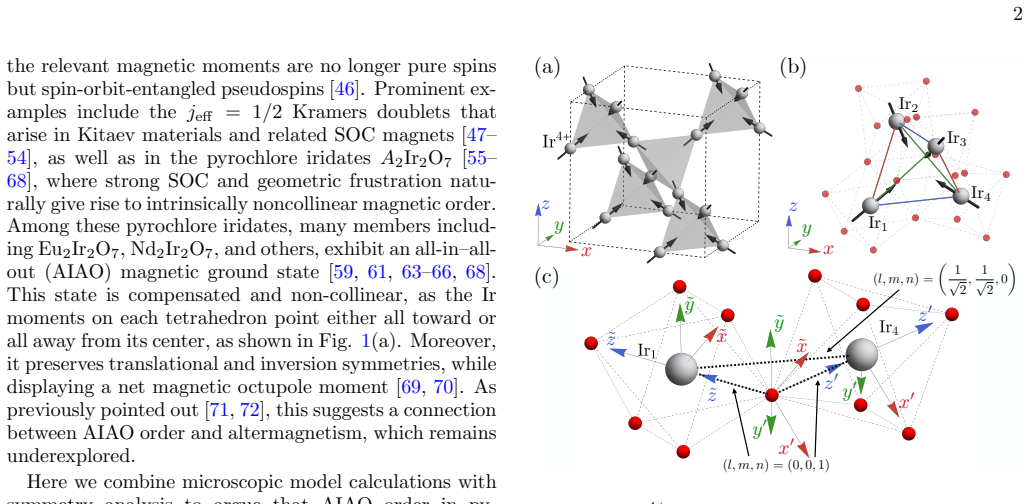
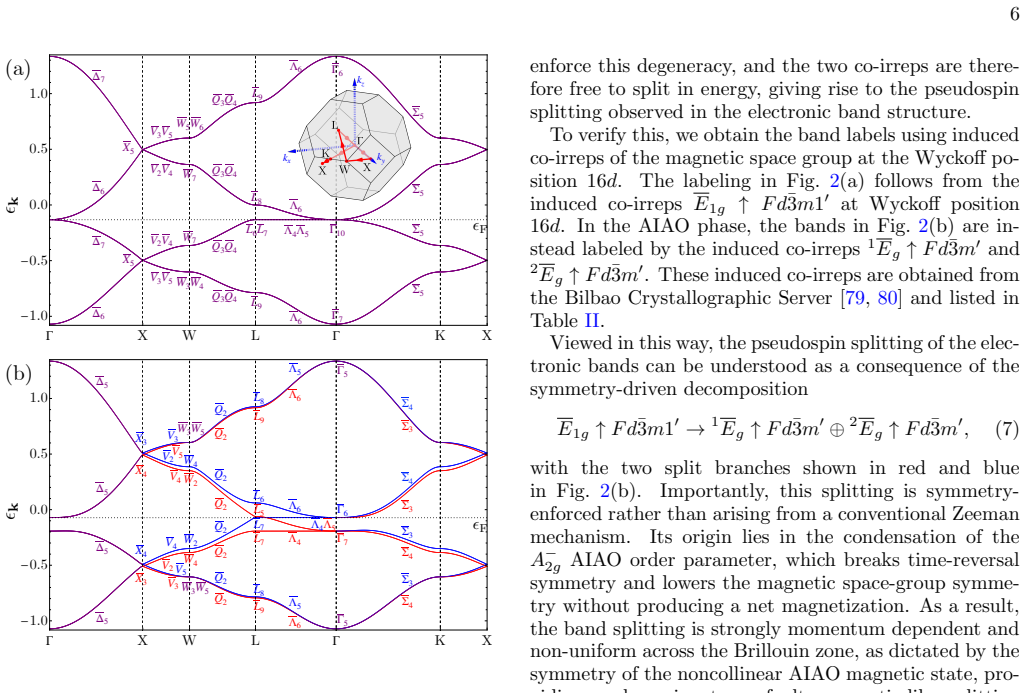
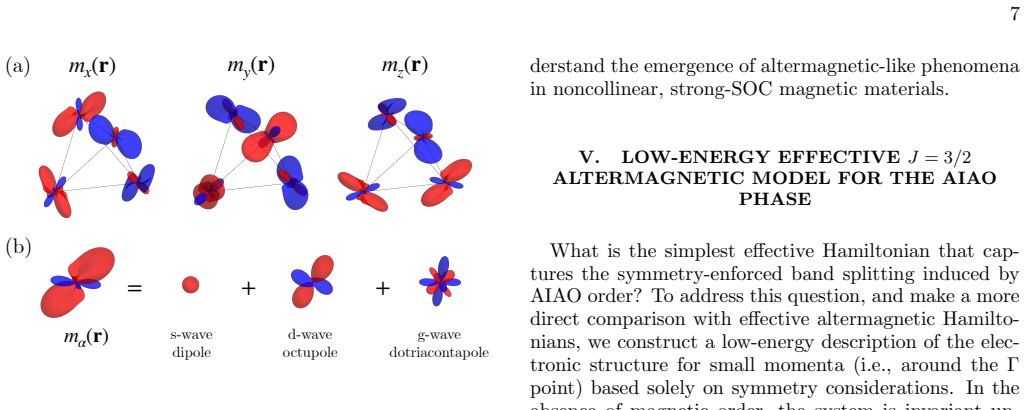
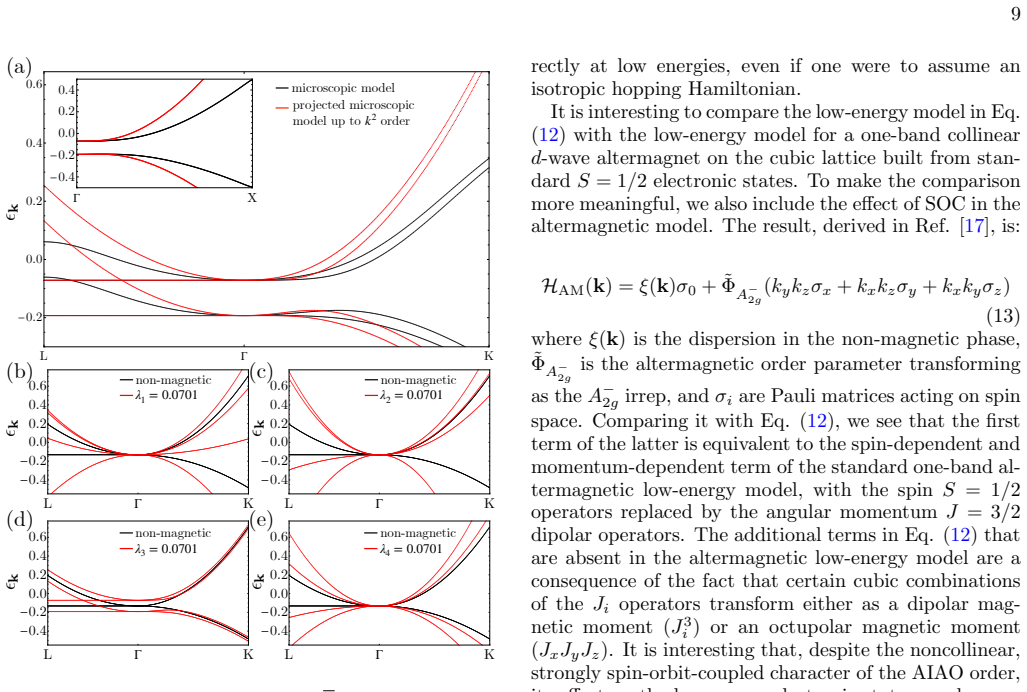
The AIAO order parameter transforms as an A_{2g}^{-} octupolar magnetic moment. This symmetry enforces both a spin-polarized momentum-dependent lifting of band degeneracies similar to that of a collinear d-wave cubic altermagnet and a band splitting at zero momentum that is captured by a low-energy model similar to the Luttinger-Kohn model for cubic semiconductors. Electronic interactions in the j_eff = 1/2 model favor the AIAO phase over other magnetic states.
What carries the argument
The A_{2g}^{-} octupolar magnetic moment carried by the AIAO order parameter, which through symmetry analysis dictates the allowed spin-splitting patterns in the electronic bands.
Load-bearing premise
The j_eff = 1/2 tight-binding model plus mean-field treatment of interactions on the pyrochlore lattice is enough to capture all symmetry-enforced band splittings without higher-order orbital or relativistic corrections.
What would settle it
Absence of momentum-dependent spin splitting or absence of zero-momentum band splitting in angle-resolved photoemission spectra of an AIAO-ordered pyrochlore iridate would falsify the symmetry-enforced splitting claim.
Figures
read the original abstract
Altermagnets are collinear magnetically ordered states that exhibit momentum-dependent spin splitting in the absence of net magnetization and spin-orbit coupling (SOC). Related spin-splitting patterns, however, can also emerge in noncollinear magnetic systems with large SOC. Here we show, via a microscopic model, that the all-in-all-out (AIAO) state in pyrochlore iridates constitutes a noncollinear counterpart of a $d$-wave altermagnet stabilized by strong SOC. Starting from a microscopic $j_{\mathrm{eff}} = 1/2$ tight-binding model on the pyrochlore lattice, we demonstrate that electronic interactions favor the AIAO phase and analyze its symmetry properties. We show that the AIAO order parameter transforms as an $A_{2g}^{-}$ octupolar magnetic moment, breaking time-reversal symmetry while preserving inversion and zero net magnetization. Using group-theory analysis and mean-field calculations, we demonstrate that this symmetry enforces both a spin-polarized momentum-dependent lifting of band degeneracies that is similar to that of a collinear $d$-wave cubic altermagnet, but also a band splitting at zero-momentum. We show that the latter feature is captured by a low-energy model similar to the Luttinger-Kohn model for cubic semiconductors. Our results identify pyrochlore iridates as a platform for noncollinear counterparts of altermagnetism and provide a general symmetry framework for spin-split phenomena in spin-orbit coupled materials.
Editorial analysis
A structured set of objections, weighed in public.
Referee Report
Summary. The paper claims that the all-in-all-out (AIAO) magnetic order in pyrochlore iridates, obtained from a microscopic j_eff=1/2 tight-binding model with mean-field interactions, constitutes a noncollinear, SOC-stabilized counterpart to d-wave altermagnets. The AIAO state is classified via group theory as an A_{2g}^- octupolar order parameter that breaks time-reversal symmetry while preserving inversion and zero net magnetization; this symmetry enforces momentum-dependent spin splittings analogous to collinear d-wave altermagnets plus an additional Gamma-point band splitting captured by a Luttinger-Kohn-like low-energy model.
Significance. If the central claims hold, the work provides a concrete materials platform (pyrochlore iridates) and a general symmetry framework for realizing spin-split band structures in noncollinear, strongly spin-orbit-coupled magnets. The symmetry analysis is model-independent once the magnetic order is specified, and the microscopic starting point is standard for these compounds. The derivation of the low-energy effective model from the cubic point-group representations is a clear strength.
major comments (2)
- [mean-field calculations] Mean-field section: the statement that 'electronic interactions favor the AIAO phase' is presented without explicit energy comparisons, parameter scans, or stability diagrams against competing orders (e.g., other magnetic or quadrupolar states). This leaves the robustness of the AIAO stabilization unclear and makes it difficult to assess whether the reported band features are generic or tied to a narrow parameter window.
- [symmetry properties] Group-theory analysis: while the A_{2g}^- assignment for the AIAO octupole is standard, the manuscript does not explicitly list the irreducible representations of the pyrochlore space group or show the character table projection that confirms the order parameter transforms as A_{2g}^-. This step is load-bearing for the claim that the symmetry enforces both the d-wave-like splitting and the Gamma-point splitting.
minor comments (2)
- [low-energy model] The low-energy Luttinger-Kohn-like model is introduced but its explicit form (basis functions, coefficients) is not written out; adding the Hamiltonian matrix would make the Gamma-point splitting transparent.
- [abstract and introduction] Notation for the octupolar moment (A_{2g}^-) should be defined at first use with a brief reminder of the cubic point-group conventions employed.
Simulated Author's Rebuttal
We thank the referee for the careful reading, positive assessment of the work, and recommendation for minor revision. We address the two major comments point by point below.
read point-by-point responses
-
Referee: [mean-field calculations] Mean-field section: the statement that 'electronic interactions favor the AIAO phase' is presented without explicit energy comparisons, parameter scans, or stability diagrams against competing orders (e.g., other magnetic or quadrupolar states). This leaves the robustness of the AIAO stabilization unclear and makes it difficult to assess whether the reported band features are generic or tied to a narrow parameter window.
Authors: We agree that the robustness of the AIAO stabilization would be clearer with explicit comparisons. The mean-field decoupling in the manuscript already shows that the AIAO solution is self-consistent and yields the reported band features for the interaction parameters considered, but we will add a supplementary figure in the revision that compares the mean-field energies of AIAO against other candidate magnetic and quadrupolar orders over a range of interaction strengths, confirming the stability window. revision: yes
-
Referee: [symmetry properties] Group-theory analysis: while the A_{2g}^- assignment for the AIAO octupole is standard, the manuscript does not explicitly list the irreducible representations of the pyrochlore space group or show the character table projection that confirms the order parameter transforms as A_{2g}^-. This step is load-bearing for the claim that the symmetry enforces both the d-wave-like splitting and the Gamma-point splitting.
Authors: We agree that an explicit listing strengthens the presentation. Although the A_{2g}^- assignment follows directly from the standard decomposition of the magnetic octupole under the pyrochlore point group (as referenced in the literature), we will insert a short appendix in the revised manuscript that lists the relevant irreducible representations of the pyrochlore space group and shows the character-table projection confirming the A_{2g}^- transformation property of the AIAO order parameter. revision: yes
Circularity Check
No significant circularity; symmetry analysis is independent of model parameters
full rationale
The derivation begins from the standard j_eff=1/2 tight-binding model on the pyrochlore lattice (a known microscopic starting point for these materials) and applies mean-field treatment to stabilize the AIAO phase. Group-theory classification of the A2g- octupolar order parameter then enforces the reported momentum-dependent spin splittings and Gamma-point splitting in a manner that is model-independent once the magnetic order is specified. The low-energy Luttinger-Kohn-like model follows directly from cubic point-group representations. No self-citations are load-bearing, no fitted parameters are renamed as predictions, and no ansatz or uniqueness theorem is smuggled in. The central claims rest on externally verifiable symmetry arguments and standard methods rather than reducing to the paper's own inputs by construction.
Axiom & Free-Parameter Ledger
axioms (2)
- domain assumption j_eff = 1/2 description is valid for the iridate electrons
- domain assumption Mean-field treatment captures the interaction-driven AIAO phase
Reference graph
Works this paper leans on
-
[1]
between these local frames and the global crystal- lographic frame. Because the directd–dand ligand- mediatedd–p–dprocesses are most naturally formulated in different coordinate systems, they are combined only after the appropriate basis transformations. 11 dyz dzx dxy d3z2−r2 dx2−y2 dyz 1 2 ddπ+ 1 2 ddδ 1 2 ddπ− 1 2 ddδ 0 0 0 dzx 1 2 ddπ− 1 2 ddδ 1 2 ddπ...
-
[2]
Inversion symmetry restricts the Γ-point expansion to even orders ofk, so we consider the expansion up to the quadratic order ofk
Hopping term We first project the hopping part of the microscopic Hamiltonian (1) onto Γ10. Inversion symmetry restricts the Γ-point expansion to even orders ofk, so we consider the expansion up to the quadratic order ofk. At the quadratic level, the bilinears ofktransform asA 1g:k 2 x + k2 y +k 2 z,E g: ( √ 3(k2 x −k 2 y), 2k2 z −k 2 x −k 2 y), andT 2g: ...
-
[3]
Interaction term We start from the onsite Hubbard interaction in the microscopic Hamiltonian [Eq. (1)], Hint =U X i ni↑ni↓.(B8) The mean-field decoupling produces a local Zeeman-like term on each sublattice, HMF =−2U S X r,α sr,α · ˆeα,(B9) wheres r,α denotes the localj eff = 1/2 spin operator at siteαin unit cellr, and ˆeα are the AIAO unit vectors defin...
-
[4]
The zeroth order term The action of unitary generators onH A− 2g coupl consists of the Γ10 matrix representations of the magnetic point groupm ¯3m1′ which can be found from the Bilbao Crys- tallographic Server [79]. For the zeroth orderH A− 2g,(0) coupl , we only need matrices for three generators:C 2z (C2 ro- tation matrix along thezaxis),C 2,[110] (C2 r...
-
[5]
Consider the inver- sion operation in Γ10 P= 1 0 0 0 0 1 0 0 0 0 1 0 0 0 0 1 ,(C5) which acts as the 4×4 identity matrix
The linear and quadratic order terms For any higher orderk-dependentH (m) coupl,A− 2g (m≥1), each symmetry operation needs to transformkaccord- ingly in the momentum space in addition to symmetry operation as matrix multiplications. Consider the inver- sion operation in Γ10 P= 1 0 0 0 0 1 0 0 0 0 1 0 0 0 0 1 ,(C5) which acts as the 4×4 ident...
-
[6]
ˇSmejkal, J
L. ˇSmejkal, J. Sinova, and T. Jungwirth, Beyond conven- tional ferromagnetism and antiferromagnetism: A phase with nonrelativistic spin and crystal rotation symmetry, Phys. Rev. X12, 031042 (2022)
2022
-
[7]
ˇSmejkal, J
L. ˇSmejkal, J. Sinova, and T. Jungwirth, Emerging re- search landscape of altermagnetism, Phys. Rev. X12, 040501 (2022)
2022
-
[8]
Mazin (The PRX Editors), Editorial: Altermagnetism—a new punch line of fundamental magnetism, Phys
I. Mazin (The PRX Editors), Editorial: Altermagnetism—a new punch line of fundamental magnetism, Phys. Rev. X12, 040002 (2022)
2022
-
[9]
Jungwirth, R
T. Jungwirth, R. M. Fernandes, E. Fradkin, A. H. Mac- Donald, J. Sinova, and L. ˇSmejkal, Altermagnetism: An unconventional spin-ordered phase of matter, Newton1, 100162 (2025)
2025
-
[10]
Jungwirth, J
T. Jungwirth, J. Sinova, R. M. Fernandes, Q. Liu, H. Watanabe, S. Murakami, S. Nakatsuji, and L.ˇSmejkal, Symmetry, microscopy and spectroscopy signatures of al- termagnetism, Nature649, 837 (2026)
2026
-
[11]
R. Jaeschke-Ubiergo, V.-K. Bharadwaj, W. Campos, R. Zarzuela, N. Biniskos, R. M. Fernandes, T. Jung- wirth, J. Sinova, and L.ˇSmejkal, Atomic altermagnetism, arXiv:2503.10797 10.48550/arXiv.2503.10797 (2025)
-
[12]
Buiarelli, R
L. Buiarelli, R. M. Fernandes, and T. Birol, Noncollinear magnetic multipoles in collinear altermagnets, Phys. Rev. B112, 224442 (2025)
2025
-
[13]
Bhowal and N
S. Bhowal and N. A. Spaldin, Ferroically ordered mag- netic octupoles ind-wave altermagnets, Phys. Rev. X14, 011019 (2024)
2024
-
[14]
P. A. McClarty and J. G. Rau, Landau theory of alter- magnetism, Phys. Rev. Lett.132, 176702 (2024)
2024
-
[15]
V. Leeb, A. Mook, L. ˇSmejkal, and J. Knolle, Sponta- neous formation of altermagnetism from orbital ordering, Phys. Rev. Lett.132, 236701 (2024)
2024
-
[16]
Schiff, P
H. Schiff, P. McClarty, J. G. Rau, and J. Romh´ anyi, Collinear altermagnets and their landau theories, Phys. Rev. Res.7, 033301 (2025)
2025
-
[17]
Y. Noda, K. Ohno, and S. Nakamura, Momentum- dependent band spin splitting in semiconducting mno 2: A density functional calculation, Physical Chemistry Chemical Physics18, 13294 (2016)
2016
-
[18]
ˇSmejkal, R
L. ˇSmejkal, R. Gonz´ alez-Hern´ andez, T. Jungwirth, and J. Sinova, Crystal time-reversal symmetry breaking and spontaneous Hall effect in collinear antiferromagnets, Sci- ence advances6, eaaz8809 (2020)
2020
-
[19]
Hayami, Y
S. Hayami, Y. Yanagi, and H. Kusunose, Momentum- dependent spin splitting by collinear antiferromagnetic ordering, Journal of the Physical Society of Japan88, 123702 (2019)
2019
-
[20]
L.-D. Yuan, Z. Wang, J.-W. Luo, and A. Zunger, Predic- tion of low-z collinear and noncollinear antiferromagnetic compounds having momentum-dependent spin splitting even without spin-orbit coupling, Phys. Rev. Mat.5, 22 014409 (2021)
2021
-
[21]
M. Naka, S. Hayami, H. Kusunose, Y. Yanagi, Y. Mo- tome, and H. Seo, Anomalous Hall effect inκ-type organic antiferromagnets, Phys. Rev. B102, 075112 (2020)
2020
-
[22]
R. M. Fernandes, V. S. de Carvalho, T. Birol, and R. G. Pereira, Topological transition from nodal to nodeless zeeman splitting in altermagnets, Phys. Rev. B109, 024404 (2024)
2024
-
[23]
Banerjee and M
S. Banerjee and M. S. Scheurer, Altermagnetic supercon- ducting diode effect, Phys. Rev. B110, 024503 (2024)
2024
-
[24]
D. S. Antonenko, R. M. Fernandes, and J. W. F. Vender- bos, Mirror chern bands and weyl nodal loops in alter- magnets, Phys. Rev. Lett.134, 096703 (2025)
2025
-
[25]
M. Roig, A. Kreisel, Y. Yu, B. M. Andersen, and D. F. Agterberg, Minimal models for altermagnetism, Phys. Rev. B110, 144412 (2024)
2024
-
[26]
M. Roig, Y. Yu, R. C. Ekman, A. Kreisel, B. M. Ander- sen, and D. F. Agterberg, Quasisymmetry-constrained spin ferromagnetism in altermagnets, Phys. Rev. Lett. 135, 016703 (2025)
2025
-
[27]
Autieri, R
C. Autieri, R. M. Sattigeri, G. Cuono, and A. Fakhre- dine, Staggered dzyaloshinskii-moriya interaction induc- ing weak ferromagnetism in centrosymmetric altermag- nets and weak ferrimagnetism in noncentrosymmetric al- termagnets, Phys. Rev. B111, 054442 (2025)
2025
-
[28]
A. Osin, A. Levchenko, and M. Khodas, Extrinsic anoma- lous hall effect in altermagnets, npj Quantum Mater. 10.1038/s41535-026-00895-3 (2026)
-
[29]
A. D. Din, D. Usanov, L. ˇSmejkal, S. D’Souza, F. Guo, O. Amin, E. Dawa, R. Campion, K. Edmonds, B. Ki- raly,et al., Unconventional relativistic spin polarization of electronic bands in an altermagnet, arXiv:2511.01690 10.48550/arXiv.2511.01690 (2025)
-
[30]
W. H. Campos, F. Mbognou, A. B. Hellenes, J. Poata, T. Chen, J. Priessnitz, and L. ˇSmejkal, Persistent altermagnetism, arXiv:2603.12223 10.48550/arXiv.2603.12223 (2026)
-
[31]
A. B. Hellenes, T. Jungwirth, R. Jaeschke-Ubiergo, A. Chakraborty, J. Sinova, and L. ˇSmejkal, P-wave magnets, arXiv:2309.01607 10.48550/arXiv.2309.01607 (2023)
work page internal anchor Pith review Pith/arXiv arXiv doi:10.48550/arxiv.2309.01607 2023
-
[32]
Cheong and F.-T
S.-W. Cheong and F.-T. Huang, Altermagnetism with non-collinear spins, npj Quantum Mater.9, 13 (2024)
2024
-
[33]
X. Chen, J. Ren, Y. Zhu, Y. Yu, A. Zhang, P. Liu, J. Li, Y. Liu, C. Li, and Q. Liu, Enumeration and representa- tion theory of spin space groups, Phys. Rev. X14, 031038 (2024)
2024
-
[34]
Jiang, Z
Y. Jiang, Z. Song, T. Zhu, Z. Fang, H. Weng, Z.-X. Liu, J. Yang, and C. Fang, Enumeration of spin-space groups: Toward a complete description of symmetries of magnetic orders, Phys. Rev. X14, 031039 (2024)
2024
-
[35]
Z. Xiao, J. Zhao, Y. Li, R. Shindou, and Z.-D. Song, Spin space groups: Full classification and applications, Phys. Rev. X14, 031037 (2024)
2024
-
[36]
Y. Yu, M. B. Lyngby, T. Shishidou, M. Roig, A. Kreisel, M. Weinert, B. M. Andersen, and D. F. Agterberg, Odd- parity magnetism driven by antiferromagnetic exchange, Phys. Rev. Lett.135, 046701 (2025)
2025
-
[37]
Cheong and F.-T
S.-W. Cheong and F.-T. Huang, Altermagnetism classi- fication, npj Quantum Mater.10, 38 (2025)
2025
-
[38]
Y. Liu, X. Chen, Y. Yu, J. Etxebarria, J. M. Perez-Mato, and Q. Liu, Symmetry classification of magnetic orders using oriented spin space groups, Nature652, 869 (2026)
2026
-
[39]
P. G. Radaelli, Tensorial approach to altermagnetism, Phys. Rev. B110, 214428 (2024)
2024
-
[40]
P. Ghosh and R. Thomale, Zoology of Altermagnetic- type Non-collinear Magnets on the Maple Leaf Lattice, arXiv:2601.16807 10.48550/arXiv.2601.16807 (2026)
-
[41]
I. Park, T. Birol, A. Georges, and R. M. Fernandes, Im- pact of strong electronic correlations on altermagnets: The case of NiS 2, Phys. Rev. Mater.10, 054415 (2026)
2026
-
[42]
M. Hu, M. I. Iraola, P. McClarty, J. v. d. Brink, and M. G. Vergniory, Non-collinear Altermagnetic Phases in the Mott Insulator NiS 2, arXiv:2603.01329 10.48550/arXiv.2603.01329 (2026)
-
[43]
Hayami and H
S. Hayami and H. Kusunose, Unified description of elec- tronic orderings and cross correlations by complete mul- tipole representation, Journal of the Physical Society of Japan93, 072001 (2024)
2024
-
[44]
Nakatsuji, N
S. Nakatsuji, N. Kiyohara, and T. Higo, Large anoma- lous hall effect in a non-collinear antiferromagnet at room temperature, Nature527, 212 (2015)
2015
-
[45]
Suzuki, T
M.-T. Suzuki, T. Koretsune, M. Ochi, and R. Arita, Clus- ter multipole theory for anomalous hall effect in antifer- romagnets, Phys. Rev. B95, 094406 (2017)
2017
-
[46]
Santini, S
P. Santini, S. Carretta, G. Amoretti, R. Caciuffo, N. Magnani, and G. H. Lander, Multipolar interactions inf-electron systems: The paradigm of actinide dioxides, Rev. Mod. Phys.81, 807 (2009)
2009
-
[47]
Bultmark, F
F. Bultmark, F. Cricchio, O. Gr˚ an¨ as, and L. Nordstr¨ om, Multipole decomposition of LDA+Uenergy and its appli- cation to actinide compounds, Phys. Rev. B80, 035121 (2009)
2009
-
[48]
Voleti, D
S. Voleti, D. D. Maharaj, B. D. Gaulin, G. Luke, and A. Paramekanti, Multipolar magnetism in d-orbital sys- tems: Crystal field levels, octupolar order, and orbital loop currents, Phys. Rev. B101, 155118 (2020)
2020
-
[49]
Fiore Mosca, L
D. Fiore Mosca, L. V. Pourovskii, and C. Franchini, Mod- eling magnetic multipolar phases in density functional theory, Phys. Rev. B106, 035127 (2022)
2022
-
[50]
Urru and N
A. Urru and N. A. Spaldin, Magnetic octupole tensor decomposition and second-order magnetoelectric effect, Ann. Phys.447, 168964 (2022)
2022
-
[51]
Y. Yu, T. Shishidou, S. Sumita, M. Weinert, and D. F. Agterberg, Spin-orbit enabled unconventional stoner magnetism, Proc. Natl. Acad. Sci. U.S.A.121, e2411038121 (2024)
2024
-
[52]
Kitaev, Anyons in an exactly solved model and be- yond, Annals of Physics321, 2 (2006)
A. Kitaev, Anyons in an exactly solved model and be- yond, Annals of Physics321, 2 (2006)
2006
-
[53]
Jackeli and G
G. Jackeli and G. Khaliullin, Mott Insulators in the Strong Spin-Orbit Coupling Limit: From Heisenberg to a Quantum Compass and Kitaev Models, Phys. Rev. Lett. 102, 017205 (2009)
2009
-
[54]
Chaloupka, G
J. Chaloupka, G. Jackeli, and G. Khaliullin, Kitaev- Heisenberg Model on a Honeycomb Lattice: Possible Ex- otic Phases in Iridium OxidesA 2IrO3, Phys. Rev. Lett. 105, 027204 (2010)
2010
-
[55]
J. G. Rau, E. K.-H. Lee, and H.-Y. Kee, Generic Spin Model for the Honeycomb Iridates beyond the Kitaev Limit, Phys. Rev. Lett.112, 077204 (2014)
2014
-
[56]
Sizyuk, C
Y. Sizyuk, C. Price, P. W¨ olfle, and N. B. Perkins, Impor- tance of anisotropic exchange interactions in honeycomb iridates: Minimal model for zigzag antiferromagnetic or- der in Na 2IrO3, Phys. Rev. B90, 155126 (2014)
2014
-
[57]
Takagi, T
H. Takagi, T. Takayama, G. Jackeli, G. Khaliullin, and S. E. Nagler, Concept and realization of Kitaev quantum spin liquids, Nat. Rev. Phys.1, 264 (2019). 23
2019
-
[58]
Trebst and C
S. Trebst and C. Hickey, Kitaev materials, Physics Re- ports950, 1 (2022)
2022
-
[59]
Rousochatzakis, N
I. Rousochatzakis, N. B. Perkins, Q. Luo, and H.-Y. Kee, Beyond Kitaev physics in strong spin-orbit coupled mag- nets, Reports on Progress in Physics87, 026502 (2024)
2024
-
[60]
Pesin and L
D. Pesin and L. Balents, Mott physics and band topology in materials with strong spin–orbit interaction, Nature Phys6, 376–381 (2010)
2010
-
[61]
X. Wan, A. M. Turner, A. Vishwanath, and S. Y. Savrasov, Topological semimetal and Fermi-arc surface states in the electronic structure of pyrochlore iridates, Phys. Rev. B83, 205101 (2011)
2011
-
[62]
Witczak-Krempa and Y
W. Witczak-Krempa and Y. B. Kim, Topological and magnetic phases of interacting electrons in the pyrochlore iridates, Phys. Rev. B85, 045124 (2012)
2012
-
[63]
Witczak-Krempa, A
W. Witczak-Krempa, A. Go, and Y. B. Kim, Pyrochlore electrons under pressure, heat, and field: Shedding light on the iridates, Phys. Rev. B87, 155101 (2013)
2013
-
[64]
Witczak-Krempa, G
W. Witczak-Krempa, G. Chen, Y. B. Kim, and L. Ba- lents, Correlated quantum phenomena in the strong spin–orbit regime, Annual Review of Condensed Matter Physics5, 57 (2014)
2014
-
[65]
Savary, E.-G
L. Savary, E.-G. Moon, and L. Balents, New Type of Quantum Criticality in the Pyrochlore Iridates, Phys. Rev. X4, 041027 (2014)
2014
-
[66]
Goswami, B
P. Goswami, B. Roy, and S. Das Sarma, Competing or- ders and topology in the global phase diagram of py- rochlore iridates, Phys. Rev. B95, 085120 (2017)
2017
-
[67]
Machida, S
Y. Machida, S. Nakatsuji, Y. Maeno, T. Tayama, T. Sakakibara, and S. Onoda, Unconventional Anoma- lous Hall Effect Enhanced by a Noncoplanar Spin Tex- ture in the Frustrated Kondo Lattice Pr 2Ir2O7, Phys. Rev. Lett.98, 057203 (2007)
2007
-
[68]
Tomiyasu, K
K. Tomiyasu, K. Matsuhira, K. Iwasa, M. Watahiki, S. Takagi, M. Wakeshima, Y. Hinatsu, M. Yokoyama, K. Ohoyama, and K. Yamada, Emergence of Magnetic Long-Range Order in Frustrated Pyrochlore Nd 2Ir2O7 with Metal–Insulator Transition, Journal of the Physical Society of Japan81, 034709 (2012)
2012
-
[69]
M. C. Shapiro, S. C. Riggs, M. B. Stone, C. R. de la Cruz, S. Chi, A. A. Podlesnyak, and I. R. Fisher, Structure and magnetic properties of the pyrochlore iridate Y 2Ir2O7, Phys. Rev. B85, 214434 (2012)
2012
-
[70]
Sagayama, D
H. Sagayama, D. Uematsu, T. Arima, K. Sugimoto, J. J. Ishikawa, E. O’Farrell, and S. Nakatsuji, Determination of long-range all-in-all-out ordering of Ir 4+ moments in a pyrochlore iridate Eu 2Ir2O7 by resonant x-ray diffrac- tion, Phys. Rev. B87, 100403 (2013)
2013
-
[71]
H. Guo, K. Matsuhira, I. Kawasaki, M. Wakeshima, Y. Hinatsu, I. Watanabe, and Z.-a. Xu, Magnetic order in the pyrochlore iridate Nd 2Ir2O7 probed by muon spin relaxation, Phys. Rev. B88, 060411 (2013)
2013
-
[72]
Nikoli´ c, Y
P. Nikoli´ c, Y. Xu, T. Ohtsuki, D. C. Elbert, S. Nakatsuji, and N. Drichko, Possible Weyl-Luttinger phase transi- tion in pyrochlore iridates revealed by Raman scattering, Phys. Rev. B110, 035148 (2024)
2024
-
[73]
Y. Xu, Y. Yang, J. Teyssier, T. Ohtsuki, Y. Qiu, S. Nakatsuji, D. van der Marel, N. B. Perkins, and N. Drichko, Ramification of complex magnetism in Nd2Ir2O7 observed by Raman scattering spectroscopy, npj Quantum Mater.10, 88 (2025)
2025
-
[74]
T.-h. Arima, Time-reversal symmetry breaking and con- sequent physical responses induced by all-in-all-out type magnetic order on the pyrochlore lattice, Journal of the Physical Society of Japan82, 013705 (2012)
2012
-
[75]
W. J. Kim, T. Oh, J. Song, E. K. Ko, Y. Li, J. Mun, B. Kim, J. Son, Z. Yang, Y. Kohama,et al., Strain engi- neering of the magnetic multipole moments and anoma- lous hall effect in pyrochlore iridate thin films, Science Advances6, eabb1539 (2020)
2020
-
[76]
¯Oik´ e, K
J. ¯Oik´ e, K. Shinada, and R. Peters, Nonlinear magne- toelectric effect under magnetic octupole order: Appli- cation to ad-wave altermagnet and a pyrochlore lattice with all-in/all-out magnetic order, Phys. Rev. B110, 184407 (2024)
2024
-
[77]
X. Han, X. Liu, M. Kareev, J. Chakhalian, and L. Wu, Large topological magnetic optical effects and imaging of antiferromagnetic octupole domains of an altermagnet-like weyl semimetal, arXiv:2505.03713 10.48550/arXiv.2505.03713 (2025)
-
[78]
J. M. Luttinger and W. Kohn, Motion of electrons and holes in perturbed periodic fields, Phys. Rev.97, 869 (1955)
1955
-
[79]
J. M. Luttinger, Quantum theory of cyclotron resonance in semiconductors: General theory, Phys. Rev.102, 1030 (1956)
1956
-
[80]
Kurita, Y
M. Kurita, Y. Yamaji, and M. Imada, Topological insu- lators from spontaneous symmetry breaking induced by electron correlation on pyrochlore lattices, Journal of the Physical Society of Japan80, 044708 (2011)
2011
discussion (0)
Sign in with ORCID, Apple, or X to comment. Anyone can read and Pith papers without signing in.