REVIEW 3 major objections 6 minor 28 references
Lectures on error analysis of interpolation on simplicial triangulations without the shape-regularity assumption Part 1: Lagrange interpolation on triangles
T0 review · 3 major / 6 minor · reviewed 2026-08-14 · deepseek-v4-flash
Pith's one-line read For every triangle, the Lagrange interpolation error is controlled by the circumradius alone, with no shape-regularity constant.
desk verdict A mostly clean lecture write-up of a genuinely useful circumradius-based interpolation estimate, with one real gap in Lemma 23 and p=∞ left as an exercise. read the letter →
The pith
A machine-rendered reading of the paper's core claim, the machinery that carries it, and where it could break.
The reading
What carries the argument
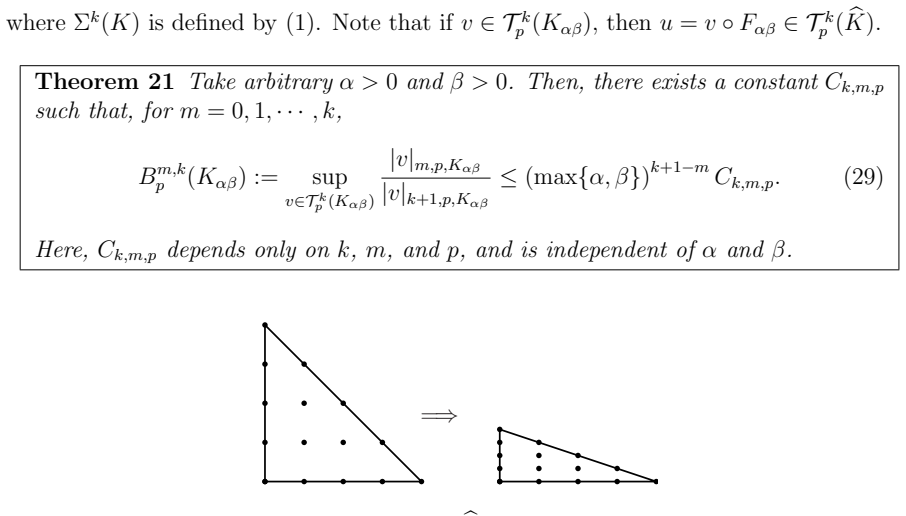
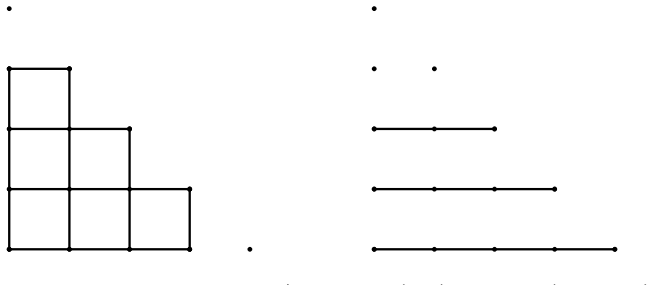
The load-bearing construction is the squeezing argument combined with a two-factor decomposition of the affine map from the reference triangle: $A = \tilde A D_{\alpha\beta}$, where $D_{\alpha\beta}=\mathrm{diag}(\alpha,\beta)$ is a diagonal scaling and $\tilde A$ has determinant one. The diagonal scaling produces the squeezed triangle $K_{\alpha\beta}$; the proof shows that interpolation constants on $K_{\alpha\beta}$ are bounded by $(\max\{\alpha,\beta\})^{k+1-m}$ times a universal constant. The remaining unimodular factor $\tilde A$ contributes at most a factor $(R_K/h_K)^m$. To control the universal constant, the paper introduces grid difference quotients: functions vanishing at all Lagrange nodes have derivatives whose integrals over certain grid rectangles $\square^\delta_{lp}$ vanish, and these integral conditions are linearly independent on the relevant polynomial space, yielding finite constants $A^{\gamma,k}_p$.
What would settle it
Run a computer-algebra search over $k\ge 4$ for a nonzero polynomial $q\in P_{k-|\delta|}$ satisfying $\int_{\square^\delta_{lp}} q = 0$ for every grid rectangle or segment $\square^\delta_{lp}$ in the reference triangle $\hat K$; any such $q$ would make Lemma 23 false and $A^{\gamma,k}_p$ infinite, breaking the proof of the circumradius estimate.
Extended reading notes
Core claim
The central claim is the circumradius estimate (Theorem 10, restated as Corollary 28): for an arbitrary triangle $K$ with circumradius $R_K$ and diameter $h_K$, for Lagrange interpolation $I_k^K$ of degree $k$, and for $1\le p\le\infty$, $0\le m\le k$, one has $|v-I_k^K v|_{m,p,K} \le C_{k,m,p}(R_K/h_K)^m h_K^{k+1-m}|v|_{k+1,p,K}$ for every $v\in W^{k+1,p}(K)$, with $C_{k,m,p}$ depending only on $k$, $m$, and $p$. The dimensionless ratio $R_K/h_K$ equals $1/(2\sin\theta_{\max})$, where $\theta_{\max}$ is the largest angle, so the bound interpolates between the classical maximum-angle regime and genuinely degenerate triangles. In particular, when $R_K$ tends to zero, the interpolation error tends to zero even if the triangle collapses toward a segment.
Load-bearing premise
The bound rests on the assertion that for every interpolation order $k$, no nonzero polynomial of degree no greater than $k-|\gamma|$ integrates to zero over all the relevant grid rectangles; the paper checks only $k=2$ and $k=3$ and asserts the general case, so if that linear-independence claim fails the whole estimate collapses.
Editorial extensions
If this is right
- For piecewise linear elements on a polygonal domain, the $H^1$ error of the Poisson finite element solution is bounded by $C\max_{K\in T_h} R_K |u|_{2,2,\Omega}$, so convergence follows as soon as all element circumradii go to zero, no matter how sharp the angles are.
- Higher-order elements can repair bad triangulations: for degree $k\ge 2$ the factor becomes $R_K h_K^{k-1}$, so even families of triangles with $R_K=O(1)$ converge as $h\to 0$, albeit with a possibly reduced rate.
- When $R_K/h_K$ is bounded, the estimate reduces to the classical $O(h_K^{k+1-m})$ bound and reproduces the maximum-angle/semiregularity regime as a special case.
- The result is geometrically scale-consistent: refining any fixed skinny triangle preserves the estimate because both sides scale like the appropriate power of $h_K$, with no hidden aspect-ratio constant.
Reading between the lines
- The paper treats two-dimensional triangles only, despite its title mentioning simplicial triangulations; extending the difference-quotient integral conditions to tetrahedral lattices would be a natural test of whether the circumradius remains the governing quantity in 3D.
- The asserted linear independence in Lemma 23 is stated for general $k$ but verified only for $k=2,3$; a computer-algebra check for $k=4,5$ would confirm whether the general claim is true and would also complete the missing $p=\infty$ case by the same contradiction argument.
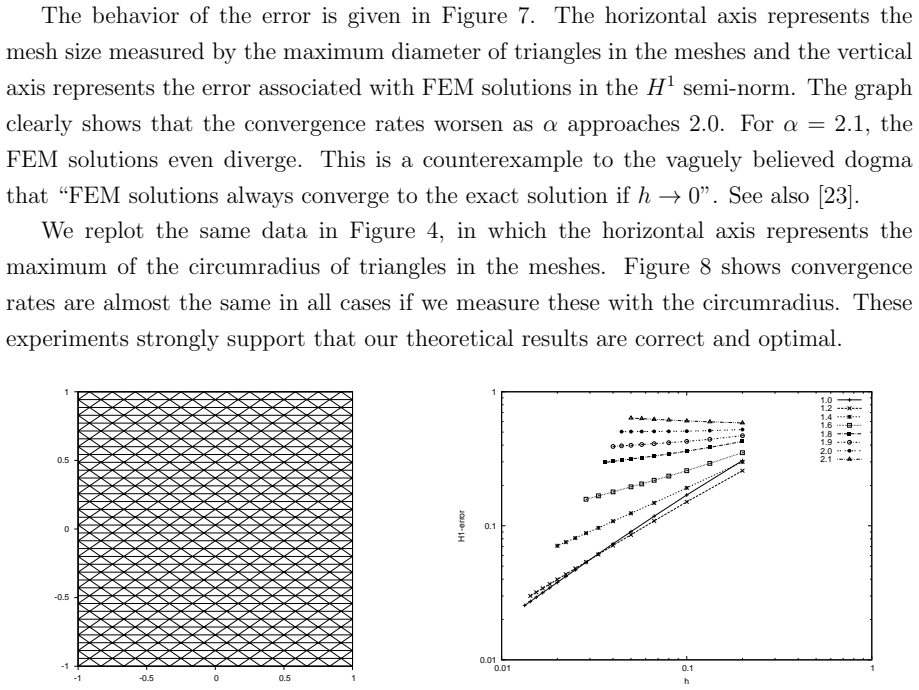
- The numerical experiments plot $H^1$ error against maximum circumradius and show nearly identical convergence rates across very different triangle families; the same data-collapse test could be applied to $L^2$ errors or to adaptive refinement loops to see whether circumradius is the right mesh-quality monitor beyond the specific problem treated here.
- If the bound is sharp, anisotropic mesh adaptation should target element circumradius rather than inradius or edge ratio when guaranteeing interpolation accuracy.
Signed reviews
Editorial analysis
A structured set of objections, weighed in public.
Referee Report
Summary. The manuscript is an expository lecture note whose central object is the error analysis of k-th order Lagrange interpolation on arbitrary triangles in R^2. The authors aim to prove that for 1≤p≤∞, 0≤m≤k, and any triangle K with circumradius R_K, the estimate |v - I_k^K v|_{m,p,K} ≤ C_{k,m,p} (R_K/h_K)^m h_K^{k+1-m} |v|_{k+1,p,K} holds for all v in W^{k+1,p}(K), with C depending only on k, m, and p. The proof strategy is to bound interpolation on right triangles K_{αβ} squeezed from the reference triangle using Babuška–Aziz type constants, to extend this to arbitrary triangles through the decomposition A = ~A D_{αβ}, and then to estimate the norm of ~A and its inverse in terms of R_K/h_K. Numerical experiments in Section 8 support the estimate and illustrate that convergence can fail when measured against h but hold when measured against the circumradius.
Significance. If completed, the main estimate is significant: it replaces the shape-regularity or maximum-angle condition by the circumradius as the controlling geometric quantity, with direct consequences for adaptive and anisotropic meshes. The paper is self-contained in its classical parts, gives explicit k=1 constants in Corollary 9, and includes numerical experiments that clearly separate h-dependence from R-dependence. The proof strategy via squeezing transformations and difference quotients is elegant. However, the manuscript is explicitly presented as a lecture note rather than as a new research contribution, and its value is primarily pedagogical; the central result is a re-presentation of the authors' earlier results in [15,17,18].
major comments (3)
- [Section 6, Lemma 23] The proof of Lemma 23 is incomplete. The assertion that the integral conditions on the rectangles □^γ_{lp} 'are linearly independent and determine q = 0 uniquely' is exactly the injectivity claim that needs proof; the preceding dimension count dim P_{k-|δ|} = #{□^δ_{lp} ⊂ \hat K} only shows that the linear system is square. Only the cases k=2 and k=3 are illustrated. Since Lemma 24 relies on Lemma 23 to conclude that the limit polynomial \bar q is zero, and Theorem 21 relies on Lemma 24, the central estimate Corollary 28 rests on this unproved combinatorial statement. Please provide a proof for general k and γ, or give a precise reference to a proof.
- [Section 6, proof of Theorem 21] Theorem 21 is stated for 1 ≤ p ≤ ∞, but the proof in Section 6 covers only 1 ≤ p < ∞; the p = ∞ case is relegated to an exercise immediately after Lemma 24. Because Corollary 22 and ultimately Corollary 28 inherit the full range 1 ≤ p ≤ ∞, the manuscript as written does not prove the main theorem for p = ∞. Please add the short max-norm argument or restrict the statement of the theorem to 1 ≤ p < ∞.
- [Sections 5.2 and 6, notation for rectangles] The notation for the rectangles is a source of avoidable confusion. In (35) the symbol □^{(t,s)}_γ denotes a rectangle with displacement (t,s) and lower-left corner x_γ, while in Section 6 the same symbol □^γ_{lp} is reused with γ standing for the derivative multi-index in (30). The implication (31) depends on identifying these two roles. Please define explicitly that □^γ_{lp} is the rectangle with displacement γ and lower-left corner (l/k, p/k), and state why (35) yields (31) for every such rectangle.
minor comments (6)
- [Corollary 28] The statement says 'for any v ∈ W^{2,p}(K)', which is inconsistent with the presence of the semi-norm |v|_{k+1,p,K} on the right-hand side; it should read W^{k+1,p}(K). In addition, one occurrence of the factor writes (R_K/h_k)^m instead of (R_K/h_K)^m.
- [Corollary 26] The last semi-norm is written as |v|_{k+1,p,T}; the domain should be K, not T.
- [Section 8] The text says 'We replot the same data in Figure 4', but the figure being referred to is Figure 8; the cross-reference should be corrected.
- [Section 2.5] 'Morry's inequality' should be 'Morrey's inequality'.
- [Throughout] There are several typographical slips, including 'C_{k,m.p}' for 'C_{k,m,p}' in Lemma 25 and Corollary 26, and 'intergers' for 'integers' in Corollary 28.
- [Theorem 14 proof] In the contradiction argument the expression 'lim_{lk→0}' should presumably be 'lim_{l_m→∞}'; the current notation is confusing.
Circularity Check
No circular reduction: the circumradius estimate is derived self-contained; only proof-completeness gaps (Lemma 23, p=∞ exercise) are noted.
full rationale
The central estimate (Corollary 28 / Theorem 10) is obtained by a self-contained chain: Theorem 15/16 gives the standard affine-transformation error bound; the squeezing Theorem 21 is proved in Sections 4-6 by defining the difference-quotient spaces Ξ^{γ,k}_p and proving finiteness of A^{γ,k}_p by contradiction with Ciarlet's Theorem 14 and Gagliardo-Nirenberg; Lemma 25 transfers the bound to a general triangle via A = ÃD_{αβ}; and (37) bounds ‖Ã^{-1}‖ by C R_K/h_K. The constant C_{k,m,p} is shown to exist by compactness, not fitted to data, and the circumradius enters through the derived inequality (37), not through an assumed estimate. Self-citations [14,15,17,18] are used for motivation, context, and prior statements, but every load-bearing lemma used here (Lemmas 17-19, 24, 25 and Theorem 21 except for the p=∞ case assigned as an exercise) is proved in the manuscript with external tools. The only weaknesses are completeness gaps: Lemma 23's linear-independence of the rectangle integral conditions is asserted after k=2,3 examples rather than proved for all k, and the p=∞ part of Theorem 21 is left to Exercise; these affect whether the proof as written is complete, but they are not circular reductions of the target estimate to itself.
Assumptions & free parameters
assumptions (4)
- standard math Sobolev imbedding theorem (e.g., W^{2,p}(K) ⊂ C^0(K) for 1≤p≤∞)
- standard math Gagliardo-Nirenberg inequality (Theorem 13)
- standard math Ciarlet's quotient norm equivalence (Theorem 14)
- ad hoc to paper Lemma 23: integral conditions over difference-quotient rectangles are linearly independent on P_{k-|γ|}
Cite this review
Pith. "Pith review of Lectures on error analysis of interpolation on simplicial triangulations without the shape-regularity assumption Part 1: Lagrange interpolation on triangles." pith.science (2026). https://pith.science/paper/GJLGL7ED
@misc{pith2026190803894,
  author       = {Pith},
  title        = {Pith review of: Lectures on error analysis of interpolation on simplicial triangulations without the shape-regularity assumption Part 1: Lagrange interpolation on triangles},
  year         = {2026},
  howpublished = {\url{https://pith.science/paper/GJLGL7ED}},
  note         = {Machine review of arXiv:1908.03894}
}
read the original abstract
In the error analysis of finite element methods, the shape regularity assumption on triangulations is typically imposed to obtain a priori error estimations. In practical computations, however, very thin or degenerated elements that violate the shape regularity assumption may appear when we use adaptive mesh refinement. In this manuscript, we attempt to establish an error analysis approach without the shape regularity assumption on triangulations. We have presented several papers on the error analysis of finite element methods on non-shape regular triangulations. The main points in these papers are that, in the error estimates of finite element methods, the circumradius of the triangles is one of the most important factors. The purpose of this manuscript is to provide a simple and plain explanation of the results to researchers and, in particular, graduate students who are interested in the subject. Therefore, this manuscript is not intended to be a research paper. We hope that, in the future, it will be merged into a textbook on the mathematical theory of the finite element methods.
Figures


Figures from the paper (5 more)


Reference graph
Works this paper leans on
-
[1]
R.A. Adams, J.J.F. Fournier: Sobolev Spaces, 2nd edition, Pure and Applied Math- ematics 140, Elsevier/Academic Press, New York, 2003
work page 2003
-
[2]
T. Apel : Anisotropic Finite Element: Local estimates and applications, Advances in Numerical Mathematics. B.G. Teubner, Stuttgart, 1999
work page 1999
-
[3]
Atkinson: An Introduction to Numerical Analysis, 2nd edition, John Wiley & Sons, New York, 1989
K.E. Atkinson: An Introduction to Numerical Analysis, 2nd edition, John Wiley & Sons, New York, 1989
work page 1989
-
[4]
I. Babuˇ ska, A.K. Aziz: On the angle condition in the finite element method, SIAM J. Numer. Anal. 13 (1976), 214–226
work page 1976
-
[5]
R.E. Barnhill, J.A. Gregory : Sard kernel theorems on triangular domains with application to finite element error bounds. Numer. Math., 25 (1976), 215-229
work page 1976
-
[6]
S.C. Brenner, L.R. Scott : The Mathematical Theory of Finite Element Methods. 3rd edition. Texts in Applied Mathematics 15, Springer, New York, 2008
work page 2008
-
[7]
Brezis: Functional Analysis, Sobolev Spaces and Partial Differential Equations
H. Brezis: Functional Analysis, Sobolev Spaces and Partial Differential Equations. Universitext, Springer, New York, 2011. 34
work page 2011
-
[8]
Ciarlet: The Finite Element Methods for Elliptic Problems
P.G. Ciarlet: The Finite Element Methods for Elliptic Problems. Classics in Applied Mathematics 40, SIAM, Philadelphia, 2002, Reprint of the 1978 original (North Holland, Amsterdam)
work page 2002
Show all 28 references
-
[9]
Brandts, S
J. Brandts, S. Korotov, M. Kˇ r´ ıˇ zek: On the equivalence of regularity criteria for tri- angular and tetrahedral finite element partitions, Comput. Math. Appl. 55 (2008), 2227–2233
2008
-
[10]
Ern, J-L
A. Ern, J-L. Guermond : Theory and Practice of Finite Elements. Applied Mathe- matical Sciences 159, Springer, New York, 2004
2004
-
[11]
Hannukainen, S
A. Hannukainen, S. Korotov, M. Kˇ r´ ıˇ zek: The maximum angle condition is not necessary for convergence of the finite element method, Numer. Math., 120, 79–88 (2012)
2012
-
[12]
Horn, C.R
R.A. Horn, C.R. Johnson : Topics in Matrix Analysis, Cambridge Univ. Press, 1991
1991
-
[13]
Jamet : Estimations d’erreur pour des elements finis droits presque degeneres
P. Jamet : Estimations d’erreur pour des elements finis droits presque degeneres. R.A.I.R.O. Anal. Numer., 10 (1976), 43–61
1976
-
[14]
Kobayashi : On the interpolation constants over triangular elements (in Japanese), RIMS Kokyuroku, 1733 (2011), 58-77
K. Kobayashi : On the interpolation constants over triangular elements (in Japanese), RIMS Kokyuroku, 1733 (2011), 58-77
2011
-
[15]
Kobayashi, T
K. Kobayashi, T. Tsuchiya : A Babuˇ ska-Aziz type proof of the circumradius condi- tion, Japan J. Indust. Appl. Math., 31 (2014), 193-210
2014
-
[16]
Kobayashi, T
K. Kobayashi, T. Tsuchiya : On the circumradius condition for piecewise linear triangular elements, Japan J. Indust. Appl. Math., 32 (2015), 65–76
2015
-
[17]
Kobayashi, T
K. Kobayashi, T. Tsuchiya : A priori error estimates for Lagrange interpolation on triangles. Appl. Math., Praha 60 (2015), 485–499
2015
-
[18]
Math., Praha 61 (2016), 121–133
K.Kobayashi, T.Tsuchiya : Extending Babuˇ ska-Aziz’s theorem to higher order La- grange interpolation, Appl. Math., Praha 61 (2016), 121–133
2016
-
[19]
Kˇ r´ ıˇ zek: On semiregular families of triangulations and linear interpolation
M. Kˇ r´ ıˇ zek: On semiregular families of triangulations and linear interpolation. Appl. Math., Praha 36 (1991), 223–232
1991
-
[20]
Kˇ r´ ıˇ zek: On the maximum angle condition for linear tetrahedral elements
M. Kˇ r´ ıˇ zek: On the maximum angle condition for linear tetrahedral elements. SIAM J. Numer. Anal., 29 (1992), 513–520
1992
-
[21]
Kufner, O
A. Kufner, O. John, S. Fuˇ c´ ık: Function Spaces. Noordhoff International Publishing, Leyden, 1977. 35
1977
-
[22]
X. Liu, F. Kikuchi : Analysis and estimation of error constants for P0 and P1 in- terpolation over triangular finite element, J. Math. Sci. Univ. Tokyo, 17 (2010), 27–78
2010
-
[23]
Oswald : Divergence of fem: Babuˇ ska-Aziz triangulations revisited, Appl
P. Oswald : Divergence of fem: Babuˇ ska-Aziz triangulations revisited, Appl. Math., Praha 60 (2015), 473–484
2015
-
[24]
Shenk : Uniform error estimates for certain narrow Lagrange finite elements
N.A. Shenk : Uniform error estimates for certain narrow Lagrange finite elements. Math. Comp., 63 (1994), 105–119
1994
-
[25]
Yamamoto : Introduction to Numerical Analysis, 2nd edition, (In Japanese), Saiensu-sha, 2003
T. Yamamoto : Introduction to Numerical Analysis, 2nd edition, (In Japanese), Saiensu-sha, 2003
2003
-
[26]
Yamamoto: Elements of Matrix Analysis (in Japanese), Saiensu-sha, 2010
T. Yamamoto: Elements of Matrix Analysis (in Japanese), Saiensu-sha, 2010
2010
-
[27]
ˇZen´ ıˇ sek: The convergence of the finite element method for boundary value prob- lems of a system of elliptic equations
A. ˇZen´ ıˇ sek: The convergence of the finite element method for boundary value prob- lems of a system of elliptic equations. (in Czech) Appl. Math., 14 (1969), 355–377
1969
-
[28]
Zl´ amal: On the finite element method, Numer
M. Zl´ amal: On the finite element method, Numer. Math. 12 (1968), 394–409. 36
1968
Reviewed August 14, 2026 · model on record in the stance chip above.
Discussion (0). Continue with ORCID to comment.