REVIEW 4 major objections 5 minor 37 references
The Contribution of Galaxies to the $3.4\,\mathrm{\mu m}$ Cosmic Infrared Background as Measured Using WISE
T0 review · 4 major / 5 minor · reviewed 2026-08-14 · deepseek-v4-flash
Pith's one-line read This paper claims that galaxies contribute $I_\nu = 9.0\pm0.5$ kJy/sr to the 3.4 μm extragalactic background light, higher than most prior galaxy-integration estimates but consistent with direct measurements and blazar upper limits.
desk verdict The 9 kJy/sr galaxy EBL at 3.4 microns is a real, reproducible measurement, but the paper's own alternative preferred chain gives ~5 kJy/sr and the quoted 2 kJy/sr systematic bound does not cover that spread, so the headline is less solid than the abstract implies. read the letter →
The pith
A machine-rendered reading of the paper's core claim, the machinery that carries it, and where it could break.
The reading
What carries the argument
The central object is the spectro-luminosity functional, which describes how many galaxies occupy each combination of luminosity and spectral energy distribution. The paper never needs the full functional: it uses its first moment, the comoving spectral luminosity density $\rho_\nu$, computed from a Schechter luminosity function $\Phi(L_f,z)$ (a power-law faint end with an exponential cutoff at a characteristic luminosity) and the mean normalized galaxy SED $\mu_\nu$. The load-bearing identity is Equation (5), $d^2 I_\nu / (dz\,dL) = [\mu_\nu([1+z]\nu, L_f, z) / (\Omega_{\rm sky}(1+z))]\,(dD_c/dz)\,L_f\,\Phi(L_f,z)$, which converts the luminosity function into a contribution to the background at each redshift and luminosity. Integrating this over $z$ and $L$ gives $I_\nu$. The luminosity function is an evolving Schechter function whose parameters come from posterior chains of a previous measurement, and the mean SED comes from a separate fit to deep survey photometry; the full posterior distribution of the LF parameters is propagated through the integral to get the uncertainty.
What would settle it
A deep spectroscopic survey measuring the faint-end slope of the 2.4 μm luminosity function at $z \approx 0.5$–$1$ to an uncertainty of $\pm0.1$ would discriminate: if the slope is as steep as $\alpha \lesssim -1.9$, the predicted background falls to roughly $5\,\mathrm{kJy\,sr^{-1}}$. Alternatively, a fully completeness-corrected W1 galaxy count at the faint end would test the model directly, since the paper's own comparison shows the preferred model over-predicting the faint counts.
Extended reading notes
Core claim
The paper claims that the contribution of galaxies to the 3.4 μm extragalactic background light is $I_\nu = 9.0 \pm 0.5\,\mathrm{kJy\,sr^{-1}}$ ($\nu I_\nu = 8.0 \pm 0.4\,\mathrm{nW\,m^{-2}\,sr^{-1}}$ per e-fold), a value higher than most earlier galaxy-integration estimates. The estimate is built by combining a 2.4 μm galaxy luminosity function, measured from more than half a million galaxies with spectroscopic redshifts, with a mean galaxy spectral energy distribution derived from deep multi-band photometry, and integrating the product over redshift to $z=5$. The paper treats the luminosity-function parameters as a Bayesian posterior and propagates the full chain through the integral, so the quoted error reflects correlated parameter uncertainties. It argues that systematic uncertainties are unlikely to exceed $2\,\mathrm{kJy\,sr^{-1}}$ in either direction, and that the result is consistent with direct sky measurements of the total background and with upper limits set by TeV blazar observations.
Load-bearing premise
The calculation assumes that the adopted evolving Schechter luminosity-function model—with a fixed faint-end slope and a mean galaxy SED that does not change with redshift or luminosity—is the true description of the galaxy population, and a different but defensible version of the same model gives about 5 kJy/sr instead of 9.
Editorial extensions
If this is right
- At 3.4 μm, known galaxies contribute $I_\nu = 9.0 \pm 0.5\,\mathrm{kJy\,sr^{-1}}$, so ordinary galaxies—not an unidentified source—account for most of the extragalactic background at this wavelength.
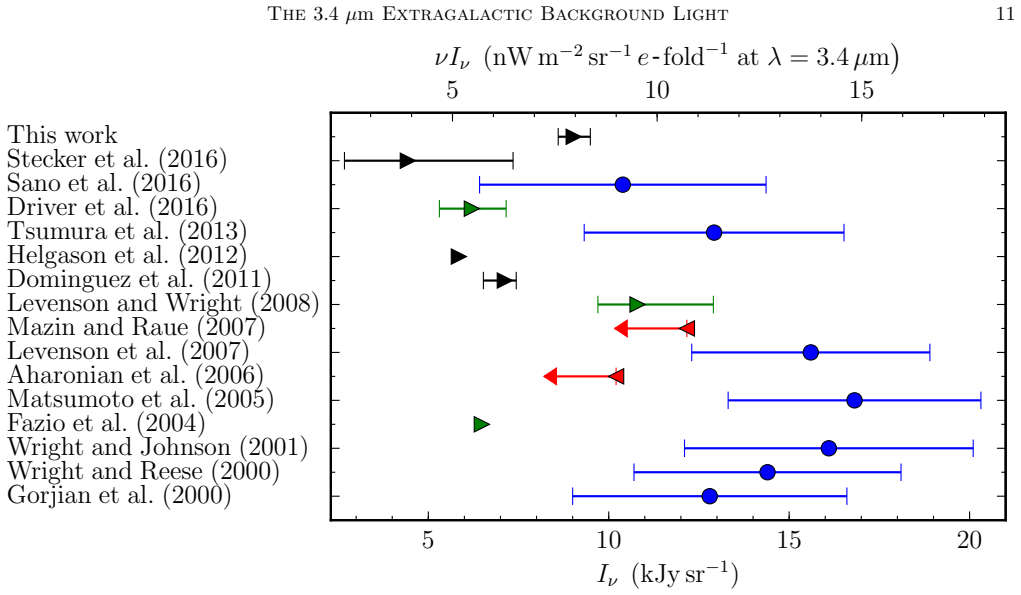
- This galaxy-only value is consistent with both direct measurements of the total EBL and upper limits from TeV blazars, easing the earlier tension among these methods near 3.4 μm.
- The evolving luminosity density and background tables published with the paper can be used directly to compute the optical depth of the universe to very-high-energy gamma rays.
- If the model's over-prediction of faint W1 counts is real, deeper completeness-corrected counts will push the estimate toward the 5 kJy/sr alternative; if incompleteness explains the discrepancy, the 9 kJy/sr value will stand.
Reading between the lines
- Editorial inference: If the 9 kJy/sr galaxy contribution survives deeper tests, the 3.4 μm band becomes a place where direct sky measurements, galaxy integration, and gamma-ray opacity constraints agree, which would localize the unresolved near-infrared background controversy to shorter wavelengths.
- Editorial inference: The published evolving EBL tables could be combined with future TeV blazar spectra to test whether the gamma-ray horizon is explained by galaxies alone or requires extra light from, for example, extended galactic halos.
- Editorial inference: The faint end is the decisive measurement: if the true faint-end slope $\alpha$ of the luminosity function is near $-2$, the integral requires a low-luminosity cutoff, and the value of that cutoff—not just the slope—determines how much faint-galaxy light is missed.
Signed reviews
Editorial analysis
A structured set of objections, weighed in public.
Referee Report
Summary. The paper estimates the contribution of galaxies to the 3.4 μm extragalactic background light (EBL) by integrating a luminosity function (from Lake et al. 2018) with a mean galaxy SED (from Lake & Wright 2016). The headline result is Iν = 9.0±0.5 kJy/sr for z<5, with a claimed systematic uncertainty below 2 kJy/sr. The authors propagate the full MCMC posterior of the LF parameters through the integral, provide machine-readable posterior chains, and compare predicted source counts in WISE and SDSS bands with observed counts. The paper concludes that known galaxies produce most of the 3.4 μm EBL, consistent with direct total-EBL measurements and blazar upper limits.
Significance. If the headline result holds, this is an important measurement: it is higher than most previous galaxy-integration estimates and helps to close the gap between direct EBL measurements and galaxy counts. The methodology has clear strengths: the EBL integral is a forward calculation from independently measured LF and SED quantities, the MCMC uncertainty propagation is statistically sound, the posterior chains are published under a DOI, and the comparison with source counts at multiple wavelengths is a useful diagnostic. The paper also is unusually honest about model limitations, including the non-evolving SED and constant faint-end slope. These strengths make the central claim worth serious consideration, provided the model-selection issue identified below is resolved.
major comments (4)
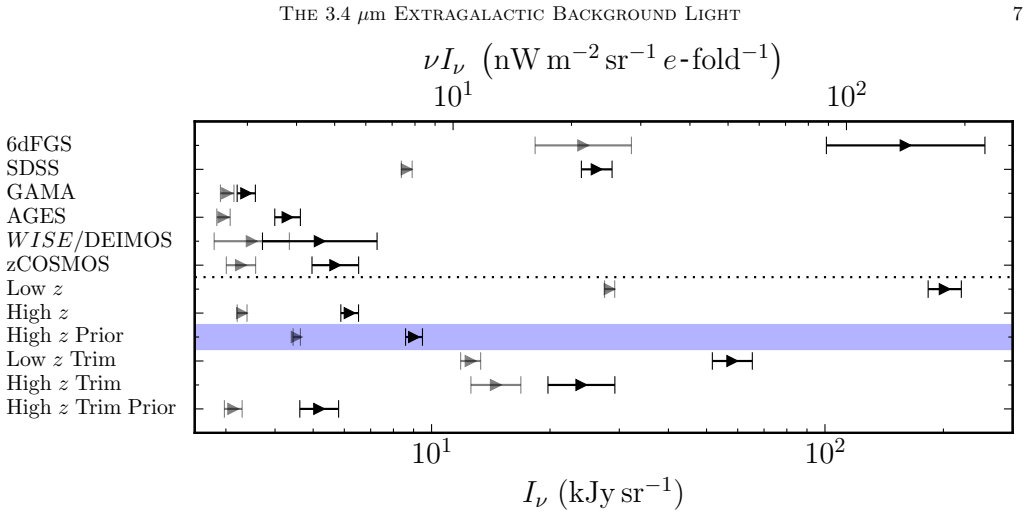
- [Section 3; Figure 3] The choice of the High z Prior chain over the High z Trim Prior chain is the load-bearing step in determining the headline value, but the paper does not provide a quantitative justification. Both chains are explicitly described as preferred, yet their z<5 backgrounds differ by roughly a factor of two (about 9 kJy/sr versus about 5 kJy/sr in Figure 3). The stated reasons for rejecting High z Trim Prior are plausibility arguments: its α = -1.93 is uncomfortably close to the α = -2 divergence, and its implied comoving number density evolution of 1.9±0.7 e-folds per Hubble time is considered too fast. These are not model-independent falsifications, and the same data set produced both chains. As written, the quoted statistical uncertainty of ±0.5 kJy/sr and the systematic bound of 2 kJy/sr do not include this between-chain spread of roughly 4 kJy/sr. The authors should either defend the selection with a quantitative criterion (e.g., a goodness-of-fit comparison or an explicitly motivated prior) or incorporate the chain-to-chain variation into the systematic uncertainty budget.
- [Section 4; Table 1; Figure 3] The redshift decomposition of the result exposes a second load-bearing concern. Table 1 shows Inu(z<1) ≈ 4.6 kJy/sr while Inu(z<5) ≈ 9.3 kJy/sr for the High z Prior chain, meaning that roughly half of the headline signal comes from z>1, beyond the redshift range of the LF data (which are limited to z≲1 as stated in Section 3). The z>1 contribution therefore rests entirely on the adopted extrapolation of φ*(z) and L*(z) in Equations 8-10. Because the competing High z Trim Prior chain effectively changes this extrapolation by a factor of two, the paper should quantify how much of the 9 versus 5 kJy/sr discrepancy arises specifically from the high-redshift extrapolation and should present a sensitivity analysis of the EBL integral to the assumed evolution model. Without such an analysis, the claim 'Iν = 9.0±0.5 kJy/sr' is not supported by the internal model spread.
- [Section 5; Figures 8-9] The paper uses the source-count comparisons as confirmation of the model, but the text itself weakens that confirmation precisely where the EBL integral is most sensitive. In Section 5, at the end of the flux-count comparison, the authors state that the High z Prior model's over-prediction at the faint end of the W1 counts 'should be viewed as suspect for the purposes of predicting faint galaxy flux counts.' Since the EBL integral is dominated by faint galaxies and high redshifts, this admission directly undermines the use of Figures 8 and 9 as independent checks of the background estimate. The authors need to explain how the faint-end count excess affects the credibility of the EBL integral, or to perform a quantitative test that separates the flux-count information from the EBL normalization. As it stands, the confirmation argument is circular in a way that is acknowledged but not addressed.
- [Section 5; last paragraph of Discussion] The systematic uncertainty budget is asserted rather than derived. The sentence 'any modification from the true value caused by the systematic limitations in this work is unlikely be more than about 2 kJy/sr in either direction' is not supported by a quantitative error analysis. The acknowledged limitations include a non-evolving mean SED, a constant faint-end slope, and an uncertain high-redshift L*(z) evolution, each of which could shift the integral by amounts comparable to or larger than the quoted 2 kJy/sr. The authors should either provide a systematic error estimate that combines these effects (e.g., by reweighting the chains or by marginalizing over plausible model extensions) or replace the 2 kJy/sr claim with a more defensible bound.
minor comments (5)
- [Section 4, paragraph describing Figure 3] In the phrase 'α = -1.93±-0.04' the sign of the error is garbled; it should read 'α = -1.93±0.04'.
- [Section 2, Equation (5) and surrounding text] The notation for LSED and µν is intricate; a short remark explicitly stating that µν is the mean of the normalized SED at fixed Lf and z would help readers who are not already familiar with the spectro-luminosity functional formalism from Lake et al. (2017).
- [Section 4, Figure 3 caption and text] The description of the 'High z' versus 'High z Trim' samples is given only in the main text; repeating the definitions in the figure caption would make Figure 3 more self-contained.
- [Section 5, Figure 7 caption] The caption does not state that the literature points are adjusted to 3.4 μm assuming Iν is roughly constant, although this is mentioned in the text. Adding this to the caption would prevent misreading.
- [Section 1, footnote 2] The WMAP9 parameter URL is given as a footnote; it would be more robust to cite the Hinshaw et al. (2013) parameters in the text as well, particularly because the cosmology affects Dc(z) in Equation (5).
Circularity Check
No significant circularity: the 3.4 μm EBL result is a forward integral of an independently measured luminosity function and mean galaxy SED, neither of which is fitted to the EBL itself.
full rationale
The paper's derivation chain is explicitly a forward calculation: Equation 5 integrates the luminosity function Φ(L_f,z) from Lake et al. (2018) against the mean SED μ_ν from Lake & Wright (2016) to produce the galaxy contribution to the EBL. The abstract states that the result is 'based on the measurement of the luminosity function in Lake et al. (2018) and the mean spectral energy distribution of galaxies in Lake & Wright (2016),' and there is no step in which the EBL value is used as input to constrain either the LF parameters or the SED. The cited prior works are data-driven measurements from spectroscopic redshift surveys and photometric catalogs, and their stated assumptions do not include the target EBL value, so they constitute independent evidence rather than a self-citation chain. The flux-count comparisons in Figures 8 and 9 partially reuse the same AllWISE and SDSS source catalogs that entered the LF construction, making them consistency checks rather than fully independent validations; however, those counts are not inputs to the EBL integral, so this does not make the central claim circular. The between-chain spread between the 'High z Prior' and 'High z Trim Prior' results is a real model-selection and robustness concern, but it is a scientific vulnerability of the chosen LF evolution model, not a circular reduction, because neither chain was selected or tuned to reproduce the EBL. On the stated criteria, the paper's central 'prediction' is not equivalent to its inputs by construction.
Assumptions & free parameters
free parameters (3)
- Schechter LF parameters (phi*, R_phi, L*, R_L, alpha, n0) from Lake et al. 2018 =
posterior MCMC chains, DOI 10.6084/m9.figshare.4109625
- Mean galaxy SED / template coefficients from Lake & Wright 2016 =
fits to zCOSMOS photometry using Assef et al. 2010 templates
- Upper integration redshift z=5 =
5
assumptions (5)
- domain assumption Schechter LF with parametric phi* and L* evolution (Eqs. 8-10) describes the galaxy population over z=0 to 5.
- domain assumption Mean SED does not evolve with luminosity or redshift.
- domain assumption Faint-end slope alpha is constant.
- domain assumption Gaussian approximation for SED variety is valid in the integration range used.
- domain assumption WMAP9 flat LCDM cosmology (Hinshaw et al. 2013) is used for distances and lookback time.
Cite this review
Pith. "Pith review of The Contribution of Galaxies to the $3.4\,\mathrm{\mu m}$ Cosmic Infrared Background as Measured Using WISE." pith.science (2026). https://pith.science/paper/GMFPH32N
@misc{pith2026190800731,
  author       = {Pith},
  title        = {Pith review of: The Contribution of Galaxies to the $3.4\,\mathrm\mu m$ Cosmic Infrared Background as Measured Using WISE},
  year         = {2026},
  howpublished = {\url{https://pith.science/paper/GMFPH32N}},
  note         = {Machine review of arXiv:1908.00731}
}
abstract
The study of the extragalactic background light (EBL) in the optical and near infrared has received a lot of attention in the last decade, especially near a wavelength of $\lambda\approx 3.4\operatorname{\mu m}$, with remaining tension among different techniques for estimating the background. In this paper we present a measurement of the contribution of galaxies to the EBL at $3.4\operatorname{\mu m}$ that is based on the measurement of the luminosity function (LF) in Lake et al. (2018) and the mean spectral energy distribution of galaxies in Lake & Wright (2016). The mean and standard deviation of our most reliable Bayesian posterior chain gives a $3.4\operatorname{\mu m}$ background of $I_\nu = 9.0\pm0.5 \operatorname{kJy} \operatorname{sr}^{-1}$ ($\nu I_\nu = 8.0\pm0.4 \operatorname{nW} \operatorname{m}^{-2} \operatorname{sr}^{-1} e\operatorname{-fold}^{-1}$), with systematic uncertainties unlikely to be greater than $2\operatorname{kJy} \operatorname{sr}^{-1}$. This result is higher than most previous efforts to measure the contribution of galaxies to the $3.4\operatorname{\mu m}$ EBL, but is consistent with the upper limits placed by blazars and the most recent direct measurements of the total $3.4\operatorname{\mu m}$ EBL.
Figures


Figures from the paper (6 more)




Reference graph
Works this paper leans on
-
[1]
, " * write output.state after.block = add.period write newline
ENTRY address archivePrefix author booktitle chapter doi edition editor eprint howpublished institution journal key month number organization pages publisher school series title misctitle type volume year version url label extra.label sort.label short.list INTEGERS output.state before.all mid.sentence after.sentence after.block FUNCTION init.state.consts ...
-
[2]
write newline
" write newline "" before.all 'output.state := FUNCTION format.url url empty "" new.block "" url * "" * if FUNCTION format.eprint eprint empty "" archivePrefix empty "" archivePrefix "arXiv" = new.block " " eprint * " " * new.block " " eprint * " " * if if if FUNCTION format.doi doi empty "" " " doi * " " * if FUNCTION format.pid doi empty eprint empty ur...
-
[3]
ܒ_ uӟ: gӿ n_͆ ^͵)Rl'@0K3 `5צ[lЌg V !6E sɞ#Υ 5ݦ s H^AMIRw# >T5ݦ tHIM !cjM ln S>G jM h&3 mjM Β Wm@@Ggt
thebibliography [1] 20pt to REFERENCES 6pt =0pt 10pt plus 3pt =0pt =0pt =1pt plus 1pt =0pt =0pt -12pt =13pt plus 1pt =20pt =13pt plus 1pt \@M =10000 =-1.0em =0pt =0pt 0pt =0pt =1.0em @enumiv\@empty 10000 10000 `\.\@m \@noitemerr \@latex@warning Empty `thebibliography' environment \@ifnextchar \@reference \@latexerr Missing key on reference command Each re...
2019
-
[4]
2013, , 87, 063002, 10.1103/PhysRevD.87.063002
Aharonian , F., Essey , W., Kusenko , A., & Prosekin , A. 2013, , 87, 063002, 10.1103/PhysRevD.87.063002
-
[5]
Aharonian , F., Akhperjanian , A. G., Bazer-Bachi , A. R., et al. 2006, , 440, 1018, 10.1038/nature04680
-
[6]
Assef , R. J., Kochanek , C. S., Brodwin , M., et al. 2010, , 713, 970, 10.1088/0004-637X/713/2/970
-
[7]
Bouwens , R. J., Illingworth , G. D., Franx , M., et al. 2009, , 705, 936, 10.1088/0004-637X/705/1/936
-
[8]
Bouwens , R. J., Illingworth , G. D., Oesch , P. A., et al. 2014, , 793, 115, 10.1088/0004-637X/793/2/115
Show all 37 references
-
[9]
T., Beichman , C
Cambr \'e sy , L., Reach , W. T., Beichman , C. A., & Jarrett , T. H. 2001, , 555, 563, 10.1086/321470
2001 doi
-
[10]
J., Wilkinson , A., Duncan , K., & Mortlock , A
Conselice , C. J., Wilkinson , A., Duncan , K., & Mortlock , A. 2016, , 830, 83, 10.3847/0004-637X/830/2/83
2016 doi
-
[11]
2016, Royal Society Open Science, 3, 150555, 10.1098/rsos.150555
Cooray , A. 2016, Royal Society Open Science, 3, 150555, 10.1098/rsos.150555
2016 doi
-
[12]
2012, Nature, 490, 514
Cooray , A., Smidt , J., De Bernardis , F., et al. 2012, Nature, 490, 514. http://dx.doi.org/10.1038/nature11474
2012 doi
-
[13]
R., Rosario , D
Dom \' nguez , A., Primack , J. R., Rosario , D. J., et al. 2011, , 410, 2556, 10.1111/j.1365-2966.2010.17631.x
2011
-
[14]
P., Andrews , S
Driver , S. P., Andrews , S. K., Davies , L. J., et al. 2016, , 827, 108, 10.3847/0004-637X/827/2/108
2016 doi
-
[15]
Essey , W., Kalashev , O., Kusenko , A., & Beacom , J. F. 2011, , 731, 51, 10.1088/0004-637X/731/1/51
2011 doi
-
[16]
2010, Astroparticle Physics, 33, 81, 10.1016/j.astropartphys.2009.11.007
Essey , W., & Kusenko , A. 2010, Astroparticle Physics, 33, 81, 10.1016/j.astropartphys.2009.11.007
2010 doi
-
[17]
G., Ashby , M
Fazio , G. G., Ashby , M. L. N., Barmby , P., et al. 2004, , 154, 39, 10.1086/422585
2004 doi
-
[18]
L., & Chary , R
Gorjian , V., Wright , E. L., & Chary , R. R. 2000, , 536, 550, 10.1086/308974
2000 doi
-
[19]
2012, , 752, 113, 10.1088/0004-637X/752/2/113
Helgason , K., Ricotti , M., & Kashlinsky , A. 2012, , 752, 113, 10.1088/0004-637X/752/2/113
2012 doi
-
[20]
2013, , 208, 19, 10.1088/0067-0049/208/2/19
Hinshaw , G., Larson , D., Komatsu , E., et al. 2013, , 208, 19, 10.1088/0067-0049/208/2/19
2013 doi
-
[21]
S., White , S
Jenkins , A., Frenk , C. S., White , S. D. M., et al. 2001, , 321, 372, 10.1046/j.1365-8711.2001.04029.x
2001
-
[22]
J., Iovino , A., et al
Knobel , C., Lilly , S. J., Iovino , A., et al. 2012, , 753, 121, 10.1088/0004-637X/753/2/121
2012 doi
-
[23]
E., & Wright , E
Lake , S. E., & Wright , E. L. 2016, The Open Journal of Astrophysics, 10.21105/astro.1603.07299
2016 arXiv
-
[24]
E., Wright , E
Lake , S. E., Wright , E. L., Assef , R. J., et al. 2018, , 866, 45, 10.3847/1538-4357/aadd47
2018 doi
-
[25]
E., Wright , E
Lake , S. E., Wright , E. L., Tsai , C.-W., & Lam , A. 2017, , 153, 189, 10.3847/1538-3881/aa643a
2017 doi
- [26]
-
[27]
R., Wright , E
Levenson , L. R., Wright , E. L., & Johnson , B. D. 2007, , 666, 34, 10.1086/520112
2007 doi
-
[28]
J., Le Brun , V., Maier , C., et al
Lilly , S. J., Le Brun , V., Maier , C., et al. 2009, , 184, 218, 10.1088/0067-0049/184/2/218
2009 doi
-
[29]
Lin , H., Yee , H. K. C., Carlberg , R. G., et al. 1999, , 518, 533, 10.1086/307297
1999 doi
-
[30]
2014, , 52, 415, 10.1146/annurev-astro-081811-125615
Madau , P., & Dickinson , M. 2014, , 52, 415, 10.1146/annurev-astro-081811-125615
2014 doi
-
[31]
2005, , 626, 31, 10.1086/429383
Matsumoto , T., Matsuura , S., Murakami , H., et al. 2005, , 626, 31, 10.1086/429383
2005 doi
-
[32]
2007, , 471, 439, 10.1051/0004-6361:20077158
Mazin , D., & Raue , M. 2007, , 471, 439, 10.1051/0004-6361:20077158
2007 doi
-
[33]
2016, , 818, 72, 10.3847/0004-637X/818/1/72
Sano , K., Kawara , K., Matsuura , S., et al. 2016, , 818, 72, 10.3847/0004-637X/818/1/72
2016 doi
-
[34]
W., Scully , S
Stecker , F. W., Scully , S. T., & Malkan , M. A. 2016, , 827, 6, 10.3847/0004-637X/827/1/6
2016 doi
-
[35]
2013, , 65, 10.1093/pasj/65.6.121
Tsumura , K., Matsumoto , T., Matsuura , S., Sakon , I., & Wada , T. 2013, , 65, 10.1093/pasj/65.6.121
2013 doi
-
[36]
L., & Johnson , B
Wright , E. L., & Johnson , B. D. 2001, ArXiv Astrophysics e-prints
2001
- [37]
Reviewed August 14, 2026 · model on record in the stance chip above.
Discussion (0). Continue with ORCID to comment.