REVIEW 4 major objections 6 minor 60 references
Effect of Primordial Black Holes on the global 21-cm signal
T0 review · 4 major / 6 minor · reviewed 2026-08-03 · deepseek-v4-flash
Pith's one-line read This paper argues that if primordial black holes seed the early active galactic nuclei seen at redshifts 10–10.4, their X-ray emission would heat the intergalactic medium and make the cosmic 21-cm absorption trough noticeably shallower, wit
desk verdict A conditional but useful update: the global 21-cm trough is shallower if z~10 AGNs are PBH-seeded with efficient X-ray escape; the size of the effect is set by an unconstrained normalization. read the letter →
The pith
A machine-rendered reading of the paper's core claim, the machinery that carries it, and where it could break.
The reading
What carries the argument
The argument runs on a semi-analytic two-population model. The star-forming galaxy component follows the standard halo mass function with an observation-calibrated star formation efficiency that matches the high-redshift UV luminosity function; the PBH component uses a log-normal mass function (characteristic mass 10^3.65 solar masses, width σ=0.7) normalized to the observed AGN number density at z≈10, assumes Eddington-limited accretion at 25% of Eddington with radiative efficiency 0.057, and converts bolometric luminosity into Ly-α, ionizing, and X-ray photon rates using standard spectral-index and bolometric-correction relations. These photon budgets feed the standard equations for the 21
What would settle it
A measurement of the global 21-cm spectrum showing a deep (~ −300 mK) absorption trough at z≈16, with no flattening at z≈18, would rule out the maximal PBH X-ray escape case; conversely, a survey that establishes stellar-remnant seeding for the bulk of the z≈10 AGN population would falsify the PBH normalization.
Extended reading notes
Core claim
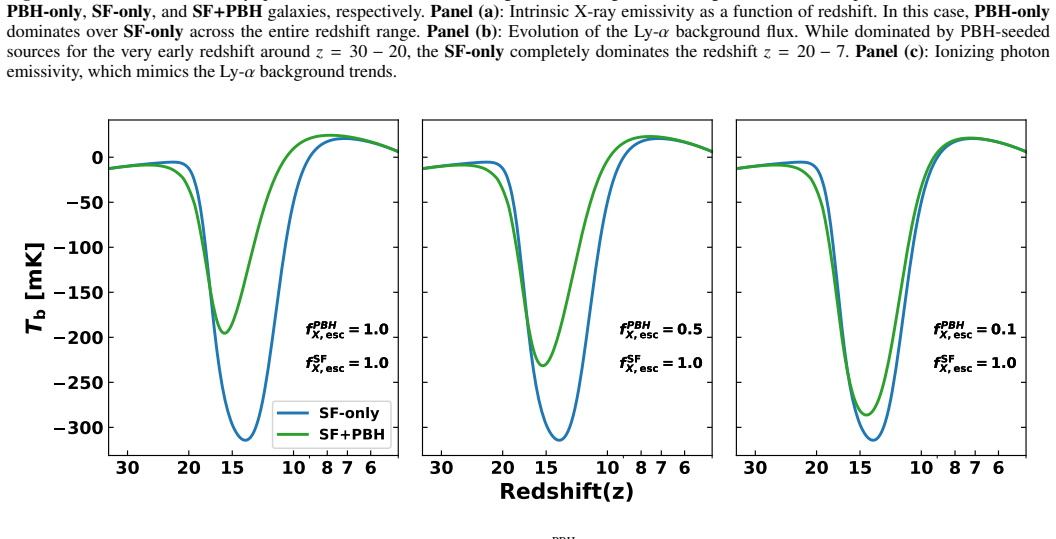
The central claim is that a PBH-seeded galaxy population, normalized to match the observed AGN number density at z≈10 and stated to be consistent with existing cosmological and astrophysical constraints, can significantly alter the redshift evolution of the global 21-cm signal. The dominant effect is X-ray heating: PBH-seeded AGNs dominate the X-ray emissivity across z≈34–5, so with a PBH X-ray escape fraction of unity the absorption trough is reduced from about −300 mK at z≈16 in the star-forming-only case to about −200 mK at z≈18. A secondary effect appears at z≈25–20, where PBH-produced Ly-α photons slightly change the early signal. Because the PBH contribution to ionizing photons is 2–3
Load-bearing premise
The whole effect rests on normalizing the PBH population by attributing every observed AGN at z≈10 to PBH-seeded galaxies; if most of those AGNs are instead powered by stellar-remnant black holes, or if the PBH abundance is lower than assumed, the predicted X-ray heating and the 21-cm flattening collapse.
Editorial extensions
If this is right
- The global 21-cm spectrum becomes a discriminator for primordial black holes: a trough near −200 mK at z≈18, instead of −300 mK at z≈16, would be the signature of PBH-seeded X-ray heating.
- Reionization constraints do not need to change: the PBH model adds at most a negligible number of ionizing photons at z<10, so existing measurements of the ionized fraction remain consistent.
- The early rise of the 21-cm signal around z≈25–20 carries information about Ly-α emission from PBH-seeded systems, independent of the X-ray escape fraction.
- Future global 21-cm experiments should treat a PBH-seeded AGN population as a standard source class alongside star-forming galaxies when interpreting trough depth and timing.
- If X-ray escape from PBH-seeded galaxies is less than unity, the predicted signal converges to the star-forming-only case, so the model's impact is directly tied to that unknown parameter.
Reading between the lines
- The normalization is the fragile point: the model assigns the entire observed AGN abundance at z~10 to PBH seeds. If future observations show those AGNs grow from ordinary stellar-remnant seeds, the predicted X-ray excess — and the 21-cm trough flattening — largely disappears. This makes the early AGN sample an indirect but direct test of PBH abundance.
- A complementary discriminator would be the amplitude of the UV luminosity function at z>10: PBH-seeded galaxies with early accretion should have distinct number counts at the very bright end, which current 21-cm data can only constrain statistically.
- The model predicts a correlation between X-ray heating and the Ly-α–driven shoulder at z≈25–20; simultaneous measurement of both features in a single spectrum could separate PBH heating from other early heating sources.
- If the observed 21-cm trough turns out deeper than any star-forming-only model permits, the PBH model as constructed here would not help — it makes the trough shallower — so a deep trough would favour other explanations, not PBHs.
Editorial analysis
A structured set of objections, weighed in public.
Referee Report
Summary. The paper presents a semi-analytic calculation of the sky-averaged 21-cm signal from z≈34 to z≈5, combining star-forming galaxies with a population of PBH-seeded galaxies whose mass function follows a lognormal form normalized to the number density of JWST-detected AGN at z≈10. Using this two-population model, the author computes the IGM kinetic temperature, Ly-alpha coupling, and reionization history, and compares the global 21-cm signal with and without the PBH component. The headline result is that with the X-ray escape fraction from PBH-seeded galaxies set equal to that of star-forming galaxies (f_PBH_X,esc=1), the extra X-ray heating raises the IGM temperature at z≈15-20 and flattens the absorption trough from about -300 mK at z≈16 (SF-only) to about -200 mK at z≈18 (SF+PBH). The difference shrinks as f_PBH_X,esc is lowered and disappears at f_PBH_X,esc=0.1. Ly-alpha from PBHs dominates at z≈20-30 and produces a small signal difference at z≈25-20; PBH ionizing photons are negligible and reionization is unchanged. The paper concludes that PBHs could have a significant effect on the global 21-cm signal if they are the seeds of the observed high-z AGN and if their X-ray output escapes as efficiently as that of star-forming galaxies.
Significance. The question is timely, and the qualitative mechanism - extra X-ray heating by an early AGN population makes the 21-cm absorption trough shallower - is robust and clearly explained. The model is semi-analytic and transparent, and the author takes care to check the SF-only model against UV luminosity functions and reionization constraints (Appendix A). The 21-cm signal is not used to fit parameters, so the prediction is not circular. The explicit exploration of f_PBH_X,esc in Fig. 2 is a useful sensitivity test. However, the central quantitative claim rests on two unsupported pillars: (i) the normalization of the PBH mass function to the z≈10 AGN number density, which assumes all such AGN are PBH-seeded and continuously active, and (ii) the absence of any quantitative comparison with PBH abundance constraints despite the abstract's assertion of consistency. Because both enter linearly in the X-ray emissivity, the headline -100 mK effect can be removed by plausible changes in either assumption. The paper is therefore a promising proof-of-concept rather than a robust prediction in its current form.
major comments (4)
- [§2.2, item 1; Eqs. (5), (11)] The normalization κ of the lognormal mass function is fixed by matching the total PBH number density to the observed z≈10 AGN space density of 10^-5.27 cMpc^-3. This equates the entire high-z AGN population with PBH-seeded galaxies and implicitly assigns every PBH a duty cycle of unity at all redshifts. The abstract's statement that the PBH model is 'consistent with existing cosmological and astrophysical constraints' is not backed by any constraint plot, table, or calculation in the manuscript. Since the PBH X-ray emissivity in Eq. (11) scales linearly with κ, an overestimate of the PBH abundance by a factor of two or three (e.g., if 30-50% of the z≈10 AGN are stellar-seeded, or if accretion is intermittent) is sufficient to erase the claimed trough difference. The manuscript should show the comparison with PBH constraints and explore the sensitivity to κ or to an active/duty-cycle frac
- [§3.1, Eq. (12); Fig. 2] The headline result uses f_PBH_X,esc=1, but this parameter is free and no physical motivation is given for equating it with the SF escape fraction. The author's own Fig. 2 shows that the difference between SF-only and SF+PBH is strongly reduced at f_PBH_X,esc=0.5 and essentially vanishes at 0.1. Because f_PBH_X,esc multiplies the same emissivity as κ, the central -100 mK effect is a parameter choice as much as a prediction. The paper should either justify f_PBH_X,esc≈1 with an ISM/CGM model or present the result as an upper-limit scenario, with the f_PBH_X,esc=0.1 case as the null result.
- [§2.2, Eq. (5); Eq. (11)] The mass function as written has dN/dM_PBH ∝ M^-2 exp[...], whereas a lognormal in ln M normally gives dN/dM ∝ M^-1 exp[...]. In addition, the integration limits M_min,PBH and M_max,PBH in Eq. (11) are never specified. With a 1/M^2 form the integral is sensitive to the lower cutoff, making the model non-reproducible. The author should state the limits, correct the mass-function normalization if needed, and briefly test the sensitivity to the assumed shape (e.g., the power-law mass function used by Dayal & Maiolino 2025). The paper itself acknowledges in Sec. 5 that the lognormal choice is not rigorously justified.
- [§3.3, Eq. (16)] The recombination term appears with a positive sign: dQ_HII/dt = ... + Q_HII α_B C n_H,com (1+z)^3. This has the wrong sign; recombinations should decrease Q_HII. If the code followed this equation, the reionization history would not match the data in Appendix A; if the text is a typo, it should be corrected. Please verify which is the case and fix the equation.
minor comments (6)
- [Eq. (8)] The expression for T_b contains an unmatched parenthesis after x_HI: '10.1 mK x HI(z))' should be cleaned up.
- [Eq. (2)] In the parameter set, ')' is used instead of '}' at the end: '{f_0, M_p, β, γ) = {0.16, ...}'. Also Eq. (1) uses both M_h and Mh inconsistently.
- [Sec. 2.1, item 2] The metallicity is given as '0.05 M⊙'; presumably this means Z=0.05 Z⊙, not a stellar mass. Please clarify.
- [Sec. 3.1 text] The phrase 'uncertainties in the ϵ_X−ρ_SFR relationship, i.e., eqn-12' should refer to Eq. (10), not Eq. (12).
- [Sec. 4 text] The phrase 'over the redshift range 34≳z≲5' mixes the direction of inequalities; should be something like 5≲z≲34 or 34≳z≳5.
- [Sec. 5 bullets] In the first bullet, 'f_Sf_X,esc' has a typo (should be f_SF_X,esc). Also in the references, 'Dayal & maiolino 2025' should be 'Dayal & Maiolino 2025'.
Circularity Check
No significant circularity: the 21-cm signal is a forward prediction from an assumed PBH population; no model parameter is fitted to the 21-cm observable.
full rationale
The derivation chain is a forward model. The SF galaxy population is calibrated to UVLF and to reionization via f_esc=0.2 (Sec. 2.1); the PBH population is normalized to the observed z~10 AGN number density (Sec. 2.2, Eq. 5); X-ray, Ly-alpha, and ionizing emissivities (Eqs. 10-14) then feed the 21-cm brightness temperature (Eqs. 8-9, 16). The target observable, the 21-cm signal, is never used to fit kappa or any PBH parameter, so the headline trough difference in Fig. 2 is not equivalent to an input by construction. The paper does rely on the Dayal & maiolino (2025) analytical PBH model, which was itself calibrated on the same JWST AGN observations used to set kappa; however, this is an imported model assumption rather than a circular derivation, because the 21-cm result is a physical consequence of that assumed source population, not a restatement of the AGN number density. The abstract's claim that the PBH model is 'consistent with existing cosmological and astrophysical constraints' is asserted without showing the constraints, and the paper itself states there is 'no rigorous justification for choosing the lognormal mass function' (Sec. 5). These are support gaps and model limitations, not circular steps. The reionization consistency in Appendix A is a calibration check for f_esc, not an independent prediction, but it does not control the PBH-vs-SF trough difference, which is driven by X-ray heating. Overall, the central 21-cm prediction is self-contained given the stated assumptions.
Assumptions & free parameters
free parameters (10)
- f_edd =
0.25
- M_c (PBH characteristic mass) =
10^3.65 Msun
- sigma (PBH mass function width) =
0.7
- kappa (PBH mass function normalization) =
chosen to match observed AGN number density 10^-5.27 cMpc^-3 at z~10
- f_PBH_X,esc =
varied 0.1-1.0
- f_esc (SF ionizing escape fraction) =
0.2
- f_star parameters {f0, Mp, beta, gamma} =
{0.16, 10^11.7, 0.9, 0.65}
- f_h =
0.2
- f_SF_X,esc =
1.0
- f_alpha (Ly-alpha escape fractions) =
1.0 for both SF and PBH
assumptions (7)
- domain assumption The Dayal & maiolino (2025) analytic model of PBH-seeded galaxy formation and growth is adopted wholesale.
- domain assumption The observed AGN number density at z~10 is attributed entirely to PBH-seeded galaxies.
- ad hoc to paper The PBH mass function is log-normal with sigma=0.7 and M_c=10^3.65 Msun.
- ad hoc to paper The X-ray escape fraction of PBH-seeded galaxies can be as high as that of SF galaxies.
- domain assumption The local Mineo et al. (2012) X-ray-SFR relation holds at z~30-7 for star-forming galaxies.
- domain assumption Starburst99 synthetic spectra with Salpeter IMF and metallicity 0.05 Msun represent high-z stellar populations.
- domain assumption Tinker et al. (2008) halo mass function and atomic-cooling threshold (T_vir=10^4 K) determine the star-forming halo population.
Cite this review
Pith. "Pith review of Effect of Primordial Black Holes on the global 21-cm signal." pith.science (2026). https://pith.science/paper/GMU26B4U
@misc{pith2026260110304,
  author       = {Pith},
  title        = {Pith review of: Effect of Primordial Black Holes on the global 21-cm signal},
  year         = {2026},
  howpublished = {\url{https://pith.science/paper/GMU26B4U}},
  note         = {Machine review of arXiv:2601.10304}
}
read the original abstract
The 21-cm global signal, a treasure trove of information about the nature of the first luminous sources of the Universe, has traditionally been modelled assuming that these early sources were predominantly star-forming galaxies. However, recent observations by the James Webb Space Telescope (JWST) have revealed several AGNs as early as z ~ 10 - 10.4 . In light of this, it is important to investigate the contribution of such AGNs to the 21-cm signal. Assuming that these AGNs are seeded by Primordial Black Holes (PBHs) and employing an analytical PBH model, consistent with existing cosmological and astrophysical constraints, we show that these exotic objects can have a significant impact on the redshift evolution of the global signal.
Figures

Reference graph
Works this paper leans on
-
[1]
& Loeb, A
Barkana, R. & Loeb, A. 2001, Phys. Rep., 349, 125
2001
-
[2]
K., & Postnov, K
Blinnikov, S., Dolgov, A., Porayko, N. K., & Postnov, K. 2016, J. Cosmology Astropart. Phys., 2016, 036 Bogdán, Á., Goulding, A. D., Natarajan, P., et al. 2024, Nature Astronomy, 8, 126
2016
-
[3]
D., Rogers, A
Bowman, J. D., Rogers, A. E. E., Monsalve, R. A., Mozdzen, T. J., & Mahesh, N. 2018, Nature, 555, 67
2018
-
[4]
& Kühnel, F
Carr, B. & Kühnel, F. 2020, Annual Review of Nuclear and Particle Science, 70, 355
2020
-
[5]
Carr, B. J. 2005, arXiv e-prints, astro
2005
-
[6]
Carr, B. J. & Hawking, S. W. 1974, MNRAS, 168, 399
1974
-
[7]
R., & Mitra, S
Chatterjee, A., Choudhury, T. R., & Mitra, S. 2021, MNRAS, 507, 2405
2021
-
[8]
R., & Schneider, R
Chatterjee, A., Dayal, P., Choudhury, T. R., & Schneider, R. 2020, MNRAS, 496, 1445
2020
Show all 60 references
-
[9]
2023, MNRAS, 525, 620
Chatterjee, A., Dayal, P., & Mauerhofer, V . 2023, MNRAS, 525, 620
2023
-
[10]
Chiu, W. A. & Ostriker, J. P. 2000, ApJ, 534, 507
2000
-
[11]
B., et al
Chornock, R., Berger, E., Fox, D. B., et al. 2013, ApJ, 774, 26
2013
-
[12]
& García-Bellido, J
Clesse, S. & García-Bellido, J. 2015, Phys. Rev. D, 92, 023524
2015
-
[13]
Cumner, J., de Lera Acedo, E., de Villiers, D. I. L., et al. 2022, Journal of Astronomical Instrumentation, 11, 2250001
2022
-
[14]
B., Hennawi, J
Davies, F. B., Hennawi, J. F., Bañados, E., et al. 2018, ApJ, 864, 142
2018
-
[15]
2024, A&A, 690, A182
Dayal, P. 2024, A&A, 690, A182
2024
-
[16]
& maiolino, R
Dayal, P. & maiolino, R. 2025, arXiv e-prints, arXiv:2506.08116
2025
-
[17]
R., et al
Dayal, P., V olonteri, M., Choudhury, T. R., et al. 2020, MNRAS, 495, 3065
2020
-
[18]
E., et al
Dayal, P., V olonteri, M., Greene, J. E., et al. 2025, A&A, 697, A211
2025
-
[19]
2025, MNRAS, 542, 2292
Dhandha, J., Fialkov, A., Gessey-Jones, T., et al. 2025, MNRAS, 542, 2292
2025
-
[20]
2018, ApJS, 239, 35
Diemer, B. 2018, ApJS, 239, 35
2018
-
[21]
T., McLure, R
Donnan, C. T., McLure, R. J., Dunlop, J. S., et al. 2024, MNRAS, 533, 3222
2024
-
[22]
2020, A&A, 636, A73
Duras, F., Bongiorno, A., Ricci, F., et al. 2020, A&A, 636, A73
2020
-
[23]
Ewall-Wice, A., Chang, T.-C., & Lazio, T. J. W. 2020, MNRAS, 492, 6086
2020
-
[24]
R., Oh, S
Furlanetto, S. R., Oh, S. P., & Briggs, F. H. 2006, Phys. Rep., 433, 181
2006
-
[25]
S., Bevins, H
Gessey-Jones, T., Sartorio, N. S., Bevins, H. T. J., et al. 2025, Nature Astronomy, 9, 1268
2025
-
[26]
K., Ciardi, B., Mellema, G., & Zaroubi, S
Ghara, R., Giri, S. K., Ciardi, B., Mellema, G., & Zaroubi, S. 2021, MNRAS, 503, 4551 Article number, page 5 A&A proofs:manuscript no. main
2021
-
[27]
2019, MNRAS, 484, 282
Gillet, N., Mesinger, A., Greig, B., Liu, A., & Ucci, G. 2019, MNRAS, 484, 282
2019
-
[28]
Greenhill, L. J. & Bernardi, G. 2012, arXiv e-prints, arXiv:1201.1700
2012 arXiv
-
[29]
& Mesinger, A
Greig, B. & Mesinger, A. 2015, MNRAS, 449, 4246
2015
-
[30]
& Mesinger, A
Greig, B. & Mesinger, A. 2018, MNRAS, 477, 3217
2018
-
[31]
2019, MNRAS, 484, 5094
Greig, B., Mesinger, A., & Bañados, E. 2019, MNRAS, 484, 5094
2019
-
[32]
1971, MNRAS, 152, 75
Hawking, S. 1971, MNRAS, 152, 75
1971
-
[33]
2021, MNRAS, 503, 3698
Hutter, A., Dayal, P., Yepes, G., et al. 2021, MNRAS, 503, 3698
2021
-
[34]
2023, ApJ, 942, 59
Jin, X., Yang, J., Fan, X., et al. 2023, ApJ, 942, 59
2023
-
[35]
S., Liu, A., Parsons, A
Kern, N. S., Liu, A., Parsons, A. R., Mesinger, A., & Greig, B. 2017, ApJ, 848, 23 Kovács, O. E., Bogdán, Á., Natarajan, P., et al. 2024, ApJ, 965, L21
2017
-
[36]
D., et al
Leitherer, C., Schaerer, D., Goldader, J. D., et al. 1999, ApJS, 123, 3
1999
-
[37]
2004, MNRAS, 351, 169
Marconi, A., Risaliti, G., Gilli, R., et al. 2004, MNRAS, 351, 169
2004
-
[38]
A., Treu, T., Dijkstra, M., et al
Mason, C. A., Treu, T., Dijkstra, M., et al. 2018, ApJ, 856, 2
2018
-
[39]
2025, A&A, 697, A65
Matteri, A., Pallottini, A., & Ferrara, A. 2025, A&A, 697, A65
2025
-
[40]
D., Mesinger, A., & D’Odorico, V
McGreer, I. D., Mesinger, A., & D’Odorico, V . 2015, MNRAS, 447, 499
2015
-
[41]
2019, The Cosmic 21-cm Revolution, 2514-3433 (IOP Publishing)
Mesinger, A., ed. 2019, The Cosmic 21-cm Revolution, 2514-3433 (IOP Publishing)
2019
-
[42]
2012, MNRAS, 419, 2095
Mineo, S., Gilfanov, M., & Sunyaev, R. 2012, MNRAS, 419, 2095
2012
-
[43]
Mittal, S., Ray, A., Kulkarni, G., & Dasgupta, B. 2022, J. Cosmology Astropart. Phys., 2022, 030
2022
-
[44]
2024, arXiv e-prints, arXiv:2410.18763
Napolitano, L., Castellano, M., Pentericci, L., et al. 2024, arXiv e-prints, arXiv:2410.18763
2024
-
[45]
Nelander, A., Cain, C., DSilva, J. C. J., et al. 2025, arXiv e-prints, arXiv:2507.21230
2025 arXiv
-
[46]
D., Bordenave, D
Nhan, B. D., Bordenave, D. D., Bradley, R. F., et al. 2018, arXiv e-prints, arXiv:1811.04917
2018 arXiv
-
[47]
J., et al
Onoue, M., Kashikawa, N., Willott, C. J., et al. 2017, ApJ, 847, L15
2017
-
[48]
H., Schaye, J., & van Scherpenzeel, E
Pawlik, A. H., Schaye, J., & van Scherpenzeel, E. 2009, MNRAS, 394, 1812 Planck Collaboration, Aghanim, N., et al. 2020, A&A, 641, A5
2009
-
[49]
Pritchard, J. R. & Loeb, A. 2012, Reports on Progress in Physics, 75, 086901
2012
-
[50]
A., Ellis, R
Schenker, M. A., Ellis, R. S., Konidaris, N. P., & Stark, D. P. 2014, ApJ, 795, 20
2014
-
[51]
2013, MNRAS, 428, 3058
Schroeder, J., Mesinger, A., & Haiman, Z. 2013, MNRAS, 428, 3058
2013
-
[52]
H., Bevins, H
Sims, P. H., Bevins, H. T. J., Fialkov, A., et al. 2025, MNRAS[arXiv:2504.09725]
2025
-
[53]
T., Subrahmanyan, R., et al
Singh, S., Jishnu, N. T., Subrahmanyan, R., et al. 2022, Nature Astronomy, 6, 607
2022
-
[54]
E., Wayth, R
Sokolowski, M., Tremblay, S. E., Wayth, R. B., et al. 2015, PASA, 32, e004
2015
-
[55]
& Sugiyama, N
Tashiro, H. & Sugiyama, N. 2013, MNRAS, 435, 3001
2013
-
[56]
V ., Klypin, A., et al
Tinker, J., Kravtsov, A. V ., Klypin, A., et al. 2008, ApJ, 688, 709
2008
-
[57]
2006, PASJ, 58, 485
Totani, T., Kawai, N., Kosugi, G., et al. 2006, PASJ, 58, 485
2006
-
[58]
2023b, MNRAS, 518, 3576 ˇDurovˇcíková, D., Katz, H., Bosman, S
Trebitsch, M., Hutter, A., Dayal, P., et al. 2023b, MNRAS, 518, 3576 ˇDurovˇcíková, D., Katz, H., Bosman, S. E. I., et al. 2020, MNRAS, 493, 4256 V oytek, T. C., Natarajan, A., Jáuregui García, J. M., Peterson, J. B., & López-Cruz, O. 2014, ApJ, 782, L9
2020
-
[59]
2021, Phys
Yang, Y . 2021, Phys. Rev. D, 104, 063528
2021
-
[60]
Zhang, S., Liu, B., Bromm, V ., et al. 2025, ApJ, 987, 185 Article number, page 6 Atrideb Chatterjee: Effect of Primordial Black Holes on the global 21-cm signal 678910 Redshift (z) 0.2 0.4 0.6 0.8 1.0QHII SF-only SF+PBH Fig. A.1.The redshift evolution of the volume filling fa...
2025
Reviewed August 3, 2026 · model on record in the stance chip above.
Discussion (0). Continue with ORCID to comment.